



《中国康复理论与实践》 ›› 2025, Vol. 31 ›› Issue (11): 1279-1289.doi: 10.3969/j.issn.1006-9771.2025.11.005
蒋逸1, 梁康1, 楚家豪2, 杨丹3, 高飞4, 厉含之4, 杜晓霞4( )
)
收稿日期:2025-09-12
修回日期:2025-10-10
出版日期:2025-11-25
发布日期:2025-11-26
通讯作者:
杜晓霞
E-mail:duxiaoxia2005@gmail.com
作者简介:蒋逸(1998-),男,汉族,浙江衢州市人,硕士研究生,主要研究方向:神经康复。
基金资助:
JIANG Yi1, LIANG Kang1, CHU Jiahao2, YANG Dan3, GAO Fei4, LI Hanzhi4, DU Xiaoxia4()
Received:2025-09-12
Revised:2025-10-10
Published:2025-11-25
Online:2025-11-26
Contact:
DU Xiaoxia
E-mail:duxiaoxia2005@gmail.com
Supported by:摘要:
目的 分析近5年脑机接口技术(BCI)在脑卒中康复领域的应用趋势和研究热点。
方法 检索2021年1月至2025年8月在Web of Science核心合集数据库中BCI在脑卒中康复领域研究的相关文献,采用CiteSpace 6.4.R1软件进行可视化分析。
结果 共纳入458篇文献。年发文量持续保持高水平,发文量最多的国家是中国,发文量最多的机构是复旦大学和Aalborg University,发文量最多的作者是Mads R Jochumsen,被引频次最多的作者是Pfurtscheller G。brain-computer interface、motor imagery、upper limb和deep learning是领域内的高频关键词和突现词。
结论 近5年BCI在脑卒中康复领域研究总体发文量保持在高水平,研究热点聚焦于BCI算法技术革新,以及通过多维度进行神经机制的验证和康复效果评估。
中图分类号:
蒋逸, 梁康, 楚家豪, 杨丹, 高飞, 厉含之, 杜晓霞. 2021年至2025年脑机接口技术在脑卒中康复领域应用的文献计量分析[J]. 《中国康复理论与实践》, 2025, 31(11): 1279-1289.
JIANG Yi, LIANG Kang, CHU Jiahao, YANG Dan, GAO Fei, LI Hanzhi, DU Xiaoxia. Application of brain-computer interface technology in stroke rehabilitation from 2021 to 2025: a bibliometric analysis[J]. Chinese Journal of Rehabilitation Theory and Practice, 2025, 31(11): 1279-1289.
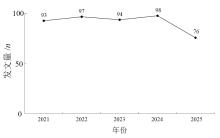
图1
年发文量"

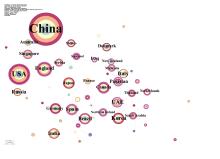
图2
国家共现图谱"

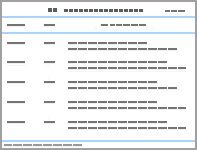
表1
发文量前10的国家"
| 国家 | 发文量/n | 中心性 |
|---|---|---|
| China | 197 | 0.00 |
| USA | 71 | 0.12 |
| England | 31 | 0.35 |
| Japan | 28 | 0.06 |
| Germany | 27 | 0.06 |
| South Korea | 23 | 0.00 |
| India | 21 | 0.00 |
| Canada | 20 | 0.31 |
| Spain | 17 | 0.57 |
| Brazil | 17 | 0.31 |
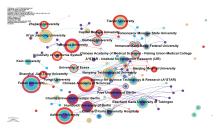
图3
机构共现图谱"

表2
发文量前10的机构"
| 机构 | 发文量/n | 中心性 |
|---|---|---|
| 复旦大学 | 14 | 0.18 |
| Aalborg University | 14 | 0.05 |
| 天津大学 | 12 | 0.00 |
| 中国科学院 | 12 | 0.28 |
| 西安交通大学 | 11 | 0.05 |
| 清华大学 | 11 | 0.25 |
| 南洋理工大学 | 10 | 0.01 |
| Charite Universitatsmedizin Berlin | 9 | 0.05 |
| Free University of Berlin | 9 | 0.05 |
| Humboldt University of Berlin | 9 | 0.05 |
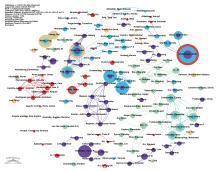
图4
作者合作网络图谱"

表3
发文量前10的作者"
| 作者 | 发文量/n | 中心性 |
|---|---|---|
| Mads R Jochumsen | 10 | 0.00 |
| 关存太 | 7 | 0.01 |
| Surjo R Soekadar | 6 | 0.00 |
| 贾杰 | 6 | 0.00 |
| 王晶 | 6 | 0.00 |
| 陈树耿 | 6 | 0.00 |
| Kai Keng Ang | 6 | 0.01 |
| Imran Khan Niazi | 4 | 0.00 |
| 张瑞 | 4 | 0.00 |
| Floriana Pichiorri | 4 | 0.00 |
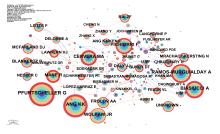
图5
作者共被引共现图谱"

表4
被引频次前10的作者"
| 作者 | 频次/n | 中心性 |
|---|---|---|
| Pfurtscheller G | 167 | 0.31 |
| Kai Keng Ang | 158 | 0.63 |
| Ander Ramos-Murguialday | 129 | 0.37 |
| Biasiucci A | 118 | 0.47 |
| Floriana Pichiorri | 108 | 0.65 |
| Jonathan R Wolpaw | 106 | 0.09 |
| María A Cervera | 104 | 0.50 |
| Ravikiran Mane | 92 | 0.10 |
| Alexander A Frolov | 77 | 0.09 |
| Benjamin Blankertz | 71 | 0.04 |
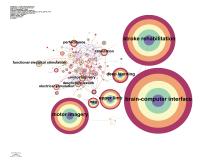
图6
关键词共现图谱"

表5
排名前10的高频关键词"
| 关键词 | 频次/n | 中心性 |
|---|---|---|
| brain-computer interface | 337 | 0.03 |
| stroke rehabilitation | 260 | 0.02 |
| motor imagery | 187 | 0.00 |
| upper limb | 104 | 0.06 |
| deep learning | 79 | 0.04 |
| EEG | 54 | 0.00 |
| stimulation | 36 | 0.04 |
| performance | 36 | 0.01 |
| motor recovery | 32 | 0.09 |
| functional electrical stimulation | 31 | 0.04 |

图7
关键词聚类图谱"

表6
关键词聚类表"
| 聚类号 | 节点数/n | 轮廓值 | 主要关键词 |
|---|---|---|---|
| #0 | 21 | 0.911 | machine learning; brain asymmetry; action observation; artificial intelligence |
| #1 | 19 | 0.923 | amyotrophic lateral sclerosis; heart rate variability; human; sensorimotor rhythms |
| #2 | 17 | 0.916 | feature extraction; stroke (medical condition); motors; convolutional neural networks |
| #3 | 16 | 0.823 | motor imagery; brain-computer interface; stroke rehabilitation; electroencephalography (EEG) |
| #4 | 16 | 0.950 | functional near-infrared spectroscopy; effective connectivity; clinical translation |
| #5 | 15 | 0.913 | motor imagery; brain-computer interface (BCI) ; brain-computer interface; stroke |
| #6 | 15 | 0.950 | EEG; hemiparesis; systematic review; decoding; brain-computer interfaces |
| #7 | 15 | 0.899 | neurofeedback, motor restoration, bimanual BCI-FES, delta alpha ratio |
| #8 | 13 | 0.871 | electroencephalography (EEG), upper limb, brain-computer interface |
| #9 | 12 | 0.922 | motor rehabilitation, functional electrical stimulation, continuous trajectory reconstruction |
| #10 | 12 | 0.831 | neurological diseases, virtual reality, neuroscience, volitional control |
| #11 | 11 | 0.968 | motor function, upper extremity, stroke, network calibration, robotic arm |
| #12 | 9 | 0.989 | movement-related cortical potential, kinesthetic motor imagery, event-related desynchronization |
| #13 | 8 | 0.805 | neuroprosthetic, gps tracking, community participation, intracortical brain-computer interfaces |
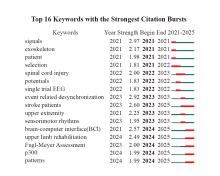
图8
突现关键词"

| [1] |
KAWALA-STERNIUK A, BROWARSKA N, AL-BAKRI A, et al. Summary of over fifty years with brain-computer interfaces: a review[J]. Brain sciences, 2021, 11(1): 43.
doi: 10.3390/brainsci11010043 |
| [2] | KÜBLER A. The history of BCI: from a vision for the future to real support for personhood in people with locked-in syndrome[J]. Neuroethics, 2019, 13, 163-180. |
| [3] |
CANTILLO-NEGRETE J, CARINO-ESCOBAR R I, ORTEGA-ROBLES E, et al. A comprehensive guide to BCI-based stroke neurorehabilitation interventions[J]. MethodsX, 2023, 11: 102452.
doi: 10.1016/j.mex.2023.102452 |
| [4] |
VARSEHI H, FIROOZABADI S M P. An EEG channel selection method for motor imagery based brain-computer interface and neurofeedback using Granger causality[J]. Neural Netw, 2021: 133: 193-206.
doi: 10.1016/j.neunet.2020.11.002 |
| [5] |
POO M M, DU J L, IP N Y, et al. China brain project: basic neuroscience, brain diseases, and brain-inspired computing[J]. Neuron, 2016, 92(3): 591-596.
doi: 10.1016/j.neuron.2016.10.050 |
| [6] |
BATISTIĆ L, SUŠANJ D, PINČIĆ D, et al. Motor imagery classification based on EEG sensing with visual and vibrotactile guidance[J]. Sensors, 2023, 23(11): 5064.
doi: 10.3390/s23115064 |
| [7] |
YOU Y, LU C, WANG W, et al. Relative CNN-RNN: learning relative atmospheric visibility from images[J]. IEEE Transact Image Process, 2018, 28(1): 45-55.
doi: 10.1109/TIP.2018.2857219 |
| [8] |
SINHA P, SAHU D, PRAKASH S, et al. A high performance hybrid LSTM CNN secure architecture for IoT environments using deep learning[J]. Scientific Reports, 2025, 15(1): 9684.
doi: 10.1038/s41598-025-94500-5 |
| [9] |
TANG Y, HUANG W, CHEN C, et al. CT-DCENet: deep EEG denoising via CNN-transformer-based dual-stage collaborative ensemble learning[J]. IEEE J Biomed Health Inform, 2025, 29(6): 4095-4108.
doi: 10.1109/JBHI.2025.3535592 |
| [10] |
ELASHMAWI W H, AYMAN A, ANTOUN M, et al. A comprehensive review on brain-computer interface (BCI)-based machine and deep learning algorithms for stroke rehabilitation[J]. Appl Sci, 2024, 14(14): 6347.
doi: 10.3390/app14146347 |
| [11] |
TONIN A, SEMPRINI M, KIPER P, et al. Brain-computer interfaces for stroke motor rehabilitation[J]. Bioengineering, 2025, 12(8): 820.
doi: 10.3390/bioengineering12080820 |
| [12] |
AL-QAYSI Z T, AHMED M A, HAMMASH N M, et al. Systematic review of training environments with motor imagery brain-computer interface: coherent taxonomy, open issues and recommendation pathway solution[J]. Health Technol, 2021, 11(4): 783-801.
doi: 10.1007/s12553-021-00560-8 |
| [13] |
MA Z Z, WU J J, CAO Z, et al. Motor imagery-based brain-computer interface rehabilitation programs enhance upper extremity performance and cortical activation in stroke patients[J]. J Neuroengin Rehabil, 2024, 21(1): 91.
doi: 10.1186/s12984-024-01387-w |
| [14] |
ZHANG M, ZHU F, JIA F, et al. Efficacy of brain-computer interfaces on upper extremity motor function rehabilitation after stroke: a systematic review and meta-analysis[J]. NeuroRehabilitation, 2024, 54(2): 199-212.
doi: 10.3233/NRE-230215 |
| [15] |
LENNON O, TONELLATO M, DEL FELICE A, et al. A systematic review establishing the current state-of-the-art, the limitations, and the DESIRED checklist in studies of direct neural interfacing with robotic gait devices in stroke rehabilitation[J]. Front Neurosci, 2020, 14: 578.
doi: 10.3389/fnins.2020.00578 |
| [16] |
YEN H C, CHEN W S, JENG J S, et al. Standard early rehabilitation and lower limb transcutaneous nerve or neuromuscular electrical stimulation in acute stroke patients: a randomized controlled pilot study[J]. Clinical Rehabilitation, 2019, 33(8): 1344-1354.
doi: 10.1177/0269215519841420 |
| [17] |
SEMPRINI M, LENCIONI T, HINTERLANG W, et al. User-centered design and development of TWIN-Acta: a novel control suite of the TWIN lower limb exoskeleton for the rehabilitation of persons post-stroke[J]. Front Neurosci, 2022, 16: 915707.
doi: 10.3389/fnins.2022.915707 |
| [18] | REN S, WANG W, HOU Z G, et al. Enhanced motor imagery based brain-computer interface via FES and VR for lower limbs[J]. IEEE Trans Neur Sys Rehabil Engin, 2020, 28(8): 1846-1855. |
| [19] |
BIASIUCCI A, LEEB R, ITURRATE I, et al. Brain-actuated functional electrical stimulation elicits lasting arm motor recovery after stroke[J]. Nat Commun, 2018, 9(1): 2421.
doi: 10.1038/s41467-018-04673-z pmid: 29925890 |
| [20] |
SAID R R, HEYAT M B B, SONG K, et al. A systematic review of virtual reality and robot therapy as recent rehabilitation technologies using EEG-brain-computer interface based on movement-related cortical potentials[J]. Biosensors, 2022, 12(12): 1134.
doi: 10.3390/bios12121134 |
| [21] |
COLUCCI A, VERMEHREN M, CAVALLO A, et al. Brain-computer interface-controlled exoskeletons in clinical neurorehabilitation: ready or not?[J]. Neurorehabil Neural Repair, 2022, 36(12): 747-756.
doi: 10.1177/15459683221138751 |
| [22] |
WEN D, FAN Y, HSU S H, et al. Combining brain-computer interface and virtual reality for rehabilitation in neurological diseases: a narrative review[J]. Ann Phys Rehabil Med, 2021, 64(1): 101404.
doi: 10.1016/j.rehab.2020.03.015 |
| [23] |
DALY J J, WOLPAW J R. Brain-computer interfaces in neurological rehabilitation[J]. Lancet Neurol, 2008, 7(11): 1032-1043.
doi: 10.1016/S1474-4422(08)70223-0 pmid: 18835541 |
| [24] |
ZIADEH H, GULYAS D, NIELSEN L D, et al. "Mine works better": examining the influence of embodiment in virtual reality on the sense of agency during a binary motor imagery task with a brain-computer interface[J]. Front Psychol, 2021, 12: 806424.
doi: 10.3389/fpsyg.2021.806424 |
| [25] |
AFONSO M, SÁNCHEZ-CUESTA F, GONZÁLEZ-ZAMORANO Y, et al. Investigating the synergistic neuromodulation effect of bilateral rTMS and VR brain-computer interfaces training in chronic stroke patients[J]. J Neural Eng, 2024, 21(5): 056037.
doi: 10.1088/1741-2552/ad8836 |
| [26] |
NUNES J D, VOURVOPOULOS A, BLANCO-MORA D A, et al. Brain activation by a VR-based motor imagery and observation task: an fMRI study[J]. PLoS One, 2023, 18(9): e0291528.
doi: 10.1371/journal.pone.0291528 |
| [27] |
KAWANO T, HATTORI N, UNO Y, et al. Large-scale phase synchrony reflects clinical status after stroke: an EEG study[J]. Neurorehabil Neural Repair, 2017, 31(6): 561-570.
doi: 10.1177/1545968317697031 pmid: 28506148 |
| [28] |
YANG X, SHI X, XUE X, et al. Efficacy of robot-assisted training on rehabilitation of upper limb function in patients with stroke: a systematic review and meta-analysis[J]. Arch Phys Med Rehabil, 2023, 104(9): 1498-1513.
doi: 10.1016/j.apmr.2023.02.004 |
| [29] |
WHEATON L A, SHIBASAKI H, HALLETT M. Temporal activation pattern of parietal and premotor areas related to praxis movements[J]. Clin Neurophysiol, 2005, 116(5): 1201-1212.
pmid: 15826863 |
| [30] |
DE SETA V, COLAMARINO E, PICHIORRI F, et al. Brain and muscle derived features to discriminate simple hand motor tasks for a rehabilitative BCI: comparative study on healthy and post-stroke individuals[J]. J Neural Eng, 2024, 21(6): 066015.
doi: 10.1088/1741-2552/ad8838 |
| [31] |
BRAMBILLA C, PIROVANO I, MIRA R M, et al. Combined use of EMG and EEG techniques for neuromotor assessment in rehabilitative applications: a systematic review[J]. Sensors, 2021, 21(21): 7014.
doi: 10.3390/s21217014 |
| [32] |
QU G, ZHOU Z, CALHOUN V D, et al. Integrated brain connectivity analysis with fMRI, DTI, and sMRI powered by interpretable graph neural networks[J]. Med Image Anal, 2025, 103: 103570.
doi: 10.1016/j.media.2025.103570 |
| [33] |
STÄMPFLI P, REISCHAUER C, JÄRMANN T, et al. Combining fMRI and DTI: a framework for exploring the limits of fMRI-guided DTI fiber tracking and for verifying DTI-based fiber tractography results[J]. Neuroimage, 2008, 39(1): 119-126.
pmid: 17931889 |
| [34] |
HE B, LIU Z. Multimodal functional neuroimaging: integrating functional MRI and EEG/MEG[J]. IEEE Rev Biomed Eng, 2008, 1: 23-40.
doi: 10.1109/RBME.2008.2008233 pmid: 20634915 |
| [35] |
BUTET S, FLEURY M, DUCHÉ Q, et al. EEG-fMRI neurofeedback versus motor imagery after stroke, a randomized controlled trial[J]. J Neuroeng Rehabil, 2025, 22(1): 67.
doi: 10.1186/s12984-025-01598-9 |
| [1] | 王潇婧, 魏婧怡, 卫晨, 王冉, 马赛, 刘西花. 针刺同步构音训练对脑卒中后痉挛型构音障碍的效果[J]. 《中国康复理论与实践》, 2025, 31(9): 1009-1016. |
| [2] | 周新悦, 叶睿雪, 马雅琦, 许莹, 曹珑耀, 王玉龙. 卒中后中枢性疼痛相关研究的文献计量分析[J]. 《中国康复理论与实践》, 2025, 31(9): 1038-1049. |
| [3] | 高云汉, 侯闪闪, 汪鑫煜, 朱崇田. 基于功能性近红外光谱探讨脑机接口对脑卒中患者上肢运动功能障碍的效果[J]. 《中国康复理论与实践》, 2025, 31(9): 1066-1073. |
| [4] | 张子昂, 陈静, 沈孟茹, 耿宗晓, 韩雪, 赵旭, 徐磊. 不同运动模式对脑卒中患者步行及平衡功能的效果比较[J]. 《中国康复理论与实践》, 2025, 31(8): 896-905. |
| [5] | 陆丹丹, 姚敬智, 李姿, 王柯文, 孙鑫廖, 陈建敏, 许建文. 2014年至2023年帕金森病物理治疗的文献计量学分析[J]. 《中国康复理论与实践》, 2025, 31(8): 906-913. |
| [6] | 王晓锋, 胡梦巧, 汪嫣, 魏坤, 徐文竹, 任丹, 马晔. 外骨骼机器人辅助步态训练对脑卒中和脊髓损伤下肢功能康复效果的系统综述[J]. 《中国康复理论与实践》, 2025, 31(8): 914-921. |
| [7] | 梁斐, 陈西梅, 戚静, 王淑荣, 梁永胜. 残疾大学生功能、职业胜任力与职业发展:基于ICF和RCF[J]. 《中国康复理论与实践》, 2025, 31(8): 922-929. |
| [8] | 董原君, 娄薪, 孙芮, 王文帅, 刘晓芹, 夏雪, 杨亚茹, 王忠彦, 邱卓英. 基于RCF康复心理学专业人员的团队工作与跨专业实践领域胜任力的培养研究[J]. 《中国康复理论与实践》, 2025, 31(8): 939-946. |
| [9] | 吕雪琴, 张通, 刘惠林, 刘建华, 李达, 王华伟. 术前运动对脑室-腹腔分流术患者的效果[J]. 《中国康复理论与实践》, 2025, 31(8): 958-964. |
| [10] | 宋竺蔓, 刘娜, 刘杨, 丁雪梅, 张晓丽. 2016年至2025年孤独症谱系障碍儿童父母心理健康研究的文献计量分析[J]. 《中国康复理论与实践》, 2025, 31(7): 790-801. |
| [11] | 孙婉婷, 艾丽皮乃·亚森, 龚翔, 肖悦, 甘兆丹, 刘铭洁, 曾兰婷, 马姝玥, 鲁俊, 许光旭. 基于运动序列学习探讨高频重复经颅磁刺激对脑卒中患者上肢功能的效果[J]. 《中国康复理论与实践》, 2025, 31(7): 812-821. |
| [12] | 刘兰群, 李艳丽, 梁家琦, 陈爽, 刘慧林. 头针结合计算机辅助训练对脑卒中后记忆障碍的效果[J]. 《中国康复理论与实践》, 2025, 31(7): 862-868. |
| [13] | 曹静, 刘晶, 张晓燕, 高少宇. 基于世界卫生组织康复胜任力架构构建中小学特殊教育教师胜任力评价指标体系[J]. 《中国康复理论与实践》, 2025, 31(6): 621-627. |
| [14] | 朱晨晨, 廖思斯, 潘建明, 夏币华, 洪宁杰. 0~3岁发育障碍婴幼儿早期家庭教育与康复:基于ICF的目标设置与服务体系研究[J]. 《中国康复理论与实践》, 2025, 31(6): 635-641. |
| [15] | 顾逸青, 程舒芃, 李勇强, 毛二莉, 励建安. 成年气管切开患者拔管的直接策略与堵管策略对比的系统综述[J]. 《中国康复理论与实践》, 2025, 31(6): 666-673. |
| 阅读次数 | ||||||
|
全文 |
|
|||||
|
摘要 |
|
|||||
|
||
