


《中国康复理论与实践》 ›› 2025, Vol. 31 ›› Issue (11): 1303-1313.doi: 10.3969/j.issn.1006-9771.2025.11.007
毛涛, 游茂林( )
)
收稿日期:2025-08-19
修回日期:2025-09-04
出版日期:2025-11-25
发布日期:2025-11-26
通讯作者:
游茂林
E-mail:youmaolin@126.com
作者简介:毛涛(2000-),男,汉族,湖南长沙市人,硕士研究生,主要研究方向:运动与健康促进。
MAO Tao, YOU Maolin()
Received:2025-08-19
Revised:2025-09-04
Published:2025-11-25
Online:2025-11-26
Contact:
YOU Maolin
E-mail:youmaolin@126.com
摘要:
目的 系统评价运动干预对帕金森病患者呼吸功能和咳嗽能力、吞咽能力的影响,并比较不同运动干预类型的效果。
方法 构建PICO架构,检索Web of Science、PubMed、Cochrane Library、Embase、中国知网、万方数据库、维普和中国生物医学文献数据库,纳入关于运动干预帕金森病患者呼吸功能的随机对照试验(RCT),检索时限为建库至2025年7月25日。采用Cochrane手册5.1.0推荐的RCT偏倚风险评价工具和PEDro量表评估文献质量,采用Revman 5.3绘制偏倚风险图,采用Stata 17.0进行Meta分析。
结果 最终纳入11篇RCT,涉及471例患者。PEDro量表评分5~8分。运动干预可以有效改善帕金森病患者的用力肺活量(FVC) (MD = 0.42, 95%CI 0.27~0.58, P < 0.001)、第1秒用力呼气容积(MD = 0.32, 95%CI 0.24~0.39, P < 0.001)、慢肺活量(MD = 0.80, 95%CI 0.68~0.93, P < 0.001)、最大吸气压力(MD = 11.53, 95%CI 7.45~15.60, P < 0.001)、最大呼气压力(MEP) (MD = 16.75, 95%CI 11.90~21.60, P < 0.001)、峰值呼气流量(MD = 55.77, 95%CI 49.87~61.66, P < 0.001)。呼吸肌训练(RMT)可以有效改善反射性咳嗽峰值流量(MD = 3.51, 95%CI 2.40~4.61, P < 0.001)、自主咳嗽峰值流量(MD = 3.09, 95%CI 2.12~4.06, P < 0.001)。亚组分析显示,在改善MEP方面,RMT优于非通气特异性运动(NVS) (P < 0.05);在改善FVC方面,NVS优于RMT (P < 0.05)。
结论 运动干预能有效改善帕金森病患者的呼吸功能,NVS在改善肺功能方面效果更好,RMT可以改善咳嗽能力,且在改善呼吸肌力方面效果更明显。
中图分类号:
毛涛, 游茂林. 运动干预对帕金森病患者呼吸功能效果的Meta分析[J]. 《中国康复理论与实践》, 2025, 31(11): 1303-1313.
MAO Tao, YOU Maolin. Effect of exercise on respiratory function in Parkinson's disease: a meta-analysis[J]. Chinese Journal of Rehabilitation Theory and Practice, 2025, 31(11): 1303-1313.
表1
PICO架构"
| 人群(Population) | 干预(Intervention) | 比较(Comparison) | 结局(Outcome) |
|---|---|---|---|
| 帕金森病患者 | 干预方式 | 与对照组比较 | FVC、FEV1、FEV1/FVC、SVC、MIP、MEP、PEF、v-PCF、r-PCF、渗透误吸量表 |
| RMT | 不同运动干预方式比较 | ||
| NVS |
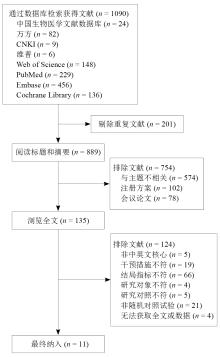
图 1
文献筛选流程图"

表 2
纳入文献PEDro量表评分"
| 纳入文献 | 纳入条件明确 | 随机分配 | 分配隐藏 | 基线指标相似 | 受试者设盲 | 治疗者设盲 | 评定者设盲 | 85%以上受试者完成试验 | 意向性治疗分析 | 组间统计结果比较 | 点测量和差异值 | 总分 | 质量 |
|---|---|---|---|---|---|---|---|---|---|---|---|---|---|
| 姜佳慧等[ | √ | √ | √ | √ | √ | √ | √ | 6 | 高 | ||||
| 范杰诚等[ | √ | √ | √ | √ | √ | √ | √ | 6 | 高 | ||||
| 王洁萍等[ | √ | √ | √ | √ | √ | √ | 5 | 中 | |||||
| 华玲等[ | √ | √ | √ | √ | √ | √ | √ | 6 | 高 | ||||
| 厉坤鹏等[ | √ | √ | √ | √ | √ | √ | √ | 6 | 高 | ||||
| Yin等[ | √ | √ | √ | √ | √ | √ | 5 | 中 | |||||
| Alves等[ | √ | √ | √ | √ | √ | √ | √ | 6 | 高 | ||||
| Reyes等[ | √ | √ | √ | √ | √ | √ | √ | 6 | 高 | ||||
| Sapienza等[ | √ | √ | √ | √ | √ | √ | √ | √ | 7 | 高 | |||
| Troche等[ | √ | √ | √ | √ | √ | √ | √ | √ | √ | 8 | 高 | ||
| Reyes等[ | √ | √ | √ | √ | √ | √ | √ | 6 | 高 |
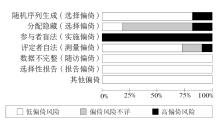
图 2
偏倚风险比例"
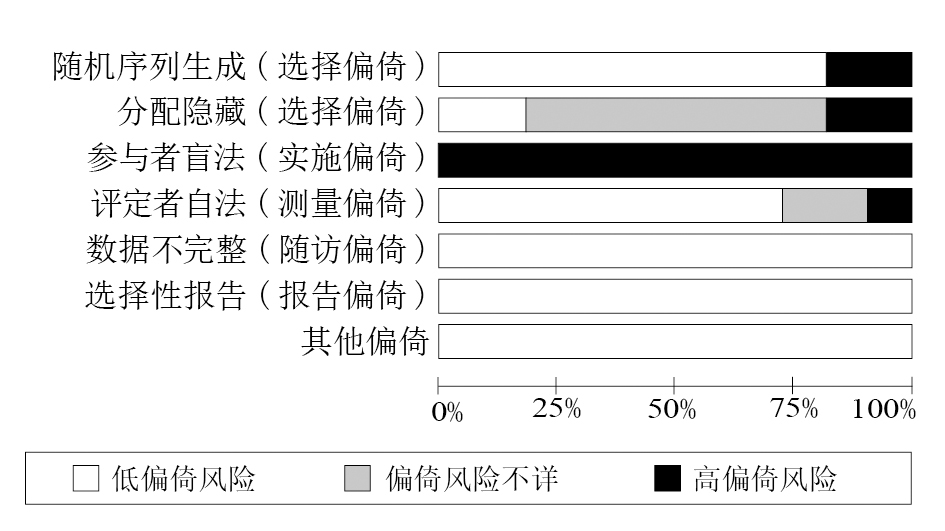
图3
纳入文献偏倚风险评估结果"
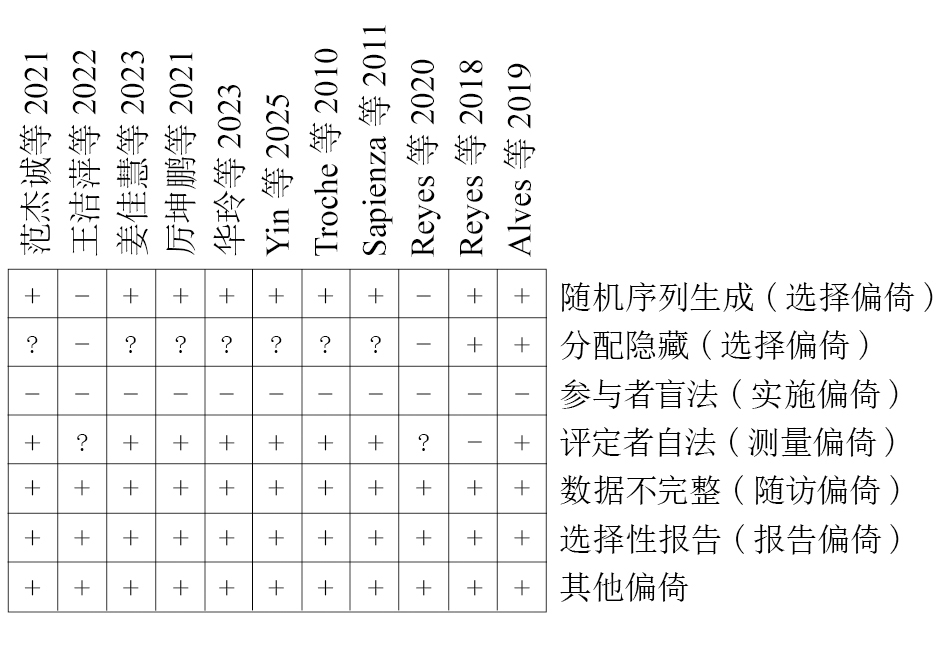
表3
纳入文献基本特征"
| 纳入文献 | 国家 | 受试者特征 | 干预方式 | 干预参数 | 结局指标 | |||
|---|---|---|---|---|---|---|---|---|
| n | 性别(男/女)/n | 年龄/岁 | 病程/年 | |||||
| 姜佳慧等[ | 中国 | T:20 C:20 | T:8/12 C:13/7 | T:60.60±6.75 C:59.45±5.45 | T:4.30±1.38 C:3.85±1.35 | T:易筋经 C:常规治疗 | 每次30 min,每周5次,共8周 | ① |
| 范杰诚等[ | 中国 | T:30 C:30 | T:21/9 C:22/8 | T:65.35±4.12 C:66.22±3.67 | T:4.62±1.31 C:4.74±1.47 | T:腹式呼吸+吸气肌训练 C:常规康复训练 | 每周5次,共24周 | ①②③ |
| 王洁萍等[ | 中国 | T:30 C:30 | T:15/15 C:13/17 | T:61.98±3.71 C:63.25±2.47 | T:3.15±2.03 C:3.26±1.89 | T:肢体协调训练 C:常规治疗 | 每次40 min,每周5次,共12周 | ①②④⑤⑥⑦ |
| 华玲等[ | 中国 | T:24 C:24 | T:11/13 C:14/10 | T:73.33±7.49 C:71.67±8.82 | T:5.96±3.66 C:5.83±4.57 | T:吸气肌训练 C:常规康复训练 | 每周5次,共8周 | ⑤ |
| 厉坤鹏等[ | 中国 | T:30 C:30 | T:16/14 C:17/13 | T:65.53±9.43 C:63.17±5.78 | T:8.11±2.23 C:8.29±2.19 | T:呼吸训练 C:常规康复 | 每周5次,共4周 | ①② |
| Yin等[ | 中国 | T:25 C:26 | T:12/13 C:12/14 | T:58.80±8.61 C:58.15±7.09 | T:6.05±3.07 C:6.15±4.47 | T:六字诀 C:常规训练 | 每次30 min,每周5次,共12周 | ①②③⑤⑥⑦ |
| Alves等[ | 巴西 | T:12 C:16 | — — | T:64.08±6.87 C:67.13±8.20 | T:6.42±2.71 C:4.50±4.07 | T:抗阻运动 C:常规治疗 | 每次30~40 min,每周2次,共16周 | ⑤⑥⑦ |
| Reyes等[ | 智利 | T1:10 T2:11 C:10 | T1:7/3 T2:6/5 C:4/6 | T1:70.40±6.81 T2:70.45±8.16 C:70.20±6.69 | — | T1:呼气肌训练 T2:吸气肌训练 C:假呼气肌训练 | 每周6次,共2个月 | ①④⑤⑥⑧⑨ |
| Sapienza等[ | 美国 | T:30 C:30 | T:25/5 C:22/8 | T:66.73±8.90 C:68.50±10.31 | — | T:呼气肌训练 C:假呼气肌训练 | 每次20 min,每周5次,共4周 | ①②③⑥⑦ |
| Troche等[ | 美国 | T:30 C:30 | T:25/5 C:22/8 | T:66.73±8.90 C:68.50±10.31 | — | T:呼气肌训练 C:假呼气肌训练 | 每次20 min,每周5次,共4周 | ⑩ |
| Reyes等[ | 智利 | T1:11 T2:11 C:11 | T1:6/5 T2:7/4 C:5/6 | T1:65.81±7.35 T2:69.81±6.75 C:70.45±6.40 | — | T1:呼气肌训练+空气叠加 T2:呼气肌训练 C:假呼气肌训练 | 每周6次,共2个月 | ④⑤⑥⑧⑨ |
表4
Meta分析结果"
| 结局指标 | 纳入研究数/n | 异质性检验 | 效应模型 | Meta分析 | ||
|---|---|---|---|---|---|---|
| P值 | I2值 | MD (95%CI) | P值 | |||
| FVC | 7 | 0.026 | 55.90% | 随机 | 0.42(0.27~0.58) | < 0.001 |
| FEV1 | 5 | 0.501 | 0% | 固定 | 0.32(0.24~0.39) | < 0.001 |
| FEV1/FVC | 3 | 0.056 | 65.30% | 随机 | 0.17(-3.35~3.70) | 0.923 |
| SVC | 3 | 0.272 | 22.30% | 固定 | 0.80(0.68~0.93) | < 0.001 |
| MIP | 6 | 0.892 | 0% | 固定 | 11.53(7.45~15.60) | < 0.001 |
| MEP | 6 | 0.138 | 36.40% | 固定 | 16.75(11.90~21.60) | < 0.001 |
| PEF | 4 | 0.781 | 0% | 固定 | 55.77(49.87~61.66) | < 0.001 |
| v-PCF | 2 | 0.648 | 0% | 固定 | 3.09(2.12~4.06) | < 0.001 |
| r-PCF | 2 | 0.305 | 17.30% | 固定 | 3.51(2.40~4.61) | < 0.001 |
表 5
亚组分析的效应量及异质性检验结果(随机效应模型)"
| 结局指标 | 运动类型 | 纳入研 究数/n | 异质性检验 | Meta分析 | 组间效应量差异/P值 | ||
|---|---|---|---|---|---|---|---|
| I2值 | P值 | MD (95%CI) | P值 | ||||
| FVC | NVS | 3 | 45.10% | 0.162 | 0.57(0.39~0.75) | < 0.001 | 0.013 |
| RMT | 4 | 0% | 0.705 | 0.30(0.18~0.42) | < 0.001 | ||
| FEV1 | NVS | 2 | 0% | 0.691 | 0.34(0.26~0.43) | < 0.001 | 0.232 |
| RMT | 3 | 0% | 0.414 | 0.24(0.10~0.38) | 0.001 | ||
| FEV1/FVC | NVS | 1 | — | — | -3.00(-6.89~0.89) | 0.131 | 0.113 |
| RMT | 2 | 64.0% | 0.096 | 1.63(-2.57~5.83) | 0.448 | ||
| SVC | NVS | 1 | — | — | 0.83(0.70~0.96) | < 0.001 | 0.103 |
| RMT | 2 | 0% | 0.478 | 0.42(-0.06~0.90) | 0.084 | ||
| MIP | NVS | 3 | 14.30% | 0.311 | 11.02(5.22~16.81) | < 0.001 | 0.843 |
| RMT | 3 | 0% | 0.967 | 11.94(4.83~19.06) | 0.001 | ||
| MEP | NVS | 3 | 0% | 0.855 | 13.52(8.19~18.84) | < 0.001 | 0.004 |
| RMT | 3 | 0% | 0.661 | 32.43(20.70~44.16) | < 0.001 | ||
| PEF | NVS | 3 | 0% | 0.584 | 55.79(49.86~61.72) | < 0.001 | 0.932 |
| RMT | 1 | — | — | 53.40(-1.10~107.90) | 0.055 | ||
| [1] |
SU D, CUI Y, HE C, et al. Projections for prevalence of Parkinson's disease and its driving factors in 195 countries and territories to 2050: modelling study of Global Burden of Disease Study 2021[J]. BMJ, 2025, 388: e080952.
doi: 10.1136/bmj-2024-080952 |
| [2] | 孙胜男, 肖琪, 范丽珊, 等. α-突触核蛋白与帕金森病的研究现状[J]. 中国临床药理学杂志, 2023, 39(8): 1201-1205. |
| SUN S N, XIAO Q, FAN L S, et al. Research status of α-synuclein and Parkinson's disease[J]. Chin J Clin Pharmacol, 2023, 39(8): 1201-1205. | |
| [3] |
OLIVEIRA L M, OLIVEIRA M A, MORIYA H T, et al. Respiratory disturbances in a mouse model of Parkinson's disease[J]. Exp Physiol, 2019, 104(5): 729-739.
doi: 10.1113/EP087507 pmid: 30758090 |
| [4] |
田敏, 刘艺鸣. 帕金森病相关呼吸功能障碍研究进展[J]. 中国现代神经疾病杂志, 2022, 22(4): 229-236.
doi: 10.3969/j.issn.1672-6731.2022.04.003 |
|
TIAN M, LIU Y M. Progression of respiratory disorders associated with Parkinson's disease[J]. Chin J Contemp Neurol Neurosurg, 2022, 22(4): 229-236.
doi: 10.3969/j.issn.1672-6731.2022.04.003 |
|
| [5] |
AKTAR B, BALCI B, DONMEZ COLAKOGLU B. Physical activity in patients with Parkinson's disease: a holistic approach based on the ICF model[J]. Clin Neurol Neurosurg, 2020, 198: 106132.
doi: 10.1016/j.clineuro.2020.106132 |
| [6] |
王会奇, 方伯言, 刘翠, 等. 帕金森病康复治疗研究进展[J]. 中国康复理论与实践, 2018, 24(7): 763-766.
doi: 10.3969/j.issn.1006-9771.2018.07.003 |
| WANG H Q, FANG B Y, LIU C, et al. Advance in rehabilitation for Parkinson's disease (review)[J]. Chin J Rehabil Theory Pract, 2018, 24(7): 763-766. | |
| [7] |
KACZYŃSKA K, ORŁOWSKA M E, ANDRZEJEWSKI K. Respiratory abnormalities in Parkinson's disease: What do we know from studies in humans and animal models?[J]. Int J Mol Sci, 2022, 23(7): 3499.
doi: 10.3390/ijms23073499 |
| [8] | KELLY B, BLAKE C, LENNON O. Acute hospital admissions of individuals with a known Parkinson's disease diagnosis in Ireland 2009-2012: a short report[J]. J Parkinsons Dis, 2016, 6(4): 709-716. |
| [9] | MOURA LOUREIRO R F, SANTANA E D S, DUQUE F M G, et al. Characteristics of respiratory rehabilitation programs for people with Parkinson's disease: a scoping review[J]. JBI Evid Synth, 2025, 23(7): 1308-1375. |
| [10] | 尹慧梅, 承欧梅, 张旭, 等. 帕金森病患者肺功能与运动症状相关性研究[J]. 重庆医科大学学报, 2025, 50(4): 523-529. |
| YIN H M, CHENG O M, ZHANG X, et al. Association between pulmonary function and motor symptoms in patients with Parkinson's disease[J]. J Chongqing Med Univ, 2025, 50(4): 523-529. | |
| [11] |
肖琳娜, 李晓红. 帕金森病冲动控制障碍的Scoping综述[J]. 中国康复理论与实践, 2021, 27(7): 774-779.
doi: 10.3969/j.issn.1006-9771.2021.07.006 |
| XIAO L N, LI X H. Impulse control disorder in Parkinson's disease: a scoping review[J]. Chin J Rehabil Theory Pract, 2021, 27(7): 774-779. | |
| [12] |
MCMAHON L, BLAKE C, LENNON O. A systematic review and meta-analysis of respiratory dysfunction in Parkinson's disease[J]. Eur J Neurol, 2023, 30(5): 1481-1504.
doi: 10.1111/ene.v30.5 |
| [13] |
AUBIER M, MURCIANO D, MENU Y, et al. Dopamine effects on diaphragmatic strength during acute respiratory failure in chronic obstructive pulmonary disease[J]. Ann Intern Med, 1989, 110(1): 17-23.
pmid: 2908830 |
| [14] | 刘晓黎, 胡伟, 魏彦姝. 造血干细胞移植患者重返工作的研究进展[J]. 中国护理管理, 2024, 24(10): 1586-1591. |
| LIU X L, HU W, WEI Y S. Research progress on returning to work among survivors of hematopoietic stem cell transplantation[J]. Chin Nurs Manag, 2024, 24(10): 1586-1591. | |
| [15] |
ZHUANG J, JIA J. Effects of respiratory muscle strength training on respiratory-related impairments of Parkinson's disease[J]. Front Aging Neurosci, 2022, 14: 929923.
doi: 10.3389/fnagi.2022.929923 |
| [16] | 王超群, 赵林芳. 慢性心力衰竭病人呼吸训练研究现状[J]. 护理研究, 2021, 35(3): 437-441. |
| WANG C Q, ZHAO L F. Research status quo of breathing training for patients with chronic heart failure[J]. Chin Nurs Res, 2021, 35(3): 437-441. | |
| [17] |
FLOR-RUFINO C, PÉREZ-ROS P, MARTÍNEZ-ARNAU F M. Influence of physical exercise on respiratory muscle function in older adults: a systematic review and meta-analysis[J]. Geriatr Nurs, 2024, 57: 189-198.
doi: 10.1016/j.gerinurse.2024.04.016 |
| [18] |
RODRÍGUEZ M Á, CRESPO I, DEL VALLE M, et al. Should respiratory muscle training be part of the treatment of Parkinson's disease? A systematic review of randomized controlled trials[J]. Clin Rehabil, 2020, 34(4): 429-437.
doi: 10.1177/0269215519896054 pmid: 31875689 |
| [19] | VAN DE WETERING-VAN DONGEN V A, KALF J G, VAN DER WEES P J, et al. The effects of respiratory training in Parkinson's disease: a systematic review[J]. J Parkinsons Dis, 2020, 10(4): 1315-1333. |
| [20] | PAGE M J, MOHER D, BOSSUYT P M, et al. PRISMA 2020 explanation and elaboration: updated guidance and exemplars for reporting systematic reviews[J]. BMJ, 2021, 372: n160. |
| [21] |
HIGGINS J P T, ALTMAN D G, GØTZSCHE P C, et al. The Cochrane Collaboration's tool for assessing risk of bias in randomised trials[J]. BMJ, 2011, 343: d5928.
doi: 10.1136/bmj.d5928 |
| [22] |
MURRAY E, POWER E, TOGHER L, et al. The reliability of methodological ratings for speechBITE using the PEDro-P scale[J]. Int J Lang Commun Disord, 2013, 48(3): 297-306.
doi: 10.1111/1460-6984.12007 pmid: 23650886 |
| [23] | 姜佳慧, 毕鸿雁. 健身气功易筋经对轻中度帕金森病病人疲劳及生活质量的影响[J]. 护理研究, 2023, 37(24): 4452-4457. |
| JIANG J H, BI H Y. Influence of fitness qigong Yijinjing on fatigue and quality of life in patients with Parkinson's disease[J]. Chin Nurs Res, 2023, 37(24): 4452-4457. | |
| [24] |
王洁萍, 彭娟, 张斐雪, 等. 肢体协调训练对早期原发性帕金森病患者肺功能的效果[J]. 中国康复理论与实践, 2022, 28(8): 966-971.
doi: 10.3969/j.issn.1006-9771.2022.08.012 |
| WANG J P, PENG J, ZHANG F X, et al. Effect of interlimb-coordinated training on pulmonary function in patients with early primary Parkinson's disease[J]. Chin J Rehabil Theory Pract, 2022, 28(8): 966-971. | |
| [25] | 范杰诚, 王佳良, 夏春凤, 等. 呼吸功能训练对帕金森病患者运动和呼吸功能及日常生活活动能力的影响[J]. 中华物理医学与康复杂志, 2021, 43(8): 693-697. |
| FAN J C, WANG J L, XIA C F, et al. Effects of breathing exercises on motor and respiratory function and on ability in daily living of patients with Parkinson's disease[J]. Chin J Phys Med Rehabil, 2021, 43(8): 693-697. | |
| [26] | 华玲, 王志, 宋达, 等. 阈值压力负荷吸气肌训练对帕金森病患者呼吸肌功能、平衡功能和步行功能的影响[J]. 中华物理医学与康复杂志, 2023, 45(8): 683-687. |
| HUA L, WANG Z, SONG D, et al. Inspiratory muscle training can improve the breathing, balance and walking of persons with Parkinson's disease[J]. Chin J Phys Med Rehabil, 2023, 45(8): 683-687. | |
| [27] |
厉坤鹏, 周宗磊, 张梓楠, 等. 呼吸训练对帕金森病患者肺功能和运动功能的效果[J]. 中国康复理论与实践, 2021, 27(3): 320-324.
doi: 10.3969/j.issn.1006-9771.2021.03.012 |
| LI K P, ZHOU Z L, ZHANG Z N, et al. Effects of respiratory training on pulmonary function and motor function for patients with Parkinson's disease[J]. Chin J Rehabil Theory Pract, 2021, 27(3): 320-324. | |
| [28] |
YIN H, CHENG O, ZHANG X, et al. Effects of Liuzijue Qigong on respiratory function among patients with Parkinson's disease: a randomized clinical trial[J]. BMC Complement Med Ther, 2025, 25(1): 63.
doi: 10.1186/s12906-025-04773-6 pmid: 39979896 |
| [29] |
ALVES W M, ALVES T G, FERREIRA R M, et al. Strength training improves the respiratory muscle strength and quality of life of elderly with Parkinson disease[J]. J Sports Med Phys Fitness, 2019, 59(10): 1756-1762.
doi: 10.23736/S0022-4707.19.09509-4 pmid: 31113177 |
| [30] |
REYES A, CASTILLO A, CASTILLO J, et al. The effects of respiratory muscle training on peak cough flow in patients with Parkinson's disease: a randomized controlled study[J]. Clin Rehabil, 2018, 32(10): 1317-1327.
doi: 10.1177/0269215518774832 pmid: 29756459 |
| [31] |
SAPIENZA C, TROCHE M, PITTS T, et al. Respiratory strength training: concept and intervention outcomes[J]. Semin Speech Lang, 2011, 32(1): 21-30.
doi: 10.1055/s-0031-1271972 pmid: 21491356 |
| [32] |
TROCHE M S, OKUN M S, ROSENBEK J C, et al. Aspiration and swallowing in Parkinson disease and rehabilitation with EMST: a randomized trial[J]. Neurology, 2010, 75(21): 1912-1919.
doi: 10.1212/WNL.0b013e3181fef115 pmid: 21098406 |
| [33] |
REYES A, CASTILLO A, CASTILLO J. Effects of expiratory muscle training and air stacking on peak cough flow in individuals with Parkinson's disease[J]. Lung, 2020, 198(1): 207-211.
doi: 10.1007/s00408-019-00291-8 pmid: 31720808 |
| [34] |
中华医学会神经病学分会神经康复学组, 中国微循环学会神经变性病专业委员会康复学组, 中国康复医学会帕金森病与运动障碍康复专业委员会. 帕金森病康复中国专家共识[J]. 中国康复理论与实践, 2018, 24(7): 745-752.
doi: 10.3969/j.issn.1006-9771.2018.00.002 |
| [35] |
GRANSEE H M, MANTILLA C B, SIECK G C. Respiratory muscle plasticity[J]. Compr Physiol, 2012, 2(2): 1441-1462.
doi: 10.1002/cphy.c110050 pmid: 23798306 |
| [36] |
HE R, REN L. Evaluation of the benefits of respirator breathing and vomiting training and dynamic core training on improving respiratory muscle strength[J]. Respir Med, 2025, 240: 108029.
doi: 10.1016/j.rmed.2025.108029 |
| [37] |
KANEKO H, SUZUKI A. Effect of chest and abdominal wall mobility and respiratory muscle strength on forced vital capacity in older adults[J]. Respir Physiol Neurobiol, 2017, 246: 47-52.
doi: S1569-9048(17)30216-1 pmid: 28797921 |
| [38] |
SUMMERHILL E M, ANGOV N, GARBER C, et al. Respiratory muscle strength in the physically active elderly[J]. Lung, 2007, 185(6): 315-320.
doi: 10.1007/s00408-007-9027-9 pmid: 17917778 |
| [39] | 韩春远, 王卫星, 成波锦, 等. 核心力量训练的基本问题:核心区与核心稳定性[J]. 天津体育学院学报, 2012, 27(2): 117-120, 172. |
| HAN C Y, WANG W X, CHENG B J, et al. Basic issues of the core strength training: the core area and core stability[J]. J Tianjin Univ Sport, 2012, 27(2): 117-120, 172. | |
| [40] |
符卫卫, 燕文娟. 体轴回旋结合节律性呼吸训练对脑卒中偏瘫下肢功能的效果[J]. 中国康复理论与实践, 2021, 27(11): 1323-1328.
doi: 10.3969/j.issn.1006-9771.2021.11.013 |
| FU W W, YAN W J. Effect of body axis rotation combined with rhythmic breathing training on lower limbs hemiplegia after stroke[J]. Chin J Rehabil Theory Pract, 2021, 27(11): 1323-1328. | |
| [41] |
EVANS K C. Cortico-limbic circuitry and the airways: insights from functional neuroimaging of respiratory afferents and efferents[J]. Biol Psychol, 2010, 84(1): 13-25.
doi: 10.1016/j.biopsycho.2010.02.005 pmid: 20211221 |
| [42] |
FERNANDES-JUNIOR S A, CARVALHO K S, MOREIRA T S, et al. Correlation between neuroanatomical and functional respiratory changes observed in an experimental model of Parkinson's disease[J]. Exp Physiol, 2018, 103(10): 1377-1389.
doi: 10.1113/eph.2018.103.issue-10 |
| [43] |
LEE S Y, CHEN M H, CHIANG P L, et al. Reduced gray matter volume and respiratory dysfunction in Parkinson's disease: a voxel-based morphometry study[J]. BMC Neurol, 2018, 18(1): 73.
doi: 10.1186/s12883-018-1074-8 |
| [44] |
RUEGSEGGER G N, VANDERBOOM P M, DASARI S, et al. Exercise and metformin counteract altered mitochondrial function in the insulin-resistant brain[J]. JCI Insight, 2019, 4(18): e130681.
doi: 10.1172/jci.insight.130681 |
| [45] |
LI F, GENG X, YUN H J, et al. Neuroplastic effect of exercise through astrocytes activation and cellular crosstalk[J]. Aging Dis, 2021, 12(7): 1644-1657.
doi: 10.14336/AD.2021.0325 |
| [46] |
FLÖEL A, RUSCHEWEYH R, KRÜGER K, et al. Physical activity and memory functions: are neurotrophins and cerebral gray matter volume the missing link?[J]. Neuroimage, 2010, 49(3): 2756-2763.
doi: 10.1016/j.neuroimage.2009.10.043 pmid: 19853041 |
| [47] |
XU J, KAO S Y, LEE F J, et al. Dopamine-dependent neurotoxicity of alpha-synuclein: a mechanism for selective neurodegeneration in Parkinson disease[J]. Nat Med, 2002, 8(6): 600-606.
doi: 10.1038/nm0602-600 pmid: 12042811 |
| [48] |
BRAAK H, DEL TREDICI K, RÜB U, et al. Staging of brain pathology related to sporadic Parkinson's disease[J]. Neurobiol Aging, 2003, 24(2): 197-211.
doi: 10.1016/s0197-4580(02)00065-9 pmid: 12498954 |
| [49] | 余锋, 贾芳芳, 张宪亮. 神经营养因子在运动调控帕金森病理机制中的作用研究进展[J]. 体育科学, 2020, 40(3): 75-89. |
| YU F, JIA F F, ZHANG X L. Research advancement of neurotrophic factors in the pathological mechanism of exercise regulating Parkinson's disease[J]. Chin Sport Sci, 2020, 40(3): 75-89. | |
| [50] | 王华林, 刘冉, 纪文亮, 等. DJ-1在运动改善PD行为功能障碍中的作用研究进展[J]. 生命科学, 2022, 34(2): 197-202. |
| WANG H L, LIU R, JI W L, et al. Research progress on the role of DJ-1 in regulating PD behavioral dysfunction by exercise[J]. Chin Bull Life Sci, 2022, 34(2): 197-202. | |
| [51] | 乔韡华, 史嘉玮, 董念国. TBX1基因突变与人类圆锥动脉干畸形关系Meta分析[J]. 中国实用儿科杂志, 2014, 29(9): 677-680. |
| QIAO W H, SHI J W, DONG N G. Meta-analysis of the association between TBX1 gene mutation and conotruncal defects[J]. Chin J Pract Pediatr, 2014, 29(9): 677-680. | |
| [52] |
RUPPEL G L, ENRIGHT P L. Pulmonary function testing[J]. Respir Care, 2012, 57(1): 165-175.
doi: 10.4187/respcare.01640 |
| [53] | LI X, MAO C, PAN Y. Effect of routine therapy assisted by physical exercise on pulmonary function in patients with asthma in stable stage: a systematic review and meta-analysis of randomized clinical trials[J]. Comput Math Methods Med, 2022, 2022: 2350297. |
| [54] |
EIJKEMANS M, MOMMERS M, DRAAISMA J M T, et al. Physical activity and asthma: a systematic review and meta-analysis[J]. PLoS One, 2012, 7(12): e50775.
doi: 10.1371/journal.pone.0050775 |
| [55] |
BLOOM C I, MONTONEN J, JÖNS O, et al. First maintenance therapy for chronic obstructive pulmonary disease: retrospective analyses of US and UK healthcare databases[J]. Pulm Ther, 2022, 8(1): 57-74.
doi: 10.1007/s41030-021-00179-0 pmid: 35015270 |
| [56] |
SIMONS J A. Swallowing dysfunctions in Parkinson's disease[J]. Int Rev Neurobiol, 2017, 134: 1207-1238.
doi: S0074-7742(17)30083-1 pmid: 28805570 |
| [57] |
CHAN H, TANG A, LI O, et al. The effects of whole-body exercise on swallowing function in older adults with Parkinson's disease: a proof-of-principle study[J]. Am J Speech Lang Pathol, 2025, 34(1): 314-332.
doi: 10.1044/2024_AJSLP-24-00137 pmid: 39656994 |
| [58] | 孟林盛, 乔恩东, 李逸君, 等. 不同方式运动对慢性阻塞性肺疾病患者肺功能及生存质量影响的Meta分析[J]. 中国体育科技, 2020, 56(5): 21-34. |
| MENG L S, QIAO E D, LI Y J, et al. Meta-analysis of the effects of different types of exercise on pulmonary function and quality of life in COPD patients[J]. Chin Sport Sci Technol, 2020, 56(5): 21-34. | |
| [59] | 陈虹辛, 程喜荣, 陈立夏, 等. 慢性阻塞性肺疾病病人心肺耐力研究进展[J]. 护理研究, 2024, 38(24): 4463-4468. |
| CHEN H X, CHENG X R, CHEN L X, et al. Research progress of cardiorespiratory fitness in patients with chronic obstructive pulmonary disease[J]. Chin Nurs Res, 2024, 38(24): 4463-4468. | |
| [60] |
BARRETTO C D, FREITAS V H, MIRANDA B S, et al. Effects of multicomponent combinations training on respiratory function in individuals with Parkinson's disease: a randomized clinical trial[J]. J Bodyw Mov Ther, 2025, 42: 15-22.
doi: 10.1016/j.jbmt.2024.11.029 |
| [61] | 余露, 臧巧英, 梁蕊, 等. 慢性阻塞性肺部疾病康复治疗进展[J]. 中国康复医学杂志, 2022, 37(3): 427-431. |
| [62] |
LEE K, PARK D, LEE G, et al. Progressive respiratory muscle training for improving trunk stability in chronic stroke survivors: a pilot randomized controlled trial[J]. J Stroke Cerebrovasc Dis, 2019, 28(5): 1200-1211.
doi: S1052-3057(19)30008-4 pmid: 30712955 |
| [63] |
KIM C Y, LEE J S, KIM H D, et al. Effects of the combination of respiratory muscle training and abdominal drawing-in maneuver on respiratory muscle activity in patients with post-stroke hemiplegia: a pilot randomized controlled trial[J]. Top Stroke Rehabil, 2015, 22(4): 262-270.
doi: 10.1179/1074935714Z.0000000020 |
| [64] |
KIM C Y, LEE J S, KIM H D, et al. Short-term effects of respiratory muscle training combined with the abdominal drawing-in maneuver on the decreased pulmonary function of individuals with chronic spinal cord injury: a pilot randomized controlled trial[J]. J Spinal Cord Med, 2017, 40(1): 17-25.
doi: 10.1080/10790268.2016.1198576 |
| [1] | 魏婧怡, 王潇婧, 王冉, 卫晨, 马赛, 刘西花. 针刺同步言语训练对卒中后运动性失语患者的效果[J]. 《中国康复理论与实践》, 2025, 31(9): 1000-1008. |
| [2] | 高云汉, 侯闪闪, 汪鑫煜, 朱崇田. 基于功能性近红外光谱探讨脑机接口对脑卒中患者上肢运动功能障碍的效果[J]. 《中国康复理论与实践》, 2025, 31(9): 1066-1073. |
| [3] | 苏本跃, 刘文瑶, 宗文杰, 王保乾, 盛敏. 基于自适应时序对齐的智能下肢假肢运动意图识别[J]. 《中国康复理论与实践》, 2025, 31(9): 1101-1115. |
| [4] | 叶绿, 陈悦琳, 刘雨霏. 儿童身体活动与脑健康的认知神经科学研究技术范式与进展:Scoping综述[J]. 《中国康复理论与实践》, 2025, 31(8): 889-895. |
| [5] | 陆丹丹, 姚敬智, 李姿, 王柯文, 孙鑫廖, 陈建敏, 许建文. 2014年至2023年帕金森病物理治疗的文献计量学分析[J]. 《中国康复理论与实践》, 2025, 31(8): 906-913. |
| [6] | 王晓锋, 胡梦巧, 汪嫣, 魏坤, 徐文竹, 任丹, 马晔. 外骨骼机器人辅助步态训练对脑卒中和脊髓损伤下肢功能康复效果的系统综述[J]. 《中国康复理论与实践》, 2025, 31(8): 914-921. |
| [7] | 吕雪琴, 张通, 刘惠林, 刘建华, 李达, 王华伟. 术前运动对脑室-腹腔分流术患者的效果[J]. 《中国康复理论与实践》, 2025, 31(8): 958-964. |
| [8] | 杜雯倩, 张旭, 陈继伟, 王兴, 朱昆. 运动干预对帕金森病冻结步态效果的Meta分析[J]. 《中国康复理论与实践》, 2025, 31(7): 781-789. |
| [9] | 孙婉婷, 艾丽皮乃·亚森, 龚翔, 肖悦, 甘兆丹, 刘铭洁, 曾兰婷, 马姝玥, 鲁俊, 许光旭. 基于运动序列学习探讨高频重复经颅磁刺激对脑卒中患者上肢功能的效果[J]. 《中国康复理论与实践》, 2025, 31(7): 812-821. |
| [10] | 唐丽, 戈晓珍, 刘杰, 张焱, 王金荣, 左雪冰, 王国栋. 冠状动脉临界病变患者心肺能力与运动后心率恢复的相关性[J]. 《中国康复理论与实践》, 2025, 31(7): 838-845. |
| [11] | 刘璇, 高玲, 褚凤明, 陈杰, 张明. 脑机接口联合上肢康复机器人对脑卒中患者上肢功能的影响[J]. 《中国康复理论与实践》, 2025, 31(6): 703-710. |
| [12] | 周天添, 张通, 张琦, 梁艳华, 张燕庆, 岳青, 李思佳. Lokomat机器人辅助步行训练对偏瘫儿童下肢运动功能的效果[J]. 《中国康复理论与实践》, 2025, 31(6): 711-720. |
| [13] | 张炜, 钱善华, 刘丽, 蒋宇靖, 俞经虎, 范雨超, 卫小梅. 吞咽动态模型构建与仿真:以舌运动幅度下降为例[J]. 《中国康复理论与实践》, 2025, 31(6): 736-744. |
| [14] | 邹聪聪, 王潇珺, 马锦蓉, 鲁商波, 丁勇, 王哈妮, 宋建飞. 耳迷走神经电刺激联合双任务训练对缺血性脑卒中患者上肢功能的效果[J]. 《中国康复理论与实践》, 2025, 31(5): 513-519. |
| [15] | 施滨, 徐宁, 周广雪. 镜像疗法应用于脑卒中运动功能康复的文献计量分析[J]. 《中国康复理论与实践》, 2025, 31(5): 561-572. |
| 阅读次数 | ||||||
|
全文 |
|
|||||
|
摘要 |
|
|||||
|
||
