



《中国康复理论与实践》 ›› 2025, Vol. 31 ›› Issue (11): 1322-1332.doi: 10.3969/j.issn.1006-9771.2025.11.009
武梦旖1, 王冲1, 王朋飞1, 邢泽宇1, 霍洪峰1,2( )
)
收稿日期:2025-06-11
修回日期:2025-09-10
出版日期:2025-11-25
发布日期:2025-11-26
通讯作者:
霍洪峰
E-mail:hhf413@163.com
作者简介:武梦旖(2000-),女,汉族,河北石家庄市人,硕士研究生,主要研究方向:运动生物力学。
基金资助:
WU Mengyi1, WANG Chong1, WANG Pengfei1, XING Zeyu1, HUO Hongfeng1,2()
Received:2025-06-11
Revised:2025-09-10
Published:2025-11-25
Online:2025-11-26
Contact:
HUO Hongfeng
E-mail:hhf413@163.com
Supported by:摘要:
目的 探究不同认知负荷(无、简单、困难)的认知-运动双任务对青年男性前额叶皮质激活及静态姿势控制的影响。
方法 2024年6月至7月,在河北师范大学招募健康男性大学生27例,通过平衡测试与训练系统、无线表面肌电仪及功能性近红外光谱技术采集受试者在无认知单任务、简单认知双任务和困难认知双任务下的静态姿势控制参数(C90面积)、下肢肌电数据(肌肉能量占比)和前额叶皮质血流动力学信号。
结果 简单认知双任务和困难认知双任务的C90面积均小于无认知单任务(P < 0.05)。简单认知双任务时,腓肠肌内侧、外侧β波段肌肉能量占比大于无认知单任务(P < 0.05),腓肠肌外侧、胫骨前肌piper波段肌肉能量占比小于无认知单任务(P < 0.05)。困难认知双任务时,双侧腹外侧前额叶皮质和右背外侧前额叶皮质激活程度高于无认知单任务时(P < 0.05)。
结论 不同认知负荷双任务对青年男性姿势稳定性具有调节效应,适度认知负荷的双任务可增强姿势稳定性。在简单认知负荷下,通过优化下肢肌群神经肌肉控制实现高效姿势维持;在困难认知负荷下,则优先调用涉及工作记忆与执行控制的右侧前额叶皮质高阶认知网络,启用神经认知代偿机制来维持姿势稳定。
中图分类号:
武梦旖, 王冲, 王朋飞, 邢泽宇, 霍洪峰. 不同认知负荷双任务对青年男性前额叶激活及静态姿势控制的影响[J]. 《中国康复理论与实践》, 2025, 31(11): 1322-1332.
WU Mengyi, WANG Chong, WANG Pengfei, XING Zeyu, HUO Hongfeng. Effect of dual tasks with different cognitive loads on prefrontal lobe activation and static posture control in young men[J]. Chinese Journal of Rehabilitation Theory and Practice, 2025, 31(11): 1322-1332.
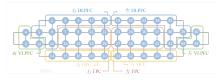
图1
fNIRS通道分布"

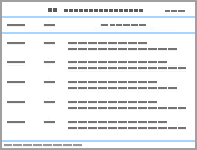
表1
不同认知负荷时C90面积的描述性统计结果(n = 27)"
| 变量 | 无认知单任务 | 简单认知双任务 | 困难认知双任务 |
|---|---|---|---|
| C90面积 | 0.034±0.011 | 0.024±0.007 | 0.028±0.101 |
表2
不同认知负荷时C90面积的重复测量方差分析结果"
| 变量 | 平方和 | 自由度 | 均方 | F值 | P值 |
|---|---|---|---|---|---|
| C90面积 | 0.001 | 2 | 0.001 | 14.784 | < 0.001 |
表3
不同认知负荷条件下C90面积的事后两两比较检验结果"
| 认知负荷 | 认知负荷 | 平均值差 | P值 | 95%CI | |
|---|---|---|---|---|---|
| 下限 | 上限 | ||||
| 无认知单任务 | 简单认知双任务 | 0.010 | 0.001 | 0.006 | 0.015 |
| 简单认知双任务 | 困难认知双任务 | -0.004 | 0.129 | -0.009 | 0.001 |
| 无认知单任务 | 困难认知双任务 | 0.006 | 0.021 | 0.001 | 0.012 |
表4
不同认知负荷任务时不同频段肌肉能量占比的描述性统计结果(n = 27)"
| 频段 | 肌肉 | 无认知单任务 | 简单认知双任务 | 困难认知双任务 |
|---|---|---|---|---|
| β | 腓肠肌内侧 | 0.08±0.03 | 0.10±0.04 | 0.09±0.29 |
| β | 腓肠肌外侧 | 0.06±0.02 | 0.08±0.03 | 0.07±0.02 |
| β | 胫骨前肌 | 0.08±0.03 | 0.10±0.28 | 0.09±0.04 |
| piper | 腓肠肌内侧 | 0.12±0.30 | 0.12±0.25 | 0.11±0.24 |
| piper | 腓肠肌外侧 | 0.11±0.03 | 0.09±0.02 | 0.09±0.03 |
| piper | 胫骨前肌 | 0.12±0.02 | 0.10±0.03 | 0.11±0.02 |
表5
不同认知负荷时不同频段肌肉能量占比的重复测量方差分析结果"
| 频段 | 肌肉 | 平方和 | 自由度 | 均方 | F值 | P值 |
|---|---|---|---|---|---|---|
| β | 腓肠肌内侧 | 0.007 | 1.505 | 0.005 | 3.879 | 0.040 |
| β | 腓肠肌外侧 | 0.005 | 1.539 | 0.003 | 4.431 | 0.026 |
| β | 胫骨前肌 | 0.002 | 1.462 | 0.001 | 2.308 | 0.126 |
| piper | 腓肠肌内侧 | 0.000 | 1.385 | 0.000 | 0.635 | 0.480 |
| piper | 腓肠肌外侧 | 0.006 | 1.198 | 0.005 | 5.257 | 0.023 |
| piper | 胫骨前肌 | 0.006 | 2.000 | 0.003 | 5.579 | 0.006 |
表6
不同认知负荷时不同频段肌肉能量占比的两两比较检验结果"
| 频段/肌肉 | 认知负荷 | 认知负荷 | 平均值差 | P值 | 95%CI | |
|---|---|---|---|---|---|---|
| 下限 | 上限 | |||||
| β/腓肠肌内侧 | 无认知单任务 | 简单认知双任务 | -0.230 | 0.046 | -0.047 | < 0.001 |
| 简单认知双任务 | 困难认知双任务 | 0.013 | 0.664 | -0.013 | 0.038 | |
| 无认知单任务 | 困难认知双任务 | -0.011 | 0.189 | -0.025 | 0.003 | |
| β/腓肠肌外侧 | 无认知单任务 | 简单认知双任务 | -0.019 | 0.037 | -0.037 | -0.001 |
| 简单认知双任务 | 困难认知双任务 | 0.011 | 0.451 | -0.008 | 0.029 | |
| 无认知单任务 | 困难认知双任务 | -0.008 | 0.220 | -0.019 | 0.003 | |
| β/胫骨前肌 | 无认知单任务 | 简单认知双任务 | -0.013 | 0.201 | -0.029 | 0.004 |
| 简单认知双任务 | 困难认知双任务 | 0.005 | 1.000 | -0.013 | 0.022 | |
| 无认知单任务 | 困难认知双任务 | -0.008 | 0.148 | -0.017 | 0.002 | |
| piper/腓肠肌内侧 | 无认知单任务 | 简单认知双任务 | -0.004 | 1.000 | -0.019 | 0.010 |
| 简单认知双任务 | 困难认知双任务 | 0.005 | 0.306 | -0.002 | 0.012 | |
| 无认知单任务 | 困难认知双任务 | < 0.001 | 1.000 | -0.013 | 0.013 | |
| piper/腓肠肌外侧 | 无认知单任务 | 简单认知双任务 | 0.019 | 0.047 | 0.000 | 0.037 |
| 简单认知双任务 | 困难认知双任务 | -0.001 | 1.000 | -0.009 | 0.006 | |
| 无认知单任务 | 困难认知双任务 | 0.017 | 0.119 | -0.003 | 0.037 | |
| piper/胫骨前肌 | 无认知单任务 | 简单认知双任务 | 0.020 | 0.016 | 0.003 | 0.038 |
| 简单认知双任务 | 困难认知双任务 | -0.012 | 0.171 | -0.028 | 0.003 | |
| 无认知单任务 | 困难认知双任务 | 0.008 | 0.456 | -0.006 | 0.022 | |
表7
不同认知负荷双任务时ROI的HbO2浓度的描述性统计结果(n = 27)"
| ROI | 无认知单任务 | 简单认知双任务 | 困难认知双任务 |
|---|---|---|---|
| 右DLPFC | -9.84±25.76 | -8.21±43.61 | 13.11±38.53 |
| 右VLPFC | -10.10±28.50 | 3.87±33.28 | 12.87±35.80 |
| 右FPC | -8.97±34.70 | -9.68±40.29 | 5.69±38.55 |
| 右OFC | -3.74±27.00 | -5.65±42.51 | 2.13±44.02 |
| 左DLPFC | -6.21±29.66 | -5.37±34.39 | 6.43±34.17 |
| 左VLPFC | -11.98±39.07 | 5.87±39.04 | 14.43±36.70 |
| 左FPC | -2.47±36.79 | -7.23±39.60 | 1.17±36.77 |
| 左OFC | -3.58±29.50 | -6.40±39.06 | -16.58±44.00 |
表8
不同认知负荷双任务时ROI的HbO2浓度的重复测量方差分析结果"
| ROI | 平方和 | 自由度 | 均方 | F值 | P值 |
|---|---|---|---|---|---|
| 右DLPFC | 8857.968 | 2 | 4428.984 | 3.202 | 0.049 |
| 右VLPFC | 7231.215 | 2 | 3615.607 | 3.671 | 0.032 |
| 右FPC | 4064.680 | 2 | 2032.340 | 2.079 | 0.135 |
| 右OFC | 886.736 | 2 | 443.368 | 0.433 | 0.651 |
| 左DLPFC | 2699.590 | 2 | 1349.795 | 1.547 | 0.223 |
| 左VLPFC | 9799.618 | 2 | 4899.809 | 3.263 | 0.046 |
| 左FPC | 957.806 | 2 | 478.903 | 0.522 | 0.596 |
| 左OFC | 2522.958 | 2 | 1261.479 | 1.196 | 0.311 |
表9
不同认知负荷双任务时ROI的HbO2浓度的事后两两比较"
| ROI | 认知负荷 | 认知负荷 | 平均值差 | P值 | 95%CI | |
|---|---|---|---|---|---|---|
| 下限 | 上限 | |||||
| 右DLPFC | 无认知单任务 | 简单认知双任务 | -1.634 | 1.000 | -26.239 | 22.970 |
| 简单认知双任务 | 困难认知双任务 | -21.321 | 0.263 | -52.060 | 9.418 | |
| 无认知单任务 | 困难认知双任务 | -22.956 | 0.034 | -44.460 | -1.451 | |
| 右VLPFC | 无认知单任务 | 简单认知双任务 | -13.968 | 0.301 | -34.945 | 7.009 |
| 简单认知双任务 | 困难认知双任务 | -8.997 | 0.948 | -31.524 | 13.529 | |
| 无认知单任务 | 困难认知双任务 | -22.965 | 0.039 | -45.007 | -0.924 | |
| 右FPC | 无认知单任务 | 简单认知双任务 | 0.719 | 1.000 | -23.630 | 25.068 |
| 简单认知双任务 | 困难认知双任务 | -15.374 | 0.102 | -32.951 | 2.204 | |
| 无认知单任务 | 困难认知双任务 | -14.655 | 0.337 | -37.473 | 8.163 | |
| 右OFC | 无认知单任务 | 简单认知双任务 | 1.913 | 1.000 | -22.729 | 26.555 |
| 简单认知双任务 | 困难认知双任务 | -7.777 | 0.732 | -24.472 | 8.917 | |
| 无认知单任务 | 困难认知双任务 | -5.864 | 1.000 | -30.474 | 18.746 | |
| 左DLPFC | 无认知单任务 | 简单认知双任务 | -0.839 | 1.000 | -23.967 | 22.290 |
| 简单认知双任务 | 困难认知双任务 | -11.806 | 0.412 | -31.514 | 7.903 | |
| 无认知单任务 | 困难认知双任务 | -12.644 | 0.282 | -31.260 | 5.972 | |
| 左VLPFC | 无认知单任务 | 简单认知双任务 | -17.844 | 0.434 | -48.211 | 12.523 |
| 简单认知双任务 | 困难认知双任务 | -8.560 | 1.000 | -36.002 | 18.883 | |
| 无认知单任务 | 困难认知双任务 | 26.404 | 0.018 | -48.990 | -3.818 | |
| 左FPC | 无认知单任务 | 简单认知双任务 | 4.764 | 1.000 | -18.744 | 28.272 |
| 简单认知双任务 | 困难认知双任务 | -8.398 | 0.817 | -27.554 | 10.759 | |
| 无认知单任务 | 困难认知双任务 | -3.634 | 1.000 | -24.012 | 16.745 | |
| 左OFC | 无认知单任务 | 简单认知双任务 | 2.814 | 1.000 | -20.594 | 26.222 |
| 简单认知双任务 | 困难认知双任务 | 10.179 | 0.509 | -8.266 | 28.623 | |
| 无认知单任务 | 困难认知双任务 | 12.993 | 0.608 | -12.441 | 38.426 | |
| [1] |
MONOLI C, MORRIS A J, CROFTS R, et al. Acute and longitudinal effects of concussion on reactive balance in collegiate athletes[J]. Neurorehabil Neural Repair, 2025, 39(4): 263-273.
doi: 10.1177/15459683241309569 |
| [2] |
KRISTEVA R, PATINO L, OMLOR W. Beta-range cortical motor spectral power and corticomuscular coherence as a mechanism for effective corticospinal interaction during steady-state motor output[J]. Neuroimage, 2007, 36(3): 785-792.
doi: 10.1016/j.neuroimage.2007.03.025 pmid: 17493837 |
| [3] |
SUGIHARA Y, MATSUURA T, KUBO Y, et al. Activation of the prefrontal cortex and improvement of cognitive performance with standing on one leg[J]. Neuroscience, 2021, 477: 50-62.
doi: 10.1016/j.neuroscience.2021.10.004 pmid: 34634425 |
| [4] |
WEISSINGER K, BACH M M, BRACHMAN A, et al. Perceived cognitive fatigue has only marginal effects on static balance control in healthy young adults[J]. Exp Brain Res, 2024, 242(1): 163-177.
doi: 10.1007/s00221-023-06736-0 pmid: 37987808 |
| [5] |
PELLECCHIA G L. Postural sway increases with attentional demands of concurrent cognitive task[J]. Gait Posture, 2003, 18(1): 29-34.
pmid: 12855298 |
| [6] |
GHAI S, GHAI I, EFFENBERG A O. Effects of dual tasks and dual-task training on postural stability: a systematic review and meta-analysis[J]. Clin Interv Aging, 2017, 12: 557-577.
doi: 10.2147/CIA.S125201 pmid: 28356727 |
| [7] | POTVIN-DESROCHERS A, RICHER N, LAJOIE Y. Cognitive tasks promote automatization of postural control in young and older adults[J]. Gait Posture, 2017, 57: 40-45. |
| [8] | 张雪, 蔡燕, 王聪, 等. 认知-运动双任务训练在预防老年人跌倒中的研究进展[J]. 中华护理杂志, 2025, 60(3): 297-302. |
| ZHANG X, CAI Y, WANG C, et al. Research progress on cognitive-motor dual-task training for preventing falls in older adults[J]. Chin J Nurs, 2025, 60(3): 297-302. | |
| [9] | 刘鑫玥, 刘卉, 刘鹏波, 等. 不同类型和负荷双任务对社区脑卒中患者行走稳定性的影响[J]. 医用生物力学, 2024, 39(S1): 135. |
| [10] | 张晨晨, 陈秀恩, 郑洁皎, 等. 基于功能性近红外光谱技术的不同吞咽任务态前额叶皮质功能研究[J]. 中国康复医学杂志, 2023, 38(10): 1372-1378. |
| ZHANG C C, CHEN X E, ZHENG J J, et al. The study of prefrontal cortex function in different swallowing task based on functional near-infrared spectroscopy[J]. Chin J Rehabil Med, 2023, 38(10): 1372-1378. | |
| [11] |
IZZETOGLU M, HOLTZER R. Effects of processing methods on fnirs signals assessed during active walking tasks in older adults[J]. IEEE Trans Neural Syst Rehabil Eng, 2020, 28(3): 699-709.
doi: 10.1109/TNSRE.7333 |
| [12] | 王惠, 卢茜, 陈陆蕊, 等. 功能性近红外光谱技术在成年人单-双任务范式平衡测试前额皮层脑功能活动测量中的应用[J]. 中国康复医学杂志, 2024, 39(10): 1443-1448. |
| WANG H, LU Q, CHEN L R, et al. The application of functional near-infrared spectroscopy in measuring the activity of prefrontal cortex in healthy individuals during balance task under single or dual task paradigm[J]. Chin J Rehabil Med, 2024, 39(10): 1443-1448. | |
| [13] |
FRASER S A, DUPUY O, POULIOT P, et al. Comparable cerebral oxygenation patterns in younger and older adults during dual-task walking with increasing load[J]. Front Aging Neurosci, 2016, 8: 240.
pmid: 27812334 |
| [14] |
KVIST A, BEZUIDENHOUT L, JOHANSSON H, et al. Validation of fNIRS measurement of executive demand during walking with and without dual-task in younger and older adults and people with Parkinson's disease[J]. Neuroimage Clin, 2024, 43: 103637.
doi: 10.1016/j.nicl.2024.103637 |
| [15] | SARAIVA M, CASTRO M A, VILAS-BOAS J P. Muscular and prefrontal cortex activity during dual-task performing in young adults[J]. Eur J Investig Health Psychol Educ, 2023, 13(4): 736-747. |
| [16] |
TEO W P, RANTALAINEN T, NUZUM N, et al. Altered prefrontal cortex responses in older adults with subjective memory complaints and dementia during dual-task gait: an fNIRS study[J]. Eur J Neurosci, 2021, 53(4): 1324-1333.
doi: 10.1111/ejn.v53.4 |
| [17] |
PAPEGAAIJ S, HORTOBÁGYI T, GODDE B, et al. Neural correlates of motor-cognitive dual-tasking in young and old adults[J]. PLoS One, 2017, 12(12): e0189025.
doi: 10.1371/journal.pone.0189025 |
| [18] | 刘鑫玥, 霍洪峰. 双重任务介入对人体静态平衡和动态稳定性的影响[J]. 中国康复医学杂志, 2024, 39(4): 581-584. |
| [19] | 白啸天, 霍洪峰. 基于线性和非线性分析的人体站立稳定调控策略[J]. 医用生物力学, 2023, 38(5): 1003-1009. |
| BAI X T, HUO H F. Stabilization regulation strategy during standing based on linear and nonlinear analysis[J]. J Med Biomech, 2023, 38(5): 1003-1009. | |
| [20] |
BROWN P. Cortical drives to human muscle: the Piper and related rhythms[J]. Prog Neurobiol, 2000, 60(1): 97-108.
pmid: 10622378 |
| [21] | 倪新迪, 杨蕾, 刘晔. 动态疲劳中的神经肌肉控制策略:基于同步压缩小波变换和排列熵的肌电分析[C]. 天津: 第十三届全国体育科学大会论文摘要集——专题报告(运动生理与生物化学分会), 2023: 3. |
| [22] |
HALLIDAY D M, CONWAY B A, FARMER S F, et al. Using electroencephalography to study functional coupling between cortical activity and electromyograms during voluntary contractions in humans[J]. Neurosci Lett, 1998, 241(1): 5-8.
doi: 10.1016/s0304-3940(97)00964-6 pmid: 9502202 |
| [23] |
FISHER K M, ZAIMI B, WILLIAMS T L, et al. Beta-band intermuscular coherence: a novel biomarker of upper motor neuron dysfunction in motor neuron disease[J]. Brain, 2012, 135(Pt 9): 2849-2864.
doi: 10.1093/brain/aws150 pmid: 22734124 |
| [24] | YANG J, YAN S, CAO C. Different dual-task paradigm reduce postural control ability and dynamic stability of healthy young adults during stair descent[J]. Appl Bionics Biomech, 2024, 2024: 9942042. |
| [25] |
MONGOLD S J, PIITULAINEN H, LEGRAND T, et al. Temporally stable beta sensorimotor oscillations and corticomuscular coupling underlie force steadiness[J]. Neuroimage, 2022, 261: 119491.
doi: 10.1016/j.neuroimage.2022.119491 |
| [26] |
FUJITA N, KUNIMUNE S, OKADA S. Contribution of the dorsolateral prefrontal cortex activation, ankle muscle activities, and coactivation during dual-tasks to postural steadiness: a pilot study[J]. J Phys Ther Sci, 2020, 32(7): 467-472.
doi: 10.1589/jpts.32.467 pmid: 32753789 |
| [27] |
BROWN P, SALENIUS S, ROTHWELL J C, et al. Cortical correlate of the Piper rhythm in humans[J]. J Neurophysiol, 1998, 80(6): 2911-2917.
doi: 10.1152/jn.1998.80.6.2911 pmid: 9862895 |
| [28] | 郑慧芬, 孙威, 宋祺鹏, 等. 手机任务介入对下楼梯行走动态稳定性的影响[J]. 中国运动医学杂志, 2021, 40(7): 528-535. |
| ZHENG H F, SUN W, SONG Q P, et al. Effects of mobile phone task on dynamic stability during stair descent[J]. Chin J Sports Med, 2021, 40(7): 528-535. | |
| [29] | SHUMWAY-COOK A, WOOLLACOTT M, KERNS K A, et al. The effects of two types of cognitive tasks on postural stability in older adults with and without a history of falls[J]. J Gerontol A Biol Sci Med Sci, 1997, 52(4): M232-M240. |
| [30] |
TING L H, MCKAY J L. Neuromechanics of muscle synergies for posture and movement[J]. Curr Opin Neurobiol, 2007, 17(6): 622-628.
doi: 10.1016/j.conb.2008.01.002 pmid: 18304801 |
| [31] |
TAKAKUSAKI K. Functional neuroanatomy for posture and gait control[J]. J Mov Disord, 2017, 10(1): 1-17.
doi: 10.14802/jmd.16062 pmid: 28122432 |
| [32] |
HOLTZER R, MAHONEY J R, IZZETOGLU M, et al. Online fronto-cortical control of simple and attention-demanding locomotion in humans[J]. Neuroimage, 2015, 112: 152-159.
doi: S1053-8119(15)00174-3 pmid: 25765257 |
| [33] |
XU G, ZHOU M, CHEN Y, et al. Brain activation during standing balance control in dual-task paradigm and its correlation among older adults with mild cognitive impairment: a fNIRS study[J]. BMC Geriatr, 2024, 24(1): 144.
doi: 10.1186/s12877-024-04772-1 pmid: 38341561 |
| [34] | FUJITA H, KASUBUCHI K, WAKATA S, et al. Role of the frontal cortex in standing postural sway tasks while dual-tasking: a functional near-infrared spectroscopy study examining working memory capacity[J]. Biomed Res Int, 2016, 2016: 7053867. |
| [35] | TEO W P, GOODWILL A M, HENDY A M, et al. Sensory manipulation results in increased dorsolateral prefrontal cortex activation during static postural balance in sedentary older adults: an fNIRS study[J]. Brain Behav, 2018, 8(10): e1109. |
| [36] |
BARBÉ A K, KOENIGS M, GRAFMAN J. Dorsolateral prefrontal contributions to human working memory[J]. Cortex, 2013, 49(5): 1195-1205.
doi: 10.1016/j.cortex.2012.05.022 pmid: 22789779 |
| [37] | STOJAN R, MACK M, BOCK O, et al. Inefficient frontal and parietal brain activation during dual-task walking in a virtual environment in older adults[J]. Neuroimage, 2023, 2023: 273120070. |
| [38] | 王静, 陈亮, 马驰程, 等. 双重任务对身体姿势调节的影响[J]. 中国体育科技, 2024, 60(5): 58-67. |
| WANG J, CHEN L, MA C C, et al. Effects of dual-task on postural adjustments[J]. Chin Sport Sci Technol, 2024, 60(5): 58-67. | |
| [39] |
SZAMEITAT A J, VANLOO A, MÜLLER H J. Central as well as peripheral attentional bottlenecks in dual-task performance activate lateral prefrontal cortices[J]. Front Hum Neurosci, 2016, 10: 119.
doi: 10.3389/fnhum.2016.00119 pmid: 27014044 |
| [40] |
SAYLIK R, WILLIAMS A L, MURPHY R A, et al. Characterising the unity and diversity of executive functions in a within-subject fMRI study[J]. Sci Rep, 2022, 12(1): 8182.
doi: 10.1038/s41598-022-11433-z pmid: 35581269 |
| [41] |
MCKENDRICK R, AYAZ H, OLSTMESTEAD R, et al. Enhancing dual-task performance with verbal and spatial working memory training: continuous monitoring of cerebral hemodynamics with NIRS[J]. Neuroimage, 2014, 85(Pt 3): 1014-1026.
doi: 10.1016/j.neuroimage.2013.05.103 |
| [42] |
AINSWEORTH M, WU Z, BROWNCROSS H, et al. Frontopolar cortex shapes brain network structure across prefrontal and posterior cingulate cortex[J]. Prog Neurobiol, 2022, 217: 102314.
doi: 10.1016/j.pneurobio.2022.102314 |
| [43] |
MARCIANO D, STAVELAND B R, LIN J J, et al. Electrophysiological signatures of inequity-dependent reward encoding in the human OFC[J]. Cell Rep, 2023, 42(8): 112865.
doi: 10.1016/j.celrep.2023.112865 |
| [1] | 骆丹丹, 沈敏, 王素娟, 邱翁歆, 张宇轩, 吴蕴, 王圣虓. 汉语发展性阅读障碍儿童全脑静息态功能连接的特征分析[J]. 《中国康复理论与实践》, 2025, 31(9): 1023-1031. |
| [2] | 高云汉, 侯闪闪, 汪鑫煜, 朱崇田. 基于功能性近红外光谱探讨脑机接口对脑卒中患者上肢运动功能障碍的效果[J]. 《中国康复理论与实践》, 2025, 31(9): 1066-1073. |
| [3] | 段林茹, 郑洁皎, 郑拥军, 丁建伟. 老年人与青年人姿势控制能力的差异[J]. 《中国康复理论与实践》, 2025, 31(7): 846-852. |
| [4] | 邹聪聪, 王潇珺, 马锦蓉, 鲁商波, 丁勇, 王哈妮, 宋建飞. 耳迷走神经电刺激联合双任务训练对缺血性脑卒中患者上肢功能的效果[J]. 《中国康复理论与实践》, 2025, 31(5): 513-519. |
| [5] | 许琦, 郑丁炤, 牛镇远, 杨雅玲, 温卫友, 许璟胜, 吴龙强, 吴帆, 燕铁斌. 不同时序经颅直流电刺激联合坐位太极拳云手对脑卒中偏瘫患者脑皮质激活影响的功能性近红外光谱研究[J]. 《中国康复理论与实践》, 2025, 31(10): 1121-1127. |
| [6] | 王俊伟, 许琦, 王欣欣, 何毅琪, 吴心虹, 张芸. 不同时序经颅直流电刺激结合坐位太极拳云手对健康青年人脑皮质激活的功能性近红外光谱研究[J]. 《中国康复理论与实践》, 2025, 31(10): 1128-1133. |
| [7] | 王滢雅, 李泰标, 苏啊红, 林友益, 周鲜红, 田鹿, 谢洪武. 经颅直流电刺激与功能性电刺激单独或同步干预对健康青年握力及脑激活的效应比较:基于功能性近红外光谱的研究[J]. 《中国康复理论与实践》, 2025, 31(10): 1134-1142. |
| [8] | 徐胜, 张敏, 杨青青, 王庆雷, 耿阿燕, 王彤, 郭川. 功能性电刺激手摇车对脑卒中患者脑网络功能连接的功能性近红外光谱研究[J]. 《中国康复理论与实践》, 2025, 31(10): 1181-1187. |
| [9] | 谢丹丹, 陈善佳, 雷蕾, 余果, 余佳慧, 赵嘉培, 何晓阔. 健康人和脑卒中患者视觉反馈步行训练后脑激活特征的功能性近红外光谱技术研究[J]. 《中国康复理论与实践》, 2024, 30(9): 1074-1081. |
| [10] | 李冬, 张皓, 刘楠, 王昕悦, 徐淼. 认知-运动双任务训练对脑卒中恢复期患者平衡功能和步态效果的随机对照试验[J]. 《中国康复理论与实践》, 2024, 30(9): 1082-1091. |
| [11] | 赵建斌, 姚英策, 吴菁, 薛博士, 杨晓巍, 周志鹏, 郑亮亮. 肌肉能量技术对非特异性腰痛患者动态姿势控制和腰神经肌肉功能效果的随机对照试验[J]. 《中国康复理论与实践》, 2024, 30(9): 1092-1098. |
| [12] | 董平, 阚超杰, 郭川, 庄任, 王庆雷, 钱雪. 不同感觉策略下老年人平衡控制的皮质激活特征[J]. 《中国康复理论与实践》, 2024, 30(7): 848-853. |
| [13] | 刘佳琪, 侯闪闪, 汪鑫煜, 朱崇田, 王孝文. 不同吞咽时期大脑皮质激活特征:基于功能性近红外光谱技术[J]. 《中国康复理论与实践》, 2024, 30(6): 709-718. |
| [14] | 陈园月, 李加斌, 蒯凤, 彭丽丽, 项洁. 多通道功能性电刺激结合任务导向训练对脑卒中上肢偏瘫患者脑功能网络的即刻影响[J]. 《中国康复理论与实践》, 2024, 30(4): 462-467. |
| [15] | 蒋金金, 张玉婷, 王璐怡, 汪杰. 脑梗死恢复早期患者肘关节屈伸任务下皮质激活特征的功能性近红外光谱研究[J]. 《中国康复理论与实践》, 2024, 30(12): 1436-1441. |
| 阅读次数 | ||||||
|
全文 |
|
|||||
|
摘要 |
|
|||||
|
||
