



《中国康复理论与实践》 ›› 2024, Vol. 30 ›› Issue (11): 1291-1298.doi: 10.3969/j.issn.1006-9771.2024.11.007
魏凤芹, 陆敏( ), 陈勇, 杨琼, 肖露, 刘茂竹
收稿日期:2024-05-06
修回日期:2024-10-28
出版日期:2024-11-25
发布日期:2024-12-05
通讯作者:
陆敏(1970-),女,汉族,湖北武汉市人,博士,教授,博士研究生导师,主要研究方向:言语、认知及吞咽障碍的康复及高压氧的临床应用。E-mail: 作者简介:魏凤芹(1986-),女,土家族,湖北武汉市人,康复治疗师,主要研究方向:言语及吞咽障碍的康复。
WEI Fengqin, LU Min(), CHEN Yong, YANG Qiong, XIAO Lu, LIU Maozhu
Received:2024-05-06
Revised:2024-10-28
Published:2024-11-25
Online:2024-12-05
Contact:
LU Min, E-mail: 摘要:
目的 分析国际言语失用症领域研究的热点和发展趋势。
方法 检索2004年1月至2023年12月Web of Science核心合集数据库中言语失用症相关文献,采用CiteSpace 6.2 R进行分析。
结果 共纳入893篇文献,发文量呈波动上升趋势。美国和澳大利亚在言语失用症领域具有较高的影响力。梅奥诊所和悉尼大学具有高中心性,Joseph R Duffy的发文量位居前列,近5年的热点主题主要集中在帕金森病、言语失用症的分类与治疗强度方面。
结论 言语失用症的研究热度呈上升趋势,虽然在神经影像学、临床声学评估与发音-运动学干预等方面取得了显著成果,但未来仍需进一步探索言语失用症的病理机制和治疗方法。
中图分类号:
魏凤芹, 陆敏, 陈勇, 杨琼, 肖露, 刘茂竹. 2004年至2023年国际言语失用症领域研究进展的文献计量分析[J]. 《中国康复理论与实践》, 2024, 30(11): 1291-1298.
WEI Fengqin, LU Min, CHEN Yong, YANG Qiong, XIAO Lu, LIU Maozhu. Advanced in apraxia of speech from 2004 to 2023: a bibliometrics analysis[J]. Chinese Journal of Rehabilitation Theory and Practice, 2024, 30(11): 1291-1298.

图1
年发文量"
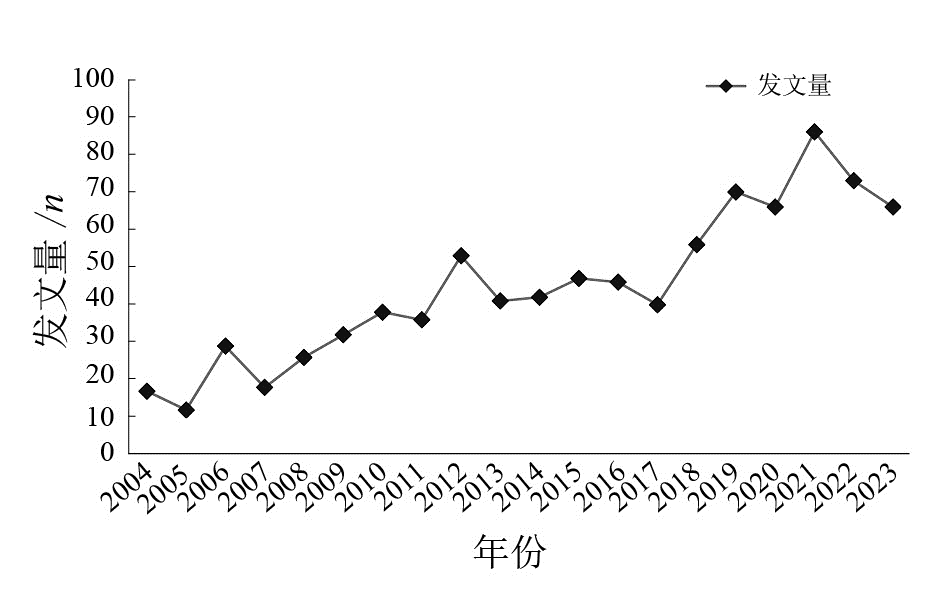

图2
国家合作网络图谱"


图3
机构合作网络图谱"

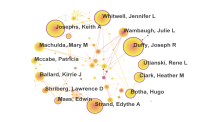
图4
作者合作网络图谱"

表1
共被引频率前10的文献"
| 序号 | 文献 | 共被引数 | 年份 |
|---|---|---|---|
| 1 | Utianski R L等[ | 62 | 2018 |
| 2 | Josephs K A等[ | 39 | 2012 |
| 3 | Shriberg L D等[ | 34 | 2017 |
| 4 | Ballard K J等[ | 33 | 2015 |
| 5 | Josephs K A等[ | 32 | 2013 |
| 6 | Murray E等[ | 32 | 2015 |
| 7 | Strand E A等[ | 31 | 2014 |
| 8 | Ballard K J等[ | 30 | 2016 |
| 9 | Utianski R L等[ | 29 | 2018 |
| 10 | Gorno-Tempini M L等[ | 29 | 2011 |
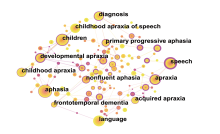
图5
关键词共现图谱"


图6
关键词聚类图谱"


图7
突现关键词"

| [1] |
OGAR J, SLAMA H, DRONKERS N, et al. Apraxia of speech: an overview[J]. Neurocase, 2005, 11(6): 427-432.
doi: 10.1080/13554790500263529 pmid: 16393756 |
| [2] |
SHRIBERG L D, KWIATKOWSKI J, MABIE H L. Estimates of the prevalence of motor speech disorders in children with idiopathic speech delay[J]. Clin Linguist Phon, 2019, 33(8): 679-706.
doi: 10.1080/02699206.2019.1595731 pmid: 30987467 |
| [3] | SYNNESTVEDT M B, CHEN C, HOLMES J H. CiteSpace II: visualization and knowledge discovery in bibliographic databases[J]. AMIA Annu Symp Proc, 2005, 2005: 724-728. |
| [4] | DUFFY J. Apraxia of speech in degenerative neurologic disease[J]. Aphasiology, 2006, 20(6): 511-527. |
| [5] | JOSEPHS K A, DUFFY J R, CLARK H M, et al. A molecular pathology, neurobiology, biochemical, genetic and neuroimaging study of progressive apraxia of speech[J]. Nat Commun, 2021, 12(1): 3452. |
| [6] |
TETZLOFF K A, DUFFY J R, STRAND E A, et al. Clinical and imaging progression over 10 years in a patient with primary progressive apraxia of speech and autopsy-confirmed corticobasal degeneration[J]. Neurocase, 2018, 24(2): 111-120.
doi: 10.1080/13554794.2018.1477963 pmid: 29799310 |
| [7] | VALLS CARBO A, REID R I, TOSAKULWONG N, et al. Tractography of supplementary motor area projections in progressive speech apraxia and aphasia[J]. Neuroimage Clin, 2022, 34: 102999. |
| [8] |
UTIANSKI R L, WHITWELL J L, SCHWARZ C G, et al. Tau-PET imaging with [18F]AV-1451 in primary progressive apraxia of speech[J]. Cortex, 2018, 99: 358-374.
doi: S0010-9452(17)30429-X pmid: 29353121 |
| [9] |
STRAND E A, DUFFY J R, CLARK H M, et al. The Apraxia of Speech Rating Scale: a tool for diagnosis and description of apraxia of speech[J]. J Commun Disord, 2014, 51: 43-50.
doi: 10.1016/j.jcomdis.2014.06.008 pmid: 25092638 |
| [10] | DUFFY J R, MARTIN P R, CLARK H M, et al. The Apraxia of Speech Rating Scale: reliability, validity, and utility[J]. Am J Speech Lang Pathol, 2023, 32(2): 469-491. |
| [11] | CLARK H M, UTIANSKI R L, DUFFY J R, et al. Western Aphasia Battery: revised profiles in primary progressive aphasia and primary progressive apraxia of speech[J]. Am J Speech Lang Pathol, 2020, 29(1s): 498-510. |
| [12] |
BOTHA H, DUFFY J R, WHITWELL J L, et al. Classification and clinicoradiologic features of primary progressive aphasia (PPA) and apraxia of speech[J]. Cortex, 2015, 69: 220-236.
doi: 10.1016/j.cortex.2015.05.013 pmid: 26103600 |
| [13] |
DUFFY J R, STRAND E A, CLARK H, et al. Primary progressive apraxia of speech: clinical features and acoustic and neurologic correlates[J]. Am J Speech Lang Pathol, 2015, 24(2): 88-100.
doi: 10.1044/2015_AJSLP-14-0174 pmid: 25654422 |
| [14] |
UTIANSKI R L, DUFFY J R, CLARK H M, et al. Prosodic and phonetic subtypes of primary progressive apraxia of speech[J]. Brain Lang, 2018, 184: 54-65.
doi: S0093-934X(17)30263-8 pmid: 29980072 |
| [15] |
WHITWELL J L, MARTIN P, DUFFY J R, et al. Survival analysis in primary progressive apraxia of speech and agrammatic aphasia[J]. Neurol Clin Pract, 2021, 11(3): 249-255.
doi: 10.1212/CPJ.0000000000000919 pmid: 34484892 |
| [16] |
WHITWELL J L, WEIGAND S D, DUFFY J R, et al. Predicting clinical decline in progressive agrammatic aphasia and apraxia of speech[J]. Neurology, 2017, 89(22): 2271-2279.
doi: 10.1212/WNL.0000000000004685 pmid: 29093069 |
| [17] |
BALLARD K J, AZIZI L, DUFFY J R, et al. A predictive model for diagnosing stroke-related apraxia of speech[J]. Neuropsychologia, 2016, 81: 129-139.
doi: S0028-3932(15)30252-9 pmid: 26707715 |
| [18] |
JOSEPHS K A, DUFFY J R, STRAND E A, et al. Characterizing a neurodegenerative syndrome: primary progressive apraxia of speech[J]. Brain, 2012, 135: 1522-1536.
doi: 10.1093/brain/aws032 pmid: 22382356 |
| [19] | SHRIBERG L D, STRAND E A, FOURAKIS M, et al. A diagnostic marker to discriminate childhood apraxia of speech from speech delay: I. development and description of the pause marker[J]. J Speech Lang Hear Res, 2017, 60(4): 1096-1117. |
| [20] |
BALLARD K J, WAMBAUGH J L, DUFFY J R, et al. Treatment for acquired apraxia of speech: a systematic review of intervention research between 2004 and 2012[J]. Am J Speech Lang Pathol, 2015, 24(2): 316-337.
doi: 10.1044/2015_AJSLP-14-0118 pmid: 25815778 |
| [21] |
JOSEPHS K A, DUFFY J R, STRAND E A, et al. Syndromes dominated by apraxia of speech show distinct characteristics from agrammatic PPA[J]. Neurology, 2013, 81(4): 337-345.
doi: 10.1212/WNL.0b013e31829c5ed5 pmid: 23803320 |
| [22] | MURRAY E, MCCABE P, HEARD R, et al. Differential diagnosis of children with suspected childhood apraxia of speech[J]. J Speech Lang Hear Res, 2015, 58(1): 43-60. |
| [23] |
UTIANSKI R L, DUFFY J R, CLARK H M, et al. Clinical progression in four cases of primary progressive apraxia of speech[J]. Am J Speech Lang Pathol, 2018, 27(4): 1303-1318.
doi: 10.1044/2018_AJSLP-17-0227 pmid: 30458509 |
| [24] | GORNO-TEMPINI M L, HILLIS A E, WEINTRAUB S, et al. Classification of primary progressive aphasia and its variants[J]. Neurology, 2011, 76(11): 1006-1014. |
| [25] |
TURNER S J, HILDEBRAND M S, BLOCK S, et al. Small intragenic deletion in FOXP2 associated with childhood apraxia of speech and dysarthria[J]. Am J Med Genet A, 2013, 161a(9): 2321-2326.
doi: 10.1002/ajmg.a.36055 pmid: 23918746 |
| [26] | EISING E, CARRION-CASTILLO A, VINO A, et al. A set of regulatory genes co-expressed in embryonic human brain is implicated in disrupted speech development[J]. Mol Psychiatry, 2019, 24(7): 1065-1078. |
| [27] |
TETZLOFF K A, DUFFY J R, CLARK H M, et al. Longitudinal structural and molecular neuroimaging in agrammatic primary progressive aphasia[J]. Brain, 2018, 141(1): 302-317.
doi: 10.1093/brain/awx293 pmid: 29228180 |
| [28] | STAIGER A, ZIEGLER W. Syllable frequency and syllable structure in the spontaneous speech production of patients with apraxia of speech[J]. Aphasiology, 2008, 22(11): 1201-1215. |
| [29] | BARTLE-MEYER C J, GOOZÉE J V, MURDOCH B E, et al. Kinematic analysis of articulatory coupling in acquired apraxia of speech post-stroke[J]. Brain Inj, 2009, 23(2): 133-145. |
| [30] |
BARTLE C J, GOOZÉE J V, MURDOCH B E. An EMA analysis of the effect of increasing word length on consonant production in apraxia of speech: a case study[J]. Clin Linguist Phon, 2007, 21(3): 189-210.
pmid: 17364625 |
| [31] |
BISLICK L, HULA W D. Perceptual characteristics of consonant production in apraxia of speech and aphasia[J]. Am J Speech Lang Pathol, 2019, 28(4): 1411-1431.
doi: 10.1044/2019_AJSLP-18-0169 pmid: 31454259 |
| [32] | GARCíA A M. Patterns of hemispheric compromise in primary progressive apraxia of speech: from clinical profiling to differential diagnosis[J]. Eur J Neurol, 2023, 30(6): 1555-1556. |
| [33] | BLUMSTEIN S E, KUROWSKI K. The foreign accent syndrome: a perspective[J]. J Neurolinguist, 2006, 19(5): 346-355. |
| [34] | HIGASHIYAMA Y, HAMADA T, SAITO A, et al. Neural mechanisms of foreign accent syndrome: lesion and network analysis[J]. Neuroimage Clin, 2021, 31: 102760. |
| [35] |
GOMEZ M, MCCABE P, PURCELL A. Clinical management of childhood apraxia of speech: a survey of speech-language pathologists in Australia and New Zealand[J]. Int J Speech Lang Pathol, 2019, 21(3): 295-304.
doi: 10.1080/17549507.2019.1608301 pmid: 31122069 |
| [36] |
STRAND E A. Dynamic temporal and tactile cueing: a treatment strategy for childhood apraxia of speech[J]. Am J Speech Lang Pathol, 2020, 29(1): 30-48.
doi: 10.1044/2019_AJSLP-19-0005 pmid: 31846588 |
| [37] | GOMEZ M, MCCABE P, PURCELL A. A survey of the clinical management of childhood apraxia of speech in the United States and Canada[J]. J Commun Disord, 2022, 96: 106193. |
| [38] | MCCABE P, PRESTON J L, EVANS P, et al. A pilot randomized control trial of motor-based treatments for childhood apraxia of speech: rapid syllable transition treatment and ultrasound biofeedback[J]. Am J Speech Lang Pathol, 2023, 32(2): 629-644. |
| [39] | VAN TELLINGEN M, HURKMANS J, TERBAND H, et al. Music and musical elements in the treatment of childhood speech sound disorders: a systematic review of the literature[J]. Int J Speech Lang Pathol, 2023, 25(4): 549-565. |
| [40] |
AHMED B, MONROE P, HAIR A, et al. Speech-driven mobile games for speech therapy: user experiences and feasibility[J]. Int J Speech Lang Pathol, 2018, 20(6): 644-658.
doi: 10.1080/17549507.2018.1513562 pmid: 30301384 |
| [41] | SWANN Z, TESMAN N, ROGALSKY C, et al. Word repetition paired with startling stimuli decreases aphasia and apraxia severity in severe-to-moderate stroke: a stratified, single-blind, randomized, phase 1 clinical trial[J]. Am J Speech Lang Pathol, 2023, 32(6): 2630-2653. |
| [42] | KALLHOFF L, MAUSZYCKI S, ROSE B, et al. The impact of telehealth on the efficacy of sound production treatment[J]. Am J Speech Lang Pathol, 2023, 32(5s): 2461-2479. |
| [43] | THEMISTOCLEOUS C, WEBSTER K, TSAPKINI K. Effects of tDCS on sound duration in patients with apraxia of speech in primary progressive aphasia[J]. Brain Sci, 2021, 11(3): 335. |
| [44] | ZHAO J, LI Y, ZHANG X, et al. Alteration of network connectivity in stroke patients with apraxia of speech after tDCS: A randomized controlled study[J]. Front Neurol, 2022, 13: 969786. |
| [45] | LEONHARTSBERGER S, HUBER E, BRANDSTÖTTER G, et al. Efficacy of treatment intensity in German-speaking children with childhood apraxia of speech[J]. Child Lang Teach Ther, 2022, 38(1): 43-58. |
| [46] | KALLHOFF L, WAMBAUGH J. Generalization outcomes of sound production treatment (SPT) for acquired apraxia of speech: relationship to treatment dosage[J]. Aphasiology, 2023, 37(3): 382-407. |
| [47] | MURRAY E, MCCABE P, BALLARD K J. A randomized controlled trial for children with childhood apraxia of speech comparing rapid syllable transition treatment and the Nuffield Dyspraxia Programme-Third Edition[J]. J Speech Lang Hear Res, 2015, 58(3): 669-686. |
| [48] | IUZZINI-SEIGEL J, CASE J, GRIGOS M I, et al. Dose frequency randomized controlled trial for dynamic temporal and tactile cueing (DTTC) treatment for childhood apraxia of speech: protocol paper[J]. BMC Pediatr, 2023, 23(1): 263. |
| [49] | KORKALAINEN J, MCCABE P, SMIDT A, et al. The effectiveness of rapid syllable transition treatment in improving communication in children with cerebral palsy: a randomized controlled trial[J]. Dev Neurorehabil, 2023, 26(5): 309-319. |
| [50] | MUNASINGHE T U, ARIYASENA A D K, SIRIWARDHANA D D. Speech therapy interventions for acquired apraxia of speech: an updated systematic review[J]. Am J Speech Lang Pathol, 2023, 32(3): 1336-1359. |
| [51] |
VARLEY R, COWELL P E, DYSON L, et al. Self-administered computer therapy for apraxia of speech: two-period randomized control trial with crossover[J]. Stroke, 2016, 47(3): 822-828.
doi: 10.1161/STROKEAHA.115.011939 pmid: 26797664 |
| [52] | KESER Z, IKRAMUDDIN S, SHEKHAR S, et al. Neuromodulation for post-stroke motor recovery: a narrative review of invasive and non‑invasive tools[J]. Curr Neurol Neurosci Rep, 2023, 23(12): 893-906. |
| [53] | ROHEGER M, RIEMANN S, BRAUER A, et al. Non-pharmacological interventions for improving language and communication in people with primary progressive aphasia[J]. Cochrane Database Syst Rev, 2024, 5(5): Cd015067. |
| [54] |
WANG J, WU D, CHENG Y, et al. Effects of transcranial direct current stimulation on apraxia of speech and cortical activation in patients with stroke: a randomized sham-controlled study[J]. Am J Speech Lang Pathol, 2019, 28(4): 1625-1637.
doi: 10.1044/2019_AJSLP-19-0069 pmid: 31618056 |
| [1] | 刘平, 周楠, 薛晓杰, 邵伟波. 脑卒中后吞咽障碍康复治疗技术应用研究的文献计量分析[J]. 《中国康复理论与实践》, 2026, 32(3): 294-303. |
| [2] | 蒲心语, 王靖萱, 王虎军, 修安达, 王颖鹏. 重复外周磁刺激在康复治疗中应用的文献计量分析[J]. 《中国康复理论与实践》, 2026, 32(3): 304-316. |
| [3] | 孙奎, 黄海伦, 刘永皑, 高恒. 脑机接口技术在脊髓损伤治疗领域的文献计量分析[J]. 《中国康复理论与实践》, 2026, 32(3): 317-328. |
| [4] | 何照楠, 张婷婷, 何照珂, 孟丽君. 基于BERTopic模型的我国康复伦理研究主题挖掘与内容分析[J]. 《中国康复理论与实践》, 2026, 32(2): 132-141. |
| [5] | 郭亚彬, 曾必云, 周阳. 2015年至2025年肌少症-疼痛共病研究的文献计量分析[J]. 《中国康复理论与实践》, 2026, 32(2): 151-161. |
| [6] | 李水艳, 李湘, 李彦慧, 陆翊濛, 李杜娟, 杨小良, 谢秋幼. 气道廓清技术在重症康复应用的文献计量分析[J]. 《中国康复理论与实践》, 2026, 32(2): 162-173. |
| [7] | 张军风, 陈昊, 杜宇征, 李琛, 于涛, 杨元庆. 2004年至2024年脑卒中后肢体痉挛非药物疗法的文献计量分析[J]. 《中国康复理论与实践》, 2026, 32(1): 45-58. |
| [8] | 高凯祥, 芦海涛. 2015年至2024年神经康复研究的文献计量分析[J]. 《中国康复理论与实践》, 2026, 32(1): 59-68. |
| [9] | 董丽军, 徐世豪, 陈秋华, 张璐, 尹小兵. 2015年至2025年虚拟现实技术在围术期患者负性情绪管理及术后康复中应用的文献计量分析[J]. 《中国康复理论与实践》, 2026, 32(1): 69-82. |
| [10] | 周新悦, 叶睿雪, 马雅琦, 许莹, 曹珑耀, 王玉龙. 卒中后中枢性疼痛相关研究的文献计量分析[J]. 《中国康复理论与实践》, 2025, 31(9): 1038-1049. |
| [11] | 陆丹丹, 姚敬智, 李姿, 王柯文, 孙鑫廖, 陈建敏, 许建文. 2014年至2023年帕金森病物理治疗的文献计量学分析[J]. 《中国康复理论与实践》, 2025, 31(8): 906-913. |
| [12] | 宋竺蔓, 刘娜, 刘杨, 丁雪梅, 张晓丽. 2016年至2025年孤独症谱系障碍儿童父母心理健康研究的文献计量分析[J]. 《中国康复理论与实践》, 2025, 31(7): 790-801. |
| [13] | 黄龙贤, 顾思佳, 黄有利, 陈丽梅. 2015年至2024年肌少症性吞咽障碍研究的文献计量分析[J]. 《中国康复理论与实践》, 2025, 31(6): 682-691. |
| [14] | 施滨, 徐宁, 周广雪. 镜像疗法应用于脑卒中运动功能康复的文献计量分析[J]. 《中国康复理论与实践》, 2025, 31(5): 561-572. |
| [15] | 周波, 佘万斌, 向松柏. 人工智能在孤独症谱系障碍儿童诊断与干预中应用的文献计量分析[J]. 《中国康复理论与实践》, 2025, 31(5): 573-580. |
| 阅读次数 | ||||||
|
全文 |
|
|||||
|
摘要 |
|
|||||
|
||
