



《中国康复理论与实践》 ›› 2025, Vol. 31 ›› Issue (7): 812-821.doi: 10.3969/j.issn.1006-9771.2025.07.008
孙婉婷1, 艾丽皮乃·亚森1, 龚翔1, 肖悦1,2, 甘兆丹1,2, 刘铭洁1, 曾兰婷1, 马姝玥1, 鲁俊1,2( ), 许光旭1,2,3()
收稿日期:2025-03-25
修回日期:2025-05-15
出版日期:2025-07-25
发布日期:2025-07-30
通讯作者:
鲁俊(1989-),男,汉族,江苏南京市人,主管治疗师,主要研究方向:运动损伤康复,E-mail: lujunrehab@foxmail.com;
许光旭(1966-),男,汉族,江苏徐州市人,主任医师、教授,主要研究方向:中枢神经损伤运动控制分析与康复干预。E-mail: xuguangxu@njmu.edu.cn
作者简介:孙婉婷(1999-),女,汉族,安徽亳州市人,硕士研究生,主要研究方向:神经调控及脑功能成像。
基金资助:
SUN Wanting1, YASEN Ailipinai1, GONG Xiang1, XIAO Yue1,2, GAN Zhaodan1,2, LIU Mingjie1, ZENG Lanting1, MA Shuyue1, LU Jun1,2(), XU Guangxu1,2,3()
Received:2025-03-25
Revised:2025-05-15
Published:2025-07-25
Online:2025-07-30
Contact:
LU Jun, E-mail: lujunrehab@foxmail.com; XU Guangxu, E-mail: xuguangxu@njmu.edu.cn
Supported by:摘要:
目的 探讨高频重复经颅磁刺激(HF-rTMS)作用于辅助运动区(SMA)或初级运动皮质(M1)在运动序列学习方面对脑卒中患者上肢功能的影响。
方法 2024年4月至2025年2月,于南京医科大学第一附属医院康复医学中心招募住院患者60例,随机分为对照组、SMA组和M1组,每组20例。3组均给予药物治疗和常规康复,在此基础上SMA组接受患侧SMA的HF-rTMS,M1组接受患侧M1的HF-rTMS,共2周。干预前后,比较各组运动诱发电位(MEP)、序列反应时(RT)任务、Fugl-Meyer评定量表上肢部分(FMA-UE)和改良Bathel指数(MBI)评分。
结果 SMA组和M1组各脱落1例。干预后,SMA组和M1组患侧MEP引出率提高(P < 0.05);SMA组和M1组患侧MEP引出率均优于对照组(χ2 > 4.792, P < 0.05)。RT顺序序列、FMA-UE、MBI评分组内效应显著(|F| > 81.546, P < 0.05),RT随机序列、RT顺序序列、∆RT、MBI评分组间效应显著(F > 3.228, P < 0.05),RT随机序列、RT顺序序列、∆RT、MBI评分交互效应显著(|F| > 3.520, P < 0.05)。干预后,各组RT顺序序列、∆RT、FMA-UE、MBI评分均改善(P < 0.05),SMA组较对照组RT随机序列显著降低(P < 0.017),SMA组和M1组RT顺序序列、∆RT、FMA-UE、MBI评分均较对照组改善(P < 0.05),SMA组与M1组之间无显著性差异(P > 0.05)。
结论 脑卒中患者患侧SMA或M1 HF-rTMS均可激活运动序列学习,改善上肢功能。
中图分类号:
孙婉婷, 艾丽皮乃·亚森, 龚翔, 肖悦, 甘兆丹, 刘铭洁, 曾兰婷, 马姝玥, 鲁俊, 许光旭. 基于运动序列学习探讨高频重复经颅磁刺激对脑卒中患者上肢功能的效果[J]. 《中国康复理论与实践》, 2025, 31(7): 812-821.
SUN Wanting, YASEN Ailipinai, GONG Xiang, XIAO Yue, GAN Zhaodan, LIU Mingjie, ZENG Lanting, MA Shuyue, LU Jun, XU Guangxu. Effect of high-frequency repetitive transcranial magnetic stimulation on upper limb function of stroke patients based on motor sequence learning[J]. Chinese Journal of Rehabilitation Theory and Practice, 2025, 31(7): 812-821.
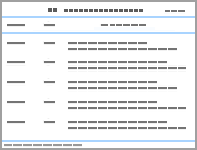
表1
各组基线资料比较"
| 组别 | n | 性别(男/女)/n | 年龄/岁 | 卒中性质(梗死/出血)/n | 卒中半球(左/右)/n | MMSE/分 | 病程/月 | BMI/(kg·m-2) |
|---|---|---|---|---|---|---|---|---|
| 对照组 | 20 | 17/3 | 58.70±16.24 | 2/18 | 11/9 | 26.15(24.25,29.00) | 1.64(0.50,2.34) | 24.79(23.66,27.04) |
| SMA组 | 20 | 18/2 | 57.50±17.14 | 3/17 | 12/8 | 28.00(24.00,29.00) | 1.09(0.54,2.83) | 23.19(20.55,27.40) |
| M1组 | 20 | 15/5 | 57.30±8.43 | 6/14 | 13/7 | 26.5(22.00,27.00) | 0.67(0.67,1.84) | 23.88(23.78,24.28) |
| F/χ2/H值 | 1.662 | 0.058 | 2.823 | 0.418 | 2.360 | 1.073 | 1.177 | |
| P值 | 0.572a | 0.944b | 0.339a | 0.945a | 0.307c | 0.585c | 0.555c |
图1
顺序序列和随机序列示意图"
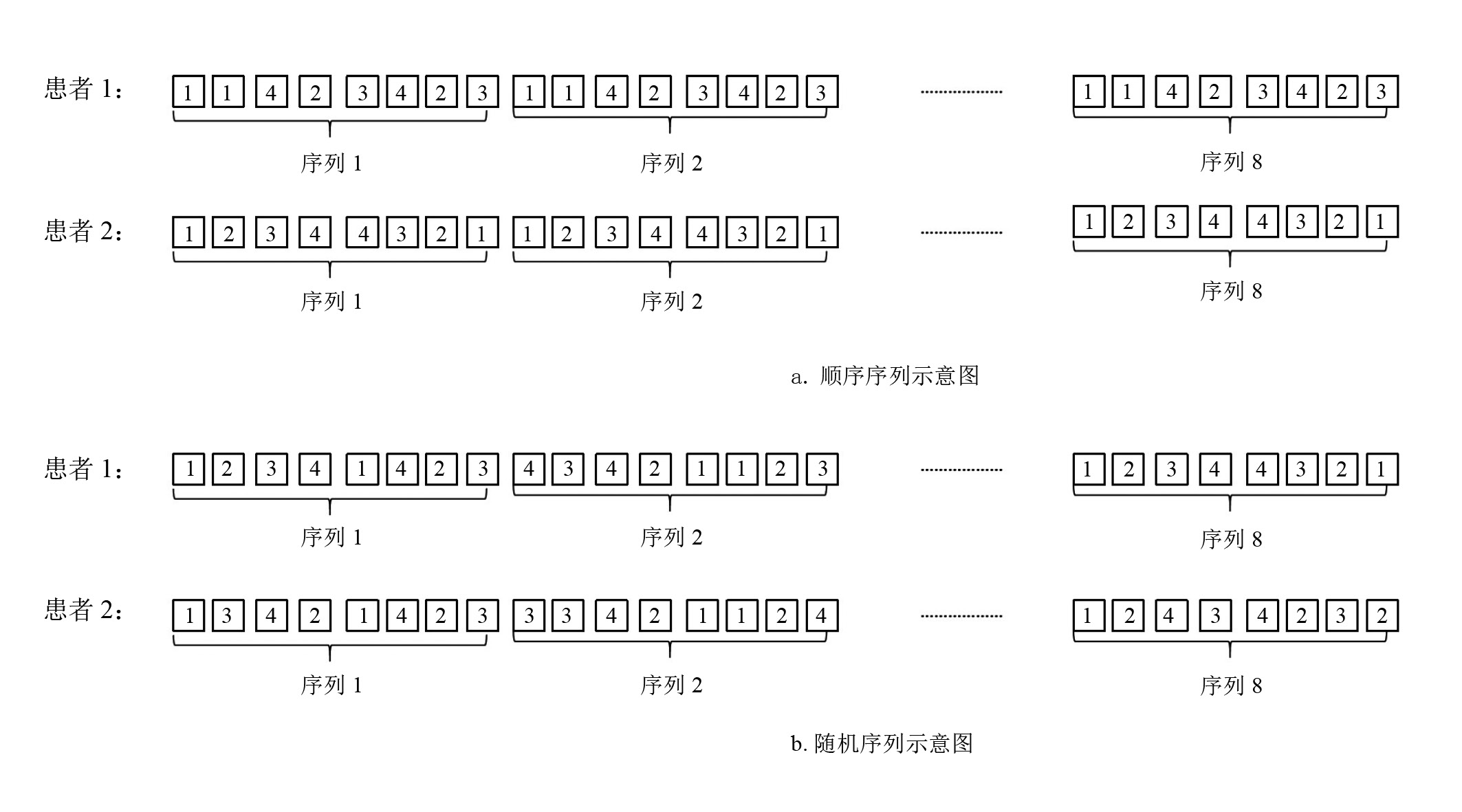
表2
各组干预前后患侧MEP引出率比较"
| 组别 | n | 干预前 | 干预后 | χ2值a | P值a |
|---|---|---|---|---|---|
| 对照组 | 20 | 2 | 3 | 0.000 | > 0.999 |
| SMA组 | 19 | 4 | 11 | - | 0.022 |
| M1组 | 19 | 1 | 9 | - | 0.008 |
| χ2值 | 2.121 | 8.194 | |||
| P值 | 0.373 | 0.016 |
表3
各组干预前后患侧MEP引出率差异检验结果"
| 组别 | 组别 | 干预前χ2值 | 干预前P值 | 干预后χ2值 | 干预后P值 |
|---|---|---|---|---|---|
| SMA组 | M1组 | 0.921 | 0.337 | 0.106 | 0.745 |
| SMA组 | 对照组 | 0.262 | 0.608 | 6.038 | 0.014 |
| M1组 | 对照组 | < 0.001 | > 0.999 | 4.792 | 0.029 |
表4
各组治疗前后各指标的描述性统计"
| 项目 | 组别 | 治疗前 | 治疗后 | ||
|---|---|---|---|---|---|
| 均数 | 标准差 | 均数 | 标准差 | ||
| RT随机序列/ms | 对照组 | 1843.21 | 1500.38 | 1935.98 | 1274.58 |
| SMA组 | 1859.22 | 1436.31 | 1761.47 | 1195.67 | |
| M1组 | 1933.25 | 1396.62 | 1867.25 | 1292.45 | |
| RT顺序序列/ms | 对照组 | 2384.19 | 1465.39 | 2235.43 | 1788.06 |
| SMA组 | 2238.65 | 1712.87 | 1809.26 | 1177.94 | |
| M1组 | 2326.19 | 1656.09 | 1930.31 | 1430.07 | |
| ∆RT/ms | 对照组 | 1473.34 | 1485.19 | 1614.21 | 1592.12 |
| SMA组 | 1426.20 | 1647.63 | 1189.48 | 1538.74 | |
| M1组 | 1412.78 | 1614.67 | 1292.77 | 1639.48 | |
| FMA-UE | 对照组 | 24.65 | 5.99 | 37.75 | 8.19 |
| SMA组 | 23.58 | 8.25 | 48.84 | 11.15 | |
| M1组 | 22.89 | 9.37 | 46.11 | 11.76 | |
| MBI | 对照组 | 41.00 | 5.31 | 58.10 | 7.59 |
| SMA组 | 43.84 | 9.29 | 71.53 | 11.17 | |
| M1组 | 42.37 | 9.65 | 69.58 | 12.67 | |
表5
各指标的重复测量方差分析结果"
| 变量 | 平方和 | 自由度 | 均方 | F值 | P值 | |
|---|---|---|---|---|---|---|
| RT随机序列 | 组内 | 1038160.950 | 1 | 1038160.950 | 0.566 | 0.452 |
| 组间 | 11837381.443 | 2 | 5918690.7213 | 3.228 | 0.040 | |
| 组内 | 12908729.071 | 2 | 6454364.535 | 3.520 | 0.030 | |
| RT顺序序列 | 组内 | 195537285.218 | 1 | 195537285.218 | 81.546 | < 0.001 |
| 组间 | 104353851.771 | 2 | 52176925.886 | 21.760 | < 0.001 | |
| 组内 | 29216678.833 | 2 | 14608339.416 | 6.092 | 0.002 | |
| ∆RT | 组内 | 9603225.048 | 1 | 9603225.048 | 3.815 | 0.051 |
| 组间 | 78882509.857 | 2 | 39441254.928 | 15.669 | < 0.001 | |
| 组内 | 46875737.454 | 2 | 23437868.727 | 9.311 | < 0.001 | |
| FMA-UE | 组内 | 12209.331 | 1 | 12209.331 | 141.535 | < 0.001 |
| 组间 | 508.086 | 2 | 254.043 | 2.945 | 0.507 | |
| 组内 | 832.619 | 2 | 416.309 | 4.826 | 0.100 | |
| MBI | 组内 | 16691.797 | 1 | 16691.797 | 183.791 | < 0.001 |
| 组间 | 1444.114 | 2 | 722.057 | 7.950 | 0.001 | |
| 组内 | 702.546 | 2 | 351.273 | 3.868 | 0.024 |
表6
各组治疗前后的差异性检验结果"
| 变量 | 组别 | 治疗前后平均值差 | 平均值差标准差 | P值 | 95%CI | |
|---|---|---|---|---|---|---|
| 下限 | 上限 | |||||
| RT随机序列 | 对照组 | -92.776 | 55.630 | 0.095 | -201.862 | 16.310 |
| SMA组 | 97.748 | 54.316 | 0.072 | -8.815 | 204.312 | |
| M1组 | 66.000 | 53.829 | 0.221 | -39.554 | 171.554 | |
| RT顺序序列 | 对照组 | 148.764 | 65.627 | 0.023 | 20.072 | 277.456 |
| SMA组 | 429.390 | 59.134 | < 0.001 | 314.494 | 544.287 | |
| M1组 | 395.880 | 68.178 | < 0.001 | 262.121 | 529.639 | |
| ∆RT | 对照组 | -140.087 | 64.750 | 0.030 | -267.904 | -13.849 |
| SMA组 | 236.724 | 64.674 | < 0.001 | 109.839 | 363.609 | |
| M1组 | 120.011 | 64.310 | 0.026 | 14.009 | 226.013 | |
| FMA-UE | 对照组 | -13.100 | 4.541 | < 0.001 | -15.225 | -10.975 |
| SMA组 | -25.263 | 6.723 | < 0.001 | -28.504 | -22.023 | |
| M1组 | -23.211 | 6.933 | < 0.001 | -26.552 | -19.869 | |
| MBI | 对照组 | -17.100 | 5.015 | < 0.001 | -19.447 | -14.753 |
| SMA组 | -27.684 | 8.280 | < 0.001 | -31.675 | -23.693 | |
| M1组 | -27.211 | 7.307 | < 0.001 | -30.733 | -23.688 | |
表7
各指标事前Bonferroni差异检验结果"
| 变量 | 组别 | 组别 | 平均差值 | P值 | 95%CI | |
|---|---|---|---|---|---|---|
| 下限 | 上限 | |||||
| RT随机序列 | SMA组 | M1组 | -74.033 | 0.621 | -214.491 | 66.425 |
| SMA组 | 对照组 | 16.012 | > 0.999 | -122.679 | 154.703 | |
| M1组 | 对照组 | 90.045 | 0.360 | -48.646 | 228.736 | |
| RT顺序序列 | SMA组 | M1组 | -87.547 | 0.542 | -244.169 | 69.076 |
| SMA组 | 对照组 | -145.547 | 0.073 | -300.199 | 9.106 | |
| M1组 | 对照组 | -58.000 | > 0.999 | -212.652 | 96.653 | |
| ∆RT | SMA组 | M1组 | 13.422 | > 0.999 | -140.280 | 167.124 |
| SMA组 | 对照组 | -47.132 | > 0.999 | -198.901 | 104.637 | |
| M1组 | 对照组 | -60.554 | > 0.999 | -212.323 | 91.215 | |
| FMA-UE | SMA组 | M1组 | 0.684 | > 0.999 | -5.695 | 7.064 |
| SMA组 | 对照组 | -1.071 | > 0.999 | -7.370 | 5.228 | |
| M1组 | 对照组 | -1.755 | > 0.999 | -8.054 | 4.544 | |
| MBI | SMA组 | M1组 | 1.474 | > 0.999 | -5.153 | 8.101 |
| SMA组 | 对照组 | 2.842 | 0.864 | -3.701 | 9.386 | |
| M1组 | 对照组 | 1.368 | > 0.999 | -5.175 | 7.912 | |
表8
各指标事后Bonferroni差异检验结果"
| 变量 | 组别 | 组别 | 平均差值 | P值 | 95%CI | |
|---|---|---|---|---|---|---|
| 下限 | 上限 | |||||
| RT随机序列 | SMA组 | M1组 | -105.781 | 0.106 | -226.206 | 14.644 |
| SMA组 | 对照组 | -174.512 | 0.002 | -296.472 | -52.553 | |
| M1组 | 对照组 | -68.731 | 0.515 | -189.157 | 51.694 | |
| RT顺序序列 | SMA组 | M1组 | -121.057 | 0.124 | -263.178 | 21.064 |
| SMA组 | 对照组 | -426.173 | < 0.001 | -568.294 | -284.052 | |
| M1组 | 对照组 | -305.116 | < 0.001 | -449.048 | -161.184 | |
| ∆RT | SMA组 | M1组 | -103.291 | 0.328 | -257.797 | 51.215 |
| SMA组 | 对照组 | -424.732 | < 0.001 | -577.295 | -272.170 | |
| M1组 | 对照组 | -321.441 | < 0.001 | -474.004 | -168.878 | |
| FMA-UE | SMA组 | M1组 | 2.737 | > 0.999 | -5.633 | 11.106 |
| SMA组 | 对照组 | 11.092 | 0.005 | 2.828 | 19.356 | |
| M1组 | 对照组 | 8.355 | 0.047 | 0.091 | 16.619 | |
| MBI | SMA组 | M1组 | 1.947 | > 0.999 | -6.578 | 10.472 |
| SMA组 | 对照组 | 13.426 | 0.001 | 5.009 | 21.844 | |
| M1组 | 对照组 | 11.479 | 0.004 | 3.061 | 19.897 | |
| [1] |
The Writing Committee of The Report on Cardiovascular Health and Diseases in China. Report on cardiovascular health and diseases in China 2022: an updated summary[J]. Biomed Environ Sci, 2023, 36(8): 669-701.
doi: 10.3967/bes2023.106 pmid: 37711081 |
| [2] | HU S S, The Writing Committee of the Report on Cardiovascular Health and Diseases in China. Epidemiology and current management of cardiovascular disease in China[J]. J Geriatr Cardiol, 2024, 21(4): 387-406. |
| [3] |
ABO M, KAKUDA W, MOMOSAKI R, et al. Randomized, multicenter, comparative study of NEURO versus CIMT in poststroke patients with upper limb hemiparesis: the NEURO-VERIFY study[J]. Int J Stroke, 2014, 9(5): 607-612.
doi: 10.1111/ijs.12100 pmid: 24015934 |
| [4] |
文翠凤, 娅茹, 黄昊, 等. 镜像疗法对脑卒中后Ⅰ型复杂区域性疼痛综合征患者上肢功能及大脑皮质活动效果的随机对照试验[J]. 中国康复理论与实践, 2024, 30(10): 1203-1214.
doi: 10.3969/j.issn.1006-9771.2024.10.011 |
| WEN C F, YA R, HUANG H, et al. Effect of mirror therapy on upper limb function and cerebral cortex activity in patients with type I complex regional pain syndrome after stroke: a randomized controlled trial[J]. Chin J Rehabil Theory Pract, 2024, 30(10): 1203-1214. | |
| [5] |
梁天佳, 龙耀斌, 陆丽燕, 等. 绳带辅助本体感觉神经肌肉促进技术训练联合绳带辅助脑机接口训练对脑卒中偏瘫上肢康复效果的随机对照试验[J]. 中国康复理论与实践, 2024, 30(8): 972-978.
doi: 10.3969/j.issn.1006-9771.2024.08.013 |
| LIANG T J, LONG Y B, LU L Y, et al. Effect of rope-assisted proprioceptive neuromuscular facilitation combined with rope-assisted brain-computer interface training on upper limb function in stroke patients with hemiplegia: a randomized controlled trial[J]. Chin J Rehabil Theory Pract, 2024, 30(8): 972-978. | |
| [6] | BERLOT E, POPP N J, DIEDRICHSEN J. A critical re-evaluation of fMRI signatures of motor sequence learning[J]. Elife, 2020, 9: e55241. |
| [7] |
LIU Y, HUANG S, XU W, et al. An fMRI study on the generalization of motor learning after brain actuated supernumerary robot training[J]. NPJ Sci Learn, 2024, 9(1): 80.
doi: 10.1038/s41539-024-00294-y pmid: 39738213 |
| [8] | FIROUZI M, BAETENS K, DUTA C, et al. The cerebellum is involved in implicit motor sequence learning[J]. Front Neurosci, 2024, 18: 1433867. |
| [9] | DAHMS C, NOLL A, WAGNER F, et al. Connecting the dots: Motor and default mode network crossroads in post-stroke motor learning deficits[J]. Neuroimage Clin, 2024, 42: 103601. |
| [10] |
BOYD L A, WINSTEIN C J. Implicit motor-sequence learning in humans following unilateral stroke: the impact of practice and explicit knowledge[J]. Neurosci Lett, 2001, 298(1): 65-69.
pmid: 11154837 |
| [11] | VELDKAMP R, MOUMDJIAN L, VAN DUN K, et al. Motor sequence learning in a goal-directed stepping task in persons with multiple sclerosis: a pilot study[J]. Ann N Y Acad Sci, 2022, 1508(1): 155-171. |
| [12] |
ANDRUSHKO J W, RINAT S, GREELEY B, et al. Improved processing speed and decreased functional connectivity in individuals with chronic stroke after paired exercise and motor training[J]. Sci Rep, 2023, 13(1): 13652.
doi: 10.1038/s41598-023-40605-8 pmid: 37608062 |
| [13] | LEFAUCHEUR J P, ALEMAN A, BAEKEN C, et al. Evidence-based guidelines on the therapeutic use of repetitive transcranial magnetic stimulation (rTMS): an update (2014-2018)[J]. Clin Neurophysiol, 2020, 131(2): 474-528. |
| [14] | FIROUZI M, BAETENS K, SWINNEN E, et al. Does transcranial direct current stimulation of the primary motor cortex improve implicit motor sequence learning in Parkinson's disease?[J]. J Neurosci Res, 2024, 102(2): e25311. |
| [15] | WANG X, CHEN X, CHAN K L C, et al. Does the alternating timing of rTMS combined with soft-hand rehabilitation robot affect the recovery of hand function in patients after stroke? A study protocol for a multicentre randomised controlled trial[J]. BMJ Open, 2025, 15(3): e094672. |
| [16] | 中华医学会神经病学分会, 中华医学会神经病学分会脑血管病学组. 中国各类主要脑血管病诊断要点2019[J]. 中华神经科杂志, 2019, 52(9): 710-715. |
| Chinese Society of Neurology, Chinese Stroke Society. Diagnostic criteria of cerebrovascular diseases in China (version 2019)[J]. Chin J Neurol, 2019, 52(9): 710-715. | |
| [17] |
OLDFIELD R C. The assessment and analysis of handedness: the Edinburgh inventory[J]. Neuropsychologia, 1971, 9(1): 97-113.
doi: 10.1016/0028-3932(71)90067-4 pmid: 5146491 |
| [18] | GUO Z, JIN Y, BAI X, et al. Distinction of high- and low-frequency repetitive transcranial magnetic stimulation on the functional reorganization of the motor network in stroke patients[J]. Neural Plast, 2021, 2021: 8873221. |
| [19] |
BRUNNER I, LUNDQUIST C B, PEDERSEN A R, et al. Brain computer interface training with motor imagery and functional electrical stimulation for patients with severe upper limb paresis after stroke: a randomized controlled pilot trial[J]. J Neuroeng Rehabil, 2024, 21(1): 10.
doi: 10.1186/s12984-024-01304-1 pmid: 38245782 |
| [20] | TROFIMOVA O, MOTTAZ A, ALLAMAN L, et al. The "implicit" serial reaction time task induces rapid and temporary adaptation rather than implicit motor learning[J]. Neurobiol Learn Mem, 2020, 175: 107297. |
| [21] | SÁNCHEZ-MORA J, TAMAYO R M. From incidental learning to explicit memory: the role of sleep after exposure to a serial reaction time task[J]. Acta Psychol(Amst), 2021, 217: 103325. |
| [22] |
ROBERTSON E M. The serial reaction time task: implicit motor skill learning?[J]. J Neurosci, 2007, 27(38): 10073-10075.
doi: 10.1523/JNEUROSCI.2747-07.2007 pmid: 17881512 |
| [23] |
SEE J, DODAKIAN L, CHOU C, et al. A standardized approach to the Fugl-Meyer Assessment and its implications for clinical trials[J]. Neurorehabil Neural Repair, 2013, 27(8): 732-741.
doi: 10.1177/1545968313491000 pmid: 23774125 |
| [24] | LEUNG S O, CHAN C C, SHAH S. Development of a Chinese version of the modified Barthel Index-validity and reliability[J]. Clin Rehabil, 2007, 21(10): 912-922. |
| [25] |
HOTERMANS C, PEIGNEUX P, DE NOORDHOUT A M, et al. Repetitive transcranial magnetic stimulation over the primary motor cortex disrupts early boost but not delayed gains in performance in motor sequence learning[J]. Eur J Neurosci, 2008, 28(6): 1216-1221.
doi: 10.1111/j.1460-9568.2008.06421.x pmid: 18783369 |
| [26] |
WILKINSON L, KOSHY P J, STEEL A, et al. Motor cortex inhibition by TMS reduces cognitive non-motor procedural learning when immediate incentives are present[J]. Cortex, 2017, 97: 70-80.
doi: S0010-9452(17)30330-1 pmid: 29096197 |
| [27] |
WANG L, ZHU Q X, ZHONG M H, et al. Effects of corticospinal tract integrity on upper limb motor function recovery in stroke patients treated with repetitive transcranial magnetic stimulation[J]. J Integr Neurosci, 2022, 21(2): 50.
doi: 10.31083/j.jin2102050 pmid: 35364638 |
| [28] |
WANG Q, ZHANG D, ZHAO Y Y, et al. Effects of high-frequency repetitive transcranial magnetic stimulation over the contralesional motor cortex on motor recovery in severe hemiplegic stroke: a randomized clinical trial[J]. Brain Stimul, 2020, 13(4): 979-986.
doi: S1935-861X(20)30073-5 pmid: 32380449 |
| [29] |
XIE H, LI X, XU G, et al. Effects of transcranial magnetic stimulation on dynamic functional networks in stroke patients as assessed by functional near-infrared spectroscopy: a randomized controlled clinical trial[J]. Cereb Cortex, 2023, 33(24): 11668-11678.
doi: 10.1093/cercor/bhad404 pmid: 37885140 |
| [30] |
DOYON J. Motor sequence learning and movement disorders[J]. Curr Opin Neurol, 2008, 21(4): 478-483.
doi: 10.1097/WCO.0b013e328304b6a3 pmid: 18607210 |
| [31] | MUEHLBERG C, GOERG S, RULLMANN M, et al. Motor learning is modulated by dopamine availability in the sensorimotor putamen[J]. Brain Commun, 2024, 6(6): fcae409. |
| [32] |
DAHMS C, BRODOEHL S, WITTE O W, et al. The importance of different learning stages for motor sequence learning after stroke[J]. Hum Brain Mapp, 2020, 41(1): 270-286.
doi: 10.1002/hbm.24793 pmid: 31520506 |
| [33] |
HERMSDORF F, FRICKE C, STOCKERT A, et al. Motor performance but neither motor learning nor motor consolidation are impaired in chronic cerebellar stroke patients[J]. Cerebellum, 2020, 19(2): 275-285.
doi: 10.1007/s12311-019-01097-3 pmid: 31997138 |
| [34] | SHENG R, CHEN C, CHEN H, et al. Repetitive transcranial magnetic stimulation for stroke rehabilitation: insights into the molecular and cellular mechanisms of neuroinflammation[J]. Front Immunol, 2023, 14: 1197422. |
| [35] | CHEN J, FAN Y, JIA X, et al. The supplementary motor area as a flexible hub mediating behavioral and neuroplastic changes in motor sequence learning: a TMS and TMS-EEG study[J]. Neurosci Bull, 2025, 41(5): 837-852. |
| [36] | GAO J, WANG H, HU Z, et al. Investigating the effects of excitatory and inhibitory somatosensory rTMS on somatosensory functioning in the acute and subacute phases of stroke: a preliminary double-blind and randomized trial[J]. Front Hum Neurosci, 2024, 18: 1474212. |
| [37] | THONG S, DOERY E, BIABANI M, et al. Disinhibition across secondary motor cortical regions during motor sequence learning: a TMS-EEG Study[J]. J Neurosci, 2025, 45(8): e0443242024. |
| [38] | HAMANO Y H, SUGAWARA S K, FUKUNAGA M, et al. The integrative role of the M1 in motor sequence learning[J]. Neurosci Lett, 2021, 760: 136081. |
| [39] |
HAMANO Y H, SUGAWARA S K, YAMAMOTO T, et al. The left primary motor cortex and cerebellar vermis are critical hubs in bimanual sequential learning[J]. Exp Brain Res, 2024, 243(1): 4.
doi: 10.1007/s00221-024-06944-2 pmid: 39607575 |
| [40] | LEFAUCHEUR J P, ANDRÉ-OBADIA N, ANTAL A, et al. Evidence-based guidelines on the therapeutic use of repetitive transcranial magnetic stimulation(rTMS)[J]. Clin Neurophysiol, 2014, 125(11): 2150-2206. |
| [41] | YANG K, XI X, WANG T, et al. Effects of transcranial direct current stimulation on brain network connectivity and complexity in motor imagery[J]. Neurosci Lett, 2021, 757: 135968. |
| [42] |
ARAI N, LU M K, UGAWA Y, et al. Effective connectivity between human supplementary motor area and primary motor cortex: a paired-coil TMS study[J]. Exp Brain Res, 2012, 220(1): 79-87.
doi: 10.1007/s00221-012-3117-5 pmid: 22623093 |
| [1] | 朱丽丽, 赵嘉欣, 程雪, 王会娟, 陈小霞. 康复期脑卒中患者疾病体验及需求的Meta整合[J]. 《中国康复理论与实践》, 2026, 32(3): 286-293. |
| [2] | 刘平, 周楠, 薛晓杰, 邵伟波. 脑卒中后吞咽障碍康复治疗技术应用研究的文献计量分析[J]. 《中国康复理论与实践》, 2026, 32(3): 294-303. |
| [3] | 杨玲, 王庆雷, 王洁, 徐雯婕, 王彤, 郭川, 钱雪. 基于功能性近红外光谱成像的卒中后焦虑患者前额叶皮质激活特征及机制研究[J]. 《中国康复理论与实践》, 2026, 32(3): 329-336. |
| [4] | 岳圆, 张通, 刘元旻, 王亚囡. 下肢外骨骼机器人对卒中后小脑性共济失调患者平衡和步行功能的影响[J]. 《中国康复理论与实践》, 2026, 32(1): 23-29. |
| [5] | 吴澄, 章云枫, 王卫宁, 余克威, 张艳正, 沈嘉蓉, 吴毅. 肘腕功能支具对脑卒中偏瘫患者足底压力和平衡功能的效果[J]. 《中国康复理论与实践》, 2026, 32(1): 30-39. |
| [6] | 张军风, 陈昊, 杜宇征, 李琛, 于涛, 杨元庆. 2004年至2024年脑卒中后肢体痉挛非药物疗法的文献计量分析[J]. 《中国康复理论与实践》, 2026, 32(1): 45-58. |
| [7] | 高凯祥, 芦海涛. 2015年至2024年神经康复研究的文献计量分析[J]. 《中国康复理论与实践》, 2026, 32(1): 59-68. |
| [8] | 王潇婧, 魏婧怡, 卫晨, 王冉, 马赛, 刘西花. 针刺同步构音训练对脑卒中后痉挛型构音障碍的效果[J]. 《中国康复理论与实践》, 2025, 31(9): 1009-1016. |
| [9] | 高云汉, 侯闪闪, 汪鑫煜, 朱崇田. 基于功能性近红外光谱探讨脑机接口对脑卒中患者上肢运动功能障碍的效果[J]. 《中国康复理论与实践》, 2025, 31(9): 1066-1073. |
| [10] | 娄彦涛, 王家伟, 肖晓飞, 李艳辉. 不同温度冷疗对青年男性运动后延迟性上肢肌肉酸痛的效果比较[J]. 《中国康复理论与实践》, 2025, 31(9): 1074-1082. |
| [11] | 张子昂, 陈静, 沈孟茹, 耿宗晓, 韩雪, 赵旭, 徐磊. 不同运动模式对脑卒中患者步行及平衡功能的效果比较[J]. 《中国康复理论与实践》, 2025, 31(8): 896-905. |
| [12] | 王晓锋, 胡梦巧, 汪嫣, 魏坤, 徐文竹, 任丹, 马晔. 外骨骼机器人辅助步态训练对脑卒中和脊髓损伤下肢功能康复效果的系统综述[J]. 《中国康复理论与实践》, 2025, 31(8): 914-921. |
| [13] | 仇爱珍, 王敏, 王秋爽, 吴野, 鲍克秀. 团体认知训练叠加重复经颅磁刺激对高功能孤独症谱系障碍共病注意缺陷多动障碍的增效作用及脑电机制[J]. 《中国康复理论与实践》, 2025, 31(8): 979-986. |
| [14] | 刘兰群, 李艳丽, 梁家琦, 陈爽, 刘慧林. 头针结合计算机辅助训练对脑卒中后记忆障碍的效果[J]. 《中国康复理论与实践》, 2025, 31(7): 862-868. |
| [15] | 刘璇, 高玲, 褚凤明, 陈杰, 张明. 脑机接口联合上肢康复机器人对脑卒中患者上肢功能的影响[J]. 《中国康复理论与实践》, 2025, 31(6): 703-710. |
| 阅读次数 | ||||||
|
全文 |
|
|||||
|
摘要 |
|
|||||
|
||
