



《中国康复理论与实践》 ›› 2026, Vol. 32 ›› Issue (1): 30-39.doi: 10.3969/j.issn.1006-9771.2026.01.004
吴澄1,2, 章云枫2, 王卫宁2, 余克威2, 张艳正3, 沈嘉蓉3, 吴毅2( )
收稿日期:2025-07-08
修回日期:2025-09-19
出版日期:2026-01-25
发布日期:2026-01-28
通讯作者:
吴毅(1961-),男,汉族,上海市人,博士,主任医师,教授,主要研究方向:中枢神经疾病后功能障碍的康复机制研究。E-mail: 作者简介:吴澄(1986-),男,汉族,上海市人,硕士研究生,主管技师,主要研究方向:神经康复治疗。
基金资助:
WU Cheng1,2, ZHANG Yunfeng2, WANG Weining2, YU Kewei2, ZHANG Yanzheng3, SHEN Jiarong3, WU Yi2()
Received:2025-07-08
Revised:2025-09-19
Published:2026-01-25
Online:2026-01-28
Contact:
WU Yi, E-mail: Supported by:摘要:
目的 探讨佩戴肘腕功能支具对脑卒中偏瘫患者足底压力和平衡功能的效果。
方法 2024年6月至2025年4月,复旦大学附属华山医院和上海禾滨康复医院收治的60例脑卒中偏瘫患者,随机分为对照组(n = 30)和观察组(n = 30)。对照组进行常规神经康复治疗,观察组增加偏瘫侧肘腕功能矫形器辅助训练,共8周。干预前后比较肘关节改良Ashworth量表(MAS)评级、足底压力对称性指数(SI)、足底压力面积和足底平均压强,并采用Berg平衡量表(BBS)、计时起立-行走测试(TUGT)和10米步行试验(10MWT)进行评定。
结果 对照组脱落2例。干预后两组肘关节MAS分级、前足SI、患侧足底压力面积、BBS评分、TUGT和10MWT均明显改善(∣Z∣ > 3.969, ∣t∣ > 3.528, P < 0.01),观察组后足SI和患足平均压强显著改善(∣t∣ > 4.264, P < 0.001);除TUGT和10MWT外,观察组均优于对照组(∣Z∣ > 2.030, ∣t∣ > 2.096, P < 0.05)。
结论 肘腕功能支具可通过降低上肢肌张力、调节重心分布和姿势控制,提高脑卒中偏瘫患者平衡功能。
中图分类号:
吴澄, 章云枫, 王卫宁, 余克威, 张艳正, 沈嘉蓉, 吴毅. 肘腕功能支具对脑卒中偏瘫患者足底压力和平衡功能的效果[J]. 《中国康复理论与实践》, 2026, 32(1): 30-39.
WU Cheng, ZHANG Yunfeng, WANG Weining, YU Kewei, ZHANG Yanzheng, SHEN Jiarong, WU Yi. Effect of elbow-wrist functional orthosis on plantar pressure and balance function in stroke patients with hemiplegia[J]. Chinese Journal of Rehabilitation Theory and Practice, 2026, 32(1): 30-39.

表1
两组基线资料比较"
| 组别 | n | 性别(男/女)/n | 年龄/岁 | 病程/周 | 卒中类型(梗死/出血)/n | 偏瘫侧(左/右)/n |
|---|---|---|---|---|---|---|
| 对照组 | 28 | 20/8 | 61.36±8.31 | 16.18±10.46 | 18/10 | 13/15 |
| 观察组 | 30 | 16/14 | 56.73±11.71 | 16.03±8.24 | 18/12 | 13/17 |
| χ2/t值 | 2.014 | -1.743 | -0.059 | 0.113 | 0.056 | |
| P值 | 0.156 | 0.090 | 0.953 | 0.737 | 0.813 |
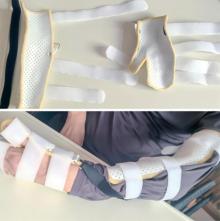
图1
肘腕功能支具结构和佩戴演示图"
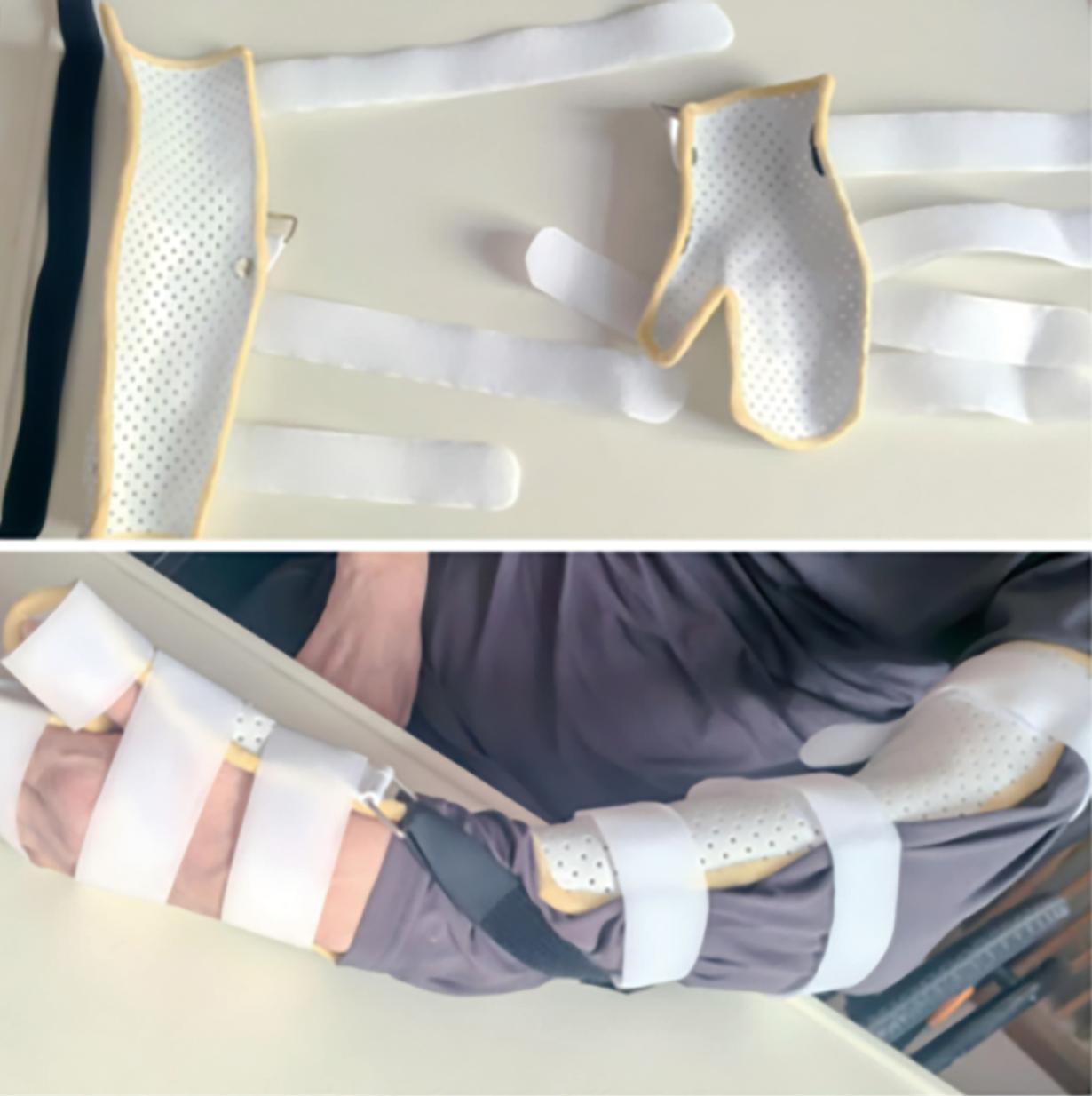
表2
两组干预前后患侧肘关节MAS分级比较"
| 组别 | n | 测试 | M(QL, QU) | Z值 | P值 |
|---|---|---|---|---|---|
| 对照组 | 28 | 前测 | 3.0(3.0, 4.0) | -3.969 | < 0.001 |
| 后测 | 2.0(1.5, 3.0) | ||||
| 观察组 | 30 | 前测 | 3.0(3.0, 4.0) | -4.590 | < 0.001 |
| 后测 | 2.0(1.38, 2.0) | ||||
| 干预前均值差 | -0.036 | 0.971 | |||
| 干预后均值差 | -2.030 | 0.042 |
表3
两组干预前后足底压力SI比较"
| 变量 | 组别 | n | 测试 | t值 | P值 | |
|---|---|---|---|---|---|---|
| 双侧前足SI | 对照组 | 28 | 前测 | 31.20±14.70 | 3.528 | 0.002 |
| 后测 | 22.73±11.34 | |||||
| 观察组 | 30 | 前测 | 28.76±12.86 | 7.008 | < 0.001 | |
| 后测 | 16.13±5.79 | |||||
| 干预前均值差 | -2.44±3.62 | -0.673 | 0.504 | |||
| 干预后均值差 | -6.61±2.39 | -2.764 | 0.009 | |||
| 双侧后足SI | 对照组 | 28 | 前测 | 23.21±15.58 | 0.282 | 0.780 |
| 后测 | 22.43±11.58 | |||||
| 观察组 | 30 | 前测 | 25.72±15.81 | 5.365 | < 0.001 | |
| 后测 | 16.35±7.54 | |||||
| 干预前均值差 | 2.51±4.13 | 0.609 | 0.545 | |||
| 干预后均值差 | -6.08±2.55 | -2.387 | 0.020 |
表4
两组干预前后足底压力面积比较"
| 变量 | 组别 | n | 测试 | M(QL,QU) | Z值 | P值 |
|---|---|---|---|---|---|---|
| 健足足底压力面积 | 对照组 | 28 | 前测 | 136.5(130.2, 140.0) | -0.606 | 0.544 |
| 后测 | 134.0(128.5, 137.8) | |||||
| 观察组 | 30 | 前测 | 132.5(128.0, 140.0) | -0.152 | 0.880 | |
| 后测 | 133.5(129.8, 138.0) | |||||
| 干预前均值差 | -0.577 | 0.564 | ||||
| 干预后均值差 | -0.585 | 0.559 | ||||
| 患足足底压力面积 | 对照组 | 28 | 前测 | 117.0(104.3, 126.8) | -4.013 | < 0.001 |
| 后测 | 127.5(121.5, 131.8) | |||||
| 观察组 | 30 | 前测 | 109.5(97.8, 123.3) | -4.485 | < 0.001 | |
| 后测 | 132.0(125.8, 137.5) | |||||
| 干预前均值差 | -0.973 | 0.330 | ||||
| 干预后均值差 | -2.096 | 0.036 |
表5
两组干预前后足底平均压强比较"
| 变量 | 组别 | n | 测试 | t值 | P值 | |
|---|---|---|---|---|---|---|
| 健足平均压强 | 对照组 | 28 | 前测 | 40.00±4.52 | 2.014 | 0.054 |
| 后测 | 39.20±4.25 | |||||
| 观察组 | 30 | 前测 | 39.53±4.43 | 3.163 | 0.004 | |
| 后测 | 37.03±3.07 | |||||
| 干预前均值差 | -0.47±1.18 | -0.398 | 0.692 | |||
| 干预后均值差 | -2.17±0.97 | -2.243 | 0.029 | |||
| 患足平均压强 | 对照组 | 28 | 前测 | 26.30±4.24 | -1.916 | 0.066 |
| 后测 | 28.07±4.27 | |||||
| 观察组 | 30 | 前测 | 27.77±4.83 | -4.264 | < 0.001 | |
| 后测 | 31.28±3.00 | |||||
| 干预前均值差 | 1.47±1.20 | 1.227 | 0.225 | |||
| 干预后均值差 | 3.22±0.96 | 3.337 | 0.002 |
表6
两组干预前后BBS、TUGT和10MWT比较"
| 变量 | 组别 | n | 测试 | t值 | P值 | |
|---|---|---|---|---|---|---|
| BBS | 对照组 | 28 | 前测 | 16.25±7.11 | -15.960 | < 0.001 |
| 后测 | 29.04±5.61 | |||||
| 观察组 | 30 | 前测 | 17.60±8.95 | -17.877 | < 0.001 | |
| 后测 | 36.87±6.64 | |||||
| 干预前均值差 | 1.35±2.13 | 0.633 | 0.529 | |||
| 干预后均值差 | 7.83±1.62 | 4.834 | < 0.001 | |||
| TUGT/s | 对照组 | 28 | 前测 | 24.75±4.46 | 9.623 | < 0.001 |
| 后测 | 18.38±3.43 | |||||
| 观察组 | 30 | 前测 | 23.89±4.45 | 12.754 | < 0.001 | |
| 后测 | 17.17±3.06 | |||||
| 干预前均值差 | -0.86±1.17 | -0.734 | 0.466 | |||
| 干预后均值差 | -1.21±0.85 | -1.417 | 0.162 | |||
| 10MWT/(cm·s-1) | 对照组 | 28 | 前测 | 36.21±6.84 | -11.345 | < 0.001 |
| 后测 | 58.75±12.07 | |||||
| 观察组 | 30 | 前测 | 34.57±6.44 | -16.226 | < 0.001 | |
| 后测 | 64.57±11.22 | |||||
| 干预前均值差 | -1.65±1.74 | -0.945 | 0.349 | |||
| 干预后均值差 | 5.82±3.06 | 1.903 | 0.062 |
| [1] | 陈晓荣, 颜流霞, 厚磊, 等. 2015-2019年中国居民脑卒中发病与死亡特征分析[J]. 中国循环杂志, 2024, 39(5): 470-476. |
| CHEN X R, YAN L X, HOU L, et al. Trends of stroke incidence and mortality from 2015 to 2019 in China[J]. Chin Circul J, 2024, 39(5): 470-476. | |
| [2] | «中国卒中中心报告2022»编写组, 王陇德. «中国卒中中心报告2022»概要[J]. 中国脑血管病杂志, 2024, 21(8): 565-576. |
| Report on Stroke Center in China Writing Group, WANG L D. Brief report on stroke center in China, 2022[J]. Chin J Cerebrovas Dis, 2024, 21(8): 565-576. | |
| [3] | 周星辰, 廖如榆, 黄龄漪, 等. 脑卒中后痉挛患者肢体功能康复的最佳证据总结[J]. 现代医药卫生, 2023, 39(13): 2232-2238. |
| ZHOU X C, LIAO R Y, HUANG L Y, et al. Summary of the best evidence for limb function rehabilitation in patients with post-stroke spasm[J]. Mod Med Health, 2023, 39(13): 2232-2238. | |
| [4] | 陆春华, 王凯, 曾贞, 等. 三维打印分指板对脑卒中早期患者手指痉挛的疗效评价[J]. 内科理论与实践, 2021, 16(4): 255-260. |
| LU C H, WANG K, ZENG Z, et al. Effects of three dimensional printing fingerboard on finger spasm in early stroke patients[J]. J Intern Med Concepts Pract, 2021, 16(4): 255-260. | |
| [5] |
黄崧华, 凌骏麒, 高天昊, 等. 动态腕手矫形器结合改良强制性运动疗法对脑卒中偏瘫患者上肢和手功能障碍的效果[J]. 中国康复理论与实践, 2024, 30(5): 606-612.
doi: 10.3969/j.issn.1006-9771.2024.05.016 |
| HUANG S H, LING J Q, GAO T H, et al. Effect of wrist-hand orthosis combined with modified constraint-induced movement therapy on upper limb and hand function in patients with stroke[J]. Chin J Rehabil Theory Pract, 2024, 30(5): 606-612. | |
| [6] | HOPPE-LUDWIG S, ARMITAGE J, TURNER K L, et al. Usability, functionality, and efficacy of a custom myoelectric elbow-wrist-hand orthosis to assist elbow function in individuals with stroke[J]. Rehabil Assist Technol Eng, 2021, 8: 20556683211035057. |
| [7] |
贾杰. "上下肢一体化"整体康复:脑卒中后手功能康复新理念[J]. 中国康复理论与实践, 2017, 23(1): 1-3.
doi: 10.3969/j.issn.1006-9771.2017.01.001 |
| JIA J. Upper and Lower Extremities Integration: a novel concept for hands functional rehabilitation[J]. Chin J Rehabil Theory Pract, 2017, 23(1): 1-3. | |
| [8] | 陈祥贵, 刘迟, 陈树耿, 等. 脑卒中后偏瘫侧手佩戴手功能支具对患者步态时空参数的影响[J]. 上海医药, 2024, 45(13): 38-43. |
| CHEN X G, LIU C, CHEN S G, et al. The effect of wearing the orthosis of hand function on gait spatiotemporal parameters in patients with hemiplegia after stroke[J]. Shanghai Med Pharm J, 2024, 45(13): 38-43. | |
| [9] | 中华人民共和国国家卫生健康委员会. 脑血管病防治指南(2024年版)[J]. 磁共振成像, 2025, 16(1): 1-8. |
| National Health Commission of the People's Republic of China. Guideline for prevention and treatment of cerebrovascular disease (2024 edition)[J]. Chin J Magn Reson Imaging, 2025, 16(1): 1-8. | |
| [10] |
林强, 郑煜欣, 廖婉晨, 等. 脑卒中患者静态平衡的足底压力分析[J]. 中国康复理论与实践, 2021, 27(3): 290-296.
doi: 10.3969/j.issn.1006-9771.2021.00.001 |
| LIN Q, ZHEN Y X, LIAO W C, et al. Static balance function in stroke patients:a plantar pressure analysis[J]. Chin J Rehabil Theory Pract, 2021, 27(3): 290-296. | |
| [11] |
KIM H, KIM H, SHIN W S. Effects of vibrotactile biofeedback providing real-time pressure information on static balance ability and weight distribution symmetry index in patients with chronic stroke[J]. Brain Sci, 2022, 12(3): 358.
doi: 10.3390/brainsci12030358 |
| [12] | 李晓亚, 张芝梅, 王山岭, 等. 脑卒中偏瘫痉挛期患者足底压力与平衡功能的相关性分析[J]. 中国康复, 2022, 37(9): 532-536. |
| LI X Y, ZHANG Z M, WANG S L, et al. Correlation between the plantar pressure distribution and standing balance function in poststroke patients with spastic[J]. Chin J Rehabil, 2022, 37(9): 532-536. | |
| [13] |
王惠娟, 何任红, 江志锦, 等. 脑卒中患者的平衡功能和躯干屈伸肌群表面肌电特征[J]. 中国康复理论与实践, 2017, 23(11): 1245-1249.
doi: 10.3969/j.issn.1006-9771.2017.11.002 |
| WANG H J, HE R H, JIANG Z J, et al. Characteristics of balance and surface electromyography of trunk flexor and extensor for stroke patients[J]. Chin J Rehabil Theory Pract, 2017, 23(11): 1245-1249. | |
| [14] |
ARASAKI K, IGARASHI O, MACHIDA T, et al. Reduction in the motor unit number estimate (MUNE) after cerebral infarction[J]. Suppl Clin Neurophysiol, 2009, 60: 189-195.
pmid: 20715381 |
| [15] |
LI W, YUE T, LIU Y. New understanding of the pathogenesis and treatment of stroke-related sarcopenia[J]. Biomed Pharmacother, 2020, 131: 110721.
doi: 10.1016/j.biopha.2020.110721 pmid: 32920517 |
| [16] |
CHON J, SOH Y, SHIM G Y. Stroke-related sarcopenia: pathophysiology and diagnostic tools[J]. Brain Neurorehabil, 2024, 17(3): e23.
doi: 10.12786/bn.2024.17.e23 pmid: 39649713 |
| [17] |
XU J, WITCHALLS J, PRESTON E, et al. Proprioception after unilateral stroke: changes in the affected and unaffected lower limbs over time[J]. Physiother Res Int, 2025, 30(1): e70027.
doi: 10.1002/pri.v30.1 |
| [18] |
KIM K H, JANG S H. Effects of cognitive sensory motor training on lower extremity muscle strength and balance in post stroke patients: a randomized controlled study[J]. Clin Pract, 2021, 11(3): 640-649.
doi: 10.3390/clinpract11030079 |
| [19] |
CALISGAN E, TALU B. The effect of vestibular and somatosensory rehabilitation in addition to early rehabilitation on balance after stroke: a randomized controlled trial[J]. Top Stroke Rehabil, 2024, 31(7): 703-712.
doi: 10.1080/10749357.2024.2318096 |
| [20] | 赵敏, 杨娜娜, 李婉莺, 等. 三维旋进式振动疗法联合运动想象训练对脑卒中偏瘫患者上肢功能、平衡能力及日常生活活动能力的影响[J]. 现代生物医学进展, 2023, 23(19): 3695-3698. |
| ZHAO M, YANG N N, LI W Y, et al. Effects of three-dimensional progressive vibration therapy combined with motor imagination training on upper limb function,balance ability and activities of daily living of stroke patients with hemiplegia[J]. Progress Mod Biomed, 2023, 23(19): 3695-3698. | |
| [21] | 武磊. 运动想象疗法联合PNF在脑卒中偏瘫患者中的应用效果[J]. 反射疗法与康复医学, 2025, 6(2): 78-81. |
| WU L. Application of motor imagery therapy combined with pnf in patients with hemiplegia after stroke[J]. Reflexol Rehabil Med, 2025, 6(2): 78-81. | |
| [22] |
YANG Y X, WANG L L, DU J, et al. Prism adaptation combined with eye movement training for unilateral spatial neglect after stroke: study protocol for a single-blind prospective, randomized controlled trial[J]. Front Neurol, 2023, 13: 1081895.
doi: 10.3389/fneur.2022.1081895 |
| [23] |
KARTHIKBABU S, GANESAN S, ELLAJOSYULA R, et al. Core stability exercises yield multiple benefits for patients with chronic stroke: a randomized controlled trial[J]. Am J Phys Med Rehabil, 2022, 101(4): 314-323.
doi: 10.1097/PHM.0000000000001794 |
| [24] | LEE D, LEE G. Effect of afferent electrical stimulation with mirror therapy on motor function, balance, and gait in chronic stroke survivors: a randomized controlled trial[J]. Eur J Phys Rehabil Med, 55(4): 442-449. |
| [25] |
MORONE G, PRINCI A A, IOSA M, et al. Effects of shoulder brace usage on postural stability in stroke survivors: a pilot randomized controlled trial[J]. NeuroRehabilitation, 2024, 54(3): 449-456.
doi: 10.3233/NRE-230250 pmid: 38457159 |
| [26] |
MENEZES-OLIVEIRA E, DA SILVA MATUTI G, DE OLIVEIRA C B, et al. Improvement of gait and balance function in chronic post-stroke patients induced by lower extremity constraint induced movement therapy: a randomized controlled clinical trial[J]. Brain Inj, 2024, 38(7): 559-568.
doi: 10.1080/02699052.2024.2328808 |
| [27] |
王海波, 陶媛媛, 李静, 等. 经颅直流电刺激协同患侧下肢强制性负重训练对脑卒中Pusher综合征的效果[J]. 中国康复理论与实践, 2023, 29(3): 269-274.
doi: 10.3969/j.issn.1006-9771.2023.03.004 |
| WANG H B, TAO Y Y, LI J, et al. Effect of transcranial direct current stimulation combined with constraint-induced weight training of the affected lower limb on Pusher syndrome after stroke[J]. Chin J Rehabil Theory Pract, 2023, 29(03):269-274. | |
| [28] | 谭寒松, 黄夏荣, 黄福锦. PNF联合下肢机器人训练对脑卒中患者姿势及步行功能的影响[J]. 中医康复, 2025, 2(1): 1-5. |
| TAN H S, HUANG X R, HUANG F J, et al. The Effect of PNF combined with lower limb robotic training on posture and walking function in stroke patients[J]. Tradit Chin Med Rehabil, 2025, 2(1): 1-5. | |
| [29] | 王帅, 王东岩, 郑应康, 等. 基于脑-肢协同调控治疗卒中后肢体运动功能障碍的研究进展[J]. 华西医学, 2023, 38(1): 140-146. |
| WANG S, WANG D Y, ZHENG Y K, et al. Research progress on the treatment of limb motor dysfunction after stroke based on brain-limb coordinate regulation[J]. West Chin Med J, 2023, 38(1): 140-146. | |
| [30] | 修雨薇, 郭川, 范磊, 等. 躯干控制对卒中后上肢功能障碍的康复研究进展[J]. 临床神经病学杂志, 2025, 38(3): 222-225. |
| XIU Y W, GUO C, FAN L, et al. Research progress on trunk control for post-stroke upper limb dysfunction rehabilitation[J]. J Clin Neurol, 2025, 38(3): 222-225. | |
| [31] |
YOUN H B, LEE J K, KO Y M, et al. Effects of gait training using a shoulder-back orthosis on balance and gait in patients with stroke[J]. J Korean Phys Ther, 2023, 35(6): 200-205.
doi: 10.18857/jkpt.2023.35.6.200 |
| [32] | 王亚囡, 张通, 刘元旻, 等. 脑卒中患者双侧站立动态姿势控制能力与平衡及步行功能相关性研究[J]. 中国康复医学杂志, 2022, 37(3): 336-342. |
| WANG Y N, ZHANG T, LIU Y M, et al. The correlation between dynamic posture control of bilateral lower limb standing and balance and walking function in stroke patients[J]. Chin J Rehabil, 2022, 37(3): 336-342. | |
| [33] |
MATUSZEWSKA A, SYCZEWSKA M. Analysis of the movements of the upper extremities during gait: their role for the dynamic balance[J]. Gait Posture, 2023, 100: 82-90.
doi: 10.1016/j.gaitpost.2022.12.004 |
| [34] | 王耀霆, 卢燕, 姚佳琴, 等. 不同大脑半球损伤脑卒中患者双下肢足底压力参数差异分析[J]. 中国组织工程研究, 2022, 26(35): 5646-5651. |
| WANG Y T, LU Y, YAO J Q, et al. Differential analysis of plantar pressure parameters of lower limbs in stroke patients with different cerebral hemispheric injuries[J]. Chin J Tissue Engin Res, 2022, 26(35): 5646-5651. |
| [1] | 朱丽丽, 赵嘉欣, 程雪, 王会娟, 陈小霞. 康复期脑卒中患者疾病体验及需求的Meta整合[J]. 《中国康复理论与实践》, 2026, 32(3): 286-293. |
| [2] | 刘平, 周楠, 薛晓杰, 邵伟波. 脑卒中后吞咽障碍康复治疗技术应用研究的文献计量分析[J]. 《中国康复理论与实践》, 2026, 32(3): 294-303. |
| [3] | 杨玲, 王庆雷, 王洁, 徐雯婕, 王彤, 郭川, 钱雪. 基于功能性近红外光谱成像的卒中后焦虑患者前额叶皮质激活特征及机制研究[J]. 《中国康复理论与实践》, 2026, 32(3): 329-336. |
| [4] | 梁冠军, 徐欢岚, 张何威, 张大力, 顾琴, 李明娣. 不同视觉输入及任务条件下痉挛型偏瘫儿童平衡与下肢生物力学变化[J]. 《中国康复理论与实践》, 2026, 32(3): 345-355. |
| [5] | 岳圆, 张通, 刘元旻, 王亚囡. 下肢外骨骼机器人对卒中后小脑性共济失调患者平衡和步行功能的影响[J]. 《中国康复理论与实践》, 2026, 32(1): 23-29. |
| [6] | 张军风, 陈昊, 杜宇征, 李琛, 于涛, 杨元庆. 2004年至2024年脑卒中后肢体痉挛非药物疗法的文献计量分析[J]. 《中国康复理论与实践》, 2026, 32(1): 45-58. |
| [7] | 高凯祥, 芦海涛. 2015年至2024年神经康复研究的文献计量分析[J]. 《中国康复理论与实践》, 2026, 32(1): 59-68. |
| [8] | 王潇婧, 魏婧怡, 卫晨, 王冉, 马赛, 刘西花. 针刺同步构音训练对脑卒中后痉挛型构音障碍的效果[J]. 《中国康复理论与实践》, 2025, 31(9): 1009-1016. |
| [9] | 高云汉, 侯闪闪, 汪鑫煜, 朱崇田. 基于功能性近红外光谱探讨脑机接口对脑卒中患者上肢运动功能障碍的效果[J]. 《中国康复理论与实践》, 2025, 31(9): 1066-1073. |
| [10] | 张子昂, 陈静, 沈孟茹, 耿宗晓, 韩雪, 赵旭, 徐磊. 不同运动模式对脑卒中患者步行及平衡功能的效果比较[J]. 《中国康复理论与实践》, 2025, 31(8): 896-905. |
| [11] | 王晓锋, 胡梦巧, 汪嫣, 魏坤, 徐文竹, 任丹, 马晔. 外骨骼机器人辅助步态训练对脑卒中和脊髓损伤下肢功能康复效果的系统综述[J]. 《中国康复理论与实践》, 2025, 31(8): 914-921. |
| [12] | 孙婉婷, 艾丽皮乃·亚森, 龚翔, 肖悦, 甘兆丹, 刘铭洁, 曾兰婷, 马姝玥, 鲁俊, 许光旭. 基于运动序列学习探讨高频重复经颅磁刺激对脑卒中患者上肢功能的效果[J]. 《中国康复理论与实践》, 2025, 31(7): 812-821. |
| [13] | 刘兰群, 李艳丽, 梁家琦, 陈爽, 刘慧林. 头针结合计算机辅助训练对脑卒中后记忆障碍的效果[J]. 《中国康复理论与实践》, 2025, 31(7): 862-868. |
| [14] | 刘璇, 高玲, 褚凤明, 陈杰, 张明. 脑机接口联合上肢康复机器人对脑卒中患者上肢功能的影响[J]. 《中国康复理论与实践》, 2025, 31(6): 703-710. |
| [15] | 周天添, 张通, 张琦, 梁艳华, 张燕庆, 岳青, 李思佳. Lokomat机器人辅助步行训练对偏瘫儿童下肢运动功能的效果[J]. 《中国康复理论与实践》, 2025, 31(6): 711-720. |
| 阅读次数 | ||||||
|
全文 |
|
|||||
|
摘要 |
|
|||||
|
||
