



《中国康复理论与实践》 ›› 2026, Vol. 32 ›› Issue (10): 1177-1185.doi: 10.3969/j.issn.1006-9771.2026.10.006
刘介生1a,2, 封玉琨1a, 何泽佳1b, 洪毅1a, 王方永1a, 张军卫1a( ), 刘宝戈2()
收稿日期:2026-02-24
修回日期:2026-05-04
接受日期:2026-08-05
出版日期:2026-10-25
发布日期:2026-10-23
通讯作者:
刘宝戈,E-mail: baogeliuttyy@163.com;作者简介:刘介生(1989-),男,汉族,安徽怀宁县人,硕士,副主任医师,主要研究方向:脊柱创伤、畸形、退变性疾病的微创手术与康复。
基金资助:
Liu Jiesheng1a,2, Feng Yukun1a, He Zejia1b, Hong Yi1a, Wang Fangyong1a, Zhang Junwei1a(), Liu Baoge2()
Received:2026-02-24
Revised:2026-05-04
Accepted:2026-08-05
Published:2026-10-25
Online:2026-10-23
Supported by:摘要:
目的 观察表面肌电(sEMG)协助制定弹力带三维矫正疗法对青少年特发性脊柱侧凸(AIS)的效果。
方法 2020年3月至2024年11月,北京博爱医院AIS患儿42例随机分为对照组(n = 21)和试验组(n = 21)。对照组采用Schroth 特定运动疗法,试验组通过采集sEMG信号进行分析,确定弹力带三维矫形训练方案,共3个月。治疗前后,采用Cobb角和国际脊柱侧凸研究学会患者问卷-22 (SRS-22)进行评定。
结果 对照组脱落1例。试验组通过sEMG结果的分析,确定最终训练方案为:主弯凹侧侧方抗阻、凹侧前弓步凸侧肩部前屈内旋抗阻和凸侧屈膝支撑臀桥。治疗后,试验组Cobb角明显减小(t = 3.306, P= 0.002),明显小于对照组(t = -3.102, P= 0.004);试验组SRS-22心理健康维度评分增加(t = -2.161, P= 0.037),且明显高于对照组(t = 2.873, P =0.007)。试验组满意度显著高于对照组(t = -4.194, P < 0.001)。
结论 sEMG可为弹力带三维矫正AIS的运动方案制定提供精准参考,并可获得良好的矫正效果和治疗满意度。
中图分类号:
刘介生, 封玉琨, 何泽佳, 洪毅, 王方永, 张军卫, 刘宝戈. 基于表面肌电的弹力带三维矫正疗法对青少年特发性脊柱侧凸的效果[J]. 《中国康复理论与实践》, 2026, 32(10): 1177-1185.
Liu Jiesheng, Feng Yukun, He Zejia, Hong Yi, Wang Fangyong, Zhang Junwei, Liu Baoge. Effect of elastic band three-dimensional correction therapy on adolescent idiopathic scoliosis based on surface electromyography[J]. Chinese Journal of Rehabilitation Theory and Practice, 2026, 32(10): 1177-1185.

表1
两组基线资料比较"
| 变量 | 对照组(n = 21) | 试验组(n = 21) | χ2/t值 | P值 |
|---|---|---|---|---|
| 年龄/岁 | 10.6±1.3 | 10.1±1.2 | 1.042 | 0.301 |
| 性别(女/男)/n | 13/8 | 15/6 | 0.427 | 0.513 |
| 身高/cm | 146.0±5.7 | 143.1±5.5 | 1.747 | 0.089 |
| 体质量/kg | 35.4±3.2 | 33.7±2.9 | 1.784 | 0.082 |
| Cobb角/° | 16.5±3.2 | 15.1±2.5 | 1.600 | 0.118 |
| 侧凸类型(主胸弯/双主弯/胸腰弯或腰弯)/n | 8/6/7 | 10/5/6 | 0.390 | 0.823 |
表2
静息态及不同训练动作下各肌肉sEMG的RMS比较"
| 位置 | 动作 | 侧别 | t值 | P值 | 位置 | 动作 | 侧别 | t值 | P值 | ||
|---|---|---|---|---|---|---|---|---|---|---|---|
| 凸侧 | 凹侧 | 凸侧 | 凹侧 | ||||||||
| T7竖脊肌 | 静息态 | 13.74±8.60 | 11.27±5.78 | 1.092 | 0.282 | 腹外斜肌 | 静息态 | 8.29±1.80 | 7.16±2.00 | 1.924 | 0.062 |
| I-A | 40.32±6.37 | 9.91±7.58 | 14.075 | < 0.001 | I-A | 16.72±7.52 | 11.68±8.93 | 1.978 | 0.055 | ||
| I-B | 9.92±2.34 | 10.75±3.18 | -0.963 | 0.342 | I-B | 15.37±8.64 | 31.13±11.39 | -5.052 | < 0.001 | ||
| II-A | 39.55±10.86 | 48.30±13.07 | 2.361 | 0.024 | II-A | 28.16±7.85 | 32.68±0.63 | 1.667 | 0.104 | ||
| II-B | 51.97±22.73 | 35.40±25.64 | 2.216 | 0.033 | II-B | 33.11±8.45 | 28.07±10.23 | 1.741 | 0.090 | ||
| III-A | 89.76±55.20 | 71.46±38.42 | 1.247 | 0.220 | III-A | 7.32±0.95 | 7.04±1.20 | 0.838 | 0.408 | ||
| III-B | 66.72±28.63 | 90.57±34.17 | 2.452 | 0.019 | III-B | 8.19±2.20 | 8.69±2.70 | 0.658 | 0.515 | ||
| III-C | 105.27±38.52 | 70.38±38.21 | 2.947 | 0.005 | III-C | 10.23±3.60 | 7.90±4.70 | 1.804 | 0.079 | ||
| T12竖脊肌 | 静息态 | 12.03±4.89 | 10.71±5.06 | 0.860 | 0.395 | 臀大肌 | 静息态 | 4.25±3.72 | 6.64±4.15 | -1.965 | 0.057 |
| I-A | 18.75±9.85 | 12.43±11.25 | 1.939 | 0.060 | I-A | 9.45±4.52 | 11.23±5.73 | -1.117 | 0.271 | ||
| I-B | 11.70±1.52 | 12.00±2.06 | -0.537 | 0.594 | I-B | 16.28±5.17 | 18.68±6.84 | -1.283 | 0.208 | ||
| II-A | 21.12±3.82 | 22.31±4.56 | 0.917 | 0.365 | II-A | 11.58±4.30 | 9.23±5.70 | 1.508 | 0.140 | ||
| II-B | 18.88±5.18 | 16.62±6.73 | 1.220 | 0.230 | II-B | 12.89±2.43 | 12.17±3.17 | 0.826 | 0.414 | ||
| III-A | 93.48±22.30 | 86.32±26.45 | 0.948 | 0.349 | III-A | 26.03±12.15 | 31.17±14.82 | 1.229 | 0.227 | ||
| III-B | 52.90±35.26 | 84.51±41.83 | 2.648 | 0.012 | III-B | 32.14±8.31 | 23.92±12.67 | 2.486 | 0.018 | ||
| III-C | 70.20±32.00 | 83.60±38.50 | 1.227 | 0.228 | III-C | 18.44±11.80 | 25.73±16.50 | 1.647 | 0.109 | ||
| L3竖脊肌 | 静息态 | 6.67±4.79 | 5.09±3.21 | 1.260 | 0.216 | 臀中肌 | 静息态 | 6.54±1.53 | 7.37±1.87 | 1.574 | 0.123 |
| I-A | 31.63±13.74 | 10.77±15.92 | 2.367 | 0.023 | I-A | 15.25±8.12 | 19.98±10.05 | -1.678 | 0.102 | ||
| I-B | 11.90±6.72 | 16.00±8.45 | -1.740 | 0.090 | I-B | 25.17±5.83 | 22.60±7.46 | 1.244 | 0.221 | ||
| II-A | 27.14±7.82 | 33.22±10.38 | 2.144 | 0.039 | II-A | 18.22±3.15 | 17.13±4.02 | 0.978 | 0.334 | ||
| II-B | 13.26±12.30 | 21.94±16.80 | 1.910 | 0.064 | II-B | 21.39±5.13 | 19.12±6.87 | 1.213 | 0.233 | ||
| III-A | 90.36±21.38 | 66.67±25.92 | 3.231 | 0.003 | III-A | 14.61±7.16 | 24.10±8.92 | 3.802 | < 0.001 | ||
| III-B | 69.95±59.84 | 135.37±70.22 | 3.249 | 0.002 | III-B | 35.36±13.72 | 23.11±16.55 | 2.612 | 0.013 | ||
| III-C | 97.62±10.30 | 92.58±12.75 | 1.409 | 0.167 | III-C | 31.06±16.50 | 40.51±20.01 | 1.670 | 0.103 | ||
| 腹直肌 | 静息态 | 5.60±1.50 | 4.99±0.90 | 1.598 | 0.119 | 半腱肌 | 静息态 | 3.96±5.69 | 7.24±7.03 | -1.662 | 0.105 |
| I-A | 11.96±3.27 | 6.10±4.28 | 5.060 | < 0.001 | I-A | 12.75±6.28 | 16.01±7.94 | -1.476 | 0.148 | ||
| I-B | 5.82±1.43 | 6.08±1.97 | -0.489 | 0.627 | I-B | 28.24±5.36 | 26.06±6.93 | 1.140 | 0.262 | ||
| II-A | 22.21±7.06 | 18.60±9.13 | 1.433 | 0.160 | II-A | 9.42±2.15 | 8.34±2.83 | 1.393 | 0.172 | ||
| II-B | 22.16±16.70 | 16.43±11.80 | 1.284 | 0.207 | II-B | 28.44±14.69 | 17.34±19.02 | 2.117 | 0.041 | ||
| III-A | 15.64±5.93 | 9.87±8.47 | 2.557 | 0.015 | III-A | 37.64±18.25 | 50.30±22.68 | 1.993 | 0.053 | ||
| III-B | 7.46±4.50 | 10.63±7.50 | 1.661 | 0.107 | III-B | 58.97±11.50 | 56.8±14.01 | 0.655 | 0.517 | ||
| III-C | 10.15±3.85 | 7.61±4.92 | 1.863 | 0.070 | III-C | 67.23±27.53 | 42.07±26.18 | 3.035 | 0.004 | ||
表3
两组治疗前后Cobb角比较"
| 组别 | n | 测试 | t值 | P值 | |
|---|---|---|---|---|---|
| 对照组 | 20 | 前测 | 16.5±3.2 | -1.057 | 0.297 |
| 后测 | 18.3±4.9 | ||||
| 试验组 | 21 | 前测 | 15.1±2.5 | 3.306 | 0.002 |
| 后测 | 12.3±7.2 | ||||
| 治疗前两组均值差 | -1.4±2.9 | -1.580 | 0.122 | ||
| 治疗后两组均值差 | -6.0±6.2 | -3.102 | 0.004 |
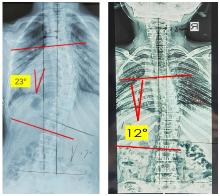
图1
病例1 注:试验组患儿,男,10岁,治疗3个月随访,Cobb角由23°降至12°。"
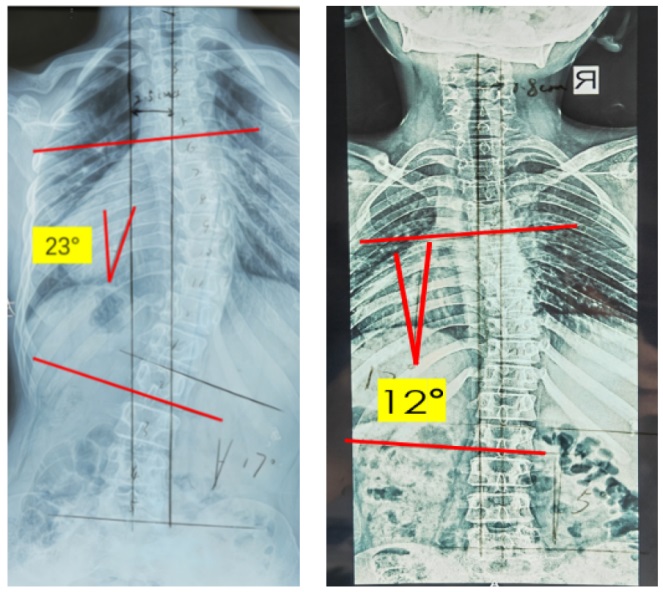
图2
病例2 注:试验组患儿,女,13岁,训练3个月后Cobb角由15.0°降至1.8°。"
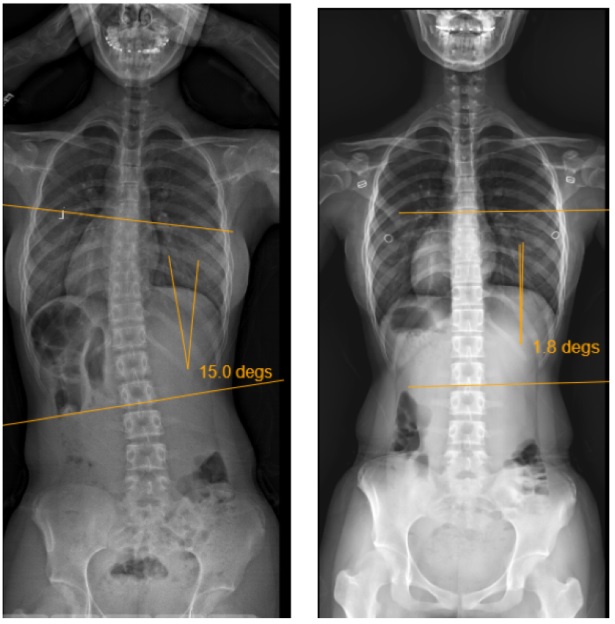
表4
两组治疗前后SRS-22评分比较"
| 变量 | 组别 | n | 测试 | t值 | P值 | |
|---|---|---|---|---|---|---|
| 功能 | 对照组 | 20 | 前测 | 4.29±0.46 | -0.758 | 0.453 |
| 后测 | 4.40±0.50 | |||||
| 试验组 | 21 | 前测 | 4.19±0.68 | -0.970 | 0.338 | |
| 后测 | 4.38±0.59 | |||||
| 治疗前两组均值差 | -0.10±0.58 | -0.552 | 0.579 | |||
| 治疗后两组均值差 | -0.02±0.55 | -0.120 | 0.907 | |||
| 疼痛 | 对照组 | 20 | 前测 | 4.19±0.60 | -0.647 | 0.521 |
| 后测 | 4.30±0.47 | |||||
| 试验组 | 21 | 前测 | 4.14±0.79 | -0.940 | 0.354 | |
| 后测 | 4.33±0.48 | |||||
| 治疗前两组均值差 | -0.05±0.70 | -0.227 | 0.821 | |||
| 治疗后两组均值差 | 0.03±0.48 | 0.202 | 0.841 | |||
| 自我感觉 | 对照组 | 20 | 前测 | 4.48±0.68 | -1.534 | 0.134 |
| 后测 | 4.75±0.44 | |||||
| 试验组 | 21 | 前测 | 4.67±0.48 | -1.041 | 0.304 | |
| 后测 | 4.81±0.40 | |||||
| 治疗前两组均值差 | 0.19±0.59 | 1.038 | 0.306 | |||
| 治疗后两组均值差 | 0.06±0.42 | 0.457 | 0.650 | |||
| 心理健康 | 对照组 | 20 | 前测 | 4.29±0.90 | 0.890 | 0.388 |
| 后测 | 4.10±0.31 | |||||
| 试验组 | 21 | 前测 | 4.10±0.62 | -2.161 | 0.037 | |
| 后测 | 4.48±0.51 | |||||
| 治疗前两组均值差 | 0.19±0.77 | 0.790 | 0.434 | |||
| 治疗后两组均值差 | 0.38±0.42 | 2.873 | 0.007 | |||
| 满意度 | 对照组 | 4.20±0.52 | -4.194 | < 0.001 | ||
| 试验组 | 4.81±0.40 |
| [1] |
Veis Karami M, Aboutorabi A, Ebrahimzadeh K, et al. The effect of orthotic interventions on balance performance in adolescent idiopathic scoliosis: a systematic literature review[J]. Assist Technol, 2020, 32(5): 260-267.
doi: 10.1080/10400435.2018.1539419 pmid: 30601092 |
| [2] | 王彦辉, 陈学明, 袁鑫, 等. 北京市通州区中学生脊柱侧凸流行病学调查[J]. 中国脊柱脊髓杂志, 2018, 28(7): 667-669. |
| Wang Y H, Chen X M, Yuan X, et al. The epidemiological investigation of adolescent scoliosis in Beijing Tongzhou district[J]. Chin J Spine Spinal Cord, 2018, 28(7): 667-669. | |
| [3] | 杜青, 励建安, 周璇, 等. 青少年特发性脊柱侧凸康复治疗卫生经济学初步研究[J]. 中国康复医学杂志, 2013, 28(7): 615-618. |
| Du Q, Li J A, Zhou X, et al. A preliminary study of the cost-effect evaluation on rehabilitation in patients with adolescent idiopathic scoliosis[J]. Chin J Rehabil Med, 2013, 28(7): 615-618. | |
| [4] | 黄剑平, 姜乃夫, 李沅衡, 等. 高密度表面肌电对青少年特发性脊柱侧凸患者竖脊肌协同活动的评估[J]. 中国脊柱脊髓杂志, 2021, 31(6): 502-509, 519. |
| Huang J P, Jiang N F, Li Y H, et al. Assessment of coordinated activity of the erector spinae muscles based on high-density surface electromyogram in adolescent idiopathic scoliosis patients[J]. Chin J Spine Spinal Cord, 2021, 31(6): 502-509, 519. | |
| [5] | 杜青, 周璇, 励建安, 等. 青少年特发性脊柱侧凸腰腹部肌群表面肌电信号特征研究[J]. 中华物理医学与康复杂志, 2013, 35(8): 612-616. |
| Du Q, Zhou X, Li J A, et al. Lumbo-abdominal muscle activity while standing in adolescents with idiopathic scoliosis[J]. Chin J Phys Med Rehabil, 2013, 35(8): 612-616. | |
| [6] |
Zetterberg C, Bjork R, Ortengren R, et al. Electromyography of the paravertebral muscles in idiopathic scoliosis: measurements of amplitude and spectral changes under load[J]. Acta Orthop Scand, 1984, 55(3): 304-309.
doi: 10.3109/17453678408992362 pmid: 6741480 |
| [7] | 袁望舒, 陈丽霞, 沈建雄, 等. 青少年特发性脊柱侧凸患者顶椎椎旁肌表面肌电信号与Cobb角及轴向躯干旋转角的相关性[J]. 中国组织工程研究, 2019, 23(24): 3824-3828. |
| Yuan W S, Chen L X, Shen J X, et al. Correlation of surface electromyogram signals of the apex vertebral paraspinal muscle with Cobb angle and axial trunk rotation angle in adolescent idiopathic scoliosis patients[J]. Chin J Tissue Eng Res, 2019, 23(24): 3824-3828. | |
| [8] |
Marti C L, Glassman S D, Knott P T, et al. Scoliosis Research Society members attitudes towards physical therapy and physiotherapeutic scoliosis specific exercises for adolescent idiopathic scoliosis[J]. Scoliosis, 2015, 10: 16.
doi: 10.1186/s13013-015-0041-z pmid: 26056527 |
| [9] |
Yuan W, Shi W, Chen L, et al. Digital physiotherapeutic scoliosis-specific exercises for adolescent idiopathic scoliosis: a randomized clinical trial[J]. JAMA Netw Open, 2025, 8(2): e2459929.
doi: 10.1001/jamanetworkopen.2024.59929 |
| [10] |
Baumann A N, Orellana K, Oleson C J, et al. The impact of patient scoliosis-specific exercises for adolescent idiopathic scoliosis: a systematic review and meta-analysis of randomized controlled trials with subgroup analysis using observational studies[J]. Spine Deform, 2024, 12(3): 545-559.
doi: 10.1007/s43390-023-00810-x pmid: 38243155 |
| [11] | Karavidas N, Iakovidis P, Chatziprodromidou I, et al. Physiotherapeutic scoliosis-specific exercises (PSSE-Schroth) can reduce the risk for progression during early growth in curves below 25°: prospective control study[J]. Eur J Phys Rehabil Med, 2024, 60(2): 331-339. |
| [12] |
Ma K, Wang C, Huang Y, et al. The effects of physiotherapeutic scoliosis-specific exercise on idiopathic scoliosis in children and adolescents: a systematic review and meta-analysis[J]. Physiotherapy, 2023, 121: 46-57.
doi: 10.1016/j.physio.2023.07.005 pmid: 37820462 |
| [13] | Białek M, Piorun S, Białek-Kucharska E, et al. Comparison of objective and subjective indicators in patients with idiopathic scoliosis undergoing PSSE therapy: retrospective observational[J]. Medicina (Kaunas), 2026, 62(4): 652. |
| [14] | Schreiber S, Whibley D, Somers E C. Schroth physiotherapeutic scoliosis-specific exercise (PSSE) trials: systematic review of methods and recommendations for future research[J]. Children (Basel), 2023, 10(6): 954. |
| [15] | 连昊. 弹力带抗阻训练结合旋转成角呼吸法对中轻度特发性脊柱侧凸患者治疗的实验研究[D]. 太原: 山西大学, 2023. |
| [16] | 刘文洁, 梁佳佳, 孙姣姣, 等. 椎旁肌电刺激治疗青少年特发性脊柱侧凸的研究进展[J]. 中国脊柱脊髓杂志, 2024, 34(12): 1315-1321. |
| Liu W J, Liang J J, Sun J J, et al. Research progress in the treatment of adolescent idiopathic scoliosis by paravertebral muscle electrical stimulation[J]. Chin J Spine Spinal Cord, 2024, 34(12): 1315-1321. | |
| [17] |
Hresko M T. Clinical practice. Idiopathic scoliosis in adolescents[J]. N Engl J Med, 2013, 368(9): 834-841.
doi: 10.1056/NEJMcp1209063 |
| [18] |
Schmid A B, Dyer L, Böni T, et al. Paraspinal muscle activity during symmetrical and asymmetrical weight training in idiopathic scoliosis[J]. J Sport Rehabil, 2010, 19(3): 315-327.
doi: 10.1123/jsr.19.3.315 pmid: 20811080 |
| [19] |
Cheung J, Veldhuizen A G, Halberts J P, et al. Geometric and electromyographic assessments in the evaluation of curve progression in idiopathic scoliosis[J]. Eur Spine J, 2005, 14(2): 130-137.
doi: 10.1007/s00586-004-0780-7 pmid: 15368104 |
| [20] | Cassidy J, Brandell B, Nykoliation J, et al. The role of paraspinal muscles in the pathogenesis of idiopathic scoliosis: a preliminary EMG study[J]. J Can Chiropr Assoc, 1987, 31(4): 179-184. |
| [21] | Kwok G, Yip J, Cheung M C, et al. Evaluation of myoelectric activity of paraspinal muscles in adolescents with idiopathic scoliosis during habitual standing and sitting[J]. Biomed Res Int, 2015, 2015: 958450. |
| [22] |
Wang Y, Wang S, Gu M, et al. Paraspinal muscles activities in S-shaped adolescent idiopathic scoliosis during physiotherapeutic scoliosis specific exercise: a case-control study[J]. BMC Musculoskelet Disord, 2025, 26(1): 167.
doi: 10.1186/s12891-025-08423-3 |
| [23] |
Cheung J, Veldhuizen A G, Halberts J P, et al. Geometric and electromyographic assessments in the evaluation of curve progression in idiopathic scoliosis[J]. Spine (Phila Pa 1976), 2006, 31(3): 322-329.
pmid: 16449906 |
| [24] |
Fan Y, To M K T, Yeung E H K, et al. Electromyographic discrepancy in paravertebral muscle activity predicts early curve progression of untreated adolescent idiopathic scoliosis[J]. Asian Spine J, 2023, 17(5): 922-932.
doi: 10.31616/asj.2023.0199 pmid: 37690987 |
| [25] |
Wilson J M, Loenneke J P, Jo E, et al. The effects of endurance, strength, and power training on muscle fiber type shifting[J]. J Strength Cond Res, 2012, 26(6): 1724-1729.
doi: 10.1519/JSC.0b013e318234eb6f pmid: 21912291 |
| [26] |
Stetkarova I, Zamecnik J, Bocek V, et al. Electrophysiological and histological changes of paraspinal muscles in adolescent idiopathic scoliosis[J]. Eur Spine J, 2016, 25(10): 3146-3153.
pmid: 27246349 |
| [27] | 李祁伟, 周永德, 吉士俊. 实验性脊柱侧弯椎旁肌肌纤维型分布的观察[J]. 中国医科大学学报, 2002, 31(z1): 16-18. |
| Li Q W, Zhou Y D, Ji S J. Effect of experimental scoliosis on the distribution of muscular fiber types in paravertebral muscles[J]. J China Med Univ, 2002, 31(z1): 16-18. | |
| [28] |
Zhang T, Li B, Sui W, et al. The neurogenic abnormalities of paraspinal muscles lead to asymmetry of fibre types in adolescent idiopathic scoliosis[J]. J Cell Mol Med, 2025, 29(10): e70619.
doi: 10.1111/jcmm.v29.10 |
| [29] | Wang Y, Pessin J E. Mechanisms for fiber-type specificity of skeletal muscle atrophy[J]. Curr Opin Clin Nutr Metab Care, 2013, 16(3): 243-250. |
| [30] | 吴亮, 邱勇, 王斌, 等. 特发性脊柱侧凸患者两侧椎旁肌中肌梭与运动终板病理学变化的对比研究[J]. 中国脊柱脊髓杂志, 2008, 18(3): 222-226. |
| Wu L, Qiu Y, Wang B, et al. Comparison of pathological changes of muscle spindle and motor end-plate in bilateral paravertebral muscle in adolescent idiopathic scoliosis[J]. Chin J Spine Spinal Cord, 2008, 18(3): 222-226. | |
| [31] | Peng Y, Wang S R, Qiu G X, et al. Research progress on the etiology and pathogenesis of adolescent idiopathic scoliosis[J]. Chin Med J (Engl), 2020, 133(4): 483-493. |
| [32] |
Liang R, Yip J, Fan Y, et al. Electromyographic analysis of paraspinal muscles of scoliosis patients using machine learning approaches[J]. Int J Environ Res Public Health, 2022, 19(3): 1177.
doi: 10.3390/ijerph19031177 |
| [33] | 王楚怀, 许轶, 梁崎, 等. 青少年特发性脊柱侧弯症患者椎旁肌表面肌电信号测试方法选择与比较[J]. 中华物理医学与康复杂志, 2009, 31(11): 753-755. |
| Wang C H, Xu Y, Liang Q, et al. A comparison of surface electromyographic signals recorded from the paraspinal muscles of adolescents with idiopathic scoliosis during three loading tests[J]. Chin J Phys Med Rehabil, 2009, 31(11): 753-755. | |
| [34] | Haksever B, Soylu C, Demir D, et al. Unraveling the muscle activation equation: 3D scoliosis-specific exercises and muscle response in adolescent idiopathic scoliosis[J]. Appl Sci (Basel), 2024, 14(16): 6984. |
| [35] | 张娟娟, 蒋楠楠, 吴亚军, 等. Schroth疗法联合核心力量训练改善轻度青少年特发性脊柱侧凸患者的侧凸角度[J]. 中国组织工程研究, 2025, 29(27): 5876-5882. |
| Zhang J J, Jiang N N, Wu Y J, et al. Schroth therapy combined with core strength training improves scoliosis angle in patients with mild adolescent idiopathic scoliosis[J]. Chin J Tissue Eng Res, 2025, 29(27): 5876-5882. | |
| [36] | 陈阳, 王洁, 朱源棚, 等. Schroth疗法治疗青少年特发性脊柱侧凸的meta分析[J]. 中华骨科杂志, 2025, 45(7): 429-435. |
| Chen Y, Wang J, Zhu Y P, et al. Schroth therapy for adolescent idiopathic scoliosis: a meta-analysis[J]. Chin J Orthop, 2025, 45(7): 429-435. | |
| [37] |
聂丹宁, 史曙生, 陶昱如. 本体感觉神经肌肉促进技术联合螺旋稳定肌肉链训练治疗青少年特发性脊柱侧弯的临床效果研究[J]. 中国全科医学, 2025, 28(24): 3032-3042.
doi: 10.12114/j.issn.1007-9572.2024.0562 |
| Nie D N, Shi S S, Tao Y R. Clinical effect of proprioceptive neuromuscular facilitation technique combined with spiral stabilizing muscle chain training in the treatment of adolescent idiopathic scoliosis[J]. Chin Gen Pract, 2025, 28(24): 3032-3042. | |
| [38] | 王孙成. 通督调脊推拿术配合Schroth脊柱矫正疗法治疗青少年特发性脊柱侧弯45例[J]. 浙江中医杂志, 2025, 60(6): 545-546. |
| Wang S C. Treatment of 45 cases of adolescent idiopathic scoliosis with Tongdu Tiaoji massage combined with Schroth spinal correction therapy[J]. Zhejiang J Tradit Chin Med, 2025, 60(6): 545-546. | |
| [39] | 曾红梅, 罗霄, 徐洋, 等. 中医正骨手法结合施罗斯训练对青少年特发性脊柱侧弯的临床效果观察[J]. 中医康复, 2025, 2(6): 30-34. |
| Zeng H M, Luo X, Xu Y, et al. The therapeutic effect of TCM bone-setting techniques combined with Schroth training on adolescent idiopathic scoliosis[J]. Tradit Chin Med Rehabil, 2025, 2(6): 30-34. | |
| [40] | 孙岩, 张雅萍, 孙运强, 等. Schroth康复锻炼计划对特发性脊柱侧凸青少年患者脊柱和足部的矫正效果[J]. 颈腰痛杂志, 2024, 45(1): 87-91. |
| Sun Y, Zhang Y P, Sun Y Q, et al. Effect of Schroth rehabilitation exercise program on alignment of spine and foot in adolescent patients with idiopathic scoliosis[J]. J Cervicodynia Lumbodynia, 2024, 45(1): 87-91. | |
| [41] | 王开乐, 周佳华, 李佳佳, 等. 核心肌群训练纠正轻度青少年特发性脊柱侧弯[J]. 中国矫形外科杂志, 2024, 32(17): 1613-1617. |
| Wang K L, Zhou J H, Li J J, et al. Core muscle training to correct mild adolescent idiopathic scoliosis[J]. Orthop J China, 2024, 32(17): 1613-1617. | |
| [42] | Tsai Y T, Leong C P, Huang Y C, et al. The electromyographic responses of paraspinal muscles during isokinetic exercise in adolescents with idiopathic scoliosis with a Cobb's angle less than fifty degrees[J]. Chang Gung Med J, 2010, 33(5): 540-550. |
| [43] |
Becker L, Li Z, Wang Z, et al. Adolescent idiopathic scoliosis is associated with muscle area asymmetries in the lumbar spine[J]. Eur Spine J, 2023, 32(11): 3979-3986.
doi: 10.1007/s00586-023-07921-z pmid: 37698695 |
| [1] | 魏彤彤, 田益凡, 陈婷, 姚琦, 胡建民. ICF在视力障碍康复中应用的Scoping综述[J]. 《中国康复理论与实践》, 2026, 32(9): 1025-1032. |
| [2] | 迟茜茜, 张小年, 朱晓敏, 孙琬玥, 张欣, 周进, 卜宏伟, 翟蕾, 张新, 凌子锐, 陈泓宇. 规范化康复单元对脑外伤的效果[J]. 《中国康复理论与实践》, 2026, 32(9): 1033-1040. |
| [3] | 冯晓娟, 黄富表, 李冬跃, 周明毅, 牛宇轩, 麦格皮热提·伊斯马伊力, 王曦贤, 王子乐. 一种自稳式家用手功能互动训练装置的研发及可行性研究[J]. 《中国康复理论与实践》, 2026, 32(9): 1068-1077. |
| [4] | 周慧玲, 曾嘉彦, 陈冰. 轻度伤残职业康复者生活质量状况及其与不同层次复工结局的关联[J]. 《中国康复理论与实践》, 2026, 32(9): 1078-1086. |
| [5] | 郭旭霞, 虞恒睿, 卢宇澄, 杨思创, 龙雨, 李佳蔚, 陈琳, 农飞玉, 龙耀斌. 基于感知-认知解耦的可解释人工智能运动康复评估系统设计与验证[J]. 《中国康复理论与实践》, 2026, 32(9): 1108-1116. |
| [6] | 中国康复医学会青年工作委员会, 中国微循环学会周围血管委员会淋巴水肿专家委员会, 中国抗癌协会肿瘤康复整合护理专业专委会, 中国康复医学会社区康复工作委员会. 乳腺癌术后腋网综合征治疗与管理规范中国专家共识(2025)[J]. 《中国康复理论与实践》, 2026, 32(8): 869-881. |
| [7] | 中国康复医学会青年工作委员会, 中国微循环学会周围血管委员会淋巴水肿专家委员会, 中国抗癌协会肿瘤康复整合护理专业委员会. 乳腺癌术后腋网综合征识别与诊断标准中国专家共识[J]. 《中国康复理论与实践》, 2026, 32(8): 882-891. |
| [8] | 梁艳华, 张通, 张琦, 周天添, 张燕庆, 岳青, 李思佳. 康复机器人训练对偏瘫儿童腹肌厚度和平衡能力的效果[J]. 《中国康复理论与实践》, 2026, 32(8): 927-937. |
| [9] | 田靖晓, 艾佳茗, 闵红巍, 赵克聪, 张宝翠, 姜虹, 杨威, 刘均娥. 基于每日目标管理路径的全膝关节置换术患者运动干预方案的构建及初步验证[J]. 《中国康复理论与实践》, 2026, 32(8): 959-967. |
| [10] | 刘华, 马欣, 李静, 王丽媛, 王丽. 基于康复胜任力的运动康复专业硕士研究生培养方案比较[J]. 《中国康复理论与实践》, 2026, 32(8): 984-992. |
| [11] | 李锦萌, 柳君娜, 陈强, 毕鸿雁. 2011年至2025年远程医疗、可穿戴设备和人工智能在慢性阻塞性肺疾病肺康复中应用的文献计量分析[J]. 《中国康复理论与实践》, 2026, 32(7): 829-840. |
| [12] | 马颖, 任君, 王首鉴, 周鑫, 何天翔, 孔令军, 房敏. 基于治疗前和支具初配信息的青少年特发性脊柱侧凸支具治疗失败风险预测模型构建与初步验证[J]. 《中国康复理论与实践》, 2026, 32(7): 850-860. |
| [13] | 张溢杉, 宋佳佳, 侯天宇, 孟丽君. 康复工程中的伦理挑战与治理前瞻[J]. 《中国康复理论与实践》, 2026, 32(7): 861-868. |
| [14] | 李欣源, 郑洁皎, 张廷宇, 吴雪娇, 梁晓笑. 间歇性θ脉冲刺激改善脑卒中患者下肢运动和平衡功能的Meta分析[J]. 《中国康复理论与实践》, 2026, 32(6): 631-644. |
| [15] | 郭子扬, 曹明. 1987年至2025年残疾人社区康复研究的文献计量分析[J]. 《中国康复理论与实践》, 2026, 32(6): 665-676. |
| 阅读次数 | ||||||
|
全文 |
|
|||||
|
摘要 |
|
|||||
|
||
