



《中国康复理论与实践》 ›› 2025, Vol. 31 ›› Issue (12): 1430-1438.doi: 10.3969/j.issn.1006-9771.2025.12.007
高婷1, 赵兵全2( )
)
收稿日期:2025-08-20
修回日期:2025-10-27
出版日期:2025-12-25
发布日期:2025-12-29
通讯作者:
赵兵全
E-mail:1248014589@qq.com
作者简介:高婷(1994-),女,彝族,云南曲靖市人,硕士,讲师,主要研究方向:神经康复。
基金资助:
GAO Ting1, ZHAO Bingquan2()
Received:2025-08-20
Revised:2025-10-27
Published:2025-12-25
Online:2025-12-29
Contact:
ZHAO Bingquan
E-mail:1248014589@qq.com
Supported by:摘要:
目的 探讨3D打印技术在脑卒中应用的研究热点和发展趋势。
方法 检索自建库至2025年Web of Science核心合集中3D打印技术在脑卒中应用的相关研究,采用CiteSpace 6.2.R7进行文献计量分析。
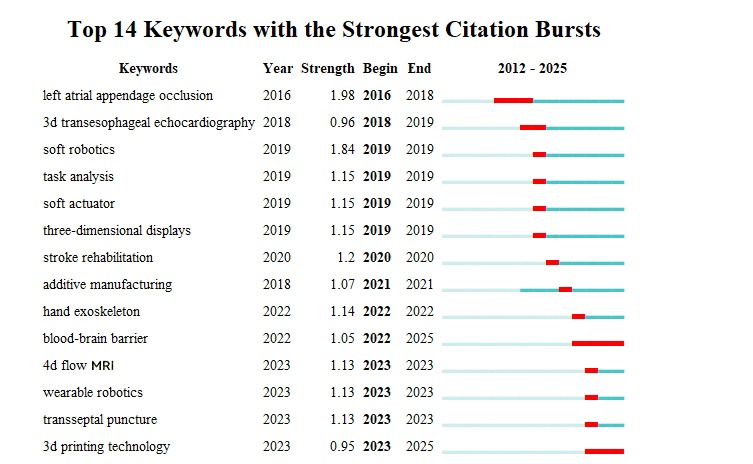
结果 共纳入264篇文献。发文量呈波动上升趋势,2023年发文量达到峰值。美国、中国发文量和中心性均位居全球前二。发文量最多的机构是佐治亚联合大学,发文量最多的作者是Bobak Mosadegh、Evan Friend、Sutanuka Bhattacharjya和Robert F Shepherd等。被引频次最高的文献为Holmes等(2014)和Otton等(2015)的文章。共现频率前5的关键词是左心耳封堵术、软机器人、房颤、人造肌肉和血脑屏障。关键词聚类分析形成7个类,主要聚焦于预防、急性治疗、康复和基础研究4个领域。近年出现的突现词是血脑屏障和3D打印技术,左心耳封堵术突现强度最高。
结论 3D打印技术在脑卒中领域主要聚焦于左心耳封堵术、软机器人和房颤管理等医工交叉方向。
中图分类号:
高婷, 赵兵全. 3D打印技术在脑卒中应用的文献计量分析[J]. 《中国康复理论与实践》, 2025, 31(12): 1430-1438.
GAO Ting, ZHAO Bingquan. Application of 3D printing technology in stroke: a bibliometric analysis[J]. Chinese Journal of Rehabilitation Theory and Practice, 2025, 31(12): 1430-1438.

图1
年发文量"
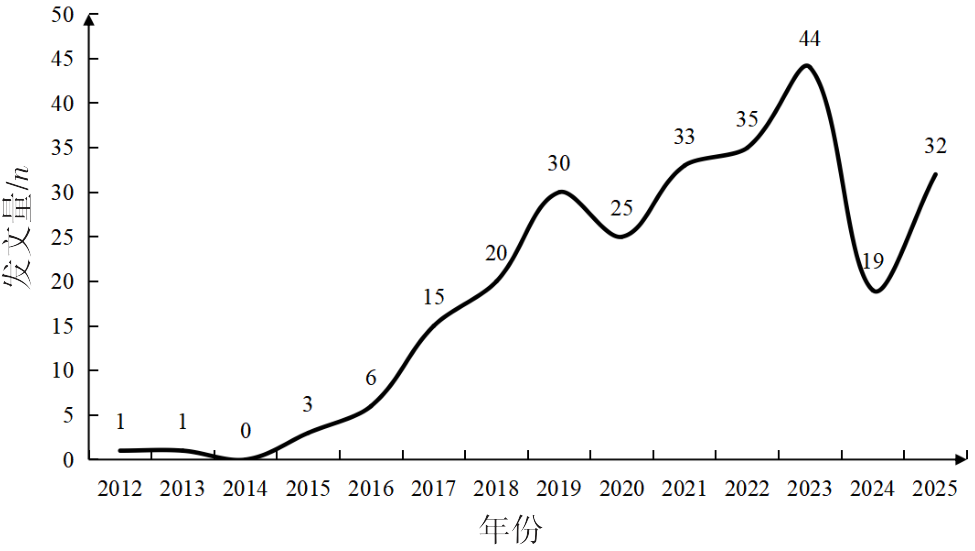
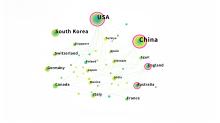
图2
国家共现图"

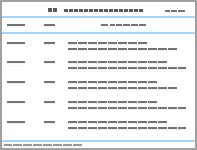
表1
国家发文量及中心性排序"
| 排名 | 发文量 | 中心性 | |||
|---|---|---|---|---|---|
| 国家 | n | 国家 | 数值 | ||
| 1 | 美国 | 73 | 美国 | 0.70 | |
| 2 | 中国 | 68 | 中国 | 0.45 | |
| 3 | 韩国 | 22 | 英国 | 0.26 | |
| 4 | 英国 | 16 | 澳大利亚 | 0.15 | |
| 5 | 澳大利亚 | 14 | 印度 | 0.08 | |
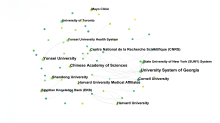
图3
机构共现图"
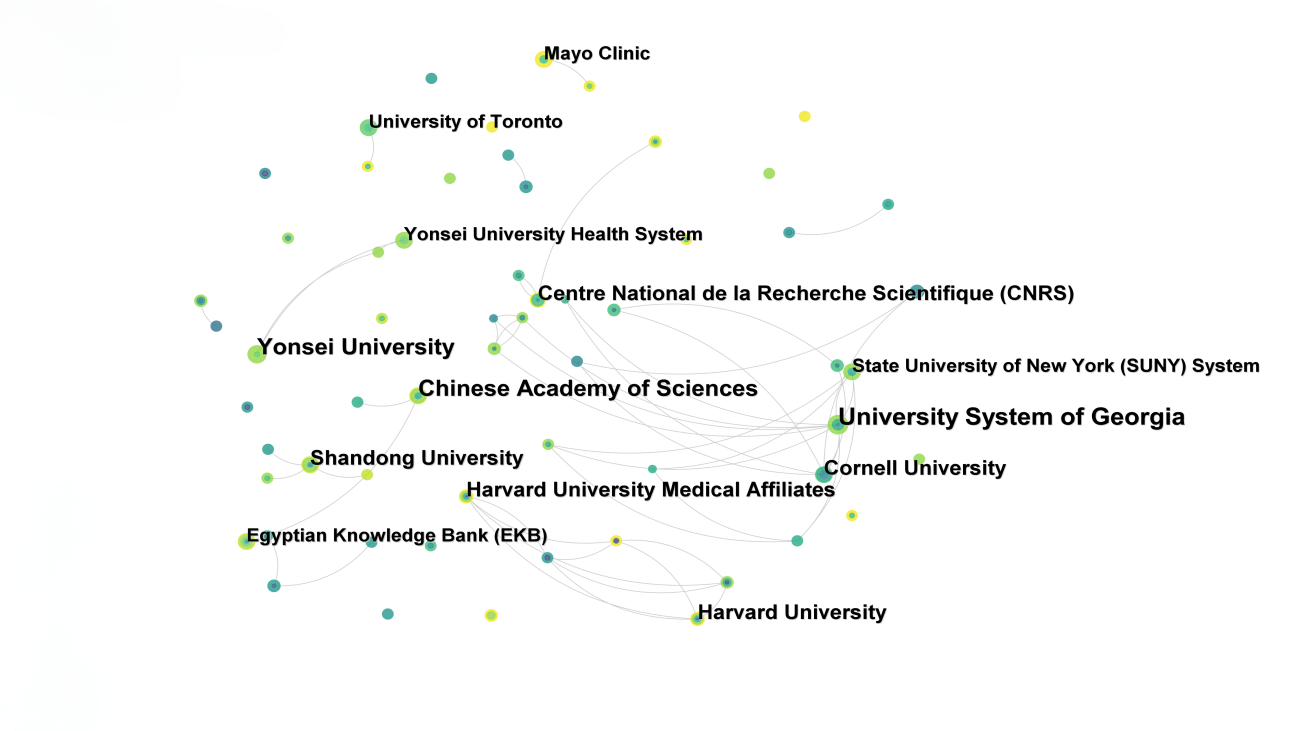
图4
作者共现图"

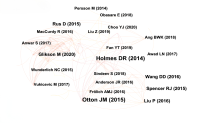
图5
共被引文献图"

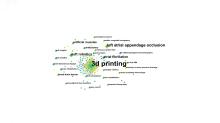
图6
关键词共现图谱"

表2
频次前5的关键词"
| 关键词 | n |
|---|---|
| 左心耳封堵术 | 12 |
| 软机器人 | 8 |
| 心房纤颤 | 7 |
| 人造肌肉 | 5 |
| 血脑屏障 | 3 |
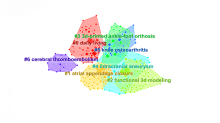
图7
关键词聚类图谱"

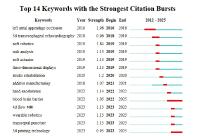
图8
关键词突现图谱"
| [1] |
MARKUS H S, LEUNG T. Stroke in China[J]. Int J Stroke, 2023, 18(3): 256-258.
doi: 10.1177/17474930231157479 pmid: 36803086 |
| [2] | SAINI V, GUADA L, YAVAGAL D R. Global epidemiology of stroke and access to acute ischemic stroke interventions[J]. Neurology, 2021, 97(20Suppl 2): S6-S16. |
| [3] | WINSTEIN C J, STEIN J, ARENA R, et al. Guidelines for adult stroke rehabilitation and recovery: a guideline for healthcare professionals from the American Heart Association/American Stroke Association[J]. Stroke, 2016, 47(6): e98-e169. |
| [4] |
施滨, 徐宁, 周广雪. 镜像疗法应用于脑卒中运动功能康复的文献计量分析[J]. 中国康复理论与实践, 2025, 31(5): 561-572.
doi: 10.3969/j.issn.1006-9771.2025.05.009 |
| SHI B, XU N, ZHOU G X. Application of mirror therapy in motor function rehabilitation for stroke: a bibliometric analysis from 2005 to 2024[J]. Chin J Rehabil Theory Pract, 2025, 31(5): 561-572. | |
| [5] | LUKIĆ M, CLARKE J, TUCK C, et al. Printability of elastomer latex for additive manufacturing or 3D printing[J]. J Appl Polym Sci, 2016, 133(4): 42931. |
| [6] | TIAN Y, CHEN C, XU X, et al. A review of 3D printing in dentistry: technologies, affecting factors, and applications[J]. Scanning, 2021, 2021: 1-12. |
| [7] | LIU Y, SONG H, XIAO B, et al. PCNL combined with 3D printing technology for the treatment of complex staghorn kidney stones[J]. J Healthcare Eng, 2022, 2022: 7554673. |
| [8] |
CHENG J T Y, TAN E C K, KANG L. Pharmacy 3D printing[J]. Biofabrication, 2024, 17(1): 012002.
doi: 10.1088/1758-5090/ad837a |
| [9] | 宁天亮. 3D打印踝足矫形器的设计与应用研究[D]. 呼和浩特: 内蒙古工业大学, 2023. |
| NING T L. Design and application research of 3D printed ankle foot orthosis[D]. Hohhot: Inner Mongolia University of Technology, 2023. | |
| [10] | 高歌. 3D打印踝足矫形器与传统踝足矫形器对脑卒中患者步行功能恢复的疗效观察[D]. 承德: 承德医学院, 2024. |
| GAO G. 3D printed ankle-foot orthosis versus traditional ankle-foot orthosis for stroke patients: curative effect observation on recovery of walking function[D]. Chengde: Chengde Medical College, 2024. | |
| [11] |
ARUMUGAM K, IBRAHIM SHERIFF K A, SRITHAR S, et al. Design and development of innovative sensor-driven electrotherapeutic glove for upper arm hemiplegia using 3D printing and STM controller[J]. Acupunct Electrother Res, 2025, 49(4): 195-205.
doi: 10.1177/03601293251337503 |
| [12] |
YEH C H, LIN K R, SU F C, et al. Optimizing 3D printed ankle-foot orthoses for patients with stroke: importance of effective elastic modulus and finite element simulation[J]. Heliyon, 2024, 10(5): e26926.
doi: 10.1016/j.heliyon.2024.e26926 |
| [13] |
HUBER J, SLONE S, BAZRARI B. An evaluation of 3D printable elastics for post stroke dynamic hand bracing: a pilot study[J]. Assist Technol, 2023, 35(6): 513-522.
doi: 10.1080/10400435.2023.2177774 |
| [14] |
FU J C M, CHEN Y J, LI C F, et al. The effect of three dimensional printing hinged ankle foot orthosis for equinovarus control in stroke patients[J]. Clin Biomech, 2022, 94: 105622.
doi: 10.1016/j.clinbiomech.2022.105622 |
| [15] | 陈悦, 陈超美, 刘则渊, 等. CiteSpace知识图谱的方法论功能[J]. 科学学研究, 2015, 33(2): 242-253. |
| CHEN Y, CHEN C M, LIU Z Y, et al. The methodology function of CiteSpace mapping knowledge domains[J]. Stud Sci Sci, 2015, 33(2): 242-253. | |
| [16] |
HOLMES D R, KAR S, PRICE M J, et al. Prospective randomized evaluation of the Watchman left atrial appendage closure device in patients with atrial fibrillation versus long-term warfarin therapy: the PREVAIL trial[J]. J Am Coll Cardiol, 2014, 64(1): 1-12.
doi: 10.1016/j.jacc.2014.04.029 pmid: 24998121 |
| [17] |
OTTON J M, SPINA R, SULAS R, et al. Left atrial appendage closure guided by personalized 3D-printed cardiac reconstruction[J]. JACC Cardiovasc Interv, 2015, 8(7): 1004-1006.
doi: 10.1016/j.jcin.2015.03.015 |
| [18] |
秦晴, 刘叶, 叶海燕, 等. 上肢机器人辅助干预脑卒中的文献计量分析[J]. 中国康复理论与实践, 2025, 31(1): 85-98.
doi: 10.3969/j.issn.1006-9771.2025.01.008 |
| QIN Q, LIU Y, YE H Y, et al. Robot-assisted therapy for upper limb of stroke: a bibliometrics analysis[J]. Chin J Rehabil Theory Pract, 2025, 31(1): 85-98. | |
| [19] | 欧吉兵, 徐春燕, 付雨桐, 等. 基于CiteSpace的脑卒中上肢功能康复的可视化分析[J]. 医学信息, 2022, 35(2): 31-35. |
| OU J B, XU C Y, FU Y T, et al. Visual analysis of upper limb functional rehabilitation after stroke based on CiteSpace[J]. J Med Inf, 2022, 35(2): 31-35. | |
| [20] | 李仁辉, 王广, 诸战诞, 等. 蓝藻溶藻细菌研究现状的可视化分析[J]. 河南师范大学学报(自然科学版), 2024, 52(2): 111-122. |
| LI R H, WANG G, ZHU Z D, et al. Visualized analyses on current research status on algicidal bacteria of cyanobacteria[J]. J Henan Norm Univ (Nat Sci Ed), 2024, 52(2): 111-122. | |
| [21] |
BERTSCHE D, PFISTERER M, DAHME T, et al. MRI-based training model for left atrial appendage closure[J]. Int J Comput Assist Radiol Surg, 2023, 18(11): 2111-2116.
doi: 10.1007/s11548-023-02870-w pmid: 36997829 |
| [22] |
KIM Y, YANG H, CHO K C, et al. 3D-printed patient-specific circles of willis with an intracranial aneurysm and their application to neurointerventional endovascular simulation[J]. Adv Mater Technol, 2023, 8(15): 2370073.
doi: 10.1002/admt.v8.15 |
| [23] |
POPIșTER F, DRAGOMIR M, CIUDIN P, et al. Empowering rehabilitation: design and structural analysis of a low-cost 3D-printed smart orthosis[J]. Polymers (Basel), 2024, 16(10):1303.
doi: 10.3390/polym16101303 |
| [24] |
CHO J E, SEO K J, HA S, et al. Effects of community ambulation training with 3D-printed ankle-foot orthosis on gait and functional improvements: a case series of three stroke survivors[J]. Front Neurol, 2023, 14: 1138807.
doi: 10.3389/fneur.2023.1138807 |
| [25] |
BHATTACHARJYA S, LINARES I, LANGAN J, et al. Engaging in a home-based exercise program: a mixed-methods approach to identify motivators and barriers for individuals with stroke[J]. Assist Technol, 2023, 35(6): 487-496.
doi: 10.1080/10400435.2022.2151663 |
| [26] |
ROBINSON S S, ALAIE S, SIDOTI H, et al. Patient-specific design of a soft occluder for the left atrial appendage[J]. Nat Biomed Eng, 2018, 2(1): 8-16.
doi: 10.1038/s41551-017-0180-z pmid: 31015654 |
| [27] |
MAC MURRAY B C, FUTRAN C C, LEE J, et al. Compliant buckled foam actuators and application in patient-specific direct cardiac compression[J]. Soft Robot, 2018, 5(1): 99-108.
doi: 10.1089/soro.2017.0018 pmid: 29412085 |
| [28] |
ROBINSON S S, AUBIN C A, WALLIN T J, et al. Stereolithography for personalized left atrial appendage occluders[J]. Adv Mater Technol, 2018, 3(12): 1800233.
doi: 10.1002/admt.v3.12 |
| [29] |
OBASARE E, MAINIGI S K, MORRIS D L, et al. CT based 3D printing is superior to transesophageal echocardiography for pre-procedure planning in left atrial appendage device closure[J]. Int J Cardiovasc Imaging, 2018, 34(5): 821-831.
doi: 10.1007/s10554-017-1289-6 pmid: 29222738 |
| [30] | SANTOS J D, BELOY F J, SULAGUE R M, et al. Three-dimensional-printed models reduce adverse events of left atrial appendage occlusion: a systematic review and meta-analysis[J]. Catheter Cardiovasc Interv, 2025, 105(7): 1688-1694. |
| [31] |
HEIDARI H, KANSCHIK D, MAIER O, et al. A comparison of conventional and advanced 3D imaging techniques for percutaneous left atrial appendage closure[J]. Front Cardiovasc Med, 2024, 11: 1328906.
doi: 10.3389/fcvm.2024.1328906 |
| [32] |
MENDEZ K, SINGH M, WILLOUGHBY P, et al. Design and validation of a high-fidelity left atrial cardiac simulator for the study and advancement of left atrial appendage occlusion[J]. Cardiovasc Eng Technol, 2025, 16(3): 279-295.
doi: 10.1007/s13239-025-00773-2 |
| [33] |
CHA M J, AN D G, KANG M, et al. Correct closure of the left atrial appendage reduces stagnant blood flow and the risk of thrombus formation: a proof-of-concept experimental study using 4D flow magnetic resonance imaging[J]. Korean J Radiol, 2023, 24(7): 647-659.
doi: 10.3348/kjr.2023.0173 pmid: 37404107 |
| [34] |
KIM W D, CHO I, KIM Y D, et al. Improving left atrial appendage occlusion device size determination by three-dimensional printing-based preprocedural simulation[J]. Front Cardiovasc Med, 2022, 9: 830062.
doi: 10.3389/fcvm.2022.830062 |
| [35] |
ZHAO Y C, WANG Z, ZHAO H, et al. Sensing the future of thrombosis management: integrating vessel-on-a-chip models, advanced biosensors, and AI-driven digital twins[J]. ACS Sens, 2025, 10(3): 1507-1520.
doi: 10.1021/acssensors.4c02764 |
| [36] |
DENGIZ D, VELVALURI P, GROTEMEYER P, et al. Thin-film NiTi intrasaccular implant with flaps for aneurysm treatments[J]. Biomater Adv, 2025, 174: 214311.
doi: 10.1016/j.bioadv.2025.214311 |
| [37] |
CHARBONNIER G, PRIMIKIRIS P, BILLOTTET B, et al. Pre-interventional 3D-printing-assisted planning of flow disrupter implantation for the treatment of an intracranial aneurysm[J]. J Clin Med, 2022, 11(11): 2950.
doi: 10.3390/jcm11112950 |
| [38] |
RAJI A, DINUNZIO S, WHITMELL A, et al. Modification of the Toronto Rehabilitation Institute-Hand Function Test for integration into robot-assisted therapy: technical validation and usability[J]. Biomed Eng Online, 2025, 24(1): 54.
doi: 10.1186/s12938-025-01384-7 pmid: 40336111 |
| [39] |
ZHANG H, ZHANG Y, SHENG L, et al. Mechanically robust neuroprotective stent by sequential Mg ions release for ischemic stroke therapy[J]. Nat Commun, 2025, 16(1): 6557.
doi: 10.1038/s41467-025-61199-x |
| [40] |
WANG F, LIANG M, ZHANG B, et al. Advances in artificial blood vessels: exploring materials, preparation, and functionality[J]. J Mater Sci Technol, 2025, 219: 225-256.
doi: 10.1016/j.jmst.2024.09.029 |
| [41] | WAQAS M, MOKIN M, LIM J, et al. Design and physical properties of 3-dimensional printed models used for neurointervention: a systematic review of the literature[J]. Neurosurgery, 2020, 87(4): E445-E453. |
| [42] |
ARAUJO R S, SILVA C R, NETTO S P N, et al. Development of a low-cost EEG-controlled hand exoskeleton 3D printed on textiles[J]. Front Neurosci, 2021, 15: 661569.
doi: 10.3389/fnins.2021.661569 |
| [43] | LIU Z, TANG Y, ZHANG Z, et al. Engineering neurovascular unit and blood-brain barrier for ischemic stroke modeling[J]. Adv Healthc Mater, 2023, 12(19): e2202638. |
| [1] | 王潇婧, 魏婧怡, 卫晨, 王冉, 马赛, 刘西花. 针刺同步构音训练对脑卒中后痉挛型构音障碍的效果[J]. 《中国康复理论与实践》, 2025, 31(9): 1009-1016. |
| [2] | 周新悦, 叶睿雪, 马雅琦, 许莹, 曹珑耀, 王玉龙. 卒中后中枢性疼痛相关研究的文献计量分析[J]. 《中国康复理论与实践》, 2025, 31(9): 1038-1049. |
| [3] | 高云汉, 侯闪闪, 汪鑫煜, 朱崇田. 基于功能性近红外光谱探讨脑机接口对脑卒中患者上肢运动功能障碍的效果[J]. 《中国康复理论与实践》, 2025, 31(9): 1066-1073. |
| [4] | 张子昂, 陈静, 沈孟茹, 耿宗晓, 韩雪, 赵旭, 徐磊. 不同运动模式对脑卒中患者步行及平衡功能的效果比较[J]. 《中国康复理论与实践》, 2025, 31(8): 896-905. |
| [5] | 陆丹丹, 姚敬智, 李姿, 王柯文, 孙鑫廖, 陈建敏, 许建文. 2014年至2023年帕金森病物理治疗的文献计量学分析[J]. 《中国康复理论与实践》, 2025, 31(8): 906-913. |
| [6] | 王晓锋, 胡梦巧, 汪嫣, 魏坤, 徐文竹, 任丹, 马晔. 外骨骼机器人辅助步态训练对脑卒中和脊髓损伤下肢功能康复效果的系统综述[J]. 《中国康复理论与实践》, 2025, 31(8): 914-921. |
| [7] | 宋竺蔓, 刘娜, 刘杨, 丁雪梅, 张晓丽. 2016年至2025年孤独症谱系障碍儿童父母心理健康研究的文献计量分析[J]. 《中国康复理论与实践》, 2025, 31(7): 790-801. |
| [8] | 孙婉婷, 艾丽皮乃·亚森, 龚翔, 肖悦, 甘兆丹, 刘铭洁, 曾兰婷, 马姝玥, 鲁俊, 许光旭. 基于运动序列学习探讨高频重复经颅磁刺激对脑卒中患者上肢功能的效果[J]. 《中国康复理论与实践》, 2025, 31(7): 812-821. |
| [9] | 刘兰群, 李艳丽, 梁家琦, 陈爽, 刘慧林. 头针结合计算机辅助训练对脑卒中后记忆障碍的效果[J]. 《中国康复理论与实践》, 2025, 31(7): 862-868. |
| [10] | 黄龙贤, 顾思佳, 黄有利, 陈丽梅. 2015年至2024年肌少症性吞咽障碍研究的文献计量分析[J]. 《中国康复理论与实践》, 2025, 31(6): 682-691. |
| [11] | 刘璇, 高玲, 褚凤明, 陈杰, 张明. 脑机接口联合上肢康复机器人对脑卒中患者上肢功能的影响[J]. 《中国康复理论与实践》, 2025, 31(6): 703-710. |
| [12] | 付国军, 余秀芳, 吕鑫, 吉璐, 刘华庆. 复合电磁刺激联合下颌抗阻训练对卒中后吞咽障碍的效果[J]. 《中国康复理论与实践》, 2025, 31(6): 721-728. |
| [13] | 梁丹, 王卫宁, 李策, 吴越, 徐舒, 谢鸿宇, 吴毅, 朱玉连. 高压氧舱内同步脑仿生电刺激对脑卒中相关睡眠障碍的效果[J]. 《中国康复理论与实践》, 2025, 31(5): 497-504. |
| [14] | 柏敏, 曹丽华, 叶子琦, 周定杰, 李雪萍. 肌电感知机器人辅助训练联合成对关联刺激对脑卒中偏瘫患者上肢功能的影响[J]. 《中国康复理论与实践》, 2025, 31(5): 505-512. |
| [15] | 邹聪聪, 王潇珺, 马锦蓉, 鲁商波, 丁勇, 王哈妮, 宋建飞. 耳迷走神经电刺激联合双任务训练对缺血性脑卒中患者上肢功能的效果[J]. 《中国康复理论与实践》, 2025, 31(5): 513-519. |
| 阅读次数 | ||||||
|
全文 |
|
|||||
|
摘要 |
|
|||||
|
||
