



《中国康复理论与实践》 ›› 2025, Vol. 31 ›› Issue (12): 1456-1463.doi: 10.3969/j.issn.1006-9771.2025.12.010
黄茂茂1a,2,3, 邢菲1a,1b, 李丹1a,2,3, 王剑雄1a,2,3( )
)
收稿日期:2025-08-12
修回日期:2025-10-11
出版日期:2025-12-25
发布日期:2025-12-29
通讯作者:
王剑雄
E-mail:jianxiongwang_swmu@126.com
作者简介:黄茂茂(1994-),女,汉族,四川自贡市人,硕士研究生,主要研究方向:认知康复及骨质疏松康复。
基金资助:
HUANG Maomao1a,2,3, XING Fei1a,1b, LI Dan1a,2,3, WANG Jianxiong1a,2,3()
Received:2025-08-12
Revised:2025-10-11
Published:2025-12-25
Online:2025-12-29
Contact:
WANG Jianxiong
E-mail:jianxiongwang_swmu@126.com
Supported by:摘要:
目的 探讨中国老年人胃肠道疾病与痴呆之间的关系。
方法 从2018年中国健康与养老全国追踪调查数据中,纳入年龄≥ 60岁且关键数据完整的老年人。
结果 共纳入6 186例老年人,其中32.15%患胃肠道疾病,13.95%患痴呆。胃肠道疾病与痴呆之间存在明显正相关(OR = 1.178, 95%CI 1.001~1.384);两者之间的相关性不受混杂因素的影响;相关性在女性、居住于城市、小学教育水平、既往吸烟、不饮酒、患2种及以上慢性病和有抑郁症状的老年人有意义。按年龄、睡眠时间和身体活动代谢分层未明显改变胃肠道与痴呆之间的相关性。
结论 加强中国老年人胃肠道疾病的防治和管理可能有助于降低痴呆的发生风险。
中图分类号:
黄茂茂, 邢菲, 李丹, 王剑雄. 中国老年人胃肠道疾病与痴呆的关联:基于CHARLS数据库的分析[J]. 《中国康复理论与实践》, 2025, 31(12): 1456-1463.
HUANG Maomao, XING Fei, LI Dan, WANG Jianxiong. Association between gastrointestinal diseases and dementia: an analysis based on CHARLS database[J]. Chinese Journal of Rehabilitation Theory and Practice, 2025, 31(12): 1456-1463.
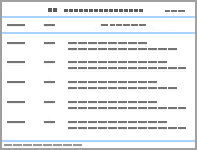
表1
有无痴呆样本的基线特征比较"
| 变量 | 总体(n = 6186) | 无痴呆(n = 5323) | 痴呆(n = 863) | χ2/t值 | P值 |
|---|---|---|---|---|---|
| 性别/n(%) | 8.589 | 0.003 | |||
| 女 | 2652(42.87) | 2242(42.12) | 410(47.51) | ||
| 男 | 3534(57.13) | 3081(57.88) | 453(52.49) | ||
| 年龄/岁 | 68.26±6.42 | 67.70±5.97 | 71.72±7.85 | -14.378 | < 0.001 |
| 婚姻状态/n(%) | 83.880 | < 0.001 | |||
| 已婚 | 5094(82.35) | 4479(84.14) | 615(71.26) | ||
| 单身 | 1092(17.65) | 844(15.86) | 248(28.74) | ||
| 教育程度/n(%) | 76.453 | < 0.001 | |||
| 文盲 | 934(15.10) | 722(13.56) | 212(24.57) | ||
| 小学 | 3020(48.82) | 2621(49.24) | 399(46.23) | ||
| 初中 | 1361(22.00) | 1195(22.45) | 166(19.24) | ||
| 高中及以上 | 871(14.08) | 785(14.75) | 86(9.97) | ||
| 居住地/n(%) | 4.548 | 0.033 | |||
| 农村 | 3373(54.53) | 2873(53.97) | 500(57.94) | ||
| 城市 | 2813(45.47) | 2450(46.03) | 363(42.06) | ||
| 吸烟/n(%) | 12.799 | 0.002 | |||
| 从不吸烟 | 3041(49.16) | 2593(48.71) | 448(51.91) | ||
| 目前吸烟 | 1768(28.58) | 1565(29.40) | 203(23.52) | ||
| 既往吸烟 | 1377(22.26) | 1165(21.89) | 212(24.57) | ||
| 饮酒/n(%) | 13.844 | < 0.001 | |||
| 否 | 2938(47.49) | 2477(46.53) | 461(53.42) | ||
| 是 | 3248(52.51) | 2846(53.47) | 402(46.58) | ||
| 慢性病数量/n(%) | 89.908 | < 0.001 | |||
| 0 | 983(15.89) | 912(17.13) | 71(8.23) | ||
| 1 | 1429(23.10) | 1287(24.18) | 142(16.45) | ||
| ≥ 2 | 3774(61.01) | 3124(58.69) | 650(75.32) | ||
| 身体活动代谢/(MET·min·周-1) | 4609.72±5730.32 | 4798.90±5781.73 | 3442.89±5257.07 | 6.953 | < 0.001 |
| 抑郁症状/n(%) | 117.214 | < 0.001 | |||
| 否 | 3866(62.50) | 3525(66.22) | 341(39.51) | ||
| 是 | 2320(37.50) | 1798(33.78) | 522(60.49) | ||
| 睡眠时间/h | 6.14±2.02 | 6.17±1.93 | 5.96±2.52 | 2.334 | 0.005 |
表2
胃肠道疾病基线特征比较"
| 变量 | 总体(n = 6186) | 无胃肠道疾病(n = 4197) | 胃肠道疾病(n = 1989) | χ2/t值 | P值 |
|---|---|---|---|---|---|
| 性别/n(%) | 39.872 | < 0.001 | |||
| 女 | 2652(42.87) | 1684(40.12) | 968(48.67) | ||
| 男 | 3534(57.13) | 2513(59.88) | 1021(51.33) | ||
| 年龄/岁 | 68.26±6.42 | 68.24±6.50 | 68.30±6.24 | -0.348 | 0.732 |
| 婚姻状态/n(%) | 18.589 | < 0.001 | |||
| 已婚 | 5094(82.35) | 3517(83.80) | 1577(79.29) | ||
| 单身 | 1092(17.65) | 680(16.20) | 412(20.71) | ||
| 教育程度/n(%) | 35.418 | < 0.001 | |||
| 文盲 | 934(15.10) | 585(13.94) | 349(17.55) | ||
| 小学 | 3020(48.82) | 1999(47.63) | 1021(51.33) | ||
| 初中 | 1361(22.00) | 984(23.45) | 377(18.95) | ||
| 高中及以上 | 871(14.08) | 629(14.99) | 242(12.17) | ||
| 居住地/n(%) | 17.249 | < 0.001 | |||
| 农村 | 3373(54.53) | 2212(52.70) | 1161(58.37) | ||
| 城市 | 2813(45.47) | 1985(47.30) | 828(41.63) | ||
| 吸烟/n(%) | 13.132 | 0.001 | |||
| 从不吸烟 | 3041(49.16) | 2007(47.82) | 1034(51.99) | ||
| 目前吸烟 | 1768(28.58) | 1257(29.95) | 511(25.69) | ||
| 既往吸烟 | 1377(22.26) | 933(22.23) | 444(22.32) | ||
| 饮酒/n(%) | 4.960 | 0.026 | |||
| 否 | 2938(47.49) | 1952(46.51) | 986(49.57) | ||
| 是 | 3248(52.51) | 2245(53.49) | 1003(50.43) | ||
| 慢性病数量/n(%) | 161.816 | < 0.001 | |||
| 0 | 983(15.89) | 793(18.89) | 190(9.55) | ||
| 1 | 1429(23.10) | 1064(25.35) | 365(18.35) | ||
| ≥ 2 | 3774(61.01) | 2340(55.75) | 1434(72.10) | ||
| 身体活动代谢/(MET·min·周-1) | 4609.72±5730.32 | 4495.39±5629.88 | 4850.98±5930.92 | -2.198 | 0.023 |
| 抑郁症状/n(%) | 121.682 | < 0.001 | |||
| 否 | 3866(62.50) | 2822(67.24) | 1044(52.49) | ||
| 是 | 2320(37.50) | 1375(32.76) | 945(47.51) | ||
| 睡眠时间/h | 6.14±2.02 | 6.33±1.97 | 5.74±2.07 | 10.555 | < 0.001 |
表3
胃肠道疾病与痴呆的Logistics回归分析结果"
| 模型 | OR | 95%CI | P值 |
|---|---|---|---|
| 模型1 | 1.432 | 1.234~1.660 | < 0.001 |
| 模型2 | 1.265 | 1.080~1.480 | 0.003 |
| 模型3 | 1.178 | 1.001~1.384 | 0.041 |
表4
胃肠道疾病与痴呆关联的亚组分析"
| 变量 | OR | 95%CI | P值 | P值(交互) | |
|---|---|---|---|---|---|
| 性别 | 男 | 1.074 | 0.855~1345 | 0.534 | |
| 女 | 1.296 | 1.024~1.638 | 0.030 | 0.267 | |
| 年龄 | 60~74岁 | 1.181 | 0.970~1.435 | 0.096 | |
| ≥ 75岁 | 1.144 | 0.856~1.524 | 0.361 | 0.593 | |
| 居住地 | 农村 | 1.013 | 0.818~1.254 | 0.902 | |
| 城市 | 1.463 | 1.138~1.875 | 0.003 | 0.063 | |
| 婚姻状态 | 已婚 | 1.158 | 0.959~1.395 | 0.125 | |
| 单身 | 1.250 | 0.901~1.732 | 0.181 | 0.912 | |
| 教育程度 | 文盲 | 0.901 | 0.626~1.291 | 0.573 | |
| 小学 | 1.271 | 1.008~1.601 | 0.042 | 0.088 | |
| 初中 | 1.100 | 0.754~1.589 | 0.614 | 0.590 | |
| 高中及以上 | 1.440 | 0.864~2.369 | 0.155 | 0.091 | |
| 吸烟 | 目前吸烟 | 0.993 | 0.706~1.383 | 0.965 | 0.301 |
| 既往吸烟 | 1.467 | 1.053~2.038 | 0.023 | 0.317 | |
| 从不吸烟 | 1.169 | 0.931~1.465 | 0.176 | ||
| 饮酒 | 是 | 1.051 | 0.827~1.331 | 0.684 | 0.324 |
| 否 | 1.298 | 1.039~1.620 | 0.021 | ||
| 慢性病数量 | 0 | 0.664 | 0.310~1.289 | 0.256 | |
| 1 | 1.242 | 0.810~1.876 | 0.311 | 0.131 | |
| ≥ 2 | 1.226 | 1.020~1.474 | 0.030 | 0.085 | |
| 抑郁症状 | 否 | 1.115 | 0.862~1.432 | 0.401 | |
| 是 | 1.240 | 1.003~1.533 | 0.047 | 0.853 | |
| 睡眠时间 | 短(< 6 h) | 1.123 | 0.882~1.429 | 0.344 | |
| 中(6~9 h) | 1.235 | 0.965~1.575 | 0.091 | 0.696 | |
| 长(> 9 h) | 1.007 | 0.594~1.686 | 0.980 | 0.705 | |
| 身体活动代谢 | 低(< 600 MET·min/周) | 1.170 | 0.924~1.478 | 0.190 | |
| 中(600~3000 MET·min/周) | 1.590 | 0.970~2.591 | 0.063 | 0.216 | |
| 高(> 3000 MET·min/周) | 1.074 | 0.831~1.385 | 0.581 | 0.601 |
| [1] | GBD 2019 Dementia Collaborators Estimation of the global prevalence of dementia in 2019 and forecasted prevalence in 2050: an analysis for the Global Burden of Disease Study 2019[J]. Lancet Public Health, 2022, 7(2): e105-e125. |
| [2] | AREVALO-RODRIGUEZ I, SMAILAGIC N, ROQUÉ-FIGULS M, et al. Mini-mental state examination (MMSE) for the early detection of dementia in people with mild cognitive impairment (MCI)[J]. Cochrane Database Syst Rev, 2021, 7(7): CD010783. |
| [3] |
WU Y T, ALI G C, GUERCHET M, et al. Prevalence of dementia in mainland China, Hong Kong and Taiwan: an updated systematic review and meta-analysis[J]. Int J Epidemiol, 2018, 47(3): 709-719.
doi: 10.1093/ije/dyy007 |
| [4] |
ZHAO Q, CHEN F, SONG X, et al. Hearing loss and cognitive impairment among older adults: findings from the China Health and Retirement Longitudinal Study[J]. BMC Public Health, 2025, 25(1): 1588.
doi: 10.1186/s12889-025-22860-8 |
| [5] |
DONG F W, WANG D H, CHANG Y J, et al. Correlation between physical activity levels and the risk of cognitive impairment in Chinese older adults[J]. Front Aging Neurosci, 2025, 17: 1519494.
doi: 10.3389/fnagi.2025.1519494 |
| [6] |
SPERBER A D, BANGDIWALA S I, DROSSMAN D A, et al. Worldwide prevalence and burden of functional gastrointestinal disorders, results of Rome Foundation Global Study[J]. Gastroenterology, 2021, 160(1): 99-114.e3.
doi: 10.1053/j.gastro.2020.04.014 pmid: 32294476 |
| [7] |
MAYER E A, NANCE K, CHEN S. The gut-brain axis[J]. Annu Rev Med, 2022, 73: 439-453.
doi: 10.1146/med.2022.73.issue-1 |
| [8] |
MARGOLIS K G, CRYAN J F, MAYER E A. The microbiota-gut-brain axis: from motility to mood[J]. Gastroenterology, 2021, 160(5): 1486-1501.
doi: 10.1053/j.gastro.2020.10.066 pmid: 33493503 |
| [9] | 李静, 刘子琦, 钱莉, 等. 微生物-肠-脑轴在癫痫中的作用研究进展[J]. [网络首发]. 中国全科医学, 2025. https://kns.cnki.net/kcms2/article/abstract?v=dzw7IdLhHkHNEgg88pvH0h0NWUJymMWxPO-8da1b4MsqRkzUEDsuTEKqOzALLYnr2EtLc-OXZEJyo74bO-5-X8lN5QUkjWfzPdqfY7VSeKTq6vQa8osRMu-IjucIbEO46Dmj9eMsYLMRCkmwtKWlFpyXfku4TlONTpOc10PYrLxGZRtWNJ7WJQ==&uniplatform=NZKPT&language=CHS. |
| LI J, LIU Z Q, QIAN L, et al. Research progress on the role of the microbiota-gut-brain axis in epilepsy[J]. [ahead of printing]. Chin Gen Pract, 2025. https://kns.cnki.net/kcms2/article/abstract?v=dzw7IdLhHkHNEgg88pvH0h0NWUJymMWxPO-8da1b4MsqRkzUEDsuTEKqOzALLYnr2EtLc-OXZEJyo74bO-5-X8lN5QUkjWfzPdqfY7VSeKTq6vQa8osRMu-IjucIbEO46Dmj9eMsYLMRCkmwtKWlFpyXfku4TlONTpOc10PYrLxGZRtWNJ7WJQ==&uniplatform=NZKPT&language=CHS. | |
| [10] |
KENNEDY P J, CRYAN J F, DINAN T G, et al. Irritable bowel syndrome: a microbiome-gut-brain axis disorder?[J]. World J Gastroenterol, 2014, 20(39): 14105-14125.
doi: 10.3748/wjg.v20.i39.14105 |
| [11] |
CLARKE G, QUIGLEY E M, CRYAN J F, et al. Irritable bowel syndrome: towards biomarker identification[J]. Trends Mol Med, 2009, 15(10): 478-489.
doi: 10.1016/j.molmed.2009.08.001 pmid: 19811951 |
| [12] |
SAJI N, MUROTANI K, HISADA T, et al. Relationship between dementia and gut microbiome-associated metabolites: a cross-sectional study in Japan[J]. Sci Rep, 2020, 10(1): 8088.
doi: 10.1038/s41598-020-65196-6 pmid: 32424166 |
| [13] |
FAYSAL M, ZEHRAVI M, SUTRADHAR B, et al. The microbiota-gut-brain connection: a new horizon in neurological and neuropsychiatric disorders[J]. CNS Neurosci Ther, 2025, 31(9): e70593.
doi: 10.1111/cns.v31.9 |
| [14] |
CHEN C H, LIN C L, KAO C H. Irritable bowel syndrome is associated with an increased risk of dementia: a nationwide population-based study[J]. PLoS One, 2016, 11(1): e0144589.
doi: 10.1371/journal.pone.0144589 |
| [15] |
YUAN S, DAN L, ZHANG Y, et al. Digestive system diseases, genetic risk, and incident dementia: a prospective cohort study[J]. Am J Prev Med, 2024, 66(3): 516-525.
doi: 10.1016/j.amepre.2023.10.017 |
| [16] |
FU P, GAO M, YUNG K K L. Association of intestinal disorders with Parkinson's disease and Alzheimer's disease: a systematic review and meta-analysis[J]. ACS Chem Neurosci, 2020, 11(3): 395-405.
doi: 10.1021/acschemneuro.9b00607 pmid: 31876406 |
| [17] | BERRILL J W, GALLACHER J, HOOD K, et al. An observational study of cognitive function in patients with irritable bowel syndrome and inflammatory bowel disease[J]. Neurogastroenterol Motil, 2013, 25(11): 918-e704. |
| [18] |
ADEWUYI E O, O'BRIEN E K, PORTER T, et al. Relationship of cognition and Alzheimer's disease with gastrointestinal tract disorders: a large-scale genetic overlap and Mendelian randomisation analysis[J]. Int J Mol Sci, 2022, 23(24): 15467.
doi: 10.3390/ijms232415467 |
| [19] | LIU Y, WU Y, CAI J, et al. Is there a common latent cognitive construct for dementia estimation across two Chinese cohorts?[J]. Alzheimers Dement (Amst), 2022, 14(1): e12356. |
| [20] |
HOPKINS C W P, POWELL N, NORTON C, et al. Cognitive impairment in adult inflammatory bowel disease: a systematic review and meta-analysis[J]. J Acad Consult Liaison Psychiatry, 2021, 62(4): 387-403.
doi: 10.1016/j.psym.2020.10.002 pmid: 34219654 |
| [21] |
PENG T R, LIN H H, YANG L J, et al. The impact of inflammatory bowel disease on dementia risk: a current systematic review and meta-analysis[J]. Sci Rep, 2025, 15(1): 12852.
doi: 10.1038/s41598-025-96331-w |
| [22] |
LIAO O L, XIE S Y, YE J, et al. Association between inflammatory bowel disease and all-cause dementia: a two-sample Mendelian randomization study[J]. World J Psychiatry, 2024, 14(1): 15-25.
doi: 10.5498/wjp.v14.i1.15 |
| [23] |
GAU S Y, LAI J N, YIP H T, et al. Higher dementia risk in people with gastroesophageal reflux disease: a real-world evidence[J]. Front Aging Neurosci, 2022, 14: 830729.
doi: 10.3389/fnagi.2022.830729 |
| [24] |
GUO J, SU M, HUANG J, et al. Longitudinal bidirectional association between gastrointestinal disease and depression symptoms among middle-aged and older adults in China[J]. Arch Public Health, 2025, 83(1): 171.
doi: 10.1186/s13690-025-01671-8 |
| [25] |
ZU B, WANG N, FAN L, et al. Cognitive impairment influencing factors in the middle-aged and elderly population in China: evidence from a National Longitudinal Cohort Study[J]. PLoS One, 2025, 20(5): e0324130.
doi: 10.1371/journal.pone.0324130 |
| [26] |
LI R, LUO L, YUAN C, et al. Association of smoke exposure with cognitive function trajectories among middle and old-aged adults: evidence from the China Health and Retirement Longitudinal Study[J]. J Glob Health, 2025, 15: 04150.
doi: 10.7189/jogh.15.04150 pmid: 40320800 |
| [27] |
NYBERG F. Structural plasticity of the brain to psychostimulant use[J]. Neuropharmacology, 2014, 87: 115-124.
doi: 10.1016/j.neuropharm.2014.07.004 pmid: 25018041 |
| [28] | ANTAL B, MCMAHON L P, SULTAN S F, et al. Type 2 diabetes mellitus accelerates brain aging and cognitive decline: complementary findings from UK Biobank and meta-analyses[J]. eLife, 2022, 11: e74462. |
| [29] |
DI PILATO V, FRESCHI G, RINGRESSI M N, et al. The esophageal microbiota in health and disease[J]. Ann N Y Acad Sci, 2016, 1381(1): 21-33.
doi: 10.1111/nyas.2016.1381.issue-1 |
| [30] |
CRYAN J F, O'RIORDAN K J, COWAN C S M, et al. The microbiota-gut-brain axis[J]. Physiol Rev, 2019, 99(4): 1877-2013.
doi: 10.1152/physrev.00018.2018 pmid: 31460832 |
| [31] |
RUTSCH A, KANTSJÖ J B, RONCHI F. The gut-brain axis: how microbiota and host inflammasome influence brain physiology and pathology[J]. Front Immunol, 2020, 11: 604179.
doi: 10.3389/fimmu.2020.604179 |
| [32] |
DOROSZKIEWICZ J, GROBLEWSKA M, MROCZKO B. The role of gut microbiota and gut-brain interplay in selected diseases of the central nervous system[J]. Int J Mol Sci, 2021, 22(18): 10040.
doi: 10.3390/ijms221810040 |
| [33] |
CHANDRA S, ALAM M T, DEY J, et al. Healthy gut, healthy brain: the gut microbiome in neurodegenerative disorders[J]. Curr Top Med Chem, 2020, 20(13): 1142-1153.
doi: 10.2174/1568026620666200413091101 pmid: 32282304 |
| [34] | COLOMBO A V, SADLER R K, LLOVERA G, et al. Microbiota-derived short chain fatty acids modulate microglia and promote Aβ plaque deposition[J]. eLife, 2021, 10: e63251. |
| [35] |
PAPPOLLA M A, PERRY G, FANG X, et al. Indoles as essential mediators in the gut-brain axis. Their role in Alzheimer's disease[J]. Neurobiol Dis, 2021, 156: 105403.
doi: 10.1016/j.nbd.2021.105403 |
| [36] |
QIAN X H, SONG X X, LIU X L, et al. Inflammatory pathways in Alzheimer's disease mediated by gut microbiota[J]. Ageing Res Rev, 2021, 68: 101317.
doi: 10.1016/j.arr.2021.101317 |
| [37] |
TACK J, PANDOLFINO J E. Pathophysiology of gastroesophageal reflux disease[J]. Gastroenterology, 2018, 154(2): 277-288.
doi: S0016-5085(17)36248-0 pmid: 29037470 |
| [38] |
BENNETT S, THOMAS A J. Depression and dementia: cause, consequence or coincidence?[J]. Maturitas, 2014, 79(2): 184-190.
doi: 10.1016/j.maturitas.2014.05.009 pmid: 24931304 |
| [39] |
OU M, DU Z, LU R, et al. Causal relationship between proton pump inhibitors and dementia risk: evidence from a Mendelian randomization study[J]. Eur Arch Psychiatry Clin Neurosci, 2025, 275(8): 2275-2284.
doi: 10.1007/s00406-025-02036-6 |
| [40] |
LAM J R, SCHNEIDER J L, ZHAO W, et al. Proton pump inhibitor and histamine 2 receptor antagonist use and vitamin B12 deficiency[J]. JAMA, 2013, 310(22): 2435-2442.
doi: 10.1001/jama.2013.280490 pmid: 24327038 |
| [41] |
MOHAN M, MANNAN A, SINGH S, et al. Unlocking the cellular mystery: how proton pump inhibitors may alter the dementia landscape[J]. Brain Res, 2025, 1861: 149702.
doi: 10.1016/j.brainres.2025.149702 |
| [42] | ORTIZ-GUERRERO G, AMADOR-MUÑOZ D, CALDERÓN-OSPINA C A, et al. Proton pump inhibitors and dementia: physiopathological mechanisms and clinical consequences[J]. Neural Plast, 2018, 2018: 5257285. |
| [43] |
KHAN Z, MEHAN S, SAIFI M A, et al. Proton pump inhibitors and cognitive health: review on unraveling the dementia connection and co-morbid risks[J]. Curr Alzheimer Res, 2024, 20(11): 739-757.
doi: 10.2174/0115672050289946240223050737 |
| [1] | 林利霞, 曾秋婵, 郭蕴源, 梁荣相, 吴昊, 邵玉萍. 睡眠时长模式对中老年日常生活活动能力的影响[J]. 《中国康复理论与实践》, 2025, 31(3): 331-338. |
| [2] | 粟昭隐, 康巍瀚, 刘亚涛, 吕媛, Michael NERLICH. 中国中老年人身体活动水平与脑卒中发生的相关性:基于CHARLS数据[J]. 《中国康复理论与实践》, 2024, 30(4): 449-453. |
| [3] | 刘华, 贾明月, 杜晓霞, 杨亚茹, 李静, 吕继辉. 北京社区55~75岁高、低痴呆风险人群身体素质及其认知功能特点[J]. 《中国康复理论与实践》, 2024, 30(2): 195-201. |
| [4] | 关莹,于国强,唐祎周,辛贵乐,李季,王璐,张立,张春艳. 头穴艾灸联合跑台训练对血管性痴呆大鼠学习记忆和氧化应激的效果[J]. 《中国康复理论与实践》, 2022, 28(8): 927-933. |
| [5] | 张冰雪,杨敏光,李建鸿,陶静,梁胜祥,柳维林,陈立典. 电针对血管性痴呆大鼠脑白质纤维和学习记忆功能的效果[J]. 《中国康复理论与实践》, 2020, 26(3): 319-324. |
| [6] | 孟敏, 李林. 双侧颈总动脉结扎致血管性痴呆大鼠模型研究进展[J]. 《中国康复理论与实践》, 2018, 24(3): 309-312. |
| [7] | 谢舒棠, 陈颖, 张桂菊, 位文静, 张振香. 痴呆患者照顾者护理能力评估量表编制及信效度检测[J]. 《中国康复理论与实践》, 2018, 24(11): 1309-1314. |
| [8] | 贺旭, 刘英飞, 罗明英, 成绍武, 葛金文. 丰富环境对血管性痴呆大鼠侧脑室室管膜下区神经再生的影响[J]. 《中国康复理论与实践》, 2017, 23(12): 1384-1389. |
| [9] | 张文彦,刘金霞,刘斌,邓春颖,张晋霞,马原源,毛文静,李世英,吕超男. 自噬对血管性痴呆大鼠海马CA1 区生长相关蛋白-43 及微管相关蛋白-2表达的影响①[J]. 《中国康复理论与实践》, 2016, 22(7): 745-749. |
| [10] | 柏华1a,1b,杨波1c,余德军1a,张启芳2. 核苷酸结合寡聚化结构域样受体蛋白3 在阿尔茨海默病和血管性痴呆患者中的表达及相关因素研究①[J]. 《中国康复理论与实践》, 2016, 22(3): 306-309. |
| [11] | 董静 a;李晶 b;刘斌 b;毛文静 b;张晋霞 b;李世英 b. 养血清脑颗粒对血管性痴呆大鼠海马CA1区胶质纤维酸性蛋白表达的影响[J]. 《中国康复理论与实践》, 2015, 21(12): 1375-1378. |
| [12] | 伞云琨;张晋霞;刘斌;刘颖;李世英. 养血清脑颗粒对血管性痴呆大鼠海马CA1区超微结构及p38丝裂原活化蛋白激酶蛋白表达的影响[J]. 《中国康复理论与实践》, 2015, 21(11): 1245-1250. |
| [13] | 李晶;刘颖;刘斌;罗永伟;范颖;马原源;毛文静;李世英. 血管性痴呆大鼠海马齿状回神经前体细胞增殖的动态变化及养血清脑颗粒的影响[J]. 《中国康复理论与实践》, 2015, 21(09): 1025-1030. |
| [14] | 刘金霞;马原源;刘斌;邓春颖;李世英. 微管相关蛋白1轻链3Ⅱ与微管相关蛋白2 在血管性痴呆大鼠海马CA1 区的表达[J]. 《中国康复理论与实践》, 2015, 21(05): 497-500. |
| [15] | 柏华;谭晓坤;李清勇. 阿尔茨海默病与血管性痴呆的磁共振成像和脑电图特征比较[J]. 《中国康复理论与实践》, 2014, 20(11): 1057-1059. |
| 阅读次数 | ||||||
|
全文 |
|
|||||
|
摘要 |
|
|||||
|
||
