



《中国康复理论与实践》 ›› 2020, Vol. 26 ›› Issue (7): 813-819.doi: 10.3969/j.issn.1006-9771.2020.07.015
王鹤玮1,王云龙2,陆小锋3,赵思淇3,王传凯4,丁力1,陈树耿1,王莹莹5,王建晖2,贾杰1( )
)
收稿日期:2019-02-13
修回日期:2019-07-17
出版日期:2020-07-25
发布日期:2020-07-24
通讯作者:
贾杰
E-mail:shannonjj@126.com
作者简介:王鹤玮(1993-),男,汉族,江苏南京市人,博士研究生,主要研究方向:中枢神经系统损伤后上肢与手功能的康复。|贾杰,女,教授,博士生导师。
基金资助:
WANG He-wei1,WANG Yun-long2,LU Xiao-feng3,ZHAO Si-qi3,WANG Chuan-kai4,DING Li1,CHEN Shu-geng1,WANG Ying-ying5,WANG Jian-hui2,JIA Jie1()
Received:2019-02-13
Revised:2019-07-17
Published:2020-07-25
Online:2020-07-24
Contact:
JIA Jie
E-mail:shannonjj@126.com
Supported by:摘要:
目的 研究脑卒中患者面对不同图案时的反应策略和影响心理旋转试验结果的主要因素。方法 2018年5月至10月,15例脑卒中患者和15例年龄、性别和教育程度匹配的健康受试者接受基于标准软件程序的心理旋转试验,视觉刺激包括手背、手心、汉字和字母4种图案,记录反应时和正确率。采用蒙特利尔认知功能评估量表(MoCA)评定所有受试者,采用Fugl-Meyer评定量表上肢部分(FMA-UE)评定脑卒中患者。结果 在手背、手心和字母测试中,脑卒中患者的正确率低于健康对照(F > 7.027, P < 0.05)。在所有测试中,脑卒中患者的反应时均显著长于健康对照( F > 14.827, P < 0.001);在手背和手心测试中,反应时随旋转角度的主效应非常高度显著( F > 7.747, P < 0.001),0°时最短。所有受试者的MoCA评分与反应时呈负相关( r < -0.375, P < 0.05),脑卒中患者FMA-UE评分与除字母测试之外的反应时呈负相关( r < -0.581, P < 0.05)。 结论 不同的刺激图案可影响心理旋转试验的处理策略和结果。脑卒中患者的运动表象能力较健康人有所减弱,但基本模式相对保留。
中图分类号:
王鹤玮,王云龙,陆小锋,赵思淇,王传凯,丁力,陈树耿,王莹莹,王建晖,贾杰. 心理旋转试验在脑卒中患者运动表象能力评估中的应用[J]. 《中国康复理论与实践》, 2020, 26(7): 813-819.
WANG He-wei,WANG Yun-long,LU Xiao-feng,ZHAO Si-qi,WANG Chuan-kai,DING Li,CHEN Shu-geng,WANG Ying-ying,WANG Jian-hui,JIA Jie. Application of Mental Rotation Test in Motor Imagery Ability Assessment for Stroke Patients[J]. 《Chinese Journal of Rehabilitation Theory and Practice》, 2020, 26(7): 813-819.
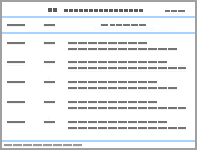
表1
两组一般资料比较"
| 组别 | n | 性别(男/女, n) | 年龄(岁) | 受教育年限(年) | 病程(d) |
|---|---|---|---|---|---|
| 对照组 | 15 | 8/7 | 48.73±12.48 | 10.87±3.76 | - |
| 患者组 | 15 | 10/5 | 50.87±11.42 | 11.27±3.52 | 110.20±92.71 |
| t值 | - | 0.488 | 0.301 | - | |
| P值 | 0.710a | 0.629 | 0.766 | - |
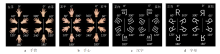
图1
心理旋转试验4种刺激呈现形式"
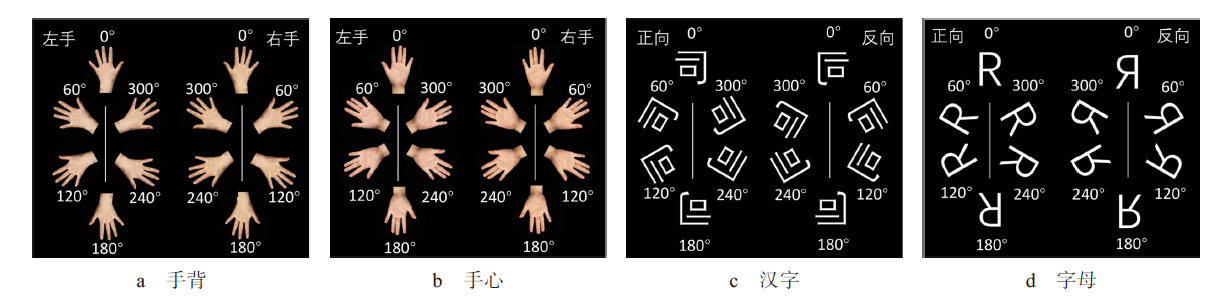
表2
视觉刺激为手背时两组正确率比较(%)"
| 组别 | n | 左 | 右 |
|---|---|---|---|
| 对照组 | 15 | 95.6±7.1 | 94.7±4.9 |
| 患者组 | 15 | 89.0±15.9 | 82.8±17.4 |
表3
视觉刺激为手心时两组正确率比较(%)"
| 组别 | n | 左 | 右 |
|---|---|---|---|
| 对照组 | 15 | 96.8±4.6 | 97.1±3.5 |
| 患者组 | 15 | 91.3±10.9 | 87.1±12.2 |
表4
视觉刺激为汉字时两组正确率比较(%)"
| 组别 | n | 正 | 反 |
|---|---|---|---|
| 对照组 | 15 | 89.5±17.4 | 87.8±14.5 |
| 患者组 | 15 | 80.3±22.1 | 85.2±17.1 |
表5
视觉刺激为字母时两组正确率比较(%)"
| 组别 | n | 正 | 反 |
|---|---|---|---|
| 对照组 | 15 | 92.2±6.2 | 91.2±12.4 |
| 患者组 | 15 | 79.8±23.4 | 80.3±14.7 |
表6
视觉刺激为手背时两组反应时比较(s)"
| 左/右 | 旋转角度 | 对照组(n = 15) | 患者组(n = 15) |
|---|---|---|---|
| 左 | 0° | 1.776±0.327 | 2.714±1.627 |
| 60° | 2.235±0.532 | 3.818±2.884 | |
| 120° | 2.962±0.935 | 5.962±5.363 | |
| 180° | 3.870±1.303 | 9.535±8.237 | |
| 240° | 2.877±0.793 | 6.158±5.808 | |
| 300° | 2.256±0.491 | 3.813±2.906 | |
| 右 | 0° | 1.707±0.359 | 2.776±1.716 |
| 60° | 2.063±0.436 | 3.862±3.007 | |
| 120° | 3.035±1.071 | 5.917±5.246 | |
| 180° | 4.295±2.055 | 9.893±7.29 | |
| 240° | 3.101±1.379 | 5.912±5.692 | |
| 300° | 2.047±0.398 | 3.888±2.751 |
表7
视觉刺激为手心时两组反应时比较(s)"
| 左/右 | 旋转角度 | 对照组(n = 15) | 患者组(n = 15) |
|---|---|---|---|
| 左 | 0° | 2.132±0.331 | 2.840±1.128 |
| 60° | 2.377±0.394 | 3.843±1.889 | |
| 120° | 3.223±0.962 | 6.308±4.721 | |
| 180° | 2.840±0.749 | 4.434±2.335 | |
| 240° | 2.520±0.513 | 3.722±1.603 | |
| 300° | 2.229±0.347 | 2.973±1.172 | |
| 右 | 0° | 2.061±0.374 | 2.971±1.929 |
| 60° | 2.300±0.444 | 4.187±3.089 | |
| 120° | 3.931±3.101 | 5.472±3.784 | |
| 180° | 2.873±1.027 | 4.586±3.587 | |
| 240° | 2.485±0.593 | 3.875±2.740 | |
| 300° | 2.170±0.400 | 3.391±2.192 |
表8
视觉刺激为汉字时两组反应时比较(s)"
| 正/反 | 旋转角度 | 对照组(n = 15) | 患者组(n = 15) |
|---|---|---|---|
| 正 | 0° | 1.653±0.451 | 2.045±0.618 |
| 60° | 1.841±0.549 | 3.677±2.183 | |
| 120° | 1.799±0.993 | 4.526±4.741 | |
| 180° | 2.589±1.352 | 3.674±2.954 | |
| 240° | 1.696±0.650 | 3.762±4.778 | |
| 300° | 2.152±0.966 | 3.775±2.734 | |
| 反 | 0° | 2.633±1.248 | 2.735±1.055 |
| 60° | 2.668±1.816 | 4.478±4.776 | |
| 120° | 2.692±1.131 | 4.882±5.630 | |
| 180° | 2.102±1.425 | 3.166±1.208 | |
| 240° | 2.095±0.957 | 4.744±8.003 | |
| 300° | 1.956±0.790 | 3.360±2.539 |
表9
视觉刺激为字母时两组反应时比较(s)"
| 正/反 | 旋转角度 | 对照组(n = 15) | 患者组(n = 15) |
|---|---|---|---|
| 正 | 0° | 1.733±0.602 | 2.738±1.175 |
| 60° | 2.740±1.578 | 4.981±5.823 | |
| 120° | 2.128±0.505 | 5.563±8.597 | |
| 180° | 1.530±0.447 | 3.668±4.440 | |
| 240° | 2.238±0.985 | 3.792±4.188 | |
| 300° | 2.199±1.021 | 4.213±3.835 | |
| 反 | 0° | 1.810±0.320 | 4.202±2.719 |
| 60° | 2.525±0.714 | 3.176±1.138 | |
| 120° | 2.301±0.554 | 3.493±2.488 | |
| 180° | 1.948±0.455 | 3.602±2.621 | |
| 240° | 2.829±1.125 | 7.873±17.102 | |
| 300° | 2.812±1.473 | 2.914±1.163 |
表10
心理旋转试验反应时和正确率与运动和认知功能的相关性"
| 功能评定 | 反应时 | 正确率 | ||||||||
|---|---|---|---|---|---|---|---|---|---|---|
| 手背 | 手心 | 汉字 | 字母 | 手背 | 手心 | 汉字 | 字母 | |||
| FMA-UE总分 | r | -0.610 | -0.581 | -0.692 | -0.406 | 0.437 | 0.345 | 0.026 | 0.463 | |
| P | 0.016 | 0.023 | 0.009 | 0.215 | 0.104 | 0.207 | 0.932 | 0.130 | ||
| MoCA总分 | r | -0.531 | -0.375 | -0.517 | -0.455 | 0.351 | 0.324 | 0.333 | 0.461 | |
| P | 0.003 | 0.041 | 0.006 | 0.026 | 0.057 | 0.080 | 0.089 | 0.020 | ||
| MoCA视空间认知评分 | r | -0.569 | -0.408 | -0.431 | -0.438 | 0.202 | 0.380 | 0.340 | 0.349 | |
| P | 0.001 | 0.025 | 0.025 | 0.032 | 0.283 | 0.038 | 0.082 | 0.087 | ||
| [1] | 贾杰. “中枢-外周-中枢”闭环康复——脑卒中后手功能康复新理念[J]. 中国康复医学杂志, 2016, 31(11): 1180-1182. |
| Jia J. Central-peripheral-central closed-loop rehabilitation: a new concept of rehabilitation of hand function after stroke[J]. Chin J Rehabil Med, 2016, 31(11): 1180-1182. | |
| [2] |
Tong Y, Pendy J J, Li W A, et al. Motor imagery-based rehabilitation: potential neural correlates and clinical application for functional recovery of motor deficits after stroke[J]. Aging Dis, 2017, 8(3): 364-371.
doi: 10.14336/AD.2016.1012 |
| [3] |
Sharma N, Pomeroy V M, Baron J C. Motor imagery: a backdoor to the motor system after stroke?[J]. Stroke, 2006, 37(7): 1941-1952.
doi: 10.1161/01.STR.0000226902.43357.fc |
| [4] |
Hardwick R M, Caspers S, Eickhoff S B, et al. Neural correlates of action: comparing meta-analyses of imagery, observation, and execution[J]. Neurosci Biobehav Rev, 2018, 94:31-44.
doi: 10.1016/j.neubiorev.2018.08.003 |
| [5] | 刘华, 程钰琦, 李洋, 等. 中文版运动觉-视觉想象问卷的结构效度[J]. 中国康复理论与实践, 2017, 23(5): 580-583. |
| Liu H, Cheng Y Q, Li Y, et al. Construct validity of Chinese version of Kinesthetic and Visual Imagery Questionnaire[J]. Chin J Rehabil Theory Pract, 2017, 23(5): 580-583. | |
| [6] | Butler A J, Cazeaux J, Fidler A, et al. The Movement Imagery Questionnaire-Revised, Second Edition (MIQ-RS) is a reliable and valid tool for evaluating motor imagery in stroke populations[J]. Evid Based Complement Alternat Med, 2012, 2012:497289. |
| [7] |
Parsons L M, Fox P T, Downs J H, et al. Use of implicit motor imagery for visual shape discrimination as revealed by PET[J]. Nature, 1995, 375(6526): 54-58.
pmid: 7723842 |
| [8] | 祁乐瑛. 表象表征: 心理旋转的实证探索[D]. 上海:华东师范大学, 2009. |
| Qi L Y. Representation: an empirical study of mental rotation[D]. Shanghai: East China Normal University, 2009. | |
| [9] | de Vries S, Tepper M, Feenstra W, et al. Motor imagery ability in stroke patients: the relationship between implicit and explicit motor imagery measures[J]. Front Hum Neurosci, 2013, 7:790. |
| [10] |
Bourrelier J, Kubicki A, Rouaud O, et al. Mental rotation as an indicator of motor representation in patients with mild cognitive impairment[J]. Front Aging Neurosci, 2015, 7:238.
doi: 10.3389/fnagi.2015.00238 pmid: 26779010 |
| [11] | Hartnoll S H, Punt T D. Yoga practice is associated with superior motor imagery performance[J]. Int J Yoga Therap, 2017, 27(1): 81-86. |
| [12] |
Kraeutner S N, MacKenzie L A, WestwoodS D A, et al. Characterizing skill acquisition through motor imagery with no prior physical practice[J]. J Exp Psychol Hum Percept Perform, 2016, 42(2): 257-265.
doi: 10.1037/xhp0000148 pmid: 26389615 |
| [13] |
Heath M, Hassall C D, MacLean S, et al. Event-related brain potentials during the visuomotor mental rotation task: the contingent negative variation scales to angle of rotation[J]. Neuroscience, 2015, 311:153-165.
doi: 10.1016/j.neuroscience.2015.10.018 pmid: 26477986 |
| [14] |
Ding L, Wang X, Guo X, et al. Camera-based mirror visual feedback: potential to improve motor preparation in stroke patients[J]. IEEE Trans Neural Syst Rehabil Eng, 2018, 26(9): 1897-1905.
doi: 10.1109/TNSRE.7333 |
| [15] |
Simmons L, Sharma N, Baron J C, et al. Motor imagery to enhance recovery after subcortical stroke: who might benefit, daily dose, and potential effects[J]. Neurorehabil Neural Repair, 2008, 22(5): 458-467.
doi: 10.1177/1545968308315597 pmid: 18780881 |
| [16] | Spruijt S, van der Kamp J, Steenbergen B. Current insights in the development of children's motor imagery ability[J]. Front Psychol, 2015, 6:787. |
| [17] |
Shepard R N, Metzler J. Mental rotation of three-dimensional objects[J]. Science, 1971, 171(3972): 701-703.
doi: 10.1126/science.171.3972.701 |
| [18] |
Sharma N, Simmons L H, Jones P S, et al. Motor imagery after subcortical stroke: a functional magnetic resonance imaging study[J]. Stroke, 2009, 40(4): 1315-1324.
doi: 10.1161/STROKEAHA.108.525766 |
| [19] | de Vries S, Tepper M, Otten B, et al. Recovery of motor imagery ability in stroke patients[J]. Rehabil Res Pract, 2011, 2011:283840. |
| [20] |
McInnes K, Friesen C, Boe S. Specific brain lesions impair explicit motor imagery ability: a systematic review of the evidence[J]. Arch Phys Med Rehabil, 2016, 97(3): 478-489.
doi: 10.1016/j.apmr.2015.07.012 |
| [21] | 崔利华, 张慧丽, 张小年. 脑卒中恢复期患者简易智能状态检查和蒙特利尔认知评估的对比研究[J]. 中国康复理论与实践, 2014, 20(8): 749-751. |
| Cui L H, Zhang H L, Zhang X N. Comparison study of application of Montreal Cognitive Assessment and Mini-Mental State Examination in stroke patients during convalescence[J]. Chin J Rehabil Theory Pract, 2014, 20(8): 749-751. | |
| [22] |
Mai L M, Sposato L A, Rothwell P M, et al. A comparison between the MoCA and the MMSE visuoexecutive sub-tests in detecting abnormalities in TIA/stroke patients[J]. Int J Stroke, 2016, 11(4): 420-424.
doi: 10.1177/1747493016632238 |
| [23] |
Pendlebury S T, Mariz J, Bull L, et al. MoCA, ACE-R, and MMSE versus the National Institute of Neurological Disorders and Stroke: Canadian Stroke Network Vascular Cognitive Impairment Harmonization Standards Neuropsychological Battery after TIA and stroke[J]. Stroke, 2012, 43(2): 464-469.
doi: 10.1161/STROKEAHA.111.633586 pmid: 22156700 |
| [24] |
Gladstone D J, Danells C J, Black S E. The Fugl-Meyer Assessment of motor recovery after stroke: a critical review of its measurement properties[J]. Neurorehabil Neural Repair, 2002, 16(3): 232-240.
doi: 10.1177/154596802401105171 |
| [25] | 刘华, 杜晓霞, 孙蓉, 等. 脑卒中患者心理旋转能力与视空间认知能力的关系[J]. 中国康复理论与实践, 2017, 23(3): 249-252. |
| Liu H, Du X X, Sun R, et al. Characteristics of mental rotation in stroke patients and relationship with visual-spatial cognitive function[J]. Chin J Rehabil Theory Pract, 2017, 23(3): 249-252. | |
| [26] |
Zapparoli L, Invernizzi P, Gandola M, et al. Like the back of the (right) hand? A new fMRI look on the hand laterality task[J]. Exp Brain Res, 2014, 232(12): 3873-3895.
doi: 10.1007/s00221-014-4065-z pmid: 25150553 |
| [27] |
Blasing B, Brugger P, Weigelt M, et al. Does thumb posture influence the mental rotation of hands?[J]. Neurosci Lett, 2013, 534:139-144.
doi: 10.1016/j.neulet.2012.11.034 |
| [28] | Braun N, Kranczioch C, Liepert J, et al. Motor imagery impairment in postacute stroke patients[J]. Neural Plast, 2017, 2017:4653256. |
| [29] |
Daprati E, Nico D, Duval S, et al. Different motor imagery modes following brain damage[J]. Cortex, 2010, 46(8): 1016-1030.
doi: 10.1016/j.cortex.2009.08.002 pmid: 19726037 |
| [30] |
Tabrizi Y M, Mazhari S, Nazari M A, et al. Abnormalities of motor imagery and relationship with depressive symptoms in mildly disabling relapsing-remitting multiple sclerosis[J]. J Neurol Phys Ther, 2014, 38(2): 111-118.
doi: 10.1097/NPT.0000000000000033 |
| [31] |
Weil R S, Schrag A E, Warren J D, et al. Visual dysfunction in Parkinson's disease[J]. Brain, 2016, 139(11): 2827-2843.
doi: 10.1093/brain/aww175 |
| [32] |
Oostra K M, Vereecke A, Jones K, et al. Motor imagery ability in patients with traumatic brain injury[J]. Arch Phys Med Rehabil, 2012, 93(5): 828-833.
doi: 10.1016/j.apmr.2011.11.018 |
| [33] | Searle J A, Hamm J P. Mental rotation: an examination of assumptions[J]. Wiley Interdiscip Rev Cogn Sci, 2017, 8(6): 6-7. |
| [34] |
Yan J, Guo X, Jin Z, et al. Cognitive alterations in motor imagery process after left hemispheric ischemic stroke[J]. PLoS One, 2012, 7(8): e42922.
doi: 10.1371/journal.pone.0042922 |
| [35] |
ter Horst A C, van Lier R, Steenbergen B. Mental rotation task of hands: differential influence number of rotational axes[J]. Exp Brain Res, 2010, 203(2): 347-354.
doi: 10.1007/s00221-010-2235-1 |
| [36] |
Hamada H, Matsuzawa D, Sutoh C, et al. Comparison of brain activity between motor imagery and mental rotation of the hand tasks: a functional magnetic resonance imaging study[J]. Brain Imaging Behav, 2018, 12(6): 1596-1606.
doi: 10.1007/s11682-017-9821-9 |
| [37] |
Kosslyn S M, DiGirolamo G J, Thompson W L, et al. Mental rotation of objects versus hands: neural mechanisms revealed by positron emission tomography[J]. Psychophysiology, 1998, 35(2): 151-161.
pmid: 9529941 |
| [1] | 林娜, 高菡璐, 卢惠苹, 陈燕清, 郑军凡, 陈述荣. 虚拟现实技术对脑卒中上肢功能影响的弥散张量成像研究[J]. 《中国康复理论与实践》, 2024, 30(1): 61-67. |
| [2] | 王昊懿, 史亚伟, 鲁俊, 许光旭. 主观垂直感知障碍对脑卒中患者功能影响的回顾性研究[J]. 《中国康复理论与实践》, 2024, 30(1): 68-73. |
| [3] | 陈珺雯, 陈谦, 陈程, 李淑月, 刘玲玲, 吴存书, 龚翔, 鲁俊, 许光旭. 改良八段锦身体活动对脑卒中患者心肺功能、运动功能和日常生活活动能力的效果[J]. 《中国康复理论与实践》, 2024, 30(1): 74-80. |
| [4] | 胡永林, 马颖, 窦超, 陆安民, 江小鸽, 宋新建, 肖玉华. 肩部控制训练联合神经松动术对脑卒中偏瘫患者肩痛及上肢功能的效果[J]. 《中国康复理论与实践》, 2024, 30(1): 81-86. |
| [5] | 王贺, 韩靓, 阚梦凡, 于少泓. 电刺激治疗脑卒中后肩手综合征有效性的系统评价与Meta分析[J]. 《中国康复理论与实践》, 2023, 29(9): 1048-1056. |
| [6] | 孙藤方, 任梦婷, 杨琳, 王耀霆, 王红雨, 闫兴洲. 高压氧治疗联合重复外周磁刺激干预脑卒中患者踝运动功能和平衡能力的效果[J]. 《中国康复理论与实践》, 2023, 29(8): 875-881. |
| [7] | 王亚楠, 刘西花. 脑卒中偏瘫患者主观和客观平衡功能测量的相关性及预测效能[J]. 《中国康复理论与实践》, 2023, 29(8): 890-895. |
| [8] | 王海云, 王寅, 周信杰, 何爱群. 基于“中枢-外周-中枢”理论的经颅直流电刺激结合针刺干预脑卒中患者中枢及上肢功能的效果[J]. 《中国康复理论与实践》, 2023, 29(8): 919-925. |
| [9] | 陈怡婷, 王倩, 崔慎红, 李映彩, 张思鈺, 魏衍旭, 任慧, 冷军, 陈斌. 双侧序贯重复经颅磁刺激干预脑卒中患者上肢运动功能的效果[J]. 《中国康复理论与实践》, 2023, 29(8): 926-932. |
| [10] | 李振亚, 孙洁, 郭鹏飞, 王光明. 脑卒中患者口期和咽期吞咽功能改变与误吸的相关性:基于电视透视吞咽检查[J]. 《中国康复理论与实践》, 2023, 29(8): 933-939. |
| [11] | 李子怡, 宋为群, 杜巨豹, 曹光磊, 张艳明, 李冉. 运动表象训练对膝关节单髁置换术后膝关节功能的效果[J]. 《中国康复理论与实践》, 2023, 29(7): 745-749. |
| [12] | 华玲, 张一楠, 郑玉, 孙俏仪, 房辉, 宋达. 手控节律音乐治疗对脑卒中后单侧空间忽略的效果[J]. 《中国康复理论与实践》, 2023, 29(7): 833-838. |
| [13] | 蒋孝翠, 刘臻, 苏清伦, 赵秦, 夏晓昧, 陆飞. 间歇性Theta节律经颅磁刺激对脑卒中后非流利性失语的影响[J]. 《中国康复理论与实践》, 2023, 29(7): 839-843. |
| [14] | 许苗苗, 李楠, 应颖, 杨凯翔, 杨婧瑞, 李杰, 邱彦群. 重复外周磁刺激对左右颈7神经交叉移位术后脑卒中患者上肢运动功能的效果[J]. 《中国康复理论与实践》, 2023, 29(6): 686-690. |
| [15] | 郑莉, 鲍治诚, 张琪, 任绪艳, 苏敏. 经皮耳迷走神经电刺激结合康复机器人训练对脑卒中患者上肢功能的效果[J]. 《中国康复理论与实践》, 2023, 29(6): 691-696. |
| 阅读次数 | ||||||
|
全文 |
|
|||||
|
摘要 |
|
|||||
|
||
