



《中国康复理论与实践》 ›› 2021, Vol. 27 ›› Issue (11): 1323-1328.doi: 10.3969/j.issn.1006-9771.2021.11.013
符卫卫1,2( ),燕文娟3
收稿日期:2021-06-17
修回日期:2021-08-21
出版日期:2021-11-25
发布日期:2021-12-03
通讯作者:
符卫卫
E-mail:fuweiwei1987@163.com
作者简介:符卫卫(1987-),男,汉族,江苏南通市人,主管治疗师,主要研究方向:神经系统损伤的物理治疗。
基金资助:
FU Wei-wei1,2(),YAN Wen-juan3
Received:2021-06-17
Revised:2021-08-21
Published:2021-11-25
Online:2021-12-03
Contact:
FU Wei-wei
E-mail:fuweiwei1987@163.com
Supported by:摘要:
目的 探讨稳定平面下进行体轴回旋结合节律性呼吸训练锻炼核心肌群对脑卒中偏瘫患者下肢运动和平衡功能的影响。方法 2018年6月至2020年6月,福建中医药大学附属康复医院物理治疗部脑卒中偏瘫患者50例,分为对照组(n = 25)和试验组(n = 25),两组均接受常规康复,试验组增加体轴回旋结合节律性呼吸训练,两组训练总时间相同,共6周。治疗前后采用Fugl-Meyer评定量表下肢部分(FMA-LE)、Berg平衡量表(BBS)、计时“起立-行走”测试(TUGT)和10米步行速度(10MWS)进行评定。结果 治疗后,两组FMA-LE和BBS评分、10MWS较治疗前显著提高(|Z| > 4.375, P < 0.001),试验组明显优于对照组(|Z| > 3.415, P < 0.01);两组TUGT时间均较治疗前显著缩短(Z = -4.372, P < 0.001),试验组明显优于对照组(Z = -2.804, P < 0.01)。结论 体轴回旋结合节律性呼吸训练可提高脑卒中偏瘫患者的平衡功能和下肢运动功能。
符卫卫,燕文娟. 体轴回旋结合节律性呼吸训练对脑卒中偏瘫下肢功能的效果[J]. 《中国康复理论与实践》, 2021, 27(11): 1323-1328.
FU Wei-wei,YAN Wen-juan. Effect of Body Axis Rotation Combined with Rhythmic Breathing Training on Lower Limbs Hemiplegia after Stroke[J]. 《Chinese Journal of Rehabilitation Theory and Practice》, 2021, 27(11): 1323-1328.
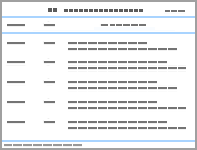
表1
两组一般资料比较"
| 组别 | n | 性别 (男/女, n) | 年龄 (岁) | 病程 (d) | 卒中类型 (出血/梗死, n) | 偏瘫侧 (左/右, n) |
|---|---|---|---|---|---|---|
| 对照组 | 25 | 15/10 | 62.24±6.61 | 72.24±22.31 | 12/13 | 12/13 |
| 试验组 | 25 | 18/7 | 64.00±4.92 | 74.44±23.98 | 10/15 | 16/9 |
| χ2/t值 | 1.608 | 0.802 | 0.336 | 0.325 | 1.299 | |
| P值 | 0.291 | 0.370 | 0.738 | 0.569 | 0.254 |
表2
两组治疗前后FMA-LE评分比较"
| 组别 | n | 治疗前 | 治疗后 | Z值 | P值 |
|---|---|---|---|---|---|
| 对照组 | 25 | 13.00 (4.50) | 20.00 (3.50) | -4.390 | < 0.001 |
| 试验组 | 25 | 13.00 (6.00) | 26.00 (5.00) | -4.831 | < 0.001 |
| Z值 | -0.293 | -4.391 | |||
| P值 | 0.770 | < 0.001 | |||
表3
两组治疗前后BBS评分比较"
| 组别 | n | 治疗前 | 治疗后 | Z值 | P值 |
|---|---|---|---|---|---|
| 对照组 | 25 | 24.00 (9.50) | 34.00 (8.50) | -4.386 | < 0.001 |
| 试验组 | 25 | 24.00 (10.50) | 45.00 (8.00) | -4.375 | < 0.001 |
| Z值 | -0.058 | -4.984 | |||
| P值 | 0.953 | < 0.001 | |||
表4
两组治疗前后TUGT时间比较(s)"
| 组别 | n | 治疗前 | 治疗后 | Z值 | P值 |
|---|---|---|---|---|---|
| 对照组 | 25 | 39.53 (19.77) | 31.46 (12.52) | -4.372 | < 0.001 |
| 试验组 | 25 | 40.70 (20.22) | 21.50 (12.41) | -4.372 | < 0.001 |
| Z值 | -0.155 | -2.804 | |||
| P值 | 0.877 | 0.005 | |||
表5
两组治疗前后10MWS比较(m/min)"
| 组别 | n | 治疗前 | 治疗后 | Z值 | P值 |
|---|---|---|---|---|---|
| 对照组 | 25 | 15.22 (3.36) | 23.57 (8.46) | -4.372 | < 0.001 |
| 试验组 | 25 | 15.44 (6.21) | 31.55 (10.40) | -4.372 | < 0.001 |
| Z值 | -0.184 | -3.415 | |||
| P值 | 0.854 | 0.001 | |||
| [1] | 姚滔涛, 王宁华, 陈卓铭. 脑卒中运动功能训练的循证医学研究[J]. 中国康复医学杂志, 2010, 25(6):565-570. |
| YAO T T, WANG N H, CHEN Z M. Evidence based medicine research on motor function training in stroke[J]. Chin J Rehabil Med, 2010, 25(6):565-570. | |
| [2] | 詹青, 王丽晶. 2016 AHA/ASA成人脑卒中康复治疗指南解读[J]. 神经病学与神经康复学杂志, 2017, 13(1):1-9. |
| ZHAN Q, WANG L J. Interpretation of 2016 AHA/ASA Adult Stroke Rehabilitation Treatment Guidelines[J]. J Neurol Neurorehabil, 2017, 13(1):1-9. | |
| [3] |
CARNES-VENDRELL A, DEUS J, MOLINA-SEGUIN J, et al. Depression and apathy after transient ischemic attack or minor stroke: prevalence, evolution and predictors[J]. Sci Rep, 2019, 9(1):16248.
doi: 10.1038/s41598-019-52721-5 |
| [4] | 刘惠林, 周斌, 赵政, 等. 脑卒中患者居家远程康复指导效果的观察[J]. 中国康复理论与实践, 2021, 27(7):807-811. |
| LIU H L, ZHOU B, ZHAO Z, et al. Effect of home-based remote rehabilitation guidance on stroke patients[J]. Chin J Rehabil Theory Pract, 2021, 27(7):807-811. | |
| [5] | 何蕾, 柴双双, 陈亚平. 平衡评估训练系统对脑卒中后平衡功能的康复效果[J]. 中国康复理论与实践, 2021, 27(7):760-764. |
| HE L, CHAI S S, CHEN Y P. Effect of balance training with balance assessment training system on balance after stroke[J]. Chin J Rehabil Theory Pract, 2021, 27(7):760-764. | |
| [6] |
CABANAS-VALDÉS R, BAGUR-CALAFAT C, GIRABENT-FARRÉS M, et al. The effect of additional core stability exercises on improving dynamic sitting balance and trunk control for subacute stroke patients: a randomized controlled trial[J]. Clin Rehabil, 2016, 30(10):1024.
doi: 10.1177/0269215515609414 |
| [7] |
TYSON S F, HANLEY M, CHILLALA J, et al. The relationship between balance, disability, and recovery after stroke: predictive validity of the Brunel Balance Assessment[J]. Neurorehabil Neural Repair, 2007, 21(4):341-346.
doi: 10.1177/1545968306296966 |
| [8] | 冯建军, 袁建国. 核心稳定性与核心力量研究述评[J]. 体育学刊, 2009, 16(11):58-62. |
| FENG J J, YUAN J G. Review on the research of core stability and core strength[J]. J Phys Educ, 2009, 16(11):58-62. | |
| [9] | 杜东, 尹瑞雪, 何任红, 等. 等速肌力测试在躯干核心肌群中的应用进展[J]. 中国康复理论与实践, 2019, 25(3):338-340. |
| DU D, YIN R X, HE R H, et al. Application progress of isokinetic muscle strength test in trunk core muscle group[J]. Chin J Rehabil Theory Pract, 2019, 25(3):338-340. | |
| [10] | 韩春远, 王卫星, 成波锦, 等. 核心力量训练的基本问题:核心区与核心稳定性[J]. 天津体育学院学报, 2012, 27(2):117-120. |
| HAN C Y, WANG W X, CHENG B J, et al. The basic problem of core strength training: core area and core stability[J]. J Tianjin Instit Phys Educ, 2012, 27(2):117-120. | |
| [11] | 中华神经科学会, 中华神经外科学会. 各类脑血管疾病诊断要点[J]. 中华神经科杂志, 1996, 29(6):379-380. |
| Chinese Society of Neurology, Chinese Neurosurgical Society. Diagnosis of Cerebral Vascular Diseases[J]. Chin J Neurol, 1996, 29(6):379-380. | |
| [12] | 何成奇. 康复医学[M]. 北京: 人民卫生出版社, 2010: 377-378. |
| HE C Q. Rehabilitation Medicine [M]. Beijing: People's Health Publishing House, 2010: 377-378. | |
| [13] | 恽晓平. 康复疗法评定学[M]. 北京: 华夏出版社, 2005: 258-259. |
| YUN X P. Evaluation of Rehabilitation Therapy [M]. Beijing: Huaxia Publishing House, 2005: 258-259. | |
| [14] | 燕铁斌. "起立-行走"计时测试简介:功能性步行能力快速定量评定法[J]. 中国康复理论与实践, 2000, 6(3):115-117. |
| YAN T B. Chin J Rehabil Theory Pract, 2000, 6(3):115-117. | |
| [15] | 赵宏, 瓮长水, 高丽萍. 用Berg平衡量表和最大步行速度评价脑卒中患者的户外步行独立性[J]. 中国康复理论与实践, 2010, 16(1):8-10. |
| ZHAO H, WENG C S, GAO L P. Evaluation of outdoor walking independence of stroke patients with Berg Balance Scale and maximum walking speed[J]. Chin J Rehabil Theory Pract, 2010, 16(1):8-10. | |
| [16] |
FISHMAN K N, ASHBAUGH A R LANCTÔT K L, et al. Apathy, not depressive symptoms, as a predictor of semantic and phonemic fluency task performance in stroke and transient ischemic attack[J]. Clin Exp Neuropsychol, 2018, 40(5):449-461.
doi: 10.1080/13803395.2017.1371282 |
| [17] |
UMAROVA R M. Adapting the concepts of brain and cognitive reserve to post-stroke cognitive deficits: implications for understanding neglect[J]. Cortex, 2017, 97:327-338.
doi: 10.1016/j.cortex.2016.12.006 |
| [18] | MEMBERS W G, MOZAFFARIAN D, BENJAMIN E J, et al. Heart Disease and Stroke Statistics-2016 Update: a report from the American Heart Association[J]. Circulation, 2016, 133(4):e38. |
| [19] | 梁连锦, 潘卫萍, 甘俭. 脑卒中早期与晚期康复训练对老年患者ADL能力的影响[J]. 中国康复医学杂志, 2011, 26(10):984-985. |
| LIANG L J, PAN W P, GAN J. Effect of early and late rehabilitation training on ADL ability of elderly patients with stroke[J]. Chin J Rehabil Med, 2011, 26(10):984-985. | |
| [20] | 曹立全, 陈爱华, 谭思洁. 核心肌力理论在运动健身和康复中的应用进展[J]. 中国康复医学杂志, 2011, 26(1):93-97. |
| CAO L Q, CHEN A H, TAN S J. Application progress of core muscle strength theory in sports fitness and rehabilitation[J]. Chin J Rehabil Med, 2011, 26(1):93-97. | |
| [21] | 周亚飞, 胡世红, 凌晴, 等. 脑卒中偏瘫早期核心肌群强化训练对静态坐位平衡的影响[J]. 中国康复, 2018, 33(5):389-391. |
| ZHOU Y F, HU S H, LING Q, et al. Effect of intensive training of core muscles on static sitting balance in early stage of stroke hemiplegia[J]. Chin J Rehabil, 2018, 33(5):389-391. | |
| [22] | 古澤正道, 陈立嘉. 针对脑卒中患者的Bobath治疗方法[J]. 中国康复理论与实践, 2011, 17(9):805-809. |
| FURUSAWA M, CHEN L J. Bobath approach to the adults with stroke[J]. Chin J Rehabil Theory Pract, 2011, 17(9):805-809. | |
| [23] | 张勃, 丁玎, 吕立. 本体感觉训练结合核心稳定性训练对脑卒中偏瘫患者下肢功能及平衡的影响[J]. 中国康复理论与实践, 2014, 20(12):1109-1112. |
| ZHANG B, DING D, LÜ L. Effects of proprioception training combined with core stability training on lower limb function and balance in stroke patients with hemiplegia[J]. Chin J Rehabil Theory Pract, 2014, 20(12):1109-1112. | |
| [24] | 梁珍梅, 沙薇. 本体感觉训练在脑卒中后下肢运动功能障碍患者康复训练中的应用[J]. 护理实践与研究, 2018, 15(4):151-153. |
| LIANG Z M, SHA W. Application of proprioceptive training in rehabilitation training of patients with lower limb motor dysfunction after stroke[J]. Nurs Prac Res, 2018, 15(4):151-153. | |
| [25] | 刘珏, 朱玉连 . 躯干控制: 脑卒中功能恢复的前提[J]. 中国康复, 2013, 28(3):205-209. |
| LIU Y, ZHU Y L. Trunk control: the premise of functional recovery after stroke[J]. Chin J Rehabil, 2013, 28(3):205-209. | |
| [26] | 刘建华, 魏清川, 胡秀茹, 等. 躯干控制训练联合肌内效贴对卒中后偏瘫患者躯干及平衡功能的临床疗效[J]. 中国康复, 2020, 35(11):582-586. |
| LIU J H, WEI Q C, HU X R, et al. Clinical effect of trunk control training combined with intramuscular plaster on trunk and balance function in patients with post-stroke hemiplegia[J]. Chin J Rehabil, 2020, 35(11):582-586. | |
| [27] | 李威, 曾祥斌, 章荣, 等. 核心稳定性训练对脑卒中偏瘫患者步态时空参数和对称性参数的影响[J]. 中国康复医学杂志, 2014, 29(9):816-822. |
| LI W, ZENG X B, ZHANG R, et al. Effect of core stability training on gait spatial-temporal parameters and symmetry parameters in stroke patients with hemiplegia[J]. Chin J Rehabil Med, 2014, 29(9):816-822. | |
| [28] | 毛玲娣. 核心肌群控制训练对脑卒中患者步行的改善[J]. 中国实用医药, 2016, 11(7):281-282. |
| MAO L D. Improvement of core muscle group control training on walking in stroke patients[J]. Chin Prac Med, 2016, 11(7):281-282. | |
| [29] |
KIM Y, KIM E, GONG W. The effects of trunk stability exercise using PNF on the Functional Reach Test and muscle activities of stroke patients[J]. J Phys Ther Sci, 2011, 23(5):699-702.
doi: 10.1589/jpts.23.699 |
| [30] | 王晨, 王人卫, 杨坚, 等. 核心稳定性训练结合常规康复治疗对脑卒中偏瘫患者躯干肌肉厚度、活动度的Meta分析[J]. 中国康复医学杂志, 2019, 34(9):1065-1070. |
| WANG C, WANG R W, YANG J, et al. Chin J Rehabil Med, 2019, 34(9):1065-1070. | |
| [31] | 杜雪晶, 张通, 刘元旻, 等. 超声视觉反馈下的核心训练对脑卒中偏瘫患者腹横肌厚度及运动功能的影响[J]. 中国康复, 2021, 36(3):135-139. |
| DU X J, ZHANG T, LIU Y M, et al. Effect of core training under ultrasonic visual feedback on transverse abdominal muscle thickness and motor function in stroke patients with hemiplegia[J]. Chin J Rehabil, 2021, 36(3):135-139. | |
| [32] | 苏国栋, 刘惠林, 黄梦洁, 等. 呼吸肌训练对急性脑卒中患者运动功能的效果[J]. 中国康复理论与实践, 2016, 22(9):1008-1010. |
| SU G D, LIU H L, HUANG M J, et al. Effect of respiratory muscle training on motor function in patients with acute stroke[J]. Chin J Rehabil Theory Pract, 2016, 22(9):1008-1010. | |
| [33] | 吕连. 不同呼吸训练方式在脑卒中患者中的应用[J]. 中国卫生标准管理, 2017, 8(6):55-56. |
| LÜ L. Application of different breathing training methods in stroke patient[J]. Chin Health Standard Manag, 2017, 8(6):55-56. | |
| [34] | 马頔, 王维. 呼吸训练联合常规康复训练对偏瘫患者功能康复的研究[J]. 中国康复医学杂志, 2016, 31(10):1111-1116. |
| MA D, WANG W. Study on functional rehabilitation of hemiplegic patients with respiratory training combined with routine rehabilitation training[J]. Chin J Rehabil Med, 2016, 31(10):1111-1116. | |
| [35] | 马艳, 王小云, 岳翔, 等. 膈肌训练对脑卒中后疲劳患者日常生活活动的影响[J]. 中华物理医学与康复杂志, 2016, 38(8):587-590. |
| MA Y, WANG X Y, YUE X, et al. Effect of diaphragm training on activities of daily living in patients with post-stroke fatigue[J]. Chin J Phys Med Rehabil, 2016, 38(8):587-590. | |
| [36] | 俞长君, 李雪萍, 林强, 等. 呼吸肌训练对亚急性期脑卒中患者呼吸功能的影响[J]. 中华物理医学与康复杂志, 2016, 38(10):735-739. |
| YU C J, LI X P, LIN Q, et al. Effect of respiratory muscle training on respiratory function in patients with subacute stroke[J]. Chin J Phys Med Rehabil, 2016, 38(10):735-739. | |
| [37] |
DONG K S, KWON O S, KIM J H, et al. The effect of trunk stabilization exercise on the thickness of the deep abdominal muscles and balance in patients with chronic stroke[J]. J Phys Ther Sci, 2012, 24(2):181-185.
doi: 10.1589/jpts.24.181 |
| [1] | 刘华, 王丽媛, 马欣, 李静, 王丽. 基于OBE-CDIO模式运动康复训练教程课程改革的效果[J]. 《中国康复理论与实践》, 2026, 32(3): 270-275. |
| [2] | 朱丽丽, 赵嘉欣, 程雪, 王会娟, 陈小霞. 康复期脑卒中患者疾病体验及需求的Meta整合[J]. 《中国康复理论与实践》, 2026, 32(3): 286-293. |
| [3] | 刘平, 周楠, 薛晓杰, 邵伟波. 脑卒中后吞咽障碍康复治疗技术应用研究的文献计量分析[J]. 《中国康复理论与实践》, 2026, 32(3): 294-303. |
| [4] | 杨玲, 王庆雷, 王洁, 徐雯婕, 王彤, 郭川, 钱雪. 基于功能性近红外光谱成像的卒中后焦虑患者前额叶皮质激活特征及机制研究[J]. 《中国康复理论与实践》, 2026, 32(3): 329-336. |
| [5] | 梁冠军, 徐欢岚, 张何威, 张大力, 顾琴, 李明娣. 不同视觉输入及任务条件下痉挛型偏瘫儿童平衡与下肢生物力学变化[J]. 《中国康复理论与实践》, 2026, 32(3): 345-355. |
| [6] | 王志伟, 孟丽君, 武雨, 刘健, 达朝锦, 延泽萍, 吴世彩. 全膝关节置换术后患者疼痛、运动恐惧、社会参与与膝关节功能的关系:基于伦理公平性视角下的网络分析[J]. 《中国康复理论与实践》, 2026, 32(3): 364-372. |
| [7] | 张力引. 帕金森病抑郁及其对认知、平衡功能和生活质量的影响[J]. 《中国康复理论与实践》, 2026, 32(2): 174-180. |
| [8] | 中国康复医学会康复医学教育专业委员会运动康复学组, 钱菁华, 廖远朋, 王琳, 张秋霞, 保文莉, 张海峰. 基于世界卫生组织康复胜任力架构构建运动康复本科专业实习体系[J]. 《中国康复理论与实践》, 2026, 32(2): 241-248. |
| [9] | 韩雪娇, 史冀鹏, 卫金鹏, 朱天瑞, 徐红旗, 何慕寒. 体力活动和平衡能力与残疾的关联性研究——基于NHANES的横断面研究[J]. 《中国康复理论与实践》, 2026, 32(1): 1-12. |
| [10] | 陈健, 李哲恒, 王定宣. 基于世界卫生组织康复胜任力架构的中国运动康复专业人才培养现状分析[J]. 《中国康复理论与实践》, 2026, 32(1): 110-116. |
| [11] | 张季辉, 伊龙悦, 杨远滨. 中老年人平衡功能障碍的相关因素及其与功能性下肢肌力的关联:基于CHARLS数据库的分析[J]. 《中国康复理论与实践》, 2026, 32(1): 13-22. |
| [12] | 岳圆, 张通, 刘元旻, 王亚囡. 下肢外骨骼机器人对卒中后小脑性共济失调患者平衡和步行功能的影响[J]. 《中国康复理论与实践》, 2026, 32(1): 23-29. |
| [13] | 吴澄, 章云枫, 王卫宁, 余克威, 张艳正, 沈嘉蓉, 吴毅. 肘腕功能支具对脑卒中偏瘫患者足底压力和平衡功能的效果[J]. 《中国康复理论与实践》, 2026, 32(1): 30-39. |
| [14] | 张军风, 陈昊, 杜宇征, 李琛, 于涛, 杨元庆. 2004年至2024年脑卒中后肢体痉挛非药物疗法的文献计量分析[J]. 《中国康复理论与实践》, 2026, 32(1): 45-58. |
| [15] | 高凯祥, 芦海涛. 2015年至2024年神经康复研究的文献计量分析[J]. 《中国康复理论与实践》, 2026, 32(1): 59-68. |
| 阅读次数 | ||||||
|
全文 |
|
|||||
|
摘要 |
|
|||||
|
||
