



《中国康复理论与实践》 ›› 2021, Vol. 27 ›› Issue (9): 1048-1058.doi: 10.3969/j.issn.1006-9771.2021.09.008
刘阳1,张孝权1( ),王恒1,齐莉萍2
收稿日期:2020-11-25
修回日期:2021-07-30
出版日期:2021-09-25
发布日期:2021-10-09
通讯作者:
张孝权
E-mail:xiaoquanzhang@dlut.edu.cn
作者简介:刘阳(1995-),男,汉族,河南信阳市人,硕士研究生,主要研究方向:运动生物力学。
基金资助:
LIU Yang1,ZHANG Xiao-quan1(),WANG Heng1,QI Li-ping2
Received:2020-11-25
Revised:2021-07-30
Published:2021-09-25
Online:2021-10-09
Contact:
ZHANG Xiao-quan
E-mail:xiaoquanzhang@dlut.edu.cn
Supported by:摘要:
目的 综合评价虚拟现实技术(VR)对帕金森病患者综合平衡能力改善的效果。方法 计算机检索Web of Science、PubMed、Cochrane Library、EMBASE、Scopus、维普数据库、万方数据库、中国知网(CNKI)数据库,搜集VR对帕金森病患者干预的随机对照研究,时间范围自建库至2020年11月。由2名研究者独立筛选文献、提取资料并评价文献质量后,采用Review Manager 5.3软件进行Meta分析。结果 共纳入24篇文献,与对照组相比,结果显示VR干预能显著改善帕金森病患者的静态平衡能力(SMD = -0.49, 95%CI -0.64~-0.35, P < 0.001),单一VR干预显著改善帕金森病患者的Berg平衡量表评分(SMD = 0.83, 95%CI 0.43~1.23, P < 0.001),联合VR干预显著改善帕金森病患者的Berg平衡量表评分(SMD = 0.75, 95%CI 0.53~0.96, P < 0.001)和计时起立-行走测试时间(SMD = -0.87, 95%CI -1.52~-0.22, P = 0.008),单一VR干预计时起立-行走测试时间与对照组无显著性差异(SMD = -0.36, 95%CI -0.74~0.03, P = 0.07)。结论 VR可以改善帕金森病患者的综合平衡能力,建议与常规康复或平衡训练联合进行。
刘阳,张孝权,王恒,齐莉萍. 虚拟现实技术对帕金森病患者综合平衡能力改善的Meta分析[J]. 《中国康复理论与实践》, 2021, 27(9): 1048-1058.
LIU Yang,ZHANG Xiao-quan,WANG Heng,QI Li-ping. Effects of Virtual Reality on Balance for Patients with Parkinson's Disease: A Meta-analysis[J]. 《Chinese Journal of Rehabilitation Theory and Practice》, 2021, 27(9): 1048-1058.

图1
文献筛选流程"

表1
纳入文献的基本特征"
| 文献 | 国家或地区 | 样本量 (女性数) | 年龄(岁) | 患病程度 | 干预措施 | 干预剂量 | 结局指标 | |
|---|---|---|---|---|---|---|---|---|
| T | C | |||||||
| Yuan (2020)[ | 中国台湾 | T = 12(10) C = 12(3) | 67.8±5.5 66.5±8.8 | H&Y T: 1期4例,2期5例,3期3例 C: 1期3例,2期4例,3期5例 | VR | 无干预 | 前6周,每周3次,每次30 min | ① |
| Pazzaglia (2020)[ | 意大利 | T = 25(7) C = 26(9) | 72±7 70±10 | UPDRS-3 T: 23±9 C: 25±10 | C+VR | 常规康复 | 6周,每周3次,每次40 min | ① |
| 夏敏(2020)[ | 中国 | T = 15(4) C = 15(3) | 65.99 ±4.30 66.00±8.55 | UPDRS-3 T: 16.60±2.47 C: 18.27±3.63 | C+VR | 常规康复 | 4周,每周3次,每次40 min,T在C的基础上再VR干预15~20 min | ① |
| 刘静 (2020)[ | 中国 | T = 21(9) C = 21(10) | 60.9±7.20 63.90±5.82 | 病程(年) T: 7.76±3.99 C: 8.10±3.42 | C+VR | 平衡训练 | 5周,每周4次,每次30 min | ① |
| Moon (2020)[ | 韩国 | T = 8(5) C = 7(5) | 63.38±5.37 62.14±5.55 | H&Y T: 2.63±0.52 C: 2.71±0.49 | C+VR | 作业疗法 | 8周,每周3次,每次30 min,T在C的基础上再VR干预30 min | ①② |
| Feng (2019)[ | 中国 | T = 14(7) C = 14(6) | 67.47±4.79 66.93±4.64 | H&Y T: 3.03±0.55 C: 2.97±0.58 | VR | 常规康复 | 12周,每周5次,每次45 min | ①② |
| Santos (2019)[ | 巴西 | T = 13(2) C = 14(3) | 61.7±7.3 64.5±9.8 | H&Y T: 1.4±0.6 C: 1.3±0.3 | VR | 常规康复 | 8周,每周2次,每次50 min | ①② |
| T = 14(5) C = 14(3) | 66.6±8.2 64.5±9.8 | H&Y T: 1.5±0.4 C: 1.3±0.3 | C+VR | |||||
| Tollár (2019)[ | 匈牙利 | T = 25(13) C = 24(11) | 70.0±4.69 67.5±4.28 | H&Y T: 2.3±0.48 C: 2.4±0.51 | VR | 健康教育 | 5周,每周5次,每次60 min | ①③ |
| T = 25(13) C = 25(14) | 70.0±4.69 70.6±4.10 | H&Y T: 2.3±0.48 C: 2.4±0.51 | 自行车 | |||||
| 秦灵芝 (2019)[ | 中国 | T = 43(18) C = 40(16) | 65.9±4.9 66.1±6.2 | H&Y T: 2.6±0.5 C: 2.6±0.4 | C+VR | 常规康复 | 6周,每周5次,每次60 min | ① |
| 冯浩 (2019)[ | 中国 | T = 14(6) C = 14(5) | 67.47±4.79 66.93±4.64 | 病程(年) T: 7.07±1.44 C: 6.60±1.45 | VR | 常规康复 | 12周,每日1次,每次45 min | ② |
| 程元元(2019)[ | 中国 | T = 20(12) C = 20(11) | 59.2±7.3 58.6±7.5 | 病程(年) T: 6.1±1.4 C: 6.2±1.7 | C+VR | 常规康复 | 8周,每周2次,每次60 min | ①② |
| Song (2018)[ | 澳大利亚 | T = 28(16) C = 25(20) | 68±7 65±7 | 病程(年) T: 7±4 C: 9±6 | 家庭VR | 无干预 | 12周,每周3次,每次不少于15 min | ② |
| Ribas (2017)[ | 巴西 | T = 10(6) C = 10(6) | 61.70±6.83 60.20±11.29 | H&Y T: 1期5例,1.5期2例,2期2例,2.5期1例 C: 1期3例,1.5期4例,2期2例,2.5期1例 | C+VR | 常规康复 | 12周,每次30 min | ① |
| Carpinella (2017)[ | 意大利 | T = 17(3) C = 20(11) | 73±7.1 75.6±8.2 | H&Y T: 2.7±0.7 C: 2.9±0.5 | VR | 平衡训练 | 每周3次,每次45 min,共20次 | ①②③ |
| Gandolfi (2017)[ | 意大利 | T = 38(15) C = 38(10) | 67.45±7.18 69.84±9.41 | H&Y(范围) T: 2.5~2.5 C: 2.5~3.0 | 家庭VR | 平衡训练 | 7周,每周3次,每次50 min | ① |
| 陈思 (2017)[ | 中国 | T = 23(9) C = 23(11) | 62.09±6.11 64.65±5.06 | H&Y T: 2.52±0.51 C: 2.57±0.50 | VR | 平衡训练 | 6周,每周5次,每次50 min | ①②③ |
| Yang (2016)[ | 中国台湾 | T = 11(4) C = 12(5) | 72.5±8.4 75.4±6.3 | H&Y(范围) T: 2~3 C: 2~3 | 家庭VR | 平衡训练 | 6周,每周3次,每次50 min | ①② |
| Shih (2016)[ | 中国台湾 | T = 10(1) C = 10(3) | 67.5±9.96 68.8±9.67 | H&Y T: 1.6±0.84 C: 1.4±0.52 | C+VR | 平衡训练 | 8周,每周2次,每次50 min | ①② |
| Özgönenel (2016)[ | 土耳其 | T = 15(10) C = 18(12) | 64 65 | H&Y T: 1期3例,2期10例,3期2例 C: 1期4例,2期6例,3期8例 | C+VR | 平衡训练 | 5周,每周3次,每次60 min | ①② |
| 林志诚 (2016)[ | 中国 | T = 17(6) C = 14(5) | 61.4±8.2 62.1±6.3 | H&Y T: 2.7±0.9 C: 2.9±0.7 | VR | 平衡训练 | 5周,每周3次,每次60 min | ①② |
| Lee (2015)[ | 韩国 | T = 10(5) C = 10(5) | 68.4±2.9 70.1±3.3 | 无数据 | C+VR | 功能治疗 | 6周,每周2次,每次45 min | ① |
| van den Heuvel (2014)[ | 荷兰 | T = 17(5) C = 16(8) | 66.3±6.39 68.8±9.68 | H&Y T: 2期6例,2.5期8例,3期3例 C: 2期5例,2.5期5例,3期6例 | VR | 平衡训练 | 5周,每周2次,每次60 min | ① |
| Laio (2014)[ | 中国台湾 | T = 12(6) C = 12(7) | 67.3±7.1 64.6±8.6 | H&Y T: 1~1.5期5例,2~2.5期4例,3期3例 C: 1~1.5期5例,2~2.5期4例,3期3例 | C+VR | 跑步机 | 6周,每周2次,每次60 min | ② |
| Pompeu (2012)[ | 巴西 | T = 16 C = 16 | None data | H&Y(范围) T: 1~2 C: 1~2 | VR | 平衡训练 | 7周,每周2次,每次60 min | ① |
表2
纳入文献的质量情况"
| 文献 | 随机序列生成 | 分配隐藏 | 参与者盲法 | 评定者盲法 | 数据不完整 | 选择性报告 | 其他偏倚 | 质量分数 |
|---|---|---|---|---|---|---|---|---|
| Yuan (2020)[ | 不清楚 | 低风险 | 低风险 | 高风险 | 低风险 | 低风险 | 不清楚 | B |
| Pazzaglia (2020)[ | 低风险 | 低风险 | 低风险 | 高风险 | 低风险 | 低风险 | 不清楚 | B |
| 夏敏 (2020)[ | 低风险 | 不清楚 | 不清楚 | 不清楚 | 高风险 | 低风险 | 高风险 | B |
| 刘静 (2020)[ | 低风险 | 不清楚 | 不清楚 | 不清楚 | 低风险 | 低风险 | 不清楚 | B |
| Moon (2020)[ | 不清楚 | 不清楚 | 不清楚 | 不清楚 | 低风险 | 低风险 | 不清楚 | B |
| Feng (2019)[ | 不清楚 | 低风险 | 低风险 | 高风险 | 低风险 | 低风险 | 不清楚 | B |
| Santos (2019)[ | 高风险 | 不清楚 | 低风险 | 低风险 | 低风险 | 低风险 | 低风险 | B |
| Tollár (2019)[ | 低风险 | 低风险 | 低风险 | 高风险 | 低风险 | 低风险 | 不清楚 | B |
| 秦灵芝 (2019)[ | 低风险 | 不清楚 | 不清楚 | 不清楚 | 低风险 | 低风险 | 不清楚 | B |
| 冯浩 (2019)[ | 不清楚 | 不清楚 | 不清楚 | 不清楚 | 低风险 | 低风险 | 不清楚 | B |
| 程元元 (2019)[ | 低风险 | 不清楚 | 不清楚 | 不清楚 | 低风险 | 低风险 | 不清楚 | B |
| Song (2018)[ | 低风险 | 低风险 | 低风险 | 不清楚 | 高风险 | 低风险 | 高风险 | B |
| Ribas (2017)[ | 不清楚 | 低风险 | 低风险 | 低风险 | 低风险 | 低风险 | 低风险 | B |
| Carpinella (2017)[ | 低风险 | 低风险 | 低风险 | 低风险 | 低风险 | 低风险 | 低风险 | A |
| Gandolfi (2017)[ | 低风险 | 低风险 | 低风险 | 高风险 | 高风险 | 低风险 | 不清楚 | B |
| 陈思 (2017)[ | 低风险 | 不清楚 | 不清楚 | 不清楚 | 低风险 | 低风险 | 不清楚 | B |
| Yang (2016)[ | 低风险 | 不清楚 | 不清楚 | 不清楚 | 低风险 | 低风险 | 不清楚 | B |
| Shih (2016)[ | 低风险 | 低风险 | 低风险 | 高风险 | 低风险 | 低风险 | 不清楚 | B |
| Özgönenel (2016)[ | 高风险 | 高风险 | 不清楚 | 高风险 | 低风险 | 低风险 | 不清楚 | B |
| 林志诚 (2016)[ | 低风险 | 低风险 | 不清楚 | 不清楚 | 低风险 | 低风险 | 不清楚 | B |
| Lee (2015)[ | 不清楚 | 不清楚 | 不清楚 | 不清楚 | 低风险 | 低风险 | 高风险 | B |
| van den Heuvel (2014)[ | 不清楚 | 不清楚 | 不清楚 | 不清楚 | 低风险 | 低风险 | 低风险 | B |
| Laio (2014)[ | 低风险 | 低风险 | 低风险 | 不清楚 | 低风险 | 低风险 | 不清楚 | B |
| Pompeu (2012)[ | 不清楚 | 不清楚 | 低风险 | 不清楚 | 高风险 | 低风险 | 高风险 | B |
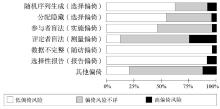
图2
偏倚项目百分比"
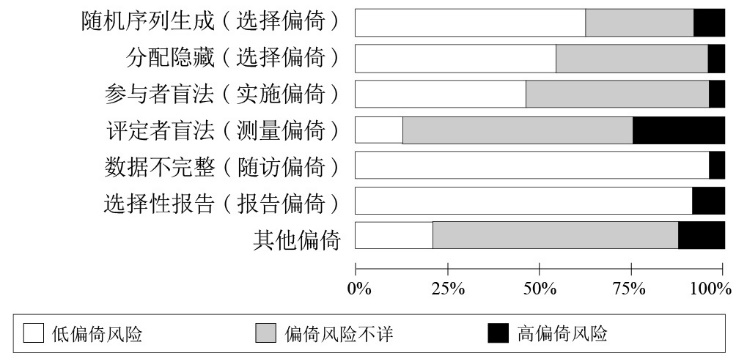

图3
VR对BBS改善效果的森林图"


图4
VR对TUGT改善效果的森林图"


图5
虚拟现实对COP改善效果的森林图"

表3
BBS与TUGT关于对照组的干预方式进行亚组分析"
| 指标 | 分组 | 研究数 | 效应量 | 95%CI | P值 | I² | P值 |
|---|---|---|---|---|---|---|---|
| BBS | VR vs. 常规康复 | 7 | 4.20 | 3.11~5.29 | < 0.001 | 27% | 0.21 |
| VR vs. 平衡训练 | 10 | 3.00 | 1.63~4.37 | < 0.001 | 64% | 0.003 | |
| VR vs. 无特殊训练 | 2 | 5.02 | -5.36~15.41 | 0.34 | 94% | < 0.001 | |
| VR vs. 特殊干预 | 2 | 1.47 | 0.60~2.34 | 0.0009 | 39% | 0.20 | |
| TUGT | VR vs. 常规康复 | 5 | -0.74 | -1.36~-0.13 | 0.02 | 73% | 0.002 |
| VR vs. 平衡训练 | 6 | -0.48 | -0.94~-0.03 | 0.04 | 57% | 0.04 | |
| VR vs. 无特殊训练 | 1 | 0.29 | -0.25~0.83 | 0.29 | |||
| VR vs. 特殊干预 | 1 | -0.69 | -1.74~0.37 | 0.20 |
表4
BBS与TUGT关于患者的患病程度进行亚组分析"
| 分组 | 研究数量 | 效应量 | 95%CI | P值 | |
|---|---|---|---|---|---|
| BBS | H&Y < 2 | 4 | 0.54 | 0.13~0.96 | 0.01 |
| H&Y 2~3 | 12 | 0.94 | 0.56~1.32 | < 0.001 | |
| H&Y > 3 | 2 | 1.00 | 0.50~1.50 | < 0.001 | |
| TUGT | H&Y ≤ 2.5 | 7 | -0.54 | -1.09~0.02 | 0.06 |
| H&Y > 2.5 | 7 | -0.43 | -0.86~0.00 | 0.05 | |
| [1] |
KALIA L V, LANG A E. Parkinson's disease[J]. Lancet, 2015, 386(9996):896-912.
doi: 10.1016/S0140-6736(14)61393-3 |
| [2] | TYSNES O B, STORSTEIN A. Epidemiology of Parkinson's disease[J]. J Neural Transm (Vienna), 2017, 124(8):901-905. |
| [3] |
ZHANG H, TONG R, BAI L, et al. Emerging targets and new small molecule therapies in Parkinson's disease treatment[J]. Bioorg Med Chem, 2016, 24(7):1419-1430.
doi: 10.1016/j.bmc.2016.02.030 |
| [4] | MARTINEZ-HORTA S, KULISEVSKY J. Mild cognitive impairment in Parkinson's disease[J]. J Neural Transm (Vienna), 2019, 126(7):897-904. |
| [5] |
SOFUWA O, NIEUWBOER A, DESLOOVERE K, et al. Quantitative gait analysis in Parkinson's disease: comparison with a healthy control group[J]. Arch Phys Med Rehabil, 2005, 86(5):1007-1013.
doi: 10.1016/j.apmr.2004.08.012 |
| [6] |
JANKOVIC J. Parkinson's disease: clinical features and diagnosis[J]. J Neurol Neurosurg Psychiatry, 2008, 79(4):368-376.
doi: 10.1136/jnnp.2007.131045 |
| [7] |
HOEHN M M, YAHR M D. Parkinsonism: onset, progression, and mortality[J]. Neurology, 1998, 50(2):318.
doi: 10.1212/WNL.50.2.318 |
| [8] | 蔡伦, 林岑, 周鼒, 等. 老年人跌倒的公共卫生研究进展[J]. 中国老年学杂志, 2018, 38(9):2265-2268. |
| CAI L, LIN C, ZHOU Z, et al. Advances in public health research on falls in the elderly[J]. Chin J Gerontol, 2018, 38(9):2265-2268. | |
| [9] |
FOX S H, KATZENSCHLAGER R, LIM S Y, et al. International Parkinson and Movement Disorder Society evidence-based medicine review: update on treatments for the motor symptoms of Parkinson's disease[J]. Mov Disord, 2018, 33(8):1248-1266.
doi: 10.1002/mds.27372 |
| [10] |
GRABLI D, KARACHI C, WELTER M L, et al. Normal and pathological gait: what we learn from Parkinson's disease[J]. J Neurol Neurosurg Psychiatry, 2012, 83(10):979-985.
doi: 10.1136/jnnp-2012-302263 |
| [11] |
ABBRUZZESE G, MARCHESE R, AVANZINO L, et al. Rehabilitation for Parkinson's disease: current outlook and future challenges[J]. Parkinsonism Relat Disord, 2016, 22(Suppl 1):S60-S64.
doi: 10.1016/j.parkreldis.2015.09.005 |
| [12] |
SPAULDING S J, BARBER B, COLBY M, et al. Cueing and gait improvement among people with Parkinson's disease: a meta-analysis[J]. Arch Phys Med Rehabil, 2013, 94(3):562-570.
doi: 10.1016/j.apmr.2012.10.026 |
| [13] | DE DREU M J, VAN DER WILK A S, POPPE E, et al. Rehabilitation, exercise therapy and music in patients with Parkinson's disease: a meta-analysis of the effects of music-based movement therapy on walking ability, balance and quality of life[J]. Parkinsonism Relat Disord, 2012, 18(Suppl 1):S114-S119. |
| [14] |
GOODWIN V A, RICHARDS S H, TAYLOR R S, et al. The effectiveness of exercise interventions for people with Parkinson's disease: a systematic review and meta-analysis[J]. Mov Disord, 2008, 23(5):631-640.
doi: 10.1002/mds.v23:5 |
| [15] | ALVES DA ROCHA P, MCCLELLAND J, MORRIS M E. Complementary physical therapies for movement disorders in Parkinson's disease: a systematic review[J]. Eur J Phys Rehabil Med, 2015, 51(6):693-704. |
| [16] | BAUS O, BOUCHARD S. Moving from virtual reality exposure-based therapy to augmented reality exposure-based therapy: a review[J]. Front Hum Neurosci, 2014, 8:112. |
| [17] | WEISS P L, KIZONY R, FEINTUCH U, et al. Virtual reality in neurorehabilitation [M]// SELZER M, CLARKE S, COHEN L G, et al. Textbook of Neural Repair and Rehabilitation, Oxford University Press, 2006: 182-197. |
| [18] |
BRUNET-GOUET E, OKER A, MARTIN J C, et al. Advances in virtual agents and affective computing for the understanding and remediation of social cognitive disorders[J]. Front Hum Neurosci, 2016, 9:697.
doi: 10.3389/fpsyg.2018.00697 |
| [19] |
KESHNER E A, FUNG J. The quest to apply VR technology to rehabilitation: tribulations and treasures[J]. J Vestib Res, 2017, 27(1):1-5.
doi: 10.3233/VES-170610 |
| [20] |
LEVIN M F, WEISS P L, KESHNER E A. Emergence of virtual reality as a tool for upper limb rehabilitation: incorporation of motor control and motor learning principles[J]. Phys Ther, 2015, 95(3):415-425.
doi: 10.2522/ptj.20130579 |
| [21] | DARTER B J, WILKEN J M, BRAWNER M E, et al. Gait training using virtual reality and real-time feedback in a transfemoral amputee[C]. 2009 Virtual Rehabilitation International Conference, IEEE, 2009: 212. |
| [22] | HARRIS D M, RANTALAINEN T, MUTHALIB M, et al. Exergaming as a viable therapeutic tool to improve static and dynamic balance among older adults and people with idiopathic Parkinson's disease: a systematic review and meta-analysis[J]. Front Aging Neurosci, 2015, 7:167. |
| [23] |
WANG B, SHEN M, WANG Y X, et al. Effect of virtual reality on balance and gait ability in patients with Parkinson's disease: a systematic review and meta-analysis[J]. Clin Rehabil, 2019, 33(7):1130-1138.
doi: 10.1177/0269215519843174 |
| [24] |
LEI C, SUNZI K, DAI F, et al. Effects of virtual reality rehabilitation training on gait and balance in patients with Parkinson's disease: a systematic review[J]. PLoS One, 2019, 14(11):e0224819.
doi: 10.1371/journal.pone.0224819 |
| [25] |
LINA C, GUOEN C, HUIDAN W, et al. The effect of virtual reality on the ability to perform activities of daily living, balance during gait, and motor function in Parkinson disease patients: a systematic review and meta-analysis[J]. Am J Phys Med Rehabil, 2020, 99(10):917-924.
doi: 10.1097/PHM.0000000000001447 |
| [26] |
CHEN Y, GAO Q, HE C Q, et al. Effect of virtual reality on balance in individuals with Parkinson disease: a systematic review and meta-analysis of randomized controlled trials[J]. Phys Ther, 2020, 100(6):933-945.
doi: 10.1093/ptj/pzaa042 |
| [27] | 王筱筱, 段宏为, 林航, 等. 虚拟现实技术对帕金森病患者平衡和日常生活能力影响的Meta分析[J]. 中国康复理论与实践, 2017, 23(12):1443-1449. |
| WANG X X, DUAN H W, LIN H, et al. Effects of virtual reality on balance and activities of daily living in patients with Parkinson's disease:a meta-analysis[J]. Chin J Rehabil Theory Pract, 2017, 23(12):1443-1449. | |
| [28] | CANNING C G, ALLEN N E, NACKAERTS E, et al. Virtual reality in research and rehabilitation of gait and balance in Parkinson disease[J]. Nat Rev Neurol, 2020, 16(8):409-425. |
| [29] |
JURAS G, BRACHMAN A, MICHALSKA J, et al. Standards of virtual reality application in balance training programs in clinical practice: a systematic review[J]. Games Health J, 2019, 8(2):101-111.
doi: 10.1089/g4h.2018.0034 |
| [30] |
SANTOS P, MACHADO T, SANTOS L, et al. Efficacy of the Nintendo Wii combination with conventional exercises in the rehabilitation of individuals with Parkinson's disease: a randomized clinical trial[J]. NeuroRehabilitation, 2019, 45(2):255-263.
doi: 10.3233/NRE-192771 |
| [31] |
SANTOS P, SCALDAFERRI G, SANTOS L, et al. Effects of the Nintendo Wii training on balance rehabilitation and quality of life of patients with Parkinson's disease: a systematic review and meta-analysis[J]. NeuroRehabilitation, 2019, 44(4):569-577.
doi: 10.3233/NRE-192700 |
| [32] |
COSTA M T S, VIEIRA L P, BARBOSA E O, et al. Virtual reality-based exercise with exergames as medicine in different contexts: a short review[J]. Clin Pract Epidemiol Ment Health, 2019, 15:15-20.
doi: 10.2174/1745017901915010015 |
| [33] | AKL E A, ALTMAN D G, ALUKO P, et al. Cochrane Handbook for Systematic Reviews of Interventions[M]. John Wiley & Sons, 2019. |
| [34] | DOCKX K, BEKKERS E M, VAN DEN BERGH V, et al. Virtual reality for rehabilitation in Parkinson's disease[M]. Cochrane Database Syst Rev, 2016, 12(12):CD010760. |
| [35] |
YUAN R Y, CHEN S C, PENG C W, et al. Effects of interactive video-game-based exercise on balance in older adults with mild-to-moderate Parkinson's disease[J]. J Neuroeng Rehabil, 2020, 17(1):1-10.
doi: 10.1186/s12984-019-0634-5 |
| [36] |
PAZZAGLIA C, IMBIMBO I, TRANCHITA E, et al. Comparison of virtual reality rehabilitation and conventional rehabilitation in Parkinson's disease: a randomised controlled trial[J]. Physiotherapy, 2020, 106:36-42.
doi: 10.1016/j.physio.2019.12.007 |
| [37] | 夏敏, 江一静, 郑得忠, 等. 体感游戏对帕金森病患者认知、步态的影响[J]. 临床荟萃, 2020, 35(10):900-903. |
| XIA M, JIANG Y J, ZHENG D Z, et al. Effect of somatosensory games on cognition and gait of patients with Parkinson's disease[J]. Clin Focus, 2020, 35(10):900-903. | |
| [38] | 刘静, 颜智, 廖瑞松, 等. 虚拟现实技术对帕金森病患者平衡功能的康复效果[J]. 中国康复医学杂志, 2020, 35(6):682-687. |
| LIU J, YAN Z, LIAO R S, et al. The effect of virtual reality training on balance function in patients with Parkinson's disease[J]. Chin J Rehabil Med, 2020, 35(6):682-687. | |
| [39] | MOON J H, JUNG J H, CHO H Y. Effects of balance training using a Wii Fit balance board on balance, gait and activities of daily living in patients with Parkinson disease: a pilot, randomized controlled trial[J]. Medico Legal Update, 2020, 20(1):1799-1803. |
| [40] |
FENG H, LI C, LIU J, et al. Virtual reality rehabilitation versus conventional physical therapy for improving balance and gait in Parkinson's disease patients: a randomized controlled trial[J]. Med Sci Monit, 2019, 25:4186-4192.
doi: 10.12659/MSM.916455 |
| [41] |
TOLLÁR J, NAGY F, HORTOBÁGYI T. Vastly different exercise programs similarly improve Parkinsonian symptoms: a randomized clinical trial[J]. Gerontology, 2019, 65(2):120-127.
doi: 10.1159/000493127 |
| [42] | 秦灵芝, 李玮, 王晓娟, 等. 虚拟现实技术在帕金森病冻结步态康复中的应用[J]. 中华物理医学与康复杂志, 2019, 41(3):206-209. |
| QIN L Z, LI W, WANG X J, et al. Virtual reality in rehabilitation for freezing of gait in Parkinson's disease[J]. Chin J Phys Med Rehabil, 2019, 41(3):206-209. | |
| [43] | 冯浩, 李翠云, 刘镓雨, 等. 虚拟现实训练对帕金森病患者步行能力的影响[J]. 中国卫生标准管理, 2019, 10(12):32-34. |
| FENG H, LI C Y, LIU J Y, et al. Effects of virtual reality training on walking ability in patients with Parkinson's disease[J]. Chin Health Stan Manage, 2019, 10(12):32-34. | |
| [44] | 程元元, 于洋, 梁思泉, 等. 虚拟现实技术结合康复训练对帕金森病患者平衡功能的影响[J]. 医学综述, 2019, 25(21):4325-4329. |
| CHENG Y Y, YU Y, LIANG S Q, et al. Effect of virtual reality technology combined with rehabilitation training on balance function of patients with Parkinson's disease[J]. Med Recapitulate, 2019, 25(21):4325-4329. | |
| [45] |
SONG J, PAUL S S, HomCAETANO M J D, et al. e-based step training using videogame technology in people with Parkinson's disease: a single-blinded randomised controlled trial[J]. Clin Rehabil, 2018, 32(3):299-311.
doi: 10.1177/0269215517721593 |
| [46] |
RIBAS C G, ALVES DA SILVA L, CORRÊA M R, et al. Effectiveness of exergaming in improving functional balance, fatigue and quality of life in Parkinson's disease: a pilot randomized controlled trial[J]. Parkinsonism Relat Disord, 2017, 38:13-18.
doi: 10.1016/j.parkreldis.2017.02.006 |
| [47] |
CARPINELLA I, CATTANEO D, BONORA G, et al. Wearable sensor-based biofeedback training for balance and gait in Parkinson disease: a pilot randomized controlled trial[J]. Arch Phys Med Rehabil, 2017, 98(4):622-630.
doi: 10.1016/j.apmr.2016.11.003 |
| [48] | GANDOLFI M, GEROIN C, DIMITROVA E, et al. Virtual reality telerehabilitation for postural instability in Parkinson's disease: a multicenter, single-blind, randomized, controlled trial[J]. Biomed Res Int, 2017, 2017:7962826. |
| [49] | 陈思, 刘杰, 李顺, 等. 虚拟现实技术对帕金森病患者平衡功能的影响[J]. 中国康复理论与实践, 2017, 23(9):1091-1095. |
| CHEN S, LIU J, LI S, et al. Effects of virtual reality rehabilitation on balance for patients with Parkinson's disease[J]. Chin J Rehabil Theory Pract, 2017, 23(9):1091-1095. | |
| [50] |
YANG W C, WANG H K, WU R M, et al. Home-based virtual reality balance training and conventional balance training in Parkinson's disease: a randomized controlled trial[J]. J Formos Med Assoc, 2016, 115(9):734-743.
doi: 10.1016/j.jfma.2015.07.012 |
| [51] |
SHIH M C, WANG R Y, CHENG S J, et al. Effects of a balance-based exergaming intervention using the Kinect sensor on posture stability in individuals with Parkinson's disease: a single-blinded randomized controlled trial[J]. J Neuroeng Rehabil, 2016, 13(1):78.
doi: 10.1186/s12984-016-0185-y |
| [52] |
ÖZGÖNENEL L, ÇAĞIRICI S, ÇABALAR M, et al. Use of game console for rehabilitation of Parkinson's disease[J]. Balkan Med J, 2016, 33(4):396-400.
doi: 10.5152/balkanmedj. |
| [53] | 林志诚, 陈阿贞, 江一静, 等. 虚拟现实平衡游戏训练对帕金森病患者平衡功能的效果[J]. 中国康复理论与实践, 2016, 22(9):1059-1063. |
| LIN Z C, CHEN A Z, JIANG Y J, et al. Effects of virtual reality balance game on balance function for Parkinson's disease[J]. Chin J Rehabil Theory Pract, 2016, 22(9):1059-1063. | |
| [54] |
LEE N Y, LEE D K, SONG H S. Effect of virtual reality dance exercise on the balance, activities of daily living, and depressive disorder status of Parkinson's disease patients[J]. J Phys Ther Sci, 2015, 27(1):145-147.
doi: 10.1589/jpts.27.145 |
| [55] |
VAN DEN HEUVEL M R, KWAKKEL G, BEEK P J, et al. Effects of augmented visual feedback during balance training in Parkinson's disease: a pilot randomized clinical trial[J]. Parkinsonism Relat Disord, 2014, 20(12):1352-1358.
doi: 10.1016/j.parkreldis.2014.09.022 |
| [56] |
LIAO Y Y, YANG Y R, CHENG S J, et al. Virtual reality-based training to improve obstacle-crossing performance and dynamic balance in patients with Parkinson's disease[J]. Neurorehabil Neural Repair, 2015, 29(7):658-667.
doi: 10.1177/1545968314562111 |
| [57] |
POMPEU J E, MENDES F A, SILVA K G, et al. Effect of Nintendo Wii™-based motor and cognitive training on activities of daily living in patients with Parkinson's disease: a randomised clinical trial[J]. Physiotherapy, 2012, 98(3):196-204.
doi: 10.1016/j.physio.2012.06.004 |
| [58] |
GOETZ C G, POEWE W, RASCOL O, et al. Movement Disorder Society Task Force report on the Hoehn and Yahr staging scale: status and recommendations[J]. Mov Disord, 2004, 19(9):1020-1028.
doi: 10.1002/mds.v19:9 |
| [59] |
BERG K, WOOD-DAUPHINE S, WILLIAMS J I, et al. Measuring balance in the elderly: preliminary development of an instrument[J]. Physiother Can, 1989, 41(6):304-311.
doi: 10.3138/ptc.41.6.304 |
| [60] |
BENECKE R, ROTHWELL J C, DICK J P, et al. Disturbance of sequential movements in patients with Parkinson's disease[J]. Brain, 1987, 110:361-379.
doi: 10.1093/brain/110.2.361 |
| [61] |
PAJALA S, ERA P, KOSKENVUO M, et al. Force platform balance measures as predictors of indoor and outdoor falls in community-dwelling women aged 63-76 years[J]. J Gerontol A Biol Sci Med Sci, 2008, 63(2):171-178.
doi: 10.1093/gerona/63.2.171 |
| [62] |
POLLOCK A S, DURWARD B R, ROWE P J, et al. What is balance?[J]. Clin Rehabil, 2000, 14(14):402-406.
doi: 10.1191/0269215500cr342oa |
| [63] | 李亚慧, 李晓红. 帕金森病运动训练方法及其机制的研究进展[J]. 中国康复理论与实践, 2019, 25(1):51-54. |
| LI Y H, LI X H. Advance in exercise and related mechanisms for Parkinson's disease[J]. Chin J Rehabil Theory Pract, 2019, 25(1):51-54. | |
| [64] |
MAIDAN I, NIEUWHOF F, BERNAD-ELAZARI H, et al. Evidence for differential effects of 2 forms of exercise on prefrontal plasticity during walking in Parkinson's disease[J]. Neurorehabil Neural Repair, 2018, 32(3):200-208.
doi: 10.1177/1545968318763750 |
| [65] |
MAIDAN I, ROSENBERG-KATZ K, JACOB Y, et al. Disparate effects of training on brain activation in Parkinson disease[J]. Neurology, 2017, 89(17):1804-1810.
doi: 10.1212/WNL.0000000000004576 |
| [66] |
DROBY A, MAIDAN I, JACOB Y, et al. Distinct effects of motor training on resting-state functional networks of the brain in Parkinson's disease[J]. Neurorehabil Neural Repair, 2020, 34(9):795-803.
doi: 10.1177/1545968320940985 |
| [67] |
BEKKERS E M J, MIRELMAN A, ALCOCK L, et al. Do patients with Parkinson's disease with freezing of gait respond differently than those without to treadmill training augmented by virtual reality?[J]. Neurorehabil Neural Repair, 2020, 34(5):440-449.
doi: 10.1177/1545968320912756 |
| [68] |
MIRELMAN A, ROCHESTER L, MAIDAN I, et al. Addition of a non-immersive virtual reality component to treadmill training to reduce fall risk in older adults (V-TIME): a randomised controlled trial[J]. Lancet, 2016, 388(10050):1170-1182.
doi: 10.1016/S0140-6736(16)31325-3 |
| [1] | 梁冠军, 徐欢岚, 张何威, 张大力, 顾琴, 李明娣. 不同视觉输入及任务条件下痉挛型偏瘫儿童平衡与下肢生物力学变化[J]. 《中国康复理论与实践》, 2026, 32(3): 345-355. |
| [2] | 张力引. 帕金森病抑郁及其对认知、平衡功能和生活质量的影响[J]. 《中国康复理论与实践》, 2026, 32(2): 174-180. |
| [3] | 夏岩, 徐思维, 祝岩岩, 王凤丽, 梁思捷, 李兢业, 梅光艳, 项洁. 基于数字健康模式下个性化帕金森病居家康复的效果[J]. 《中国康复理论与实践》, 2026, 32(2): 181-190. |
| [4] | 韩雪娇, 史冀鹏, 卫金鹏, 朱天瑞, 徐红旗, 何慕寒. 体力活动和平衡能力与残疾的关联性研究——基于NHANES的横断面研究[J]. 《中国康复理论与实践》, 2026, 32(1): 1-12. |
| [5] | 张季辉, 伊龙悦, 杨远滨. 中老年人平衡功能障碍的相关因素及其与功能性下肢肌力的关联:基于CHARLS数据库的分析[J]. 《中国康复理论与实践》, 2026, 32(1): 13-22. |
| [6] | 岳圆, 张通, 刘元旻, 王亚囡. 下肢外骨骼机器人对卒中后小脑性共济失调患者平衡和步行功能的影响[J]. 《中国康复理论与实践》, 2026, 32(1): 23-29. |
| [7] | 董丽军, 徐世豪, 陈秋华, 张璐, 尹小兵. 2015年至2025年虚拟现实技术在围术期患者负性情绪管理及术后康复中应用的文献计量分析[J]. 《中国康复理论与实践》, 2026, 32(1): 69-82. |
| [8] | 张子昂, 陈静, 沈孟茹, 耿宗晓, 韩雪, 赵旭, 徐磊. 不同运动模式对脑卒中患者步行及平衡功能的效果比较[J]. 《中国康复理论与实践》, 2025, 31(8): 896-905. |
| [9] | 陆丹丹, 姚敬智, 李姿, 王柯文, 孙鑫廖, 陈建敏, 许建文. 2014年至2023年帕金森病物理治疗的文献计量学分析[J]. 《中国康复理论与实践》, 2025, 31(8): 906-913. |
| [10] | 杜雯倩, 张旭, 陈继伟, 王兴, 朱昆. 运动干预对帕金森病冻结步态效果的Meta分析[J]. 《中国康复理论与实践》, 2025, 31(7): 781-789. |
| [11] | 段林茹, 郑洁皎, 郑拥军, 丁建伟. 老年人与青年人姿势控制能力的差异[J]. 《中国康复理论与实践》, 2025, 31(7): 846-852. |
| [12] | 张勇, 蔡增, 徐凤萍, 刘丹, 常红娟. 音乐治疗对孤独症谱系障碍儿童干预效果的Meta分析[J]. 《中国康复理论与实践》, 2025, 31(4): 423-430. |
| [13] | 苏盼盼, 叶朋, 卢倩, 何川, 陆晓. 视觉剥夺训练联合本体感觉训练对脑卒中偏瘫患者平衡功能的效果[J]. 《中国康复理论与实践》, 2025, 31(3): 254-263. |
| [14] | 杨益成, 王丹丹, 沈群策, 张磊, 吴雪萍. 癌症患者化疗期间运动干预焦虑和抑郁状态效果的Meta分析[J]. 《中国康复理论与实践》, 2025, 31(2): 184-193. |
| [15] | 马雯雯, 温嬿峥, 满日帕提·肉孜, 崔博雅, 苏音其梅. 健侧倾斜训练对脑卒中后Pusher综合征患者平衡功能的效果[J]. 《中国康复理论与实践》, 2025, 31(2): 225-230. |
| 阅读次数 | ||||||
|
全文 |
|
|||||
|
摘要 |
|
|||||
|
||
