



《中国康复理论与实践》 ›› 2022, Vol. 28 ›› Issue (1): 15-23.doi: 10.3969/j.issn.1006-9771.2022.01.003
中华医学会神经病学分会神经康复学组, 中国康复医学会脑血管病专业委员会, 中国康复研究中心
收稿日期:2021-09-02
修回日期:2022-01-07
出版日期:2022-01-25
发布日期:2022-02-11
Received:2021-09-02
Revised:2022-01-07
Published:2022-01-25
Online:2022-02-11
中图分类号:
中华医学会神经病学分会神经康复学组, 中国康复医学会脑血管病专业委员会, 中国康复研究中心. 卒中后失语临床管理专家共识[J]. 《中国康复理论与实践》, 2022, 28(1): 15-23.
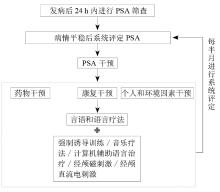
图1
PSA临床管理流程图"
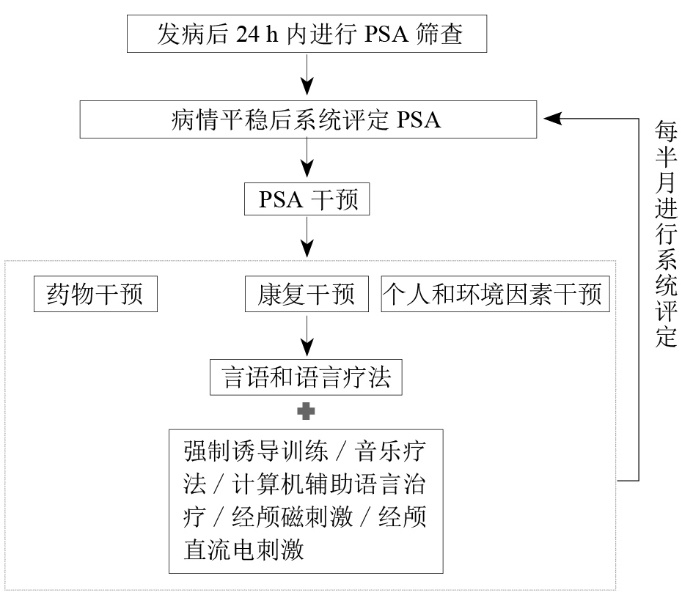

表1
PSA临床管理专家共识的临床问题清单"
| 编号 | 临床问题 |
|---|---|
| 1 | 脑卒中患者何时及使用何种方法筛查言语功能障碍? |
| 2 | PSA患者如何评估其活动和参与受限? |
| 3 | 哪些指标可帮助判断PSA患者的预后? |
| 4 | 药物治疗对PSA患者是否有效? |
| 5 | PSA患者康复训练开始时机和训练强度如何建议? |
| 6 | 对于不同类型的PSA患者如何选择言语功能康复治疗的新技术? |
| 7 | PSA患者进行经颅磁刺激治疗的适应证、禁忌证及技术参数设置? |
| 8 | PSA患者进行经颅直流电刺激治疗的适应证、禁忌证及技术参数设置? |
| 9 | 针对PSA患者的个人因素和环境因素进行哪些干预可提高患者的生活参与? |
表2
PSA证据类别、专家共识度及推荐强度的关系"
| 证据来源 | 专家共识度 | 推荐强度 |
|---|---|---|
| 严谨的Meta分析、大型随机对照试验 | 一致共识 | 强推荐 |
| 一般质量的Meta分析、小型随机对照试验、设计良好的大型回顾性研究、病例对照研究 | 基本一致共识,争议小(支持意见60%~80%) | 推荐 |
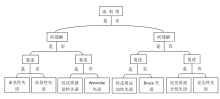
图2
评估PSA类型"

| [1] |
WORTMAN-JUTT S, EDWARDS D. Poststroke aphasia rehabilitation: Why all talk and no action?[J]. Neurorehabil Neural Repair, 2019, 33(4):235-244.
doi: 10.1177/1545968319834901 |
| [2] |
WALLACE S J, WORRALL L, ROSE T, et al. Using the International Classification of Functioning, Disability, and Health to identify outcome domains for a core outcome set for aphasia: a comparison of stakeholder perspectives[J]. Disabil Rehabil, 2019, 41(5):564-573.
doi: 10.1080/09638288.2017.1400593 |
| [3] |
SHEPPARD S M, SEBASTIAN R. Diagnosing and managing post-stroke aphasia[J]. Expert Rev Neurother, 2021, 21(2):221-234.
doi: 10.1080/14737175.2020.1855976 |
| [4] | 邱卓英, 李伦, 陈迪, 等. 基于世界卫生组织国际健康分类家族康复指南研究:理论架构和方法体系[J]. 中国康复理论与实践, 2020, 26(2):125-135. |
| QIU Z Y, LI L, CHEN D, et al. Research on rehabilitation guidelines using World Health Organization Family International Classifications: framework and approaches[J]. Chin J Rehabil Theory Pract, 2020, 26(2):125-135. | |
| [5] | 世界卫生组织. 康复2030:国际康复发展状况与行动呼吁[J]. 李安巧,邱卓英,吴弦光,等,译. 中国康复理论与实践, 2017, 23(4):379. |
| World Health Organization. Rehabilitation 2030: A Call for Action[J]. LI A Q, QIU Z Y, WU X G, et al., trans. Chin J Rehabil Theory Pract, 2017, 23(4):379. | |
| [6] | ZENG B, CHEN D, QIU Z, et al. Expert consensus on protocol of rehabilitation for COVID-19 patients using framework and approaches of WHO International Family Classifications[J]. Aging Med (Milton), 2020, 3(2):82-94. |
| [7] |
ALMEIDA M S C, SOUSA FILHO L F, RABELLO P M, et al. International Classification of Diseases-11th revision: from design to implementation[J]. Rev Saude Publica, 2020, 54:104.
doi: 10.11606/s1518-8787.2020054002120 |
| [8] |
GRÖNBERG A, HENRIKSSON I, LINDGREN A. Accuracy of NIH Stroke Scale for diagnosing aphasia[J]. Acta Neurol Scand, 2021, 143(4):375-382.
doi: 10.1111/ane.v143.4 |
| [9] |
FROMM D, FORBES M, HOLLAND A, et al. Discourse characteristics in aphasia beyond the Western Aphasia Battery cutoff[J]. Am J Speech Lang Pathol, 2017, 26(3):762-768.
doi: 10.1044/2016_AJSLP-16-0071 |
| [10] | 张庆苏, 纪树荣, 李胜利, 等. 中国康复研究中心汉语标准失语症检查量表的信度与效度分析[J]. 中国康复理论与实践, 2005, 11(9):703-705. |
| ZHANG Q S, JI S R, LI S L, et al. Reliability and validity of Chinese Rehabilitation Research Center Standard Aphasia Examination[J]. Chin J Rehabil Theory Pract, 2005, 11(9):703-705. | |
| [11] | RANGAMANI G N, JUDOVSKY H M. Quality of communication life in people with aphasia: implications for intervention[J]. Ann Indian Acad Neurol, 2020, 23(Suppl 2):S156-S161. |
| [12] | 林润, 陈锦秀, 冯木兰, 等. 脑卒中失语症患者生活质量量表汉化及信效度测评[J]. 中华护理杂志, 2013, 48(4):349-351. |
| LIN R, CHEN J X, FENG M L, et al. Reliability and validity of the Stroke and Aphasia Quality of Life Scale[J]. Chin J Nurs, 2013, 48(4):349-351. | |
| [13] | THIEL A, ZUMBANSEN A. The pathophysiology of post-stroke aphasia: a network approach[J]. Restor Neurol Neurosci, 2016, 34(4):507-518. |
| [14] |
FRIDRIKSSON J, HILLIS A E. Current approaches to the treatment of post-stroke aphasia[J]. J Stroke, 2021, 23(2):183-201.
doi: 10.5853/jos.2020.05015 |
| [15] |
SAXENA S, HILLIS A E. An update on medications and noninvasive brain stimulation to augment language rehabilitation in post-stroke aphasia[J]. Expert Rev Neurother, 2017, 17(11):1091-1107.
doi: 10.1080/14737175.2017.1373020 |
| [16] |
ZHANG X, SHU B, ZHANG D, et al. The efficacy and safety of pharmacological treatments for post-stroke aphasia[J]. CNS Neurol Disord Drug Targets, 2018, 17(7):509-521.
doi: 10.2174/1871527317666180706143051 |
| [17] |
REUTER B, GUMBINGER C, SAUER T, et al. Access, timing and frequency of very early stroke rehabilitation: insights from the Baden-Wuerttemberg stroke registry[J]. BMC Neurol, 2016, 16(1):222.
doi: 10.1186/s12883-016-0744-7 |
| [18] |
GODECKE E, ARMSTRONG E, RAI T, et al. A randomized control trial of intensive aphasia therapy after acute stroke: The Very Early Rehabilitation for SpEech (VERSE) study[J]. Int J Stroke, 2021, 16(5):556-572.
doi: 10.1177/1747493020961926 |
| [19] |
HARVEY S R, CARRAGHER M, DICKEY M W, et al. Treatment dose in post-stroke aphasia: a systematic scoping review[J]. Neuropsychol Rehabil, 2021, 31(10):1629-1660.
doi: 10.1080/09602011.2020.1786412 |
| [20] |
FCET2EC study group. Intensive speech and language therapy in patients with chronic aphasia after stroke: a randomised, open-label, blinded-endpoint, controlled trial in a health-care setting[J]. Lancet, 2017, 389(10078):1528-1538.
doi: 10.1016/S0140-6736(17)30067-3 |
| [21] |
CROSSON B, RODRIGUEZ A D, COPLAND D, et al. Neuroplasticity and aphasia treatments: new approaches for an old problem[J]. J Neurol Neurosurg Psychiatry, 2019, 90(10):1147-1155.
doi: 10.1136/jnnp-2018-319649 |
| [22] |
HARVEY D Y, PODELL J, TURKELTAUB P E, et al. Functional reorganization of right prefrontal cortex underlies sustained naming improvements in chronic aphasia via repetitive transcranial magnetic stimulation[J]. Cogn Behav Neurol, 2017, 30:133-144.
doi: 10.1097/WNN.0000000000000141 |
| [23] |
LUISA C, PAWEL K, MARTINA G, et al. Telerehabilitation for people with aphasia: a systematic review and meta-analysis[J]. J Commun Disord, 2021, 92:106111.
doi: 10.1016/j.jcomdis.2021.106111 |
| [24] | BRADY M C, KELLY H, GODWIN J, et al. Speech and language therapy for aphasia following stroke[J]. Cochrane Database Syst Rev, 2016(6):D425. |
| [25] |
ROSE M L, COPLAND D, NICKELS L, et al. Constraint-induced or Multi-modal Personalized Aphasia Rehabilitation (COMPARE): a randomized controlled trial for stroke-related chronic aphasia[J]. Int J Stroke, 2019, 14(9):972-976.
doi: 10.1177/1747493019870401 |
| [26] |
ROSE M L, RAI T, COPLAND D, et al. Statistical analysis plan for the COMPARE trial: a 3-arm randomised controlled trial comparing the effectiveness of Constraint-induced Aphasia Therapy Plus and Multi-modality Aphasia Therapy to usual care in chronic post-stroke aphasia (COMPARE)[J]. Trials, 2021, 22(1):303.
doi: 10.1186/s13063-021-05238-0 |
| [27] |
LEONARDI S, CACCIOLA A, DE LUCA R, et al. The role of music therapy in rehabilitation: improving aphasia and beyond[J]. Int J Neurosci, 2018, 128(1):90-99.
doi: 10.1080/00207454.2017.1353981 |
| [28] | 吴晓莉, 张晓颖, 张庆苏, 等. 旋律音调疗法治疗脑卒中后非流畅性失语的效果[J]. 中国康复理论与实践, 2020, 26(11):1327-1332. |
| WU X L, ZHANG X Y, ZHANG Q S, et al. Effect of melodic intonation therapy on nonfluent aphasia after stroke[J]. Chin J Rehabil Theory Pract, 2020, 26(11):1327-1332. | |
| [29] |
HARO-MARTÍNEZ A M, LUBRINI G, MADERO-JARABO R, et al. Melodic intonation therapy in post-stroke nonfluent aphasia: a randomized pilot trial[J]. Clin Rehabil, 2019, 33(1):44-53.
doi: 10.1177/0269215518791004 |
| [30] |
CHOI M J, KIM H, NAH H W, et al. Digital therapeutics: emerging new therapy for neurologic deficits after stroke[J]. J Stroke, 2019, 21(3):242-258.
doi: 10.5853/jos.2019.01963 |
| [31] | GIACHERO A, CALATI M, PIA L, et al. Conversational therapy through semi-immersive virtual reality environments for language recovery and psychological well-being in post stroke aphasia[J]. Behav Neurol, 2020, 2020:2846046. |
| [32] | FISICARO F, LANZA G, GRASSO A A, et al. Repetitive transcranial magnetic stimulation in stroke rehabilitation: review of the current evidence and pitfalls[J]. Ther Adv Neurol Disord, 2019, 12:1756286419878317. |
| [33] |
LEFAUCHEUR J P, ALEMAN A, BAEKEN C, et al. Evidence-based guidelines on the therapeutic use of repetitive transcranial magnetic stimulation (rTMS): an update (2014-2018)[J]. Clin Neurophysiol, 2020, 131(2):474-528.
doi: 10.1016/j.clinph.2019.11.002 |
| [34] | REN C, ZHANG G, XU X, et al. The effect of rTMS over the different targets on language recovery in stroke patients with global aphasia: a randomized sham-controlled study[J]. Biomed Res Int, 2019, 2019:4589056. |
| [35] |
YAO L, ZHAO H, SHEN C, et al. Low-frequency repetitive transcranial magnetic stimulation in patients with poststroke aphasia: systematic review and meta-analysis of its effect upon communication[J]. J Speech Lang Hear Res, 2020, 63(11):3801-3815.
doi: 10.1044/2020_JSLHR-19-00077 |
| [36] | FISICARO F, LANZA G, GRASSO A A, et al. Repetitive transcranial magnetic stimulation in stroke rehabilitation: review of the current evidence and pitfalls[J]. Ther Adv Neurol Disord, 2019, 12:1756286419878317. |
| [37] |
HARA T, ABO M, KAKITA K, et al. Does a combined intervention program of repetitive transcranial magnetic stimulation and intensive occupational therapy affect cognitive function in patients with post-stroke upper limb hemiparesis?[J]. Neural Regen Res, 2016, 11(12):1932-1939.
doi: 10.4103/1673-5374.197134 |
| [38] |
ZHENG Y, ZHONG D, HUANG Y, et al. Effectiveness and safety of repetitive transcranial magnetic stimulation (rTMS) on aphasia in cerebrovascular accident patients: Protocol of a systematic review and meta-analysis[J]. Medicine (Baltimore), 2019, 98(52):e18561.
doi: 10.1097/MD.0000000000018561 |
| [39] | 陈韵佳, 陈柱, 朱燕, 等. 神经调控技术在失语症治疗中的应用进展[J]. 中国康复理论与实践, 2019, 25(8):930-935. |
| CHEN Y J, CHEN Z, ZHU Y, et al. Application of neuromodulation technique in treatment of aphasia (review)[J]. Chin J Rehabil Theory Pract, 2019, 25(8):930-935. | |
| [40] |
BIOU E, CASSOUDESALLE H, COGNÉ M, et al. Transcranial direct current stimulation in post-stroke aphasia rehabilitation: a systematic review[J]. Ann Phys Rehabil Med, 2019, 62(2):104-121.
doi: 10.1016/j.rehab.2019.01.003 |
| [41] |
LEFAUCHEUR J P, ANTAL A, AYACHE S S, et al. Evidence-based guidelines on the therapeutic use of transcranial direct current stimulation (tDCS)[J]. Clin Neurophysiol, 2017, 128(1):56-92.
doi: 10.1016/j.clinph.2016.10.087 |
| [42] | ELSNER B, KUGLER J, POHL M, et al. Transcranial direct current stimulation (tDCS) for improving aphasia in adults with aphasia after stroke[J]. Cochrane Database Syst Rev, 2019, 5(5):CD009760. |
| [43] | 柳波, 夏扬, 黄嘉, 等. 经颅直流电刺激对卒中后运动性失语患者抑郁状态的疗效[J]. 中国康复理论与实践, 2019, 25(11):1348-1351. |
| LIU B, XIA Y, HUANG J, et al. Effects of transcranial direct current stimulation on post-stroke depression with Broca's aphasia[J]. Chin J Rehabil Theory Pract, 2019, 25(11):1348-1351. | |
| [44] |
ARHEIX-PARRAS S, BARRIOS C, PYTHON G, et al. A systematic review of repetitive transcranial magnetic stimulation in aphasia rehabilitation: leads for future studies[J]. Neurosci Biobehav Rev, 2021, 127:212-241.
doi: 10.1016/j.neubiorev.2021.04.008 |
| [45] |
FRIDRIKSSON J, RORDEN C, ELM J, et al. Transcranial direct current stimulation vs sham stimulation to treat aphasia after stroke: a randomized clinical trial[J]. JAMA Neurol, 2018, 75(12):1470-1476.
doi: 10.1001/jamaneurol.2018.2287 |
| [46] |
ALHARBI M F, ARMIJO-OLIVO S, KIM E S. Transcranial direct current stimulation (tDCS) to improve naming ability in post-stroke aphasia: a critical review[J]. Behav Brain Res, 2017, 332:7-15.
doi: 10.1016/j.bbr.2017.05.050 |
| [47] | ELSNER B, KUGLER J, MEHRHOLZ J. Transcranial direct current stimulation (tDCS) for improving aphasia after stroke: a systematic review with network meta-analysis of randomized controlled trials[J]. J Neuroeng Rehabil, 2020, 17(1):88. |
| [48] | SILVA F, MAC-KAY A, CHAO J C, et al. Transcranial direct current stimulation: a study on naming performance in aphasic individuals[J]. Codas, 2018, 30(5):e20170242. |
| [49] |
PESTALOZZI M I, DI PIETRO M, MARTINS G C, et al. Effects of prefrontal transcranial direct current stimulation on lexical access in chronic poststroke aphasia[J]. Neurorehabil Neural Repair, 2018, 32(10):913-923.
doi: 10.1177/1545968318801551 |
| [50] |
MARANGOLO P. The potential effects of transcranial direct current stimulation (tDCS) on language functioning: combining neuromodulation and behavioral intervention in aphasia[J]. Neurosci Lett, 2020, 719:133329.
doi: 10.1016/j.neulet.2017.12.057 |
| [51] |
PERIN C, BOLIS M, LIMONTA M, et al. Differences in rehabilitation needs after stroke: a similarity analysis on the ICF core set for stroke[J]. Int J Environ Res Public Health, 2020, 17(12):4291.
doi: 10.3390/ijerph17124291 |
| [1] | 朱丽丽, 赵嘉欣, 程雪, 王会娟, 陈小霞. 康复期脑卒中患者疾病体验及需求的Meta整合[J]. 《中国康复理论与实践》, 2026, 32(3): 286-293. |
| [2] | 刘平, 周楠, 薛晓杰, 邵伟波. 脑卒中后吞咽障碍康复治疗技术应用研究的文献计量分析[J]. 《中国康复理论与实践》, 2026, 32(3): 294-303. |
| [3] | 杨玲, 王庆雷, 王洁, 徐雯婕, 王彤, 郭川, 钱雪. 基于功能性近红外光谱成像的卒中后焦虑患者前额叶皮质激活特征及机制研究[J]. 《中国康复理论与实践》, 2026, 32(3): 329-336. |
| [4] | 王啸鹤, 张璐, 肖树芹. 基于共享心智模型的脑卒中康复病房护士多学科团队沟通合作能力提升干预方案构建[J]. 《中国康复理论与实践》, 2026, 32(1): 101-109. |
| [5] | 岳圆, 张通, 刘元旻, 王亚囡. 下肢外骨骼机器人对卒中后小脑性共济失调患者平衡和步行功能的影响[J]. 《中国康复理论与实践》, 2026, 32(1): 23-29. |
| [6] | 吴澄, 章云枫, 王卫宁, 余克威, 张艳正, 沈嘉蓉, 吴毅. 肘腕功能支具对脑卒中偏瘫患者足底压力和平衡功能的效果[J]. 《中国康复理论与实践》, 2026, 32(1): 30-39. |
| [7] | 张军风, 陈昊, 杜宇征, 李琛, 于涛, 杨元庆. 2004年至2024年脑卒中后肢体痉挛非药物疗法的文献计量分析[J]. 《中国康复理论与实践》, 2026, 32(1): 45-58. |
| [8] | 颜如秀, 宋鲁平, 黄富表, 梁艳华, 崔尧, 杨昊. 计算机认知矫正疗法对卒中后认知功能障碍的效果[J]. 《中国康复理论与实践》, 2025, 31(12): 1439-1449. |
| [9] | 高婷, 赵兵全. 3D打印技术在脑卒中应用的文献计量分析[J]. 《中国康复理论与实践》, 2025, 31(12): 1430-1438. |
| [10] | 蒋逸, 梁康, 楚家豪, 杨丹, 高飞, 厉含之, 杜晓霞. 2021年至2025年脑机接口技术在脑卒中康复领域应用的文献计量分析[J]. 《中国康复理论与实践》, 2025, 31(11): 1279-1289. |
| [11] | 张梓寒, 张家成, 刘婧訸, 陈宇航, 吴丹, 王荟荧, 黄幸, 常静玲. 基于功能连接探索卒中后失语患者的脑电脑功能网络特征[J]. 《中国康复理论与实践》, 2025, 31(11): 1342-1353. |
| [12] | 中国康复医学会多学科康复诊疗工作委员会, 中华医学会神经病学分会神经康复专业组, 中国康复研究中心. 中国脑卒中患者远程康复管理专家共识[J]. 《中国康复理论与实践》, 2025, 31(11): 1241-1255. |
| [13] | 王辉煌, 李雪静, 刘福, 陈思航, 李疏影, 蒲昱帆. 缺血性脑卒中手功能障碍患者静息态脑功能的活动特征[J]. 《中国康复理论与实践》, 2025, 31(11): 1256-1264. |
| [14] | 何爱群, 黎景波, 刘海鸥, 宋秋爽, 何茂莉, 林如敏. 上肢机器人启动训练后双侧上肢训练对脑卒中重度偏瘫上肢功能的效果[J]. 《中国康复理论与实践》, 2025, 31(11): 1265-1270. |
| [15] | 田富宝, 李泓钰, 田洋, 许宁, 李珂, 白川萍, 杨彩军. 基于双峰平衡恢复模型的经颅直流电刺激对缺血性脑卒中患者上肢功能障碍的效果[J]. 《中国康复理论与实践》, 2025, 31(11): 1271-1278. |
| 阅读次数 | ||||||
|
全文 |
|
|||||
|
摘要 |
|
|||||
|
||
