



《中国康复理论与实践》 ›› 2023, Vol. 29 ›› Issue (1): 6-11.doi: 10.3969/j.issn.1006-9771.2023.01.002
吕攀攀, 徐冲锋, 高文婷, 刘聪聪, 耿立蒙, 刘芳( )
)
收稿日期:2022-11-22
修回日期:2022-12-19
出版日期:2023-01-25
发布日期:2023-02-17
通讯作者:
刘芳,女,汉族,山东滨州市人,副主任医师,主要研究方向:孤独症谱系障碍筛查及干预,E-mail: zhshlldy@163.com。
作者简介:吕攀攀(1985-),女,汉族,山东淄博市人,主治医师,主要研究方向:孤独症谱系障碍筛查及干预。
基金资助:
LÜ Panpan, XU Chongfeng, GAO Wenting, LIU Congcong, GENG Limeng, LIU Fang()
Received:2022-11-22
Revised:2022-12-19
Published:2023-01-25
Online:2023-02-17
Contact:
LIU Fang, E-mail: zhshlldy@163.com
Supported by:摘要:
目的 探讨孤独症儿童在象征性游戏中的典型行为特点,并分析象征性游戏测试(SPT)在孤独症早期识别中的价值。
方法 收集2021年11月至2022年9月在滨州医学院附属医院儿童保健科以语言问题就诊的儿童260例,确诊孤独症患儿193例为观察组,健康儿童67例为对照组,均行SPT,探讨孤独症儿童SPT中的典型行为特点,并对SPT结果进行信效度分析。采用Gesell发育量表(GDS)适应性及个人社交进行评分,与SPT总分进行相关性分析。
结果 孤独症儿童SPT评估Cronbach α系数为0.835~0.935,SPT总分以及以物代物、虚构属性、虚构客体评分之间均呈正相关(r > 0.607, P < 0.001)。观察组SPT评分显著低于对照组(t > 9.615, P < 0.001)。SPT总分与GDS适应性和个人社交发育商均呈正相关(r > 0.609, P < 0.001)。
结论 孤独症儿童典型行为可以在象征性游戏中得到体现,SPT可以为孤独症早期识别提供线索。
中图分类号:
吕攀攀, 徐冲锋, 高文婷, 刘聪聪, 耿立蒙, 刘芳. 孤独症儿童在象征性游戏中的典型行为分析[J]. 《中国康复理论与实践》, 2023, 29(1): 6-11.
LÜ Panpan, XU Chongfeng, GAO Wenting, LIU Congcong, GENG Limeng, LIU Fang. Typical behavior analysis of children with autism in symbolic play[J]. 《Chinese Journal of Rehabilitation Theory and Practice》, 2023, 29(1): 6-11.
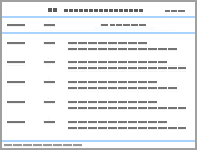
表1
两组一般资料比较"
| 组别 | n | 性别(男/女)/n | 年龄/月 |
|---|---|---|---|
| 对照组 | 67 | 46/21 | 29.85±7.56 |
| 观察组 | 193 | 138/55 | 31.63±7.41 |
| χ2/F值 | 0.171 | 1.389 | |
| P值 | 0.680 | 0.240 |
表2
两组SPT评分比较"
| 组别 | n | 以物代物 | 虚构属性 | 虚构客体 | 总分 |
|---|---|---|---|---|---|
| 对照组 | 67 | 3.87±1.41 | 5.24±2.08 | 3.01±1.63 | 13.30±4.78 |
| 观察组 | 193 | 2.13±0.73 | 2.74±1.38 | 0.83±0.87 | 5.71±2.63 |
| t值 | 13.754 | 9.615 | 11.014 | 17.434 | |
| P值 | < 0.001 | < 0.001 | < 0.001 | < 0.001 |
表3
孤独症儿童SPT内部一致性信度分析(n = 193)"
| 行为 | Cronbach α |
|---|---|
| 以物代物 | 0.928 |
| 虚构属性 | 0.854 |
| 虚构客体 | 0.835 |
| 总体行为 | 0.935 |
表4
孤独症儿童SPT效度分析(n = 193)"
| 指标 | r值 | P值 |
|---|---|---|
| 以物代物vs.总体行为 | 0.820 | < 0.001 |
| 虚构属性vs.总体行为 | 0.922 | < 0.001 |
| 虚构客体vs.总体行为 | 0.851 | < 0.001 |
| 以物代物vs.虚构属性 | 0.649 | < 0.001 |
| 以物代物vs.虚构客体 | 0.607 | < 0.001 |
| 虚构属性vs.虚构客体 | 0.653 | < 0.001 |
表5
两组SPT月龄及GDS适应性及个人社交能力比较"
| 组别 | n | SPT月龄/月 | GDS | |||
|---|---|---|---|---|---|---|
| 适应性发育商 | 适应性月龄/月 | 个人社交发育商 | 个人社交月龄/月 | |||
| 对照组 | 67 | 23.50±6.04 | 82.57±10.96 | 24.40±6.41 | 86.40±10.98 | 25.50±6.38 |
| 观察组 | 193 | 10.49±7.44 | 48.75±9.47 | 16.06±4.01 | 42.20±10.64 | 14.24±4.07 |
| t值 | -12.901 | -14.156 | -12.289 | -19.062 | -16.655 | |
| P值 | < 0.001 | < 0.001 | < 0.001 | < 0.001 | < 0.001 | |
表6
SPT总分与GDS适应性和个人社交发育商的相关性"
| GDS | r值 | P值 |
|---|---|---|
| 适应性发育商 | 0.609 | < 0.001 |
| 个人社交发育商 | 0.672 | < 0.001 |
| [1] |
KODAK T, BERGMANN S. Autism spectrum disorder: characteristics, associated behaviors, and early intervention[J]. Pediatr Clin North Am, 2020, 67(3): 525-535.
doi: 10.1016/j.pcl.2020.02.007 |
| [2] |
MUKHERJEE S B. Identification, evaluation, and management of children with autism spectrum disorder: American Academy of Pediatrics 2020 Clinical Guidelines[J]. Indian Pediatr, 2020, 57(10): 959-962.
pmid: 33089812 |
| [3] |
JOON P, KUMAR A, PARLE M. What is autism?[J]. Pharmacol Rep, 2021, 73(5): 1255-1264.
doi: 10.1007/s43440-021-00244-0 pmid: 33694100 |
| [4] | MAENNER M J, SHAW K A, BAKIAN A V, et al. Prevalence and characteristics of autism spectrum disorder among children aged 8 years: Autism and Developmental Disabilities Monitoring Network, 11 sites, United States, 2018[J]. MMWR Surveill Summ, 2021, 70(11): 1-16. |
| [5] |
THIEMANN-BOURQUE K, JOHNSON L K, BRADY N C. Similarities in functional play and differences in symbolic play of children with autism spectrum disorder[J]. Am J Intellect Dev Disabil, 2019, 124(1): 77-91.
doi: 10.1352/1944-7558-124.1.77 |
| [6] |
LESLIE A M. Pretense and representation: The origins of "theory of mind"[J]. Psychol Rev, 1987, 94(4): 412-426.
doi: 10.1037/0033-295X.94.4.412 |
| [7] |
SOBIESKI M, SOBIESKA A, SEKUŁOWICZ M, et al. Tools for early screening of autism spectrum disorders in primary health care: a scoping review[J]. BMC Prim Care, 2022, 23(1): 46.
doi: 10.1186/s12875-022-01645-7 |
| [8] | GONZÁLEZ-SALA F, GÓMEZ-MARÍ I, TÁRRAGA-MÍNGUEZ R, et al. Symbolic play among children with autism spectrum disorder: a scoping review[J]. Children (Basel), 2021, 8(9): 801. |
| [9] | American Psychiatric Association. Diagnostic and statistical manual of mental disorders (DSM-V)[M]. Washington D.C.: American Psychiatric Association, 2013: 50-51. |
| [10] | 杨红, 史惟, 徐秀娟, 等. 象征性游戏测试的心理测量学特性研究[J]. 中国循证儿科杂志, 2007, 2(2): 108-114. |
| YANG H, SHI W, XU X J, et al. Study of psychometric character of symbolic play test[J]. Chin J Evid Based Pediatr, 2007, 2(2): 108-114. | |
| [11] |
EVERS K, MALJAARS J, SCHEPENS H, et al. Conceptualization of quality of life in autistic individuals[J]. Dev Med Child Neurol, 2022, 64(8): 950-956.
doi: 10.1111/dmcn.15205 |
| [12] |
WIECKOWSKI A T, HAMNER T, NANOVIC S, et al. Early and repeated screening detects autism spectrum disorder[J]. J Pediatr, 2021, 234: 227-235.
doi: 10.1016/j.jpeds.2021.03.009 |
| [13] | 孙慧珍, 王国祥, 邱卓英, 等. 应用ICF-CY研究孤独症儿童的功能状态与体育活动和运动康复[J]. 中国康复理论与实践, 2017, 23(10): 1123-1129. |
| SUN H Z, WANG G X, QIU Z Y, et al. Application of ICF-CY in analysis of functioning and disability, and physical activity and sport rehabilitation for children with autism spectrum disorder[J]. Chin J Rehabil Theory Pract, 2017, 23(10): 1123-1129. | |
| [14] |
FRYE R E. A personalized multidisciplinary approach to evaluating and treating autism spectrum disorder[J]. J Pers Med, 2022, 12(3): 464.
doi: 10.3390/jpm12030464 |
| [15] | 陈玲芳, 王慧, 李海峰, 等. 关键反应训练联合视频反馈法家长培训对孤独症谱系障碍儿童的疗效研究[J]. 中国康复医学杂志, 2022, 37(8): 1073-1078. |
| CHEN L F, WANG H, LI H F, et al. A study on the efficacy of pivotal response treatment combined with video-feedback intervention of parent training on children with autism spectrum disorders[J]. Chin J Rehabil Med, 2022, 37(8): 1073-1078. | |
| [16] | 李爱文, 曾婷, 邓梁琼, 等. 柳州市超早期干预孤独症谱系障碍患儿38例康复治疗的效果观察[J]. 重庆医学, 2022, 51(13): 2247-2250. |
| LI A W, ZENG T, DENG L Q, et al. Observation on effect of rehabilitation treatment in 38 children with autism spectrum disorder by super early intervention in Liuzhou City[J]. Chongqing Med, 2022, 51(13): 2247-2250. | |
| [17] |
SOLMI M, SONG M, YON D K, et al. Incidence, prevalence, and global burden of autism spectrum disorder from 1990 to 2019 across 204 countries[J]. Mol Psychiatry, 2022, 27(10): 4172-4180.
doi: 10.1038/s41380-022-01630-7 |
| [18] |
STRID K, HEIMANN M, TJUS T. Pretend play, deferred imitation and parent-child interaction in speaking and non-speaking children with autism[J]. Scand J Psychol, 2013, 54(1): 26-32.
doi: 10.1111/sjop.12003 pmid: 23121545 |
| [19] |
RUSS S W. Pretend play: antecedent of adult creativity[J]. New Dir Child Adolesc Dev, 2016, 2016(151): 21-32.
doi: 10.1002/cad.20154 pmid: 26994722 |
| [20] |
LILLARD A S, LERNER M D, HOPKINS E J, et al. The impact of pretend play on children's development: a review of the evidence[J]. Psychol Bull, 2013, 139(1): 1-34.
doi: 10.1037/a0029321 pmid: 22905949 |
| [21] |
SHIRE S Y, SHIH W, BRACAGLIA S, et al. Peer engagement in toddlers with autism: community implementation of dyadic and individual joint attention, symbolic play, engagement, and regulation intervention[J]. Autism, 2020, 24(8): 2142-2152.
doi: 10.1177/1362361320935689 |
| [22] |
CHANG Y C, SHIH W, LANDA R, et al. Symbolic play in school-aged minimally verbal children with autism spectrum disorder[J]. J Autism Dev Disord, 2018, 48(5): 1436-1445.
doi: 10.1007/s10803-017-3388-6 |
| [23] | ZHAO Y V, GIBSON J L. Solitary symbolic play, object substitution and peer role play skills at age 3 predict different aspects of age 7 structural language abilities in a matched sample of autistic and non-autistic children[J]. Autism Dev Lang Impair, 2022, 7: 23969415211063822. |
| [24] | 程昱. 象征性游戏测试在儿童语言发育异常临床评估中的应用探讨[J]. 临床医药文献电子杂志, 2019, 6(25): 28. |
|
CHENG Y. Application of symbolic play test on clinical evaluation for children with abnormal language development[J]. J Clin Med, 2019, 6(25): 28.
doi: 10.3390/jcm6030028 |
|
| [25] |
MARWICK H, JARVIE K, COWIE H, et al. Developing pretend play in autistic children using the playboxes joint play approach as part of ongoing practice[J]. J Autism Dev Disord, 2022, 52(7): 3050-3060.
doi: 10.1007/s10803-021-05156-9 |
| [26] | 李薇, 聂晶, 李婷婷. 象征性游戏在18-36月龄儿童孤独症筛查中的应用价值[J]. 中国妇幼保健, 2021, 36(11): 2440-2442. |
| LI W, NIE J, LI T T. Application of symbolic play test in the screening of autism in children aged 18-36 months[J]. Matern Child Health Care Chin, 2021, 36(11): 2440-2442. | |
| [27] |
LEE G T, QU K, HU X, et al. Arranging play activities with missing items to increase object-substitution symbolic play in children with autism spectrum disorder[J]. Disabil Rehabil, 2021, 43(22): 3199-3211.
doi: 10.1080/09638288.2020.1734107 |
| [28] | 陈强, 杨悦, 庄志成, 等. 孤独症谱系障碍早期筛查模式及其效果研究[J]. 中国妇幼健康研究, 2020, 31(3): 302-306. |
| CHEN Q, YANG Y, ZHUANG Z C, et al. Study of the early screening model for autism spectrum disorder and its effect[J]. Chin J Woman Child Health Res, 2020, 31(3): 302-306. | |
| [29] |
CEDERLUND M. Parent questionnaires in the evaluation of pre-school children referred for neuropsychiatric assessment[J]. J Autism Dev Disord, 2022, 52(4): 1742-1751.
doi: 10.1007/s10803-021-05080-y |
| [30] |
LIN C L, SHEN C P, LIN C K. The performance of visual, auditory, and motor cognitive flexibility for children with autism spectrum disorder in Taiwan[J]. Neuropsychiatr Dis Treat, 2022, 18: 2151-2158.
doi: 10.2147/NDT.S372519 |
| [31] |
CARRUTHERS S, PICKLES A, SLONIMS V, et al. Beyond intervention into daily life: a systematic review of generalisation following social communication interventions for young children with autism[J]. Autism Res, 2020, 13(4): 506-522.
doi: 10.1002/aur.2264 pmid: 31943828 |
| [32] | 季忆婷, 沈春, 范云, 等. 象征性游戏在孤独症谱系障碍早期识别诊断中的作用[J]. 临床儿科杂志, 2018, 36(9): 674-677. |
| JI Y T, SHEN C, FAN Y, et al. The role of symbolic play test in early diagnosis and identification autism spectrum disorders[J]. J Clin Pediatr, 2018, 36(9): 674-677. | |
| [33] | 周子琦, 程茜. 图片交换沟通系统对孤独症谱系障碍儿童社交及语言功能康复效果的系统评价[J]. 中国康复理论与实践, 2016, 22(9): 1075-1079. |
| ZHOU Z Q, CHENG Q. Effect of picture exchange communication system on social communication and speech in children with autism spectrum disorder: a systematic review[J]. Chin J Rehabil Theory Pract, 2016, 22(9): 1075-1079. | |
| [34] | 张雅如, 陶红梅, 阳光, 等. 专业人员指导下孤独症谱系障碍儿童家长执行的家庭康复疗效观察的前瞻性研究[J]. 中国当代儿科杂志, 2021, 23(12): 1256-1261. |
| ZHANG Y R, TAO H M, YANG G, et al. Efficacy of family rehabilitation treatment performed by parents under the guidance of professionals in children with autism spectrum disorder: a prospective study[J]. Chin J Congtemp Pediatr, 2021, 23(12): 1256-1261. | |
| [35] |
TOMASZEWSKI B, SAVAGE M N, HUME K. Examining physical activity and quality of life in adults with autism spectrum disorder and intellectual disability[J]. J Intellect Disabil, 2022, 26(4): 1075-1088.
doi: 10.1177/17446295211033467 |
| [1] | 刘敏, 覃轲宇, 陈思齐, 刘巧云. 孤独症谱系障碍儿童沟通性发声对表达性词汇量的预测效果[J]. 《中国康复理论与实践》, 2025, 31(9): 1017-1022. |
| [2] | 仇爱珍, 王敏, 王秋爽, 吴野, 鲍克秀. 团体认知训练叠加重复经颅磁刺激对高功能孤独症谱系障碍共病注意缺陷多动障碍的增效作用及脑电机制[J]. 《中国康复理论与实践》, 2025, 31(8): 979-986. |
| [3] | 宋竺蔓, 刘娜, 刘杨, 丁雪梅, 张晓丽. 2016年至2025年孤独症谱系障碍儿童父母心理健康研究的文献计量分析[J]. 《中国康复理论与实践》, 2025, 31(7): 790-801. |
| [4] | 周波, 佘万斌, 向松柏. 人工智能在孤独症谱系障碍儿童诊断与干预中应用的文献计量分析[J]. 《中国康复理论与实践》, 2025, 31(5): 573-580. |
| [5] | 张勇, 蔡增, 徐凤萍, 刘丹, 常红娟. 音乐治疗对孤独症谱系障碍儿童干预效果的Meta分析[J]. 《中国康复理论与实践》, 2025, 31(4): 423-430. |
| [6] | 李凡, 林珂瑜, 肖永涛. 孤独症谱系障碍儿童隐喻理解能力与心理推测能力的联系[J]. 《中国康复理论与实践》, 2025, 31(4): 484-489. |
| [7] | 张观珠, 刘巧云, 刘敏, 张月新, 徐恋. 新颖启动模式对孤独症谱系障碍儿童发起要求行为的效果[J]. 《中国康复理论与实践》, 2025, 31(2): 136-140. |
| [8] | 佘慧莉, 蔡文竹, 蒋瑜, 方亭亭, 章文佩, 沈汝婷. 基于创造性问题解决模型的孤独症谱系障碍儿童电子绘本模式建构与干预效果[J]. 《中国康复理论与实践》, 2025, 31(2): 141-149. |
| [9] | 段冠婷, 肖雪, 侯会生, 姜芸桥, 刘雨歌, 时文霞. 孤独症谱系障碍儿童体育锻炼与心理健康的关系:社交反应的中介作用[J]. 《中国康复理论与实践》, 2025, 31(2): 150-157. |
| [10] | 向松柏, 周雯慧, 王崇高. 2004年至2024年机器人在孤独症谱系障碍儿童康复中应用的文献计量分析[J]. 《中国康复理论与实践》, 2025, 31(2): 158-164. |
| [11] | 杨文睿, 崔思栋, 曾莉. 虚拟与增强现实对孤独症谱系障碍儿童青少年认知、情绪和适应性行为干预效果的系统综述[J]. 《中国康复理论与实践》, 2024, 30(9): 1026-1033. |
| [12] | 韩旭伶, 赵航, 孙睦迪, 赵梅萍, 王艳霞, 刘敏, 瞿璐, 刘巧云. 不同引导行为下中重度孤独症谱系障碍幼儿回应共同注意的特征[J]. 《中国康复理论与实践》, 2024, 30(8): 882-887. |
| [13] | 杨宇然, 王茜, 陈翠翠, 杜晓新. 不同方法干预3~6岁轻中度孤独症谱系障碍儿童共同注意的效果[J]. 《中国康复理论与实践》, 2024, 30(8): 888-893. |
| [14] | 吕倩倩, 王萌萌, 吴易凌, 杨晓真, 马玲玲, 赵亚萍, 肖瑶, 桑杲. 早期介入丹佛模式基础上联合神经反馈训练对孤独症谱系障碍儿童效果的随机对照试验[J]. 《中国康复理论与实践》, 2024, 30(8): 914-921. |
| [15] | 张哲, 董献文, 徐成铭, 胡文静, 贺婷丽, 崔鑫鑫, 徐红艳, 周章盈, 韩雅男. 近10年脑电图应用于孤独症谱系障碍领域研究的文献计量分析[J]. 《中国康复理论与实践》, 2024, 30(6): 693-700. |
| 阅读次数 | ||||||
|
全文 |
|
|||||
|
摘要 |
|
|||||
|
||
