


《中国康复理论与实践》 ›› 2023, Vol. 29 ›› Issue (2): 223-230.doi: 10.3969/j.issn.1006-9771.2023.02.011
刘明月, 樊亚蕾, 张蒙, 宋薛艺, 李哲2,3( )
)
收稿日期:2022-08-12
修回日期:2023-01-06
出版日期:2023-02-25
发布日期:2023-03-16
通讯作者:
李哲
E-mail:Lizhe.1974@163.com
作者简介:刘明月(1994-),男,汉族,河南周口市人,硕士研究生,主要研究方向:脑机接口技术。
基金资助:
LIU Mingyue, FAN Yalei, ZHANG Meng, SONG Xueyi, LI Zhe2,3()
Received:2022-08-12
Revised:2023-01-06
Published:2023-02-25
Online:2023-03-16
Contact:
LI Zhe
E-mail:Lizhe.1974@163.com
Supported by:摘要:
目的 对近10年脑机接口技术用于脑卒中康复领域的相关研究进行可视化分析,识别并预测研究热点及其演变趋势。方法 检索Web of Science核心合集数据库中2011年1月至2022年10月收录的脑机接口技术用于脑卒中康复领域的相关文献,通过CiteSpace 5.8.R3软件绘制发文量、国家、机构、作者、关键词、共被引以及基金支持的可视化图谱并进行解读。结果与结论 共纳入592篇文献。该领域研究年发文量呈快速增长趋势,研究热度持续增加。美国在此领域处于领先地位,合作发文量最多且中介中心性最高;中国在此领域具有一定的优势,但仍需加强与其他国家/地区间交流合作。国外机构、作者间形成交流密切的合作关系网络,并形成以Niels Birbaumer、Cuntai Guan、Kai Keng Ang等为代表的高影响力团队;国内作者、机构之间合作关系欠佳,存在地域限制,缺乏高影响力的学术团体。关键词以“motor imagery”“recovery”等为代表形成10个主要聚类和15个变化率高的突显词,研究方向呈现出多元化趋势。上肢运动康复的疗效研究和中枢机制探讨一直是该领域的热点,且在未来一段时间内仍将持续;下肢脑机接口系统用于改善脑卒中患者足下垂、步态和平衡功能,以及多模态脑机接口的应用,可能会发展为未来的研究热点;基于脑机接口引导的神经反馈训练用于脑卒中的认知、语言康复同样需要予以关注。
中图分类号:
刘明月, 樊亚蕾, 张蒙, 宋薛艺, 李哲. 近10年脑机接口技术用于脑卒中康复领域的可视化分析[J]. 《中国康复理论与实践》, 2023, 29(2): 223-230.
LIU Mingyue, FAN Yalei, ZHANG Meng, SONG Xueyi, LI Zhe. Brain-computer interface technology for stroke in the past decade: a visualized analysis[J]. 《Chinese Journal of Rehabilitation Theory and Practice》, 2023, 29(2): 223-230.
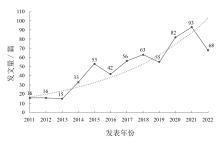
图1
脑机接口技术用于脑卒中康复领域发文量的年度趋势图"
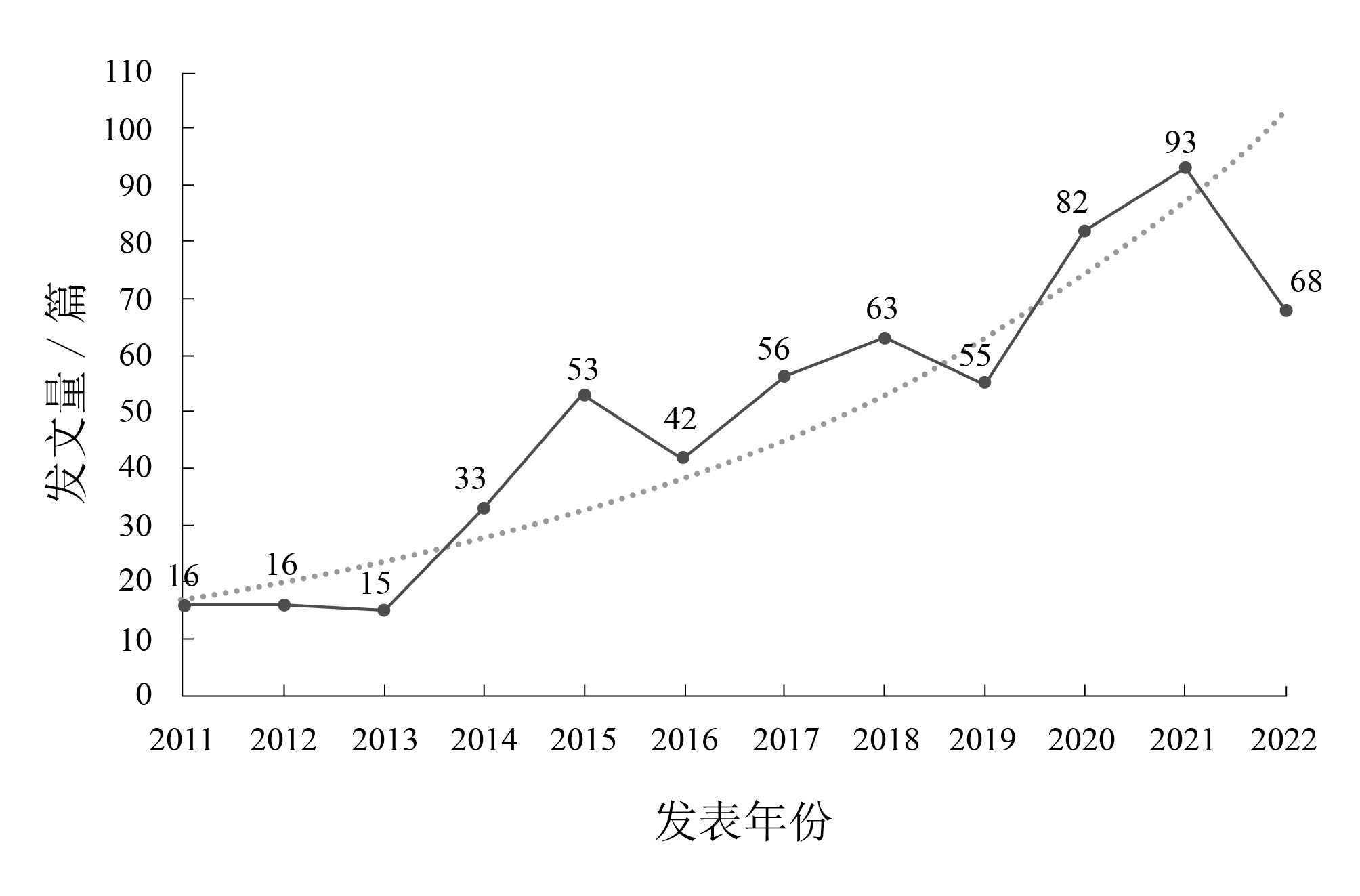
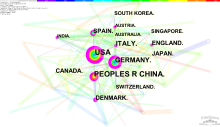
图2
脑机接口技术用于脑卒中康复领域的国家/地区共现图谱"

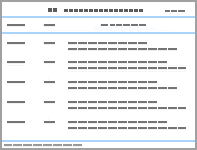
表1
脑机接口技术用于脑卒中康复领域研究的主要国家 (前5位)"
| 排名 | 国家 | 发文量 | 中心性 |
|---|---|---|---|
| 1 | 美国 | 118 | 0.31 |
| 2 | 中国 | 110 | 0.15 |
| 3 | 德国 | 89 | 0.26 |
| 4 | 意大利 | 56 | 0.16 |
| 5 | 日本 | 45 | 0.05 |
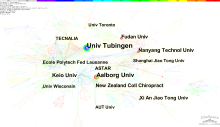
图3
脑机接口技术用于脑卒中康复领域研究机构的共现图谱"

表2
脑机接口技术用于脑卒中康复领域的主要研究机构(前5位)"
| 排名 | 机构 | 频次 | 中心性 |
|---|---|---|---|
| 1 | 图宾根大学(德国) | 46 | 0.41 |
| 2 | 奥尔堡大学(丹麦) | 30 | 0.09 |
| 3 | 庆应义塾大学(日本) | 20 | 0.06 |
| 4 | 南洋理工大学(新加坡) | 17 | 0.10 |
| 5 | 复旦大学(中国) | 15 | 0.09 |
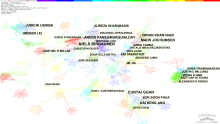
图4
脑机接口技术用于脑卒中康复领域作者共现图谱"

表3
脑机接口技术用于脑卒中康复研究的主要作者(前5位)"
| 排名 | 作者 | 频次 | 中心性 |
|---|---|---|---|
| 1 | Niels Birbaumer | 27 | 0.16 |
| 2 | Cuntai Guan | 20 | 0.14 |
| 3 | Mads Jochumsen | 20 | 0.08 |
| 4 | Junichi Ushiba | 18 | 0.04 |
| 5 | Kai Keng Ang | 18 | 0.11 |
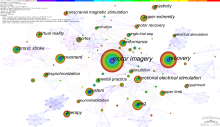
图5
脑机接口技术用于脑卒中康复领域的关键词共现图谱"

表4
脑机接口技术用于脑卒中康复领域研究的关键词(前10位)"
| 排名 | 关键词 | 频次 | 中心性 |
|---|---|---|---|
| 1 | motor imagery | 223 | 0.12 |
| 2 | recovery | 177 | 0.11 |
| 3 | EEG | 79 | 0.33 |
| 4 | movement | 68 | 0.11 |
| 5 | functional electrical stimulation | 66 | 0.30 |
| 6 | system | 61 | 0.19 |
| 7 | chronic stroke | 54 | 0.15 |
| 8 | therapy | 54 | 0.11 |
| 9 | upper extremity | 47 | 0.13 |
| 10 | performance | 46 | 0.03 |
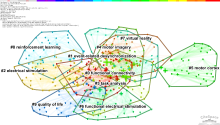
图6
脑机接口技术用于脑卒中康复领域的关键词聚类图"

表5
关键词聚类图中包含的主要关键词"
| 聚类号 | 聚类中包含的主要关键词 |
|---|---|
| #0 | motor recovery; functional connectivity; neural plasticity; motor impairment; noninvasive brain stimulation; cortex activity; feedback |
| #1 | event-related desynchronization; electroencephalogram; selection; pattern; independent component analysis |
| #2 | upper extremity; electrical stimulation; plasticity; gait rehabilitation; walking; mu rhythm |
| #3 | mental practice; task analysis; reorganization; cortical potential; mechanism; movement intention |
| #4 | motor imagery; transcranial magnetic stimulation; spremotor cortex; fMRI; self regulation |
| #5 | neurofeedback; motor cortex; hand function; functional near-infrared spectroscopy |
| #6 | modulation; functional electrical stimulation; induced movement therapy; neural plasticity; beta oscillation |
| #7 | virtual reality; cognition; cortical control; functional recovery |
| #8 | chronic stroke; reinforcement learning; motor cortex; moter evoked potentials |
| #9 | quality of life; functional restoration; soft robotics |
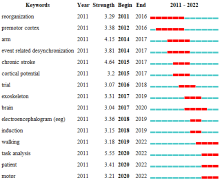
图7
脑机接口技术用于脑卒中康复领域的关键词突现图谱"
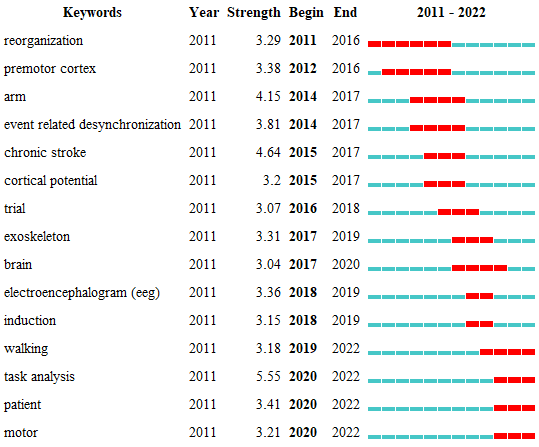
表6
脑机接口技术用于脑卒中康复领域的高被引文献(前5名)"
| 排名 | 第一作者 | 年份 | 题目 | 频次 | 中心性 |
|---|---|---|---|---|---|
| 1 | Ramos-Murguialday A | 2013 | Brainmachine interface in chronic stroke rehabilitation: a controlled study | 124 | 0.09 |
| 2 | Biasiucci A | 2018 | Brain-actuated functional electrical stimulation elicits lasting arm motor recovery after stroke | 93 | 0.01 |
| 3 | Pichiorri F | 2015 | Brain-computer interface boosts motor imagery practice during stroke recovery | 88 | 0.04 |
| 4 | Cervera M A | 2018 | Brain-computer interfaces for post-stroke motor rehabilitation: a meta-analysis | 82 | 0.02 |
| 5 | Ang K K | 2015 | A randomized controlled trial of EEG-based motor imagery brain-computer interface robotic rehabilitation for stroke | 70 | 0.02 |
表7
脑机接口技术用于脑卒中康复领域的高被引期刊(前5位)"
| 排名 | 期刊名称 | 国家 | 频次 | 中心性 |
|---|---|---|---|---|
| 1 | Clin Neurophysiol | 英国 | 409 | 0.02 |
| 2 | Stroke | 美国 | 380 | 0.03 |
| 3 | J Neural Eng | 英国 | 378 | 0.06 |
| 4 | J Neuroeng Rehabil | 英国 | 371 | 0.07 |
| 5 | IEEE T Neur Sys Reh | 美国 | 357 | 0.06 |
| [1] |
WU S, WU B, LIU M, et al. Stroke in China: advances and challenges in epidemiology, prevention, and management[J]. Lancet Neurol, 2019, 18(4): 394-405.
doi: S1474-4422(18)30500-3 pmid: 30878104 |
| [2] |
STINEAR C M, LANG C E, ZEILER S, et al. Advances and challenges in stroke rehabilitation[J]. Lancet Neurol, 2020, 19(4): 348-360.
doi: S1474-4422(19)30415-6 pmid: 32004440 |
| [3] |
MCLEAN D E. Medical complications experienced by a cohort of stroke survivors during inpatient, tertiary-level stroke rehabilitation[J]. Arch Phys Med Rehabil, 2004, 85(2): 466-469.
doi: 10.1016/S0003-9993(03)00484-2 |
| [4] | 陈树耿, 贾杰. 脑机接口在脑卒中手功能康复中的应用进展[J]. 中国康复理论与实践, 2017, 23(1): 23-26. |
| CHEN S G, JIA J. Advances in the application of brain-computer interface in stroke hand function rehabilitation[J]. Chin J Rehabil Theory Pract, 2017, 23(1): 23-26. | |
| [5] |
GAO X, WANG Y, CHEN X, et al. Interface, interaction, and intelligence in generalized brain computer interfaces[J]. Trends Cogn Sci, 2021, 25(8): 671-684.
doi: 10.1016/j.tics.2021.04.003 |
| [6] |
BIASIUCCI A, LEEB R, ITURRATE I, et al. Brain-actuated functional electrical stimulation elicits lasting arm motor recovery after stroke[J]. Nat Commun, 2018, 9(1): 2421.
doi: 10.1038/s41467-018-04673-z pmid: 29925890 |
| [7] |
LI X, MA E, QU H. Knowledge mapping of hospitality research: a visual analysis using CiteSpace[J]. Int J Hosp Manag, 2017, 60(7): 77-93.
doi: 10.1016/j.ijhm.2016.10.006 |
| [8] |
XU A H, SUN Y X. Research hotspots and effectiveness of repetitive transcranial magnetic stimulation in stroke rehabilitation[J]. Neural Regen Res, 2020, 15(11): 2089-2097.
doi: 10.4103/1673-5374.282269 |
| [9] | CHEN C. The structure and dynamics of cocitation clusters:a multiple-perspective cocitation analysis[J]. Wiley Inter Sci, 2009, 7(61): 1386-1409. |
| [10] |
CHEN C. Searching for intellectual turning points: progressive knowledge domain visualization[J]. Proc Natl Acad Sci USA, 2004, 101(Suppl 1): 5303-5310.
doi: 10.1073/pnas.0307513100 |
| [11] |
LIU Z, YIN Y, LIU W, et al. Visualizing the intellectual structure and evolution of innovation systems research: a bibliometric analysis[J]. Scientometrics, 2015, 103(1): 135-158.
doi: 10.1007/s11192-014-1517-y |
| [12] |
POO M M, DU J L, IP N Y, et al. China brain project: basic neuroscience, brain diseases, and brain-inspired computing[J]. Neuron, 2016, 92(3): 591-596.
doi: 10.1016/j.neuron.2016.10.050 |
| [13] |
BUCH E, WEBER C, COHEN L G, et al. Think to move: a neuromagnetic brain-computer interface (BCI) system for chronic stroke[J]. Stroke, 2008, 39(3): 910-917.
doi: 10.1161/STROKEAHA.107.505313 pmid: 18258825 |
| [14] |
CHAUDHARY U, BIRBAUMER N, RAMOS-MURGUIALDAY A. Brain-computer interfaces for communication and rehabilitation[J]. Nat Rev Neurol, 2016, 12(9): 513-525.
doi: 10.1038/nrneurol.2016.113 pmid: 27539560 |
| [15] |
CHAUDHARY U, BIRBAUMER N, CURADO M R. Brain-machine interface (BMI) in paralysis[J]. Ann Phys Rehabil Med, 2015, 58(1): 9-13.
doi: S1877-0657(14)01835-1 pmid: 25623294 |
| [16] |
CHAUDHARY U, BIRBAUMER N, RAMOS-MURGUIALDAY A. Brain-computer interfaces in the completely locked-in state and chronic stroke[J]. Prog Brain Res, 2016, 228: 131-161.
doi: 10.1016/bs.pbr.2016.04.019 pmid: 27590968 |
| [17] |
CHEN S, CAO L, SHU X, et al. Longitudinal electroencephalography analysis in subacute stroke patients during intervention of brain-computer interface with exoskeleton feedback[J]. Front Neurosci, 2020, 14: 809.
doi: 10.3389/fnins.2020.00809 |
| [18] |
LI M, LIU Y, WU Y, et al. Neurophysiological substrates of stroke patients with motor imagery-based brain-computer interface training[J]. Int J Neurosci, 2014, 124(6): 403-415.
doi: 10.3109/00207454.2013.850082 pmid: 24079396 |
| [19] |
CERVERA M A, SOEKADAR S R, USHIBA J, et al. Brain-computer interfaces for post-stroke motor rehabilitation: a meta-analysis[J]. Ann Clin Transl Neurol, 2018, 5(5): 651-663.
doi: 10.1002/acn3.2018.5.issue-5 |
| [20] |
JOHNSON N N, CAREY J, EDELMAN B J, et al. Combined rTMS and virtual reality brain-computer interface training for motor recovery after stroke[J]. J Neural Eng, 2018, 15(1): 016009.
doi: 10.1088/1741-2552/aa8ce3 |
| [21] |
DING Q, LIN T, WU M, et al. Influence of iTBS on the acute neuroplastic change after BCI training[J]. Front Cell Neurosci, 2021, 15: 653487.
doi: 10.3389/fncel.2021.653487 |
| [22] |
SHU X, CHEN S, CHAI G, et al. Neural modulation by repetitive transcranial magnetic stimulation (rTMS) for BCI enhancement in stroke patients[J]. Annu Int Conf IEEE Eng Med Biol Soc, 2018, 2018: 2272-2275.
doi: 10.1109/EMBC.2018.8512860 pmid: 30440859 |
| [23] |
ANG K K, GUAN C, PHUA K S, et al. Facilitating effects of transcranial direct current stimulation on motor imagery brain-computer interface with robotic feedback for stroke rehabilitation[J]. Arch Phys Med Rehabil, 2015, 96(3 Suppl): S79-S87.
doi: 10.1016/j.apmr.2014.08.008 |
| [24] |
IRIMIA D C, CHO W, ORTNER R, et al. Brain-computer interfaces with multi-sensory feedback for stroke rehabilitation: a case study[J]. Artif Organs, 2017, 41(11): E178-E184.
doi: 10.1111/aor.2017.41.issue-11 |
| [25] |
RAMOS-MURGUIALDAY A, BROETZ D, REA M, et al. Brain-machine interface in chronic stroke rehabilitation: a controlled study[J]. Ann Neurol, 2013, 74(1): 100-108.
doi: 10.1002/ana.v74.1 |
| [26] |
PICHIORRI F, MORONE G, PETTI M, et al. Brain-computer interface boosts motor imagery practice during stroke recovery[J]. Ann Neurol, 2015, 77(5): 851-865.
doi: 10.1002/ana.24390 pmid: 25712802 |
| [27] |
ANG K K, CHUA K S G, PHUA K S, et al. A randomized controlled trial of EEG-based motor imagery brain-computer interface robotic rehabilitation for stroke[J]. Clin EEG Neurosci, 2015, 46(4): 310-320.
doi: 10.1177/1550059414522229 pmid: 24756025 |
| [28] |
RASHID M, SULAIMAN N, P P ABDUL MAJEED A, et al. Current status, challenges, and possible solutions of EEG-based brain-computer interface: a comprehensive review[J]. Front Neurorobot, 2020, 14: 25.
doi: 10.3389/fnbot.2020.00025 |
| [29] |
MCCRIMMON C M, KING C E, WANG P T, et al. Brain-controlled functional electrical stimulation for lower-limb motor recovery in stroke survivors[J]. Annu Int Conf IEEE Eng Med Biol Soc, 2014, 2014: 1247-1250.
doi: 10.1109/EMBC.2014.6943823 pmid: 25570191 |
| [30] |
MCCRIMMON C M, KING C E, WANG P T, et al. Brain-controlled functional electrical stimulation therapy for gait rehabilitation after stroke: a safety study[J]. J Neuroeng Rehabil, 2015, 11(12): 57.
doi: 10.1186/1743-0003-11-57 |
| [31] |
DO A H, WANG P T, KING C E, et al. Brain-computer interface controlled functional electrical stimulation device for foot drop due to stroke[J]. Annu Int Conf IEEE Eng Med Biol Soc, 2012, 2012: 6414-6417.
doi: 10.1109/EMBC.2012.6347462 pmid: 23367397 |
| [32] |
TAKAHASHI M, TAKEDA K, OTAKA Y, et al. Event related desynchronization-modulated functional electrical stimulation system for stroke rehabilitation: a feasibility study[J]. J Neuroeng Rehabil, 2012, 16(9): 56.
doi: 10.1186/s12984-019-0531-y |
| [33] |
ROST N S, BRODTMANN A, PASE M P, et al. Post-stroke cognitive impairment and dementia[J]. Circ Res, 2022, 130(8): 1252-1271.
doi: 10.1161/CIRCRESAHA.122.319951 pmid: 35420911 |
| [34] |
TOPPI J, MATTIA D, ANZOLIN A, et al. Time varying effective connectivity for describing brain network changes induced by a memory rehabilitation treatment[J]. Annu Int Conf IEEE Eng Med Biol Soc, 2014, 2014: 6786-6789.
doi: 10.1109/EMBC.2014.6945186 pmid: 25571554 |
| [35] | KOBER S E, SCHWEIGER D, WITTE M, et al. Specific effects of EEG based neurofeedback training on memory functions in post-stroke victims[J]. J Neuroeng Rehabil, 2015, 1(12): 107. |
| [36] | CARELLI L, SOLCA F, FAINI A, et al. Brain-computer interface for clinical purposes: cognitive assessment and rehabilitation[J]. Biomed Res Int, 2017, 2017: 1695290. |
| [37] |
MANE R, CHOUHAN T, GUAN C. BCI for stroke rehabilitation: motor and beyond[J]. J Neural Eng, 2020, 17(4): 041001.
doi: 10.1088/1741-2552/aba162 |
| [38] | MANE R, WU Z, WANG D. Poststroke motor, cognitive and speech rehabilitation with brain-computer interface: a perspective review[J]. Stroke Vasc Neurol, 2022, 2022: 001506. |
| [1] | 钱李果, 吴同绚, 张巧云, 邢剑, 杨延砚. 康复治疗师继续教育病例库联合案例学习法的设计与运用效果[J]. 《中国康复理论与实践》, 2026, 32(3): 249-257. |
| [2] | 安乐, 覃小霞, 顾彬, 胡国兵, 田维毅. 职业本科康复治疗专业“双师型”教师胜任力模型:基于康复胜任力架构与多源标准的融合研究[J]. 《中国康复理论与实践》, 2026, 32(3): 258-269. |
| [3] | 刘华, 王丽媛, 马欣, 李静, 王丽. 基于OBE-CDIO模式运动康复训练教程课程改革的效果[J]. 《中国康复理论与实践》, 2026, 32(3): 270-275. |
| [4] | 刘霞, 张元民, 葛淑惠, 刘金美, 孙晨鸣, 王元会, 刘静, 李文福. 新医科背景下地方院校康复治疗人才培养模式的构建与实践[J]. 《中国康复理论与实践》, 2026, 32(3): 276-285. |
| [5] | 朱丽丽, 赵嘉欣, 程雪, 王会娟, 陈小霞. 康复期脑卒中患者疾病体验及需求的Meta整合[J]. 《中国康复理论与实践》, 2026, 32(3): 286-293. |
| [6] | 刘平, 周楠, 薛晓杰, 邵伟波. 脑卒中后吞咽障碍康复治疗技术应用研究的文献计量分析[J]. 《中国康复理论与实践》, 2026, 32(3): 294-303. |
| [7] | 蒲心语, 王靖萱, 王虎军, 修安达, 王颖鹏. 重复外周磁刺激在康复治疗中应用的文献计量分析[J]. 《中国康复理论与实践》, 2026, 32(3): 304-316. |
| [8] | 孙奎, 黄海伦, 刘永皑, 高恒. 脑机接口技术在脊髓损伤治疗领域的文献计量分析[J]. 《中国康复理论与实践》, 2026, 32(3): 317-328. |
| [9] | 杨玲, 王庆雷, 王洁, 徐雯婕, 王彤, 郭川, 钱雪. 基于功能性近红外光谱成像的卒中后焦虑患者前额叶皮质激活特征及机制研究[J]. 《中国康复理论与实践》, 2026, 32(3): 329-336. |
| [10] | 张文静, 李浩, 袁佳佳, 胡怀宁. 远程监督指导下居家肺部音乐疗法对慢性阻塞性肺疾病的效果[J]. 《中国康复理论与实践》, 2026, 32(3): 337-344. |
| [11] | 吴世彩. 康复伦理管理的理论构建与实践探索[J]. 《中国康复理论与实践》, 2026, 32(2): 125-131. |
| [12] | 何照楠, 张婷婷, 何照珂, 孟丽君. 基于BERTopic模型的我国康复伦理研究主题挖掘与内容分析[J]. 《中国康复理论与实践》, 2026, 32(2): 132-141. |
| [13] | 孟丽君. 残疾儿童康复研究伦理审查的挑战与思考[J]. 《中国康复理论与实践》, 2026, 32(2): 142-150. |
| [14] | 李水艳, 李湘, 李彦慧, 陆翊濛, 李杜娟, 杨小良, 谢秋幼. 气道廓清技术在重症康复应用的文献计量分析[J]. 《中国康复理论与实践》, 2026, 32(2): 162-173. |
| [15] | 夏岩, 徐思维, 祝岩岩, 王凤丽, 梁思捷, 李兢业, 梅光艳, 项洁. 基于数字健康模式下个性化帕金森病居家康复的效果[J]. 《中国康复理论与实践》, 2026, 32(2): 181-190. |
| 阅读次数 | ||||||
|
全文 |
|
|||||
|
摘要 |
|
|||||
|
||
