



《中国康复理论与实践》 ›› 2024, Vol. 30 ›› Issue (10): 1203-1214.doi: 10.3969/j.issn.1006-9771.2024.10.011
文翠凤1,2, 娅茹1, 黄昊1, 廖雪梅1, 白玉龙3( )
收稿日期:2024-05-08
修回日期:2024-09-06
出版日期:2024-10-25
发布日期:2024-11-08
通讯作者:
白玉龙(1966-),男,博士,主任医师,博士研究生导师,主要研究方向:神经损伤和运动伤病的康复。E-mail: dr_baiyl@fudan.edu.cn
作者简介:文翠凤(1985-),女,汉族,上海市人,硕士研究生,主治医师,主要研究方向:神经康复。
基金资助:
WEN Cuifeng1,2, YA Ru1, HUANG Hao1, LIAO Xuemei1, BAI Yulong3()
Received:2024-05-08
Revised:2024-09-06
Published:2024-10-25
Online:2024-11-08
Contact:
BAI Yulong, E-mail: dr_baiyl@fudan.edu.cn
Supported by:摘要:
目的 探讨镜像疗法对脑卒中后I型复杂区域性疼痛综合征(CRPS)上肢功能及大脑皮质活动的影响。
方法 2017年10月至2022年2月,在上海中医药大学附属第三康复医院招募脑卒中后I型CRPS患者72例,随机分为对照组(n = 36)和镜像组(n = 36)。对照组给予常规康复训练,镜像组在对照组基础上给予镜像疗法,共6周。治疗前、治疗3周后、治疗6周后分别对患者进行疼痛视觉模拟量表(VAS)、改良Barthel指数(MBI)、水肿容积和Brunnstrom分期评定。采用NirSmart 32通道功能性近红外光谱(fNIRS)采集静息态440 s。
结果 治疗后,两组VAS评分均明显改善,且治疗6周后明显优于治疗3周后(P < 0.01);治疗6周后镜像组优于对照组(P < 0.05)。两组MBI评分均显著改善,且治疗6周后显著优于治疗3周后(P < 0.001)。两组水肿均显著改善(Z > 30.113, P < 0.001),且治疗6周后镜像组明显优于对照组(Z = -3.347, P = 0.001);镜像组患者的水肿容积在治疗3周后、6周后均明显减少(Z < -0.667, P < 0.01),且治疗6周后效果更优(Z = -0.667, P = 0.005)。两组Brunnstrom分期均显著改善(Z > 29.714, P < 0.001),治疗6周后镜像组优于对照组(Z = -2.046, P = 0.041)。治疗后对照组右侧M1与右侧初级体感皮质连接强度较强,镜像组左侧M1与右侧M1、右侧初级体感皮质、右侧皮质运动前区和辅助运动区连接强度较强。镜像组左右侧初级体感皮质、左侧皮质运动前区和辅助运动区与右侧M1区、右侧皮质运动前区和辅助运动区与左侧初级体感皮质、左侧M1区与左侧初级体感皮质、左侧初级体感皮质与右侧M1区的连接强度强于对照组(∣t∣ > 3.402, P < 0.01)。
结论 镜像疗法有助于改善脑卒中后I型CRPS患者患手的疼痛、水肿和上肢运动功能。镜像疗法可加强健侧感觉区与患侧感觉运动区的连接,促进感觉运动皮质重组。
中图分类号:
文翠凤, 娅茹, 黄昊, 廖雪梅, 白玉龙. 镜像疗法对脑卒中后I型复杂区域性疼痛综合征患者上肢功能及大脑皮质活动效果的随机对照试验[J]. 《中国康复理论与实践》, 2024, 30(10): 1203-1214.
WEN Cuifeng, YA Ru, HUANG Hao, LIAO Xuemei, BAI Yulong. Effect of mirror therapy on upper limb function and cerebral cortex activity in patients with type I complex regional pain syndrome after stroke: a randomized controlled trial[J]. Chinese Journal of Rehabilitation Theory and Practice, 2024, 30(10): 1203-1214.
表1
两组基线资料比较"
| 组别 | n | 性别(男/女)/n | 年龄/岁 | 病程/月 | 卒中类型(出血/梗死)/n | 偏瘫侧/(左/右)/n |
|---|---|---|---|---|---|---|
| 对照组 | 36 | 24/12 | 60.33±12.059 | 2.481(1.00,3.75) | 22/14 | 15/21 |
| 镜像组 | 36 | 28/8 | 61.39±9.237 | 2.494(1.15,3.80) | 28/8 | 19/17 |
| χ2/t/Z值 | 1.108a | 0.167b | -0.256c | 2.356a | 8.920a | |
| P值 | 0.293 | 0.868 | 0.798 | 0.125 | 0.345 |

图1
fNIRS的脑皮质通道分布及试验设计"

表2
两组治疗前后VAS和MBI评分的描述性统计结果"
| 变量 | 组别 | n | 治疗前 | 治疗3周后 | 治疗6周后 |
|---|---|---|---|---|---|
| VAS | 对照组 | 36 | 5.003±1.962 | 3.961±1.858 | 3.319±2.102 |
| 镜像组 | 36 | 5.611±1.596 | 3.856±1.598 | 2.186±1.644 | |
| MBI | 对照组 | 36 | 47.92±16.535 | 55.14±13.705 | 59.03±13.407 |
| 镜像组 | 36 | 47.64±11.494 | 56.67±9.411 | 64.44±9.620 |
表3
两组VAS和MBI评分的重复测量方差分析结果"
| 变量 | 变量 | 平方和 | 自由度 | 均方 | F值 | P值 |
|---|---|---|---|---|---|---|
| VAS | 组内 | 235.565 | 1 | 149.800 | 184.572 | < 0.001 |
| 组间 | 2.386 | 2 | 2.386 | 0.281 | 0.598 | |
| 组内×组间 | 27.596 | 2 | 17.549 | 21.622 | < 0.001 | |
| MBI | 组内 | 7077.083 | 1 | 5106.064 | 134.446 | < 0.001 |
| 组间 | 266.667 | 2 | 266.667 | 0.628 | 0.431 | |
| 组内×组间 | 304.861 | 2 | 219.955 | 5.792 | 0.010 |
表4
两组VAS和MBI评分的事前事后LSD差异检验结果"
| 变量 | 组别/时间 | 组别/时间 | 组别/时间 | 平均值差 | P值 | 95%CI | |
|---|---|---|---|---|---|---|---|
| 上限 | 下限 | ||||||
| VAS | 对照组 | 治疗前 | 治疗3周后 | 1.042 | < 0.001 | 0.667 | 1.416 |
| 治疗前 | 治疗6周后 | 1.683 | < 0.001 | 1.115 | 2.251 | ||
| 治疗3周后 | 治疗6周后 | 0.642 | < 0.001 | 0.221 | 1.062 | ||
| 镜像组 | 治疗前 | 治疗3周后 | 1.756 | < 0.001 | 1.381 | 2.130 | |
| 治疗前 | 治疗6周后 | 3.425 | < 0.001 | 2.857 | 3.993 | ||
| 治疗3周后 | 治疗6周后 | 1.669 | 0.001 | 1.249 | 2.090 | ||
| 治疗前 | 对照组 | 镜像组 | -0.608 | 0.153 | -1.449 | 0.232 | |
| 治疗3周后 | 对照组 | 镜像组 | 0.106 | 0.797 | -0.709 | 0.920 | |
| 治疗6周后 | 对照组 | 镜像组 | 1.133 | 0.013 | 0.246 | 2.020 | |
| MBI | 对照组 | 治疗前 | 治疗3周后 | -7.222 | < 0.001 | -9.904 | -4.540 |
| 治疗前 | 治疗6周后 | -11.111 | < 0.001 | -14.916 | -7.306 | ||
| 治疗3周后 | 治疗6周后 | -3.889 | < 0.001 | -6.062 | -1.716 | ||
| 镜像组 | 治疗前 | 治疗3周后 | -9.028 | < 0.001 | -11.710 | -6.346 | |
| 治疗前 | 治疗6周后 | -16.806 | < 0.001 | -20.610 | -13.001 | ||
| 治疗3周后 | 治疗6周后 | -7.778 | < 0.001 | -9.951 | -5.605 | ||
| 治疗前 | 对照组 | 镜像组 | 0.278 | 0.934 | -6.416 | 6.972 | |
| 治疗3周后 | 对照组 | 镜像组 | -1.528 | 0.583 | -7.054 | 3.999 | |
| 治疗6周后 | 对照组 | 镜像组 | -5.417 | 0.053 | -10.902 | 0.068 | |
表5
Comparison of edema volumes in two groups pre- and post-treatment 单位:mL"
| 组别 | n | 测试 | M(QL, QU) | Z值 | P值 |
|---|---|---|---|---|---|
| 对照组 | 36 | 治疗前 | 40.00(30.00, 58.75) | 30.113 | < 0.001 |
| 治疗3周后 | 32.50(25.00, 45.00) | ||||
| 治疗6周后 | 30.00(25.00, 45.00) | ||||
| 镜像组 | 36 | 治疗前 | 45.00(35.00, 55.00) | 55.482 | < 0.001 |
| 治疗3周后 | 25.00(25.00, 38.75) | ||||
| 治疗6周后 | 20.00(15.00, 30.00) | ||||
| 治疗前两组差值 | -5.00(-23.75, 18.75) | -1.318 | 0.188 | ||
| 3周后两组差值 | 2.50(-15.00, 18.75) | -1.285 | 0.199 | ||
| 6周后两组差值 | 15.00(0.00, 28.75) | -3.347 | 0.001 | ||
表6
两组治疗前后水肿容积变化两两比较"
| 组别 | 时间 | 时间 | Z值 | P值 | 95%CI | |
|---|---|---|---|---|---|---|
| 上限 | 下限 | |||||
| 对照组 | 治疗前 | 治疗3周后 | -0.750 | 0.001 | 37.462 | 53.204 |
| 治疗3周后 | 治疗6周后 | -0.333 | 0.157 | 29.997 | 44.336 | |
| 治疗前 | 治疗6周后 | -1.083 | < 0.001 | 28.576 | 43.424 | |
| 镜像组 | 治疗前 | 治疗3周后 | -0.792 | < 0.001 | 42.374 | 58.181 |
| 治疗3周后 | 治疗6周后 | -0.667 | 0.005 | 26.956 | 36.100 | |
| 治疗前 | 治疗6周后 | -1.458 | < 0.001 | 18.387 | 27.724 | |
表7
两组治疗前后Brunnstrom分期比较"
| 组别 | n | 测试 | M(QL, QU) | Z值 | P值 |
|---|---|---|---|---|---|
| 对照组 | 36 | 治疗前 | 2.0(1.0, 3.0) | 29.714 | < 0.001 |
| 3周后 | 2.0(1.3, 3.0) | ||||
| 6周后 | 3.0(2.0, 3.8) | ||||
| 镜像组 | 36 | 治疗前 | 2.0(1.3, 3.0) | 51.235 | < 0.001 |
| 3周后 | 3.0(2.0, 3.0) | ||||
| 6周后 | 3.0(3.0, 4.0) | ||||
| 治疗前两组差值 | 0.0(-1.0, 1.0) | -0.189 | 0.850 | ||
| 3周后两组差值 | -1.0(-1.0, 1.0) | -1.654 | 0.098 | ||
| 6周后两组差值 | -1.0(-2.0, 0.8) | -2.046 | 0.041 | ||
表8
两组治疗前后Brunnstrom分期组内两两比较结果"
| 组别 | 时间 | 时间 | Z值 | P值 | 95%CI | |
|---|---|---|---|---|---|---|
| 上限 | 下限 | |||||
| 对照组 | 治疗前 | 治疗3周后 | -0.222 | 0.346 | 1.841 | 2.500 |
| 治疗3周后 | 治疗6周后 | -0.556 | 0.018 | 2.000 | 2.671 | |
| 治疗前 | 治疗6周后 | -0.778 | < 0.001 | 2.371 | 3.130 | |
| 镜像组 | 治疗前 | 治疗3周后 | -0.625 | 0.008 | 1.910 | 2.540 |
| 治疗3周后 | 治疗6周后 | -0.792 | < 0.001 | 2.441 | 3.061 | |
| 治疗前 | 治疗6周后 | -1.417 | < 0.001 | 2.950 | 3.720 | |

图2
通道的Pearson相关系数矩阵"


图3
基于ROI的功能连接 注: 图中红色代表连接强度增加的功能通道。数值越大,颜色越红,连接强度越强。"
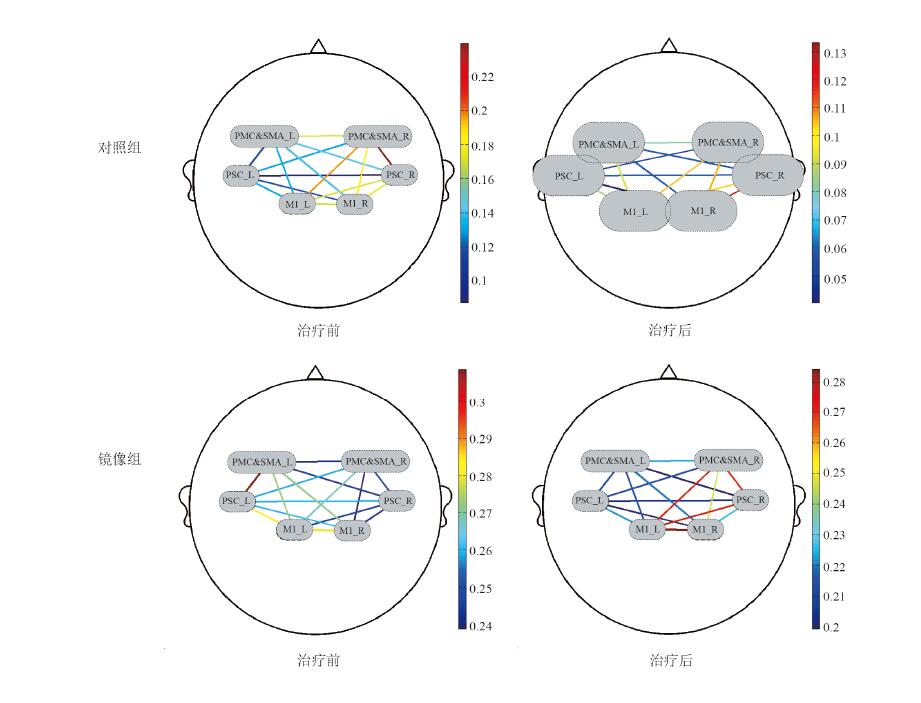
表9
治疗前两组ROI间连结强度比较"
| ROI-ROI | 对照组 | 镜像组 | t值 | P值 |
|---|---|---|---|---|
| PMC&SMA_L—PMC&SMA_R | 0.170±0.096 | 0.242±0.074 | -1.871 | 0.129 |
| PMC&SMA_L—M1_L | 0.132±0.133 | 0.272±0.089 | -2.763 | 0.026 |
| PMC&SMA_L—PSC_L | 0.114±0.117 | 0.308±0.127 | -3.541 | 0.013 |
| PMC&SMA_L—PSC_R | 0.141±0.079 | 0.248±0.068 | -3.218 | 0.014 |
| PMC&SMA_L—M1_R | 0.139±0.097 | 0.271±0.113 | -2.805 | 0.025 |
| PMC&SMA_R—M1_L | 0.197±0.157 | 0.267±0.096 | -1.206 | 0.280 |
| PMC&SMA_R—PSC_L | 0.128±0.088 | 0.258±0.086 | -3.328 | 0.014 |
| PMC&SMA_R—PSC_R | 0.239±0.186 | 0.251±0.09 | -0.189 | 0.852 |
| PMC&SMA_R—M1_R | 0.183±0.132 | 0.238±0.098 | -1.060 | 0.324 |
| M1_L—PSC_L | 0.132±0.112 | 0.283±0.073 | -3.566 | 0.013 |
| M1_L—PSC_R | 0.171±0.123 | 0.249±0.078 | -1.689 | 0.147 |
| M1_L—M1_R | 0.168±0.149 | 0.284±0.142 | -1.784 | 0.136 |
| PSC_L—PSC_R | 0.087±0.064 | 0.259±0.084 | -5.109 | 0.001 |
| PSC_L—M1_R | 0.119±0.088 | 0.259±0.112 | -3.115 | 0.014 |
| PSC_R—M1_R | 0.173±0.132 | 0.244±0.123 | -1.226 | 0.280 |
表10
治疗后两组ROI间连结强度比较"
| ROI-ROI | 对照组 | 镜像组 | t值 | P值 |
|---|---|---|---|---|
| PMC&SMA_L—PMC&SMA_R | 0.080±0.114 | 0.223±0.107 | -2.878 | 0.016 |
| PMC&SMA_L—M1_L | 0.091±0.113 | 0.215±0.108 | -2.490 | 0.028 |
| PMC&SMA_L—PSC_L | 0.094±0.105 | 0.215±0.063 | -3.114 | 0.012 |
| PMC&SMA_L—PSC_R | 0.058±0.118 | 0.199±0.072 | -3.214 | 0.012 |
| PMC&SMA_L—M1_R | 0.059±0.098 | 0.219±0.111 | -3.402 | 0.009 |
| PMC&SMA_R—M1_L | 0.104±0.166 | 0.273±0.134 | -2.498 | 0.028 |
| PMC&SMA_R—PSC_L | 0.055±0.073 | 0.213±0.083 | -4.528 | 0.001 |
| PMC&SMA_R—PSC_R | 0.123±0.177 | 0.271±0.115 | -2.208 | 0.043 |
| PMC&SMA_R—M1_R | 0.105±0.123 | 0.246±0.157 | -2.215 | 0.043 |
| M1_L—PSC_L | 0.084±0.062 | 0.222±0.075 | -4.464 | 0.001 |
| M1_L—PSC_R | 0.102±0.155 | 0.273±0.113 | -2.821 | 0.016 |
| M1_L—M1_R | 0.133±0.096 | 0.284±0.133 | -2.899 | 0.016 |
| PSC_L—PSC_R | 0.059±0.073 | 0.204±0.050 | -5.105 | 0.001 |
| PSC_L—M1_R | 0.040±0.099 | 0.201±0.084 | -3.885 | 0.004 |
| PSC_R—M1_R | 0.124±0.134 | 0.225±0.115 | -1.803 | 0.088 |

图4
治疗前后两组ROI间功能连接强度组间差异"

| [1] | GRIFFITHS G S, THOMPSON B L, SNELL D L, et al. Experiences of diagnosis and treatment for upper limb complex regional pain syndrome: a qualitative analysis[J]. Pain Med, 2023, 24(12): 1355-1363. |
| [2] | SMART K M, FERRARO M C, WAND B M, et al. Physiotherapy for pain and disability in adults with complex regional pain syndrome (CRPS) types I and II[J]. Cochrane Database Syst Rev, 2022, 5(5): CD10853. |
| [3] |
WEN B, PAN Y, CHENG J, et al. The role of neuroinflammation in complex regional pain syndrome: a comprehensive review[J]. J Pain Res, 2023, 16: 3061-3073.
doi: 10.2147/JPR.S423733 pmid: 37701560 |
| [4] | BIRKLEIN F, DIMOVA V. Complex regional pain syndrome: up-to-date[J]. Pain Rep, 2017, 2(6): e624. |
| [5] | MELF-MARZI A, BOHRINGER B, WIEHLE M, et al. Modern principles of diagnosis and treatment in complex regional pain syndrome[J]. Dtsch Arztebl Int, 2022, 119(51-52): 879-886. |
| [6] | KIM C Y, CHOI S B, LEE E S. Prevalence and predisposing factors of post-stroke complex regional pain syndrome: retrospective case-control study[J]. J Stroke Cerebrovasc Dis, 2024, 33(2): 107522. |
| [7] | DIEPOLD J, DEININGER C, VON AMELUNXEN B C, et al. Comparison of epidemiological data of complex regional pain syndrome (CRPS) patients in relation to disease severity: a retrospective single-center study[J]. Int J Environ Res Public Health, 2023, 20(2): 946. |
| [8] |
HARDEN R N, MCCABE C S, GOEBEL A, et al. Complex regional pain syndrome: practical diagnostic and treatment guidelines, 5th edition[J]. Pain Med, 2022, 23(Suppl 1): S1-S53.
doi: 10.1093/pm/pnac046 pmid: 35687369 |
| [9] | TAYLOR S, NOOR N, URITS I, et al. Complex regional pain syndrome: a comprehensive review[J]. Pain Ther, 2021, 10(2): 875-892. |
| [10] | MENDEZ-REBOLLEDO G, GATICA-ROJAS V, TORRES-CUECO R, et al. Update on the effects of graded motor imagery and mirror therapy on complex regional pain syndrome type 1: a systematic review[J]. J Back Musculoskelet Rehabil, 2017, 30(3): 441-449. |
| [11] | 崔玉荣, 景蓉, 杨莉, 等. 镜像疗法在脑卒中后功能障碍治疗中的研究进展[J]. 临床医学进展, 2024, 14(1): 15-19. |
| CUI Y R, JING R, YANG L, et al. Research progress of mirror therapy in the treatment of post-stroke dysfunction[J]. Adv Clin Med, 2024, 14(1): 15-19. | |
| [12] | CHENG C H, LIN S H, WU C Y, et al. Mirror illusion modulates M1 activities and functional connectivity patterns of perceptual-attention circuits during bimanual movements: a magnetoencephalography study[J]. Front Neurosci, 2019, 13: 1363. |
| [13] | BELLO U M, WINSER S J, CHAN C. Role of kinaesthetic motor imagery in mirror-induced visual illusion as intervention in post-stroke rehabilitation[J]. Rev Neurosci, 2020, 31(6): 659-674. |
| [14] |
BARTUR G, PRATT H, FRENKEL-TOLEDO S, et al. Neurophysiological effects of mirror visual feedback in stroke patients with unilateral hemispheric damage[J]. Brain Res, 2018, 1700: 170-180.
doi: S0006-8993(18)30458-X pmid: 30194016 |
| [15] |
ROHAFZA M, SALEH S, ADAMOVICH S. EEG based analysis of cortical activity during mirror visual feedback target-directed movement[J]. Annu Int Conf IEEE Eng Med Biol Soc, 2019, 2019: 5156-5159.
doi: 10.1109/EMBC.2019.8857945 pmid: 31947019 |
| [16] | MANUWEERA T, YAROSSI M, ADAMOVICH S, et al. Parietal activation associated with target-directed right hand movement is lateralized by mirror feedback to the ipsilateral hemisphere[J]. Front Hum Neurosci, 2019, 12: 531. |
| [17] | 伯丹花, 魏丽萍, 江丹, 等. 健侧上肢训练对偏瘫肢体上肢功能的影响[J]. 中国当代医药, 2017, 24(33): 39-41. |
| BO D H, WEI L P, JIANG D, et al. Influence of uninjured upper limb training on upper limb function of hemiplegic limbs[J]. Chin Mod Med, 2017, 24(33): 39-41. | |
| [18] | 骆丽, 陈绿叶, 邹晶晶, 等. 分级运动想象疗法对脑卒中偏瘫患者下肢运动功能的影响[J]. 中国康复, 2023, 38(10): 585-588. |
| LUO L, CHEN L Y, ZOU J J, et al. Effect of graded motor imagination therapy on lower limb motor function in stroke hemiplegia patients[J]. Chin J Rehabil, 2023, 38(10): 585-588. | |
| [19] | LUKE R, LARSON E, SHADER M J, et al. Analysis methods for measuring passive auditory fNIRS responses generated by a block-design paradigm[J]. Neurophotonics, 2021, 8(2): 25008. |
| [20] | PINTI P, TACHTSIDIS I, HAMILTON A, et al. The present and future use of functional near-infrared spectroscopy (fNIRS) for cognitive neuroscience[J]. Ann N Y Acad Sci, 2020, 1464(1): 5-29. |
| [21] | SUI Y, KAN C, ZHU S, et al. Resting-state functional connectivity for determining outcomes in upper extremity function after stroke: a functional near-infrared spectroscopy study[J]. Front Neurol, 2022, 13: 965856. |
| [22] | ZHUANG J Y, DING L, SHU B B, et al. Associated mirror therapy enhances motor recovery of the upper extremity and daily function after stroke: a randomized control study[J]. Neural Plast, 2021, 2021: 7266263. |
| [23] | MACHAC S, CHASAKOVA L, KAKAWAND S, et al. Mirror visual feedback as therapeutic modality in unilateral upper extremity complex regional pain syndrome type I: randomized controlled trial[J]. Eur J Phys Rehabil Med, 2024, 60(2): 280-291. |
| [24] | SHAFIEE E, MACDERMID J, PACKHAM T, et al. The effectiveness of rehabilitation interventions on pain and disability for complex regional pain syndrome: a systematic review and meta-analysis[J]. Clin J Pain, 2023, 39(2): 91:105. |
| [25] |
KANIKA Y W, GOYAL C, GOYAL K. Effectiveness of the physiotherapy interventions on complex regional pain syndrome in patients with stroke: a systematic review and meta-analysis[J]. J Bodyw Mov Ther, 2023, 35: 175-181.
doi: 10.1016/j.jbmt.2023.04.040 pmid: 37330766 |
| [26] | HSIEH Y W, LIN Y H, ZHU J D, et al. Treatment effects of upper limb action observation therapy and mirror therapy on rehabilitation outcomes after subacute stroke: a pilot study[J]. Behav Neurol, 2020, 2020: 6250524. |
| [27] | 徐攀. 经颅直流电刺激联合镜像疗法治疗脑卒中肩手综合征的疗效研究[D]. 昆明: 昆明医科大学, 2023. |
| XU P. Clinical observation of transcranial direct currentstimulation combined with mirror therapy in the treatmentof poststroke shoulder-hand syndrom[D]. Kunming: Kunming Medical University, 2023. | |
| [28] |
魏辰, 王子贤, 李淑璠, 等. 镜像疗法对脑卒中患者上肢运动功能和日常生活活动能力影响的Meta分析[J]. 中国康复理论与实践, 2024, 30(3): 281-291.
doi: 10.3969/j.issn.1006-9771.2024.03.005 |
| WEI C, WANG Z X, LI S F, et al. Effect of mirror therapy on upper extremity motor function and activities of daily living in stroke patients: a meta analysis[J]. Chin J Rehabil Theory Pract, 2024, 30(3): 281-291. | |
| [29] | WEN X, LI L, LI X, et al. Therapeutic role of additional mirror therapy on the recovery of upper extremity motor function after stroke: a single-blind, randomized controlled trial[J]. Neural Plast, 2022, 2022: 8966920. |
| [30] |
KIM J Y, YOON S Y, KIM J, et al. Neural substrates for poststroke complex regional pain syndrome type I: a retrospective case-control study using voxel-based lesion symptom mapping analysis[J]. Pain, 2020, 161(6): 1311-1320.
doi: 10.1097/j.pain.0000000000001816 pmid: 31985589 |
| [31] | LEE J I, KWON S W, LEE A, et al. Neuroanatomical correlates of poststroke complex regional pain syndrome: a voxel-based lesion symptom-mapping study[J]. Sci Rep, 2021, 11(1): 13093. |
| [32] |
RAMACHANDRAN V S, ALTSCHULER E L. The use of visual feedback, in particular mirror visual feedback, in restoring brain function[J]. Brain, 2009, 132(Pt 7): 1693-1710.
doi: 10.1093/brain/awp135 pmid: 19506071 |
| [33] |
NOGUEIRA N, PARMA J O, LEAO S, et al. Mirror therapy in upper limb motor recovery and activities of daily living, and its neural correlates in stroke individuals: a systematic review and meta-analysis[J]. Brain Res Bull, 2021, 177: 217-238.
doi: 10.1016/j.brainresbull.2021.10.003 pmid: 34626693 |
| [34] |
MANCINI F, WANG A P, SCHIRA M M, et al. Fine-grained mapping of cortical somatotopies in chronic complex regional pain syndrome[J]. J Neurosci, 2019, 39(46): 9185-9196.
doi: 10.1523/JNEUROSCI.2005-18.2019 pmid: 31570533 |
| [35] | CHAN A W, BILGER E, GRIFFIN S, et al. Visual responsiveness in sensorimotor cortex is increased following amputation and reduced after mirror therapy[J]. Neuroimage Clin, 2019, 23: 101882. |
| [36] | RIZZO M, PETRINI L, DEL P C, et al. Neurophysiological oscillatory mechanisms underlying the effect of mirror visual feedback-induced illusion of hand movements on nociception and cortical activation[J]. Brain Sci, 2024, 14(7): 696. |
| [37] |
GU P, TU W, DENG F, et al. Sequential neural activity in sensorimotor area and mirror neural system for graded mirror therapy with imagined hand movements[J]. NeuroRehabilitation, 2021, 49(4): 641-654.
doi: 10.3233/NRE-210185 pmid: 34776425 |
| [38] |
BODDINGTON L J, REYNOLDS J. Targeting interhemispheric inhibition with neuromodulation to enhance stroke rehabilitation[J]. Brain Stimul, 2017, 10(2): 214-222.
doi: S1935-861X(17)30006-2 pmid: 28117178 |
| [39] | LEE H, GUNRAJ C, CHEN R. The effects of inhibitory and facilitatory intracortical circuits on interhemispheric inhibition in the human motor cortex[J]. J Physiol, 2007, 580 (Pt.3): 1021-1032. |
| [40] |
AVANZINO L, RAFFO A, PELOSIN E, et al. Training based on mirror visual feedback influences transcallosal communication[J]. Eur J Neurosci, 2014, 40(3): 2581-2588.
doi: 10.1111/ejn.12615 pmid: 24819225 |
| [41] |
MIRDAMADI J L, XU J, AREVALO-ALAS K M, et al. State-dependent interhemispheric inhibition reveals individual differences in motor behavior in chronic stroke[J]. Clin Neurophysiol, 2023, 149: 157-167.
doi: 10.1016/j.clinph.2023.02.177 pmid: 36965468 |
| [42] |
SALEH S, ADAMOVICH S V, TUNIK E. Mirrored feedback in chronic stroke: recruitment and effective connectivity of ipsilesional sensorimotor networks[J]. Neurorehabil Neural Repair, 2014, 28(4): 344-354.
doi: 10.1177/1545968313513074 pmid: 24370569 |
| [43] | WANG Y X, LUO Z Z. Research on the effect of MT+FES training on sensorimotor cortex[J]. Neural Plast, 2022, 2022: 6385755. |
| [44] |
CABIBEL V, HORDACRE B, PERREY S. Implication of the ipsilateral motor network in unilateral voluntary muscle contraction: the cross-activation phenomenon[J]. J Neurophysiol, 2020, 123(5): 2090-2098.
doi: 10.1152/jn.00064.2020 pmid: 32319836 |
| [1] | 朱丽丽, 赵嘉欣, 程雪, 王会娟, 陈小霞. 康复期脑卒中患者疾病体验及需求的Meta整合[J]. 《中国康复理论与实践》, 2026, 32(3): 286-293. |
| [2] | 刘平, 周楠, 薛晓杰, 邵伟波. 脑卒中后吞咽障碍康复治疗技术应用研究的文献计量分析[J]. 《中国康复理论与实践》, 2026, 32(3): 294-303. |
| [3] | 杨玲, 王庆雷, 王洁, 徐雯婕, 王彤, 郭川, 钱雪. 基于功能性近红外光谱成像的卒中后焦虑患者前额叶皮质激活特征及机制研究[J]. 《中国康复理论与实践》, 2026, 32(3): 329-336. |
| [4] | 岳圆, 张通, 刘元旻, 王亚囡. 下肢外骨骼机器人对卒中后小脑性共济失调患者平衡和步行功能的影响[J]. 《中国康复理论与实践》, 2026, 32(1): 23-29. |
| [5] | 吴澄, 章云枫, 王卫宁, 余克威, 张艳正, 沈嘉蓉, 吴毅. 肘腕功能支具对脑卒中偏瘫患者足底压力和平衡功能的效果[J]. 《中国康复理论与实践》, 2026, 32(1): 30-39. |
| [6] | 张军风, 陈昊, 杜宇征, 李琛, 于涛, 杨元庆. 2004年至2024年脑卒中后肢体痉挛非药物疗法的文献计量分析[J]. 《中国康复理论与实践》, 2026, 32(1): 45-58. |
| [7] | 高凯祥, 芦海涛. 2015年至2024年神经康复研究的文献计量分析[J]. 《中国康复理论与实践》, 2026, 32(1): 59-68. |
| [8] | 王潇婧, 魏婧怡, 卫晨, 王冉, 马赛, 刘西花. 针刺同步构音训练对脑卒中后痉挛型构音障碍的效果[J]. 《中国康复理论与实践》, 2025, 31(9): 1009-1016. |
| [9] | 高云汉, 侯闪闪, 汪鑫煜, 朱崇田. 基于功能性近红外光谱探讨脑机接口对脑卒中患者上肢运动功能障碍的效果[J]. 《中国康复理论与实践》, 2025, 31(9): 1066-1073. |
| [10] | 娄彦涛, 王家伟, 肖晓飞, 李艳辉. 不同温度冷疗对青年男性运动后延迟性上肢肌肉酸痛的效果比较[J]. 《中国康复理论与实践》, 2025, 31(9): 1074-1082. |
| [11] | 张子昂, 陈静, 沈孟茹, 耿宗晓, 韩雪, 赵旭, 徐磊. 不同运动模式对脑卒中患者步行及平衡功能的效果比较[J]. 《中国康复理论与实践》, 2025, 31(8): 896-905. |
| [12] | 王晓锋, 胡梦巧, 汪嫣, 魏坤, 徐文竹, 任丹, 马晔. 外骨骼机器人辅助步态训练对脑卒中和脊髓损伤下肢功能康复效果的系统综述[J]. 《中国康复理论与实践》, 2025, 31(8): 914-921. |
| [13] | 孙婉婷, 艾丽皮乃·亚森, 龚翔, 肖悦, 甘兆丹, 刘铭洁, 曾兰婷, 马姝玥, 鲁俊, 许光旭. 基于运动序列学习探讨高频重复经颅磁刺激对脑卒中患者上肢功能的效果[J]. 《中国康复理论与实践》, 2025, 31(7): 812-821. |
| [14] | 刘兰群, 李艳丽, 梁家琦, 陈爽, 刘慧林. 头针结合计算机辅助训练对脑卒中后记忆障碍的效果[J]. 《中国康复理论与实践》, 2025, 31(7): 862-868. |
| [15] | 刘璇, 高玲, 褚凤明, 陈杰, 张明. 脑机接口联合上肢康复机器人对脑卒中患者上肢功能的影响[J]. 《中国康复理论与实践》, 2025, 31(6): 703-710. |
| 阅读次数 | ||||||
|
全文 |
|
|||||
|
摘要 |
|
|||||
|
||
