



《中国康复理论与实践》 ›› 2026, Vol. 32 ›› Issue (6): 621-630.doi: 10.3969/j.issn.1006-9771.2026.06.001
管昱杰1, 刘可妍1, 杨可钦2, 梁玉林2, 张金朋2, 赵彬2( )
收稿日期:2026-03-16
修回日期:2026-05-15
出版日期:2026-06-25
发布日期:2026-06-24
通讯作者:
赵彬, E-mail: 521zhaobin@163.com作者简介:管昱杰(2000-),男,汉族,山东淄博市人,硕士研究生,主要研究方向:神经康复学、中医康复学。基金资助:
GUAN Yujie1, LIU Keyan1, YANG Keqin2, LIANG Yulin2, ZHANG Jinpeng2, ZHAO Bin2()
Received:2026-03-16
Revised:2026-05-15
Published:2026-06-25
Online:2026-06-24
Contact:
ZHAO Bin, E-mail: 521zhaobin@163.com
Supported by:摘要:
目的 探讨头穴丛刺联合太极拳对卒中后抑郁(PSD)患者抑郁症状、运动功能、日常生活活动能力、血清标志物及脑功能连接(FC)和网络拓扑属性的影响。
方法 选取2022年9月至2023年9月于黑龙江中医药大学附属第二医院就诊的PSD患者40例,随机分为对照组(n=20)和试验组(n=20)。对照组接受头穴丛刺,试验组增加太极拳训练,共4周。治疗前后采用汉密尔顿抑郁量表17项版本(HAMD-17)、Fugl-Meyer评定量表(FMA)和Barthel指数(BI)进行评定,采用酶联免疫吸附法检测血清多巴胺(DA)、5-羟色胺(5-HT)、白细胞介素-6 (IL-6)和肿瘤坏死因子-α (TNF-α)水平,采用静息态功能磁共振成像(rs-fMRI)评估脑FC,以及网络的全局效率(Eg)和小世界属性(σ)。
结果 治疗后,两组HAMD-17、FMA和BI评分均明显改善(t>2.922,P<0.01),试验组优于对照组(t>2.517,P<0.05);两组血清DA和5-HT水平升高(t>2.637,P<0.05),试验组优于对照组(t>2.192,P<0.05);试验组IL-6和TNF-α水平显著降低(t>4.059,P<0.001),且优于对照组(t>2.154,P<0.05)。治疗后,试验组左侧额中回与右侧前扣带回、左侧海马与右侧楔前叶的FC显著高于对照组(t>3.867,P<0.001);两组Eg和σ均升高(t>2.828,P<0.05),试验组优于对照组(t>2.675,P<0.05)。
结论 联合太极拳可进一步改善PSD患者的抑郁症状、运动功能和日常生活活动能力,可能与调节神经递质和炎症因子水平、增强前额叶-边缘系统FC、优化脑网络全局拓扑属性有关。
中图分类号:
管昱杰, 刘可妍, 杨可钦, 梁玉林, 张金朋, 赵彬. 头穴丛刺联合太极拳对卒中后抑郁患者脑功能连接及网络拓扑的影响[J]. 《中国康复理论与实践》, 2026, 32(6): 621-630.
GUAN Yujie, LIU Keyan, YANG Keqin, LIANG Yulin, ZHANG Jinpeng, ZHAO Bin. Effect of cluster scalp acupuncture combined with Taijiquan on brain functional connectivity and network topology for patients with post-stroke depression[J]. Chinese Journal of Rehabilitation Theory and Practice, 2026, 32(6): 621-630.

表1
两组基线资料比较"
| 组别 | n | 性别 (男/女)/n | 年龄/岁 | 病程/d | 疾病性质 (出血/梗死)/n | 受教育 年限/年 | 高血压/n | 糖尿病/n | MMSE |
|---|---|---|---|---|---|---|---|---|---|
| 对照组 | 20 | 7/13 | 66.51±8.50 | 35.50±11.50 | 4/16 | 9.50±2.65 | 19 | 18 | 28.20±1.01 |
| 试验组 | 20 | 9/11 | 64.50±8.50 | 38.50±13.90 | 5/15 | 8.50±3.59 | 17 | 16 | 28.75±0.85 |
| χ²/t值 | 0.417 | 0.747 | 0.744 | 0.156 | 1.002 | 0.417 | 0.784 | 1.868 | |
| P值 | 0.519 | 0.460 | 0.462 | 0.693 | 0.323 | 0.292 | 0.376 | 0.070 |
表2
两组治疗前后HAMD-17评分比较"
| 组别 | n | 测试 | t值 | P值 | |
|---|---|---|---|---|---|
| 对照组 | 20 | 前测 | 20.15±6.50 | 2.922 | 0.009 |
| 后测 | 15.50±5.50 | ||||
| 试验组 | 20 | 前测 | 20.90±6.73 | 5.047 | <0.001 |
| 后测 | 11.50±4.50 | ||||
| 治疗前两组均值差 | -0.75±2.10 | 0.357 | 0.723 | ||
| 治疗后两组均值差 | 4.00±1.59 | 2.517 | 0.016 |
表3
两组治疗前后FMA评分比较"
| 组别 | n | 测试 | t值 | P值 | |
|---|---|---|---|---|---|
| 对照组 | 20 | 前测 | 35.50±5.24 | 8.366 | <0.001 |
| 后测 | 46.27±6.50 | ||||
| 试验组 | 20 | 前测 | 35.68±5.83 | 9.332 | <0.001 |
| 后测 | 52.50±8.50 | ||||
| 治疗前两组均值差 | -0.18±1.75 | 0.103 | 0.919 | ||
| 治疗后两组均值差 | -6.23±2.39 | 2.604 | 0.013 |
表4
两组治疗前后BI评分比较"
| 组别 | n | 测试 | t值 | P值 | |
|---|---|---|---|---|---|
| 对照组 | 20 | 前测 | 36.51±7.42 | 3.339 | 0.003 |
| 后测 | 43.51±6.49 | ||||
| 试验组 | 20 | 前测 | 38.51±6.50 | 4.741 | <0.001 |
| 后测 | 49.50±7.49 | ||||
| 治疗前两组均值差 | -2.00±2.20 | 0.907 | 0.370 | ||
| 治疗后两组均值差 | -5.99±2.22 | 2.703 | 0.010 |
表5
两组治疗前后血清标志物水平比较"
| 变量 | 组别 | n | 测试 | t值 | P值 | |
|---|---|---|---|---|---|---|
| DA/(ng·mL-1) | 对照组 | 20 | 前测 | 115.50±14.50 | 2.890 | 0.009 |
| 后测 | 129.51±14.50 | |||||
| 试验组 | 20 | 前测 | 112.50±13.50 | 7.060 | <0.001 | |
| 后测 | 142.50±15.50 | |||||
| 治疗前两组均值差 | 3.00±4.43 | 0.676 | 0.503 | |||
| 治疗后两组均值差 | -12.99±4.75 | 2.738 | 0.009 | |||
| 5-HT/(ng·mL-1) | 对照组 | 20 | 前测 | 58.51±6.51 | 2.637 | 0.016 |
| 后测 | 64.95±7.48 | |||||
| 试验组 | 20 | 前测 | 59.50±6.49 | 5.146 | <0.001 | |
| 后测 | 70.50±8.49 | |||||
| 治疗前两组均值差 | -1.00±2.06 | 0.486 | 0.629 | |||
| 治疗后两组均值差 | -5.55±2.53 | 2.192 | 0.035 | |||
| IL-6/(pg·mL-1) | 对照组 | 20 | 前测 | 19.50±5.50 | 1.843 | 0.081 |
| 后测 | 15.92±5.50 | |||||
| 试验组 | 20 | 前测 | 20.50±6.50 | 4.245 | <0.001 | |
| 后测 | 12.50±4.50 | |||||
| 治疗前两组均值差 | -1.00±1.90 | 0.526 | 0.602 | |||
| 治疗后两组均值差 | 3.42±1.59 | 2.154 | 0.038 | |||
| TNF-α/(pg·mL-1) | 对照组 | 20 | 前测 | 25.50±6.09 | 1.914 | 0.071 |
| 后测 | 21.50±5.50 | |||||
| 试验组 | 20 | 前测 | 25.50±6.50 | 4.059 | <0.001 | |
| 后测 | 17.73±4.77 | |||||
| 治疗前两组均值差 | 0.00±1.99 | 0.001 | 1.000 | |||
| 治疗后两组均值差 | 3.76±1.63 | 2.313 | 0.026 |
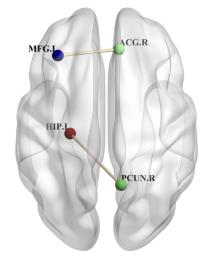
图1
两组治疗后FC差异脑区"
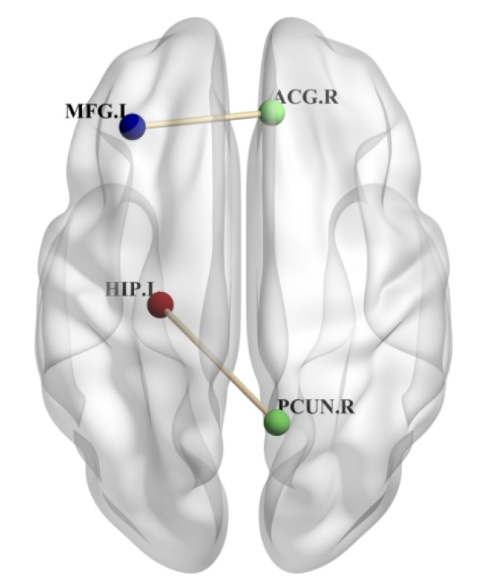
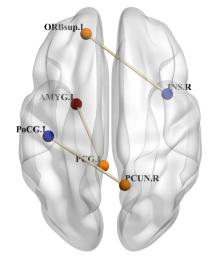
图2
对照组治疗前后FC差异脑区"
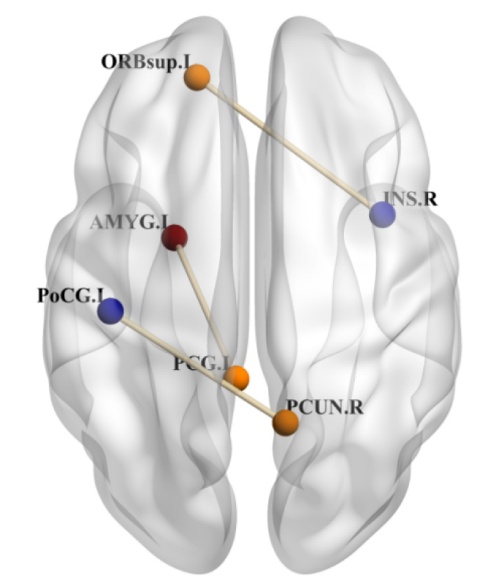
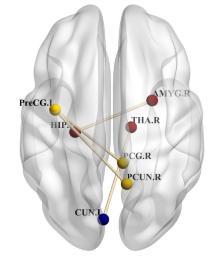
图3
试验组治疗前后FC差异脑区"
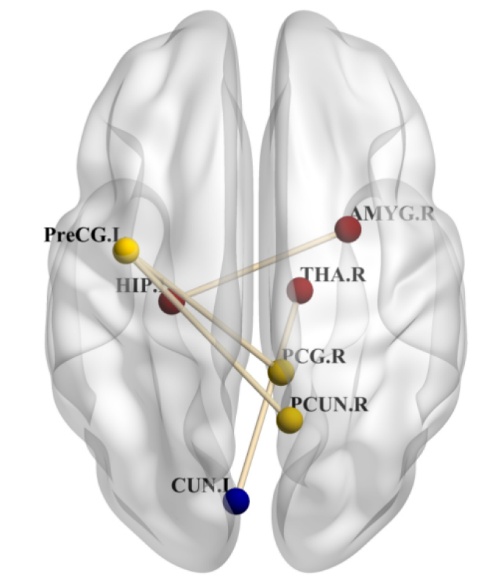
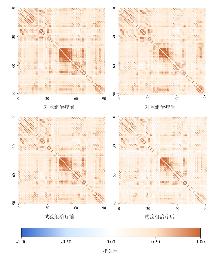
图4
两组治疗前后FC水平矩阵"
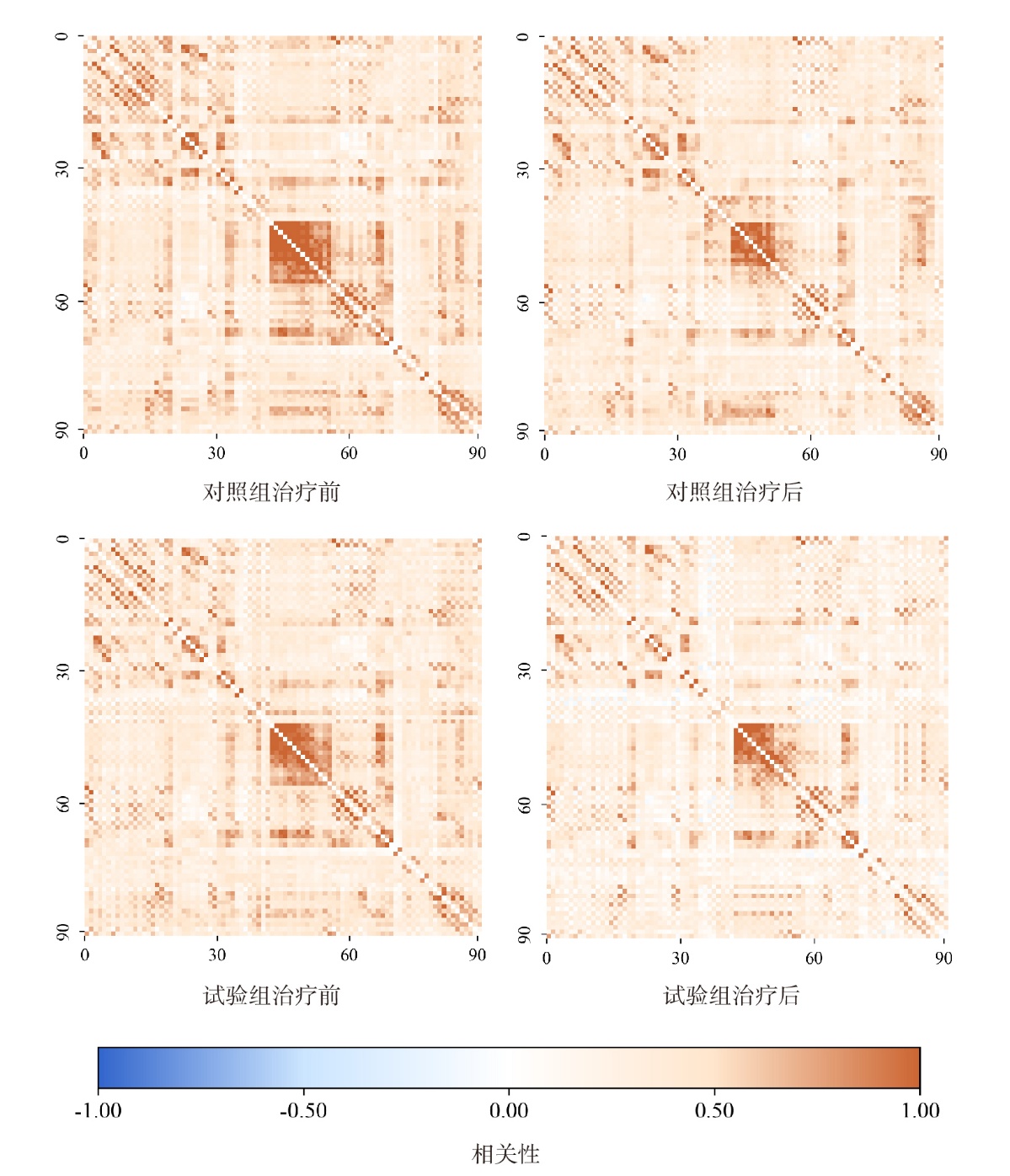
表6
两组治疗前后图论分析指标比较"
| 变量 | 组别 | n | 测试 | t值 | P值 | |
|---|---|---|---|---|---|---|
| Eg | 对照组 | 20 | 前测 | 0.173±0.008 | 4.778 | 0.002 |
| 后测 | 0.185±0.006 | |||||
| 试验组 | 20 | 前测 | 0.177±0.006 | 6.511 | <0.001 | |
| 后测 | 0.192±0.003 | |||||
| 治疗前两组均值差 | -0.004±0.004 | 1.152 | 0.269 | |||
| 治疗后两组均值差 | -0.007±0.002 | 2.944 | 0.011 | |||
| σ | 对照组 | 20 | 前测 | 0.520±0.079 | 2.828 | 0.025 |
| 后测 | 0.631±0.062 | |||||
| 试验组 | 20 | 前测 | 0.582±0.045 | 6.804 | <0.001 | |
| 后测 | 0.723±0.074 | |||||
| 治疗前两组均值差 | -0.062±0.032 | 1.948 | 0.072 | |||
| 治疗后两组均值差 | -0.092±0.034 | 2.675 | 0.018 |
| [1] |
ROBINSON R G, JORGE R E. Post-stroke depression: a review[J]. Am J Psychiatry, 2016, 173(3): 221-231.
doi: 10.1176/appi.ajp.2015.15030363 |
| [2] |
ROBINSON R G, JORGE R E, STARKSTEIN S E. Poststroke depression: an update[J]. J Neuropsychiatry Clin Neurosci, 2024, 36(1): 22-35.
doi: 10.1176/appi.neuropsych.21090231 |
| [3] |
LIU L, XU M, MARSHALL I J, et al. Prevalence and natural history of depression after stroke: a systematic review and meta-analysis of observational studies[J]. PLoS Med, 2023, 20(3): e1004200.
doi: 10.1371/journal.pmed.1004200 |
| [4] |
MEDEIROS G C, ROY D, KONTOS N, et al. Post-stroke depression: a 2020 updated review[J]. Gen Hosp Psychiatry, 2020, 66: 70-80.
doi: 10.1016/j.genhosppsych.2020.06.011 |
| [5] | 倪小佳, 林浩, 罗旭飞, 等. 脑卒中中西医结合防治指南(2023版)[J]. 中国全科医学, 2025, 28(5): 521-533. |
| NI X J, LIN H, LUO X F, et al. Clinical practice guideline for the prevention and treatment of stroke with integrated traditional Chinese and western medicine (2023 edition)[J]. Chin Gen Pract, 2025, 28(5): 521-533. | |
| [6] | LEGG L A, RUDBERG A S, HUA X, et al. Selective serotonin reuptake inhibitors (SSRIs) for stroke recovery[J]. Cochrane Database Syst Rev, 2021, 11(11): CD009286. |
| [7] |
KALBOUNEH H M, TOUBASI A A, ALBUSTANJI F H, et al. Safety and efficacy of SSRIs in improving poststroke recovery: a systematic review and meta-analysis[J]. J Am Heart Assoc, 2022, 11(13): e025868.
doi: 10.1161/JAHA.122.025868 |
| [8] |
XIAO K, LI X, HU W, et al. Acupuncture combined with repetitive transcranial magnetic stimulation for the treatment of post-stroke depression: a systematic evaluation and meta-analysis based on randomised controlled trial[J]. Front Neurol, 2024, 15: 1360437.
doi: 10.3389/fneur.2024.1360437 |
| [9] |
WANG H, LI Y. A pilot controlled trial of a combination of electroacupuncture and psychological intervention for post-stroke depression[J]. Complement Ther Med, 2022, 71: 102899.
doi: 10.1016/j.ctim.2022.102899 |
| [10] | 徐花, 郏文亭, 朱承媛, 等. 有氧训练对脑卒中后抑郁患者的效果[J]. 国际精神病学杂志, 2023, 50(5): 1072-1074. |
| XU H, JIA W T, ZHU C Y, et al. The effect of aerobic training on depression patients after stroke[J]. Int J Psychiatry, 2023, 50(5): 1072-1074. | |
| [11] |
ZHANG S H, WANG Y L, ZHANG C X, et al. Effect of interactive dynamic scalp acupuncture on post-stroke cognitive function, depression, and anxiety: a multicenter, randomized, controlled trial[J]. Chin J Integr Med, 2022, 28(2): 106-115.
doi: 10.1007/s11655-021-3338-1 |
| [12] | 陈静, 曾超, 李辉, 等. 针康法对卒中后抑郁患者认知及神经功能恢复的影响[J]. 中医药学报, 2021, 49(6): 72-75. |
| CHEN J, ZENG C, LI H, et al. Effects of acupuncture-rehabilitation therapy on cognitive and neurological recovery in patients with post-stroke depression[J]. Acta Chin Med Pharmacol, 2021, 49(6): 72-75. | |
| [13] |
赵彬, 唐强, 王艳, 等. 太极拳对卒中后抑郁患者运动功能及抑郁状态的影响[J]. 中国康复理论与实践, 2017, 23(3): 334-337.
doi: 10.3969/j.issn.1006-9771.2017.03.019 |
| ZHAO B, TANG Q, WANG Y, et al. Effects of Taijiquan on motor function and depression in patients with post-stroke depression[J]. Chin J Rehabil Theory Pract, 2017, 23(3): 334-337. | |
| [14] |
GUAN X, LAN M, GE L, et al. Effect of Tai Chi combined with visual-action-sensory rehabilitation therapies on cognitive function in acute ischemic stroke: a study protocol for a randomized controlled trial[J]. Ann Med, 2025, 57(1): 2566877.
doi: 10.1080/07853890.2025.2566877 |
| [15] |
ZHAO J, CHAU J P C, CHAN A W K, et al. Tailored sitting Tai Chi program for subacute stroke survivors: a randomized controlled trial[J]. Stroke, 2022, 53(7): 2192-2203.
doi: 10.1161/STROKEAHA.121.036578 |
| [16] | 中华医学会神经病学分会, 中华医学会神经病学分会脑血管病学组. 中国各类主要脑血管病诊断要点2019[J]. 中华神经科杂志, 2019, 52(9): 710-715. |
| Chinese Society of Neurology, Chinese Stroke Society. Diagnostic criteria of cerebrovascular diseases in China (version 2019)[J]. Chin J Neurol, 2019, 52(9): 710-715. | |
| [17] | 周强, 李明, 董全伟, 等. «国际疾病分类第十一次修订本(ICD-11)»传统医学章节与新版中医国家标准的比较研究[J]. 上海中医药杂志, 2021, 55(5): 1-6, 23. |
| ZHOU Q, LI M, DONG Q W, et al. A comparative study on international classification of traditional medicine included in ICD-11 and new editions of TCM national standards[J]. Shanghai J Tradit Chin Med, 2021, 55(5): 1-6, 23. | |
| [18] | 赵彬. 针康法对脑卒中后抑郁患者静息态功能核磁及血清标志物的影响[D]. 哈尔滨: 黑龙江中医药大学, 2022. |
| ZHAO B. Effects of acupuncture and health therapy on resting-state functional MRI and serum markers in patients with post-stroke depression[D]. Harbin: Heilongjiang University of Chinese Medicine, 2022. | |
| [19] | 于致顺. 头穴基础与临床[M]. 北京: 中国医药科技出版社, 1992. |
| YU Z S. Head point: foundation and clinic[M]. Beijing: China Medical Science and Technology Press, 1992. | |
| [20] |
LIU F, GONG L, ZHAO H, et al. Validity of evaluation scales for post-stroke depression: a systematic review and meta-analysis[J]. BMC Neurol, 2024, 24(1): 286.
doi: 10.1186/s12883-024-03744-7 pmid: 39148052 |
| [21] |
WIESNER K, SCHWARZ A, MEYA L, et al. Interrater reliability of the Fugl-Meyer motor assessment in stroke patients: a quality management project within the ESTREL study[J]. Front Neurol, 2024, 15: 1335375.
doi: 10.3389/fneur.2024.1335375 |
| [22] |
WANG Y C, CHANG P F, CHEN Y M, et al. Comparison of responsiveness of the Barthel Index and modified Barthel Index in patients with stroke[J]. Disabil Rehabil, 2023, 45(6): 1097-1102.
doi: 10.1080/09638288.2022.2055166 |
| [23] |
RUBINOV M, SPORNS O. Complex network measures of brain connectivity: uses and interpretations[J]. Neuroimage, 2010, 52(3): 1059-1069.
doi: 10.1016/j.neuroimage.2009.10.003 pmid: 19819337 |
| [24] |
BULLMORE E, SPORNS O. Complex brain networks: graph theoretical analysis of structural and functional systems[J]. Nat Rev Neurosci, 2009, 10(3): 186-198.
doi: 10.1038/nrn2575 pmid: 19190637 |
| [25] | 周婷, 白昕予, 孙甜, 等. 滋水涵木针法联合头穴透刺治疗卒中后上肢运动功能障碍临床研究[J]. 辽宁中医杂志, 2024, 51(6): 167-170. |
| ZHOU T, BAI X Y, SUN T, et al. Clinical study on treatment of upper limb motor dysfunction after stroke by nourishing water to moisten wood acupuncture combined with head point penetrating acupuncture[J]. Liaoning J Tradit Chin Med, 2024, 51(6): 167-170. | |
| [26] | 唐强. 头穴丛刺与康复治疗的有机结合[J]. 中国康复理论与实践, 2011, 17(4): 301-303. |
| TANG Q. A combined approach of cluster needling of scalp acupuncture and rehabilitation for functional recovery of stroke[J]. Chin J Rehabil Theory Pract, 2011, 17(4): 301-303. | |
| [27] | 姜林鸿, 齐瑞, 赵莉娟, 等. 太极拳运动对卒中后运动功能障碍影响及其机制的研究进展[J]. 中国康复医学杂志, 2022, 37(8): 1116-1120. |
| [28] |
MONCRIEFF J, COOPER R E, STOCKMANN T, et al. The serotonin theory of depression: a systematic umbrella review of the evidence[J]. Mol Psychiatry, 2023, 28(8): 3243-3256.
doi: 10.1038/s41380-022-01661-0 |
| [29] |
NESTLER E J, CARLEZON W A. The mesolimbic dopamine reward circuit in depression[J]. Biol Psychiatry, 2006, 59(12): 1151-1159.
doi: 10.1016/j.biopsych.2005.09.018 |
| [30] |
MAC GIOLLABHUI N, NG T H, ELLMAN L M, et al. The longitudinal associations of inflammatory biomarkers and depression revisited: systematic review, meta-analysis, and meta-regression[J]. Mol Psychiatry, 2021, 26(7): 3302-3314.
doi: 10.1038/s41380-020-00867-4 |
| [31] | 付琳, 李冀, 董婉茹, 等. 基于"神经-内分泌-免疫"调节机制探讨针刺治疗抑郁症的研究概况[J]. 针灸临床杂志, 2021, 37(4): 93-97. |
| FU L, LI J, DONG W R, et al. Research overview of acupuncture in treating depression based on 'neuro-endocrine-immune' regulation mechanism[J]. J Clin Acupunct Moxibustion, 2021, 37(4): 93-97. | |
| [32] | 韩名媛, 高睿泽, 杨成妍, 等. 针刺治疗卒中后抑郁的神经-内分泌-免疫网络机制[J]. 中国针灸, 2024, 44(9): 1100-1106. |
| HAN M Y, GAO R Z, YANG C Y, et al. Neuro-endocrine-immune network mechanism of acupuncture for post-stroke depression[J]. Chin Acupunct Moxibustion, 2024, 44(9): 1100-1106. | |
| [33] |
OH J E, KIM S N. Anti-inflammatory effects of acupuncture at ST36 point: a literature review in animal studies[J]. Front Immunol, 2021, 12: 813748.
doi: 10.3389/fimmu.2021.813748 |
| [34] |
ZHAO R. Exercise mimetics: a novel strategy to combat neuroinflammation and Alzheimer's disease[J]. J Neuroinflammation, 2024, 21(1): 40.
doi: 10.1186/s12974-024-03031-9 |
| [35] |
ZHANG B, QI S, LIU S, et al. Altered spontaneous neural activity in the precuneus, middle and superior frontal gyri, and hippocampus in college students with subclinical depression[J]. BMC Psychiatry, 2021, 21(1): 280.
doi: 10.1186/s12888-021-03292-1 pmid: 34074266 |
| [36] |
ROLLS E T, CHENG W, GONG W, et al. Functional connectivity of the anterior cingulate cortex in depression and in health[J]. Cereb Cortex, 2019, 29(8): 3617-3630.
doi: 10.1093/cercor/bhy236 pmid: 30418547 |
| [37] |
ZHANG Y, SHAO J, WANG X, et al. Functional impairment-based segmentation of anterior cingulate cortex in depression and its relationship with treatment effects[J]. Hum Brain Mapp, 2021, 42(12): 4035-4047.
doi: 10.1002/hbm.25537 pmid: 34008911 |
| [38] |
KAISER R H, ANDREWS-HANNA J R, WAGER T D, et al. Large-scale network dysfunction in major depressive disorder: a meta-analysis of resting-state functional connectivity[J]. JAMA Psychiatry, 2015, 72(6): 603-611.
doi: 10.1001/jamapsychiatry.2015.0071 pmid: 25785575 |
| [39] |
YAN C G, CHEN X, LI L, et al. Reduced default mode network functional connectivity in patients with recurrent major depressive disorder[J]. Proc Natl Acad Sci U S A, 2019, 116(18): 9078-9083.
doi: 10.1073/pnas.1900390116 |
| [40] |
ZENG L, WANG C, SUN K, et al. Upregulation of a small-world brain network improves inhibitory control: an fNIRS neurofeedback training study[J]. Brain Sci, 2023, 13(11): 1568.
doi: 10.3390/brainsci13111568 |
| [41] |
ZHOU Y, LONG Y. Sex differences in human brain networks in normal and psychiatric populations from the perspective of small-world properties[J]. Front Psychiatry, 2024, 15: 1456714.
doi: 10.3389/fpsyt.2024.1456714 |
| [42] |
SIEGEL J S, SEITZMAN B A, RAMSEY L E, et al. Re-emergence of modular brain networks in stroke recovery[J]. Cortex, 2018, 101: 44-59.
doi: S0010-9452(17)30427-6 pmid: 29414460 |
| [43] | NEMATI P R, BACKHAUS W, FELDHEIM J, et al. Brain network topology early after stroke relates to recovery[J]. Brain Commun, 2022, 4(2): fcac049. |
| [1] | 杨玲, 王庆雷, 王洁, 徐雯婕, 王彤, 郭川, 钱雪. 基于功能性近红外光谱成像的卒中后焦虑患者前额叶皮质激活特征及机制研究[J]. 《中国康复理论与实践》, 2026, 32(3): 329-336. |
| [2] | 骆丹丹, 沈敏, 王素娟, 邱翁歆, 张宇轩, 吴蕴, 王圣虓. 汉语发展性阅读障碍儿童全脑静息态功能连接的特征分析[J]. 《中国康复理论与实践》, 2025, 31(9): 1023-1031. |
| [3] | 山磊, 刘影, 张欣, 迟茜茜, 朱晓敏. 加速间歇性爆发性θ波刺激治疗卒中后抑郁的效果[J]. 《中国康复理论与实践》, 2025, 31(7): 822-829. |
| [4] | 张梓寒, 张家成, 刘婧訸, 陈宇航, 吴丹, 王荟荧, 黄幸, 常静玲. 基于功能连接探索卒中后失语患者的脑电脑功能网络特征[J]. 《中国康复理论与实践》, 2025, 31(11): 1342-1353. |
| [5] | 许琦, 郑丁炤, 牛镇远, 杨雅玲, 温卫友, 许璟胜, 吴龙强, 吴帆, 燕铁斌. 不同时序经颅直流电刺激联合坐位太极拳云手对脑卒中偏瘫患者脑皮质激活影响的功能性近红外光谱研究[J]. 《中国康复理论与实践》, 2025, 31(10): 1121-1127. |
| [6] | 王俊伟, 许琦, 王欣欣, 何毅琪, 吴心虹, 张芸. 不同时序经颅直流电刺激结合坐位太极拳云手对健康青年人脑皮质激活的功能性近红外光谱研究[J]. 《中国康复理论与实践》, 2025, 31(10): 1128-1133. |
| [7] | 陈宇航, 杨瑜爱, 卢轩禹, 王昱航, 张蒙园, 张梓寒, 王荟荧, 常静玲. 卒中后失语和卒中后抑郁自发脑活动改变的静息态功能磁共振成像Meta分析[J]. 《中国康复理论与实践》, 2025, 31(10): 1143-1155. |
| [8] | 徐胜, 张敏, 杨青青, 王庆雷, 耿阿燕, 王彤, 郭川. 功能性电刺激手摇车对脑卒中患者脑网络功能连接的功能性近红外光谱研究[J]. 《中国康复理论与实践》, 2025, 31(10): 1181-1187. |
| [9] | 穆姿辰, 唐强, 史云秋, 王艳, 朱淑伟, 庄亚楠, 徐丹双, 李宏玉, 李保龙, 张春艳, 袁孟珂. 丰富环境训练结合头穴丛刺对孤独症谱系障碍模型大鼠行为的影响[J]. 《中国康复理论与实践》, 2024, 30(2): 176-182. |
| [10] | 李芳, 刘慧珍, 梅利平, 张通, 张豪杰, 李冰洁, 赵军. 脑梗死患者康复科住院期间卒中后抑郁程度的相关因素[J]. 《中国康复理论与实践》, 2024, 30(2): 217-222. |
| [11] | 张明兰, 张玲玲, 王丽莎, 刘莉, 高润, 饶江, 刘婉, 夏子安, 张传文, 程欣欣. 自主神经功能对卒中后抑郁患者运动功能的影响[J]. 《中国康复理论与实践》, 2024, 30(2): 223-231. |
| [12] | 罗启航, 吴羽皙, 张嘉璇, 黎婉颖, 欧海宁, 林强, 梁俊杰. 老年人平衡功能的脑网络变化:基于功能性近红外线光谱研究[J]. 《中国康复理论与实践》, 2023, 29(2): 238-242. |
| [13] | 秦彦强, 董浩, 孙迎春, 程先宽, 姚海江. 不同针刺方案对卒中后抑郁大鼠神经递质及相关炎性因子的影响[J]. 《中国康复理论与实践》, 2023, 29(1): 30-37. |
| [14] | 崔家宝, 林舰, 刘育成, 王鹏, 曾洪发. 大学生太极拳活动的心理健康效益:基于ICF的系统综述[J]. 《中国康复理论与实践》, 2023, 29(1): 48-54. |
| [15] | 刘辉,尹航,梅博威,贾绍辉,柏开祥. 24式简化太极拳野马分鬃动作导致膝关节损伤的风险评估[J]. 《中国康复理论与实践》, 2022, 28(6): 690-695. |
| 阅读次数 | ||||||
|
全文 |
|
|||||
|
摘要 |
|
|||||
|
||
