



《中国康复理论与实践》 ›› 2026, Vol. 32 ›› Issue (8): 946-958.doi: 10.3969/j.issn.1006-9771.2026.08.008
唐琪1,2, 吕军1,2,3( ), 马春华4(), 黄昊鹰4, 孙嘉遥1,5, 陶冉1,2, 鲁春蕾1,2, 黄爱华4
收稿日期:2026-01-04
修回日期:2026-03-01
接受日期:2026-03-03
出版日期:2026-08-25
发布日期:2026-08-25
通讯作者:
吕军,E-mail: lujun@shmu.edu.cn;作者简介:唐琪(1990-),女,汉族,安徽淮北市人,博士,青年副研究员,主要研究方向:卫生政策与管理。基金资助:
Tang Qi1,2, Lü Jun1,2,3(), Ma Chunhua4(), Huang Haoying4, Sun Jiayao1,5, Tao Ran1,2, Lu Chunlei1,2, Huang Aihua4
Received:2026-01-04
Revised:2026-03-01
Accepted:2026-03-03
Published:2026-08-25
Online:2026-08-25
Contact:
Lü Jun, E-mail: lujun@shmu.edu.cn;Ma Chunhua, E-mail: 2445219050@qq.comSupported by:摘要:
目的 应用并系统评价福利机构成年残疾人照护服务需求分级评估工具。
方法 2025年6月至7月,选择上海市4家残疾人照护机构,采用自研福利机构成年残疾人照护服务需求分级评估工具对1 002例成年残疾人实施评估。采用照护需求分级结果和等级分布变化评价其应用效果;采用各功能维度得分差异、各等级降维聚类散点图、校标变量评价应用效度;采用平均评估时长和学习曲线评价其应用效率;采用各等级服务清单的分布特征和映射关系评价效用价值。
结果 评估后各等级分布为:1级84例、2级298例、3级92例、4级246例、5级282例,呈现由原体系较高等级向新体系中、低等级转移的趋势。工具在各功能维度上均表现强辨别力(P < 0.001),区分效度良好;所划分的5个等级在降维空间中呈现清晰的聚类边界,结构效度良好;分级结果与年龄、残疾类型、残疾等级、患病种类数和主要疾病诊断等校标间理论预期一致(P < 0.05),外部效度良好。工具评估时长中位数5.80 min,且表现出显著的学习效应(P = 0.037),体现出较高的评估效率。形成针对不同等级的服务清单,各等级间的服务内容存在梯度差异,并映射各等级照护需求特征,体现效用价值。
结论 本研究应用的评估工具将成年残疾人照护服务需求有效划分为5个等级,工具效度良好、评估效率高,所形成的不同照护等级服务清单可用于指导实践,适用于成年残疾人需求分级评估。
中图分类号:
唐琪, 吕军, 马春华, 黄昊鹰, 孙嘉遥, 陶冉, 鲁春蕾, 黄爱华. 福利机构成年残疾人照护服务需求分级评估工具应用评价[J]. 《中国康复理论与实践》, 2026, 32(8): 946-958.
Tang Qi, Lü Jun, Ma Chunhua, Huang Haoying, Sun Jiayao, Tao Ran, Lu Chunlei, Huang Aihua. Application evaluation of the care-need grading assessment tool for adult with disabilities in welfare institutions[J]. Chinese Journal of Rehabilitation Theory and Practice, 2026, 32(8): 946-958.

表1
试点机构成年残疾人基本情况分析"
| 项目 | 总体(n = 1002) | 男(n = 630) | 女(n = 372) | t/χ2值 | P值 |
|---|---|---|---|---|---|
| 年龄/岁 | 31.75±12.29 | 30.86±11.53 | 33.27±13.35 | -2.901 | 0.004 |
| 医疗保障类型/n(%) | 22.050 | < 0.001 | |||
| 城乡居民基本医疗保险 | 777 (77.54) | 519 (82.38) | 258 (69.35) | ||
| 城镇职工基本医疗保险 | 225 (22.46) | 111 (17.62) | 114 (30.65) | ||
| 所在残疾人照护机构/n(%) | 62.624 | < 0.001 | |||
| 上海市第二社会福利院 | 601 (59.98) | 335 (53.17) | 266 (71.51) | ||
| 上海市第五社会福利院 | 248 (24.75) | 208 (33.02) | 40 (10.75) | ||
| 浦东新区重度残疾人寄养院(听民分院) | 103 (10.28) | 57 (9.05) | 46 (12.37) | ||
| 宝山区秋晖重残养护院 | 50 (4.99) | 30 (4.76) | 20 (5.38) | ||
| 残疾类型/n(%) | < 0.001a | ||||
| 视力残疾 | 9 (0.90) | 3 (0.48) | 6 (1.61) | ||
| 听力残疾 | 1 (0.10) | 0 (0.0) | 1 (0.27) | ||
| 肢体残疾 | 43 (4.29) | 8 (1.27) | 35 (9.41) | ||
| 智力残疾 | 315 (31.44) | 210 (33.33) | 105 (28.23) | ||
| 精神残疾 | 13 (1.30) | 8 (1.27) | 5 (1.34) | ||
| 多重残疾 | 7 (0.70) | 5 (0.79) | 2 (0.54) | ||
| 未评残 | 614 (61.28) | 396 (62.86) | 218 (58.60) | ||
| 残疾等级/n(%) | 45.770 | < 0.001 | |||
| 一级 | 150 (14.97) | 70 (11.11) | 80 (21.51) | ||
| 二级 | 123 (12.28) | 103 (16.35) | 20 (5.38) | ||
| 三级 | 74 (7.39) | 41 (6.51) | 33 (8.87) | ||
| 四级 | 41 (4.09) | 20 (3.17) | 21 (5.65) | ||
| 未评残 | 614 (61.28) | 396 (62.86) | 218 (58.60) | ||
| 患病种类数 | 1.42±0.77 | 1.39±0.75 | 1.46±0.81 | -1.375 | 0.169 |
| 疾病诊断/n(%) | |||||
| 脑瘫 | 272 (27.15) | 177 (28.10) | 95 (25.54) | 0.650 | 0.420 |
| 癫痫 | 156 (15.57) | 94 (14.92) | 62 (16.67) | 0.418 | 0.518 |
| 极重度精神发育迟滞 | 123 (12.28) | 76 (12.06) | 47 (12.63) | 0.028 | 0.868 |
| 重度精神发育迟滞 | 113 (11.28) | 56 (8.89) | 57 (15.32) | 9.044 | 0.003 |
| 中度精神发育迟滞 | 44 (4.39) | 25 (3.97) | 19 (5.11) | 0.477 | 0.490 |
| 轻度精神发育迟滞 | 49 (4.89) | 34 (5.40) | 15 (4.03) | 0.666 | 0.414 |
| 高血压 | 42 (4.19) | 20 (3.17) | 22 (5.91) | 3.715 | 0.054 |
| 心脏病 | 22 (2.20) | 13 (2.06) | 9 (2.42) | 0.022 | 0.882 |
| 糖尿病 | 12 (1.20) | 3 (0.48) | 9 (2.42) | 0.012a | |
| 胆囊炎 | 10 (1.00) | 5 (0.79) | 5 (1.34) | 0.513a |
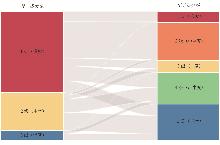
图1
照护需求等级变化桑基图"
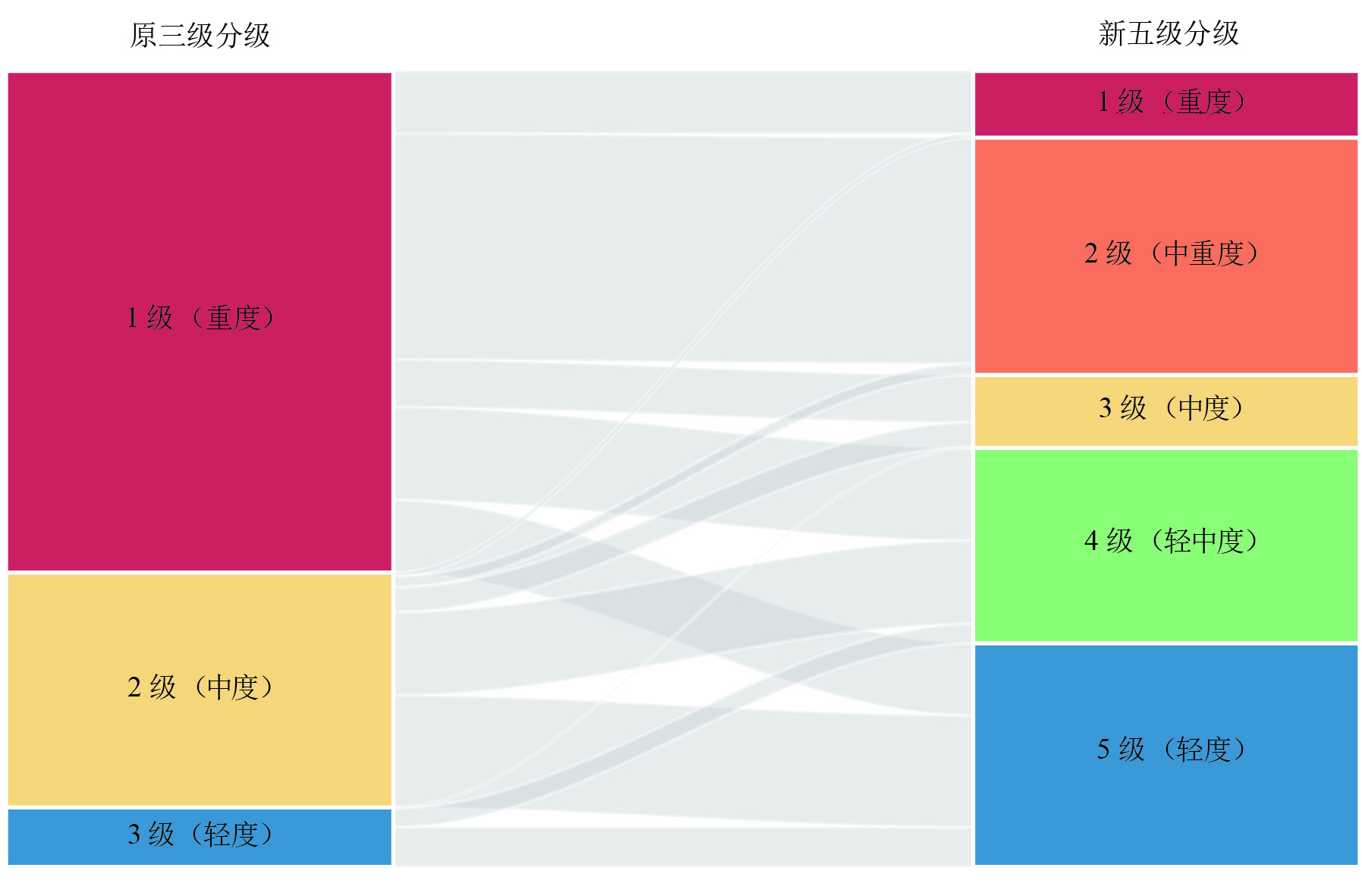
表2
4个维度对应等级得分情况分析(n=1002)"
| 维度 | 1级(重度) (n = 84) | 2级(中重度) (n = 298) | 3级(中度) (n = 92) | 4级(轻中度) (n = 246) | 5级(轻度) (n = 282) | F值 | P值 |
|---|---|---|---|---|---|---|---|
| 生理功能 | 8.49±6.00 | 16.41±6.30 | 26.33±4.21 | 32.13±4.72 | 35.05±2.84 | 3061.852 | < 0.001 |
| 日常生活能力 | 5.38±11.73 | 7.94±11.10 | 44.32±25.81 | 78.49±13.05 | 84.50±10.24 | 4281.692 | < 0.001 |
| 精神心理功能 | 5.19±3.78 | 14.73±1.93 | 7.60±2.92 | 13.76±2.03 | 17.67±1.83 | 434.155 | < 0.001 |
| 环境适应能力 | 2.57±1.68 | 7.84±1.56 | 5.55±1.20 | 7.89±1.14 | 9.75±0.97 | 633.400 | < 0.001 |
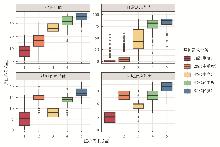
图2
4个功能维度对应等级箱线图"

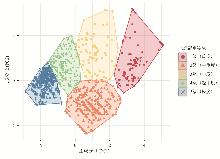
图3
照护需求等级聚类散点图"
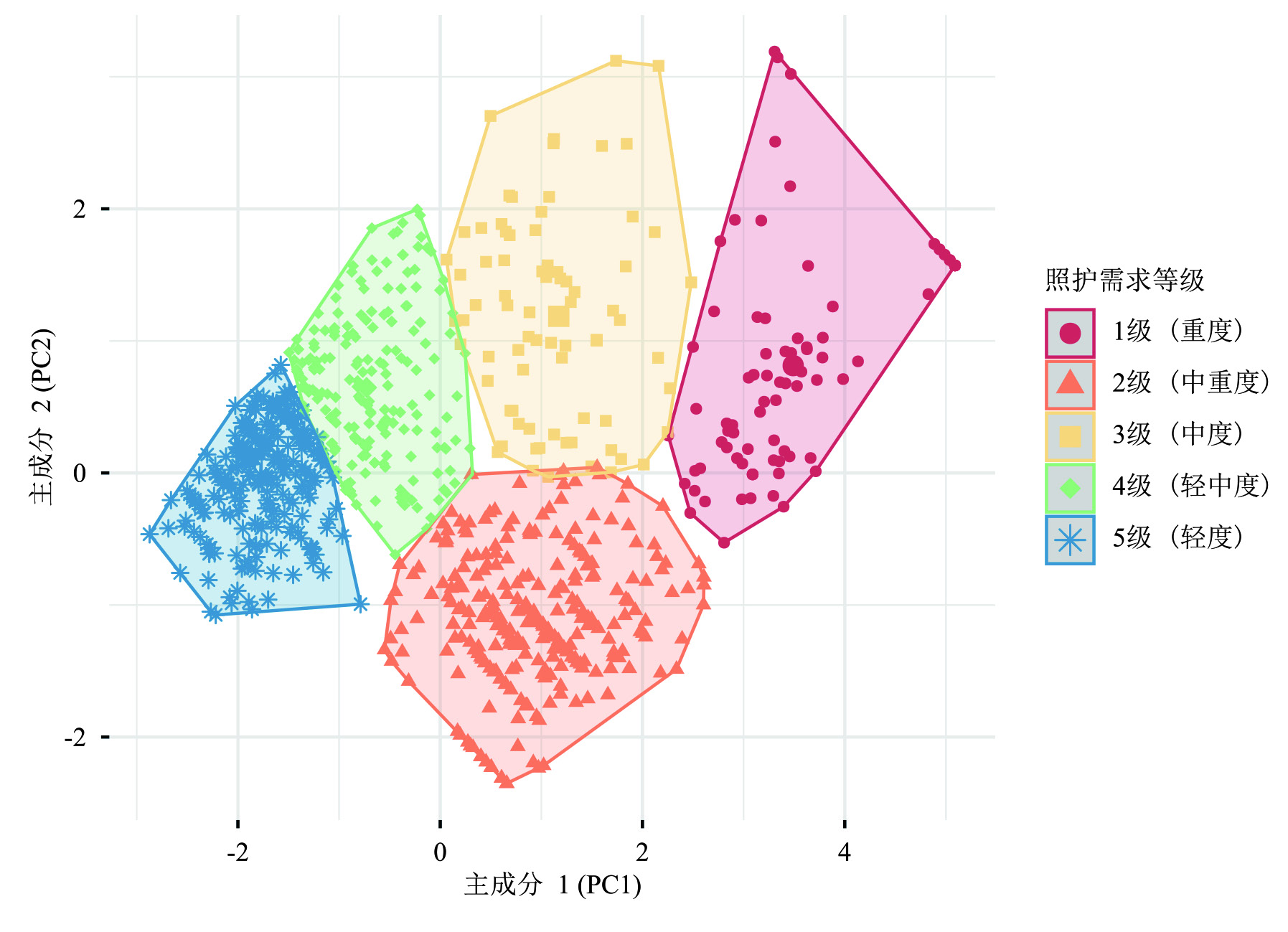
表3
不同照护需求等级外部效度情况分析"
| 项目 | 1级 (重度) | 2级 (中重度) | 3级 (中度) | 4级 (轻中度) | 5级 (轻度) | 系数值 | P值 |
|---|---|---|---|---|---|---|---|
| 年龄/岁* | 23.93±7.28 | 26.69±9.63 | 33.57±13.72 | 35.96±12.25 | 35.16±12.62 | 1.051 (1.041, 1.061)a | < 0.001 |
| 残疾类型/n(%)# | 0.173b | < 0.001 | |||||
| 视力残疾 | 1 (3.03) | 0 (0.00) | 1 (2.70) | 2 (1.60) | 5 (4.35) | ||
| 听力残疾 | 0 (0.00) | 0 (0.00) | 0 (0.00) | 1 (0.80) | 0 (0.00) | ||
| 肢体残疾 | 3 (9.09) | 21 (26.92) | 1 (2.70) | 10 (8.00) | 8 (6.96) | ||
| 智力残疾 | 28 (84.85) | 57 (73.08) | 32 (86.49) | 108 (86.40) | 90 (78.26) | ||
| 精神残疾 | 1 (3.03) | 0 (0.00) | 1 (2.70) | 2 (1.60) | 9 (7.83) | ||
| 多重残疾 | 0 (0.00) | 0 (0.00) | 2 (5.41) | 2 (1.60) | 3 (2.61) | ||
| 残疾等级/n(%)# | 1.690 (1.407, 2.037)a | < 0.001 | |||||
| 一级 | 15 (45.45) | 47 (60.26) | 16 (43.24) | 36 (28.80) | 36 (31.30) | ||
| 二级 | 17 (51.52) | 22 (28.21) | 13 (35.14) | 38 (30.40) | 33 (28.70) | ||
| 三级 | 1 (3.03) | 7 (8.97) | 6 (16.22) | 35 (28.00) | 25 (21.74) | ||
| 四级 | 0 (0.00) | 2 (2.56) | 2 (5.41) | 16 (12.80) | 21 (18.26) | ||
| 患病种类数* | 1.83±1.26 | 1.47±0.80 | 1.29±0.52 | 1.31±0.60 | 1.36±0.71 | 0.704 (0.603, 0.821)a | < 0.001 |
| 脑瘫/n(%)* | 33 (12.13) | 154 (56.62) | 16 (5.88) | 22 (8.09) | 47 (17.28) | -10.210c | < 0.001 |
| 癫痫/n(%)* | 20 (12.82) | 70 (44.87) | 14 (8.97) | 31 (19.87) | 21 (13.46) | -5.745 c | < 0.001 |
| 重度精神发育迟滞/n(%)* | 22 (19.47) | 28 (24.78) | 12 (10.62) | 21 (18.58) | 30 (26.55) | -2.167c | 0.030 |
| 轻度精神发育迟滞/n(%)* | 2 (4.08) | 12 (24.49) | 1 (2.04) | 13 (26.53) | 21 (42.86) | 2.365 c | 0.018 |
表4
评估主体评估效率情况"
| 项目 | 评估员人数/n | 评估对象数/n | 评估时间/min |
|---|---|---|---|
| 总体 | 38 | 1002 | 5.80 (4.17, 8.45) |
| 性别 | |||
| 男 | 5 | 88 | 6.25 (4.74, 8.42) |
| 女 | 33 | 914 | 5.66 (4.13, 8.45) |
| 岗位 | |||
| 医生 | 1 | 42 | 5.87 (4.64, 8.17) |
| 护士 | 16 | 486 | 5.38 (3.85, 8.25) |
| 护理员 | 8 | 174 | 6.62 (5.07, 9.22) |
| 社会工作者 | 5 | 96 | 4.81 (3.96, 6.97) |
| 管理人员 | 8 | 204 | 6.16 (4.53, 9.59) |
图4
评估熟练度的练习效应"
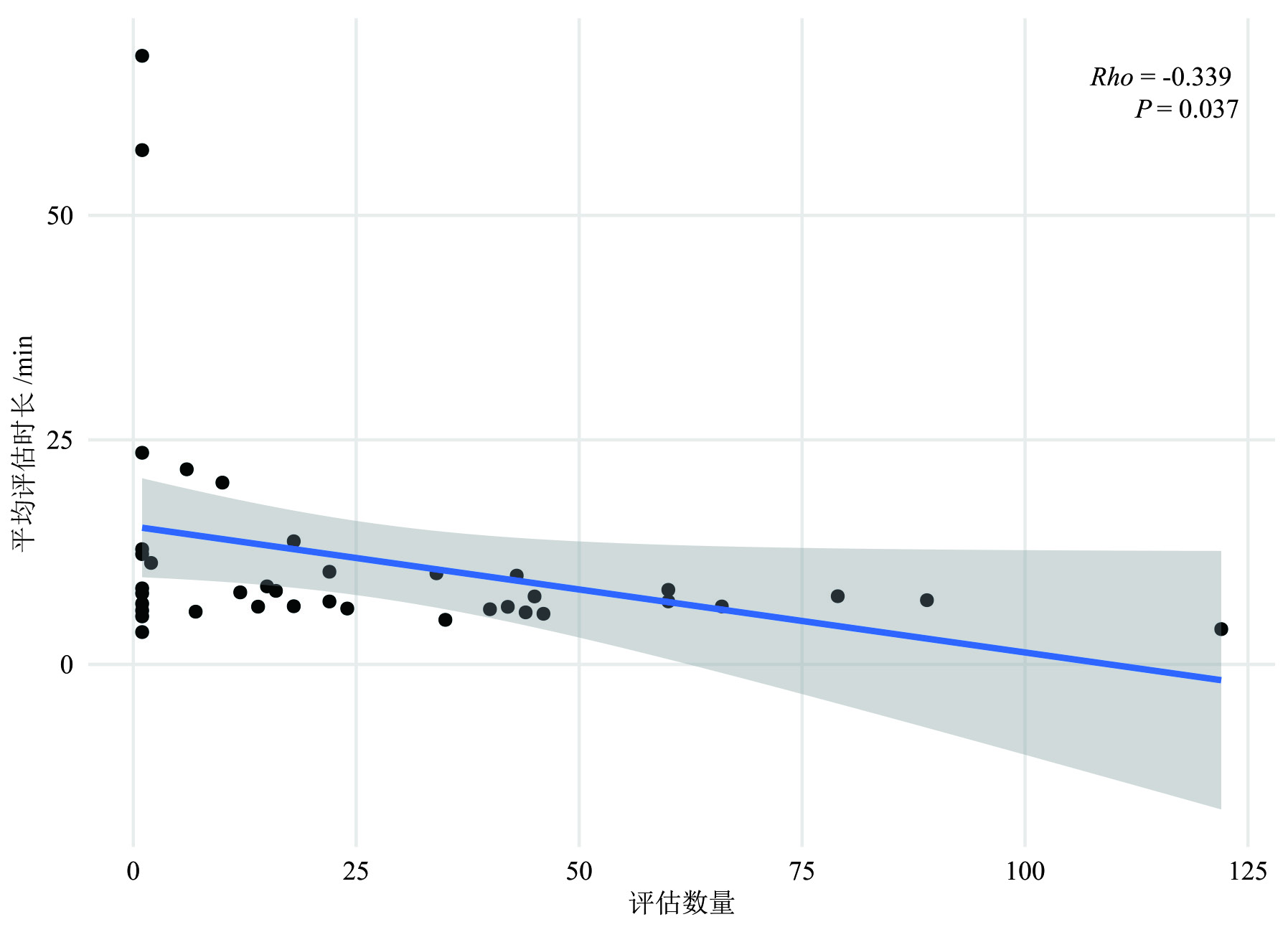
表5
不同照护需求等级服务清单"
| 项目 | 基本照护服务 | 5级(轻度) | 4级(轻中度) | 3级(中度) | 2级(中重度) | 1级(重度) |
|---|---|---|---|---|---|---|
| 1-日常照护服务 | ||||||
| 1-1饮用水供应和用餐服务 | 24 h供应饮用水;按医嘱提供特殊饮食;检查自带食品质量 | 督促进食前手卫生及安全宣教;食物微波炉加热 | 按需帮助清洁手及口腔;关注吞咽、咀嚼等安全状况 | 4级内容基础上,帮助将食物剔骨(刺)、切碎,送餐到床边;按需提供喂食服务 | 帮助饮水或喂水;提供认知障碍照料,看护下进食,防止异物 | 2级内容基础上,按需定时提供喂食、鼻饲服务 |
| 1-2睡眠照护服务 | 提供适宜睡眠环境(床单位、温控、光声等) | 观察服务对象睡眠状况 | 观察睡眠规律及变化,记录并报告异常 | 4级内容基础上,睡眠时拉好床护栏 | 遵医嘱提供改善睡眠药物并观察效果 | 延续2级内容 |
| 1-3洗漱、修饰和洗浴服务 | 提醒按时洗漱、修剪指甲、理发剃须及洗浴;关注洗浴安全 | 协助洗漱、定期修剪指甲、理发剃须、按时洗浴 | 协助晨晚间护理、口腔及义齿清洁;定期洗浴或擦浴 | 延续4级内容 | 帮助完成口腔清洁(棉球、棉棒等)、义齿清洁及各形式洗浴 | 2级内容基础上,按需帮助服务对象床上沐浴 |
| 1-4穿脱衣服务 | — | 提醒定时更换衣裤,保持整洁适季 | 协助穿脱衣裤;保持着装整洁适季 | 延续4级内容 | 帮助穿脱衣裤 | 延续2级内容 |
| 1-5二便管理 | 定期关心询问二便情况;遵医嘱提供开塞露通便 | 发现异常协助报告医生 | 按需协助如厕、使用便器、清洁皮肤;观察二便性质、量、颜色 | 4级内容基础上,搀扶如厕 | 帮助如厕、使用便器、更换尿布、清洁皮肤;异常及时报医 | 延续2级内容 |
| 1-6日常巡视 | 每2小时巡视1次,特殊情况酌情调整;突发状况立即处理 | — | 及时了解需求并帮助解决 | 延续4级内容 | 巡视频率缩短至每小时1次 | 延续2级内容 |
| 1-7压疮预防及移动照护 | — | — | 做好压疮风险评估;指导轮椅使用;定期检查皮肤状况 | 4级内容基础上,协助上下床及使用轮椅 | 为长期卧床者建立翻身卡(至少2小时1次);提供减压及移动转运 | 延续2级内容 |
| 1-8物品整理及健康宣教 | 提醒整理橱柜及床单位;定期更换床品;开展安全及健康宣教 | 督促或协助物品整理及床单位清洁;做好安全与健康宣教 | 协助定期整理橱柜;保持物品分类放置;协助整理床单位 | 4级内容基础上,重视心理评估,做好安全与健康宣教 | 帮助定期整理橱柜及床单位;保持床单位清洁、干燥、平整 | 2级内容基础上,重视心理评估与安全巡视 |
| 2-预防保健服务 | ||||||
| 2-1用药管理 | 按需接收登记自带药;督促检查有效期;送药到口并确认服下 | — | 增加药品保管与排药服务;送药到床边 | 延续4级内容 | 延续4级内容 | 延续4级内容 |
| 2-2康复服务 | 指导进行增加体力、灵活性的训练 | 按需提供群体康复训练 | 按需为肢体功能障碍者提供康复训练 | 延续4级内容 | 延续4级内容 | 延续4级内容 |
| 2-3导管护理及常用医疗护理 | — | — | — | — | — | 提供鼻饲管、导尿管、吸氧管等管路护理;提供吸痰、换药、冲洗等 |
| [1] | 中国残疾人联合会. 十四届全国人大三次会议第4130号建议及办理复文[EB/OL]. (2025-09-28)[2025-12-12]. https://www.cdpf.org.cn/ztzl/zyzt1/qglhjytafw/2025nlhjytablfwgk/qgrdjyblfw2025/3e6c7524c7c0494ba8a303f5d77943e4.htm. |
| [2] | 国务院. "十四五"残疾人保障和发展规划[EB/OL]. (2021-07-21)[2025-11-21]. https://www.gov.cn/zhengce/zhengceku/2021-07/21/content_5626391.htm. |
| [3] | 中国残疾人联合会. 2024年残疾人事业发展统计公报[EB/OL]. (2025-05-08)[2025-10-18]. https://www.cdpf.org.cn/zwgk/zccx/tjgb/1706f34657364af9a52b67f77d8c9f2b.htm. |
| [4] | Paramasivam A, Jaiswal A, Budhiraja S, et al. The International Classification of Functioning, Disability and Health Health Core Set for deafblindness. Part I: a systematic review of outcome measures[J]. Eur J Phys Rehabil Med, 2023, 59(5): 615-627. |
| [5] |
王一然, 戴婉薇, 苏彬彬, 等. 我国康复服务需求评估与供需缺口原因分析[J]. 中国康复理论与实践, 2022, 28(6): 725-729.
doi: 10.3969/j.issn.1006-9771.2022.06.015 |
| Wang Y R, Dai W W, Su B B, et al. Assessment of demand for rehabilitation services and analysis of causes of the gap between supply and demand in China[J]. Chin J Rehabil Theory Pract, 2022, 28(6): 725-729. | |
| [6] |
谭睿. 我国长期护理保险失能等级评定的实践及思考[J]. 卫生软科学, 2022, 36(7): 60-65.
doi: 10.3969/j.issn.1003-2800.2022.07.013 |
| Tan R. The practice and thinking of long-term care insurance disability rating in China[J]. Soft Sci Health, 2022, 36(7): 60-65. | |
| [7] | 孙嘉遥. 成年残疾人机构照护服务需求分级评估工具研制及应用研究——以上海市为例[D]. 上海: 复旦大学, 2025. |
| Sun J Y. Development and application research of Graded Assessment Tool for Institutional Care Needs of Working-Age Disabled People: a case study of Shanghai[D]. Shanghai: Fudan University, 2025. | |
| [8] |
孙嘉遥, 马春华, 吕军, 等. 福利机构成年残疾人照护服务需求分级评估工具研制[J]. 中国康复理论与实践, 2025, 31(7): 802-811.
doi: 10.3969/j.issn.1006-9771.2025.07.007 |
| Sun J Y, Ma C H, Lü J, et al. Development of a needs assessment tool for grading care services for adults with disabilities in welfare institutions[J]. Chin J Rehabil Theory Pract, 2025, 31(7): 802-811. | |
| [9] | 柴雪. 标准化营养评估工具在老年人群中的适用性及有效性研究[J]. 中国标准化, 2025(12): 256-259. |
| Chai X. Study on the applicability and effectiveness of standardized nutritional assessment tools in the elderly population[J]. Chin Standard, 2025(12): 256-259. | |
| [10] | Domeisen Benedetti F, Hechinger M, Fringer A. Self-assessment instruments for supporting family caregivers: an integrative review[J]. Healthcare (Basel), 2024, 12(10): 1016. |
| [11] |
Nadash P, Doty P, Von Schwanenflügel M. The German Long-Term Care Insurance Program: evolution and recent developments[J]. Gerontologist, 2018, 58(3): 588-597.
doi: 10.1093/geront/gnx018 pmid: 28379357 |
| [12] | Riedel M. Peer review on "Germany's latest reforms of the long-term care system": bypassing or catching up on Austrian standards?; Peer country comments paper-Austria[R]. Berlin: European Commission, Directorate-General for Employment, Social Affairs and Inclusion, 2017. |
| [13] |
Konishi T, Inokuchi H, Yasunaga H. Services in public long-term care insurance in Japan[J]. Ann Clin Epidemiol, 2023, 6(1): 1-4.
doi: 10.37737/ace.24001 |
| [14] |
Hashimoto A, Hashimoto H, Kawaguchi H. Technical efficiency of prevention services for functional dependency in Japan's public long-term care insurance system: an ecological study[J]. Int J Health Policy Manag, 2024, 13: 8226.
doi: 10.34172/ijhpm.8226 pmid: 39099485 |
| [15] |
Yoshida Y, Tamura K; Geriatric Oncology Guideline-Establishing Study Group. Implementation of geriatric assessment and long-term care insurance system by medical professionals in cancer treatment: a nationwide survey in Japan[J]. Jpn J Clin Oncol, 2022, 52(5): 449-455.
doi: 10.1093/jjco/hyac020 |
| [16] | 日本厚生劳动省. 令和5年度介護保険事業状況報告(年報)[EB/OL]. (2025-08-28)[2025-12-01]. https://www.mhlw.go.jp/topics/kaigo/osirase/jigyo/23/dl/r05_point.pdf. |
| [17] | 甘珍珍, 郝勇. 长期护理保险实施效果的评价指标体系构建——以上海市为例[J]. 上海保险, 2021(12): 25-30. |
| [18] |
邱卓英, 李安巧, 黄珂, 等. 基于ICF和联合国«残疾人权利公约»对国际组织有关残疾定义及其测量的内容研究[J]. 中国康复理论与实践, 2018, 24(10): 1117-1121.
doi: 10.3969/j.issn.1006-9771.2018.10.001 |
| Qiu Z Y, Li A Q, Huang K, et al. Content analysis of definition and measurement of disability: based on ICF and UN Convention on the Rights of Persons with Disabilities[J]. Chin J Rehabil Theory Pract, 2018, 24 (10): 1117-1121. | |
| [19] | 姜倩倩, 宋洁, 吴淑琳, 等. 社区整合照护模式及需求评估工具的研究进展[J]. 中国医药导报, 2021, 18(20): 4. |
| Jiang Q Q, Song J, Wu S L, et al. Research progress of community integrated care models and needs assessment tools[J]. Chin Med Herald, 2021, 18(20): 4. | |
| [20] |
Zhang Z, Peng J, Song Q, et al. Identification of depression subtypes in Parkinson's disease patients via structural MRI whole-brain radiomics: an unsupervised machine learning study[J]. CNS Neurosci Ther, 2025, 31(2): e70182.
doi: 10.1111/cns.v31.2 |
| [21] |
Cho A R, Heo S J, Han T, et al. Cluster-based analysis of lipid profiles and inflammation in association with cardiovascular disease incidence and mortality: a 17.5-year longitudinal study[J]. J Clin Hypertens (Greenwich), 2025, 27(3) e70035.
doi: 10.1111/jch.v27.3 |
| [22] | 李彩平, 李海荣, 夏仲年, 等. 基于K-means聚类方法的分类肺康复对慢性阻塞性肺疾病稳定期患者的干预效果[J]. 实用心脑肺血管病杂志, 2019, 27(9): 50-55. |
| Li C P, Li H R, Xia Z N, et al. Intervention effect of classified pulmonary rehabilitation based on K-means clustering method on patients with stable chronic obstructive pulmonary disease[J]. Pract J Cardiac Cerebr Pneum Vascul Dis, 2019, 27(9): 50-55. | |
| [23] | 顾冯霞, 罗婷, 许凯迪, 等. 基于双次K-means聚类分析的老年慢性共病模式及管理[J]. 中国老年学杂志, 2024, 44(22): 5593-5597. |
| [24] |
Poldrugovac M, Wammes J D, Bos V L L C, et al. Performance indicators on long-term care for older people in 43 high- and middle-income countries: literature review, web search and expert consultation[J]. BMC Health Serv Res, 2025, 25(1): 460.
doi: 10.1186/s12913-025-12573-4 |
| [25] | 刘畅, 张红娟, 王园园. 基于ICF理论的分级照护干预老年CHF患者效果[J]. 山西卫生健康职业学院学报, 2024, 34(2): 115-117. |
| [26] |
Chien A T, Spence S J, Okumura M J, et al. Impairment types and combinations among adolescents and young adults with disabilities: Colorado 2014-2018[J]. Acad Pediatr, 2024, 24(4): 587-595.
doi: 10.1016/j.acap.2023.10.010 |
| [27] |
Park S, Jeon H W, Lee J, et al. Continuity of care among people with hypertension and disabilities[J]. Chronic Illn, 2025, 21(4): 467-478.
doi: 10.1177/17423953251377176 |
| [28] | 何文炯, 纪楠楠, 刘来泽, 等. 长期护理保险制度建立后的残疾人照护保障体系研究[J]. 残疾人研究, 2024(1): 24-32. |
| He W J, Ji N N, Liu L Z, et al. The caring security system for persons with disabilities after the establishment of long-term care insurance system[J]. Disabil Res, 2024(1): 24-32. | |
| [29] | 刘战旗, 杨婕娱, 王旭东, 等. 重度残疾人分类精准照护及政策对接研究[J]. 残疾人研究, 2022(3):47-57. |
| Liu Z Q, Yang J Y, Wang X D, et al. Research on classified precision care and policy docking of persons with severe disabilities[J]. Disabil Res, 2022(3): 47-57. | |
| [30] |
Nijhof K, Boot F H, Naaldenberg J, et al. Health support of people with intellectual disability and the crucial role of support workers[J]. BMC Health Serv Res, 2024, 24(1): 4.
doi: 10.1186/s12913-023-10206-2 pmid: 38167137 |
| [31] |
Gao Y, Zhou W, Zhou L. Specialized home care needs and models for disabled older adults by disability level: a cross-sectional study[J]. J Nurs Manag, 2025, 2025: 8917956.
doi: 10.1155/jonm.v2025.1 |
| [32] |
Tyrer F, Morriss R, Kiani R, et al. Health needs and their relationship with life expectancy in people with and without intellectual disabilities in England[J]. Int J Environ Res Public Health, 2022, 19(11): 6602.
doi: 10.3390/ijerph19116602 |
| [33] |
Lin L P, Lin J D. Perspectives on intellectual disability in Taiwan: epidemiology, policy and services for children and adults[J]. Curr Opin Psychiatry, 2011, 24(5): 413-418.
doi: 10.1097/YCO.0b013e328346176e |
| [34] | 陈程, 焦昕, 王乙休, 等. 5种老年人失能失智分级标准及可视化评估工具的编制和信效度检验[J]. 中华老年医学杂志, 2024, 43(5): 616-622. |
| Cheng C, Jiao X, Wang Y X, et al. Development of five grading standards and visual assessment tools for the elderly disability with dementia and its reliability and validity testing[J]. Chin J Geriatr, 2024, 43(5): 616-622. | |
| [35] |
Dimanopoulos M T A, Trenoweth M K, De Young A C, et al. The acceptability, feasibility and adoption of a co-designed electronic post-injury psychosocial screening tool for carers of children admitted to hospital following injury[J]. J Pediatr Nurs, 2025, 81: 155-164.
doi: 10.1016/j.pedn.2025.01.027 pmid: 39908860 |
| [36] |
Gray L C, Berg K, Fries B E, et al. Sharing clinical information across care settings: the birth of an integrated assessment system[J]. BMC Health Serv Res, 2009, 9: 71.
doi: 10.1186/1472-6963-9-71 pmid: 19402891 |
| [37] |
Aliberti M J R, Covinsky K E, Apolinario D, et al. 10-minute Targeted Geriatric Assessment predicts disability and hospitalization in fast-paced acute care settings[J]. J Gerontol A Biol Sci Med Sci, 2019, 74(10): 1637-1642.
doi: 10.1093/gerona/glz109 |
| [38] | 潘子涵, 金雪, 杨兴慧, 等. 优化慢性阻塞性肺疾病基层规范化管理模式的探讨[J]. 中华医学杂志, 2025, 105(26): 2154-2161. |
| Pan Z H, Jin X, Yang X H, et al. Optimizing a standardized management model for chronic obstructive pulmonary disease in primary healthcare institutions[J]. Chin Med J, 2025, 105(26): 2154-2161. | |
| [39] | 周春山, 李一璇. 发达国家(地区)长期照护服务体系模式及对中国的启示[J]. 社会保障研究, 2015(2): 83-90. |
| Zhou C S, Li Y X. Long-term care system models in developed countries and regions and its enlightenment to China[J]. Soc Secur Stud, 2015(2): 83-90. | |
| [40] | World Health Organization. World Report on Ageing and Health[EB/OL]. (2015-09-29)[2025-12-18]. https://www.who.int/publications/i/item/9789241565042. |
| [41] |
Pedersen A K B, Skinner M S, Sogstad M. Needs assessment in long-term care: expression of national principles for priority setting in service allocation[J]. BMC Health Serv Res, 2024, 24(1): 530.
doi: 10.1186/s12913-024-10889-1 pmid: 38671489 |
| [42] | 刘涛. 德国长期护理保险制度的缘起,运行,调整与改革[J]. 安徽师范大学学报:人文社会科学版, 2021, 49(1): 74-86. |
| Liu T. The origin, operation, adjustment and reform of German long-term care insurance system[J]. J Anhui Norm Univ (Hum & Soc Sci), 2021, 49(1): 74-86. | |
| [43] | Schulz E. The long-term care system in Germany[R]. Berlin: ENEPRI Research Report, 2010. |
| [1] | 陆海,李欣. 成年残疾人参与体育活动状况及其影响因素的Logistic回归模型研究[J]. 《中国康复理论与实践》, 2020, 26(6): 631-636. |
| [2] | 刘冯铂,吴铭,邱卓英,李欣,李伦,陈迪,陈佳妮,申兆慧,王国祥,孙宏伟,杨剑,杜若飞,鲁心灵. 成年残疾人康复需求与康复服务发展研究[J]. 《中国康复理论与实践》, 2020, 26(5): 497-501. |
| [3] | 崔德刚,邱芬,邱服冰,黄甜,李中浩,张雅茹,张晓强,侯英. 基于ICF成年残疾人休闲体育活动与功能康复的Scoping综述[J]. 《中国康复理论与实践》, 2020, 26(12): 1373-1382. |
| [4] | 程云飞, 赵艺皓, 郑晓瑛. 不同残疾类型成年人的社会经济状况与康复服务利用的相关性[J]. 《中国康复理论与实践》, 2019, 25(3): 367-372. |
| 阅读次数 | ||||||
|
全文 |
|
|||||
|
摘要 |
|
|||||
|
||
