



《中国康复理论与实践》 ›› 2022, Vol. 28 ›› Issue (10): 1169-1177.doi: 10.3969/j.issn.1006-9771.2022.10.007
李欣欣1a,刘卉1b( ),马沐佳1a
收稿日期:2021-11-26
修回日期:2022-08-24
出版日期:2022-10-25
发布日期:2022-11-08
通讯作者:
刘卉
E-mail:liuhuibupe@163.com
作者简介:李欣欣(1999-),女,汉族,安徽淮南市人,硕士研究生,主要研究方向:运动生物力学。|刘卉(1972-),女,汉族,天津市人,博士,教授,博士生导师,主要研究方向:运动生物力学。
LI Xinxin1a,LIU Hui1b(),MA Mujia1a
Received:2021-11-26
Revised:2022-08-24
Published:2022-10-25
Online:2022-11-08
Contact:
LIU Hui
E-mail:liuhuibupe@163.com
摘要:
目的 系统评价太极拳练习对降低老年人跌倒发生率、提高平衡能力和减少跌倒恐惧感的效果是否优于其他运动干预。
方法 检索PubMed、EMBASE、Web of Science、The Cochrane Library、中国知网、万方数据库和维普数据库中太极拳练习干预老年人跌倒相关的文献,检索时限均为建库至2021年9月。由两名研究者独立筛选文献、提取资料并评价文献质量后,采用Review Manager 5.3软件进行Meta分析。
结果 共纳入12篇随机对照试验,包括1 345例健康老年人。太极拳练习后跌倒发生率低于其他运动干预(RR = 0.54, 95%CI 0.42~0.68, P < 0.001)。关于跌倒危险因素的相关指标,太极拳练习者单腿站立时间(MD = 9.57, 95%CI 6.19~ 12.94, P < 0.001)、功能性伸展距离(MD = 2.16, 95%CI 1.31~3.01, P < 0.001)均优于其他运动干预。而太极拳练习对跌倒恐惧感、计时“起立-行走”测试时间的改善与其他运动干预方式相比无显著性差异(P > 0.05)。
结论 太极拳练习在降低老年人跌倒率、提高静态平衡能力方面比其他运动干预方式更有优势,但没有足够的证据表明太极拳练习更能减少跌倒恐惧感,提高动态平衡能力。
中图分类号:
李欣欣,刘卉,马沐佳. 太极拳与其他运动降低老年人跌倒风险的Meta分析[J]. 《中国康复理论与实践》, 2022, 28(10): 1169-1177.
LI Xinxin,LIU Hui,MA Mujia. Reduction of risk of fall for aging adults participating in Tai Chi and other exercises: a meta-analysis[J]. 《Chinese Journal of Rehabilitation Theory and Practice》, 2022, 28(10): 1169-1177.

图1
筛选流程及结果"
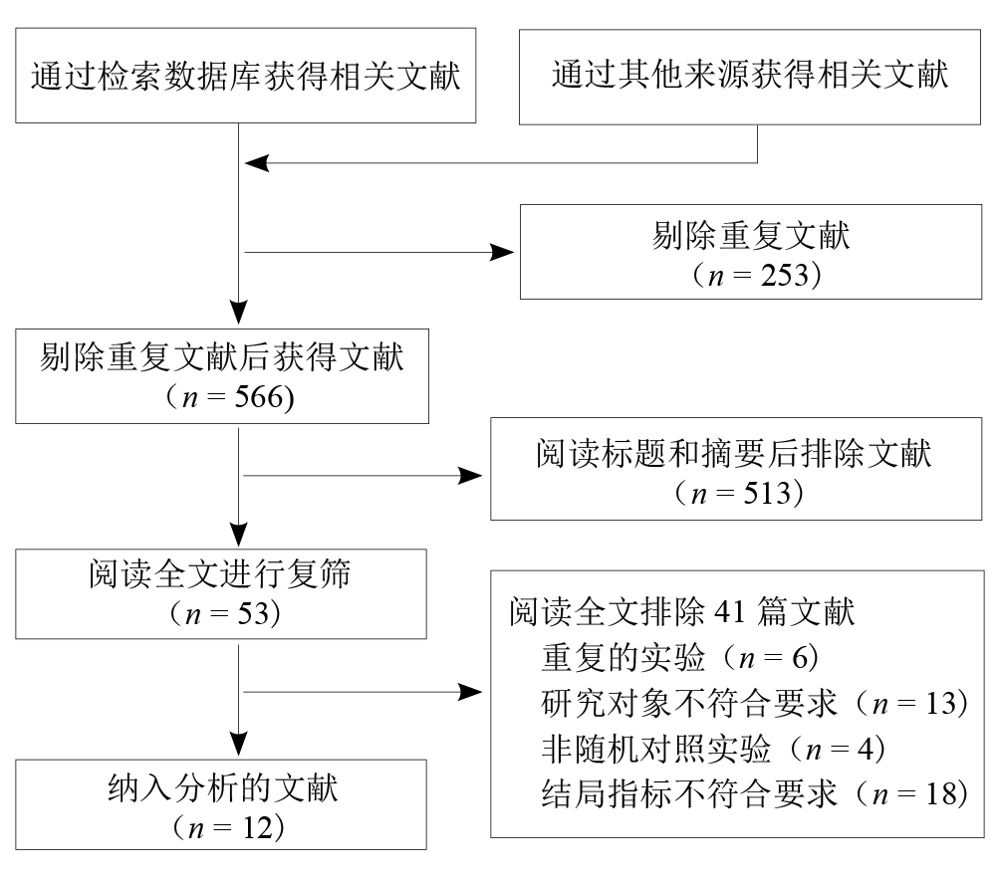
表1
纳入文献的基本特征"
| 纳入研究 | 国家 | 组别 | 年龄/岁 | n(女性) | 干预措施 | 干预时间 | 干预频率 | 随访 时间 | 结局 指标 |
|---|---|---|---|---|---|---|---|---|---|
| Son等[ | 韩国 | 对照组 | 71.5±3.6 | 24(24) | 奥塔戈(平衡再训练和下肢力量训练) | 12周 | 每次60 min,每周2次 | 6个月 | SLS、TUG、FR |
| 试验组 | 72.8±4.7 | 21(21) | 21式改良孙式太极拳 | 12周 | 每次60 min,每周2次 | 6个月 | |||
| Li等[ | 美国 | 对照组 | 77.4±4.95 | 131 | 拉伸控制训练 | 6个月 | 每次60 min,每周3次 | 6个月 | 跌倒发生 |
| 试验组 | 77.4±4.95 | 125 | 杨式太极拳24式 | 6个月 | 每次60 min,每周3次 | 6个月 | |||
| Wolf等[ | 美国 | 对照组 | 76.3±75.1 | 64(49) | 计算机平衡训练 | 15周 | 每次45 min,每周1次 | 4个月 | 跌倒发生 |
| 试验组 | 76.9±74.8 | 72(58) | 太极拳 | 15周 | 每次45 min,每周2次 | 4个月 | |||
| Kim等[ | 韩国 | 对照组 | 71.2±3.6 | 23(23) | 跆拳道 | 12周 | 每次60 min,每周3次 | 12周 | SLS、FR、TUG |
| 试验组 | 70.4±4.5 | 23(23) | 21式改良孙式太极拳 | 12周 | 每次60 min,每周2次 | 12周 | |||
| Li等[ | 美国 | 对照组 | 77.4±4.95 | 131 | 拉伸控制训练 | 6个月 | 每次60 min,每周3次 | 6个月 | FES-I |
| 试验组 | 77.4±4.95 | 125 | 杨式太极拳24式 | 6个月 | 每次60 min,每周3次 | 6个月 | |||
| Yildirim等[ | 土耳其 | 对照组 | 64.4±7.5 | 30(26) | 联合运动处方(步行、下肢肌肉力量和拉伸锻炼) | 12周 | 每次60 min,每周3次 | 12周 | TUG |
| 试验组 | 62.9±6.5 | 30(27) | 杨式太极拳12式 | 12周 | 每次60 min,每周3次 | 12周 | |||
| Pluchino等[ | 美国 | 对照组1 | 76.00±7.74 | 14(9) | 标准化平衡练习计划 | 8周 | 每次60 min,每周2次 | 8周 | FES、FR、TUG、SLS |
| 对照组2 | 70.72±8.46 | 12(8) | Wii Fit游戏(瑜伽、力量训练、有氧运动和平衡游戏) | 8周 | 每次60 min,每周2次 | 8周 | |||
| 试验组 | 69.28±6.03 | 14(8) | 孙式太极拳 | 8周 | 每次60 min,每周2次 | 8周 | |||
| Ni等[ | 美国 | 对照组1 | 77.80±7.78 | 15(13) | 标准平衡项目 | 12周 | 每次60 min,每周2次 | 3个月 | SLS、FR |
| 对照组2 | 73.23±5.09 | 13(10) | 瑜伽 | 12周 | 每次60 min,每周2次 | 3个月 | |||
| 试验组 | 70.27±5.69 | 11(9) | 陈式太极拳 | 12周 | 每次60 min,每周2次 | 3个月 | |||
| Hwang等[ | 中国 | 对照组 | 72.7±8.1 | 175(151) | 下肢训练(拉伸、肌肉强化和平衡训练) | 6个月 | 每次60 min,每周1次 | 12个月 | 跌倒发生、FES-I |
| 试验组 | 72.0±8.1 | 182(153) | 杨式太极拳18式 | 6个月 | 每次60 min,每周1次 | 12个月 | |||
| Zhao等[ | 中国 | 对照组 | 68.8±3.0 | 20(13) | 平衡改善练习计划 | 16周 | 每次90 min,每周3次 | 24周 | FES-I |
| 试验组 | 70.2±3.9 | 20(14) | 杨式太极拳8式 | 16周 | 每次90 min,每周3次 | 24周 | |||
| Zhao等[ | 中国 | 对照组 | 68.8±3.0 | 20(13) | 平衡改善练习计划 | 16周 | 每次90 min,每周3次 | 24周 | TUG |
| 试验组 | 70.2±3.9 | 20(14) | 杨式太极拳8式 | 16周 | 每次90 min,每周3次 | 24周 | |||
| Li[ | 美国 | 对照组 | 76.20±6.3 | 15(12) | 伸展控制训练 | 24周 | 每次60 min,每周3次 | 24周 | 跌倒发生、TUG |
| 试验组 | 76.13±6.2 | 15(9) | 太极拳 | 24周 | 每次60 min,每周3次 | 24周 |

图2
独立文献偏倚风险评估图"


图3
总体文献偏倚风险评估图"
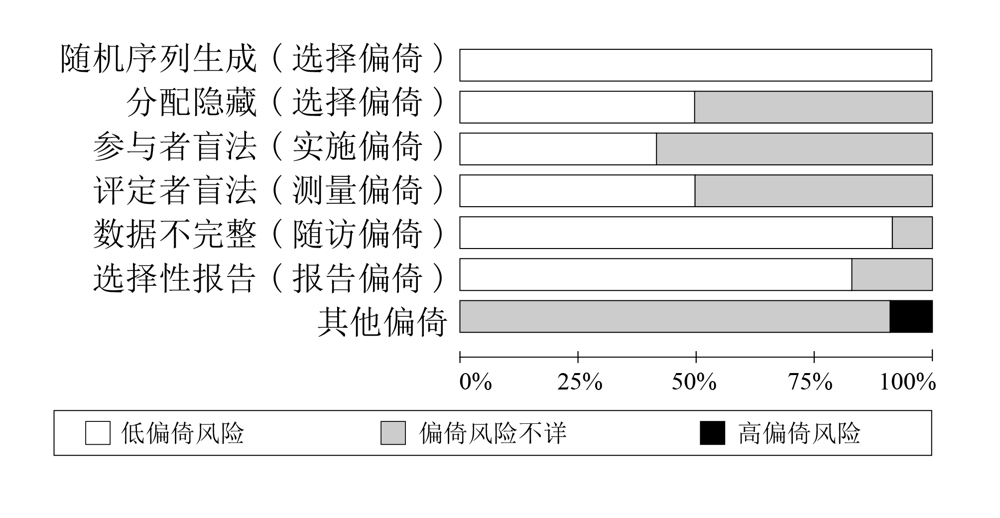

图4
太极拳组和对照组间跌倒发生率的比较"

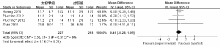
图5
太极拳组和对照组间跌倒恐惧感的比较"


图6
太极拳组和对照组间单腿站立时间的比较"


图7
太极拳组和对照组间计时“起立-行走”测试时间的比较"


图 8
太极拳组和对照组间功能性伸展测试的结果的比较"

| [1] |
RUBENSTEIN L Z. Falls in older people: epidemiology, risk factors and strategies for prevention[J]. Age Ageing, 2006, 35(Suppl 2): ii37-ii41.
doi: 10.1093/ageing/afl084 |
| [2] |
SON N K, RYU Y U, JEONG H W, et al. Comparison of 2 different exercise approaches: Tai Chi versus Otago, in community-dwelling older women[J]. J Geriatr Phys Ther, 2016, 39(2): 51-57.
doi: 10.1519/JPT.0000000000000042 |
| [3] | LI F, HARMER P, FISHER K, et al. Tai Chi: improving functional balance and predicting subsequent falls in older persons[J]. Med Sci Sports Exerc, 2004, 36(12): 2046-2052. |
| [4] |
WOLF S, BARNHART H, KUTNER N, et al. Selected as the best paper in the 1990s: reducing frailty and falls in older persons: an investigation of Tai Chi and computerized balance training[J]. J Am Geriatr Soc, 2003, 51(12): 1794-1803.
pmid: 14687360 |
| [5] |
KIM C, JE H, JEONG H, et al. Effects of Tai Chi versus Taekkyon on balance, lower-extremity strength, and gait ability in community-dwelling older women: a single-blinded randomized clinical trial[J]. J Back Musculoskelet Rehabil, 2020, 33(1): 41-48.
doi: 10.3233/BMR-181493 |
| [6] |
CHEN Y W, HUNT M A, CAMPBELL K L, et al. The effect of Tai Chi on four chronic conditions-cancer, osteoarthritis, heart failure and chronic obstructive pulmonary disease: a systematic review and meta-analyses[J]. Br J Sports Med, 2016, 50(7): 397-407.
doi: 10.1136/bjsports-2014-094388 |
| [7] | CHOO Y T, JIANG Y, HONG J, et al. Effectiveness of Tai Chi on quality of life, depressive symptoms and physical function among community-dwelling older adults with chronic disease: a systematic review and meta-analysis[J]. Int J Nurs Stud, 2020, 111: 103737. |
| [8] |
SONG R, ROBERTS B, LEE E, et al. A randomized study of the effects of Tai Chi on muscle strength, bone mineral density, and fear of falling in women with osteoarthritis[J]. J Altern Complement Med, 2010, 16(3): 227-233.
doi: 10.1089/acm.2009.0165 |
| [9] | HUANG H, LIU C, HUANG Y, et al. Community-based interventions to reduce falls among older adults in Taiwan: long time follow-up randomised controlled study[J]. J Clin Nurs 2010, 19(7-8): 959-968. |
| [10] |
HUANG S, YU X, LU Y, et al. Body weight support-Tai Chi footwork for balance of stroke survivors with fear of falling: a pilot randomized controlled trial[J]. Complement Ther Clin Pract, 2019, 37: 140-147.
doi: 10.1016/j.ctcp.2019.101061 |
| [11] |
LOGGHE I H, VERHAGEN A P, RADEMAKER A C, et al. The effects of Tai Chi on fall prevention, fear of falling and balance in older people: a meta-analysis[J]. Prev Med, 2010, 51(3-4): 222-227.
doi: 10.1016/j.ypmed.2010.06.003 pmid: 20558197 |
| [12] | LI F, FISHER K J, HARMER P, et al. Falls self-efficacy as a mediator of fear of falling in an exercise intervention for older adults[J]. J Gerontol B Psychol Sci Soc Sci, 2005, 60(1): 34-40. |
| [13] |
DAY L, HILL K, STATHAKIS V, et al. Impact of Tai-Chi on falls among preclinically disabled older people. A randomized controlled trial[J]. J Am Med Dir Assoc, 2015, 16(5): 420-426.
doi: 10.1016/j.jamda.2015.01.089 pmid: 25769960 |
| [14] | CHEN X, SAVARESE G, CAI Y, et al. Tai Chi and Qigong practices for chronic heart failure: a systematic review and meta-analysis of randomized controlled trials[J]. Evid Based Complement Alternat Med, 2020, 2020: 2034625. |
| [15] | 曾宪涛, 孙竹, 汤红明. Meta分析系列之十:合格标准的制定[J]. 中国循证心血管医学杂志, 2013, 5(1): 6-9. |
| ZENG X T, SUN Z, TANG H M. Meta-analysis series ten: establishment of eligibility criteria[J]. Chin J Evidence-Based Cardiov Med, 2013, 5(1): 6-9. | |
| [16] |
YILDIRIM P, OFLUOGLU D, AYDOGAN S, et al. Tai Chi vs. combined exercise prescription: a comparison of their effects on factors related to falls[J]. J Back Musculoskelet Rehabil, 2016, 29(3): 493-501.
doi: 10.3233/BMR-150645 |
| [17] | 谷鸿秋, 王杨, 李卫. Cochrane偏倚风险评估工具在随机对照研究Meta分析中的应用[J]. 中国循环杂志, 2014, 29(2): 147-148. |
| GU H Q, WANG Y, LI W. J Chin Circ J, 2014, 29(2): 147-148. | |
| [18] |
PLUCHINO A, LEE S Y, ASFOUR S, et al. Pilot study comparing changes in postural control after training using a video game balance board program and 2 standard activity-based balance intervention programs[J]. Arch Phys Med Rehabil, 2012, 93(7): 1138-1146.
doi: 10.1016/j.apmr.2012.01.023 |
| [19] |
NI M, MOONEY K, RICHARDS L, et al. Comparative impacts of Tai Chi, balance training, and a specially-designed yoga program on balance in older fallers[J]. Arch Phys Med Rehabil, 2014, 95(9): 1620-1628.e30.
doi: 10.1016/j.apmr.2014.04.022 |
| [20] |
HWANG H F, CHEN S J, LEE HSIEH J, et al. Effects of home-based Tai Chi and lower extremity training and self-practice on falls and functional outcomes in older fallers from the emergency department: a randomized controlled trial[J]. J Am Geriatr Society, 2016, 64(3): 518-525.
doi: 10.1111/jgs.13952 |
| [21] | ZHAO Y, CHUNG P, TONG T. Effectiveness of a community-based exercise program on balance performance and fear of falling in older nonfallers at risk for falling: a randomized, controlled study[J]. J Aging Phys Act, 2016, 24(4): 516-524. |
| [22] |
ZHAO Y, CHUNG P, TONG T. Effectiveness of a balance-focused exercise program for enhancing functional fitness of older adults at risk of falling: a randomised controlled trial[J]. Geriatr Nurs, 2017, 38(6): 491-497.
doi: S0197-4572(17)30051-4 pmid: 28359614 |
| [23] |
LI F, HARMER P, VOIT J, et al. Implementing an online virtual falls prevention intervention during a public health pandemic for older adults with mild cognitive impairment: a feasibility trial[J]. Clin Interv Aging, 2021, 16: 973-983.
doi: 10.2147/CIA.S306431 pmid: 34079243 |
| [24] |
WONG A M K, LAN C. Tai Chi and balance control[J]. Med Sport Sci, 2008, 52: 115-123.
doi: 10.1159/000134291 pmid: 18487891 |
| [25] |
TSANG W, HUI-CHAN C. Effect of 4- and 8-wk intensive Tai Chi training on balance control in the elderly[J]. Med Sci Sports Exerc, 2004, 36(4): 648-657.
doi: 10.1249/01.MSS.0000121941.57669.BF |
| [26] | VOELCKER-REHAGE C, GODDE B, STAUDINGER U M. Cardiovascular and coordination training differentially improve cognitive performance and neural processing in older adults[J]. Front Hum Neurosci, 2011, 5: 26. |
| [27] |
CHIESA A, CALATI R, SERRETTI A. Does mindfulness training improve cognitive abilities? A systematic review of neuropsychological findings[J]. Clin Psychol Rev, 2011, 31(3): 449-464.
doi: 10.1016/j.cpr.2010.11.003 pmid: 21183265 |
| [28] | TINETTI M E, RICHMAN D, POWELL L. Falls efficacy as a measure of fear of falling[J]. J Gerontol, 1990, 45(6): 239-243. |
| [29] |
ZHANG J, ISHIKAWA-TAKATA K, YAMAZAKI H, et al. The effects of Tai Chi Chuan on physiological function and fear of falling in the less robust elderly: an intervention study for preventing falls[J]. Arch Gerontol Geriatr, 2006, 42(2): 107-116.
doi: 10.1016/j.archger.2005.06.007 |
| [30] | 李晓军, 陈婷玉, 冯翠娥, 等. 太极拳对老年人单足站立时间影响差异性的Meta分析[J]. 康复学报, 2016, 26(5): 54-58, 62. |
| LI X J, CHEN T Y, FENG C E, et al. A meta-analysis:effect of Tai Chi on single-leg standing time of the elderly[J]. Rehabil Med, 2016, 26(5): 54-58, 62. | |
| [31] | 朱从彬. 太极拳锻炼对老年人步态稳定性的影响[J]. 中国老年学杂志, 2018, 38(6): 1394-1396. |
| ZHU C B. Effects of Tai Chi exercise on gait stability in the elderly[J]. Chin J Gerontol, 2018, 38(6): 1394-1396. | |
| [32] | 赵春艳, 周嫣, 赵慧华, 等. 静态平衡仪用于预测老年人跌倒风险的有效性[J]. 解放军护理杂志, 2017, 34(6): 26-29. |
| ZHAO C Y, ZHOU Y, ZHAO H H, et al. Effectiveness of predicting the risk for fall in elderly using static posturographic balance system[J]. Nurs J Chin PLA, 2017, 34(6): 26-29. | |
| [33] | 陈君, 石凤英, 李泽萍, 等. 预测老年人跌倒危险的平衡和步态功能性评定研究进展[J]. 中国康复医学杂志, 2004, 19(9): 73-75. |
| CHEN J, SHI F Y, LI Z P, et al. Chin J Rehabil Med, 2004, 19(9): 73-75. | |
| [34] |
DUNCAN P W, STUDENSKI S, CHANDLER J, et al. Functional reach: predictive validity in a sample of elderly male veterans[J]. J Gerontol, 1992, 47(3): M93-M98.
doi: 10.1093/geronj/47.3.M93 |
| [35] |
JACOBSON B H, CHEN H C, CASHEL C, et al. The effect of T'ai Chi Chuan training on balance, kinesthetic sense, and strength[J]. Percept Motor Skills, 1997, 84(1): 27-33.
doi: 10.2466/pms.1997.84.1.27 |
| [36] |
LAN C, LAI J S, CHEN S Y, et al. 12-month Tai Chi training in the elderly: its effect on health fitness[J]. Med Sci Sports Exerc, 1998, 30(3): 345-351.
doi: 10.1097/00005768-199803000-00003 |
| [37] |
LI F, HARMER P, FITZGERALD K, et al. Tai chi and postural stability in patients with Parkinson's disease[J]. N Engl J Med, 2012, 366(6): 511-519.
doi: 10.1056/NEJMoa1107911 |
| [38] |
KRASOVSKY T, LEVIN M F. Review: toward a better understanding of coordination in healthy and poststroke gait[J]. Neurorehabil Neural Repair, 2010, 24(3): 213-224.
doi: 10.1177/1545968309348509 pmid: 19822722 |
| [39] |
HALLAL C Z, MARQUES N R, SPINOSO D H, et al. Electromyographic patterns of lower limb muscles during apprehensive gait in younger and older female adults[J]. J Electromyogr Kinesiol, 2013, 23(5): 1145-1149.
doi: 10.1016/j.jelekin.2013.06.006 |
| [40] |
BUSSE M E, WILES C M, VAN DEURSEN R W. Co-activation: its association with weakness and specific neurological pathology[J]. J Neuroeng Rehabil, 2006, 3: 26.
pmid: 17116259 |
| [41] | WAYNE P M, GOW B J, HOU F, et al. Tai Chi training's effect on lower extremity muscle co-contraction during single- and dual-task gait: cross-sectional and randomized trial studies[J]. PLoS One, 2021, 16(1): e0242963. |
| [1] | 梁冠军, 徐欢岚, 张何威, 张大力, 顾琴, 李明娣. 不同视觉输入及任务条件下痉挛型偏瘫儿童平衡与下肢生物力学变化[J]. 《中国康复理论与实践》, 2026, 32(3): 345-355. |
| [2] | 张力引. 帕金森病抑郁及其对认知、平衡功能和生活质量的影响[J]. 《中国康复理论与实践》, 2026, 32(2): 174-180. |
| [3] | 韩雪娇, 史冀鹏, 卫金鹏, 朱天瑞, 徐红旗, 何慕寒. 体力活动和平衡能力与残疾的关联性研究——基于NHANES的横断面研究[J]. 《中国康复理论与实践》, 2026, 32(1): 1-12. |
| [4] | 张季辉, 伊龙悦, 杨远滨. 中老年人平衡功能障碍的相关因素及其与功能性下肢肌力的关联:基于CHARLS数据库的分析[J]. 《中国康复理论与实践》, 2026, 32(1): 13-22. |
| [5] | 岳圆, 张通, 刘元旻, 王亚囡. 下肢外骨骼机器人对卒中后小脑性共济失调患者平衡和步行功能的影响[J]. 《中国康复理论与实践》, 2026, 32(1): 23-29. |
| [6] | 陈俊利, 张晗, 张叶凡, 张艳秋, 高润国, 高倩倩, 蔡伟芹, 李海燕, 嵇丽红, 董志伟, 井淇. 基于老年人整合照护框架构建老年人轻度认知功能障碍社区-家庭管理模式[J]. 《中国康复理论与实践》, 2026, 32(1): 90-100. |
| [7] | 张子昂, 陈静, 沈孟茹, 耿宗晓, 韩雪, 赵旭, 徐磊. 不同运动模式对脑卒中患者步行及平衡功能的效果比较[J]. 《中国康复理论与实践》, 2025, 31(8): 896-905. |
| [8] | 都丽露, 姚仁魁, 赵衍宇, 李孟轩, 邹敏, 张功法. 生命意义感和居住方式在日常生活活动能力对老年人抑郁影响中的效应[J]. 《中国康复理论与实践》, 2025, 31(8): 987-992. |
| [9] | 杜雯倩, 张旭, 陈继伟, 王兴, 朱昆. 运动干预对帕金森病冻结步态效果的Meta分析[J]. 《中国康复理论与实践》, 2025, 31(7): 781-789. |
| [10] | 段林茹, 郑洁皎, 郑拥军, 丁建伟. 老年人与青年人姿势控制能力的差异[J]. 《中国康复理论与实践》, 2025, 31(7): 846-852. |
| [11] | 吴晓晖, 蒋雷, 朱静茹, 解利辉. 深度学习在老年人轻度认知障碍诊断中应用的Scoping综述[J]. 《中国康复理论与实践》, 2025, 31(6): 674-681. |
| [12] | 陈俊利, 张晗, 石志学, 刘亚, 赵盈喆, 董志伟, 嵇丽红, 李海燕, 陈芳芳, 王春平, 马安宁, 井淇. 老年人轻度认知障碍社区识别-干预工具包的研制[J]. 《中国康复理论与实践》, 2025, 31(6): 692-702. |
| [13] | 张勇, 蔡增, 徐凤萍, 刘丹, 常红娟. 音乐治疗对孤独症谱系障碍儿童干预效果的Meta分析[J]. 《中国康复理论与实践》, 2025, 31(4): 423-430. |
| [14] | 苏盼盼, 叶朋, 卢倩, 何川, 陆晓. 视觉剥夺训练联合本体感觉训练对脑卒中偏瘫患者平衡功能的效果[J]. 《中国康复理论与实践》, 2025, 31(3): 254-263. |
| [15] | 林利霞, 曾秋婵, 郭蕴源, 梁荣相, 吴昊, 邵玉萍. 睡眠时长模式对中老年日常生活活动能力的影响[J]. 《中国康复理论与实践》, 2025, 31(3): 331-338. |
| 阅读次数 | ||||||
|
全文 |
|
|||||
|
摘要 |
|
|||||
|
||
