



《中国康复理论与实践》 ›› 2026, Vol. 32 ›› Issue (1): 59-68.doi: 10.3969/j.issn.1006-9771.2026.01.007
高凯祥1, 芦海涛1,2( )
收稿日期:2025-07-25
修回日期:2025-10-02
出版日期:2026-01-25
发布日期:2026-01-28
通讯作者:
芦海涛(1975-),女,博士,主任医师,主要研究方向:神经系统疾病康复。E-mail: 作者简介:高凯祥(1998-),男,汉族,河南三门峡市人,硕士研究生,主要研究方向:生物医学工程。
GAO Kaixiang1, LU Haitao1,2()
Received:2025-07-25
Revised:2025-10-02
Published:2026-01-25
Online:2026-01-28
Contact:
LU Haitao, E-mail: 摘要:
目的 分析近10年神经康复的研究热点及趋势。
方法 检索2015年1月至2024年12月Web of Science核心合集以神经康复为主题的文献。采用Citespace 6.3.R1对文献来源的国家、作者、机构和关键词等进行文献计量分析。
结果 共纳入8 727篇文献,其中来自于中国的有1 117篇。年发文量均呈上升趋势。发文量最多的国家是美国,发文量最多的机构是哈佛大学。全球频次前3的关键词为spinal cord injury、neurological rehabilitation和virtual reality,中国频次前3的关键词为spinal cord injury、ischemic stroke和brain-computer interface。近年全球研究出现的突现词包括functional neurological disorder、artificial intelligence和deep learning,中国研究出现的突现词为neurological function和machine learning。
结论 近10年全球和中国神经康复研究数量持续增长。脑卒中、脊髓损伤、脑外伤和神经退行性疾病等神经系统疾病为该领域研究热点。人工智能、虚拟现实和脑机接口等新技术正在推动神经康复领域发展。
中图分类号:
高凯祥, 芦海涛. 2015年至2024年神经康复研究的文献计量分析[J]. 《中国康复理论与实践》, 2026, 32(1): 59-68.
GAO Kaixiang, LU Haitao. Research in neurorehabilitation from 2015 to 2024: a bibliometric analysis[J]. Chinese Journal of Rehabilitation Theory and Practice, 2026, 32(1): 59-68.
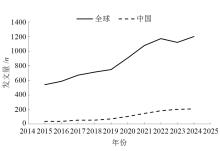
图1
年发文量"
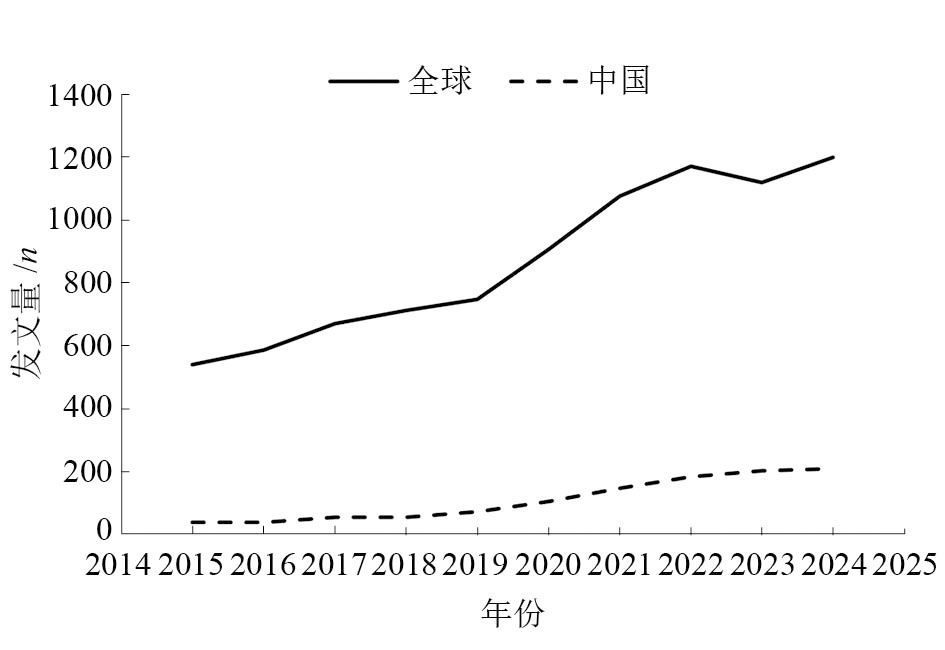
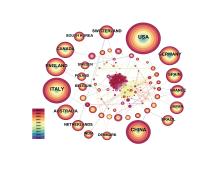
图2
国家共现图"


表1
发文量前10的国家"
| 国家 | 发文量/n | 中心性 |
|---|---|---|
| 美国 | 1931 | 0.00 |
| 意大利 | 1300 | 0.00 |
| 中国 | 1117 | 0.00 |
| 德国 | 711 | 0.00 |
| 英国 | 704 | 0.03 |
| 澳大利亚 | 530 | 0.03 |
| 加拿大 | 530 | 0.05 |
| 西班牙 | 479 | 0.00 |
| 瑞士 | 421 | 0.08 |
| 日本 | 334 | 0.05 |
图3
机构共现图"
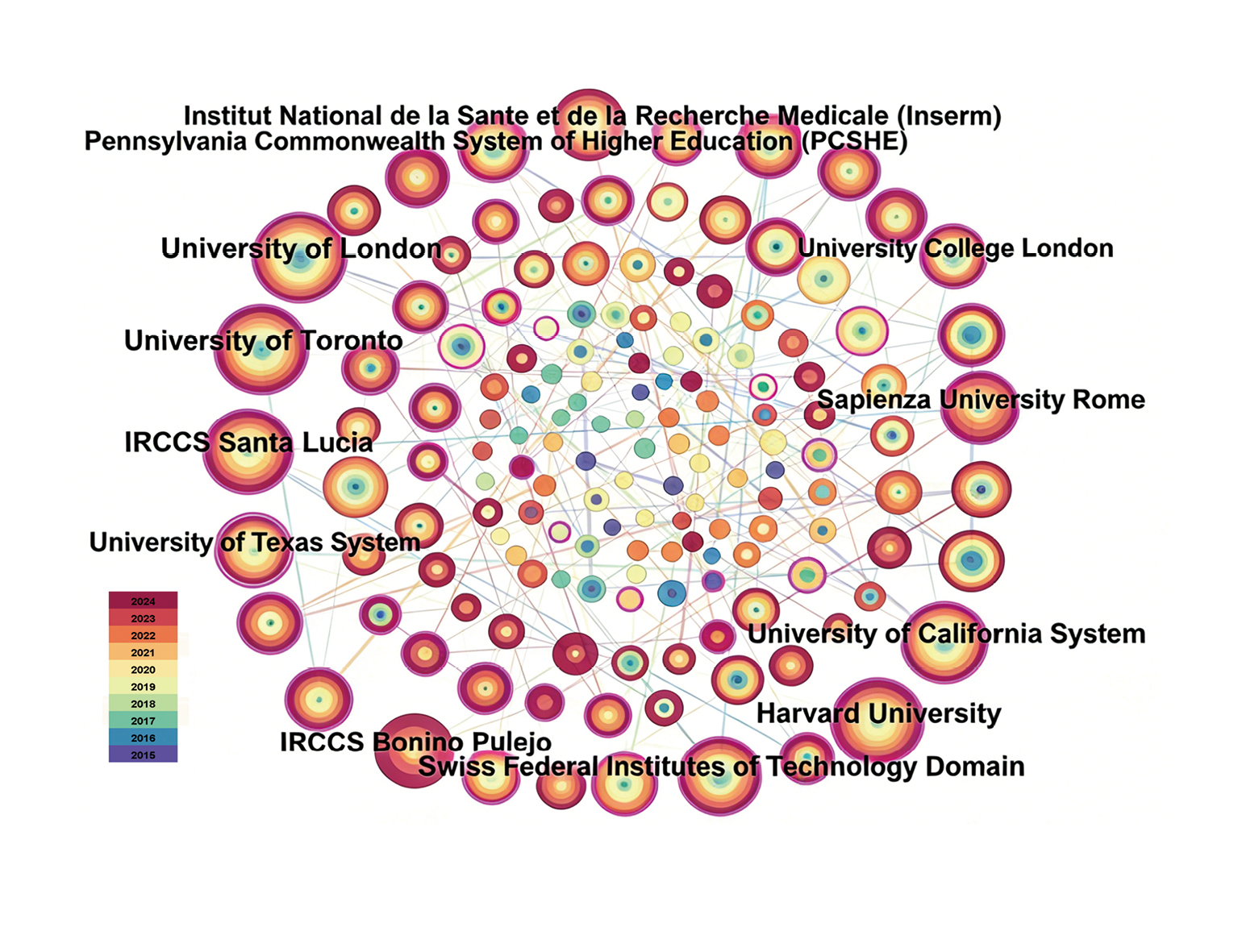
表2
发文量前10的机构"
| 机构 | 发文量/n | 中心性 |
|---|---|---|
| Harvard University | 444 | 0.36 |
| University of London | 184 | 0.16 |
| University of Toronto | 183 | 0.04 |
| IRCCS Santa Lucia | 174 | 0.26 |
| Swiss Federal Institutes of Technology Domain | 152 | 0.59 |
| University of California System | 151 | 0.03 |
| IRCCS Bonino Pulejo | 151 | 0.01 |
| Sapienza University Rome | 139 | 0.00 |
| Institut National de la Sante et de la Recherche Medicale (Inserm) | 130 | 0.01 |
| University of Texas System | 121 | 0.11 |
图4
作者合作网络图谱"
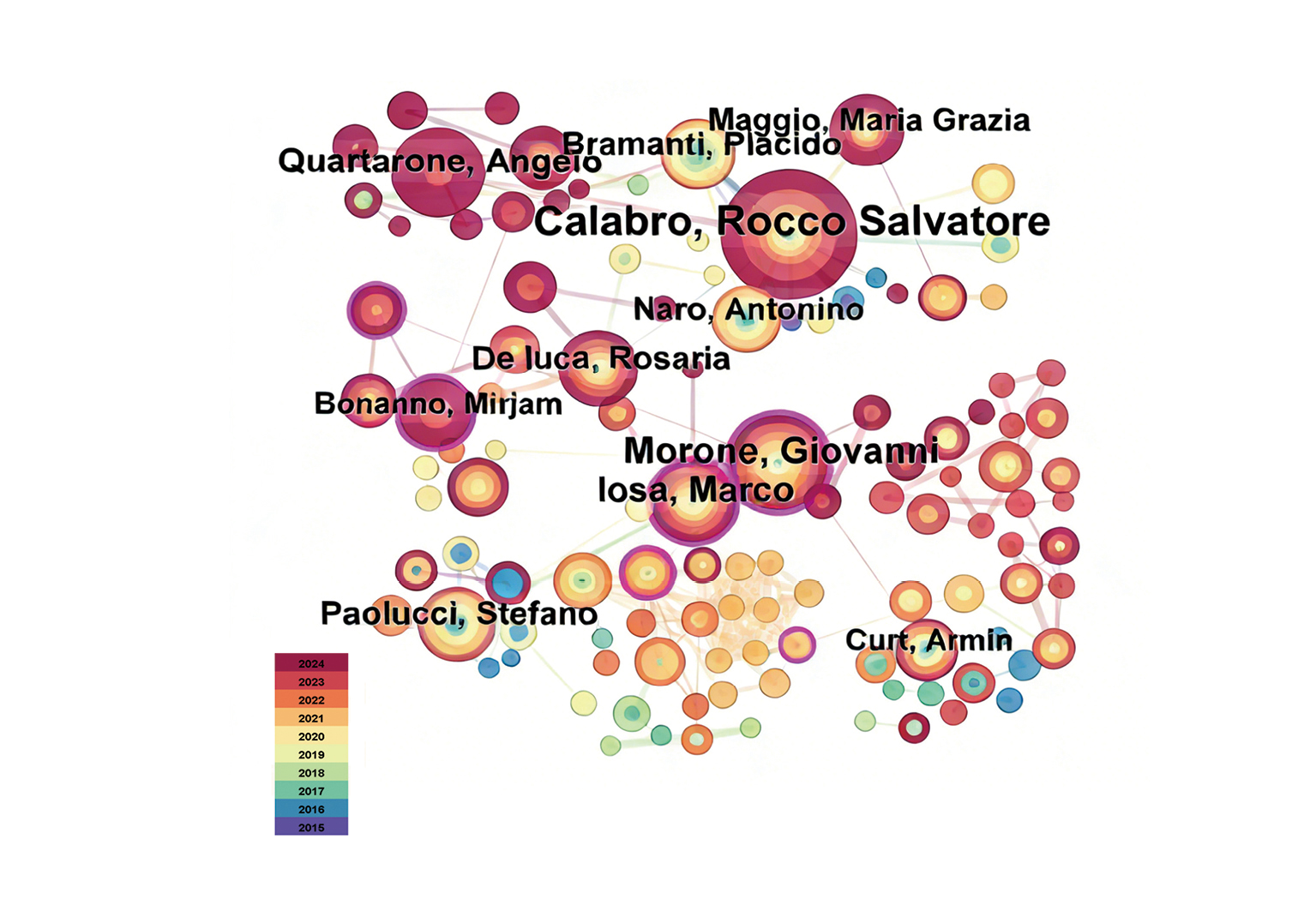
表3
发文量排名前10的作者"
| 作者 | 发文量/n | 中心性 |
|---|---|---|
| Rocco Salvatore Calabrò | 128 | 0.07 |
| Giovanni Morone | 69 | 0.22 |
| Marco Iosa | 58 | 0.10 |
| Angelo Quartarone | 53 | 0.00 |
| Rosaria De Luca | 45 | 0.08 |
| Placido Bramanti | 41 | 0.03 |
| Stefano Paolucci | 40 | 0.04 |
| Marcello Giuseppe Maggio | 36 | 0.01 |
| Antonino Naro | 35 | 0.01 |
| Armin Curt | 33 | 0.06 |
图5
作者共被引共现图"

表4
被引频次前10的作者"
| 作者 | 频次/n | 中心性 |
|---|---|---|
| Gert Kwakkel | 484 | 0.67 |
| Valery L. Feigin | 404 | 0.04 |
| Peter Langhorne | 395 | 0.00 |
| Jan Mehrholz | 348 | 0.29 |
| Richard W. Bohannon | 316 | 0.07 |
| William P. Duncan | 282 | 0.02 |
| Axel R. Fugl-Meyer | 279 | 0.02 |
| John W. Krakauer | 275 | 0.50 |
| John Choen | 267 | 0.02 |
| Bruce H. Dobkin | 266 | 0.06 |
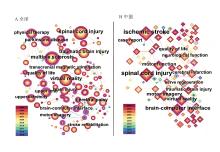
图6
关键词共现网络"
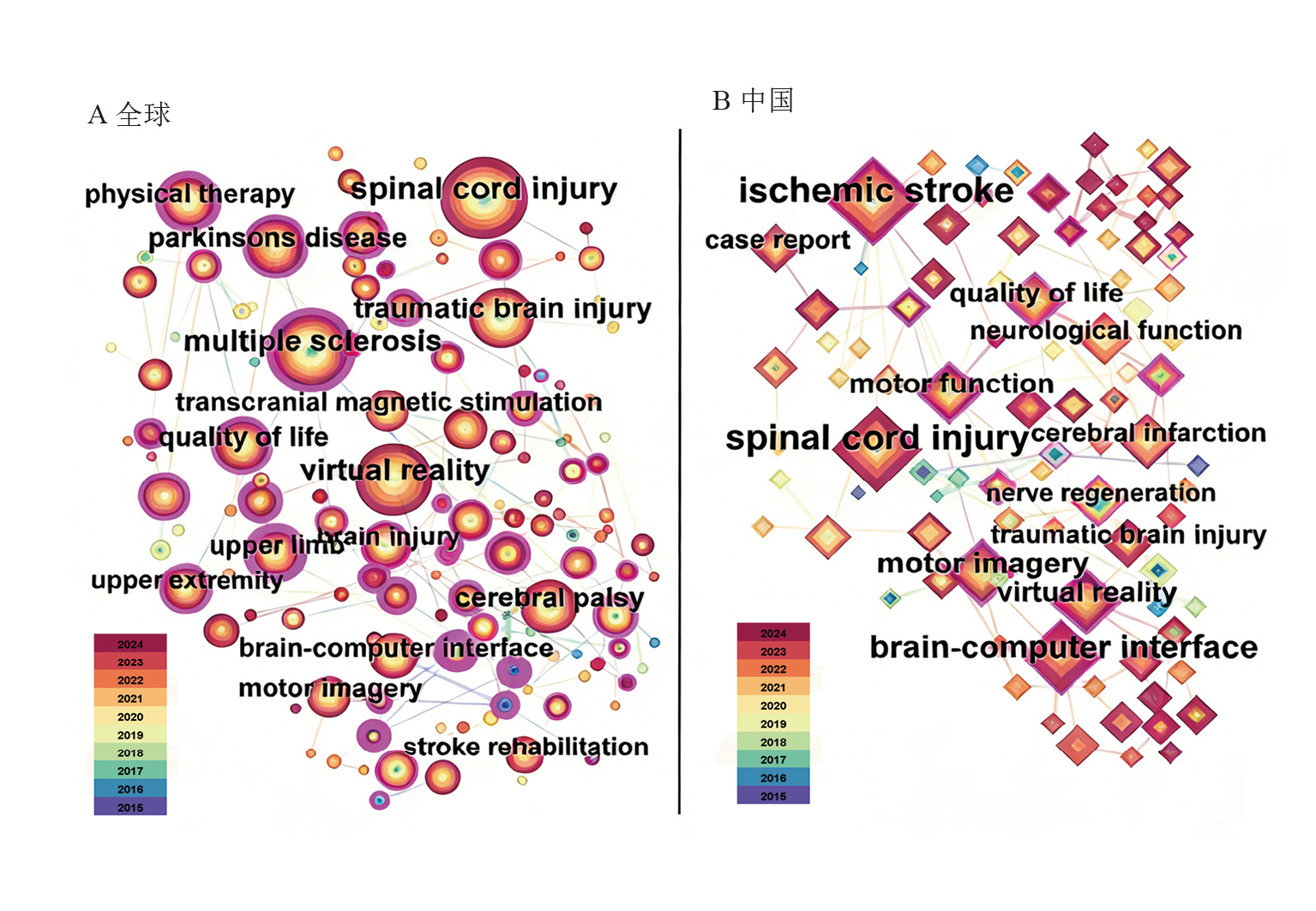
表5
全球词频前10的关键词"
| 关键词 | 频次/n | 中心性 |
|---|---|---|
| spinal cord injury | 391 | 0.00 |
| neurological rehabilitation | 359 | 0.19 |
| virtual reality | 300 | 0.10 |
| multiple sclerosis | 272 | 0.53 |
| traumatic brain injury | 230 | 0.08 |
| Parkinson disease | 178 | 0.31 |
| cerebral palsy | 174 | 0.03 |
| quality of life | 162 | 0.29 |
| physical therapy | 141 | 0.50 |
| brain-computer interface | 136 | 0.03 |
表6
中国词频前10的关键词"
| 关键词 | 频次/n | 中心性 |
|---|---|---|
| spinal cord injury | 50 | 0.07 |
| ischemic stroke | 49 | 0.15 |
| brain-computer interface | 31 | 0.16 |
| motor imagery | 24 | 0.24 |
| virtual reality | 21 | 0.21 |
| motor function | 19 | 0.36 |
| quality of life | 18 | 0.37 |
| cerebral infarction | 16 | 0.03 |
| neurological function | 16 | 0.03 |
| traumatic brain injury | 15 | 0.00 |
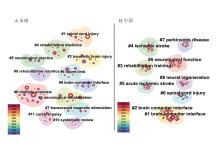
图7
关键词聚类图"
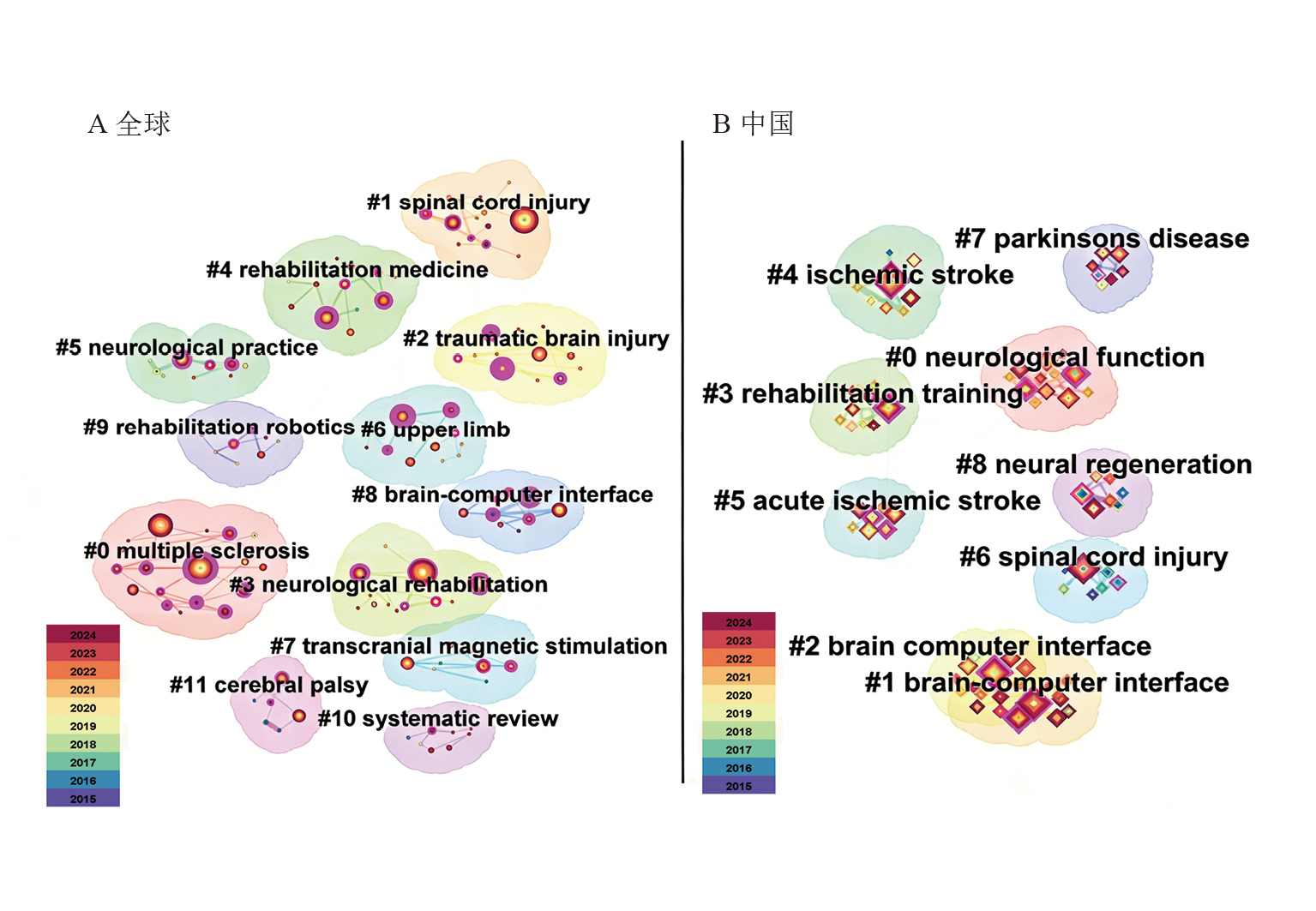
表7
全球关键词聚类表"
| 聚类号 | 节点数/n | 轮廓值 | 主要关键词 |
|---|---|---|---|
| #0 | 19 | 0.920 | virtual reality; cognitive rehabilitation; robot-aided gait training |
| #1 | 14 | 1.000 | spinal cord injury; motor control; traumatic brain injury; Parkinson disease |
| #2 | 13 | 0.915 | traumatic brain injury; vegetative state; locked-in syndrome |
| #3 | 13 | 0.933 | neurological rehabilitation; postural balance; exercise therapy; assistive devices |
| #4 | 12 | 1.000 | rehabilitation medicine; neurological injury; physical therapy modalities |
| #5 | 12 | 0.981 | occupational therapy; neurological practice; long-term conditions |
| #6 | 11 | 0.918 | ischemic stroke; interhemispheric inhibition; parvalbumin neurons |
| #7 | 9 | 1.000 | transcranial magnetic stimulation; transcranial direct current stimulation |
| #8 | 10 | 0.766 | brain-computer interface |
| #9 | 9 | 0.964 | rehabilitation robotics; task analysis; brain-computer interface |
| #10 | 8 | 0.851 | systematic review; health-related quality; Huntington disease |
| #11 | 7 | 0.850 | cerebral palsy; brain injury; best evidence synthesis; psychometric properties |
表8
中国关键词聚类表"
| 聚类号 | 节点数/n | 轮廓值 | 主要关键词 |
|---|---|---|---|
| #0 | 12 | 0.861 | neurological function; intracerebral hemorrhage; multiple sclerosis |
| #1、#2 | 22 | 1.000 | motor imagery; transfer learning; common spatial patterns |
| #3 | 10 | 0.931 | motor function; cerebellar stimulation; shoulder-hand syndrome; parallel robots |
| #4 | 8 | 1.000 | ischemic stroke; blood-brain barrier; transient middle cerebral artery occlusion |
| #5 | 8 | 0.835 | acute ischemic stroke; orthogonal design; program optimization |
| #6 | 8 | 0.955 | spinal cord injury; neuronal damage; extracellular vesicles; axonal regeneration |
| #7 | 7 | 0.931 | Alzheimer's disease; cognitive function; epigenetic regulation; neuronal plasticity |
| #8 | 7 | 0.900 | nerve regeneration; protein kinase; glycogen synthase; treadmill training |
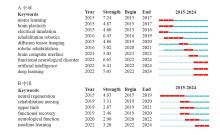
图8
关键词突现图谱"

| [1] | BRADNAM L V, MEIRING R M, BOYCE M, et al. Neurorehabilitation in dystonia: a holistic perspective[J]. J Neural Transm (Vienna), 2021, 128(4): 549-558. |
| [2] |
MARQUES S, VAUGHAN-GRAHAM J, COSTA R, et al. The Bobath concept (NDT) in adult neurorehabilitation: a scoping review of conceptual literature[J]. Disabil Rehabil, 2025, 47(6): 1379-1390.
doi: 10.1080/09638288.2024.2375054 |
| [3] |
HUNTER H, QIN E, WALLINGFORD A, et al. Neurorehabilitation for adults with brain and spine tumors[J]. Semin Neurol, 2024, 44(1): 64-73.
doi: 10.1055/s-0043-1777407 pmid: 38049116 |
| [4] |
LEVIN M F, PISCITELLI D. Motor control: a conceptual framework for rehabilitation[J]. Motor Control, 2022, 26(4): 497-517.
doi: 10.1123/mc.2022-0026 |
| [5] |
DUAN H, JING Y, LI Y, et al. Rehabilitation treatment of multiple sclerosis[J]. Front Immunol, 2023, 14: 1168821.
doi: 10.3389/fimmu.2023.1168821 |
| [6] |
BOYNE P, BILLINGER S A, REISMAN D S, et al. Optimal intensity and duration of walking rehabilitation in patients with chronic stroke: a randomized clinical trial[J]. JAMA Neurol, 2023, 80(4): 342-351.
doi: 10.1001/jamaneurol.2023.0033 pmid: 36822187 |
| [7] |
KHAN M A, FARES H, GHAYVAT H, et al. A systematic review on functional electrical stimulation based rehabilitation systems for upper limb post-stroke recovery[J]. Front Neurol, 2023, 14: 1272992.
doi: 10.3389/fneur.2023.1272992 |
| [8] |
MAGGIO M G, DE BARTOLO D, CALABRO R S, et al. Computer-assisted cognitive rehabilitation in neurological patients: state-of-art and future perspectives[J]. Front Neurol, 2023, 14: 1255319.
doi: 10.3389/fneur.2023.1255319 |
| [9] |
GAKHAR H, KHURANA K, KATARIA D C. Tele-rehabilitation in ankylosing spondylitis: current evidence and future directions in remote physiotherapy[J]. Musculoskeletal Care, 2025, 23(2): e70144.
doi: 10.1002/msc.v23.2 |
| [10] |
LLAMAS-RAMOS R, SANCHEZ-GONZALEZ J L, LLAMAS-RAMOS I. Robotic systems for the physiotherapy treatment of children with cerebral palsy: a systematic review[J]. Int J Environ Res Public Health, 2022, 19(9): 5116.
doi: 10.3390/ijerph19095116 |
| [11] | COLOMBO R, PISANO F, DELCONTE C, et al. Comparison of exercise training effect with different robotic devices for upper limb rehabilitation: a retrospective study[J]. Eur J Phys Rehabil Med, 2017, 53(2): 240-248. |
| [12] |
谌小猛, 滕腾, 董晶, 等. 近20年国际视力障碍领域定向行走研究的文献计量分析[J]. 中国康复理论与实践, 2024, 30(10): 1151-1159.
doi: 10.3969/j.issn.1006-9771.2024.10.005 |
| CHEN X M, TENG T, DONG J, et al. International researches on orientation and mobility for visual impairments in the last two decades: a bibliometrics analysis[J]. Chin J Rehabil Theory Pract, 2024, 30(10): 1151-1159. | |
| [13] |
ZHANG Y, TANG Y W, PENG Y T, et al. Acupuncture, an effective treatment for post-stroke neurologic dysfunction[J]. Brain Res Bull, 2024, 215: 111035.
doi: 10.1016/j.brainresbull.2024.111035 |
| [14] |
WANG J, LI Y, QI L, et al. Advanced rehabilitation in ischaemic stroke research[J]. Stroke Vasc Neurol, 2024, 9(4): 328-343.
doi: 10.1136/svn-2022-002285 |
| [15] | «中国脑卒中防治报告2020»编写组. «中国脑卒中防治报告2020»概要[J]. 中国脑血管病杂志, 2022, 19(2): 136-144. |
| Report on Stroke Prevention and Treatment in China Writing Group. Brief report on stroke prevention and treatment in China, 2020[J]. Chin J Cerebrovasc Dis, 2022, 19(2): 136-144. | |
| [16] |
MARKUS H S, MICHEL P. Treatment of posterior circulation stroke: acute management and secondary prevention[J]. Int J Stroke, 2022, 17(7): 723-732.
doi: 10.1177/17474930221107500 |
| [17] | 宋子伟, 张梅, 王志会, 等. 大数据背景下的脑卒中疾病负担研究方法概述[J]. 中华流行病学杂志, 2021, 42(9): 1695-1699. |
| SONG Z W, ZHANG M, WANG Z H, et al. Summary of research methods of stroke disease burden in big data era[J]. Chin J Epidemiol, 2021, 42(9): 1695-1699. | |
| [18] |
SHI C, CHEN Y, YE L, et al. Transcutaneous spinal cord stimulation on motor function in patients with spinal cord injury: a meta-analysis[J]. NeuroRehabilitation, 2024, 54(4): 563-573.
doi: 10.3233/NRE-240057 pmid: 38943403 |
| [19] |
MCDONALD J W, SADOWSKY C. Spinal-cord injury[J]. Lancet, 2002, 359(9304): 417-425.
doi: 10.1016/S0140-6736(02)07603-1 pmid: 11844532 |
| [20] |
KALRA S, MALIK R, SINGH G, et al. Pathogenesis and management of traumatic brain injury (TBI): role of neuroinflammation and anti-inflammatory drugs[J]. Inflammopharmacology, 2022, 30(4): 1153-1166.
doi: 10.1007/s10787-022-01017-8 pmid: 35802283 |
| [21] |
YANG Y, YANG H, YANG Y, et al. Exosomal microRNAs have great potential in the neurorestorative therapy for traumatic brain injury[J]. Exp Neurol, 2022, 352: 114026.
doi: 10.1016/j.expneurol.2022.114026 |
| [22] | 中华医学会神经病学分会神经免疫学组. 多发性硬化诊断与治疗中国指南(2023版)[J]. 中华神经科杂志, 2024, 57(1): 10-23. |
| Chinese Society of Neuroimmunology. Chinese guidelines for diagnosis and treatment of multiple sclerosis (2023 edition)[J]. Chin J Neurology, 2024, 57(1): 10-23. | |
| [23] |
WANG Y, WANG J, FENG J. Multiple sclerosis and pregnancy: pathogenesis, influencing factors, and treatment options[J]. Autoimmun Rev, 2023, 22(11): 103449.
doi: 10.1016/j.autrev.2023.103449 |
| [24] |
GORIS A, VANDEBERGH M, MCCAULEY J L, et al. Genetics of multiple sclerosis: lessons from polygenicity[J]. Lancet Neurol, 2022, 21(9): 830-842.
doi: 10.1016/S1474-4422(22)00255-1 pmid: 35963264 |
| [25] |
LANGESKOV-CHRISTENSEN M, FRANZEN E, GRONDAH-HVID L, et al. Exercise as medicine in Parkinson's disease[J]. J Neurol Neurosurg Psychiatry, 2024, 95(11): 1077-1088.
doi: 10.1136/jnnp-2023-332974 |
| [26] |
LI K P, WU J J, ZHOU Z L, et al. Noninvasive brain stimulation for neurorehabilitation in post-stroke patients[J]. Brain Sci, 2023, 13(3): 451.
doi: 10.3390/brainsci13030451 |
| [27] |
COLUCCI A, VERMEHREN M, CAVALLO A, et al. Brain-computer interface-controlled exoskeletons in clinical neurorehabilitation: ready or not?[J]. Neurorehabil Neural Repair, 2022, 36(12): 747-756.
doi: 10.1177/15459683221138751 |
| [28] |
CHEN J, OR C K, CHEN T. Effectiveness of using virtual reality-supported exercise therapy for upper extremity motor rehabilitation in patients with stroke: systematic review and meta-analysis of randomized controlled trials[J]. J Med Internet Res, 2022, 24(6): e24111.
doi: 10.2196/24111 |
| [29] |
MA Z Z, WU J J, CAO Z, et al. Motor imagery-based brain-computer interface rehabilitation programs enhance upper extremity performance and cortical activation in stroke patients[J]. J Neuroeng Rehabil, 2024, 21(1): 91.
doi: 10.1186/s12984-024-01387-w |
| [30] |
JURCAU A, ARDELEAN A I. Oxidative stress in ischemia/reperfusion injuries following acute ischemic stroke[J]. Biomedicines, 2022, 10(3): 574.
doi: 10.3390/biomedicines10030574 |
| [31] |
ZHANG H, ZHANG Z, LIN H. Research progress on the reduced neural repair ability of aging Schwann cells[J]. Front Cell Neurosci, 2023, 17: 1228282.
doi: 10.3389/fncel.2023.1228282 |
| [32] |
CLIFFORD T, FINKEL Z, RODRIGUEZ B, et al. Current advancements in spinal cord injury research-glial scar formation and neural regeneration[J]. Cells, 2023, 12(6): 853.
doi: 10.3390/cells12060853 |
| [33] |
向松柏, 周雯慧, 王崇高. 2004年至2024年机器人在孤独症谱系障碍儿童康复中应用的文献计量分析[J]. 中国康复理论与实践, 2025, 31(2): 158-164.
doi: 10.3969/j.issn.1006-9771.2025.02.005 |
| XIANG S B, ZHOU W H, WANG C G. Application of robots in rehabilitation of children with autism spectrum disorder from 2004 to 2024: a bibliometrics analysis[J]. Chin J Rehabil Theory Pract, 2025, 31(2): 158-164. | |
| [34] | 孟丽君, 李义庭, 孙莹炜, 等. 人工智能在康复领域研究应用的伦理审视[J]. 中国医学伦理学, 2025, 38(2): 166-172. |
| MENG L J, LI Y T, SUN Y W, et al. Ethical examination of the research and application of artificial intelligence in the field of rehabilitation[J]. Chin Med Ethics, 2025, 38(2): 166-172. | |
| [35] | 李金峰, 郑子微, 张元鸣飞, 等. 人工神经网络在康复评定中的应用进展[J]. 中国康复医学杂志, 2020, 35(12): 1527-1531. |
| LI J F, ZHENG Z W, ZHANG Y M F, et al. Progress in the application of artificial neural net-works in rehabilitation assessment[J]. Chin J Rehabil Med, 2020, 35(12): 1527-1531. |
| [1] | 朱丽丽, 赵嘉欣, 程雪, 王会娟, 陈小霞. 康复期脑卒中患者疾病体验及需求的Meta整合[J]. 《中国康复理论与实践》, 2026, 32(3): 286-293. |
| [2] | 刘平, 周楠, 薛晓杰, 邵伟波. 脑卒中后吞咽障碍康复治疗技术应用研究的文献计量分析[J]. 《中国康复理论与实践》, 2026, 32(3): 294-303. |
| [3] | 蒲心语, 王靖萱, 王虎军, 修安达, 王颖鹏. 重复外周磁刺激在康复治疗中应用的文献计量分析[J]. 《中国康复理论与实践》, 2026, 32(3): 304-316. |
| [4] | 孙奎, 黄海伦, 刘永皑, 高恒. 脑机接口技术在脊髓损伤治疗领域的文献计量分析[J]. 《中国康复理论与实践》, 2026, 32(3): 317-328. |
| [5] | 杨玲, 王庆雷, 王洁, 徐雯婕, 王彤, 郭川, 钱雪. 基于功能性近红外光谱成像的卒中后焦虑患者前额叶皮质激活特征及机制研究[J]. 《中国康复理论与实践》, 2026, 32(3): 329-336. |
| [6] | 何照楠, 张婷婷, 何照珂, 孟丽君. 基于BERTopic模型的我国康复伦理研究主题挖掘与内容分析[J]. 《中国康复理论与实践》, 2026, 32(2): 132-141. |
| [7] | 郭亚彬, 曾必云, 周阳. 2015年至2025年肌少症-疼痛共病研究的文献计量分析[J]. 《中国康复理论与实践》, 2026, 32(2): 151-161. |
| [8] | 李水艳, 李湘, 李彦慧, 陆翊濛, 李杜娟, 杨小良, 谢秋幼. 气道廓清技术在重症康复应用的文献计量分析[J]. 《中国康复理论与实践》, 2026, 32(2): 162-173. |
| [9] | 岳圆, 张通, 刘元旻, 王亚囡. 下肢外骨骼机器人对卒中后小脑性共济失调患者平衡和步行功能的影响[J]. 《中国康复理论与实践》, 2026, 32(1): 23-29. |
| [10] | 吴澄, 章云枫, 王卫宁, 余克威, 张艳正, 沈嘉蓉, 吴毅. 肘腕功能支具对脑卒中偏瘫患者足底压力和平衡功能的效果[J]. 《中国康复理论与实践》, 2026, 32(1): 30-39. |
| [11] | 张军风, 陈昊, 杜宇征, 李琛, 于涛, 杨元庆. 2004年至2024年脑卒中后肢体痉挛非药物疗法的文献计量分析[J]. 《中国康复理论与实践》, 2026, 32(1): 45-58. |
| [12] | 董丽军, 徐世豪, 陈秋华, 张璐, 尹小兵. 2015年至2025年虚拟现实技术在围术期患者负性情绪管理及术后康复中应用的文献计量分析[J]. 《中国康复理论与实践》, 2026, 32(1): 69-82. |
| [13] | 王潇婧, 魏婧怡, 卫晨, 王冉, 马赛, 刘西花. 针刺同步构音训练对脑卒中后痉挛型构音障碍的效果[J]. 《中国康复理论与实践》, 2025, 31(9): 1009-1016. |
| [14] | 周新悦, 叶睿雪, 马雅琦, 许莹, 曹珑耀, 王玉龙. 卒中后中枢性疼痛相关研究的文献计量分析[J]. 《中国康复理论与实践》, 2025, 31(9): 1038-1049. |
| [15] | 高云汉, 侯闪闪, 汪鑫煜, 朱崇田. 基于功能性近红外光谱探讨脑机接口对脑卒中患者上肢运动功能障碍的效果[J]. 《中国康复理论与实践》, 2025, 31(9): 1066-1073. |
| 阅读次数 | ||||||
|
全文 |
|
|||||
|
摘要 |
|
|||||
|
||
