



《中国康复理论与实践》 ›› 2026, Vol. 32 ›› Issue (4): 426-436.doi: 10.3969/j.issn.1006-9771.2026.04.006
车蕊芯1, 唐永甜1, 潘世琴1( ), 童雅倩2
收稿日期:2025-07-29
修回日期:2026-01-07
出版日期:2026-04-25
发布日期:2026-05-06
通讯作者:
潘世琴,E-mail: 289662520@qq.com作者简介:车蕊芯(1992-),女,汉族,青海西宁市人,硕士研究生,主要研究方向:康复护理、肺康复和呼吸康复。基金资助:
CHE Ruixin1, TANG Yongtian1, PAN Shiqin1(), TONG Yaqian2
Received:2025-07-29
Revised:2026-01-07
Published:2026-04-25
Online:2026-05-06
Contact:
PAN Shiqin,E-mail: 289662520@qq.comSupported by:摘要:
目的 探讨经皮穴位电刺激(TEAS)对慢性阻塞性肺疾病(COPD)肺功能、运动耐力和临床症状的干预效果。
方法 系统检索中国知网、万方数据库、维普、中国生物医学文献服务系统、PubMed、Embase和Cochrane Library中关于TEAS对COPD干预效果的随机对照试验(RCT),检索期限从建库至2025年3月。由2名研究人员独立筛选文献和提取资料,采用Cochrane评价手册5.1.0版RCT偏倚风险评估工具和PEDro量表对纳入文献进行质量评价。采用RevMan 5.4进行统计学分析。
结果 共纳入11篇文献,涉及542例患者。PEDro量表评分5~9分。TEAS显著改善第1秒用力呼气容积(FEV1) (MD = 0.19, 95%CI 0.08~0.29, P < 0.001),FEV1与用力肺活量比值(MD = 5.15, 95%CI 4.21~6.09, P < 0.001),FEV1占预计值百分比(MD = 8.46, 95%CI 5.71~11.22, P < 0.001),呼气峰流速(MD = 0.18, 95%CI 0.05~0.31, P = 0.006),COPD评估测试评分(MD = -3.60, 95%CI -4.81~-2.40, P < 0.001);6分钟步行测试距离虽有增加(MD = 25.97, 95%CI 7.88~44.05, P = 0.005),但在敏感性分析后未达最小临床阈值。亚组分析显示,多穴位联合干预效果优于单一穴位(MD = 0.29 vs. 0.12),干预1~2周效果最佳(MD = 0.37)。TEAS联合常规药物或运动训练具有协同增强作用。
结论 TEAS有助于改善COPD患者的肺功能和临床症状。TEAS与常规干预联合应用具有协同增强作用。
中图分类号:
车蕊芯, 唐永甜, 潘世琴, 童雅倩. 经皮穴位电刺激对慢性阻塞性肺疾病效果的Meta分析[J]. 《中国康复理论与实践》, 2026, 32(4): 426-436.
CHE Ruixin, TANG Yongtian, PAN Shiqin, TONG Yaqian. Effect of transcutaneous electrical acupoint stimulation on chronic obstructive pulmonary disease: a meta-analysis[J]. Chinese Journal of Rehabilitation Theory and Practice, 2026, 32(4): 426-436.

表1
PICO架构"
| 人群(Population) | 干预(Intervention) | 比较(Comparison) | 结局(Outcome) |
|---|---|---|---|
| COPD患者 年龄不限 疾病分级不限 | TEAS治疗包括: 单一穴位电刺激 多穴位联合电刺激 干预时长不限 刺激参数不限 | 假刺激:在相同穴位部位贴电极但不通电流,告知患者操作可能无特殊感觉 单纯常规药物治疗:支气管扩张剂、糖皮质激素、抗生素等 联合运动训练对照:TEAS联合下肢运动训练 vs. 单纯下肢运动训练 | 肺功能指标:FEV1、FEV1/FVC、FEV1%、PEF 运动耐力:6MWT距离 临床症状:CAT评分 |
图1
文献筛选流程图"
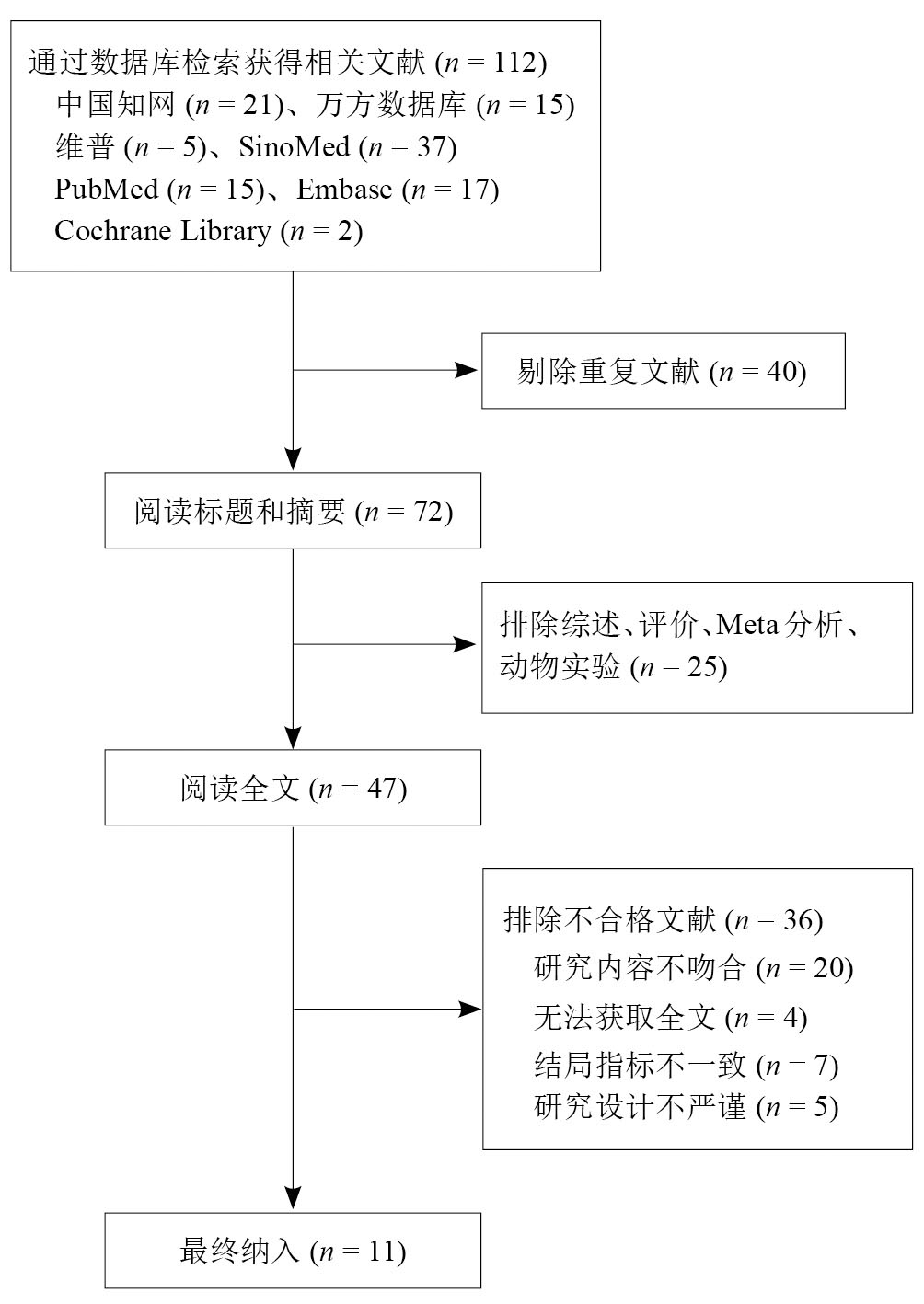
表2
纳入文献基本特征"
| 纳入文献 | 疾病分期 | 性别(男/女)/n | 年龄/岁 | 对照组措施 | 试验组措施 | 干预参数 | 结局指标 | ||
|---|---|---|---|---|---|---|---|---|---|
| C | T | C | T | ||||||
| 寿依群等[ | 稳定期 | 4/11 | 6/9 | 70.0 ±9.2 | 68.3 ±10.2 | 同穴位贴电极但不通电流+常规治疗 | TEAS肺俞穴 | 频率:4 Hz 波宽:200 μs 强度:患者可耐受最大值 频次:每次40 min,每天1次,共4周 | ①②③ |
| 李姝等[ | 稳定期 | 17/13 | 20/13 | 61.29 ±7.12 | 62.38 ±7.52 | 同穴位贴电极但不通电流+常规治疗 | TEAS肺俞、肾俞、定喘、足三里 | 频率:2 Hz 频次:每次40 min,隔天1次,共4周 | ②④⑤⑥ |
| 王芳等[ | 急性加重期 | 19/16 | 18/17 | 62.36 ±8.69 | 63.97 ±8.61 | 单纯常规药物治疗(支气管扩张剂、糖皮质激素等) | TEAS丰隆、足三里、肺俞、脾俞、膻中、大椎、太渊、定喘、中府 | 强度:局部肌肉轻度跳动患者可耐受 频次:每次30 min,每天1次,连续7 d | ①④ |
| 谷静等[ | 稳定期 | 15/15 | 17/13 | 59.57 ±4.98 | 61.23 ±5.72 | 下肢运动训练每次30 min,每周3次,共4周 | TEAS定喘、肺俞、肾俞、足三里,下肢运动训练同对照组 | 频率:2 Hz 强度:患者可耐受最大值 频次:每次40 min,每周3次,共4周 | ①④⑤⑥ |
| 谢德娟等[ | 稳定期 | 20/15 | 24/11 | 63.5 ±12.4 | 63.5 ±10.7 | 肺俞、中府相邻区域给予TEAS+常规治疗 | TEAS肺俞、中府 | 频率:100 Hz 波宽:200 μs 强度:患者可耐受最大值 频次:每次20 min,每天1次,连续10 d | ①④⑤ |
| Lau等[ (2008) | 稳定期 | 12/11 | 19/4 | 73.7 ±6.8 | 77.5 ±6.5 | 同穴位贴电极但不通电流+常规治疗 | TEAS定喘穴 | 频率:4 Hz 脉宽:200 μs 强度:患者可耐受最大值 频次:每次45 min,单次 | ① |
| Fernández-Jané等[ | 急性加重期 | 6/2 | 5/6 | 71.3 ±3.4 | 62.4 ±7.7 | 同穴位贴电极但不通电流+常规治疗 | TEAS定喘穴 | 频率:2 Hz 脉宽:200 μs 强度:患者可耐受最大值 频次:每次45 min,每天1次,至出院 | ③ |
| Jones等[ (2011) | 稳定期 | 14/8 | 11/11 | 69.3 ±2.4 | 69.0 ±2.3 | 同穴位贴电极但不通电流+常规治疗 | TEAS定喘穴 | 频率:2 Hz 脉宽:200 μs 频次:每次45 min,单次 | ①③ |
| Ngai等[ (2010) | 稳定期 | 10/0 | 9/1 | 69.7 ±2.4 | 73.8 ±2.0 | 同穴位贴电极但不通电流+常规治疗 | TEAS定喘穴 | 频率:2 Hz 脉宽:200 μs 频次:每次45 min,每天1次,共4周 | ①⑤ |
| Liu等[ | 稳定期 | 15/10 | 10/15 | 66.4 ±9.36 | 66.04 ±8.815 | 多穴位贴电极但不通电+常规治疗 | TEAS肺俞、肾俞、定喘、足三里 | 频率:2 Hz 频次:每次40 min,每2天1次,共4周 | ②⑤⑥ |
| Öncü等[ | 急性加重期 | 26/9 | 28/7 | 66.5 ±5.8 | 66.9 ±6.2 | 同穴位贴电极但不通电流+常规治疗 | TEAS定喘、列缺穴 | 频率:4 Hz 脉宽:200 μs 强度:患者可耐受最大值 频次:每次45 min,每天1次,共20次 | ① |
图2
偏倚风险图"
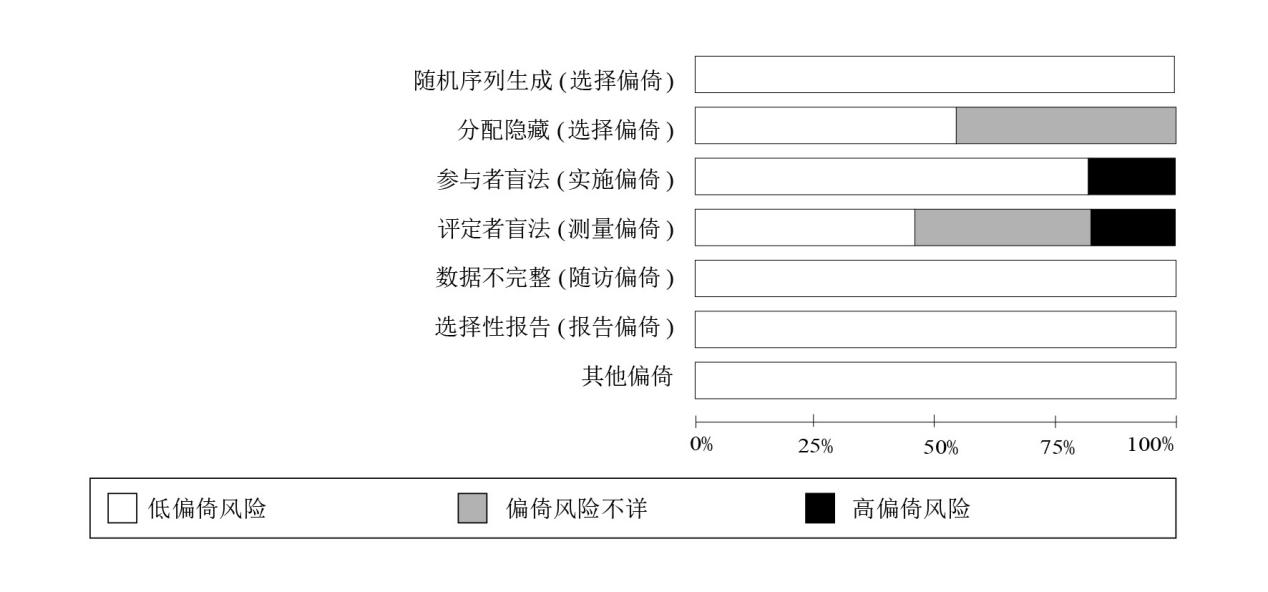
图3
纳入文献偏倚评估"
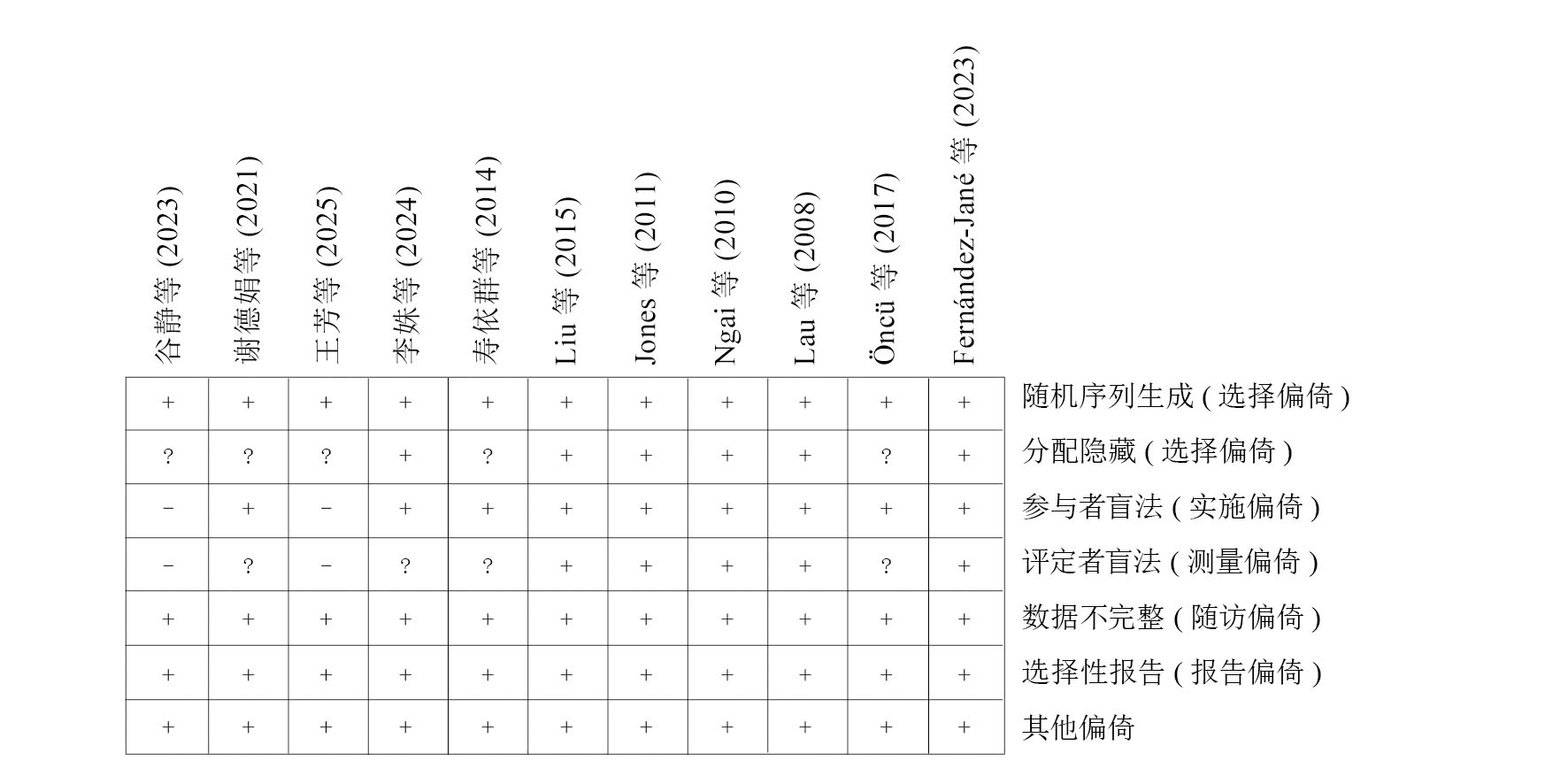
表3
纳入文献的PEDro量表评分"
| 纳入文献 | 明确的纳入与排除标准 | 随机分配 | 分配隐藏 | 基线相似 | 研究对象盲 | 治疗师盲 | 评估者盲 | 失访率< 15% | 意向性治疗 | 组间统计分析 | 点测量和差异值 | 总分 |
|---|---|---|---|---|---|---|---|---|---|---|---|---|
| 寿依群等[ | √ | √ | √ | √ | √ | √ | √ | 6 | ||||
| 李姝等[ | √ | √ | √ | √ | √ | √ | √ | √ | 7 | |||
| 王芳等[ | √ | √ | √ | √ | √ | √ | 5 | |||||
| 谷静等[ | √ | √ | √ | √ | √ | √ | 5 | |||||
| 谢德娟等[ | √ | √ | √ | √ | √ | √ | √ | 6 | ||||
| Lau等[ | √ | √ | √ | √ | √ | √ | √ | √ | √ | √ | 9 | |
| Fernández-Jané[ | √ | √ | √ | √ | √ | √ | √ | √ | 7 | |||
| Jones等[ | √ | √ | √ | √ | √ | √ | √ | √ | √ | √ | 9 | |
| Ngai等[ | √ | √ | √ | √ | √ | √ | √ | √ | √ | 8 | ||
| Liu等[ | √ | √ | √ | √ | √ | √ | √ | √ | √ | √ | 9 | |
| Öncü等[ | √ | √ | √ | √ | √ | √ | √ | 6 |
表4
Meta分析结果"
| 结局指标 | 纳入研究数/n | 异质性检验 | Meta分析结果 | 效应模型 | ||
|---|---|---|---|---|---|---|
| I2值 | P值 | MD (95%CI) | P值 | |||
| FEV1 | 8[ | 77.7% | < 0.001 | 0.19(0.08, 0.29) | < 0.001 | 随机效应模型 |
| FEV1/FVC | 4[ | 0% | 0.395 | 5.15(4.21,6.09) | < 0.001 | 固定效应模型 |
| FEV1% | 3[ | 0% | 0.359 | 8.46(5.71,11.22) | < 0.001 | 固定效应模型 |
| PEF | 3[ | 0% | 0.589 | 0.18(0.05,0.31) | 0.006 | 固定效应模型 |
| 6MWT | 5[ | 90.1% | < 0.001 | 25.97(7.88,44.05) | 0.005 | 随机效应模型 |
| CAT | 3[ | 0% | 0.546 | -3.6(-4.81,-2.40) | < 0.001 | 固定效应模型 |
表5
FEV1亚组分析结果"
| 亚组分类 | 纳入研究数 | 异质性检验 | Meta分析结果 | 效应模型 | |||
|---|---|---|---|---|---|---|---|
| I2值 | P值 | MD (95%CI) | P值 | ||||
| 疾病阶段 | 稳定期 | 6[ | 56.1% | 0.044 | 0.17(0.09,0.25) | < 0.001 | 随机效应模型 |
| 急性加重期 | 2[ | 87.7% | 0.004 | 0.21(-0.25,0.66) | 0.379 | 随机效应模型 | |
| 干预类型 | 安慰剂对照组 | 5[ | 0% | 0.581 | 0.12(0.08,0.16) | < 0.001 | 固定效应模型 |
| 常规疗法联合干预组 | 3[ | 9.2% | 0.332 | 0.36(0.28,0.44) | < 0.001 | 固定效应模型 | |
| 穴位选择 | 多穴位联合 | 4[ | 66% | 0.032 | 0.29(0.14,0.43) | < 0.001 | 随机效应模型 |
| 单一穴位 | 4[ | 0% | 0.659 | 0.12(0.08,0.17) | < 0.001 | 固定效应模型 | |
| 干预时间 | 单次干预组 | 2[ | 35.3% | 0.214 | 0.12(0.07,0.17) | < 0.001 | 固定效应模型 |
| 短期干预组(1~2周) | 2[ | 49.6% | 0.159 | 0.37(0.27,0.47) | < 0.001 | 固定效应模型 | |
| 长期干预组(3~4周) | 4[ | 62.6% | 0.046 | 0.16(0.01,0.31) | 0.037 | 随机效应模型 | |
| [1] |
王凤燕, 张冬莹, 梁振宇, 等. 面向全科医生的«慢性阻塞性肺疾病诊治指南(2021年修订版)»解读[J]. 中国全科医学, 2021, 24(29): 3660-3663.
doi: 10.12114/j.issn.1007-9572.2021.01.304 |
| WANG F Y, ZHANG D Y, LIANG Z Y, et al. Interpretation of Guideline for the Diagnosis and Treatment of COPD (2021 revision) for general practitioners[J]. Chin Gener Pract, 2021, 24(29): 3660-3663. | |
| [2] |
BOERS E, BARRETT M, SU J G, et al. Global burden of chronic obstructive pulmonary disease through 2050[J]. JAMA Netw Open, 2023, 6(12): e2346598.
doi: 10.1001/jamanetworkopen.2023.46598 |
| [3] |
HALPIN D M G. Mortality of patients with COPD[J]. Expert Rev Respir Med, 2024, 18(6): 381-395.
doi: 10.1080/17476348.2024.2375416 |
| [4] |
PARK S C, KIM D W, PARK E C, et al. Mortality of patients with chronic obstructive pulmonary disease: a nationwide population based cohort study[J]. Korean J Intern Med, 2019, 34(6): 1272-1278.
doi: 10.3904/kjim.2017.428 |
| [5] | SAFIRI S, CARSON-CHAHHOUD K, NOORI M, et al. Burden of chronic obstructive pulmonary disease and its attributable risk factors in 204 countries and territories, 1990-2019: results from the Global Burden of Disease Study 2019 [J]. BMJ, 2022, 378: e69679. |
| [6] | 李雪萍, 王凤燕, 梁振宇, 等. 2025年慢性阻塞性肺疾病全球倡议解读[J]. 中国临床新医学, 2025, 18(2): 113-119. |
| LI X P, WANG F Y, LIANG Z Y, et al. Interpretation of Global Initiative for Chronic Obstructive Lung Disease 2025[J]. Chin J New Clin Med, 2025, 18(2): 113-119. | |
| [7] |
MIRAVITLLES M, AULADELL-RISPAU A, MONTEAGUDO M, et al. Systematic review on long-term adverse effects of inhaled corticosteroids in the treatment of COPD[J]. Eur Respir Rev, 2021, 30(160): 210075.
doi: 10.1183/16000617.0075-2021 |
| [8] |
SMITH D, GILL A, HALL L, et al. Prevalence, pattern, risks factors and consequences of antibiotic resistance in COPD: a systematic review[J]. COPD, 2021, 18(6): 672-682.
doi: 10.1080/15412555.2021.2000957 |
| [9] | 邓嘉, 李力. «慢性阻塞性肺疾病伴肺曲霉病诊治和管理专家共识»解读[J]. 中国临床新医学, 2025, 18(2): 120-124. |
| DENG J, LI L. Interpretation of expert consensus on the diagnosis and treatment of pulmonary aspergillosis in patients with chronic obstructive pulmonary disease[J]. Chin J New Clin Med, 2025, 18(2): 120-124. | |
| [10] | 何孟霖, 胡澄, 田伟千. 经皮穴位电刺激在围手术期的应用[J]. 针刺研究, 2021, 46(9): 800-803. |
| HE M L, HU C, TIAN W Q. Application of transcutaneous electrical acupoint stimulation in perioperative period[J]. Acupunct Res, 2021, 46(9): 800-803. | |
| [11] | 李莹飔, 方娟, 陈采益, 等. 经皮穴位电刺激镇痛机制及应用的研究进展[J]. 中国医药导报, 2023, 20(1): 61-64. |
| LI Y S, FANG J, CHEN C Y, et al. Research progress on analgesic mechanism and application of transcutaneous electrical acupoint stimulation[J]. Chin Med Herald, 2023, 20(1): 61-64. | |
| [12] | 周黄超. 经皮穴位电刺激治疗慢性阻塞性肺疾病临床疗效的Meta分析[D]. 南昌: 南昌大学, 2018. |
| ZHOU H C. Effects of transcutaneous electrical acupoint stimulationon patients with chronic obstructive pulmonary disease: a meta-analysis[D]. Nanchang: Nanchang University, 2018. | |
| [13] |
NGAI S P C, SPENCER L M, JONES A Y M, et al. Acu-TENS reduces breathlessness during exercise in people with chronic obstructive pulmonary disease[J]. Evid Based Complement Alternat Med, 2017, 2017: 3649257.
doi: 10.1155/ecam.v2017.1 |
| [14] | 肖雄, 李姝, 王燕, 等. 经皮穴位电刺激对慢性阻塞性肺疾病患者急性加重风险的影响[J]. 针刺研究, 2021, 46(7): 598-604. |
| XIAO X, LI S, WANG Y, et al. Effect of transcutaneous electrical acupoint stimulation on lung function and risks of exacerbation for patients with chronic obstructive pulmonary disease[J]. Acupunct Res, 2021, 46(7): 598-604. | |
| [15] |
TSAI C, LAN C, WU C, et al. Acupuncture point stimulation treatments combined with conventional treatment in chronic obstructive pulmonary disease: a systematic review and network meta-analysis[J]. Front Med, 2021, 8: 586900.
doi: 10.3389/fmed.2021.586900 |
| [16] | 寿依群, 葛慧青, 戴泽宁, 等. 肺俞穴经皮电神经刺激对慢性阻塞性肺疾病患者肺功能及诱导痰肿瘤坏死因子-α浓度的影响[J]. 中华物理医学与康复杂志, 2014, 36(9): 705-708. |
| SHOU Y Q, GE H Q, DAI Z N, et al. The effects of transcutaneous electrical nerve stimulation on pulmonary function, airflow, dyspnea, exercise capacity and TNF-α levels in patients with pulmonary obstruction[J]. Chin J Phys Med Rehabil, 2014, 36(9): 705-708. | |
| [17] | 李姝, 张霞, 肖雄, 等. 经皮神经穴位电刺激对COPD稳定期患者临床疗效、肺功能及急性加重风险的影响[J]. 四川中医, 2024, 42(11): 207-212. |
| LI S, ZHANG X, XIAO X, et al. Effect of transcutaneous electrical nerve point stimulation on clinical outcome, lung function and risk of acute exacerbation in patients with stable COPD[J]. J Sichuan Tradit Chin Med, 2024, 42(11): 207-212. | |
| [18] | 王芳, 马欢欢, 俞建红, 等. 经皮穴位电刺激联合常规药物治疗慢性阻塞性肺疾病急性加重痰浊壅肺证的疗效观察及对肺功能、血清炎性因子的影响[J]. 中国中医药科技, 2025, 32(1): 86-89. |
| [19] | 谷静, 朱黎明, 彭艳萍, 等. 经皮穴位电刺激联合下肢运动训练在COPD患者肺康复中的应用[J]. 热带医学杂志, 2023, 23(9): 1198-1202, 1211. |
| GU J, ZHU L M, PENG Y P, et al. The application of transcutaneous electrical acupoint stimulation combined withlower limb exercise training in pulmonary rehabilitation of COPD patients[J]. J Trop Med, 2023, 23(9): 1198-1202, 1211. | |
| [20] | 谢德娟, 李小宏. 俞募配穴结合TENS治疗COPD的临床效果研究[J]. 中国实用医药, 2021, 16(21): 175-177. |
| [21] |
LAU K S L, JONES A Y M. A single session of Acu-TENS increases FEV1 and reduces dyspnoea in patients with chronic obstructive pulmonary disease: a randomised, placebo-controlled trial[J]. Aust J Physiother, 2008, 54(3): 179-184.
pmid: 18721121 |
| [22] | FERNÁNDEZ-JANÉ C, VILARÓ J, COSTA-TUTUSAUS L. Acupoint transcutaneous electrical nerve stimulation in hospitalized COPD patients with severe dyspnoea: a randomized controlled trial[J]. J Evid Based Integr Med, 2023, 28: 2515690X231198308. |
| [23] | JONES A Y M, NGAI S P C, HUI-CHAN C W Y, et al. Acute effects of acu-TENS on FEV1 and blood beta-endorphin level in chronic obstructive pulmonary disease[J]. Altern Ther Health Med, 2011, 17(5): 8-13. |
| [24] |
NGAI S P, JONES A Y, HUI-CHAN C W, et al. Effect of 4 weeks of acu-TENS on functional capacity and beta-endorphin level in subjects with chronic obstructive pulmonary disease: a randomized controlled trial[J]. Respir Physiol Neurobiol, 2010, 173(1): 29-36.
doi: 10.1016/j.resp.2010.06.005 pmid: 20601209 |
| [25] |
LIU X, FAN T, LAN Y, et al. Effects of transcutaneous electrical acupoint stimulation on patients with stable chronic obstructive pulmonary disease: a prospective, single-blind, randomized, placebo-controlled study[J]. J Altern Complement Med, 2015, 21(10): 610-616.
doi: 10.1089/acm.2014.0284 |
| [26] |
ÖNCÜ E, ZINCIR H. The effect of transcutaneous electrical nerve stimulation in patients with acute exacerbation of chronic obstructive pulmonary disease: randomised controlled trial[J]. J Clin Nurs, 2017, 26(13-14): 1834-1844.
doi: 10.1111/jocn.13450 pmid: 27325551 |
| [27] |
JONES P W, BEEH K M, CHAPMAN K R, et al. Minimal clinically important differences in pharmacological trials[J]. Am J Respir Crit Care Med, 2014, 189(3): 250-255.
doi: 10.1164/rccm.201310-1863PP |
| [28] |
HOLLAND A E, HILL C J, RASEKABA T, et al. Updating the minimal important difference for six-minute walk distance in patients with chronic obstructive pulmonary disease[J]. Arch phys Med Rehabil, 2010, 91(2): 221-225.
doi: 10.1016/j.apmr.2009.10.017 |
| [29] |
KAKAVAS S, KOTSIOU O S, PERLIKOS F, et al. Pulmonary function testing in COPD: looking beyond the curtain of FEV1[J]. NPJ Prim Care Respir Med, 2021, 31(1): 23.
doi: 10.1038/s41533-021-00236-w |
| [30] |
陈典, 隆寰宇, 张丛溪, 等. 2025年GOLD慢性阻塞性肺疾病诊断、治疗、管理及预防全球策略更新要点解读[J]. 中国全科医学, 2025, 28(16): 1937-1949.
doi: 10.12114/j.issn.1007-9572.2024.0588 |
| CHEN D, LONG H Y, ZHANG C X, et al. Treatment, Interpretation of Global Strategy for the Diagnosis, Management and Prevention of Chronic Obstructive Pulmonary Disease 2025 Report[J]. Chin Generl Pract, 2025, 28(16): 1937-1949. | |
| [31] | 黄晓旗, 白利杰, 沈聪, 等. 慢性阻塞性肺疾病患者双气相CT扫描平均肺密度与肺功能的相关性研究[J]. 西安交通大学学报(医学版), 2019, 40(2): 178-181. |
| HUANG X Q, BAI L J, SHEN C, et al. Correlation between mean lung density and lung function test in patients with chronic obstructive pulmonary disease by dual phase CT[J]. J Xi'an Jiaotong Univ (Med Sci), 2019, 40(2): 178-181. | |
| [32] |
BAILEY K L. The importance of the assessment of pulmonary function in COPD[J]. Med Clin N Am, 2012, 96(4): 745-752.
doi: 10.1016/j.mcna.2012.04.011 |
| [33] |
WEI Y, YUAN N, DONG Y, et al. Transcutaneous electrical nerve stimulation over acupoint for chronic obstructive pulmonary disease: a systematic review and meta-analysis[J]. Front Public Health, 2022, 10: 937835.
doi: 10.3389/fpubh.2022.937835 |
| [34] | 王彩云, 苏景超, 张新芳, 等. 电针对慢性阻塞性肺疾病大鼠肺神经内分泌细胞及神经活性物质分泌的影响[J]. 针刺研究, 2022, 47(4): 305-313. |
| WANG C Y, SU J C, ZHANG X F, et al. Effect of electroacupuncture on pulmonary neuroendocrine cells and secretion of neuroactive substances in lung of COPD rats[J]. Acupunct Res, 2022, 47(4): 305-313. | |
| [35] | 曹庆, 苗青, 廖星, 等. 基于数据挖掘的穴位贴敷治疗慢性阻塞性肺疾病稳定期选穴规律分析[J]. 中国中药杂志, 2020, 45(22): 5356-5361. |
| CAO Q, MIAO Q, LIAO X, et al. Analysis of acupoint selection of plaster therapy in treatment of stable chronicobstructive pulmonary disease based on data mining[J]. Chin J Chin Materia Medica, 2020, 45(22): 5356-5361. | |
| [36] |
YANG L, ZHOU D, CAO J, et al. Revealing the biological mechanism of acupuncture in alleviating excessive inflammatory responses and organ damage in sepsis: a systematic review[J]. Front Immunol, 2023, 14: 1242640.
doi: 10.3389/fimmu.2023.1242640 |
| [37] | 刘娜, 王林凤, 李一帆, 等. 电针通过迷走神经调控肺泡巨噬细胞极化对慢性阻塞性肺疾病小鼠肺部炎症的影响[J]. 南京中医药大学学报, 2025, 41(10): 1356-1364. |
| LIU N, WANG L F, LI Y F, et al. Electroacupuncture modulates alveolar macrophage polarization via the vagus nerve to alleviate pulmonary inflammation in a mouse model of chronic obstructive pulmonary disease[J]. J Nanjing Univ Tradit Chin Med, 2025, 41(10): 1356-1364. | |
| [38] | 王婷婷, 周立志, 任涛, 等. 电针联合百令胶囊治疗慢性阻塞性肺疾病稳定期疗效观察及对血清PTX3、5-HT、NF-κB的影响[J]. 上海针灸杂志, 2021, 40(7): 820-825. |
| WANG T T, ZHOU L Z, REN T, et al. Observation on the efficacy of electroacupuncture combined with Bailing capsules in treating stable chronic obstructive pulmonary disease and its effects on serum PTX3, 5-HT, and NF-κB[J]. Shanghai J Acu-mox, 2021, 40(7): 820-825. | |
| [39] |
MATKOVIC Z, CVETKO D, RAHELIC D, et al. Nutritional status of patients with chronic obstructive pulmonary disease in relation to their physical performance[J]. COPD, 2017, 14(6): 626-634.
doi: 10.1080/15412555.2017.1386643 pmid: 29099635 |
| [40] | 王世豪, 王至婉. 慢性阻塞性肺疾病呼吸肌疲劳的康复锻炼研究进展[J]. 护理研究, 2021, 35(20): 3641-3646. |
| WANG S H, WANG Z W. Research progress on rehabilitation exercise for respiratory muscle fatigue in patients with chronicobstructive pulmonary disease[J]. Chin Nurs Res, 2021, 35(20): 3641-3646. | |
| [41] |
PATEL N. An update on COPD prevention, diagnosis, and management: the 2024 GOLD Report[J]. Nurse Pract, 2024, 49(6): 29-36.
doi: 10.1097/01.NPR.0000000000000180 pmid: 38941078 |
| [42] | 李媛媛, 陈良玉, 孙培莉. CAT评分联合指脉氧监测在慢性阻塞性肺病管理中的应用价值[J]. 南京医科大学学报(自然科学版), 2020, 40(1): 77-81. |
| LI Y Y, CHEN L Y, SUN P L. The application value of COPD Assessment Test (CAT) and monitoring oxygen saturationin management of patients with chronic obstructive pulmonary disease[J]. J Nanjing Med Univ (Nat Sci), 2020, 40(1): 77-81. | |
| [43] |
KON S S C, CANAVAN J L, JONES S E, et al. Minimum clinically important difference for the COPD Assessment Test: a prospective analysis[J]. Lancet Respir Med, 2014, 2(3): 195-203.
doi: 10.1016/S2213-2600(14)70001-3 |
| [44] | 刘微, 聂赛美, 王小溪, 等. 穴位埋线治疗慢性阻塞性肺疾病的临床选穴规律及机制探讨[J]. 中国医药导报, 2025, 22(16): 139-143. |
| LIU W, NIE S M, WANG X X, et al. Clinical acupoint selection rules and mechanism of acupoint catgut embedding for chronic obstructive pulmonary disease[J]. Chin Med Herald, 2025, 22(16): 139-143. | |
| [45] | 李尹, 张新芳, 刘自兵, 等. 电针对慢性阻塞性肺疾病大鼠肺泡巨噬细胞M1极化的影响[J]. 针刺研究, 2020, 45(3): 173-179. |
| LI Y, ZHANG X F, LIU Z B, et al. Effect of electroacupuncture on pulmonary function and M1 polarization of alveolar macrophages in rats with chronic obstructive pulmonary disease[J]. Acupunct Res, 2020, 45(3): 173-179. | |
| [46] | 秦中银, 陈盼碧, 唐徐韵, 等. 针刺调节丝裂原活化蛋白激酶通路影响哮喘大鼠肺组织嗜酸性粒细胞凋亡的机制研究[J]. 针刺研究, 2022, 47(8): 690-695. |
| QIN Z Y, CHEN P B, TANG X Y, et al. Acupuncture affects the apoptosis of eosinophilic granulocytes in lung tissue of asthmatic rats by regulating the p38MApK signaling pathway[J]. Acupunct Res, 2022, 47(8): 690-695. |
| [1] | 张文静, 李浩, 袁佳佳, 胡怀宁. 远程监督指导下居家肺部音乐疗法对慢性阻塞性肺疾病的效果[J]. 《中国康复理论与实践》, 2026, 32(3): 337-344. |
| [2] | 祁莉, 张雷, 漆毅, 冯立军, 刘冬梅, 马慧娜. 心肺康复运动对老年慢性阻塞性肺疾病并发慢性心力衰竭患者的效果[J]. 《中国康复理论与实践》, 2026, 32(2): 191-197. |
| [3] | 杜雯倩, 张旭, 陈继伟, 王兴, 朱昆. 运动干预对帕金森病冻结步态效果的Meta分析[J]. 《中国康复理论与实践》, 2025, 31(7): 781-789. |
| [4] | 张勇, 蔡增, 徐凤萍, 刘丹, 常红娟. 音乐治疗对孤独症谱系障碍儿童干预效果的Meta分析[J]. 《中国康复理论与实践》, 2025, 31(4): 423-430. |
| [5] | 杨益成, 王丹丹, 沈群策, 张磊, 吴雪萍. 癌症患者化疗期间运动干预焦虑和抑郁状态效果的Meta分析[J]. 《中国康复理论与实践》, 2025, 31(2): 184-193. |
| [6] | 朱艾荣, 刘培豪, 郭晶, 管婷玉, 陈玺竹, 蔡诗凝, 胡雁, 张玉侠. 运动-认知双任务训练对帕金森病患者认知功能的Meta分析[J]. 《中国康复理论与实践》, 2025, 31(12): 1376-1384. |
| [7] | 刘东斐, 颜会义, 杨帆, 张帅. 运动干预对唐氏综合征儿童青少年多维健康结局影响的Meta分析[J]. 《中国康复理论与实践》, 2025, 31(12): 1398-1413. |
| [8] | 赵文, 王灿, 李丽文. 以行动研究法为指导的组合式呼吸训练对老年慢性阻塞性肺疾病的效果[J]. 《中国康复理论与实践》, 2025, 31(12): 1464-1471. |
| [9] | 张浩, 许传蕾, 魏振兴, 马丽虹. 不同虚拟现实技术对帕金森病患者运动功能疗效的网状Meta分析[J]. 《中国康复理论与实践》, 2025, 31(11): 1290-1302. |
| [10] | 毛涛, 游茂林. 运动干预对帕金森病患者呼吸功能效果的Meta分析[J]. 《中国康复理论与实践》, 2025, 31(11): 1303-1313. |
| [11] | 陈宇航, 杨瑜爱, 卢轩禹, 王昱航, 张蒙园, 张梓寒, 王荟荧, 常静玲. 卒中后失语和卒中后抑郁自发脑活动改变的静息态功能磁共振成像Meta分析[J]. 《中国康复理论与实践》, 2025, 31(10): 1143-1155. |
| [12] | 杨三峡, 刘清栾, 万嘉敏. 音乐干预对阿尔茨海默病患者激活模式区域差异的功能磁共振成像Meta分析[J]. 《中国康复理论与实践》, 2025, 31(10): 1156-1163. |
| [13] | 赵英楠, 郑鑫彤, 刘俊玲, 王紫丹, 吴泓悦, 李冰, 李燕. 阈值吸气肌训练对肺癌术后患者肺康复影响的Meta分析[J]. 《中国康复理论与实践》, 2025, 31(10): 1164-1171. |
| [14] | 龚娉, 窦英茹, 戴雪梅, 蒋雪萍, 吴美芳, 姜帆. 老年慢性阻塞性肺疾病患者吞咽障碍的心理体验及护理需求的质性研究[J]. 《中国康复理论与实践》, 2025, 31(1): 117-124. |
| [15] | 温艳飞, 杨露, 班玥, Ykabaru Daniela BERBESI NORIEGA, 张郝琪, 王丽, 刘华. ICF框架下运动疗法对慢性非特异性颈痛效果的Meta分析[J]. 《中国康复理论与实践》, 2024, 30(7): 778-788. |
| 阅读次数 | ||||||
|
全文 |
|
|||||
|
摘要 |
|
|||||
|
||
