



《中国康复理论与实践》 ›› 2026, Vol. 32 ›› Issue (4): 463-472.doi: 10.3969/j.issn.1006-9771.2026.04.010
桂舜, 张见飞, 黄慧芝( )
收稿日期:2025-10-17
修回日期:2026-02-02
出版日期:2026-04-25
发布日期:2026-05-06
通讯作者:
黄慧芝,E-mail: 297522040@qq.com作者简介:桂舜(1986-),男,汉族,江西抚州市人,副主任医师,主要研究方向:康复医学。
基金资助:
GUI Shun, ZHANG Jianfei, HUANG Huizhi()
Received:2025-10-17
Revised:2026-02-02
Published:2026-04-25
Online:2026-05-06
Contact:
HUANG Huizhi, E-mail: 297522040@qq.comSupported by:摘要:
目的 开发一种基于机器学习(ML)的脑卒中患者神经功能康复结局的预测模型。
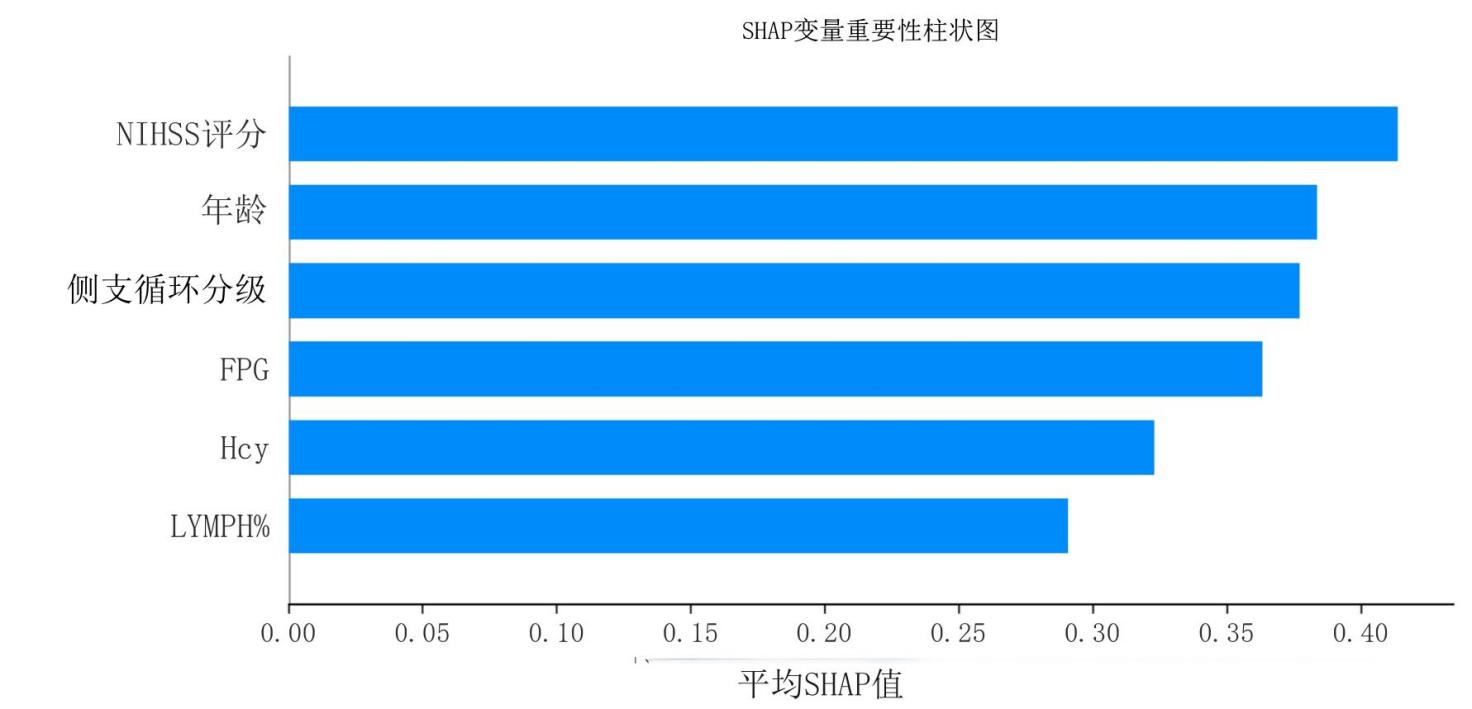
方法 选取2022年10月至2024年10月抚州市第一人民医院收治的420例脑卒中患者作为训练集,根据出院后3个月改良Rankin量表(mRS)评分分为预后良好组(n = 289)和预后不良组(n = 131)。另选取2024年11月至2025年4月抚州市第一人民医院收治的180例脑卒中患者作为验证集。通过单因素分析、最小绝对收缩和选择算子回归和多因素Logistic回归,确定患者神经功能康复预后的独立影响因素。以筛选出的独立影响因素为特征变量,训练逻辑回归、线性判别分析、朴素的贝叶斯、支持向量机、随机森林和极限梯度提升(XGBoost) 6种ML模型。采用受试者工作特征曲线下面积(AUC)、混淆矩阵指标(准确率、精确率、召回率、F1分数)、校准曲线和决策曲线分析评估模型的预测效能、校准度和临床净获益,并在验证集中验证。采用沙普利可加解释(SHAP)框架对最佳性能模型进行可解释性分析,采用条形图可视化模型的特征重要性。
结果 年龄、美国国立卫生研究院卒中量表(NIHSS)评分、侧支循环分级、空腹血糖(FPG)、淋巴细胞百分比(LYMPH%)和同型半胱氨酸(Hcy)是患者神经功能康复预后不良的独立影响因素(P < 0.05)。XGBoost模型在训练集和验证集的AUC分别为0.963 (95%CI 0.947~0.979)和0.825 (95%CI 0.764~0.885),准确率分别为88.81%和77.22%,精确率分别为92.86%和68.42%,召回率分别为69.47%和47.27%,F1分数分别为79.48%和55.91%,校准度和临床净获益均表现最佳。各特征对XGBoost模型预测的重要性从高到低依次为NIHSS评分、年龄、侧支循环分级、FPG、Hcy和LYMPH%。
结论 基于可解释的XGBoost ML模型在预测脑卒中患者神经功能康复结局方面展现出优越的预测效能和良好的临床适用性。
中图分类号:
桂舜, 张见飞, 黄慧芝. 可解释的机器学习模型对脑卒中患者神经功能康复结局的预测效能[J]. 《中国康复理论与实践》, 2026, 32(4): 463-472.
GUI Shun, ZHANG Jianfei, HUANG Huizhi. Prediction of neurological function rehabilitation outcome for stroke patients using interpretable machine learning models[J]. Chinese Journal of Rehabilitation Theory and Practice, 2026, 32(4): 463-472.

表1
训练集两组各变量的单因素分析"
| 变量 | 预后良好组(n = 289) | 预后不良组(n = 131) | t/χ2/Z值 | P值 |
|---|---|---|---|---|
| 性别/n | 0.009 | 0.923 | ||
| 男 | 164 | 75 | ||
| 女 | 125 | 56 | ||
| 年龄/岁 | 63.31±8.54 | 67.00±8.82 | 4.064 | < 0.001 |
| BMI/(kg·m-2) | 24.70±3.16 | 24.61±3.23 | 0.276 | 0.783 |
| 高血压病史/n | 0.325 | 0.569 | ||
| 是 | 200 | 87 | ||
| 否 | 89 | 44 | ||
| 糖尿病病史/n | 0.231 | 0.630 | ||
| 是 | 73 | 36 | ||
| 否 | 216 | 95 | ||
| 心房颤动史/n | 3.747 | 0.053 | ||
| 是 | 59 | 38 | ||
| 否 | 230 | 93 | ||
| 冠心病史/n | 2.914 | 0.088 | ||
| 是 | 50 | 32 | ||
| 否 | 239 | 99 | ||
| 高脂血症史/n | 1.568 | 0.210 | ||
| 是 | 111 | 42 | ||
| 否 | 178 | 89 | ||
| 吸烟史/n | 1.851 | 0.174 | ||
| 是 | 112 | 60 | ||
| 否 | 177 | 71 | ||
| 饮酒史/n | 2.685 | 0.101 | ||
| 是 | 89 | 51 | ||
| 否 | 200 | 80 | ||
| 入院时收缩压/mmHg | 156.35±23.37 | 154.95±22.15 | 0.576 | 0.565 |
| 入院时舒张压/mmHg | 86.66±14.06 | 87.13±14.28 | 0.315 | 0.753 |
| NIHSS评分 | 10.14±4.28 | 11.46±4.86 | 2.797 | 0.005 |
| TOAST分型/n | 7.380 | 0.117 | ||
| 大动脉粥样硬化型 | 99 | 42 | ||
| 心源性栓塞型 | 33 | 26 | ||
| 小动脉闭塞型 | 76 | 24 | ||
| 其他明确病因型 | 14 | 8 | ||
| 不明原因型 | 67 | 31 | ||
| 梗死体积/mL | 19.70(13.80, 27.85) | 23.70(14.20, 32.50) | 2.274 | 0.023 |
| 侧支循环分级/n | 17.503 | < 0.001 | ||
| 0~1级 | 81 | 64 | ||
| 2级 | 125 | 38 | ||
| 3~4级 | 83 | 29 | ||
| WBC/(109·L-1) | 7.97±2.22 | 8.02±2.31 | 0.232 | 0.817 |
| NEUT%/% | 69.72±9.21 | 71.63±9.34 | 1.957 | 0.051 |
| LYMPH%/% | 30.50±8.43 | 28.28±8.74 | 2.471 | 0.014 |
| PLT/(109·L-1) | 210.90±65.73 | 203.19±71.03 | 1.086 | 0.278 |
| FPG/(mmol·L-1) | 6.35±1.45 | 6.83±1.64 | 3.004 | 0.003 |
| HbA1c/% | 6.08±1.24 | 6.16±1.28 | 0.633 | 0.527 |
| TG/(mmol·L-1) | 1.63±0.71 | 1.53±0.54 | 1.412 | 0.159 |
| Hcy/(μmol·L-1) | 13.05±5.09 | 14.15±5.28 | 2.039 | 0.042 |
| FIB/(g·L-1) | 3.41±0.74 | 3.58±0.95 | 2.080 | 0.038 |
| DD/(mg·L-1) | 0.80(0.53,1.36) | 0.91(0.62,1.45) | 1.587 | 0.113 |
| hs-CRP/(mg·L-1) | 8.50(5.05,14.45) | 10.30(5.40,16.40) | 1.592 | 0.111 |
| 静脉溶栓/n | 0.033 | 0.856 | ||
| 是 | 53 | 25 | ||
| 否 | 236 | 106 | ||
| 动脉取栓治疗/n | 2.879 | 0.090 | ||
| 是 | 35 | 24 | ||
| 否 | 254 | 107 |
表2
各影响因素赋值"
| 影响因素 | 赋值 |
|---|---|
| 年龄 | 原值 |
| NIHSS评分 | 原值 |
| 梗死体积 | 原值 |
| 侧支循环分级(以0~1级为参照) | 2级(0,1,0),3~4级(0,0,1) |
| LYMPH% | 原值 |
| FPG | 原值 |
| Hcy | 原值 |
| FIB | 原值 |
表3
多因素Logistic回归分析结果"
| 因素 | β值 | S.E | Wald | P值 | OR | 95%CI | |
|---|---|---|---|---|---|---|---|
| 下限 | 上限 | ||||||
| 年龄 | 0.047 | 0.014 | 11.796 | 0.001 | 1.048 | 1.020 | 1.077 |
| NIHSS评分 | 0.067 | 0.025 | 7.188 | 0.007 | 1.070 | 1.018 | 1.123 |
| 侧支循环分级 | 15.187 | 0.001 | |||||
| 侧支循环分级(1) | -0.965 | 0.264 | 13.381 | < 0.001 | 0.381 | 0.227 | 0.639 |
| 侧支循环分级(2) | -0.793 | 0.289 | 7.511 | 0.006 | 0.453 | 0.257 | 0.798 |
| FPG | 0.187 | 0.075 | 6.249 | 0.012 | 1.205 | 1.041 | 1.395 |
| LYMPH% | -0.030 | 0.013 | 5.112 | 0.024 | 0.971 | 0.946 | 0.996 |
| Hcy | 0.045 | 0.022 | 4.174 | 0.041 | 1.046 | 1.002 | 1.092 |
| 常量 | -4.988 | 1.183 | 17.784 | < 0.001 | 0.007 | ||
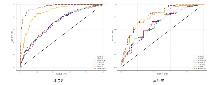
图1
各模型的ROC曲线"
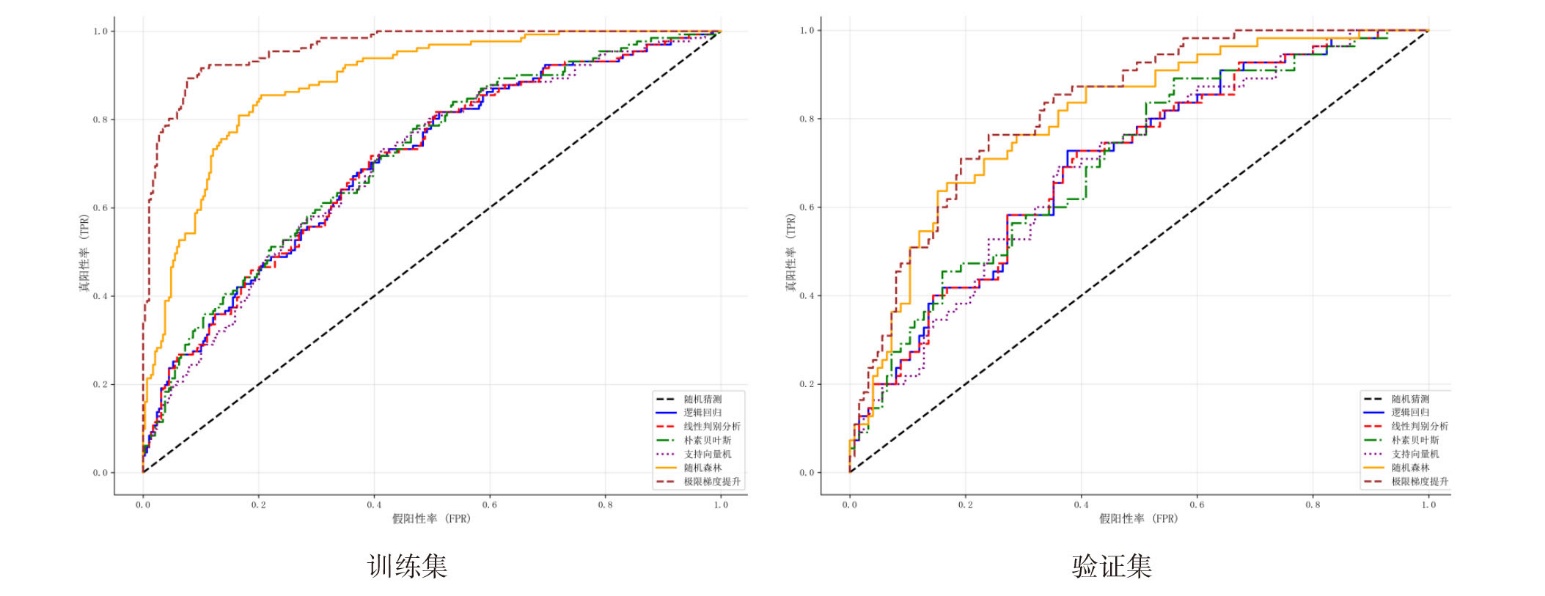
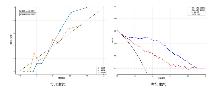
图2
XGBoost模型"
表4
各模型的AUC及混淆矩阵分析"
| 模型 | 数据集 | AUC(95%CI) | 准确率/% | 精确率/% | 召回率/% | F1分数/% |
|---|---|---|---|---|---|---|
| LR | 训练集 | 0.706(0.655~0.758) | 72.62 | 66.00 | 25.19 | 36.46 |
| 验证集 | 0.701(0.621~0.782) | 70.56 | 54.17 | 23.64 | 32.91 | |
| LDA | 训练集 | 0.706(0.655~0.758) | 72.62 | 66.00 | 25.19 | 36.46 |
| 验证集 | 0.700(0.619~0.780) | 70.56 | 54.17 | 23.64 | 32.91 | |
| NB | 训练集 | 0.715(0.664~0.765) | 72.38 | 62.30 | 29.01 | 39.58 |
| 验证集 | 0.703(0.621~0.784) | 71.67 | 57.69 | 27.27 | 37.04 | |
| SVM | 训练集 | 0.702(0.650~0.753) | 71.19 | 66.67 | 15.27 | 24.84 |
| 验证集 | 0.693(0.613~0.773) | 71.11 | 63.64 | 12.73 | 21.21 | |
| RF | 训练集 | 0.886(0.854~0.918) | 78.10 | 79.10 | 40.46 | 53.54 |
| 验证集 | 0.802(0.734~0.870) | 73.33 | 64.00 | 29.09 | 40.00 | |
| XGBoost | 训练集 | 0.963(0.947~0.979) | 88.81 | 92.86 | 69.47 | 79.48 |
| 验证集 | 0.825(0.764~0.885) | 77.22 | 68.42 | 47.27 | 55.91 |
图3
SHAP条形图 平均SHAP值"
| [1] | «中国脑卒中防治报告»编写组. «中国脑卒中防治报告2020»概要[J]. 中国脑血管病杂志, 2022, 19(2): 136-144. |
| Compilation Group of China Stroke Prevention and Treatment Report. Brief report on stroke prevention and treatment in China, 2020[J]. Chin J Cerebrovasc Dis, 2022, 19(2): 136-144. | |
| [2] | 郑霞, 赵瑞峰. 液体衰减反转恢复血管高信号征评估急性脑卒中的研究进展[J]. 实用放射学杂志, 2025, 41(10): 1737-1740. |
| ZHENG X, ZHAO R F. Advances in fluid attenuated inversion recovery vascular hyperintensity for assessment of acute ischemic stroke[J]. J Pract Radiol, 2025, 41(10): 1737-1740. | |
| [3] | 况嘉茜, 陈淳, 张倩. 脑卒中患者运动功能预后预测模型的范围综述及护理启示[J]. 中华护理杂志, 2025, 60(3): 364-372. |
| KUANG J Q, CHEN C, ZHANG Q. A scoping review of functional prognosis prediction models for stroke patients[J]. Chin J Nurs, 2025, 60(3): 364-372. | |
| [4] | 杨婷, 丁智斌, 江楠, 等. 星形胶质细胞调节缺血性脑卒中的胶质瘢痕形成[J]. 中国组织工程研究, 2024, 28(1): 131-138. |
| YANG T, DING Z B, JIANG N, et al. Astrocytes regulate glial scar formation in cerebral ischemic stroke[J]. Chin J Tissue Eng Res, 2024, 28(1): 131-138. | |
| [5] | 王家辉, 彭艳丽. 机器学习在屈光手术领域的应用研究进展[J]. 中华眼科杂志, 2025, 61(4): 304-309. |
| WANG J H, PENG Y L. Advancements in machine learning applications in refractive surgery[J]. Chin J Ophthalmol, 2025, 61(4): 304-309. | |
| [6] | 耿祺焜, 李吉利, 胡雲迪, 等. 基于可解释机器学习的重症慢性阻塞性肺疾病的预后模型[J]. 中国呼吸与危重监护杂志, 2024, 23(3): 153-159. |
| GENG Q K, LI J L, HU Y D, et al. Interpretable machine learning-based prognostic model for severe chronic obstructive pulmonary disease[J]. Chin J Respir Crit Care Med, 2024, 23(3): 153-159. | |
| [7] | 李婷婷, 刘欢庆, 雷倩, 等. 基于机器学习算法的诊断模型对结核性胸膜炎的应用价值[J]. 中国防痨杂志, 2025, 47(11): 1508-1514. |
| LI T T, LIU H Q, LEI Q, et al. Application value of machine-learning-based diagnostic model for tuberculous pleurisy[J]. Chin J Antituberc, 2025, 47(11): 1508-1514. | |
| [8] | 王嘉孺, 张瑛, 杨永, 等. 基于机器学习脑卒中功能恢复及预后预测模型的系统评价[J]. 中国组织工程研究, 2025, 29(29): 6317-6325. |
| WANG J R, ZHANG Y, YANG Y, et al. Systematic review of machine learning models for predicting functional recovery and prognosis in stroke[J]. Chin J Tissue Eng Res, 2025, 29(29): 6317-6325. | |
| [9] | 唐萍, 周亮, 李松达, 等. 基于机器学习的原发性肺癌患者合并肌肉减少症风险预测模型构建与验证[J]. 现代预防医学, 2025, 52(16): 2900-2907. |
| TANG P, ZHOU L, LI S D, et al. Construction and validation of a machine learning based risk prediction model for primary lung cancer patients with muscle atrophy[J]. Mod Prev Med, 2025, 52(16): 2900-2907. | |
| [10] | 中华医学会神经病学分会, 中华医学会神经病学分会脑血管病学组. 中国急性缺血性卒中诊治指南2023[J]. 中华神经科杂志, 2024, 57(6): 523-559. |
| Neurology Branch of Chinese Medical Association, Chinese Stroke Society. Guidelines for the diagnosis and treatment of acute ischemic stroke in China 2023[J]. Chin J Neurol, 2024, 57(6): 523-559. | |
| [11] | 王家良. 临床流行病学:临床科研设计,测量与评价[M]. 上海: 上海科学技术出版社, 2014: 157-159. |
| WANG J L. Clinical epidemiology: design, measurement and evaluation of clinical research[M]. Shanghai: Shanghai Science and Technology Press, 2014: 157-159. | |
| [12] |
HAGGAG H, HODGSON C. Clinimetrics: modified Rankin scale (mRS)[J]. J Physiother, 2022, 68(4): 281.
doi: 10.1016/j.jphys.2022.05.017 pmid: 35715375 |
| [13] | 王保国, 肖伟, 王震, 等. "通督治郁"针法治疗脑卒中后抑郁对临床症状及血清5-HT、NE、DA的影响[J]. 中华中医药学刊, 2023, 42(3): 190-193. |
| WANG B G, XIAO W, WANG Z, et al. Influence of acupuncture of dredging Du meridian in treating depression on clinical symptoms and serum 5-HT, NE and DA in patients with post-stroke depression[J]. Chin Arch Tradit Chin Med, 2023, 42(3): 190-193. | |
| [14] | 叶枫, 郭莹, 程良玲, 等. 缺血性脑卒中后吞咽障碍的危险因素分析及机器学习预测模型的构建[J]. 医学研究与战创伤救治, 2025, 38(5): 523-528. |
| YE F, GUO Y, CHENG L L, et al. Analysis of risk factors for dysphagia after ischemic stroke and construction of a machine learning prediction model[J]. J Med Res Combat Trauma Care, 2025, 38(5): 523-528. | |
| [15] |
LI H, YE S S, WU Y L, et al. Predicting mortality in acute ischaemic stroke treated with mechanical thrombectomy: analysis of a multicentre prospective registry[J]. BMJ Open, 2021, 11(4): e043415.
doi: 10.1136/bmjopen-2020-043415 |
| [16] |
KIM Y, JEONG H S, SHIM S R, et al. Discharge neurological deficit as a predictor of early stroke recurrence: a nationwide registry-based propensity-matched study[J]. J Am Heart Assoc, 2025, 14(20): e043529.
doi: 10.1161/JAHA.125.043529 |
| [17] |
ZHANG P, HU M, XU Y, et al. Predictors of futile recanalization in patients with basilar artery occlusion with large versus nonlarge infarcts[J]. J Am Heart Assoc, 2025, 14(10): e039941.
doi: 10.1161/JAHA.124.039941 |
| [18] | 李华, 周静, 祖百法, 等. 中老年脑卒中患者康复动机影响因素及路径分析[J]. 护理学杂志, 2025, 40(12): 12-17. |
| LI H, ZHOU J, ZU B F, et al. Influencing factors and pathways of rehabilitation motivation in middle-aged and elderly stroke patients[J]. J Nurs Sci, 2025, 40(12): 12-17. | |
| [19] | 王翀, 张丽, 卢德霞, 等. 中老年急性缺血性脑卒中早期神经功能恶化预测模型的建立与验证:单中心回顾性研究[J]. 河北医科大学学报, 2025, 46(6): 662-667. |
| WANG C, ZHANG L, LU D X, et al. Establishment and validation of a prediction model for early neurological deterioration in middle-aged and elderly patients with acute ischemic stroke: a single centre retrospective study[J]. J Hebei Med Univ, 2025, 46(6): 662-667. | |
| [20] | 田玲玲, 谌秘, 邹田子. 康复期脑卒中患者日间过度嗜睡现状及影响因素研究[J]. 护理学杂志, 2024, 39(15): 11-15. |
| TIAN L L, SHEN M, ZOU T Z. Excessive daytime sleepiness and its influencing factors in stroke patients during rehabilitation[J]. J Nurs Sci, 2024, 39(15): 11-15. | |
| [21] |
董敏, 徐蕾, 何清华, 等. 老年缺血性脑卒中合并心房颤动及冠心病患者的6年预后随访研究[J]. 中国全科医学, 2021, 24(17): 2148-2156.
doi: 10.12114/j.issn.1007-9572.2021.00.527 |
| DONG M, XU L, HE Q H, et al. A six-year follow-up study on the prognosis in elderly patients with ischemic stroke combined with atrial fibrillation and coronary heart disease[J]. Chin Gen Pract, 2021, 24(17): 2148-2156. | |
| [22] | 吴芳, 刘崇, 李菓. 老年脑卒中患者血清神经元特异性烯醇化酶和神经肽Y水平与睡眠障碍的关系[J]. 中华老年心脑血管病杂志, 2025, 27(10): 1372-1375. |
| WU F, LIU C, LI G. Relationship of serum neuron-specific enolase and neuropeptide Y with sleep disorders in elderly stroke patients[J]. Chin J Geriatr Heart Brain Vessel Dis, 2025, 27(10): 1372-1375. | |
| [23] | 王雪扬, 孙昕, 葛宏艳, 等. 多模态CT成像对急性缺血性脑卒中患者静脉溶栓后早期神经功能恶化的预测价值[J]. 中国医药导报, 2024, 21(18): 159-163. |
| WANG X Y, SUN X, GE H Y, et al. Predictive value of multimodal CT imaging for early neurological deterioration in patients with acute ischemic stroke after intravenous thrombolysis[J]. Chin Med Herald, 2024, 21(18): 159-163. | |
| [24] | 赵开杰, 孙秀亭, 袁曼, 等. 脑侧支循环评估方法的研究进展[J]. 中国卒中杂志, 2025, 20(4): 500-510. |
|
ZHAO K J, SUN X T, YUAN M, et al. Advances in cerebral collateral circulation assessment methods[J]. Chin J Stroke, 2025, 20(4): 500-510.
doi: 10.3969/j.issn.1673-5765.2025.04.015 |
|
| [25] |
ZHU J, JI X, SHI R, et al. Hyperglycemia aggravates the cerebral ischemia injury via protein o-glcnacylation[J]. J Alzheimers Dis, 2023, 94(2): 651-668.
doi: 10.3233/JAD-230264 pmid: 37334605 |
| [26] |
DENG Y, WU S, LIU J, et al. The stress hyperglycemia ratio is associated with the development of cerebral edema and poor functional outcome in patients with acute cerebral infarction[J]. Front Aging Neurosci, 2022, 14: 936862.
doi: 10.3389/fnagi.2022.936862 |
| [27] |
JAKUBOWSKI H, WITUCKI Ł. Homocysteine metabolites, endothelial dysfunction, and cardiovascular disease[J]. Int J Mol Sci, 2025, 26(2): 746.
doi: 10.3390/ijms26020746 |
| [28] | 张灵, 袁小飞, 李琦, 等. 血清Hcy、MTHFR基因多态性与血液病患者并发冠心病的相关性[J]. 中国实验血液学杂志, 2022, 30(1): 305-309. |
| ZHANG L, YUAN X F, LI Q, et al. Correlation between serum homocysteine level, MTHFR gene polymorphism and patients with hematological diseases complicated with coronary heart disease[J]. J Exp Hematol, 2022, 30(1): 305-309. | |
| [29] | 陈彩敏, 彭林辉, 徐恩. T淋巴细胞在缺血性卒中中的作用[J]. 国际脑血管病杂志, 2025, 33(2): 138-143. |
| CHEN C M, PENG L H, XU E. Role of T lymphocytes in ischemic stroke[J]. Int J Cerebrovasc Dis, 2025, 33(2): 138-143. | |
| [30] | 于雅巍, 徐永平, 杨冬生, 等. 多模态CT联合免疫炎症参数预测急性缺血性脑卒中伴Ⅱ型糖尿病短期预后的价值[J]. 临床放射学杂志, 2025, 44(2): 200-206. |
| YU Y W, XU Y P, YANG D S, et al. The value of multimodal CT combined with immune-inflammatory parameters in predicting short-term prognosis of acute ischemic stroke with type 2 diabetes[J]. J Clin Radiol, 2025, 44(2): 200-206. | |
| [31] | 林钱森, 余红, 潘美娟, 等. 基于T1WI增强不同机器学习模型鉴别胶质母细胞瘤与原发性中枢神经系统淋巴瘤[J]. 中国临床医学影像杂志, 2024, 35(1): 1-6. |
| LIN Q S, YU H, PAN M J, et al. Differentiation of glioblastoma from primary central nervous system lymphoma using different machine learning models based on T1WI enhancement[J]. J Clin Med Imaging China, 2024, 35(1): 1-6. | |
| [32] | 李彦乐, 吴越, 曲金荣, 等. 基于增强CT影像组学预测食管胃结合部腺癌新辅助化疗疗效的应用研究[J]. 临床放射学杂志, 2025, 44(9): 1671-1676. |
| LI Y L, WU Y, QU J R, et al. Application of contrast-enhanced CT-based radiomics in predicting the efficacy of neoadjuvant chemotherapy for adenocarcinoma of the esophagogastric junction[J]. J Clin Radiol, 2025, 44(9): 1671-1676. | |
| [33] | 吴倩, 陈意, 余浩凯, 等. 基于集成学习的IgA肾病中医辨证智能模型的构建及应用[J]. 广州中医药大学学报, 2026, 43(1): 246-256. |
| WU Q, CHEN Y, YU H K, et al. Construction and application of integrated learning-based TCM syndrome differentiation AI model for IgA nephropathy[J]. J Guangzhou Univ Chin Med, 2026, 43(1): 246-256. | |
| [34] | AVERBUCH T, ZAFARI A, ISLAM S, et al. Comparative performance of risk prediction indices for mortality or readmission following heart failure hospitalization[J]. ESC Heart Fail, 2025, 12(2): 1227-1236. |
| [35] | 徐湘, 曹玲, 赵艾红. 基于可解释机器学习算法构建难治性肺炎支原体肺炎患儿发生闭塞性细支气管炎的风险预测模型[J]. 实用心脑肺血管病杂志, 2025, 33(2): 20-26. |
| XU X, CAO L, ZHAO A H. Construction of a risk prediction model for obliterative bronchiolitis in children with refractory mycoplasma pneumoniae pneumonia based on interpretable machine learning algorithms[J]. Pract J Cardiac Cerebral Pneumal Vascular Dis, 2025, 33(2): 20-26. | |
| [36] | 洪显钗, 舒美春, 林碎丽, 等. 基于3种机器学习算法构建脑卒中患者隐性误吸风险预测模型[J]. 护理与康复, 2025, 24(6): 1-6. |
| HONG X C, SHU M C, LIN S L, et al. Construction of a risk prediction model for silent aspiration in stroke patients based on three machine learning algorithms[J]. J Nurs Rehabil, 2025, 24(6): 1-6. | |
| [37] |
刘忠典, 许琪, 陈伊静, 等. 心血管疾病中高风险人群颈动脉粥样硬化的识别:基于机器学习的预测模型及验证[J]. 中国全科医学, 2024, 27(30): 3763-3771.
doi: 10.12114/j.issn.1007-9572.2024.0019 |
| LIU Z D, XU Q, CHEN Y J, et al. Identification of carotid atherosclerosis in medium-high risk population of cardiovascular disease: based on machine learning prediction model and validation[J]. Chin Gen Pract, 2024, 27(30): 3763-3771. | |
| [38] | 吴晓明, 王波, 崔晓剑, 等. 基于全脑CT灌注成像参数的急性缺血性脑卒中预后预测模型的构建与验证[J]. 温州医科大学学报, 2025, 55(12): 1020-1025. |
| WU X M, WANG B, CUI X J, et al. Construction and validation of a prognostic prediction model for acute ischemic stroke based on whole brain CT perfusion imaging parameters[J]. J Wenzhou Med Univ, 2025, 55(12): 1020-1025. | |
| [39] |
KAMRAN F, TJANDRA D, VALLEY T S, et al. Reformulating patient stratification for targeting interventions by accounting for severity of downstream outcomes resulting from disease onset: a case study in sepsis[J]. J Am Med Inform Assoc, 2025, 32(5): 905-913.
doi: 10.1093/jamia/ocaf036 pmid: 40127468 |
| [40] |
杨宏伟, 王娟, 吉辉, 等. 虚拟现实技术对脑卒中患者肢体康复干预效果的系统评价再评价[J]. 中华护理杂志, 2025, 60(17): 2150-2157.
doi: 10.3761/j.issn.0254-1769.2025.17.017 |
| YANG H W, WANG J, JI H, et al. Virtual reality for post-stroke limb rehabilitation: an overview of systematic reviews[J]. Chin J Nurs, 2025, 60(17): 2150-2157. |
| [1] | 黄成, 沈扬艺, 卢碧莹, 刘通, 刘悦. 2016年至2025年动作观察疗法在脑卒中康复领域应用的文献计量分析[J]. 《中国康复理论与实践》, 2026, 32(4): 399-410. |
| [2] | 刘华, 李静, 王丽媛, 马欣, 王丽. 体医融合背景下基于对分课堂模式的运动康复治疗技术课社协同教学改革效果[J]. 《中国康复理论与实践》, 2026, 32(4): 482-487. |
| [3] | 石颖, 孙潇蒙, 程军, 陈迪, 田益凡, 马迎春, 王欣欣, 叶海燕. 肾脏病康复诊疗与质控信息平台建设[J]. 《中国康复理论与实践》, 2026, 32(4): 488-496. |
| [4] | 钱李果, 吴同绚, 张巧云, 邢剑, 杨延砚. 康复治疗师继续教育病例库联合案例学习法的设计与运用效果[J]. 《中国康复理论与实践》, 2026, 32(3): 249-257. |
| [5] | 安乐, 覃小霞, 顾彬, 胡国兵, 田维毅. 职业本科康复治疗专业“双师型”教师胜任力模型:基于康复胜任力架构与多源标准的融合研究[J]. 《中国康复理论与实践》, 2026, 32(3): 258-269. |
| [6] | 刘华, 王丽媛, 马欣, 李静, 王丽. 基于OBE-CDIO模式运动康复训练教程课程改革的效果[J]. 《中国康复理论与实践》, 2026, 32(3): 270-275. |
| [7] | 刘霞, 张元民, 葛淑惠, 刘金美, 孙晨鸣, 王元会, 刘静, 李文福. 新医科背景下地方院校康复治疗人才培养模式的构建与实践[J]. 《中国康复理论与实践》, 2026, 32(3): 276-285. |
| [8] | 朱丽丽, 赵嘉欣, 程雪, 王会娟, 陈小霞. 康复期脑卒中患者疾病体验及需求的Meta整合[J]. 《中国康复理论与实践》, 2026, 32(3): 286-293. |
| [9] | 刘平, 周楠, 薛晓杰, 邵伟波. 脑卒中后吞咽障碍康复治疗技术应用研究的文献计量分析[J]. 《中国康复理论与实践》, 2026, 32(3): 294-303. |
| [10] | 蒲心语, 王靖萱, 王虎军, 修安达, 王颖鹏. 重复外周磁刺激在康复治疗中应用的文献计量分析[J]. 《中国康复理论与实践》, 2026, 32(3): 304-316. |
| [11] | 杨玲, 王庆雷, 王洁, 徐雯婕, 王彤, 郭川, 钱雪. 基于功能性近红外光谱成像的卒中后焦虑患者前额叶皮质激活特征及机制研究[J]. 《中国康复理论与实践》, 2026, 32(3): 329-336. |
| [12] | 张文静, 李浩, 袁佳佳, 胡怀宁. 远程监督指导下居家肺部音乐疗法对慢性阻塞性肺疾病的效果[J]. 《中国康复理论与实践》, 2026, 32(3): 337-344. |
| [13] | 吴世彩. 康复伦理管理的理论构建与实践探索[J]. 《中国康复理论与实践》, 2026, 32(2): 125-131. |
| [14] | 何照楠, 张婷婷, 何照珂, 孟丽君. 基于BERTopic模型的我国康复伦理研究主题挖掘与内容分析[J]. 《中国康复理论与实践》, 2026, 32(2): 132-141. |
| [15] | 孟丽君. 残疾儿童康复研究伦理审查的挑战与思考[J]. 《中国康复理论与实践》, 2026, 32(2): 142-150. |
| 阅读次数 | ||||||
|
全文 |
|
|||||
|
摘要 |
|
|||||
|
||
