



《中国康复理论与实践》 ›› 2026, Vol. 32 ›› Issue (7): 788-796.doi: 10.3969/j.issn.1006-9771.2026.07.006
周广雪, 徐宁( ), 施滨
收稿日期:2026-03-09
修回日期:2026-05-06
接受日期:2026-05-14
出版日期:2026-07-25
发布日期:2026-07-30
通讯作者:
徐宁,E-mail: xuning7172@126.com作者简介:周广雪(2002-),女,汉族,山东济宁市人,硕士研究生,主要研究方向:神经康复。基金资助:
Zhou Guangxue, Xu Ning(), Shi Bin
Received:2026-03-09
Revised:2026-05-06
Accepted:2026-05-14
Published:2026-07-25
Online:2026-07-30
Supported by:摘要:
目的 系统评价虚拟现实技术(VR)联合作业治疗对脑卒中患者上肢运动功能的康复效果。
方法 检索中国知网、维普、万方数据库、PubMed、Cochrane Library和Web of Science,收集有关VR结合作业治疗干预脑卒中患者上肢运动功能的随机对照试验,检索时限为建库至2026年4月。采用Cochrane干预措施系统评价手册5.1.0版和PEDro量表对纳入文献进行质量评价,采用RevMan 5.4软件进行Meta分析。
结果 共纳入15篇文献,涉及636例研究对象。PEDro量表评分7~10分。VR结合作业治疗能改善Fugl-Meyer评定量表上肢部分评分(SMD = 0.64, 95%CI 0.28~1.01, P < 0.001)和上肢动作研究量表评分(SMD = 1.22, 95%CI 0.88~1.56, P < 0.001),而Barthel指数/改良Barthel指数评分(SMD = 0.50, 95%CI -0.07~1.07, P = 0.087)、Jebsen-Taylor手功能测试评分(SMD = 0.32, 95%CI -0.29~0.93, P = 0.308)和盒块测试评分(SMD = 0.50, 95%CI -0.43~1.43, P = 0.289)无显著性差异。
结论 VR联合作业治疗可能改善脑卒中患者的上肢运动功能,但其对日常生活活动能力、手功能操作速度及抓握搬运能力的效果尚不确定。
中图分类号:
周广雪, 徐宁, 施滨. 虚拟现实技术联合作业治疗对脑卒中患者上肢运动功能康复效果的Meta分析[J]. 《中国康复理论与实践》, 2026, 32(7): 788-796.
Zhou Guangxue, Xu Ning, Shi Bin. Effect of virtual reality combined with occupational therapy on upper limb motor function in patients with stroke: a meta-analysis[J]. Chinese Journal of Rehabilitation Theory and Practice, 2026, 32(7): 788-796.

表1
PICO架构"
| 人群(Population) | 干预(Intervention) | 比较(Comparison) | 结局(Outcome) |
|---|---|---|---|
| 脑卒中患者 | 干预场所 医院 康复服务中心 干预措施 VR联合OT 常规OT 干预人员 康复治疗师 干预时间 干预周期 | VR结合OT组与常规OT组比较 不同干预周期和单次干预时长的效果比较 | 身体功能 b7神经肌肉骨骼和运动相关功能 活动与参与 d2一般任务与需求 d4行动能力 d5自我照顾 d6家庭活动 d8主要生活领域 |
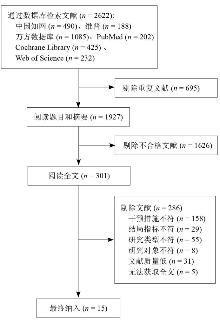
图1
文献筛选流程图"
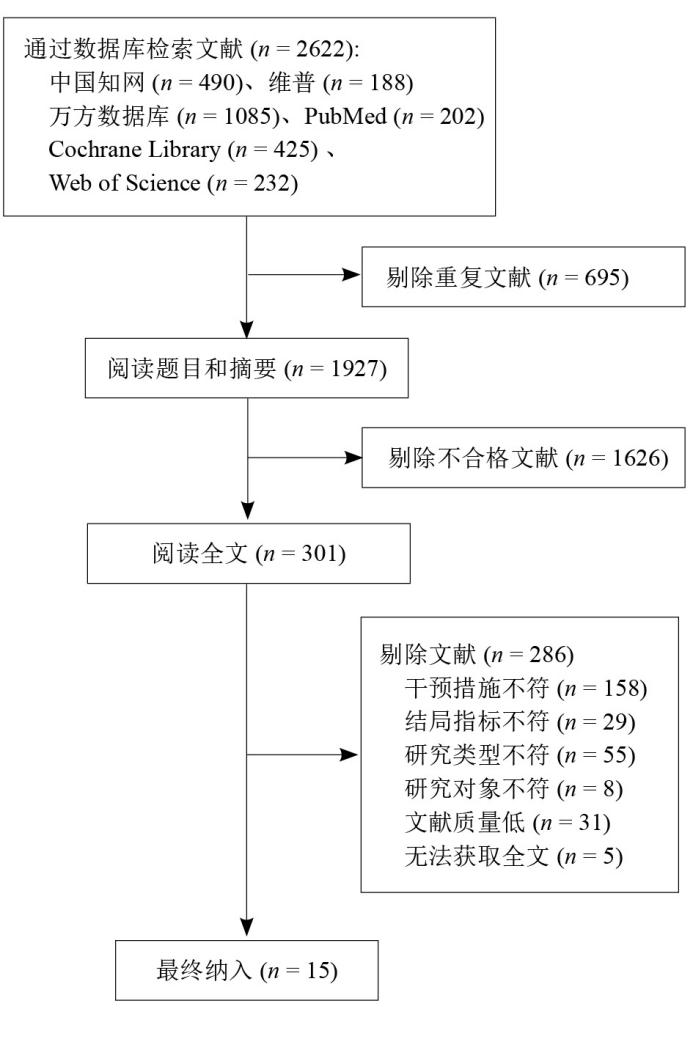
图2
偏倚风险比例"
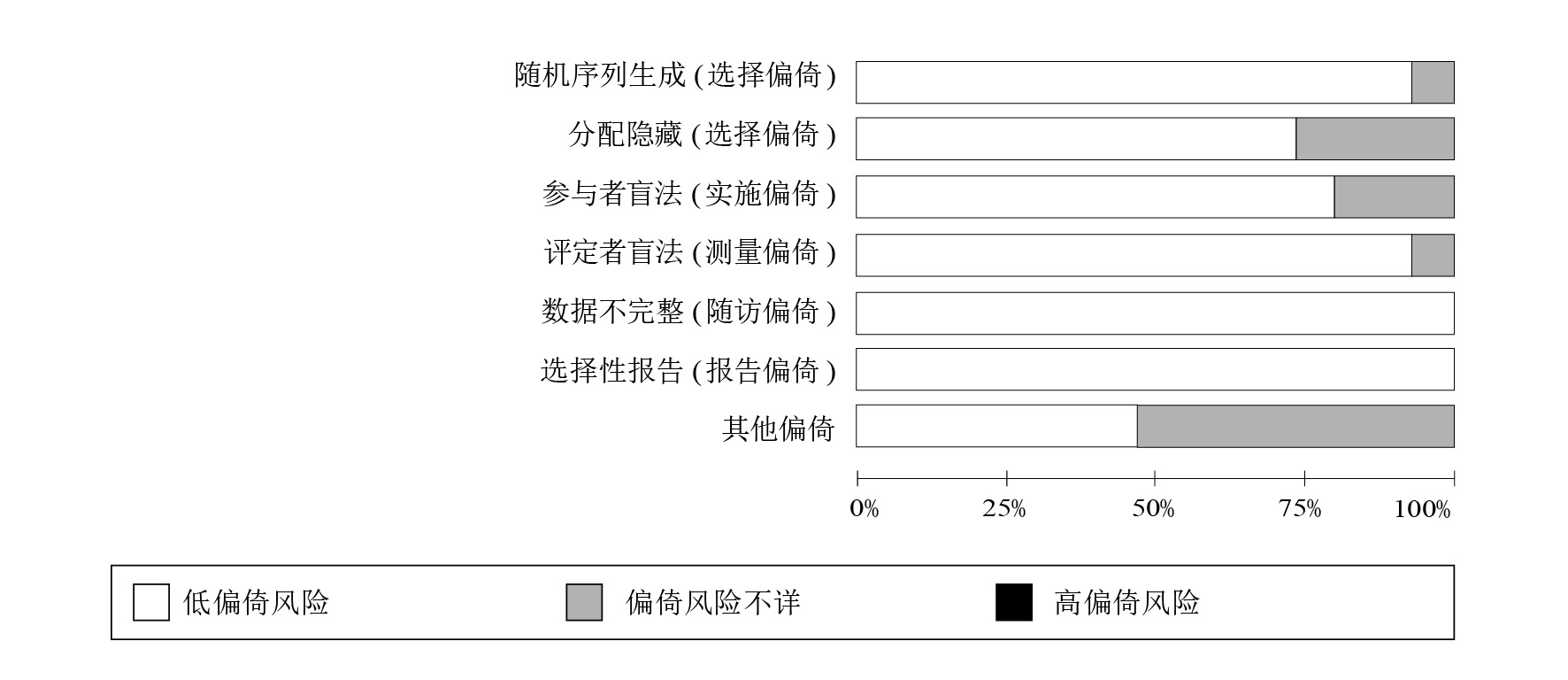
图3
纳入文献偏倚评估"
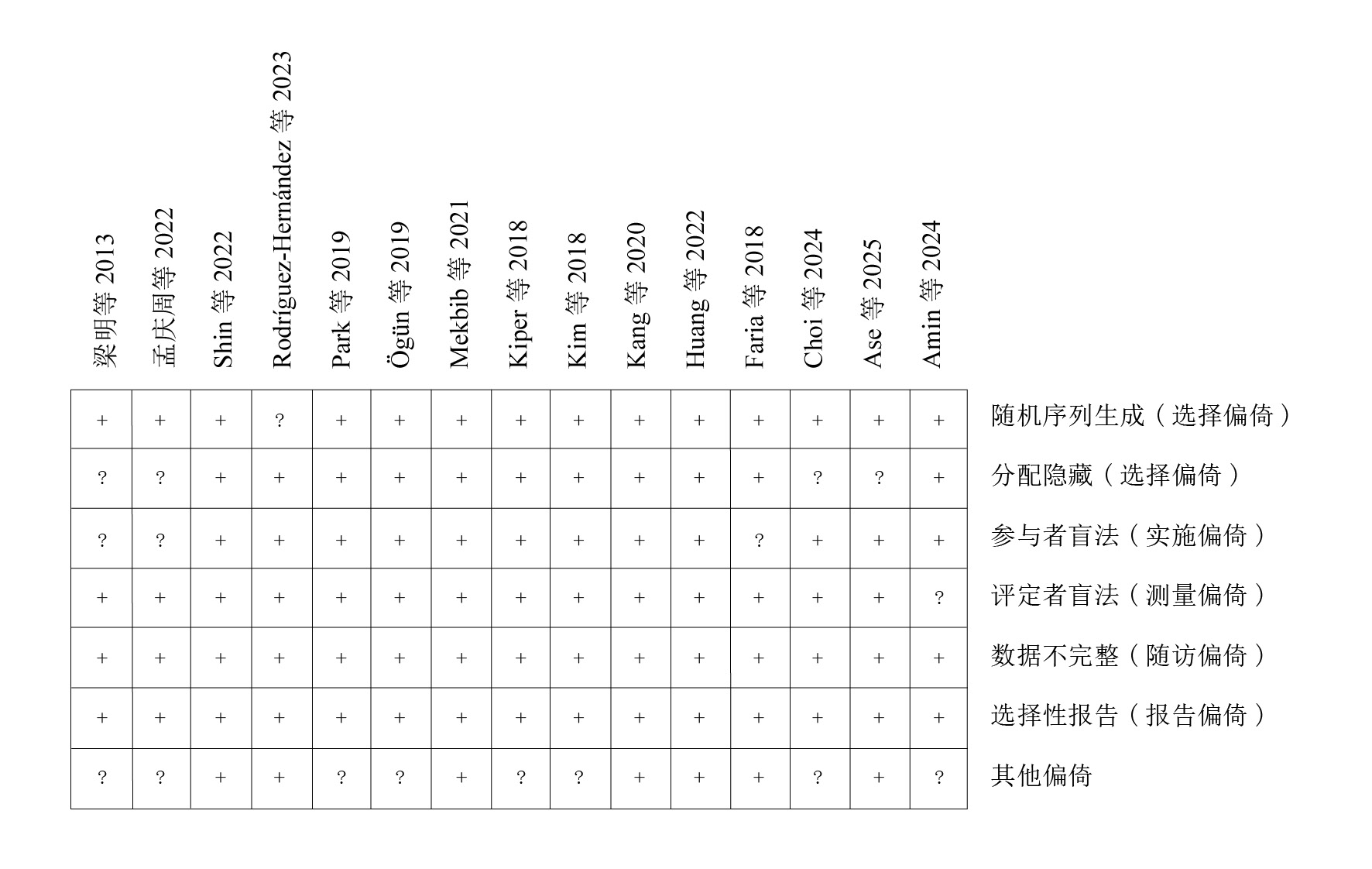
表2
纳入文献的PEDro量表评分"
| 纳入文献 | 明确的纳入与排除标准 | 随机分配 | 分配隐藏 | 基线相似 | 研究对象施盲 | 治疗师施盲 | 结果评估施盲 | 退出率<15% | 意向治疗分析 | 组间统计结果分析 | 点测量和差异值 | 总分 |
|---|---|---|---|---|---|---|---|---|---|---|---|---|
| 梁明等[ | √ | √ | √ | √ | √ | √ | √ | √ | 7 | |||
| Kim等[ | √ | √ | √ | √ | √ | √ | √ | √ | √ | √ | √ | 10 |
| Faria等[ | √ | √ | √ | √ | √ | √ | √ | √ | 7 | |||
| Kiper等[ | √ | √ | √ | √ | √ | √ | √ | √ | √ | √ | √ | 10 |
| Ögün等[ | √ | √ | √ | √ | √ | √ | √ | √ | √ | √ | √ | 10 |
| Park等[ | √ | √ | √ | √ | √ | √ | √ | √ | √ | √ | 9 | |
| Kang等[ | √ | √ | √ | √ | √ | √ | √ | √ | √ | √ | √ | 10 |
| Mekbib等[ | √ | √ | √ | √ | √ | √ | √ | √ | √ | √ | 9 | |
| Huang等[ | √ | √ | √ | √ | √ | √ | √ | √ | √ | √ | √ | 10 |
| Shin等[ | √ | √ | √ | √ | √ | √ | √ | √ | √ | √ | 9 | |
| 孟庆周等[ | √ | √ | √ | √ | √ | √ | √ | √ | 7 | |||
| Rodríguez-Hernández等[ | √ | √ | √ | √ | √ | √ | √ | √ | √ | √ | √ | 10 |
| Amin等[ | √ | √ | √ | √ | √ | √ | √ | √ | √ | √ | 9 | |
| Choi等[ | √ | √ | √ | √ | √ | √ | √ | √ | √ | √ | 9 | |
| Ase等[ | √ | √ | √ | √ | √ | √ | √ | √ | √ | √ | 9 |
表3
纳入研究基本特征"
| 纳入文献 | 国家 | n(C/T) | 性别(男/女)/n | 年龄 (C/T)/岁 | 病程(C/T) | 干预措施 | 干预频率 | 干预周期 | 结局指标 | |
|---|---|---|---|---|---|---|---|---|---|---|
| C | T | |||||||||
| 梁明等[ | 中国 | 17/16 | 23/10 | (58.82±15.03)/(56.75±13.57) | (3.06±1.50)个月/(3.38±1.57)个月 | 常规OT | 常规OT+VR训练 | 每次40 min,每天1次,每周5 d | 3周 | ①② |
| Kim等[ | 韩国 | 11/12 | 17/6 | (53.5±16.0)/(54.7±14.3) | (15.0±5.3) d/(23.7±14.8) d | 常规OT+假VR | 常规OT+VR训练 | 每次60 min,每天1次,每周5 d | 2周 | ①②④ |
| Faria等[ | 葡萄牙 | 12/12 | 15/9 | (68.9±9.8)/(57.1±11.0) | (41.1±41.0)个月/(24.9±20.3)个月 | 常规OT | 常规OT+VR训练 | 每次90~105 min,每天1次,每周2~3 d | 1个月 | ①② |
| Kiper等[ | 意大利 | 68/68 | 80/56 | (66.0±12.9)/(62.5±15.2) | (4.1±3.2)个月/ (4.4±2.8)个月 | 物理治疗+常规OT | 物理治疗+常规OT+VR训练 | 每次120 min,每天1次,每周5 d | 4周 | ① |
| Ögün等[ | 土耳其 | 32/33 | 51/14 | (59.75±8.07)/(61.48±10.92) | (15.37±9.77) d/(14.72±7.38) d | 物理治疗+常规OT | 物理治疗+常规OT+VR训练 | 每次60 min,每天1次,每周3 d | 6周 | ①⑤ |
| Park等[ | 韩国 | 12/12 | - | (51.5±16.7)/(53.5±13.0) | (533.5±635.3) d/(982.3±1473.3) d | 常规OT | 常规OT+VR训练 | 每次60 min,每天1次,每周5 d | 4周 | ①② |
| Kang等[ | 韩国 | 11/12 | 12/11 | (64.64±13.83)/(50.92±16.68) | (19.00±9.85) d/(30.75±20.01) d | 常规OT | 常规OT+VR训练 | 每次60 min,每天1次,每周5 d | 2周 | ①③④ |
| Mekbib等[ | 中国 | 11/12 | 17/6 | (61.00±7.69)/(52.17±13.26) | (39.36±18.08) d/(36.92±22.04) d | 常规OT | 常规OT+VR训练 | 每次120 min,每天1次,每周4 d | 2周 | ①② |
| Huang等[ | 中国台湾 | 15/15 | 10/20 | (58.33±11.22)/(50.80±12.32) | (17.91±21.25)个月/36.20±42.38个月 | 常规OT | 常规OT+VR训练 | 每次60 min,每天1次,每周2~3 d | 6周 | ① |
| Shin等[ | 韩国 | 16/20 | 17/19 | (63.69±8.58)/(57.00±12.78) | (76.6±28.5) d/(67.1±45.3) d | 常规OT | 常规OT+VR训练 | 每次60 min,每天1次,每周5 d | 4周 | ①③ |
| 孟庆周等[ | 中国 | 32/32 | 49/15 | (57.12±16.32)/(56.81±16.23) | (3.61±1.59)个月/(3.62±1.61)个月 | 常规OT | 常规OT+VR训练 | 每次40 min,每天1次,每周5 d | 3周 | ①② |
| Rodríguez-Hernández 等[ (2023) | 西班牙 | 20/23 | 35/8 | (63.6±12.2)/(62.6±13.5) | (54.2±30.4) d/(55.3±34.3) d | 物理治疗+常规OT | 物理治疗+常规OT+VR训练 | 每次150 min,每天1次,每周5 d | 3周 | ①⑤ |
| Amin等[ | 巴基斯坦 | 26/26 | 34/18 | (49.8±9.9)/(51.8±12.9) | 物理治疗+常规OT | 物理治疗+常规OT+VR训练 | 每次48~80 min,每天1次,每周4 d | 6周 | ①②④⑤ | |
| Choi等[ | 韩国 | 23/23 | 25/21 | (59.30±10.26)/(55.69±9.74) | (9.13±2.46)个月/(8.34±2.16)个月 | 常规OT | 常规OT+VR训练 | 每次40 min,每天1次,每周5 d | 8周 | ①③ |
| Ase等[ | 日本 | 7/7 | 12/2 | (51.4±6.7)/(58.0±6.4) | (4.7±4.2)年/ (5.4±3.7)年 | 门诊OT | 门诊OT+VR训练 | 每次30 min,每天1次,每周5 d | 4周 | ①③④ |
表4
Meta分析结果"
| 结局指标 | 纳入研究数/n | 异质性检验 | 效应模型 | Meta分析 | |||
|---|---|---|---|---|---|---|---|
| I2 | P值 | SMD(95%CI) | Z值 | P值 | |||
| FMA-UE | 15[ | 78% | < 0.001 | 随机 | 0.64(0.28~1.01) | 3.46 | < 0.001 |
| ARAT | 3[ | 40% | 0.187 | 固定 | 1.22(0.88~1.56) | 7.01 | < 0.001 |
| BI/MBI | 7[ | 79% | < 0.001 | 随机 | 0.50(-0.07~1.07) | 1.70 | 0.087 |
| JTT | 4[ | 60% | 0.057 | 随机 | 0.32(-0.29~0.93) | 1.02 | 0.308 |
| BBT | 4[ | 81% | 0.001 | 随机 | 0.50(-0.43~1.43) | 1.06 | 0.289 |
表5
亚组分析结果"
| 结局指标 | 亚组 | 纳入研究数/n | 异质性检验 | Meta分析 | |||
|---|---|---|---|---|---|---|---|
| I2 | P值 | SMD(95%CI) | P值 | ||||
| FMA-UE | 干预周期 | ≥ 4周 | 9[ | 82% | < 0.001 | 0.62(0.11~1.13) | 0.017 |
| < 4周 | 6[ | 72% | 0.003 | 0.68(0.13~1.24) | 0.016 | ||
| 单次干预时间 | ≤ 45 min | 4[ | 78% | 0.004 | 0.89(0.13~1.65) | 0.021 | |
| > 45 min | 11[ | 79% | < 0.001 | 0.56(0.12~0.99) | 0.012 | ||
| BI/MBI | 干预周期 | ≥ 4周 | 3[ | 92% | < 0.001 | 0.68(-0.86~2.21) | 0.385 |
| < 4周 | 4[ | 0% | 0.670 | 0.36(0.03~0.69) | 0.035 | ||
| 单次干预时间 | ≤ 45 min | 2[ | 0% | 0.370 | 0.26(-0.14~0.66) | 0.204 | |
| > 45 min | 5[ | 84% | < 0.001 | 0.64(-0.24~1.52) | 0.150 | ||
| [1] | «中国脑卒中防治报告»编写组. «中国脑卒中防治报告2021»概要[J]. 中国脑血管病杂志, 2023, 20(11): 783-793. |
| Report on Stroke Prevention and Treatment in China Writing Group. Brief report on stroke prevention and treatment in China[J]. Chin J Cerebravasc Dis, 2023, 20(11): 783-793. | |
| [2] | GBD 2019 Stroke Collaborators. Global,regional,and national burden of stroke and its risk factors,1990-2019:a systematic analysis for the global burden of disease study 2019[J]. Lancet Neurol, 2021, 20(10): 795-820. |
| [3] | Kwakkel G, Stinear C, Essers B, et al. Motor rehabilitation after stroke: European Stroke Organisation (ESO) consensus-based definition and guiding framework[J]. Eur Stroke J, 2023, 8(4): 880-894. |
| [4] | 徐悦莹, 郑洁皎, 高文, 等. 基于WHO-FICs作业治疗改善脑卒中上肢功能效果的系统综述[J]. 中国康复理论与实践, 2023, 29(2): 140-150. |
| Xu Y Y, Zheng J J, Gao W, et al. Effects of occupational therapy on upper extremity for patients with stroke: a systematic review using WHO-FICs[J]. Chin J Rehabil Theory Pract, 2023, 29(2): 140-150. | |
| [5] | Alsubiheen A M, Choi W, Yu W, et al. The effect of task-oriented activities training on upper-limb function, daily activities, and quality of life in chronic stroke patients: a randomized controlled trial[J]. Int J Environ Res Public Health, 2022, 19(21): 14125. |
| [6] | Almhdawi K A, Mathiowetz V G, White M, et al. Efficacy of occupational therapy task-oriented approach in upper extremity post-stroke rehabilitation[J]. Occup Ther Int, 2016, 23(4): 444-456. |
| [7] | Ceradini M, Losanno E, Micera S, et al. Immersive VR for upper-extremity rehabilitation in patients with neurological disorders: a scoping review[J]. J Neuroeng Rehabil, 2024, 21(1): 75. |
| [8] | Zak M, Wasik M, Sikorski T, et al. Rehabilitation in older adults affected by immobility syndrome, aided by virtual reality technology: a narrative review[J]. J Clin Med, 2023, 12(17): 5675. |
| [9] | 孙振宇, 朱颖, 周丹, 等. 虚拟现实上肢康复机器人训练结合常规作业疗法对脑卒中患者上肢功能和生活质量的影响[J]. 现代医学与健康研究电子杂志, 2025, 9(20): 142-144. |
| Sun Z Y, Zhu Y, Zhou D, et al. Effects of virtual reality upper limb rehabilitation robot training combined with conventional occupational therapy on upper limb function and quality of life in stroke patients[J]. Mod Med Health Res, 2025, 9(20): 142-144. | |
| [10] | Page M J, Moher D, Bossuyt P M, et al. PRISMA 2020 explanation and elaboration: updated guidance and exemplars for reporting systematic reviews[J]. BMJ, 2021, 372: n160. |
| [11] | 邱卓英, 李伦, 陈迪, 等. 基于世界卫生组织国际健康分类家族康复指南研究:理论架构和方法体系[J]. 中国康复理论与实践, 2020, 26(2): 125-135. |
| Qiu Z Y, Li L, Chen D, et al. Research on rehabilitation guidelines using World Health Organization Family International Classifications: framework and approaches[J]. Chin J Rehabil Theory Pract, 2020, 26(2): 125-135. | |
| [12] | 中华医学会神经病学分会, 中华医学会神经病学分会脑血管病学组. 中国各类主要脑血管病诊断要点2019[J]. 中华神经科杂志, 2019, 52(9): 710-715. |
| Chinese Society of Neurology, Chinese Stroke Society. Diagnostic criteria of cerebrovascular diseases in China (version 2019)[J]. Chinese J Neurol, 2019, 52(9): 710-715. | |
| [13] | Cumpston M, Li T, Page M J, et al. Updated guidance for trusted systematic reviews: a new edition of the Cochrane Handbook for Systematic Reviews of Interventions[J]. Cochrane Database Syst Rev, 2019, 10(10): Ed000142. |
| [14] | Moseley A M, Elkins M R, Van Der Wees P J, et al. Using research to guide practice: The Physiotherapy Evidence Database (PEDro)[J]. Braz J Phys Ther, 2020, 24(5): 384-391. |
| [15] | 梁明, 窦祖林, 王清辉, 等. 虚拟现实技术在脑卒中患者偏瘫上肢功能康复中的应用[J]. 中国康复医学杂志, 2013, 28(2): 114-118. |
| Liang M, Dou Z L, Wang Q H, et al. Application of virtual reality technique in rehabilitation of hemiplegic upper extremities function of stroke patients[J]. Chin J Rehabil Med, 2013, 28(2): 114-118. | |
| [16] | Kim W S, Cho S, Park S H, et al. A low cost kinect-based virtual rehabilitation system for inpatient rehabilitation of the upper limb in patients with subacute stroke: a randomized, double-blind, sham-controlled pilot trial[J]. Medicine (Baltimore), 2018, 97(25): e11173. |
| [17] | Faria A L, Cameirão M S, Couras J F, et al. Combined cognitive-motor rehabilitation in virtual reality improves motor outcomes in chronic stroke: a pilot study[J]. Front Psychol, 2018, 9: 854. |
| [18] | Kiper P, Szczudlik A, Agostini M, et al. Virtual reality for upper limb rehabilitation in subacute and chronic stroke: a randomized controlled trial[J]. Arch Phys Med Rehabil, 2018, 99(5): 834-842. |
| [19] | Ögün M N, Kurul R, Yaşar M F, et al. Effect of leap motion-based 3D immersive virtual reality usage on upper extremity function in ischemic stroke patients[J]. Arq Neuropsiquiatr, 2019, 77(10): 681-688. |
| [20] | Park M, Ko M H, Oh S W, et al. Effects of virtual reality-based planar motion exercises on upper extremity function, range of motion, and health-related quality of life: a multicenter, single-blinded, randomized, controlled pilot study[J]. J Neuroeng Rehabil, 2019, 16(1): 122. |
| [21] | Kang M G, Yun S J, Lee S Y, et al. Effects of upper-extremity rehabilitation using smart glove in patients with subacute stroke: results of a prematurely terminated multicenter randomized controlled trial[J]. Front Neurol, 2020, 11: 580393. |
| [22] | Mekbib D B, Debeli D K, Zhang L, et al. A novel fully immersive virtual reality environment for upper extremity rehabilitation in patients with stroke[J]. Ann N Y Acad Sci, 2021, 1493(1): 75-89. |
| [23] | Huang C Y, Chiang W C, Yeh Y C, et al. Effects of virtual reality-based motor control training on inflammation, oxidative stress, neuroplasticity and upper limb motor function in patients with chronic stroke: a randomized controlled trial[J]. BMC Neurol, 2022, 22(1): 21. |
| [24] | Shin S, Lee H J, Chang W H, et al. A smart glove digital system promotes restoration of upper limb motor function and enhances cortical hemodynamic changes in subacute stroke patients with mild to moderate weakness: a randomized controlled trial[J]. J Clin Med, 2022, 11(24): 7343. |
| [25] | 孟庆周, 朱佳萍, 李进飞, 等. 虚拟厨房上肢康复训练联合常规作业治疗对脑卒中上肢偏瘫康复的临床疗效[J]. 中外医药研究, 2022, 1(3): 15-17. |
| Meng Q Z, Zhu J P, Li J F, et al. Clinical efficacy of virtual kitchen upper limb rehabilitation training combined with conventional occupational therapy in stroke patients with hemiplegic upper limb recovery[J]. J Chin Foreign Med Pharm Res, 2022, 1(3): 15-17. | |
| [26] | Rodríguez-Hernández M, Polonio-López B, Corregidor-Sánchez A I, et al. Can specific virtual reality combined with conventional rehabilitation improve poststroke hand motor function? A randomized clinical trial[J]. J Neuroeng Rehabil, 2023, 20(1): 38. |
| [27] | Amin F, Waris A, Syed S, et al. Effectiveness of immersive virtual reality-based hand rehabilitation games for improving hand motor functions in subacute stroke patients[J]. IEEE Trans Neural Syst Rehabil Eng, 2024, 32: 2060-2069. |
| [28] | Choi J B, Cho K I. Effects of virtual reality-based robot therapy combined with task-oriented therapy on upper limb function and cerebral cortex activation in patients with stroke[J]. Medicine (Baltimore), 2024, 103(27): e38723. |
| [29] | Ase H, Honaga K, Tani M, et al. Effects of home-based virtual reality upper extremity rehabilitation in persons with chronic stroke: a randomized controlled trial[J]. J Neuroeng Rehabil, 2025, 22(1): 20. |
| [30] | Tater P, Pandey S. Post-stroke movement disorders: clinical spectrum, pathogenesis, and management[J]. Neurol India, 2021, 69(2): 272-283. |
| [31] | Mehrabi S, Flores-Sandoval C, Fleet J L, et al. Time post-stroke and upper extremity stroke motor recovery rehabilitation: a meta-analysis[J]. Neurorehabil Neural Repair, 2025, 39(11): 945-953. |
| [32] | 杨晓龙, 杨亚茹, 邱服冰, 等. 基于ICF的作业治疗:理论架构与方法体系[J]. 中国康复理论与实践, 2022, 28(6): 621-629. |
| Yang X L, Yang Y R, Qiu F B, et al. Application of ICF in occupational therapy: conceptual framework and approaches[J]. Chin J Rehabil Theory Pract, 2022, 28(06): 621-629. | |
| [33] | Laver K E, Lange B, George S, et al. Virtual reality for stroke rehabilitation[J]. Cochrane Database Syst Rev, 2025, 6(6): Cd008349. |
| [34] | 李孝熠, 李天伦, 李哲. 虚拟现实技术应用于脑卒中康复领域近十年研究的可视化分析[J]. 神经损伤与功能重建, 2022, 17(7): 373-377. |
| Li X Y, Li T L, Li Z. Virtual reality technology for stroke in recent ten years: a bibliometric analysis[J]. Neur Injury Funct Reconstr, 2022, 17(7): 373-377. | |
| [35] | Leong S C, Tang Y M, Toh F M, et al. Examining the effectiveness of virtual, augmented, and mixed reality (VAMR) therapy for upper limb recovery and activities of daily living in stroke patients: a systematic review and meta-analysis[J]. J Neuroeng Rehabil, 2022, 19(1): 93. |
| [36] | Dordevic M, Wendt C, Külzow N, et al. Additional VR-based training improves upper extremity functions in subacute stroke patients: a single-blinded pairwise-matched trial[J]. Front Neurol, 2025, 16: 1711528. |
| [37] | Liu Y, Li J H, Tao J Y, et al. Virtual reality combined with task-oriented circuit training for upper limb rehabilitation in subacute stroke patients: a randomized controlled trial[J]. Medicine (Baltimore), 2025, 104(31): e43505. |
| [38] | Navas-Otero A, Canal-Pérez A, Martín-Núñez J, et al. Rehabilitation applied with virtual reality improves functional capacity in post-stroke patients. A systematic review and meta-analysis[J]. Rehabilitacion (Madr), 2025, 59(2): 100907. |
| [39] | Oagaz H, Schoun B, Choi M H. Performance improvement and skill transfer in table tennis through training in virtual reality[J]. IEEE Trans Vis Comput Graph, 2022, 28(12): 4332-4343. |
| [40] | Alt Murphy M, Munoz-Novoa M, Heremans C, et al. European Stroke Organisation (ESO) guideline on motor rehabilitation[J]. Eur Stroke J, 2025, 10(4): 1160-1188. |
| [1] | 周洁, 何志成, 张晓钰, 王雪, 刘大美, 宋宁, 吴珺. 视动整合训练对脑卒中后单侧空间忽略的效果[J]. 《中国康复理论与实践》, 2026, 32(7): 745-751. |
| [2] | 黄耀辉, 叶祥明, 刘勇, 唐沛, 卢逸舒. 重复经颅磁刺激对脑卒中后慢性意识障碍的效果[J]. 《中国康复理论与实践》, 2026, 32(7): 752-759. |
| [3] | 单桂香, 杜巨豹, 曹磊, 叶琳琳, 姜春静, 张晔, 马慧娟, 宋为群. 基于超声的脑卒中患者膈肌功能的特征分析[J]. 《中国康复理论与实践》, 2026, 32(7): 760-767. |
| [4] | 张费, 傅博勋, 沈慧, 陈进. 基于镜像神经元理论的动作观察疗法联合低频重复经颅磁刺激对脑卒中后单侧空间忽略的效果[J]. 《中国康复理论与实践》, 2026, 32(7): 768-775. |
| [5] | 樊留博, 单婷婷, 刘宝华, 罗咪咪, 张露丁, 王明慧. 超声引导联合改良导管球囊定位下不同剂量A型肉毒毒素治疗脑卒中后环咽肌功能障碍的效果[J]. 《中国康复理论与实践》, 2026, 32(7): 776-787. |
| [6] | 敦士博, 李玉周. 血流限制训练对脑卒中下肢运动功能康复效果的Meta分析[J]. 《中国康复理论与实践》, 2026, 32(7): 797-806. |
| [7] | 袁依依, 田武超, 张献斌, 钞强, 李永生, 刘桂新, 吴万庆, 王朴. 双任务训练对脑卒中患者移动和平衡功能康复疗效的Meta分析[J]. 《中国康复理论与实践》, 2026, 32(7): 807-816. |
| [8] | 李欣源, 郑洁皎, 张廷宇, 吴雪娇, 梁晓笑. 间歇性θ脉冲刺激改善脑卒中患者下肢运动和平衡功能的Meta分析[J]. 《中国康复理论与实践》, 2026, 32(6): 631-644. |
| [9] | 高惠刚, 刘远文, 秦煜玲, 胡昔权, 朱琳. 2020年至2025年足踝软体外骨骼机器人改善脑卒中患者步行功能的Scoping综述[J]. 《中国康复理论与实践》, 2026, 32(6): 645-652. |
| [10] | 李雯, 闫欣越, 黄秋晨, 张睿, 孙悦梅, 周越. 神经肌肉电刺激对人工全膝置换术后患者康复效果的Meta分析[J]. 《中国康复理论与实践》, 2026, 32(6): 653-664. |
| [11] | 申婷婷, 刘东斐. 运动干预对唐氏综合征成人患者多维健康结局影响的Meta分析[J]. 《中国康复理论与实践》, 2026, 32(6): 677-689. |
| [12] | 韩天星, 刘昊天, 徐子淇, 彭晓涵, 王杨, 曹丹娜. 基于静息态磁共振功能成像对阿尔茨海默病轻度认知障碍期默认网络与内侧颞叶区脑功能连接研究的Meta分析[J]. 《中国康复理论与实践》, 2026, 32(5): 522-533. |
| [13] | 刘睿, 高振梅, 周星宇, 张琦, 吴建林. 2015年至2025年数字健康技术在脑卒中上肢运动功能康复中应用的文献计量分析[J]. 《中国康复理论与实践》, 2026, 32(5): 534-549. |
| [14] | 倪天皓, 毕思雨, 戴媛, 钱红, 王勇丽, 万勤, 黄昭鸣. 汉语普通话言语失用症评估诊断工具的编制与验证[J]. 《中国康复理论与实践》, 2026, 32(5): 550-560. |
| [15] | 安咏怡, 李雪梅, 常学优, 赵雅宁, 黄海玲, 杨亚东. 不同强度血流限制训练联合低强度抗阻训练对老年脑卒中衰弱患者运动功能的影响[J]. 《中国康复理论与实践》, 2026, 32(5): 561-570. |
| 阅读次数 | ||||||
|
全文 |
|
|||||
|
摘要 |
|
|||||
|
||
