



《中国康复理论与实践》 ›› 2026, Vol. 32 ›› Issue (7): 797-806.doi: 10.3969/j.issn.1006-9771.2026.07.007
敦士博, 李玉周( )
收稿日期:2026-03-23
修回日期:2026-05-12
接受日期:2026-05-14
出版日期:2026-07-25
发布日期:2026-07-30
通讯作者:
李玉周,E-mail: yuzhouli2003@163.com作者简介:敦士博(2000-),男,汉族,河南安阳市人,硕士研究生,主要研究方向:运动康复。基金资助:
Dun Shibo, Li Yuzhou()
Received:2026-03-23
Revised:2026-05-12
Accepted:2026-05-14
Published:2026-07-25
Online:2026-07-30
Supported by:摘要:
目的 系统评价血流限制训练(BFRT)辅助康复干预对脑卒中患者下肢运动功能、平衡能力、步行耐力和日常生活活动能力的康复效果。
方法 计算机检索中国知网、万方数据、PubMed、Embase、Cochrane Library和Web of Science数据库,搜集建库至2026年1月31日发表的BFRT联合康复训练干预脑卒中患者的随机对照试验(RCT)。由2名研究人员依据PICO原则独立完成文献筛选、数据提取和偏倚风险评价,采用RevMan 5.4.1及Stata 17.0软件进行Meta分析、亚组分析和敏感性分析。
结果 最终纳入15篇文献,共712例脑卒中患者,其中对照组354例,试验组358例。相较于常规康复,联合BFRT干预可显著提升患者Fugl-Meyer评定量表下肢部分评分(MD = 1.77, 95%CI 0.02~3.52, P = 0.047)、Berg平衡量表评分(MD = 5.39, 95%CI 2.20~8.59, P < 0.001)和6分钟步行测试距离(MD = 10.24, 95%CI 7.76~12.72, P < 0.001);两组间改良Barthel指数和起立-行走计时测试无显著性差异(P > 0.05)。亚组分析提示,干预周期 > 4周、BFRT联合抗阻训练的干预方案效果更优。
结论 BFRT作为辅助康复手段,可显著改善脑卒中患者下肢运动功能、平衡能力和步行耐力,对日常生活活动能力和功能性移动能力的改善效果尚不明确。临床优先推荐> 4周的BFRT联合抗阻训练方案,适用于病情稳定、具备基础行走能力、无认知障碍的慢性期脑卒中患者。
中图分类号:
敦士博, 李玉周. 血流限制训练对脑卒中下肢运动功能康复效果的Meta分析[J]. 《中国康复理论与实践》, 2026, 32(7): 797-806.
Dun Shibo, Li Yuzhou. Effect of blood flow restriction training on lower-limb motor function after stroke: a meta-analysis[J]. Chinese Journal of Rehabilitation Theory and Practice, 2026, 32(7): 797-806.

表1
PICO架构"
| 人群(Population) | 干预(Intervention) | 比较(Comparison) | 结局(Outcome) |
|---|---|---|---|
| 脑卒中患者 明确诊断为脑卒中并存在下肢运动功能障碍 | BFRT联合其他训练 | 不含BFRT的常规康复训练或其他训练 | FMA-LE BBS 6MWT MBI TUGT |
图1
文献筛选流程图"
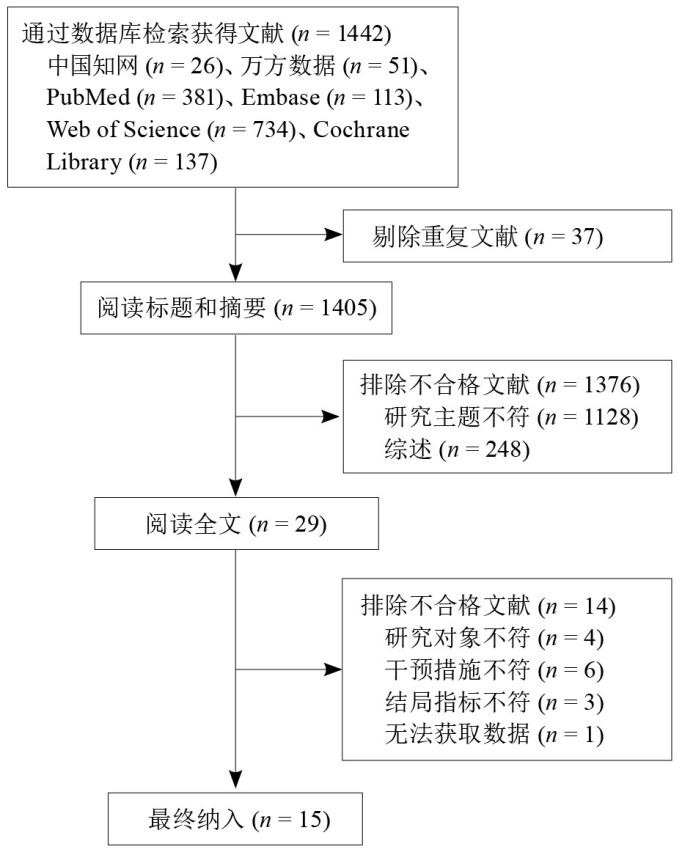
图2
偏倚风险图"
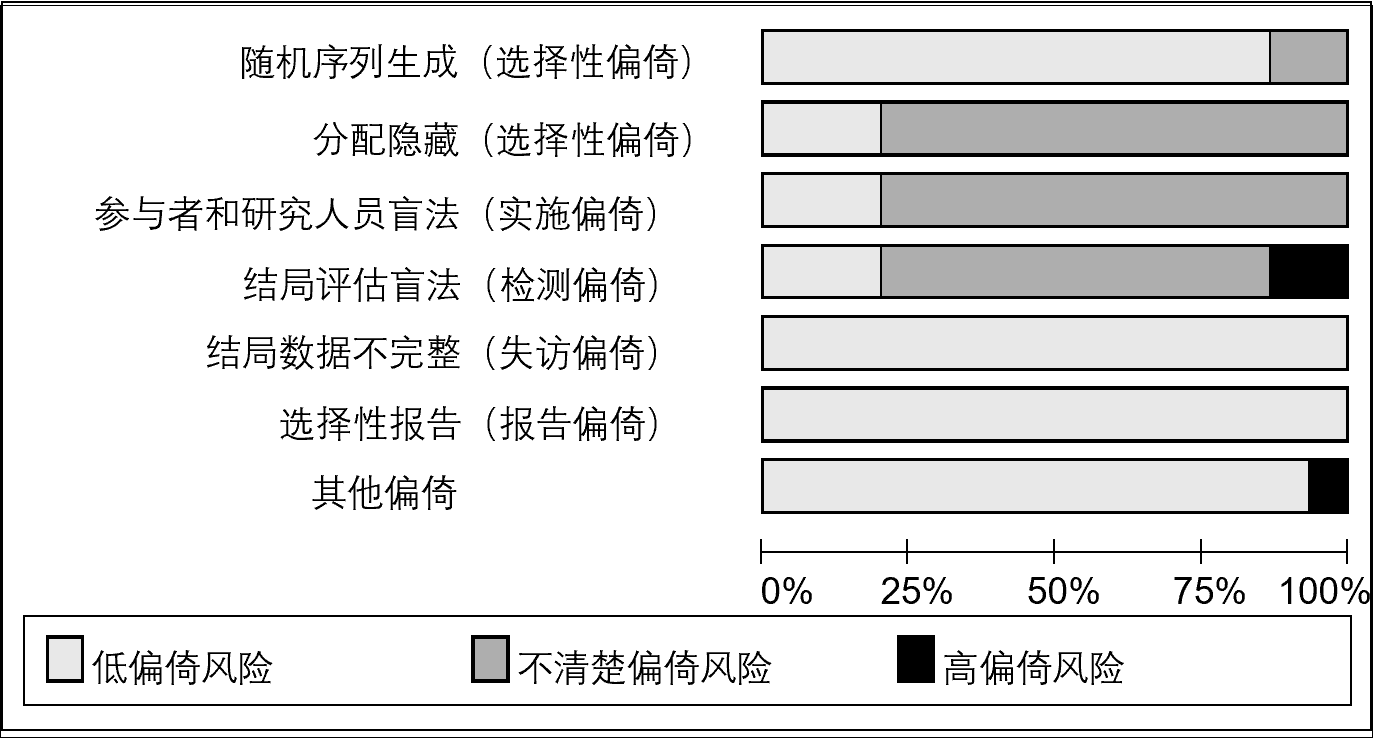
图3
纳入文献偏倚评估"
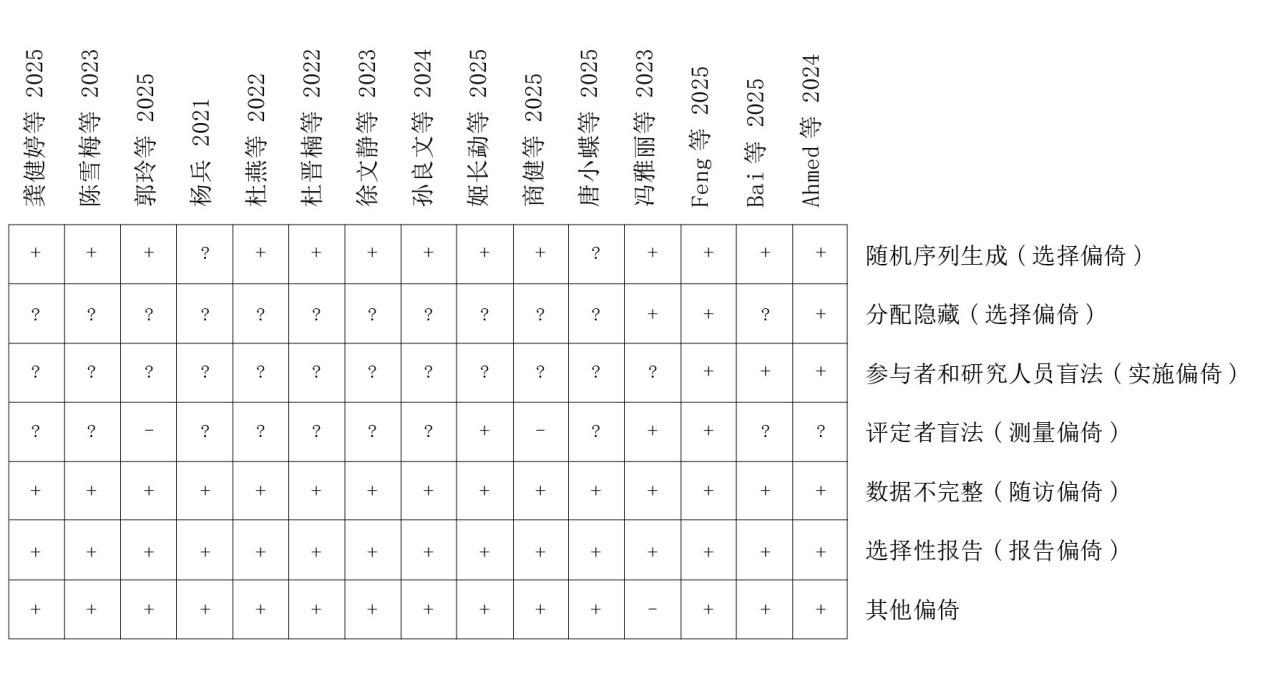
表2
纳入文献的PEDro量表评分"
| 纳入文献 | 明确纳入排除标准 | 随机分配 | 分配隐藏 | 基线相似 | 研究对象施盲 | 治疗师施盲 | 结果评估施盲 | 退出率< 15% | 意向治疗分析 | 组间统计结果分析 | 点测量和差异值 | 总分 |
|---|---|---|---|---|---|---|---|---|---|---|---|---|
| 杨兵[ | √ | √ | √ | √ | √ | 4 | ||||||
| 徐文静等[ | √ | √ | √ | √ | √ | √ | 5 | |||||
| 唐小蝶等[ | √ | √ | √ | √ | √ | 4 | ||||||
| 孙良文等[ | √ | √ | √ | √ | √ | √ | 5 | |||||
| 商健等[ | √ | √ | √ | √ | √ | √ | 5 | |||||
| 姬长勐等[ | √ | √ | √ | √ | √ | √ | 5 | |||||
| 郭玲等[ | √ | √ | √ | √ | √ | √ | 5 | |||||
| 龚健婷等[ | √ | √ | √ | √ | √ | √ | 5 | |||||
| 冯雅丽等[ | √ | √ | √ | √ | √ | √ | 5 | |||||
| 杜燕等[ | √ | √ | √ | √ | √ | √ | 5 | |||||
| 杜晋楠等[ | √ | √ | √ | √ | √ | √ | 5 | |||||
| 陈雪梅等[ | √ | √ | √ | √ | √ | √ | 5 | |||||
| Feng等[ | √ | √ | √ | √ | √ | √ | √ | √ | 7 | |||
| Bai等[ | √ | √ | √ | √ | √ | √ | √ | 6 | ||||
| Ahmed等[ | √ | √ | √ | √ | √ | √ | √ | √ | 7 |
表3
纳入文献基本特征"
| 纳入文献 | 国家 | 性别(男/女)/n | 年龄/岁 | 卒中类型 | 干预措施 | ||||
|---|---|---|---|---|---|---|---|---|---|
| C | T | C | T | C | T | ||||
| 杨兵[ | 中国 | 14/19 | 15/18 | 46.26±5.21 | 46.21±4.98 | 出血/梗死 | 抗阻训练 | 抗阻训练联合BFRT | |
| 徐文静等[ | 中国 | 24/5 | 19/10 | 59.41±11.85 | 60.10±11.22 | 未报告 | 常规康复训练+踏车抗阻训练 | 常规康复训练+踏车抗阻训练联合BFRT | |
| 唐小蝶等[ | 中国 | 14/2 | 13/3 | 52±9 | 52±12 | 缺血 | 常规康复训练 | 常规康复训练联合BFRT | |
| 孙良文等[ | 中国 | 18/7 | 15/12 | 71.32±4.21 | 70.70 ±4.91 | 缺血/出血 | 常规康复训练 | 常规康复训练+全身振动训练联合BFRT | |
| 商健等[ | 中国 | 14/6 | 16/4 | 54.27±7.18 | 54.40±6.86 | 首次单侧卒中 | 常规康复训练+悬吊训练 | 常规康复训练+悬吊训练联合BFRT | |
| 姬长勐等[ | 中国 | 16/7 | 15/8 | 62.13±10.44 | 62.43±12.05 | 出血/梗死 | 常规康复训练+功率自行车有氧训练 | 常规康复训练+功率自行车有氧训练联合BFRT | |
| 郭玲等[ | 中国 | 14/6 | 13/7 | 62.95±7.26 | 62.15±7.36 | 出血/梗死 | 常规康复训练+悬吊训练 | 常规康复训练+悬吊训练联合BFRT | |
| 龚健婷等[ | 中国 | 13/13 | 17/9 | 61.69±9.10 | 57.50±12.17 | 梗死/出血 | 常规康复训练+头针治疗+常规踏车训练 | 常规康复训练+头针治疗+常规踏车训练联合BFRT | |
| 冯雅丽等[ | 中国 | 11/3 | 10/5 | 45.29±13.74 | 54.07±10.44 | 未报告 | 常规康复+运动训练 | 常规康复+运动训练联合BFRT | |
| 杜燕等[ | 中国 | 17/13 | 18/12 | 67.2±10.8 | 66. 8±11.2 | 首次单侧卒中 | 抗阻训练 | 抗阻训练联合BFRT | |
| 杜晋楠等[ | 中国 | 18/12 | 17/13 | 51.8±4.2 | 52.1±3.9 | 脑卒中 | 常规康复训练+rTMS | 常规康复训练+rTMS联合BFRT | |
| 陈雪梅等[ | 中国 | 21/15 | 22/13 | 66.9±11.7 | 65.8±10.2 | 单侧新发梗死 | 低强度抗阻训练 | 低强度抗阻训练联合BFRT | |
| Feng等[ | 中国 | 17 | 19 | 44.85±12.99 | 52.70±11.12 | 缺血/出血 | 运动训练 | 运动训练联合BFRT | |
| Bai等[ | 中国 | 11/9 | 12/8 | 60.9±10.3 | 61.7±9.6 | 缺血 | 热身+踏车抗阻训练 | 热身+踏车抗阻训练联合BFRT | |
| Ahmed等[ | 土耳其 | 9/6 | 10/5 | 54.73±14.08 | 54.20±13.19 | 单侧缺血 | 高强度抗阻训练 | 有氧训练+低强度抗阻联合BFRT | |
表4
纳入文献BFRT参数及结局"
| 纳入文献 | 干预处方 | 绑带类型/cm | 压力模式/mmHg | 施压位置 | 结局指标 |
|---|---|---|---|---|---|
| 杨兵[ | 每次30~40 min,每周5次,共6周 | 充气尼龙加压带(7) | 固定绝对压力(160~170) | 股骨中段 | ① |
| 徐文静等[ | 每次20 min,每周6次,共2周 | 止血带(-) | 固定绝对压力(200) | 股骨中段 | ② |
| 唐小蝶等[ | 每次15~30 min,每周5次,共2周 | 专用充气袖带(-) | 固定绝对压力(70) | 大腿近端 | ① |
| 孙良文等[ | 每次9 min,每周5次,共6周 | 止血袖带(9) | 相对压力(140~200) | 大腿近端 | ①③ |
| 商健等[ | 每次30 min,每周5次,共4周 | BFR训练带(-) | 固定绝对压力(200) | 股骨中段 | ②④ |
| 姬长勐等[ | 每次20 min,每周5次,共8周 | Theratools血流限制训练带(10) | 固定绝对压力(160) | 大腿近端 | ③ |
| 郭玲等[ | 每次30 min,共4周 | 加压血流限制训练带(-) | 固定绝对压力(200) | 股骨中段 | ①②④ |
| 龚健婷等[ | 每次20 min,每周12次,共4周 | Theratools血流限制训练带(-) | 固定绝对压力(120) | 大腿近端 | ① |
| 冯雅丽等[ | 每次20 min,每周7次,共3周 | B STRONG加压带(-) | 绝对压力区间(160~200) | 大腿近端 | ②⑤④ |
| 杜燕等[ | 每次30 min,每周5次,共8周 | 止血袖带(7) | 相对压力(140~200) | 股骨中段 | ①②④ |
| 杜晋楠等[ | 每次20 min,每周5次,共6周 | B STRONG加压带(-) | 固定绝对压力(250) | 股骨中段 | ②③④ |
| 陈雪梅等[ | 每次30 min,每周5次,共12周 | 止血袖带(7) | 相对压力(140~200) | 股骨中段 | ④ |
| Feng等[ | 每次30 min,共4周 | B STRONG加压带(-) | 绝对压力区间(160~200) | 大腿近端 | ②⑤ |
| Bai等[ | 每次20 min,每周5次,共4周 | B STRONG气动袖带(7) | 固定绝对压力(200) | 大腿近端 | ② |
| Ahmed等[ | 每次40 min,每周3次,共5周 | 血压袖带(-) | 绝对压力区间(150~160) | 下肢近端 | ③⑤ |
表5
Meta分析结果"
| 结局指标 | 纳入研究数/n | 异质性检验 | 效应模型 | Meta分析结果 | ||
|---|---|---|---|---|---|---|
| I² | P值 | MD(95%CI) | P值 | |||
| FMA-LE | 8[ | 76% | < 0.001 | 随机 | 1.77(0.02~3.52) | 0.047 |
| BBS | 6[ | 91% | < 0.001 | 随机 | 5.39(2.20~8.59) | < 0.001 |
| MBI | 6[ | 90% | < 0.001 | 随机 | 4.77(-1.15~10.70) | 0.114 |
| 6MWT | 4[ | 47% | 0.132 | 固定 | 10.24(7.76~12.72) | < 0.001 |
| TUGT | 3[ | 0% | 0.445 | 固定 | 4.02(-2.08~10.11) | 0.197 |
表6
干预周期对FMA-LE评分影响的亚组分析"
| 干预周期 | MD(95%CI) | Z值 | P值 | P交互值 | 异质性 | |
|---|---|---|---|---|---|---|
| I² | P值 | |||||
| ≤ 4周[ | 0.54(-0.61~1.69) | 0.92 | 0.358 | 0.004 | 15% | 0.318 |
| > 4周[ | 4.38(2.00~6.77) | 3.60 | < 0.001 | 71% | 0.065 | |
表7
基础训练方式对FMA-LE评分影响的亚组分析"
| 基础训练 | MD(95%CI) | Z值 | P值 | P交互值 | 异质性 | |
|---|---|---|---|---|---|---|
| I² | P值 | |||||
| 抗阻训练[ | 2.19(-0.02~4.39) | 1.94 | 0.052 | 0.41 | 62% | 0.071 |
| 悬吊训练[ | 0.47(-0.85~1.80) | 0.70 | 0.484 | 0% | 0.424 | |
| 综合训练[ | 1.64(-3.82~7.10) | 0.59 | 0.555 | 85% | 0.002 | |
表8
基础训练方式对BBS评分影响的亚组分析"
| 基础训练 | MD(95%CI) | Z值 | P值 | P交互值 | 异质性 | |
|---|---|---|---|---|---|---|
| I² | P值 | |||||
| 抗阻训练[ | 7.60(5.74~9.45) | 8.02 | < 0.001 | 0.048 | 0% | 0.660 |
| 综合训练[ | 3.24(-0.67~7.15) | 1.62 | 0.105 | 94% | < 0.001 | |
表9
基础训练方式对MBI评分影响的亚组分析"
| 基础训练 | MD(95%CI) | Z值 | P值 | P交互值 | 异质性 | |
|---|---|---|---|---|---|---|
| I² | P值 | |||||
| 抗阻训练[ | 11.82(9.08~14.57) | 8.44 | < 0.001 | < 0.001 | 0% | 0.639 |
| 悬吊训练[ | -1.33(-4.44~1.78) | 0.84 | 0.401 | 0% | 0.777 | |
| 综合训练[ | 3.27(-12.60~19.15) | 0.40 | 0.689 | 91% | 0.001 | |
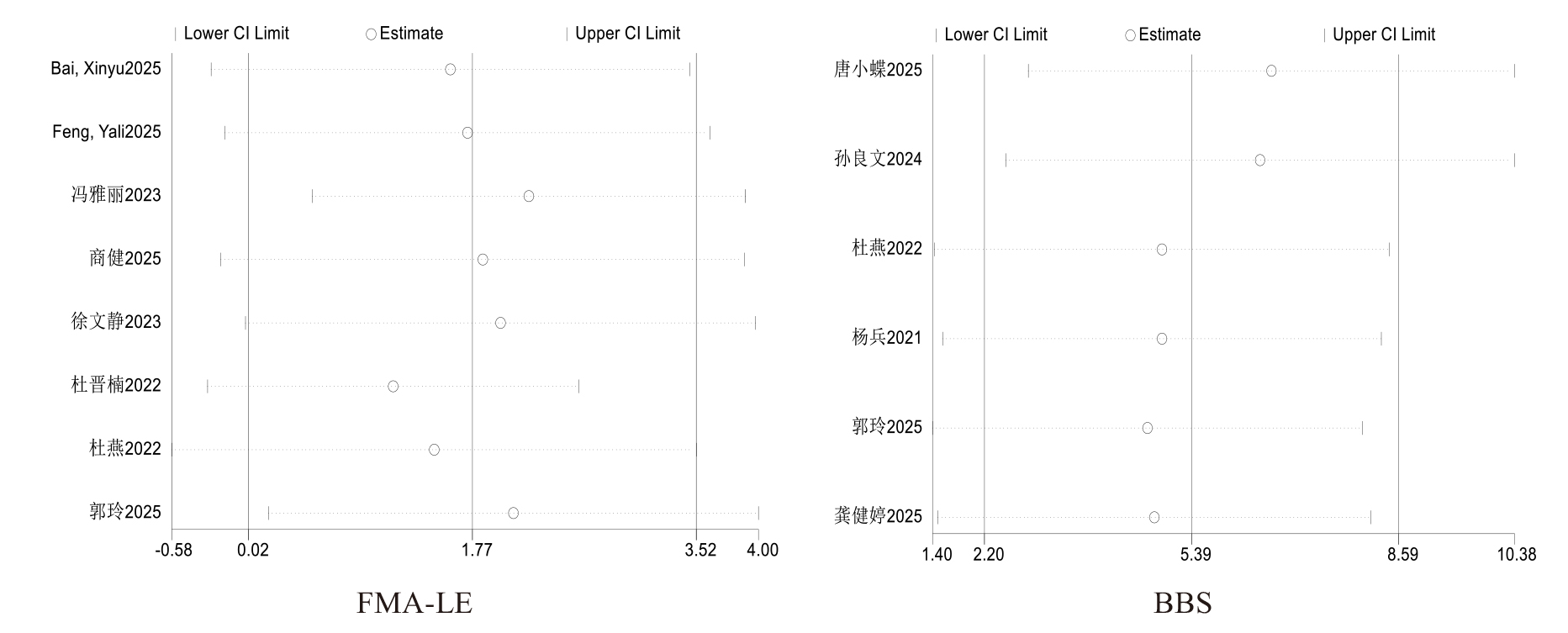
图4
敏感性分析"
| [1] | Balaban B, Tok F. Gait disturbances in patients with stroke[J]. PM R, 2014, 6(7): 635-642. |
| [2] | 王陇德, 刘建民, 杨弋, 等. 我国脑卒中防治仍面临巨大挑战:«中国脑卒中防治报告2018»概要[J]. 中国循环杂志, 2019, 34(2): 105-119. |
| Wang L D, Liu J M, Yang Y, et al. The prevention and treatment of stroke still face huge challenges: brief report on stroke prevention and treatment in China, 2018[J]. Chin Circ J, 2019, 34(2): 105-119. | |
| [3] | Donkor E S. Stroke in the 21st century: a snapshot of the burden, epidemiology, and quality of life[J]. Stroke Res Treat, 2018, 2018: 3238165. |
| [4] | Kollen B, Kwakkel G, Lindeman E. Longitudinal robustness of variables predicting independent gait following severe middle cerebral artery stroke: a prospective cohort study[J]. Clin Rehabil, 2006, 20(3): 262-268. |
| [5] | Manini T M, Clark B C. Blood flow restricted exercise and skeletal muscle health[J]. Exerc Sport Sci Rev, 2009, 37(2): 78-85. |
| [6] | 李新通, 潘玮敏, 覃华生, 等. 血流限制训练: 加速肌肉骨骼康复的新方法[J]. 中国组织工程研究, 2019, 23(15): 2415-2420. |
| Li X T, Pan W M, Qin H S, et al. Blood flow restriction training: a new method for accelerating musculoskeletal rehabilitation[J]. Chin J Tissue Eng Res, 2019, 23(15): 2415-2420. | |
| [7] | 杨兵. 血流限制训练法对肥胖脑卒中偏瘫患者肌肉与肢体功能康复的影响[J]. 辽宁医学杂志, 2021, 35(3): 98-100. |
| Yang B. Effect of blood flow restriction training on muscle and limb function rehabilitation in obese stroke patients with hemiplegia[J]. Liaoning Med J, 2021, 35(3): 98-100. | |
| [8] | 徐文静, 朱兴国, 周停, 等. 血流限制联合低强度抗阻运动对脑卒中患者下肢功能及表面肌电的影响[J]. 中国康复医学杂志, 2023, 38(1): 46-51. |
| Xu W J, Zhu X G, Zhou T, et al. Effects of blood flow restriction combined with low intensity resistance exercise on lower limb motor function and surface electromyographic characteristics in patients with stroke[J]. Chin J Rehabil Med, 2023, 38(1): 46-51. | |
| [9] | 唐小蝶, 袁淑娟, 封亮. 血流限制训练对缺血性脑卒中患者平衡功能的疗效观察[J]. 山西医药杂志, 2025, 54(12): 900-904. |
| TANG X D, YUAN S J, FENG L. Effects of blood flow restriction training on balance function in patients with ischemic stroke[J]. Shanxi Med J, 2025, 54(12): 900-904. | |
| [10] | 孙良文, 韦春霞, 刘淼, 等. 全身振动联合血流限制训练对老年脑卒中偏瘫患者运动功能及社区活动能力的影响[J]. 实用医学杂志, 2024, 40(20): 2874-2879. |
| Sun L W, Wei C X, Liu M, et al. Effects of whole-body vibration training combined with blood flow restriction on motor function and community activity in elderly stroke patients with hemiplegia[J]. J Pract Med, 2024, 40(20): 2874-2879. | |
| [11] | 商健, 郭耀锐, 白丽, 等. 血流限制联合悬吊训练对脑卒中患者下肢功能和步行能力的影响[J]. 中国康复, 2025, 40(1): 11-15. |
| Shang J, Guo Y R, Bai L, et al. Effects of blood flow restriction combined with suspension training on lower limb function and walking ability in stroke patients[J]. China Rehabil, 2025, 40(1): 11-15. | |
| [12] | 姬长勐, 徐思惠, 李天虎, 等. 血流限制联合有氧训练对脑卒中平衡及步行功能改善作用[J]. 浙江实用医学, 2025, 30(1): 75-77. |
| [13] | 郭玲, 刘柱, 尚建琴, 等. 血流限制联合悬吊训练对脑卒中患者膝过伸的影响[J]. 甘肃医药, 2025, 44(7): 627-630. |
| [14] | 龚健婷, 吕仁华, 李青, 等. 血流限制性训练联合头针治疗中风患者平衡功能的临床研究[J]. 湖南中医药大学学报, 2025, 45(3): 480-485. |
| Gong J T, Lü R H, Li Q, et al. Clinical research of blood flow restriction training combined with scalp acupuncture on balance function in stroke patients[J]. J Hunan Univ Chin Med, 2025, 45(3): 480-485. | |
| [15] | 冯雅丽, 文方林, 周谊, 等. 血流限制联合运动训练对脑卒中患者下肢功能和步行能力的影响[J]. 中国康复医学杂志, 2023, 38(3): 331-336. |
| Feng Y L, Wen F L, Zhou Y, et al. Effects of blood flow restriction combined with exercise training on lower extremity and gait function in stroke patients[J]. Chin J Rehabil Med, 2023, 38(3): 331-336. | |
| [16] | 杜燕, 陈雪梅, 李丽. 血流限制联合抗阻训练对老年脑卒中偏瘫患者下肢功能的影响[J]. 吉林医学, 2022, 43(3): 800-802. |
| [17] | 杜晋楠, 郭宝珍, 王群有. 血流限制训练联合重复经颅刺激对脑卒中后下肢功能影响的疗效评价[J]. 中外医疗, 2022, 41(12): 23-26, 35. |
| Du J N, Guo B Z, Wang Q Y. Effect of blood flow restriction training combined with repeated transcranial stimulation on lower limb function after stroke[J]. Chin Foreign Med Treat, 2022, 41(12): 23-26, 35. | |
| [18] | 陈雪梅, 余广兰. 血流限制联合低强度抗阻运动在脑梗死合并肌少症老年患者的应用研究[J]. 神经损伤与功能重建, 2023, 18(1): 23-27. |
| Chen X M, Yu G L. Application of blood flow restriction combined with low-intensity resistance exercise in elderly patients with cerebral infarction and sarcopenia[J]. Neural Inj Funct Reconstr, 2023, 18(1): 23-27. | |
| [19] | Feng Y, Wen F, Ahmad I, et al. Does exercise training combined with blood flow restriction improve muscle mass, lower extremity function, and walking capacity in hemiplegic patients? A randomized clinical trial[J]. Top Stroke Rehabil, 2025, 32(8): 800-809. |
| [20] | Bai X, Zhang Y, Cao W, et al. Cerebral cortical activation and muscle performance during blood flow restriction training after ischemic stroke: a randomised functional near-infrared spectroscopy study[J]. PLoS One, 2025, 20(10): e0334123. |
| [21] | Ahmed I, Mustafaoglu R, Erhan B. The effects of low-intensity resistance training with blood flow restriction versus traditional resistance exercise on lower extremity muscle strength and motor function in ischemic stroke survivors: a randomized controlled trial[J]. Top Stroke Rehabil, 2024, 31(4): 418-429. |
| [22] | Sacco R L, Kasner S E, Broderick J P, et al. An updated definition of stroke for the 21st century: a statement for healthcare professionals from the American Heart Association/American Stroke Association[J]. Stroke, 2013, 44(7): 2064-2089. |
| [23] | Kwong P W H, Ng S S M. Cutoff score of the lower-extremity motor subscale of Fugl-Meyer Assessment in chronic stroke survivors: a cross-sectional study[J]. Arch Phys Med Rehabil, 2019, 100(9): 1782-1787. |
| [24] | Alghadir A H, Al-Eisa E S, Anwer S, et al. Reliability, validity, and responsiveness of three scales for measuring balance in patients with chronic stroke[J]. BMC Neurol, 2018, 18(1): 141. |
| [25] | Shah S, Vanclay F, Cooper B. Improving the sensitivity of the Barthel Index for stroke rehabilitation[J]. J Clin Epidemiol, 1989, 42(8): 703-709. |
| [26] | Herman T, Giladi N, Hausdorff J M. Properties of the 'Timed Up and Go' test: more than meets the eye[J]. Gerontology, 2011, 57(3): 203-210. |
| [27] | Fulk G D, Echternach J L, Nof L, et al. Clinometric properties of the six-minute walk test in individuals undergoing rehabilitation poststroke[J]. Physiother Theory Pract, 2008, 24(3): 195-204. |
| [28] | Higgins J P T, Altman D G, Gøtzsche P C, et al. The Cochrane Collaboration's tool for assessing risk of bias in randomised trials[J]. BMJ, 2011, 343: d5928. |
| [29] | Billinger S A, Arena R, Bernhardt J, et al. Physical activity and exercise recommendations for stroke survivors: a statement for healthcare professionals from the American Heart Association/American Stroke Association[J]. Stroke, 2014, 45(8): 2532-2553. |
| [30] | Alawieh A, Zhao J, Feng W. Factors affecting post-stroke motor recovery: implications on neurotherapy after brain injury[J]. Behav Brain Res, 2018, 340: 94-101. |
| [31] | Kjeldsen S S, Næss-Schmidt E T, Lee M, et al. Blood flow restriction exercise of the tibialis anterior in people with stroke: a preliminary study[J]. J Integr Neurosci, 2022, 21(2): 53. |
| [32] | Li Y, Liu Y, Xiong J. Effects of restricted blood flow interval training on lower extremity muscles and motor function in stroke patients[J]. Brain Behav, 2025, 15(7): e70683. |
| [33] | Vinolo-Gil M J, Rodríguez-Huguet M, Martin-Vega F J, et al. Effectiveness of blood flow restriction in neurological disorders: a systematic review[J]. Healthcare (Basel), 2022, 10(12): 2407. |
| [34] | Jønsson A B, Krogh S, Laursen H S, et al. Safety and efficacy of blood flow restriction exercise in individuals with neurological disorders: a systematic review[J]. Scand J Med Sci Sports, 2024, 34(1): e14561. |
| [35] | Renzi C P, Tanaka H, Sugawara J. Effects of leg blood flow restriction during walking on cardiovascular function[J]. Med Sci Sports Exerc, 2010, 42(4): 726-732. |
| [36] | Pinto R R, Polito M D. Haemodynamic responses during resistance exercise with blood flow restriction in hypertensive subjects[J]. Clin Physiol Funct Imaging, 2016, 36(5): 407-413. |
| [37] | Rolnick N, Kimbrell K, De Queiros V. Beneath the cuff: often overlooked and under-reported blood flow restriction device features and their potential impact on practice: a review of the current state of the research[J]. Front Physiol, 2023, 14: 1089065. |
| [38] | Campagnini S, Sodero A, Baccini M, et al. Prediction of the functional outcome of intensive inpatient rehabilitation after stroke using machine learning methods[J]. Sci Rep, 2025, 15(1): 16083. |
| [39] | Pearson S J, Hussain S R. A review on the mechanisms of blood-flow restriction resistance training-induced muscle hypertrophy[J]. Sports Med, 2015, 45(2): 187-200. |
| [40] | Huang R, Ma Y, Yang Z, et al. Hemodynamic analysis of blood flow restriction training: a systematic review[J]. BMC Sports Sci Med Rehabil, 2025, 17(1): 46. |
| [1] | 周洁, 何志成, 张晓钰, 王雪, 刘大美, 宋宁, 吴珺. 视动整合训练对脑卒中后单侧空间忽略的效果[J]. 《中国康复理论与实践》, 2026, 32(7): 745-751. |
| [2] | 黄耀辉, 叶祥明, 刘勇, 唐沛, 卢逸舒. 重复经颅磁刺激对脑卒中后慢性意识障碍的效果[J]. 《中国康复理论与实践》, 2026, 32(7): 752-759. |
| [3] | 单桂香, 杜巨豹, 曹磊, 叶琳琳, 姜春静, 张晔, 马慧娟, 宋为群. 基于超声的脑卒中患者膈肌功能的特征分析[J]. 《中国康复理论与实践》, 2026, 32(7): 760-767. |
| [4] | 张费, 傅博勋, 沈慧, 陈进. 基于镜像神经元理论的动作观察疗法联合低频重复经颅磁刺激对脑卒中后单侧空间忽略的效果[J]. 《中国康复理论与实践》, 2026, 32(7): 768-775. |
| [5] | 樊留博, 单婷婷, 刘宝华, 罗咪咪, 张露丁, 王明慧. 超声引导联合改良导管球囊定位下不同剂量A型肉毒毒素治疗脑卒中后环咽肌功能障碍的效果[J]. 《中国康复理论与实践》, 2026, 32(7): 776-787. |
| [6] | 周广雪, 徐宁, 施滨. 虚拟现实技术联合作业治疗对脑卒中患者上肢运动功能康复效果的Meta分析[J]. 《中国康复理论与实践》, 2026, 32(7): 788-796. |
| [7] | 袁依依, 田武超, 张献斌, 钞强, 李永生, 刘桂新, 吴万庆, 王朴. 双任务训练对脑卒中患者移动和平衡功能康复疗效的Meta分析[J]. 《中国康复理论与实践》, 2026, 32(7): 807-816. |
| [8] | 李欣源, 郑洁皎, 张廷宇, 吴雪娇, 梁晓笑. 间歇性θ脉冲刺激改善脑卒中患者下肢运动和平衡功能的Meta分析[J]. 《中国康复理论与实践》, 2026, 32(6): 631-644. |
| [9] | 高惠刚, 刘远文, 秦煜玲, 胡昔权, 朱琳. 2020年至2025年足踝软体外骨骼机器人改善脑卒中患者步行功能的Scoping综述[J]. 《中国康复理论与实践》, 2026, 32(6): 645-652. |
| [10] | 李雯, 闫欣越, 黄秋晨, 张睿, 孙悦梅, 周越. 神经肌肉电刺激对人工全膝置换术后患者康复效果的Meta分析[J]. 《中国康复理论与实践》, 2026, 32(6): 653-664. |
| [11] | 申婷婷, 刘东斐. 运动干预对唐氏综合征成人患者多维健康结局影响的Meta分析[J]. 《中国康复理论与实践》, 2026, 32(6): 677-689. |
| [12] | 曹传宝, 马刚, 闫士芳. 渐进式平衡训练对慢性踝关节不稳患者运动皮质兴奋性、本体感觉和平衡能力的影响[J]. 《中国康复理论与实践》, 2026, 32(6): 721-730. |
| [13] | 韩天星, 刘昊天, 徐子淇, 彭晓涵, 王杨, 曹丹娜. 基于静息态磁共振功能成像对阿尔茨海默病轻度认知障碍期默认网络与内侧颞叶区脑功能连接研究的Meta分析[J]. 《中国康复理论与实践》, 2026, 32(5): 522-533. |
| [14] | 刘睿, 高振梅, 周星宇, 张琦, 吴建林. 2015年至2025年数字健康技术在脑卒中上肢运动功能康复中应用的文献计量分析[J]. 《中国康复理论与实践》, 2026, 32(5): 534-549. |
| [15] | 倪天皓, 毕思雨, 戴媛, 钱红, 王勇丽, 万勤, 黄昭鸣. 汉语普通话言语失用症评估诊断工具的编制与验证[J]. 《中国康复理论与实践》, 2026, 32(5): 550-560. |
| 阅读次数 | ||||||
|
全文 |
|
|||||
|
摘要 |
|
|||||
|
||
