



《中国康复理论与实践》 ›› 2026, Vol. 32 ›› Issue (10): 1143-1153.doi: 10.3969/j.issn.1006-9771.2026.00.004
车芙蓉1, 潘义1, 祁森洁1, 温晓妮2( )
收稿日期:2026-07-01
修回日期:2026-08-03
接受日期:2026-08-05
出版日期:2026-10-25
发布日期:2026-08-21
通讯作者:
温晓妮(1973-),女,汉族,陕西渭南市人,博士,教授,主要研究方向:慢性病与老年病康复。E-mail: weniweni@163.com作者简介:车芙蓉(1999-),女,汉族,陕西渭南市人,硕士研究生,主要研究方向:慢性病与老年病康复。
基金资助:
Che Furong1, Pan Yi1, Qi Senjie1, Wen Xiaoni2()
Received:2026-07-01
Revised:2026-08-03
Accepted:2026-08-05
Published:2026-10-25
Online:2026-08-21
Supported by:摘要:
目的 评价不同振动频率的全身振动训练(WBV)对脑卒中患者平衡和步行功能的疗效。
方法 计算机检索中国知网、维普、万方数据库、中国生物医学数据库、PubMed、Embase和Cochrane Library数据库,收集建库至2026年4月关于WBV改善脑卒中后平衡和步行功能的随机对照试验(RCT)。以Berg平衡量表(BBS)、功能性步行量表(FAC)和计时起立-行走测试(TUGT)为结局指标,采用Cochrane 5.1.0手册推荐的RCT偏倚风险评估工具和PEDro量表对所纳入文献进行质量评价,采用Stata 18.0进行Meta分析。
结果 共纳入22篇RCT,涉及1 335例患者,PEDro量表评分为5~9分。Meta分析显示,WBV训练后脑卒中患者的BBS评分(WMD = 4.761, 95%CI 3.220~6.302, P < 0.001)、FAC分级(WMD = 0.537, 95%CI 0.239~0.835, P < 0.001)均显著优于对照组,TUGT时间明显缩短(WMD = -2.329, 95%CI -3.889~-0.769, P = 0.003)。亚组分析显示,低频(≤ 20 Hz) WBV在BBS、FAC和TUGT方面优于对照组(P < 0.05),而高频(> 20 Hz)未达显著性水平(P > 0.05);低频WBV的FAC分级明显优于高频(Q = 8.070, P= 0.005),高低频亚组间BBS和TUGT比较无显著性差异(P> 0.05);Meta回归提示频率并非异质性的主要来源,总干预次数和病程可能是潜在影响因素;不良反应轻微且均见于高频组。
结论 WBV能有效改善脑卒中后平衡和步行功能,基于当前有限证据,低频(≤ 20 Hz) WBV在疗效和安全性方面均优于高频;同时应重视训练总量的累积效应,结合患者病程选择最佳干预时机。
中图分类号:
车芙蓉, 潘义, 祁森洁, 温晓妮. 不同振动频率的全身振动训练对脑卒中患者平衡和步行功能影响的Meta分析[J]. 《中国康复理论与实践》, 2026, 32(10): 1143-1153.
Che Furong, Pan Yi, Qi Senjie, Wen Xiaoni. Effects of whole body vibration training at different vibration frequencies on balance and gait in stroke patients: a meta-analysis[J]. Chinese Journal of Rehabilitation Theory and Practice, 2026, 32(10): 1143-1153.

表1
PICO架构"
| 人群(Population) | 干预(Intervention) | 比较(Comparison) | 结局(Outcome) |
|---|---|---|---|
| 脑卒中患者 立位平衡Ⅱ级及以上 年龄、性别、病程不限 | 干预方式 WBV 联合干预 常规康复训练或药物治疗 干预参数 干预频率、振幅、频次、疗程 | 与对照组比较 不同干预频率比较 | 有效性 Berg平衡量表 功能性步行量表 计时起立-行走测试 安全性 不良反应 |
图1
文献筛选流程图"
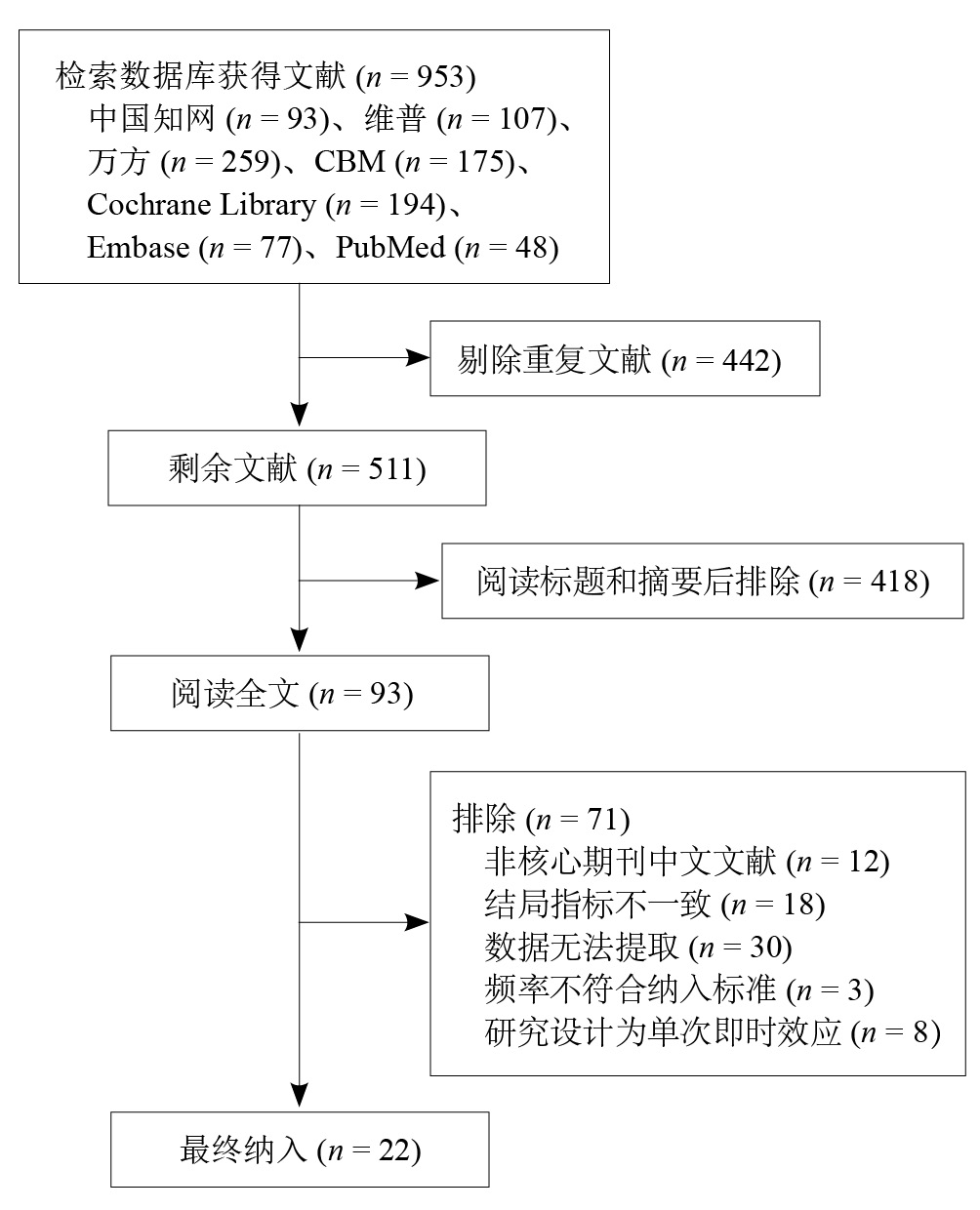
表2
纳入文献PEDro量表评分"
| 纳入文献 | 纳入与排除标准 | 随机分配 | 分配隐藏 | 基线相似 | 被试施盲 | 治疗师施盲 | 评估者施盲 | 退出率≤15% | 意向治疗分析 | 组间统计比较 | 点测量和差异值 | 总分 |
|---|---|---|---|---|---|---|---|---|---|---|---|---|
| 马飞翔等[ | √ | √ | √ | √ | √ | √ | √ | √ | 7 | |||
| 涂美等[ | √ | √ | √ | √ | √ | √ | √ | √ | 7 | |||
| 王盛等[ | √ | √ | √ | √ | √ | √ | 5 | |||||
| 宋云锋等[ | √ | √ | √ | √ | √ | √ | √ | 6 | ||||
| 金振华等[ | √ | √ | √ | √ | √ | √ | √ | √ | 7 | |||
| 魏巍等[ | √ | √ | √ | √ | √ | √ | √ | 6 | ||||
| 肖悦等[ | √ | √ | √ | √ | √ | √ | √ | 6 | ||||
| 胡川等[ | √ | √ | √ | √ | √ | √ | √ | 6 | ||||
| 张国兴等[ | √ | √ | √ | √ | √ | √ | √ | 6 | ||||
| 金振华等[ | √ | √ | √ | √ | √ | √ | √ | 6 | ||||
| 李岩等[ | √ | √ | √ | √ | √ | √ | √ | 6 | ||||
| 王伟国等[ | √ | √ | √ | √ | √ | √ | √ | 6 | ||||
| 毛璐熙等[ | √ | √ | √ | √ | √ | √ | √ | 6 | ||||
| 冯兵等[ | √ | √ | √ | √ | √ | √ | √ | 6 | ||||
| Irshad等[ | √ | √ | √ | √ | √ | √ | √ | √ | 7 | |||
| Lee等[ | √ | √ | √ | √ | √ | √ | 5 | |||||
| Lee等[ | √ | √ | √ | √ | √ | √ | √ | √ | √ | 8 | ||
| Burq等[ | √ | √ | √ | √ | √ | √ | √ | √ | 7 | |||
| Marín等[ | √ | √ | √ | √ | √ | √ | √ | √ | √ | 8 | ||
| van Nes等[ | √ | √ | √ | √ | √ | √ | √ | √ | √ | √ | 9 | |
| Brogårdh等[ | √ | √ | √ | √ | √ | √ | √ | √ | √ | √ | 9 | |
| Lau等[ | √ | √ | √ | √ | √ | √ | √ | √ | √ | 8 |
图2
偏倚风险图"
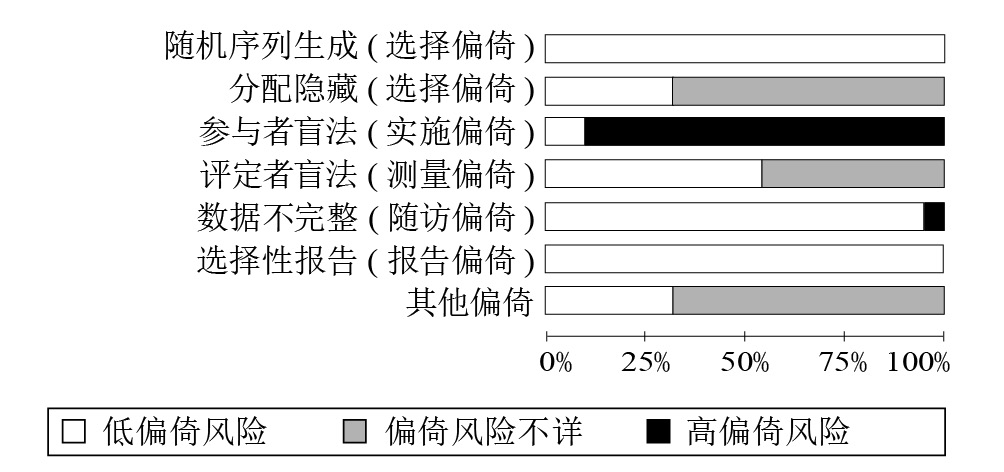
图3
纳入文献偏倚评估"
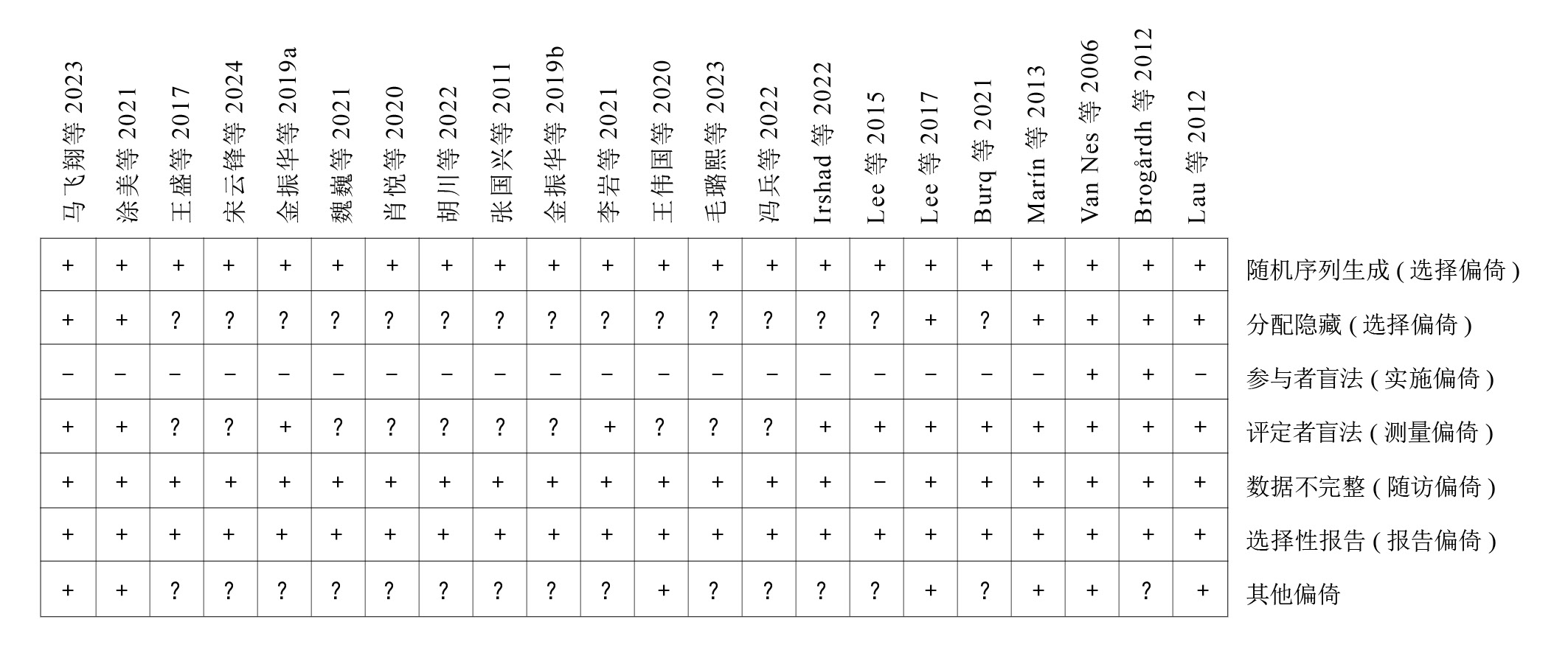
表3
纳入文献基本特征"
| 纳入文献 | n(男/女) | 年龄/岁 | 病程 | 干预措施 | 疗程 | 评价指标 | ||||
|---|---|---|---|---|---|---|---|---|---|---|
| C | T | C | T | C | T | C | T | |||
| 马飞翔等[ | 13/7 | 13/9 | 50.90±7.14 | 51.14±6.80 | (107.90±35.52) d | (103.09±33.48) d | Ⅱ、Ⅲ | Ⅱ+7 Hz、3 mm的WBV | 每周10次,4周 | ①③ |
| 14/6 | 49.35±8.10 | (101.30±26.88) d | Ⅱ+15 Hz、3 mm的WBV | |||||||
| 涂美等[ | 17 | 16 | 55.4±4.5 | 53.9±3.8 | (10.0±2.3)个月 | (11.4±4.4)个月 | Ⅱ | Ⅱ+5 Hz、2 mm的WBV | 每周5次,6周 | ③ |
| 17 | 55.6±4.3 | (11.7±3.1)个月 | Ⅱ+5 Hz、2 mm的WBV | |||||||
| 16 | 57.2±4.0 | (11.1±2.1)个月 | Ⅱ+5 Hz、2 mm的WBV | |||||||
| 王盛等[ | 8/6 | 9/6 | 62.50±7.78 | 57.67±11.55 | (19.00±4.47) d | (21.50±5.71) d | Ⅱ、Ⅲ | Ⅱ+起始2 Hz、4 mm的WBV | 每周5次,3周 | ① |
| 宋云锋等[ | 36/32 | 35/23 | 49.76±7.55 | 49.43±7.12 | — | — | Ⅰ、Ⅱ | Ⅰ+Ⅱ+20~35 Hz、2 mm的WBV | 每周5次,12周 | ① |
| 金振华等[ | 17/17 | 18/15 | 61.09±4.34 | 60.55±4.59 | (67.79±4.03) d | (67.18±5.45) d | Ⅱ | Ⅱ+20 Hz、4 mm的WBV | 6周 | ② |
| 魏巍等[ | 19/11 | 18/12 | 50.28±6.17 | 49.62±8.48 | (79.58±37.26) d | (82.72±30.81) d | Ⅰ、Ⅱ | Ⅰ、Ⅱ+30 Hz、2 mm的WBV | 每周6次,4周 | ① |
| 肖悦等[ | 9/6 | 8/7 | 59.13±10.88 | 60.93±9.98 | (2.26±1.57)个月 | (2.63±1.53)个月 | Ⅱ、Ⅲ | Ⅱ+5/10/5 Hz、4 mm的WBV | 每周6次,2周 | ③ |
| 胡川等[ | 13/10 | 14/9 | 62.42±9.34 | 60.35±11.63 | (3.23±1.76)个月 | (3.41±1.48)个月 | Ⅱ | Ⅱ+5~8 Hz、2 mm的WBV | 每周5次,4周 | ③ |
| 张国兴等[ | 6/4 | 7/3 | 59.5±11.9 | 60.7±10.3 | (40.1±9.2) d | (38.54±10.3) d | Ⅱ、Ⅳ | Ⅱ+Ⅳ+20 Hz、5 mm的WBV | 6周 | ①② |
| 金振华等[ | 16/19 | 18/17 | 55.0±4.7 | 55.0±4.8 | (63.5±5.0) d | (63.7±6.0) d | Ⅱ、Ⅴ | Ⅱ+Ⅴ+20 Hz、3 mm的WBV | 每周5次,6周 | ①② |
| 李岩等[ | 12/13 | 18/7 | 61.92±5.64 | 62.64±7.02 | (53.28±11.72) d | (53.68±8.88) d | Ⅱ、Ⅲ | Ⅱ+12 Hz、2 mm的WBV | 每周5次,8周 | ① |
| 王伟国等[ | 26/17 | 27/16 | 59.83±6.52 | 60.15±7.8 | — | — | Ⅱ | Ⅱ+5~8 Hz、2.5 mm的WBV | 每周6次,12周 | ① |
| 毛璐熙等[ | 52/18 | 55/15 | 48.64±8.25 | 50.51±9.86 | (38.15±6.68) d | (40.53±6.17) d | Ⅱ | Ⅱ+8/20/20 Hz的WBV(间歇/连续) | 每周5次,4周 | ①② |
| 冯兵等[ | 26/22 | 27/21 | 62.22±6.18 | 62.22±5.23 | (45.50±6.80) d | (44.50±7.60) d | Ⅱ | Ⅱ+15 Hz、5 mm的WBV | 每周5次,4周 | ① |
| Irshad等[ | 25/18 | 23/20 | — | — | — | — | Ⅱ、Ⅵ | Ⅱ+30/40/50 Hz、2.5/3.5/8 mm的WBV | 每周5次,6周 | ①③ |
| Lee等[ | 6/3 | 8/4 | 56.0±9.1 | 59.3±13.2 | (18.0±10.9)个月 | (19.0±9.1)个月 | Ⅱ | Ⅱ+1~3 Hz、30 mm的WBV | 每周3次,6周 | ①③ |
| Lee等[ | 7/8 | 8/7 | 64.4±14.8 | 59.1±16.9 | (25.3±12.2) d | (18.4±6.9) d | Ⅱ | Ⅱ(单次)+40 Hz的WBV | 每周5次,2周 | ①② |
| Burq等[ | 19/13 | 21/11 | 55.06±11.48 | 54.56±8.85 | (10.82±5.15)个月 | (14.46±12.14)个月 | Ⅱ | Ⅱ+20 Hz、3 mm的WBV | 每周6次,2周 | ③ |
| Marín等[ | 5/4 | 6/5 | 64.4±7.6 | 62.4±10.7 | (4.3±3.0)年 | (4.3±2.0)年 | Ⅱ、Ⅲ | Ⅱ+5~21 Hz、4~6 mm的WBV | 12周,17次 | ① |
| van Nes等[ | 14/12 | 16/11 | 62.6±7.6 | 59.7±12.3 | (34.2±11.1) d | (38.9±9.2) d | Ⅱ、Ⅶ | Ⅱ+30 Hz、3 mm的WBV | 每周5次,6周 | ①② |
| Brogardh等[ | 12/3 | 13/3 | 63.9±5.8 | 61.3±8.5 | (33.1±29.2)个月 | (37.4±31.8)个月 | Ⅲ | 25 Hz、3.75 mm的WBV | 每周2次,6周 | ①③ |
| Lau等[ | 32/9 | 26/15 | 57.4±11.1 | 57.3±11.3 | (5.3±4.2)年 | (4.6±3.5)年 | Ⅷ | Ⅷ+20~30 Hz、0.44~0.60 mm的WBV | 每周3次,8周 | ① |
表4
Meta分析结果"
| 结局指标 | 纳入研究数/n | 样本量/n | 异质性检验 | Meta分析结果 | 效应模型 | ||
|---|---|---|---|---|---|---|---|
| I2值 | P值 | WMD(95%CI) | P值 | ||||
| BBS | 17[ | 1062 | 89.3% | < 0.001 | 4.761(3.220~6.302) | < 0.001 | 随机 |
| FAC | 5[ | 327 | 77.2% | 0.002 | 0.537(0.239~0.835) | < 0.001 | 随机 |
| TUGT | 8[ | 406 | 70.3% | 0.001 | -2.329(-3.889~-0.769) | 0.003 | 随机 |
表5
亚组分析结果"
| 结局指标 | 亚组 | 纳入研究数/n | 样本量/n | 异质性检验 | Meta分析结果 | 亚组间比较 | ||||
|---|---|---|---|---|---|---|---|---|---|---|
| I2值 | P值 | Z值 | WMD(95%CI) | P值 | Q值 | P值 | ||||
| BBS | 低频 | 10[ | 594 | 79.2% | < 0.001 | 7.645 | 5.603 (4.166~7.039) | < 0.001 | 1.420 | 0.233 |
| 高频 | 7[ | 468 | 93.9% | < 0.001 | 1.962 | 3.374 (0.003~6.745) | 0.050 | |||
| 低剂量 | 9[ | 509 | 89.5% | < 0.001 | 2.946 | 3.814 (1.277~6.352) | 0.003 | 1.810 | 0.178 | |
| 高剂量 | 7[ | 533 | 85.4% | < 0.001 | 7.069 | 5.887 (4.255~7.519) | < 0.001 | |||
| FAC | 低频 | 4[ | 297 | 62.3% | 0.047 | 5.408 | 0.660 (0.421~0.899) | < 0.001 | 8.070 | 0.005 |
| 高频 | 1[ | 30 | - | - | -0.420 | -0.100 (-0.567~0.367) | 0.674 | |||
| TUGT | 低频 | 6[ | 289 | 0.0% | 0.525 | -6.121 | -2.737 (-3.614~-1.861) | < 0.001 | 0.450 | 0.505 |
| 高频 | 2[ | 117 | 94.8% | < 0.001 | -0.043 | -0.166 (-7.667~7.336) | 0.965 | |||
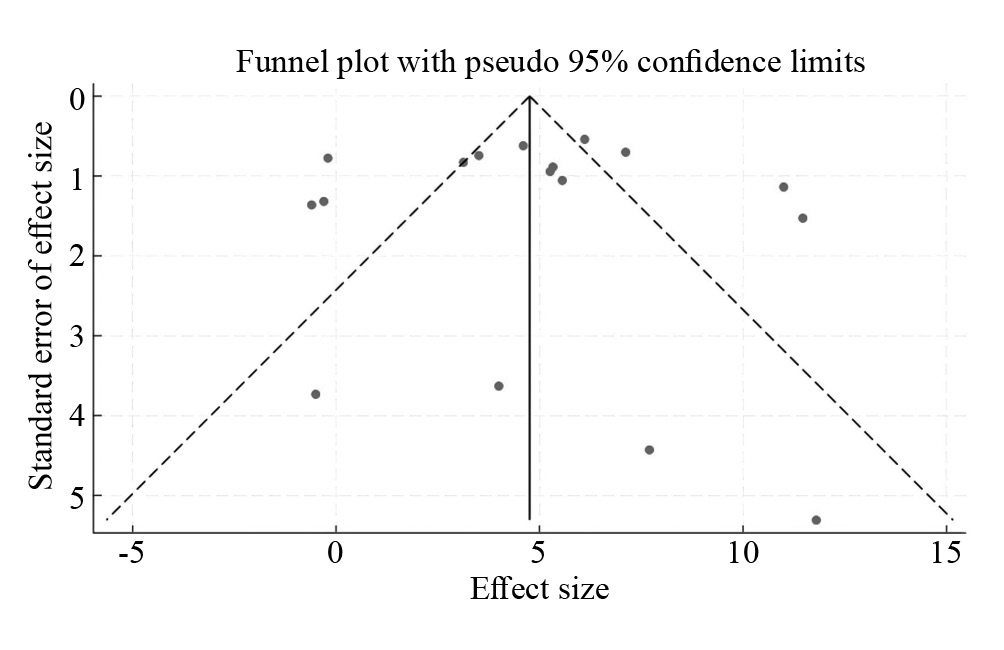
图4
WBV对BBS量表评分的发表偏倚漏斗图"
| [1] |
GBD 2019 Stroke Collaborators. Global, regional, and national burden of stroke and its risk factors, 1990-2019: a systematic analysis for the Global Burden of Disease Study 2019[J]. Lancet Neurol, 2021, 20(10): 795-820.
doi: 10.1016/S1474-4422(21)00252-0 |
| [2] | 《中国脑卒中防治报告2021》编写组. 《中国脑卒中防治报告2021》概要[J]. 中国脑血管病杂志, 2023, 20(11): 783-793. |
| Report on Stroke Prevention and Treatment in China Writing Group. Brief report on stroke prevention and treatment in China, 2021[J]. Chin J Cerebrovascular Dis, 2023, 20(11): 783-793. | |
| [3] | Cho J E, Kim H. Ankle proprioception deficit is the strongest factor predicting balance impairment in patients with chronic stroke[J]. Arch Rehabil Res Clin Transl, 2021, 3(4): 100165. |
| [4] |
Zhang M, Wei J, Wu X. Effects of whole-body vibration training on lower limb motor function and neural plasticity in patients with stroke: protocol for a randomised controlled clinical trial[J]. BMJ Open, 2022, 12(6): e060796.
doi: 10.1136/bmjopen-2022-060796 |
| [5] |
Tian X, Fu S, He J, et al. Whole-body vibration training improves muscle mass and strength in older adults through intra- and extra-muscular pathways[J]. Front Cell Dev Biol, 2025, 13: 1643478.
doi: 10.3389/fcell.2025.1643478 |
| [6] | 马飞翔, 李万浪, 朱颖玲, 等. 低频共振训练对脑卒中后偏瘫患者平衡及步行功能的影响[J]. 中华物理医学与康复杂志, 2023, 45(9): 776-780. |
| Ma F X, Li W L, Zhu Y L, et al. Low-frequency whole-body resonance stimulation can improve the balance and walking of hemiplegic stroke survivors[J]. Chin J Phys Med Rehabil, 2023, 45(9): 776-780. | |
| [7] |
Seo J W, Kim J D, Seok J W. The effects of whole-body vibration on spasticity in stroke: a systematic review and meta-analysis[J]. J Clin Med, 2025, 14(17): 5966.
doi: 10.3390/jcm14175966 |
| [8] |
Xing K, Duan R, Fang Z, et al. Does frequency of the mechanical vibration matter? Evaluating the impact of whole-body vibration training on older adults strength, balance, and gait performance: a systematic review and network meta-analysis[J]. Arch Phys Med Rehabil, 2026, 107(3): 507-521.
doi: 10.1016/j.apmr.2025.07.015 |
| [9] |
Zhang Q, Zheng S, Li S, et al. Efficacy and safety of whole-body vibration therapy for post-stroke spasticity: a systematic review and meta-analysis[J]. Front Neurol, 2023, 14: 1074922.
doi: 10.3389/fneur.2023.1074922 |
| [10] | 涂美, 王剑雄, 张驰, 等. 不同下肢体位振动对脑卒中患者下肢肌力及运动功能的影响[J]. 中国康复医学杂志, 2021, 36(2): 166-171. |
| Tu M, Wang J X, Zhang C, et al. A study on different lower limb position vibrations on lower limb muscle strength and motor function in patients with stroke[J]. Chin J Rehabil Med, 2021, 36(2): 166-171. | |
| [11] | 王盛, 王翔, 王彤, 等. 渐进性全身垂直振动治疗方案对缺血性脑卒中偏瘫早期患者下肢功能与平衡功能的影响[J]. 中国康复医学杂志, 2017, 32(3): 297-300. |
| Wang S, Wang X, Wang T, et al. Effects of progressive whole body vertical vibration on lower limb function and balance in acute cerebral infarction patients with hemiplegia[J]. Chin J Rehabil Med, 2017, 32(3): 297-300. | |
| [12] | 宋云锋, 杜爱玲. 康复训练结合振动治疗对脑卒中后骨代谢及运动功能的影响分析[J]. 康复, 2024(23): 131-134. |
| [13] | 金振华, 陈玲, 叶祥明, 等. 全身低频渐进振动联合运动治疗对卒中患者下肢肌张力与步行能力的作用[J]. 中国康复, 2019, 34(6): 283-286. |
| Jin Z H, Chen L, Ye X M, et al. Effect of low frequency progressive whole-body vibration to spasticity of hemiplegic lower limb and walking ability in stroke patients[J]. Chin J Rehabil, 2019, 34(6): 283-286. | |
| [14] | 魏巍, 程凯, 杨云. 全身振动疗法对脑卒中后偏瘫患者双下肢本体感觉及平衡功能的影响[J]. 中国康复, 2021, 36(4): 200-203. |
| Wei W, Cheng K, Yang Y. Effect of whole body vibration therapy on proprioception and balance function of lower limbs in patients with hemiplegia after stroke[J]. Chin J Rehabilitation, 2021, 36(4): 200-203. | |
| [15] | 肖悦, 许光旭, 曹蓉, 等. 全身振动训练促进脑卒中偏瘫患者平衡功能和步行效率的研究[J]. 中华物理医学与康复杂志, 2020, 42(4): 312-316. |
| Xiao Y, Xu G X, Cao R, et al. Whole body vibration can improve balance and walking after a stroke[J]. Chin J Phys Med Rehabil, 2020, 42(4): 312-316. | |
| [16] | 胡川, 杨晓, 顾莹, 等. 全身振动训练对脑卒中后偏瘫病人步行功能的影响[J]. 中西医结合心脑血管病杂志, 2022, 20(2): 337-340. |
| [17] | 张国兴, 刘四文. 全身振动训练对脑卒中患者平衡及步行能力的影响[J]. 中国康复, 2011, 26(6): 418-420. |
| Zhang G X, Liu S W. Effect of whole body vibration training on balance and walking ability of post-acute stroke patients[J]. Chin J Rehabil, 2011, 26(6): 418-420. | |
| [18] |
金振华, 陈玲, 叶祥明. 全身振动训练对脑卒中患者下肢功能的效果[J]. 中国康复理论与实践, 2019, 25(3): 347-351.
doi: 10.3969/j.issn.1006-9771.2019.03.018 |
| Jin Z H, Chen L, Ye X M. Effect of whole body vibration on abilities of lower extremities for stroke patients[J]. Chin J Rehabil Theory Practice, 2019, 25(3): 347-351. | |
| [19] | 李岩, 何雯雯, 董燕飞, 等. 全身振动训练对脑卒中偏瘫患者本体感觉及平衡功能的影响[J]. 中国康复医学杂志, 2021, 36(6): 709-712. |
| [20] | 王伟国, 吴华. 全身振动训练对脑卒中偏瘫患者临床效果及平衡功能的影响[J]. 中国基层医药, 2020, 27(4): 394-397. |
| Wang W G, Wu H. Effect of whole body vibration training on balance function of stroke patients with hemiplegia[J]. Chin J Primary Med Pharm, 2020, 27(4): 394-397. | |
| [21] | 毛璐熙, 张安琪, 黄昆, 等. 全身振动训练对脑卒中偏瘫患者平衡功能及运动功能的影响[J]. 中国康复, 2023, 38(8): 480-482. |
| [22] | 冯兵, 史静琴, 杨斌, 等. 全身振动训练结合躯干控制训练在脑卒中患者康复治疗中的应用效果[J]. 广西医学, 2022, 44(20): 2438-2441. |
| [23] | Irshad A, Abbas T, Sumaira, et al. Comparative effects of whole-body vibration and squatting training on balance and mobility in chronic stroke patients, a randomized controlled trial[J]. Pak J Med Health Sci, 2022, 16(7): 685-688. |
| [24] |
Lee G C. Does whole-body vibration training in the horizontal direction have effects on motor function and balance of chronic stroke survivors? a preliminary study[J]. J Phys Ther Sci, 2015, 27: 1133-1136.
doi: 10.1589/jpts.27.1133 pmid: 25995573 |
| [25] |
Lee J H, Kim S B, Lee K W, et al. The effect of a whole-body vibration therapy on the sitting balance of subacute stroke patients: a randomized controlled trial[J]. Top Stroke Rehabil, 2017, 24(6): 457-462.
doi: 10.1080/10749357.2017.1305655 pmid: 28335701 |
| [26] |
Burq H S I A, Karimi H, Ahmad A, et al. The effects of whole body vibration on gait after chronic stroke: a randomized controlled clinical trial[J]. J Pak Med Assoc, 2021, 71(11): 2511-2514.
doi: 10.47391/JPMA.711 pmid: 34783727 |
| [27] |
Marín P J, Ferrero C M, Menéndez H, et al. Effects of whole-body vibration on muscle architecture, muscle strength, and balance in stroke patients: a randomized controlled trial[J]. Am J Phys Med Rehabil, 2013, 92(10): 881-888.
doi: 10.1097/PHM.0b013e318292336c |
| [28] |
Van Nes I J W, Latour H, Schils F, et al. Long-term effects of 6-week whole-body vibration on balance recovery and activities of daily living in the postacute phase of stroke: a randomized, controlled trial[J]. Stroke, 2006, 37(9): 2331-2335.
doi: 10.1161/01.STR.0000236494.62957.f3 pmid: 16902175 |
| [29] |
Brogårdh C, Flansbjer U B, Lexell J. No specific effect of whole-body vibration training in chronic stroke: a double-blind randomized controlled study[J]. Arch Phys Med Rehabil, 2012, 93(2): 253-258.
doi: 10.1016/j.apmr.2011.09.005 |
| [30] |
Lau R W K, Yip S P, Pang M Y C. Whole-body vibration has no effect on neuromotor function and falls in chronic stroke[J]. Med Sci Sports Exerc, 2012, 44(8): 1409-1418.
doi: 10.1249/MSS.0b013e31824e4f8c |
| [31] |
Eldeeb A M, Abdel-aziem A A. Effect of whole-body vibration exercise on power profile and bone mineral density in postmenopausal women with osteoporosis: a randomized controlled trial[J]. J Manipulative Physiol Ther, 2020, 43(4): 384-393.
doi: 10.1016/j.jmpt.2019.12.003 |
| [32] |
Dincher A, Becker P, Wydra G. Effect of whole-body vibration on freezing and flexibility in Parkinson's disease: a pilot study[J]. Neurol Sci, 2021, 42(7): 2795-2801.
doi: 10.1007/s10072-020-04884-7 pmid: 33159620 |
| [33] | 瓮长水, 王军, 王刚, 等. Berg平衡量表在脑卒中患者中的内在信度和同时效度[J]. 中国康复医学杂志, 2007, 22(8): 688-690. |
| Weng C S, Wang J, Wang G, et al. Assessments of internal reliability and concurrent validity of Berg Balance Scale in stroke patients[J]. Chin J Rehabil Med, 2007, 22(8): 688-690. | |
| [34] |
Mehrholz J, Wagner K, Rutte K, et al. Predictive validity and responsiveness of the Functional Ambulation Category in hemiparetic patients after stroke[J]. Arch Phys Med Rehabil, 2007, 88(10): 1314-1319.
doi: 10.1016/j.apmr.2007.06.764 |
| [35] | 瓮长水, 田哲, 李敏, 等. "起立-行走"计时测试在评定脑卒中患者功能性移动能力中的价值[J]. 中国康复理论与实践, 2004, 10(12): 17-19. |
| Weng C S, Tian Z, Li M, et al. The value of the timed "up and go" test at the evaluation of functional mobility in stroke patients[J]. Chin J Rehabil Theory Pract, 2004, 10(12): 17-19. | |
| [36] |
Qu X, Hu X, Zhao J, et al. The roles of lower-limb joint proprioception in postural control during gait[J]. Appl Ergon, 2022, 99: 103635.
doi: 10.1016/j.apergo.2021.103635 |
| [37] |
Chen X, Qu X. Age-related differences in the relationships between lower-limb joint proprioception and postural balance[J]. Hum Factors, 2019, 61(5): 702-711.
doi: 10.1177/0018720818795064 pmid: 30130130 |
| [38] | Garay-Sánchez A, Marcén-Román Y, Ferrando-Margelí M, et al. Effect of physiotherapy treatment with immersive virtual reality in subjects with stroke: a protocol for a randomized controlled trial[J]. Healthcare (Basel), 2023, 11(9): 1335. |
| [39] |
Tazawa T, Yasui M, Otsuka S, et al. Development of a musculoskeletal shoulder model considering anatomic joint structures and soft-tissue deformation for dynamic simulation[J]. Anat Sci Int, 2024, 99(3): 278-289.
doi: 10.1007/s12565-024-00773-7 pmid: 38698275 |
| [40] |
Wakeling J M, Nigg B M, Rozitis A I. Muscle activity damps the soft tissue resonance that occurs in response to pulsed and continuous vibrations[J]. J Appl Physiol, 2002, 93(3): 1093-1103.
doi: 10.1152/japplphysiol.00142.2002 pmid: 12183507 |
| [41] |
Rittweger J. Vibration as an exercise modality: how it may work, and what its potential might be[J]. Eur J Appl Physiol, 2010, 108(5): 877-904.
doi: 10.1007/s00421-009-1303-3 pmid: 20012646 |
| [42] |
Viganò A, Celletti C, Giuliani G, et al. Focal muscle vibration (FMV) for post-stroke motor recovery: multisite neuroplasticity induction, timing of intervention, clinical approaches, and prospects from a narrative review[J]. Vibration, 2023, 6(3): 645-658.
doi: 10.3390/vibration6030040 |
| [43] |
Williams L E, Küffer L, Bawa T, et al. Repetitive sensory stimulation potentiates and recruits sensory-evoked cortical population activity[J]. J Neurosci, 2025, 45(4): e2189232024.
doi: 10.1523/JNEUROSCI.2189-23.2024 |
| [44] |
Yang C X, Xu Y, Zhao Z, et al. Optimal exercise prescription for balance after stroke: a Bayesian dose-response network meta-analysis[J]. Front Neurol, 2026, 17: 1804224.
doi: 10.3389/fneur.2026.1804224 |
| [45] |
Morone G, Capone F, Iosa M, et al. May dual transcranial direct current stimulation enhance the efficacy of robot-assisted therapy for promoting upper limb recovery in chronic stroke?[J]. Neurorehabil Neural Repair, 2022, 36(12): 800-809.
doi: 10.1177/15459683221138743 pmid: 36458455 |
| [46] |
Raghavan P. Top-down and bottom-up mechanisms of motor recovery poststroke[J]. Phys Med Rehabil Clin N Am, 2024, 35(2): 235-257.
doi: 10.1016/j.pmr.2023.07.006 pmid: 38514216 |
| [1] | 蒋阳, 彭皓, 尹兴晓, 李艳琪, 宋艳萍, 姚娜, 申震, 陈奇刚. 虚拟现实运动游戏对认知功能障碍人群多维结局的影响:基于ICF框架的三水平Meta分析[J]. 《中国康复理论与实践》, 2026, 32(9): 1003-1015. |
| [2] | 黄旭丽, 王萍芝, 罗天娥. 实时与视频动作观察疗法下脑卒中患者脑区血氧动力学反应比较:一项基于功能性近红外光谱的研究[J]. 《中国康复理论与实践》, 2026, 32(9): 1041-1051. |
| [3] | 苏盼盼, 何川, 琼吉, 孟殿怀. 老年脑卒中偏瘫患者不同站立姿势下静态平衡特征的比较[J]. 《中国康复理论与实践》, 2026, 32(9): 1052-1060. |
| [4] | 沈小花, 陈芳元, 荣积峰, 饶彪琴, 孔令轩, 田威, 陈志群, 李丽. 座椅前倾对脑卒中患者坐-站转移能力的影响及脑网络研究[J]. 《中国康复理论与实践》, 2026, 32(9): 1061-1067. |
| [5] | 冯晓娟, 黄富表, 李冬跃, 周明毅, 牛宇轩, 麦格皮热提·伊斯马伊力, 王曦贤, 王子乐. 一种自稳式家用手功能互动训练装置的研发及可行性研究[J]. 《中国康复理论与实践》, 2026, 32(9): 1068-1077. |
| [6] | 闫嘉铮, 罗小琴, 刘日华, 于瀛, 亓丰学. 非侵入性脑刺激技术改善脑卒中后平衡功能的网状Meta分析[J]. 《中国康复理论与实践》, 2026, 32(8): 903-915. |
| [7] | 刘姗, 许坤尧, 周芷萌, 周凌云, 曾茂, 何莎, 代洛阳, 覃婷, 胡庆林, 杨家海, 李蕊. 不同电磁刺激方案对脑卒中患者手功能及日常生活活动能力效果的网状Meta分析[J]. 《中国康复理论与实践》, 2026, 32(8): 916-926. |
| [8] | 周洁, 何志成, 张晓钰, 王雪, 刘大美, 宋宁, 吴珺. 视动整合训练对脑卒中后单侧空间忽略的效果[J]. 《中国康复理论与实践》, 2026, 32(7): 745-751. |
| [9] | 黄耀辉, 叶祥明, 刘勇, 唐沛, 卢逸舒. 重复经颅磁刺激对脑卒中后慢性意识障碍的效果[J]. 《中国康复理论与实践》, 2026, 32(7): 752-759. |
| [10] | 单桂香, 杜巨豹, 曹磊, 叶琳琳, 姜春静, 张晔, 马慧娟, 宋为群. 基于超声的脑卒中患者膈肌功能的特征分析[J]. 《中国康复理论与实践》, 2026, 32(7): 760-767. |
| [11] | 张费, 傅博勋, 沈慧, 陈进. 基于镜像神经元理论的动作观察疗法联合低频重复经颅磁刺激对脑卒中后单侧空间忽略的效果[J]. 《中国康复理论与实践》, 2026, 32(7): 768-775. |
| [12] | 樊留博, 单婷婷, 刘宝华, 罗咪咪, 张露丁, 王明慧. 超声引导联合改良导管球囊定位下不同剂量A型肉毒毒素治疗脑卒中后环咽肌功能障碍的效果[J]. 《中国康复理论与实践》, 2026, 32(7): 776-787. |
| [13] | 周广雪, 徐宁, 施滨. 虚拟现实技术联合作业治疗对脑卒中患者上肢运动功能康复效果的Meta分析[J]. 《中国康复理论与实践》, 2026, 32(7): 788-796. |
| [14] | 敦士博, 李玉周. 血流限制训练对脑卒中下肢运动功能康复效果的Meta分析[J]. 《中国康复理论与实践》, 2026, 32(7): 797-806. |
| [15] | 袁依依, 田武超, 张献斌, 钞强, 李永生, 刘桂新, 吴万庆, 王朴. 双任务训练对脑卒中患者移动和平衡功能康复疗效的Meta分析[J]. 《中国康复理论与实践》, 2026, 32(7): 807-816. |
| 阅读次数 | ||||||
|
全文 |
|
|||||
|
摘要 |
|
|||||
|
||
