



《中国康复理论与实践》 ›› 2026, Vol. 32 ›› Issue (10): 1154-1164.doi: 10.3969/j.issn.1006-9771.2026.10.004
王丽媛1, 马欣1, 李静1, 张建2, 杜艳艳1, 陈晓红1, 刘华1( )
收稿日期:2026-07-27
修回日期:2026-09-28
接受日期:2026-09-30
出版日期:2026-10-25
发布日期:2026-10-23
通讯作者:
刘华,E-mail: liuhua@cupes.edu.cn作者简介:王丽媛(2000-),女,汉族,山东菏泽市人,硕士研究生,主要研究方向:青少年脊柱健康。
基金资助:
Wang Liyuan1, Ma Xin1, Li Jing1, Zhang Jian2, Du Yanyan1, Chen Xiaohong1, Liu Hua1()
Received:2026-07-27
Revised:2026-09-28
Accepted:2026-09-30
Published:2026-10-25
Online:2026-10-23
Supported by:摘要:
目的 基于《国际功能、残疾和健康分类(儿童青少年版)》(ICF-CY)框架,结合基于共识的健康测量工具选择标准(COSMIN)和改良GRADE证据分级方法,系统评价青少年脊柱功能障碍相关患者报告结局测量工具(PROMs)的测量内容、测量学特性和证据质量。
方法 系统检索中国知网、万方数据库、PubMed、Embase、Web of Science,纳入评价青少年脊柱功能障碍相关PROMs测量学特性的研究。采用COSMIN偏倚风险核查表评价纳入研究的方法学质量,依据COSMIN标准判定各工具测量学特性结果,采用改良GRADE方法完成证据质量分级;根据ICF-CY链接规则分析各PROMs条目的测量内容及对功能领域的覆盖情况。
结果 共纳入23项研究,涉及8种PROMs。支具治疗生活质量量表(BrQ)、意大利青少年脊柱生活质量量表(ISYQOL)、脊柱畸形生活质量量表(QLPSD)、脊柱外观量表(SAQ)、日本脊柱侧凸量表-27 (SJ-27)、脊柱侧弯研究学会22项修订版量表(SRS-22r)证据等级B级;欧洲五维健康量表青少年五级版(EQ-5D-Y-5L)和青少年脊柱量表(YSQ)为C级。8种PROMs可分别链接6~24个ICF-CY类目,其中BrQ覆盖类目数量最多(24个),其次为SJ-27 (19个)和SRS-22r (16个)。除SAQ主要聚焦身体功能与结构领域外,其余工具均同时覆盖身体功能和结构、活动和参与两大领域;BrQ、ISYQOL、SRS-22r和YSQ还涉及环境因素领域。纳入研究普遍存在内容效度证据不足、因子分析方法选用不规范、重测信度报告要素缺失等方法学缺陷;测量误差、最小重要变化值(MIC)、反应度相关证据整体匮乏。
结论 现有青少年脊柱功能障碍PROMs的测量学证据质量参差不齐。BrQ、ISYQOL、QLPSD、SAQ、SJ-27和SRS-22r具备一定应用潜力,但仍需开展更多高质量研究完善测量学证据;EQ-5D-Y-5L和YSQ存在高质量不充分证据,临床应用应当审慎。选择PROMs需要综合考量目标人群、测量目的、内容覆盖范围和证据质量;后续研究应提升研究报告规范性。
中图分类号:
王丽媛, 马欣, 李静, 张建, 杜艳艳, 陈晓红, 刘华. 青少年脊柱功能障碍患者报告结局测量工具的系统综述:基于COSMIN和ICF-CY[J]. 《中国康复理论与实践》, 2026, 32(10): 1154-1164.
Wang Liyuan, Ma Xin, Li Jing, Zhang Jian, Du Yanyan, Chen Xiaohong, Liu Hua. Patient-reported outcome measures for adolescents with spinal dysfunction: a systematic review based on COSMIN and ICF-CY[J]. Chinese Journal of Rehabilitation Theory and Practice, 2026, 32(10): 1154-1164.
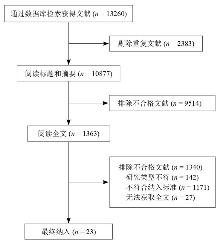
图1
文献筛选流程图"
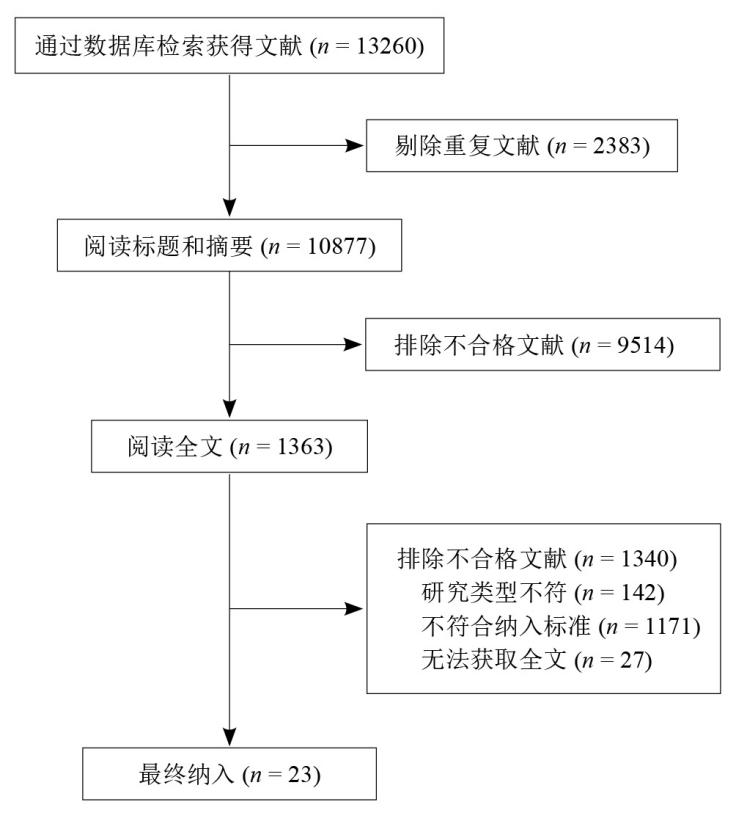

表1
纳入文献基本特征"
| 量表 | 纳入文献 | 国家 | 样本量/n | 研究对象 | 年龄/岁 | 条目数/维度数 | 重测时间/d |
|---|---|---|---|---|---|---|---|
| BrQ | Fernandes等[ | 巴西 | 84 | AIS | 10~18 | 34/8 | 7 |
| Lim等[ | 韩国 | 120 | AIS | 10~16 | 34/8 | 14 | |
| Peeters等[ | 荷兰 | 80 | AIS | 12~18 | 34/8 | 28 | |
| Zhang等[ | 中国 | 250 | AIS | 10~17 | 34/8 | 7 | |
| EQ-5D-Y-5L | Bonsel等[ | 荷兰 | 107 | AIS | 12~18 | NR | 7~14 |
| ISYQOL | Babaee等[ | 伊朗 | 178 | AIS、SK | 10~18 | 20/2 | 14 |
| Cheng等[ | 中国 | 131 | AIS | 10~18 | 20/2 | 14 | |
| Forest等[ | 加拿大 | 111 | AIS | 10~18 | 20/2 | 7、14 | |
| Liu等[ | 中国 | 138 | AIS | 10~18 | 20/2 | 14 | |
| Park等[ | 韩国 | 120 | AIS | 10~17 | 20/2 | 14 | |
| QLPSD | Hu等[ | 中国 | 129 | AIS | 10~18 | 21/5 | 14 |
| Korkmaz等[ | 土耳其 | 125 | AIS | 10~16 | 21/5 | 42 | |
| Park等[ | 韩国 | 120 | AIS | 10~17 | 21/5 | 14 | |
| SAQ | Babaee等[ | 伊朗 | 106 | AIS | 10~17 | 20/9 | 14 |
| Carreon等[ | 美国 | 1802 | AIS | 14.8±2.1 | 14/2 | 14 | |
| Lee等[ | 韩国 | 160 | AIS | 10~16 | 20/9 | 14 | |
| SJ-27 | Doi等[ | 日本 | 384 | AIS | 10~18 | 27/5 | NR |
| Kim等[ | 韩国 | 140 | AIS | 10~18 | 27/5 | 14 | |
| SRS-22r | Garg等[ | 印度 | 108 | AIS | 10~18 | NR | 10~14 |
| Monticone等[ | 意大利 | 223 | AIS | 10~18 | 22/5 | 7 | |
| Oeffinger等[ | 美国 | 1823 | AIS | 14.9±2.2 | 22/5 | NR | |
| Potoupnis等[ | 希腊 | 117 | AIS | 12~18 | NR | 14 | |
| YSQ | Nyirö等[ | 德国 | 131 | 颈部或背部疼痛青少年 | 10~16 | NR | 14 |
表2
PROMs的方法学质量与测量学特性"
| 量表 | 纳入文献 | 内容效度 | 结构效度 | 内部一致性 | 重测信度 | 假设检验 | 测量误差 | 反应度 | ||||||||
|---|---|---|---|---|---|---|---|---|---|---|---|---|---|---|---|---|
| 相关性 | 全面性 | 理解性 | 指标 | 评价 | Cronbach α | 评价 | ICC/Kappa | 评价 | 相关性 | 评价 | 指标 | 评价 | AUC | 评价 | ||
| BrQ | Fernandes等[ | NR | NR | Da,b/? | NR | NR | 0.36~0.93 | D/? | 0.34~0.86 | D/- | 1个量表 | D/+ | SEM | D/? | NR | NR |
| Lim等[ | NR | NR | Da,b/? | NR | NR | 0.86~0.90 | D/? | 0.85~0.93 | D/+ | 1个量表 | D/? | NR | NR | NR | NR | |
| Peeters等[ | NR | NR | Da,b/? | NR | NR | 0.35~0.89 | D/? | 0.62~0.91 | D/- | 1个量表 | D/? | NR | NR | NR | NR | |
| Zhang等[ | NR | NR | Da,b/? | NR | NR | 0.83 | D/? | 0.78~0.91 | D/+ | 1个量表 | D/? | NR | NR | NR | NR | |
| EQ-5D-Y-5L | Bonsel等[ | NR | NR | NR | NR | NR | NR | NR | 0.19~0.69 | D/- | 1个量表 | V/- | NR | NR | NR | NR |
| ISYQOL | Babaee等[ | NR | NR | Da,b/? | NR | NR | 0.70~0.80 | D/? | 0.82~0.95 | D/+ | 1个量表 | D/? | NR | NR | NR | NR |
| Cheng等[ | NR | NR | Da,b/? | Rasch | D/? | 0.90/0.89 | D/? | 0.95/0.96 | D/+ | 7个量表 | D/? | SEM | D/? | NR | NR | |
| Forest等[ | NR | NR | Da,b/? | NR | NR | 0.81/0.85 | D/? | 0.96/0.90 | D/+ | 2个量表 | D/+ | SEM | D/? | NR | NR | |
| Liu等[ | NR | NR | Da/? | NR | NR | 0.75/0.88 | D/? | 0.72/0.80 | A/+ | 1个量表 | D/? | NR | NR | NR | NR | |
| Park等[ | NR | NR | Da,b/? | EFA 2个因子 | D/+ | 0.77~0.87 | D/+ | 0.73~0.81 | D/+ | 1个量表 | D/+ | NR | NR | NR | NR | |
| QLPSD | Hu等[ | NR | NR | Da,b/? | PCA | I/+ | 0.77~0.91 | D/+ | 0.78~0.92 | D/+ | 2个量表 | D/? | NR | NR | NR | NR |
| Korkmaz等[ | NR | NR | Db/? | EFA 5个因子 | D/+ | 0.78~0.97 | D/+ | 0.82~0.97 | D/+ | 1个量表 | D/? | NR | NR | NR | NR | |
| Park等[ | NR | NR | Da,b/? | EFA 5个因子 | D/? | 0.80~0.92 | D/? | 0.72~0.82 | D/+ | 1个量表 | D/+ | NR | NR | NR | NR | |
| SAQ | Babaee等[ | NR | NR | Da,b/? | PCA | I/- | 0.65~0.72 | D/? | 0.85~0.98 | D/+ | 1个量表 | D/? | NR | NR | NR | NR |
| Carreon等[ | NR | NR | NR | PCA | I/? | 0.88~0.89 | D/? | 0.81~0.91 | D/+ | 1个量表 | D/? | NR | NR | NR | NR | |
| Lee等[ | NR | NR | Da,b/? | NR | NR | 0.87~0.91 | D/? | 0.86~0.95 | D/+ | 1个量表 | D/? | NR | NR | NR | NR | |
| SJ-27 | Doi等[ | NR | NR | Da,b/? | CATPCA | I/? | 0.91 | D/? | NR | NR | 1个量表 | D/? | NR | NR | NR | NR |
| Kim等[ | NR | NR | Da,b/? | EFA 5个因子 | D/+ | 0.77~0.90 | D/+ | 0.74~0.91 | D/+ | 1个量表 | D/+ | NR | NR | NR | NR | |
| SRS-22r | Garg等[ | NR | NR | Da,b/? | NR | NR | 0.61~0.84 | D/? | 0.92~0.96 | D/+ | 1个量表 | D/? | NR | NR | NR | NR |
| Monticone等[ | NR | NR | Da,b/? | EFA 4个因子 | A/? | 0.65~0.78 | D/? | 0.97~1.00 | D/+ | 1个量表 | D/? | NR | NR | NR | NR | |
| Oeffinger等[ | NR | NR | NR | CFI = 0.98 | D/+ | 0.69~0.87 | D/- | NR | NR | NR | NR | NR | NR | NR | NR | |
| Potoupnis等[ | NR | NR | NR | EFA 5个因子 | D/? | 0.66~0.92 | D/? | 0.78~0.88 | D/+ | 1个量表 | D/? | NR | NR | NR | NR | |
| YSQ | Nyirö等[ | NR | NR | Db/? | NR | NR | NR | NR | 0.60~0.88 | V/- | 1个量表 | V/+ | NR | NR | AUC | D/- |
表3
PROMs改良GRADE证据质量分级及推荐等级"
| 量表 | 内容效度 | 结构效度 | 内部一致性 | 重测信度 | 假设检验 | 测量误差 | 反应度 | 推荐等级 | |||||||
|---|---|---|---|---|---|---|---|---|---|---|---|---|---|---|---|
| 评价 | 证据质量 | 评价 | 证据质量 | 评价 | 证据质量 | 评价 | 证据质量 | 评价 | 证据质量 | 评价 | 证据质量 | 评价 | 证据质量 | ||
| BrQ | ? | 中 | NR | NR | ? | 中 | ± | 低 | ± | 低 | ? | 中 | NR | NR | B |
| EQ-5D-Y-5L | NR | NR | NR | NR | NR | NR | - | 中 | - | 高 | NR | NR | NR | NR | C |
| ISYQOL | ? | 中 | ± | 低 | ± | 低 | + | 中 | ± | 低 | ? | 中 | NR | NR | B |
| QLPSD | ? | 中 | ± | 低 | ± | 低 | + | 中 | ± | 低 | NR | NR | NR | NR | B |
| SAQ | ? | 中 | ± | 极低 | ? | 中 | + | 中 | ? | 中 | NR | NR | NR | NR | B |
| SJ-27 | ? | 中 | ± | 极低 | ± | 低 | + | 中 | ± | 低 | NR | NR | NR | NR | B |
| SRS-22r | ? | 中 | ± | 低 | ± | 低 | + | 中 | ? | 中 | NR | NR | NR | NR | B |
| YSQ | ? | 中 | NR | NR | NR | NR | - | 高 | + | 高 | NR | NR | - | 中 | C |
表4
基于ICF-CY的PROMs内容特征"
| 量表 | 评估内容 | 身体功能与结构 | 活动和参与 | 环境因素 |
|---|---|---|---|---|
| BrQ | 总体健康感知 躯体功能 情绪功能 自尊与外貌感知 活力 学校活动能力 躯体疼痛 社会功能 | b126气质和人格功能 b130能量和驱力功能 b134睡眠功能 b140注意力功能 b152情绪功能 b1801身体意象 b280痛觉 b440呼吸功能 b455运动耐受功能 | d160集中注意力 d4153维持坐姿 d450步行 d4551攀登 d4552跑步 d540穿着 d550吃 d710基本人际交往 d750非正式社会关系 d760家庭人际关系 d820学校教育 d9205社会活动 | e1101药品 e1151个人日常生活中用的辅助用品和技术 e5800卫生的服务 |
| EQ-5D-Y-5L | 行动能力 自我照顾 日常活动 疼痛或不适 担心、伤心或不开心 | b152情绪功能 b280痛觉 | d230进行日常事务 d450步行 d510盥洗自身 d540穿着 | |
| ISYQOL | 脊柱健康 支具 | b152情绪功能 b1801身体意象 b280痛觉 b710关节活动功能 | d410改变身体的基本姿势 d540穿着 d710基本人际交往 d910社区生活 | e1151个人日常生活中用的辅助用品和技术 e5800卫生的服务 |
| QLPSD | 心理社会功能 睡眠障碍 背部疼痛 身体形象 背部灵活性 | b134睡眠功能 b152情绪功能 b1801身体意象 b2801身体单一部位疼痛 | d4100躺下 d4105屈身 d430举起和搬运物体 d540穿着 d640做家务 d710基本人际交往 d750非正式社会关系 d910社区生活 d920娱乐和休闲 | |
| SAQ | 总体外观感知 侧弯曲度 肋骨及侧腰隆起 躯干偏移 腰部 肩部 驼背 胸廓 术后瘢痕 | b1801身体意象 b530体重维持功能 s6302乳房和乳头 s710头颈部的结构 s720肩部的结构 s740骨盆部的结构 s750下肢的结构 s760躯干的结构 s7700骨 | ||
| SJ-27 | 躯体疼痛 活动受限 躯体活动 自我形象 心理健康 | b126气质和人格功能 b152情绪功能 b1801身体意象 b2801身体单一部位疼痛 b660生殖功能 b710关节活动功能 | d4150保持躺姿 d4153保持坐姿 d4154保持站姿 d430举起和搬运物体 d510盥洗自身 d540穿着 d710基本人际交往 d740正式人际关系 d750非正式社会关系 d760家庭人际关系 d770亲密关系 d9201运动 d9205社会活动 | |
| SRS-22r | 功能/活动 疼痛 自我形象/外貌 心理健康 对管理的满意度 | b152情绪功能 b1801身体意象 b280痛觉 s760躯干的结构 | d4150保持躺姿 d640做家务 d710基本人际交往 d750非正式社会关系 d760家庭人际关系 d820学校教育 d850有报酬的就业 d870经济自给 d9201运动 d9205社会活动 | e1101药品 e5800卫生的服务 |
| YSQ | 脊柱疼痛 疼痛相关行为 家庭影响 | b2801身体单一部位疼痛 | d820学校教育 d850有报酬的就业 d9201运动 | e310直系亲属家庭 e5800卫生的服务 |
| [1] | 姚斌彬, 周淳浩, 王红卫. 体育运动对青少年脊柱健康的影响[J]. 中国学校体育, 2025, 44(1): 86-88. |
| [2] |
Montgomery L R C, Swain M, Dario A B, et al. Does sedentary behaviour cause spinal pain in children and adolescents? A systematic review with meta-analysis[J]. Br J Sports Med, 2025, 59(6): 409-422.
doi: 10.1136/bjsports-2024-108648 |
| [3] |
Mei Y, Lin Y F, Gong Z, et al. Prevalence of incorrect posture among school adolescents after the COVID-19 pandemic: a large population-based scoliosis screening in China[J]. J Orthop Surg Res, 2025, 20: 156.
doi: 10.1186/s13018-025-05479-8 pmid: 39939858 |
| [4] |
Maekawa M, Yoshizawa E, Hayata G, et al. Physical and psychological effects of postural educational intervention for students experienced school refusal[J]. Curr Psychol, 2023, 42(5): 3510-3519.
doi: 10.1007/s12144-021-01677-9 |
| [5] | De Miranda A P O C, Penha P J, Pereira L G, et al. Posture of adolescent and the relationship with body mass index, sex, and physical activity[J]. Child Obes, 2022, 18(5): 342-349. |
| [6] |
Kuru Çolak T, Durmuş B B, Saatçi E Z, et al. Systematic review of clinical outcome parameters of conservative treatment of adolescent idiopathic scoliosis patients[J]. J Clin Med, 2025, 14(4): 1063.
doi: 10.3390/jcm14041063 |
| [7] | Parent E C, Vaclavik M, Bourgoin C, et al. Inventory of patient-reported outcome measures used in the non-operative care of scoliosis: a scoping review[J]. Children (Basel), 2023, 10(2): 239. |
| [8] |
An M, Tanaka R, Hirota N, et al. A scoping review of adapted physical activity interventions for children and youth with disabilities using International Classification of Functioning, Disability and Health: Children and Youth version as a reference[J]. Int J Dev Disabil, 2023, 70(7): 1127-1152.
doi: 10.1080/20473869.2022.2161987 |
| [9] |
姜静远, 李安巧, 邱服冰, 等. 基于ICF-CY儿童青少年身体活动指南的内容分析与比较[J]. 中国康复理论与实践, 2020, 26(9): 993-1004.
doi: 10.3969/j.issn.1006-9771.2020.09.001 |
| Jiang J Y, Li A Q, Qiu F B, et al. Content analysis and comparison of physical activity guidelines for children and adolescents based on ICF-CY[J]. Chin J Rehabil Theory Pract, 2020, 26(9): 993-1004. | |
| [10] |
Mokkink L B, De Vet H C W, Prinsen C A C, et al. COSMIN risk of bias checklist for systematic reviews of patient-reported outcome measures[J]. Qual Life Res, 2018, 27(5): 1171-1179.
doi: 10.1007/s11136-017-1765-4 pmid: 29260445 |
| [11] |
Mokkink L B, Elsman E B M, Terwee C B. COSMIN guideline for systematic reviews of patient-reported outcome measures version 2.0[J]. Qual Life Res, 2024, 33(11): 2929-2939.
doi: 10.1007/s11136-024-03761-6 |
| [12] | 施月仙, 张海明, 黄亚琪, 等. 选择健康测量工具的共识标准(COSMIN)偏倚风险评价清单的解读[J]. 中国护理管理, 2021, 21(7): 1053-1057. |
| Shi Y X, Zhang H M, Huang Y Q, et al. Interpretation of the COSMIN risk of bias checklist for selecting health measurement instruments[J]. Chin Nurs Manag, 2021, 21(7): 1053-1057. | |
| [13] |
Prinsen C A C, Mokkink L B, Bouter L M, et al. COSMIN guideline for systematic reviews of patient-reported outcome measures[J]. Qual Life Res, 2018, 27(5): 1147-1157.
doi: 10.1007/s11136-018-1798-3 pmid: 29435801 |
| [14] | 陈祎婷, 沈蓝君, 彭健, 等. 改良版定量系统评价证据分级方法对患者报告结局测量工具的评价[J]. 解放军护理杂志, 2020, 37(10): 57-60. |
| Chen Y T, Shen L J, Peng J, et al. Evaluation of patient-reported outcome measures using the modified GRADE approach[J]. Nurs J Chin PLA, 2020, 37(10): 57-60. | |
| [15] |
Cieza A, Geyh S, Chatterji S, et al. ICF linking rules: an update based on lessons learned[J]. J Rehabil Med, 2005, 37(4): 212-218.
doi: 10.1080/16501970510040263 pmid: 16024476 |
| [16] |
Fernandes I P, Gomes M V P, Andrade R M, et al. Translation, cross-cultural adaptation and clinimetric properties of the Brazilian Portuguese version of the Brace Questionnaire[J]. Spine Deform, 2024, 12(5): 1337-1343.
doi: 10.1007/s43390-024-00883-2 |
| [17] |
Lim J M, Goh T S, Shin J K, et al. Validation of the Korean version of the Brace Questionnaire[J]. Br J Neurosurg, 2018, 32(6): 678-681.
doi: 10.1080/02688697.2018.1501464 pmid: 30146912 |
| [18] |
Peeters C M M, Bonsel J M, Munnik-Hagewoud R, et al. Validity and reliability of the adapted Dutch version of the Brace Questionnaire (BrQ)[J]. Acta Orthop, 2023, 94: 460-465.
doi: 10.2340/17453674.2023.18492 pmid: 37670558 |
| [19] |
Zhang X, Wang D, Yao M, et al. Reliability and validity of Chinese version of Brace Questionnaire for adolescent idiopathic scoliosis: a cross-sectional study[J]. Medicine (Baltimore), 2021, 100(33): e26965.
doi: 10.1097/MD.0000000000026965 |
| [20] |
Bonsel J M, Peeters C M M, Reijman M, et al. A head-to-head comparison of the adult EQ-5D-5L and youth EQ-5D-Y-5L in adolescents with idiopathic scoliosis[J]. J Patient Rep Outcomes, 2025, 9(1): 13.
doi: 10.1186/s41687-025-00842-z pmid: 39878911 |
| [21] |
Babaee T, Esfandiari E, Rouhani N, et al. The Italian Spine Youth Quality of Life questionnaire: reliability and validity of the Persian version in adolescents with spinal deformities[J]. Spine Deform, 2022, 10(4): 775-782.
doi: 10.1007/s43390-022-00475-y |
| [22] | Cheng A Y, Jim P K, Kwan N W, et al. Cross-cultural adaptation and psychometric properties of the traditional Chinese version of the Italian Spine Youth Quality of Life (ISYQOL) questionnaire[J]. Healthcare (Basel), 2023, 11(19): 2683. |
| [23] |
Forest C, Parent E, Chémaly O, et al. Cross-cultural French-Canadian adaptation and psychometric assessment of the Italian Spine Youth Quality of Life (ISYQOL) questionnaire[J]. Spine J, 2022, 22(11): 1893-1902.
doi: 10.1016/j.spinee.2022.07.094 pmid: 35870800 |
| [24] |
Liu S, Liang J, Xu N, et al. Reliability and validity of simplified Chinese version of the Italian Spine Youth Quality of Life questionnaire in adolescents with idiopathic scoliosis[J]. BMC Musculoskelet Disord, 2021, 22(1): 568.
doi: 10.1186/s12891-021-04462-8 |
| [25] |
Park S H, Goh T S, Son S M, et al. Validation of the Italian Spine Youth Quality of Life (ISYQOL) in Korean population[J]. J Clin Neurosci, 2021, 92: 165-168.
doi: 10.1016/j.jocn.2021.08.015 pmid: 34509245 |
| [26] |
Hu M, Cai Z, Yang Y, et al. Reliability and validity of the adapted Chinese version of the Quality of Life Profile for Spine Deformities in adolescents with idiopathic scoliosis[J]. Global Spine J, 2024, 14(4): 1269-1276.
doi: 10.1177/21925682221139462 |
| [27] |
Korkmaz M D, Korkmaz M, Alt Y F, et al. Adaptation and validation of the Turkish version of the Quality of Life Profile for Spine Deformities in idiopathic scoliosis[J]. Acta Orthop Traumatol Turc, 2024, 58(3): 182-186.
doi: 10.5152/j.aott.2024.23078 |
| [28] | Park S H, Goh T S, Park Y G, et al. Validation of a Korean version of the Quality-of-Life Profile for Spine Deformities (QLPSD) in patients with adolescent idiopathic scoliosis[J]. Eur Rev Med Pharmacol Sci, 2022, 26(1): 84-89. |
| [29] |
Babaee T, Moradi V, Rouhani N, et al. Assessment of reliability and validity of the adapted Persian version of the Spinal Appearance Questionnaire in adolescents with idiopathic scoliosis[J]. Spine Deform, 2022, 10(2): 317-326.
doi: 10.1007/s43390-021-00414-3 |
| [30] | Carreon L Y, Sanders J O, Polly D W, et al. Spinal Appearance Questionnaire: factor analysis, scoring, reliability, and validity testing[J]. Spine, 2011, 36(18): E1240-E1244. |
| [31] |
Lee J S, Shin J K, Goh T S, et al. Validation of the Korean version of the Spinal Appearance Questionnaire[J]. J Back Musculoskelet Rehabil, 2017, 30(6): 1203-1208.
doi: 10.3233/BMR-150480 pmid: 28655125 |
| [32] |
Doi T, Inoue H, Arai Y, et al. Reliability and validity of a novel quality of life questionnaire for female patients with adolescent idiopathic scoliosis: Scoliosis Japanese Questionnaire-27: a multicenter, cross-sectional study[J]. BMC Musculoskelet Disord, 2018, 19(1): 99.
doi: 10.1186/s12891-018-2025-7 |
| [33] |
Kim H S, Kim K, Cho Y J, et al. Validation of the Scoliosis Japanese Questionnaire-27 in Korean patients with adolescent idiopathic scoliosis[J]. J Clin Neurosci, 2024, 129: 110830.
doi: 10.1016/j.jocn.2024.110830 |
| [34] |
Garg B, Mehta N, Swamy A M, et al. Reliability and validity of a cross-culturally adapted Hindi version of the SRS-22r questionnaire in Indian patients[J]. Spine Deform, 2020, 8(5): 885-891.
doi: 10.1007/s43390-020-00106-4 |
| [35] | Monticone M, Baiardi P, Calabrò D, et al. Development of the Italian version of the revised Scoliosis Research Society-22 Patient Questionnaire, SRS-22r-I: cross-cultural adaptation, factor analysis, reliability, and validity[J]. Spine, 2010, 35(24): E1412-E1417. |
| [36] | Oeffinger D J, Iwinski H, Talwalkar V, et al. Psychometric analysis and the implications for the use of the Scoliosis Research Society Questionnaire (SRS-22r English) for individuals with adolescent idiopathic scoliosis[J]. N Am Spine Soc J, 2024, 19: 100545. |
| [37] |
Potoupnis M, Papavasiliou K, Kenanidis E, et al. Reliability and concurrent validity of the adapted Greek version of the Scoliosis Research Society-22r Questionnaire. a cross-sectional study performed on conservatively treated patients[J]. Hippokratia, 2012, 16(3): 225-229.
pmid: 23935288 |
| [38] |
Nyirö L, Potthoff T, Siegenthaler M H, et al. Translation and validation of the German version of the Young Spine Questionnaire[J]. BMC Pediatr, 2021, 21(1): 359.
doi: 10.1186/s12887-021-02804-y pmid: 34429090 |
| [39] |
Terwee C B, Prinsen C A C, Chiarotto A, et al. COSMIN methodology for evaluating the content validity of patient-reported outcome measures: a Delphi study[J]. Qual Life Res, 2018, 27(5): 1159-1170.
doi: 10.1007/s11136-018-1829-0 pmid: 29550964 |
| [40] |
Norris M, Lecavalier L. Evaluating the use of exploratory factor analysis in developmental disability psychological research[J]. J Autism Dev Disord, 2010, 40(1): 8-20.
doi: 10.1007/s10803-009-0816-2 pmid: 19609833 |
| [41] |
Smit T H. On growth and scoliosis[J]. Eur Spine J, 2024, 33(6): 2439-2450.
doi: 10.1007/s00586-024-08276-9 pmid: 38705903 |
| [42] |
Van Kampen D A, Willems W J, Van Beers L W, et al. Determination and comparison of the smallest detectable change (SDC) and the minimal important change (MIC) of four-shoulder patient-reported outcome measures (PROMs)[J]. J Orthop Surg Res, 2013, 8: 40.
doi: 10.1186/1749-799X-8-40 pmid: 24225254 |
| [43] |
Terwee C B, Roorda L D, Knol D L, et al. Linking measurement error to minimal important change of patient-reported outcomes[J]. J Clin Epidemiol, 2009, 62(10): 1062-1067.
doi: 10.1016/j.jclinepi.2008.10.011 pmid: 19230609 |
| [44] |
Stone L E, Sindewald R, Kelly M P. Self-image in spinal deformity: a state-of-the-art review[J]. Spine Deform, 2024, 12(5): 1179-1202.
doi: 10.1007/s43390-024-00875-2 pmid: 38696080 |
| [45] |
Paradkar R, Paradkar R, Singh M, et al. The impact of the social determinants of health on adolescent idiopathic scoliosis: a systematic review[J]. Spine Deform, 2025, 13(4): 997-1006.
doi: 10.1007/s43390-025-01065-4 |
| [1] | 马颖, 任君, 王首鉴, 周鑫, 何天翔, 孔令军, 房敏. 基于治疗前和支具初配信息的青少年特发性脊柱侧凸支具治疗失败风险预测模型构建与初步验证[J]. 《中国康复理论与实践》, 2026, 32(7): 850-860. |
| [2] | 谢浩宇, 李岩, 谢皓, 王楚怀. 噪声前庭电刺激对青少年特发性脊柱侧凸患者椎旁肌激活与姿势控制的即时效应[J]. 《中国康复理论与实践》, 2026, 32(2): 222-232. |
| [3] | 刘介生, 封玉琨, 何泽佳, 洪毅, 王方永, 张军卫, 刘宝戈. 基于表面肌电的弹力带三维矫正疗法对青少年特发性脊柱侧凸的效果[J]. 《中国康复理论与实践》, 2026, 32(10): 1177-1185. |
| [4] | 杨同念, 任杰, 肖辉. 儿童青少年身体活动对焦虑的效果:系统综述的系统综述[J]. 《中国康复理论与实践》, 2025, 31(8): 883-888. |
| [5] | 王晓锋, 胡梦巧, 汪嫣, 魏坤, 徐文竹, 任丹, 马晔. 外骨骼机器人辅助步态训练对脑卒中和脊髓损伤下肢功能康复效果的系统综述[J]. 《中国康复理论与实践》, 2025, 31(8): 914-921. |
| [6] | 顾逸青, 程舒芃, 李勇强, 毛二莉, 励建安. 成年气管切开患者拔管的直接策略与堵管策略对比的系统综述[J]. 《中国康复理论与实践》, 2025, 31(6): 666-673. |
| [7] | 冯海洋. 足功能指数在儿童和青少年扁平足中的信度和效度[J]. 《中国康复理论与实践》, 2025, 31(6): 729-735. |
| [8] | 王梅, 朱文平. 身体活动干预2型糖尿病患者的健康效益:系统综述的系统综述[J]. 《中国康复理论与实践》, 2025, 31(5): 553-560. |
| [9] | 叶绿, 常晶, 凌海润. 网络行为成瘾的运动干预效果:系统综述的系统综述[J]. 《中国康复理论与实践》, 2025, 31(4): 431-440. |
| [10] | 朱志强, 徐巧玲, 邵雪云. 肥胖和超重儿童参与身体活动的健康效益:系统综述的系统综述[J]. 《中国康复理论与实践》, 2025, 31(3): 296-305. |
| [11] | 蔡倩, 张溪, 苏海荣, 刘娜, 黄颖, 李际强, 夏金根, 郑德采. 吸气肌训练对脱机失败者脱机疗效的系统综述[J]. 《中国康复理论与实践》, 2025, 31(3): 306-313. |
| [12] | 徐晓红, 钟晓珂, 孙思怡, 张祁, 程怀春. 轻度认知障碍老年人参与艺术治疗心理健康效益的系统综述[J]. 《中国康复理论与实践》, 2025, 31(2): 165-171. |
| [13] | 段富文, 张倍齐, 李丽. 运动干预对运动相关性脑震荡预防作用的系统综述[J]. 《中国康复理论与实践》, 2025, 31(12): 1385-1397. |
| [14] | 刘东斐, 颜会义, 杨帆, 张帅. 运动干预对唐氏综合征儿童青少年多维健康结局影响的Meta分析[J]. 《中国康复理论与实践》, 2025, 31(12): 1398-1413. |
| [15] | 张郝琪, 刘华, 孙璞, 温艳飞, 张霁月, 杨露. 基于ICF-CY的学龄期儿童基本运动技能评估量表结构内容和心理测量特性的系统综述[J]. 《中国康复理论与实践》, 2025, 31(10): 1172-1180. |
| 阅读次数 | ||||||
|
全文 |
|
|||||
|
摘要 |
|
|||||
|
||
