



《中国康复理论与实践》 ›› 2026, Vol. 32 ›› Issue (8): 903-915.doi: 10.3969/j.issn.1006-9771.2026.08.004
闫嘉铮1, 罗小琴1, 刘日华1, 于瀛2, 亓丰学1( )
收稿日期:2026-04-07
修回日期:2026-06-17
接受日期:2026-06-23
出版日期:2026-08-25
发布日期:2026-08-25
通讯作者:
亓丰学,E-mail: fengxue.qi@hotmail.com作者简介:闫嘉铮(2002-),男,满族,安徽太和县人,硕士研究生,主要研究方向:脑刺激与运动表现提升、运动与脑功能促进。基金资助:
Yan Jiazheng1, Luo Xiaoqin1, Liu Rihua1, Yu Ying2, Qi Fengxue1()
Received:2026-04-07
Revised:2026-06-17
Accepted:2026-06-23
Published:2026-08-25
Online:2026-08-25
Contact:
Qi Fengxue,E-mail: fengxue.qi@hotmail.comSupported by:摘要:
目的 采用网状Meta分析系统对比不同非侵入性脑刺激(NIBS)技术对脑卒中患者平衡功能的干预疗效。
方法 系统检索PubMed、Embase、Web of Science、Cochrane Library、Scopus、中国知网数据库,检索时限自建库至2026年2月,纳入探究NIBS改善脑卒中平衡功能的随机对照试验(RCT)和随机交叉试验(RCD)。采用Cochrane偏倚风险评估工具进行偏倚风险评价;采用RevMan 5.4进行敏感性分析;采用Stata 18.0进行亚组分析和网状Meta分析。
结果 最终纳入35项研究(31项RCT、4项RCD),涉及1 226例患者。网状Meta结果显示,各类NIBS对计时起立行走测试结局无显著改善效应;经颅直流电刺激(tDCS)改善Berg平衡量表疗效排序最优(SUCRA = 85.9%)。亚组分析提示,病程≤ 6个月、刺激靶点为初级运动皮质、磁刺激参数80%~100% RMT的干预方案平衡获益更显著。
结论 tDCS改善脑卒中患者综合平衡功能的疗效最优,可作为脑卒中平衡康复的辅助干预手段。
中图分类号:
闫嘉铮, 罗小琴, 刘日华, 于瀛, 亓丰学. 非侵入性脑刺激技术改善脑卒中后平衡功能的网状Meta分析[J]. 《中国康复理论与实践》, 2026, 32(8): 903-915.
Yan Jiazheng, Luo Xiaoqin, Liu Rihua, Yu Ying, Qi Fengxue. Non-invasive brain stimulation techniques for balance function after stroke: a network meta-analysis[J]. Chinese Journal of Rehabilitation Theory and Practice, 2026, 32(8): 903-915.

表1
PICO架构"
| 人群(Population) | 干预(Intervention) | 比较(Comparison) | 结局(Outcome) |
|---|---|---|---|
| 脑卒中患者 | 干预形式:TMS、tDCS、tACS、rTMS、TBS、tRNS | 与常规康复训练、伪刺激比较 | 平衡功能 |
| 干预方案:干预周期、刺激频率、干预时长 | 不同刺激技术比较 | 综合平衡功能 | |
| 静态平衡功能 | |||
| 动态平衡功能 |
表2
NIBS干预类型"
| 类型 | 参数 |
|---|---|
| tDCS | 强度1~2 mA 时间10~30 min |
| tACS | 强度< 4 mA 频率:β波多为20 Hz、γ波多为40 Hz 时间10~30 min |
| rTMS | 强度80%~120% MT 频率:低频< 1 Hz,高频5~20 Hz 时间15~40 min |
| iTBS | 强度:80%~120% RMT或80% AMT 频率< 50 Hz 时间3~10 min |
| tRNS | 强度1~2 mA 频率0.1~640 Hz 时间10~30 min |
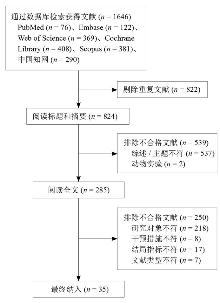
图1
文献筛选流程图"
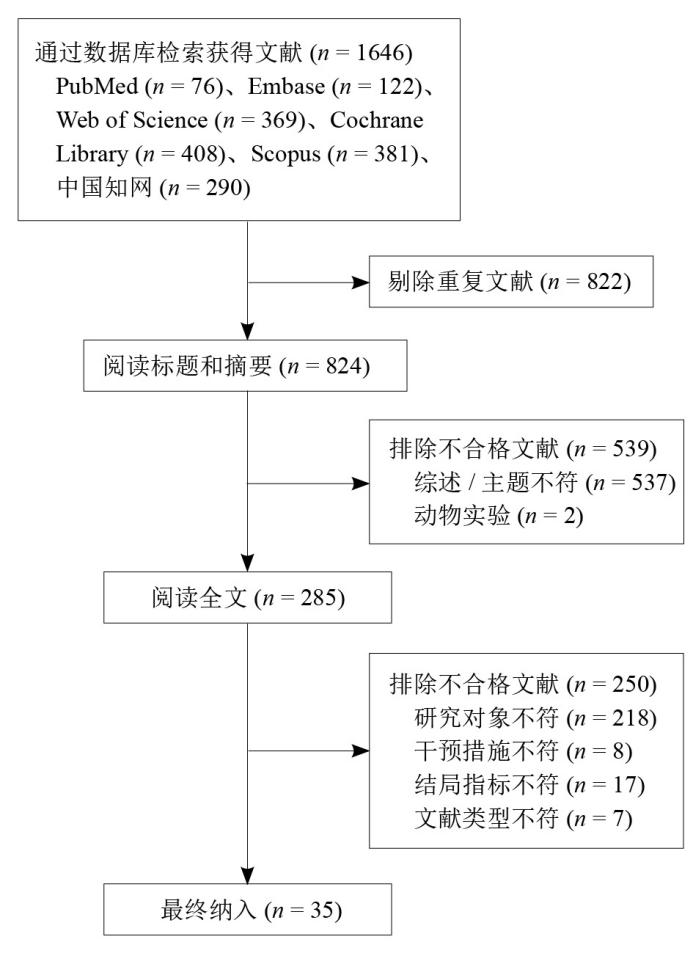
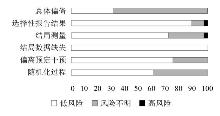
图2
偏倚风险比例"

表3
纳入文献基本特征"
| 纳入文献 | 样本量/n | 年龄/岁 | 刺激强度 | 刺激靶点 | 病程 | 干预措施 | 结局 指标 | ||||
|---|---|---|---|---|---|---|---|---|---|---|---|
| C | T | C | T | C | T | C | T | ||||
| Qurat-ul-ain等[ | 22 | 22 22 | 57.95±5.45 | 59.00±4.61 55.77±6.30 | 2 mA | 小脑 M1 | (16.41±10.26)个月 | (16.50±11.80)个月 (11.23±7.73)个月 | d | a | ①③④ |
| Da Cunha等[ | 16 | 16 | 58.25±9.75 | 55.44±8.47 | 2 mA | M1 | ≥ 6个月 | ≥ 6个月 | e | a | ① |
| Ehsani等[ | 11 | 12 | 61.90±5.84 | 62.33±7.02 | 2 mA | M1 | (134.56±4.10) d | (140.50±4.20) d | d | a | ③ |
| Haleem等[ | 22 | 22 | 56.41±4.04 | 57.18±4.66 | 2 mA | M1 | (3.23±1.54)个月 | (4.00±1.19)个月 | e | a | ③ |
| Kim等[ | 12 | 12 | 58.50±16.41 | 62.58±11.22 | 2 mA | M1 | (45.83±25.94)个月 | (59.17±58.92)个月 | e | a | ①②③ |
| Klomjai等[ | 10 | 9 | 57.20±2.80 | 58.60±2.60 | 2 mA | M1 | (3.30±0.50)个月 | e | a | ① | |
| Manji等[ | 15 | 15 | 63.70±11.00 | 62.20±10.10 | 1 mA | SMA | (149.70±24.20) d | (134.50±55.70) d | e | a | ① |
| Qurat-ul-ain等[ | 22 | 22 22 | 58.36±5.90 | 56.18±6.30 57.91±5.75 | 2 mA | 小脑 M1 | (18.18±13.10)个月 | (17.63±13.75)个月 (10.45±9.30)个月 | e | a | ①③④ |
| Saeys等[ | 15 | 16 | 64.53±7.23 | 62.00±9.61 | 1.5 mA | M1 | (38.40±15.14) d | (45.50±21.80) d | 4周e 4周b | 4周a 4周e | ⑤ |
| Seo等[ | 10 | 11 | 62.90±8.90 | 61.10±8.90 | 2 mA | M1 | (152.50±122.80)个月 | (75.50±83.40)个月 | e | a | ③ |
| Sha等[ | 10 | 10* 10# | > 18 | > 18 | 2 mA | M1 | — | — | e | a | ③ |
| Shakeb等[ | 18 | 18 | 58.00±9.16 | 54.38±7.45 | 2 mA | M1 | (4.97±0.81)个月 | (4.88±1.01)个月 | e | a | ①② |
| Utarapichat等[ | 5 | 5 | 57.10±12.20 | 57.10±12.20 | 2 mA | M1 | — | (34.10±18.90)个月 | 先e 后b | 先a 后e | ① |
| Wang等[ | 40 | 42 | 61.94±3.28 | 63.16±5.75 | 2 mA | M1 | (18.89±5.17) d | (20.05±4.28) d | e | a | ①③ |
| Zandvliet等[ | 10 | 15 | 57.90±7.10 | 57.10±10.00 | 1.5 mA | 小脑 | — | (107.80±143.60)个月 | 优势侧b +优势侧e | 对侧a+同侧a+对侧e | ⑥ |
| Forogh等[ | 7 | 8 | 53.00~79.00 | 53.00~79.00 | — | M1 | > 6个月 | > 6个月 | e | b | ③ |
| Lin等[ | 15 | 16 | 62.30±11.70 | 58.30±10.80 | 100%RMT | M1 | (33.50±23.80) d | (40.60±29.10) d | e | b | ⑤ |
| Ma等[ | 36 | 37 | 65.83±8.45 | 68.62±10.67 | 90% RMT | M1 | 1~7 d | 1~7 d | d | b | ① |
| Rastgoo等[ | 10 | 10 | 49.70±11.00 | 54.60±11.75 | 90% RMT | M1 | (27.40±20.10)个月 | (30.20±18.30)个月 | 先e 后b | 先b 后e | ① |
| Wang等[ | 20 | 27 | 60.34±6.07 | 60.95±4.11 | 90% RMT | M1 | (15.86±6.59) d | (12.37±6.15) d | d | b | ③ |
| Wang等[ | 16 | 16 | 47.94±18.39 | 52.38±11.94 | 100%RMT | M1 | (8.47±7.88)个月 | (8.50±7.74)个月 | e | b | ③ |
| Yu等[ | 9 | 9 | 57.37±12.78 | 54.60±11.83 | 80% RMT | DLPFC | (1.34±0.27)个月 | (1.01±0.32)个月 | d | b | ①③ |
| Zhao等[ | 18 | 18 18 | 58.11±8.11 | 57.78±8.72 57.89±7.81 | 100%RMT | M1 SMA | (29.33±22.08) d | (27.78±19.18) d (33.22±19.18) d | d | b | ③ |
| Liao等[ | 12 | 12 12 | 57.08±11.28 | 57.17±11.63 58.25±14.63 | 80% RMT | 小脑 M1 | (52.50±38.52) d | (53.33±34.73) d (72.00±67.13) d | e | c | ③ |
| Xie等[ | 18 | 18 | 54.41±7.01 | 52.35±8.62 | 80% AMT | 小脑 | (2.91±1.96)个月 | (2.22±1.70)个月 | e | c | ① |
| Zhu等[ | 18 | 18 | 62.33±8.78 | 58.67±7.24 | 80% AMT | 小脑 | (52.00±48.56) d | (61.89±46.72) d | e | c | ①③ |
| Xia等[ | 9 | 11 11 | 54.44±14.21 | 50.36±8.99 47.18±11.98 | 100%RMT | SMA M1 | (49.00±25.00) d | (50.00±13.00) d (50.00±17.00) d | c | c | ⑥ |
| Liao等[ | 15 | 15 | 55.40±8.10 | 51.53±9.22 | 80% AMT | 小脑 | (86.53±45.26) d | (70.40±44.43) d | e | c | ③ |
| Koch等[ | 18 | 18 | 65.00±12.00 | 63.00±11.00 | 80% AMT | 小脑 | > 6个月 | e | c | ③ | |
| Xiao等[ | 24 | 25 | 54.00±13.00 | 53.90±14.90 | 80% RMT | M1 | (42.30±24.30) d | (51.40±19.40) d | d | b | ③ |
| Toktas等[ | 14 | 14 | 62.57±8.53 | 58.79±10.19 | 2 mA | M1 | (6.86±3.08)个月 | (8.07±5.37)个月 | d | a | ①③ |
| Zhang等[ | 14 | 13 | 59.86±9.45 | 56.15±10.43 | 90% RMT | M1 | (2.50±1.83)个月 | (2.73±1.73)个月 | d | b | ③ |
| Fang等[ | 18 | 18 | 57.00±12.61 | 58.67±9.91 | 90% RMT | M1 | 1~6个月 | d | b | ③ | |
| Goel等[ | 16 | 16 | 58.67±9.14 | 55.94±8.39 | 2 mA | M1 | ≥6个月 | d | a | ①② | |
| Lin等[ | 10 | 10 | 61.10±9.70 | 60.80±8.10 | — | M1 | > 6个月 | e | c | ①③ | |
表4
BBS评分的亚组分析"
| 亚组 | 纳入研究数/n | 样本量/n | I2/% | Meta分析结果 | ||
|---|---|---|---|---|---|---|
| SMD(95%CI) | P值 | |||||
| 靶点 | 小脑 | 6项[ | 214 | 92.1 | 0.32(0.03~0.62) | 0.031 |
| M1 | 18项[ | 616 | 78.5 | 0.51(0.34~0.68) | < 0.001 | |
| 强度 | ≤ 2 mA | 9项[ | 374 | 69.9 | 0.04(-0.16~0.23) | 0.720 |
| 80%~100% RMT | 8项[ | 299 | 83.4 | 0.97(0.73~1.21) | < 0.001 | |
| 80% AMT | 3项[ | 102 | 87.3 | 0.89(0.46~1.31) | < 0.001 | |
| 病程 | > 6个月 | 9项[ | 308 | 81.4 | 0.05(-0.17~0.27) | 0.671 |
| ≤ 6个月 | 12项[ | 482 | 80.8 | 0.74(0.55~0.93) | < 0.001 | |
| 干预方式 | tDCS | 9项[ | 374 | 69.9 | 0.04(-0.16~0.23) | 0.720 |
| rTMS | 8项[ | 278 | 49.1 | 0.79(0.55~1.03) | < 0.001 | |
| iTBS | 5项[ | 158 | 91.3 | 1.11(0.75~1.47) | <0.001 | |
表5
TUGT的亚组分析"
| 亚组 | 纳入研究数/n | 样本量/n | I2/% | Meta分析结果 | ||
|---|---|---|---|---|---|---|
| SMD(95%CI) | P值 | |||||
| 靶点 | 小脑 | 4项[ | 160 | 69.4 | 0.39(0.07~0.71) | 0.017 |
| M1 | 13项[ | 464 | 81.8 | -0.10(-0.29~0.09) | 0.285 | |
| 干预参数 | ≤ 2mA | 11项[ | 425 | 84.8 | 0.08(-0.11~0.27) | 0.405 |
| 80%~100% RMT | 3项[ | 111 | 0.0 | -0.18(-0.56~0.19) | 0.336 | |
| 80%AMT | 2项[ | 72 | 10.0 | -0.12(-0.58~0.35) | 0.629 | |
| 病程 | > 6个月 | 9项[ | 298 | 83.8 | 0.33(0.10~0.55) | 0.005 |
| ≤ 6个月 | 8项[ | 330 | 0.0 | -0.28(-0.49~-0.06) | 0.013 | |
| 干预方式 | tDCS | 11项[ | 425 | 84.8 | 0.08(-0.11~0.27) | 0.405 |
| rTMS | 3项[ | 111 | 0.0 | -0.18(-0.56~0.19) | 0.336 | |
| iTBS | 3项[ | 92 | 0.0 | -0.05(-0.46~0.37) | 0.830 | |
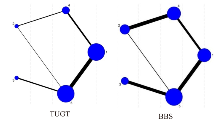
图3
网络证据图"
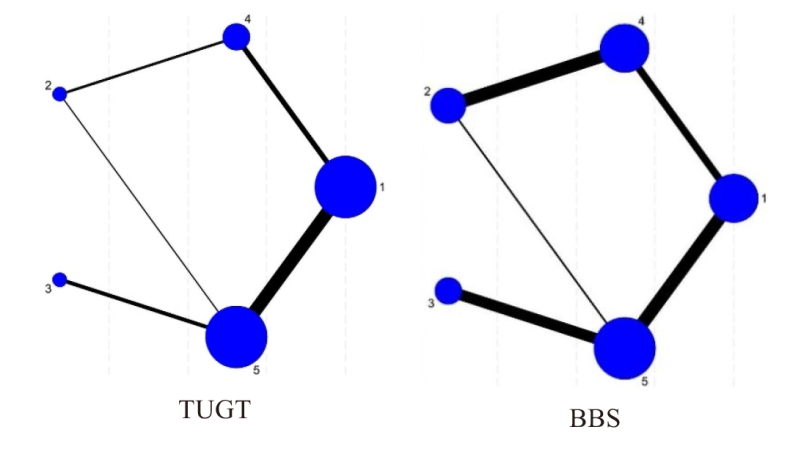
表6
TUGT两两比较结果"
| 组别 | SMD | 95%CI |
|---|---|---|
| rTMS vs. tDCS | 0.24 | -1.80~2.28 |
| iTBS vs. tDCS | -0.17 | -2.17~1.83 |
| 常规康复 vs. tDCS | 1.03 | -0.44~2.50 |
| 伪刺激 vs. tDCS | -0.01 | -1.03~1.01 |
| iTBS vs. rTMS | -0.41 | -3.10~2.28 |
| 常规康复 vs. rTMS | 0.79 | -1.02~2.60 |
| 伪刺激 vs. rTMS | -0.25 | -2.32~1.82 |
| 常规康复 vs. iTBS | 1.20 | -1.21~3.62 |
| 伪刺激 vs. iTBS | 0.16 | -1.56~1.88 |
| 伪刺激 vs. 常规康复 | -1.04 | -2.74~0.65 |
表7
BBS两两比较结果"
| 组别 | SMD | 95%CI |
|---|---|---|
| rTMS vs. tDCS | -0.45 | -1.59~0.68 |
| iTBS vs. tDCS | -0.25 | -1.42~0.92 |
| 常规康复 vs. tDCS | -1.65 | -2.62~-0.68 |
| 伪刺激 vs. tDCS | -1.17 | -1.97~-0.37 |
| iTBS vs. rTMS | 0.20 | -1.31~1.71 |
| 常规康复 vs. rTMS | -1.20 | -1.95~-0.44 |
| 伪刺激 vs. rTMS | -0.72 | -1.97~0.53 |
| 常规康复 vs. iTBS | -1.40 | -2.83~0.04 |
| 伪刺激 vs. iTBS | -0.92 | -1.78~-0.06 |
| 伪刺激 vs. 常规康复 | 0.48 | -0.67~1.63 |
图4
比较-校正漏斗图"
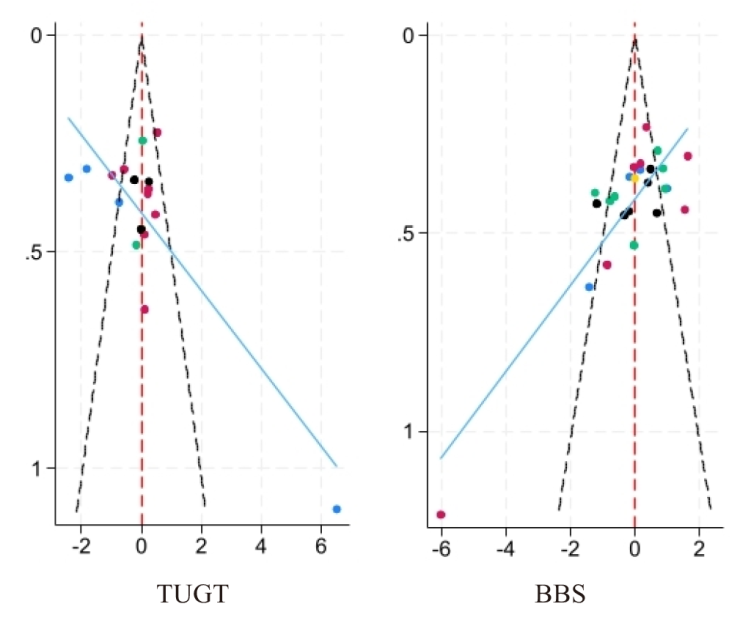
表8
TUGT的敏感性分析"
| 剔除研究 | SMD | 95%CI | P值 | I2/% |
|---|---|---|---|---|
| 未剔除 | -0.03 | -0.37~0.31 | 0.88 | 77 |
| Qurat-ul-ain等小脑组[ | -0.07 | -0.42~0.28 | 0.69 | 77 |
| Qurat-ul-ain等M1组[ | -0.03 | -0.39~0.33 | 0.87 | 79 |
| Da Cunha等[ | -0.06 | -0.41~0.30 | 0.75 | 78 |
| Eunmi等[ | -0.06 | -0.41~0.29 | 0.73 | 78 |
| Wanalee等[ | -0.04 | -0.40~0.31 | 0.81 | 79 |
| Manji等[ | -0.01 | -0.36~0.35 | 0.97 | 78 |
| Qurat-ul-ain等小脑组[ | -0.08 | -0.42~0.26 | 0.64 | 76 |
| Qurat-ul-ain等M1组[ | -0.07 | -0.42~0.28 | 0.69 | 71 |
| Shakeb等[ | -0.02 | -0.38~0.34 | 0.90 | 79 |
| Utarapichat等[ | -0.03 | -0.38~0.32 | 0.87 | 79 |
| Wang等[ | -0.02 | -0.32~0.37 | 0.90 | 75 |
| Ma等[ | -0.02 | -0.38~0.35 | 0.93 | 78 |
| Rastgoo等[ | -0.03 | -0.38~0.33 | 0.88 | 79 |
| Yu等[ | -0.03 | -0.38~0.33 | 0.88 | 79 |
| Xie等[ | -0.01 | -0.37~0.35 | 0.96 | 78 |
| Zhu等[ | -0.04 | -0.40~0.32 | 0.83 | 79 |
| Toktas等[ | -0.04 | -0.40~0.31 | 0.81 | 79 |
| Goel等[ | -0.12 | -0.12~0.36 | 0.33 | 53 |
| Lin等[ | -0.04 | -0.39~0.32 | 0.83 | 79 |
表9
BBS的敏感性分析"
| 剔除研究 | SMD | 95%CI | P值 | I2/% |
|---|---|---|---|---|
| 未剔除 | 0.59 | 0.25~0.93 | < 0.001 | 82 |
| Qurat-ul-ain等[ | 0.64 | 0.30~0.98 | < 0.001 | 81 |
| Qurat-ul-ain等M1[ | 0.61 | 0.26~0.97 | < 0.001 | 83 |
| Ehsani等[ | 0.58 | 0.23~0.93 | 0.001 | 83 |
| Haleem等[ | 0.62 | 0.27~0.98 | < 0.001 | 83 |
| Kim等[ | 0.62 | 0.27~0.97 | < 0.001 | 83 |
| Qurat-ul-ain等小脑组[ | 0.64 | 0.30~0.98 | < 0.001 | 81 |
| Qurat-ul-ain等M1组[ | 0.65 | 0.31~0.98 | < 0.001 | 81 |
| Seo等[ | 0.61 | 0.26~0.97 | < 0.001 | 83 |
| Sha等[ | 0.59 | 0.23~0.94 | 0.001 | 83 |
| WANG等[ | 0.59 | 0.23~0.95 | 0.001 | 83 |
| Forogh等[ | 0.59 | 0.24~0.94 | 0.001 | 83 |
| Wang等[ | 0.54 | 0.20~0.87 | 0.002 | 81 |
| Wang等[ | 0.58 | 0.23~0.93 | 0.001 | 83 |
| Yu等[ | 0.60 | 0.24~0.95 | < 0.001 | 83 |
| Zhao等M1组[ | 0.55 | 0.21~0.90 | 0.002 | 82 |
| Zhao等SMA组[ | 0.61 | 0.25~0.96 | < 0.001 | 83 |
| Liao等小脑组[ | 0.50 | 0.17~0.82 | 0.003 | 80 |
| Liao等M1组[ | 0.59 | 0.17~0.80 | 0.003 | 79 |
| Zhu等[ | 0.61 | 0.25~0.96 | < 0.001 | 83 |
| Liao等[ | 0.59 | 0.24~0.95 | 0.001 | 83 |
| Koch等[ | 0.51 | 0.18~0.84 | 0.002 | 80 |
| Xiao等[ | 0.60 | 0.24~0.96 | 0.001 | 83 |
| Toktas等[ | 0.60 | 0.25~0.96 | < 0.001 | 83 |
| Zhang等[ | 0.60 | 0.25~0.95 | < 0.001 | 83 |
| Fang等[ | 0.59 | 0.23~0.94 | 0.001 | 83 |
| Lin等[ | 0.62 | 0.26~0.97 | < 0.001 | 83 |
| [1] |
Zhao Y, Zhang X, Chen X, et al. Neuronal injuries in cerebral infarction and ischemic stroke: from mechanisms to treatment[J]. Int J Mol Med, 2022, 49(2): 15.
doi: 10.3892/ijmm |
| [2] |
Murray C J, Vos T, Lozano R, et al. Disability-adjusted life years (DALYs) for 291 diseases and injuries in 21 regions, 1990-2010: a systematic analysis for the Global Burden of Disease Study 2010[J]. Lancet, 2012, 380(9859): 2197-2223.
doi: 10.1016/S0140-6736(12)61689-4 pmid: 23245608 |
| [3] |
Ursin M H, Bergland A, Fure B, et al. Balance and mobility as predictors of post-stroke cognitive impairment[J]. Dement Geriatr Cogn Dis Extra, 2015, 5(2): 203-211.
doi: 10.1159/000381669 pmid: 26195976 |
| [4] |
Ben Assayag E, Shenhar-Tsarfaty S, Korczyn A D, et al. Gait measures as predictors of poststroke cognitive function: evidence from the TABASCO study[J]. Stroke, 2015, 46(4): 1077-1083.
doi: 10.1161/STROKEAHA.114.007346 pmid: 25677599 |
| [5] |
Stinear C M, Petoe M A, Byblow W D. Primary motor cortex excitability during recovery after stroke: implications for neuromodulation[J]. Brain Stimul, 2015, 8(6): 1183-1190.
doi: 10.1016/j.brs.2015.06.015 pmid: 26195321 |
| [6] | Lopez C. A neuroscientific account of how vestibular disorders impair bodily self-consciousness[J]. Front Integr Neurosci, 2013, 7: 91. |
| [7] |
Parikh V, Medley A, Thomas J, et al. Differential effect of M1 and cerebellar repetitive transcranial magnetic stimulation on balance performance in stroke[J]. Eur J Neurosci, 2026, 63(1): e70363.
doi: 10.1111/ejn.v63.1 |
| [8] |
Klomjai W, Katz R, Lackmy-Vallée A. Basic principles of transcranial magnetic stimulation (TMS) and repetitive TMS (rTMS)[J]. Ann Phys Rehabil Med, 2015, 58(4): 208-213.
doi: S1877-0657(15)00079-2 pmid: 26319963 |
| [9] |
Nitsche M A, Paulus W. Excitability changes induced in the human motor cortex by weak transcranial direct current stimulation[J]. J Physiol, 2000, 527(3): 633-639.
doi: 10.1111/tjp.2000.527.issue-3 |
| [10] |
Elyamany O, Leicht G, Herrmann C S, et al. Transcranial alternating current stimulation (tACS): from basic mechanisms towards first applications in psychiatry[J]. Eur Arch Psychiatry Clin Neurosci, 2021, 271(1): 135-156.
doi: 10.1007/s00406-020-01209-9 |
| [11] |
Pascual-Leone A, Tormos J M, Keenan J, et al. Study and modulation of human cortical excitability with transcranial magnetic stimulation[J]. J Clin Neurophysiol, 1998, 15(4): 333-343.
doi: 10.1097/00004691-199807000-00005 pmid: 9736467 |
| [12] |
Huang Y Z, Edwards M J, Rounis E, et al. Theta burst stimulation of the human motor cortex[J]. Neuron, 2005, 45(2): 201-206.
doi: 10.1016/j.neuron.2004.12.033 |
| [13] |
Contemori G, Trotter Y, Cottereau B R, et al. tRNS boosts perceptual learning in peripheral vision[J]. Neuropsychologia, 2019, 125: 129-136.
doi: S0028-3932(19)30028-4 pmid: 30721741 |
| [14] |
Barker A T, Jalinous R, Freeston I L. Non-invasive magnetic stimulation of human motor cortex[J]. Lancet, 1985, 1(8437): 1106-1107.
doi: 10.1016/s0140-6736(85)92413-4 pmid: 2860322 |
| [15] |
Chase H W, Boudewyn M A, Carter C S, et al. Transcranial direct current stimulation: a roadmap for research, from mechanism of action to clinical implementation[J]. Mol Psychiatry, 2020, 25(2): 397-407.
doi: 10.1038/s41380-019-0499-9 |
| [16] |
To W T, De Ridder D, Hart J, et al. Changing brain networks through non-invasive neuromodulation[J]. Front Hum Neurosci, 2018, 12: 128.
doi: 10.3389/fnhum.2018.00128 pmid: 29706876 |
| [17] |
van den Heuvel M P, Sporns O. Rich-club organization of the human connectome[J]. J Neurosci, 2011, 31(44): 15775-15786.
doi: 10.1523/JNEUROSCI.3539-11.2011 pmid: 22049421 |
| [18] |
Fritsch B, Reis J, Martinowich K, et al. Direct current stimulation promotes BDNF-dependent synaptic plasticity: potential implications for motor learning[J]. Neuron, 2010, 66(2): 198-204.
doi: 10.1016/j.neuron.2010.03.035 pmid: 20434997 |
| [19] |
Inukai Y, Saito K, Sasaki R, et al. Comparison of three non-invasive transcranial electrical stimulation methods for increasing cortical excitability[J]. Front Hum Neurosci, 2016, 10: 668.
doi: 10.3389/fnhum.2016.00668 pmid: 28082887 |
| [20] |
Chen K, Sun M, Zhuang H. Effect of theta burst stimulation on lower extremity motor function improvement and balance recovery in patients with stroke: a systematic review and meta-analysis of randomized controlled trials[J]. Medicine (Baltimore), 2024, 103(44): e40098.
doi: 10.1097/MD.0000000000040098 |
| [21] |
Kang N, Lee R D, Lee J H, et al. Functional balance and postural control improvements in patients with stroke after noninvasive brain stimulation: a meta-analysis[J]. Arch Phys Med Rehabil, 2020, 101(1): 141-153.
doi: 10.1016/j.apmr.2019.09.003 |
| [22] | Liu Y, Li H, Zhang J, et al. A meta-analysis: whether repetitive transcranial magnetic stimulation improves dysfunction caused by stroke with lower limb spasticity[J]. Evid Based Complement Alternat Med, 2021, 2021: 7219293. |
| [23] |
Huang J, Bao C, Chen Y, et al. Comparative efficacy and acceptability of non-invasive neuromodulation technologies and botulinum toxin injections for post-stroke spasticity and motor function: a network meta-analysis of randomised controlled trials[J]. EClinicalMedicine, 2024, 80: 103034.
doi: 10.1016/j.eclinm.2024.103034 |
| [24] |
Page M J, McKenzie J E, Bossuyt P M, et al. Updating guidance for reporting systematic reviews: development of the PRISMA 2020 statement[J]. J Clin Epidemiol, 2021, 134: 103-112.
doi: 10.1016/j.jclinepi.2021.02.003 pmid: 33577987 |
| [25] | Meseguer-Henarejos A B, Rubio-Aparicio M, López-Pina J A, et al. Characteristics that affect score reliability in the Berg Balance Scale: a meta-analytic reliability generalization study[J]. Eur J Phys Rehabil Med, 2019, 55(5): 570-584. |
| [26] |
Horak F B, Wrisley D M, Frank J. The balance evaluation systems test (BESTest) to differentiate balance deficits[J]. Phys Ther, 2009, 89(5): 484-498.
doi: 10.2522/ptj.20080071 pmid: 19329772 |
| [27] |
Tinetti M E. Performance-oriented assessment of mobility problems in elderly patients[J]. J Am Geriatr Soc, 1986, 34(2): 119-126.
doi: 10.1111/j.1532-5415.1986.tb05480.x pmid: 3944402 |
| [28] |
Pasma J H, Bijlsma A Y, van der Bij M D, et al. Age-related differences in quality of standing balance using a composite score[J]. Gerontology, 2014, 60(4): 306-314.
doi: 10.1159/000357406 pmid: 24968882 |
| [29] |
Outermans J C, van Peppen R P, Wittink H, et al. Effects of a high-intensity task-oriented training on gait performance early after stroke: a pilot study[J]. Clin Rehabil, 2010, 24(11): 979-987.
doi: 10.1177/0269215509360647 pmid: 20719820 |
| [30] |
Hafsteinsdóttir T B, Rensink M, Schuurmans M. Clinimetric properties of the Timed Up and Go Test for patients with stroke: a systematic review[J]. Top Stroke Rehabil, 2014, 21(3): 197-210.
doi: 10.1310/tsr2103-197 pmid: 24985387 |
| [31] | Sterne J A C, Savović J, Page M J, et al. RoB 2: a revised tool for assessing risk of bias in randomised trials[J]. BMJ, 2019, 366: l4898. |
| [32] |
Qurat-ul-ain, Ahmad Z, Ilyas S, et al. Comparison of a single session of tDCS on cerebellum vs. motor cortex in stroke patients: a randomized sham-controlled trial[J]. Ann Med, 2023, 55(2): 2252439.
doi: 10.1080/07853890.2023.2252439 |
| [33] | Da Cunha M J, Pinto C, Schifino G P, et al. Bicephalic transcranial direct-current stimulation does not add benefits to a footdrop stimulator for improving functional mobility in people with chronic hemiparesis after stroke: a double-blind, randomized controlled trial[J]. Phys Ther, 2022, 102(8): pzac079. |
| [34] |
Ehsani F, Mortezanejad M, Yosephi M H, et al. The effects of concurrent M1 anodal tDCS and physical therapy interventions on function of ankle muscles in patients with stroke: a randomized, double-blinded sham-controlled trial study[J]. Neurol Sci, 2022, 43(3): 1893-1901.
doi: 10.1007/s10072-021-05503-9 |
| [35] | Haleem M H, Baig M O, Abualait T, et al. Effects of transcranial direct current stimulation combined with motor relearning program on strength and balance in stroke patients[J]. PeerJ, 2025, 13: e18925. |
| [36] |
Kim E, Lee G, Lee J, et al. Simultaneous high-definition transcranial direct current stimulation and robot-assisted gait training in stroke patients[J]. Sci Rep, 2024, 14(1): 4483.
doi: 10.1038/s41598-024-53482-6 pmid: 38396060 |
| [37] |
Klomjai W, Aneksan B. A randomized sham-controlled trial on the effects of dual-tDCS "during" physical therapy on lower limb performance in sub-acute stroke and a comparison to the previous study using a "before" stimulation protocol[J]. BMC Sports Sci Med Rehabil, 2022, 14(1): 68.
doi: 10.1186/s13102-022-00463-9 pmid: 35428346 |
| [38] |
Manji A, Amimoto K, Matsuda T, et al. Effects of transcranial direct current stimulation over the supplementary motor area body weight-supported treadmill gait training in hemiparetic patients after stroke[J]. Neurosci Lett, 2018, 662: 302-305.
doi: S0304-3940(17)30875-3 pmid: 29107706 |
| [39] |
Qurat-ul-ain, Ahmad Z, Ishtiaq S, et al. Short term effects of anodal cerebellar vs. anodal cerebral transcranial direct current stimulation in stroke patients, a randomized control trial[J]. Front Neurosci, 2022, 16: 1035558.
doi: 10.3389/fnins.2022.1035558 |
| [40] |
Saeys W, Vereeck L, Lafosse C, et al. Transcranial direct current stimulation in the recovery of postural control after stroke: a pilot study[J]. Disabil Rehabil, 2015, 37(20): 1857-1863.
doi: 10.3109/09638288.2014.982834 pmid: 25401406 |
| [41] | Seo H G, Lee W H, Lee S H, et al. Robotic-assisted gait training combined with transcranial direct current stimulation in chronic stroke patients: a pilot double-blind, randomized controlled trial[J]. Restor Neurol Neurosci, 2017, 35(5): 527-536. |
| [42] | Sha H, Khandare S, Siddapur T, et al. Effect of transcranial direct current stimulation on balance and stroke specific quality of life in stroke patients[J]. Indian J Occup Ther, 2021, 15(1): 9-13. |
| [43] |
Shakeb S, Obaid Baig M, Abualait T, et al. Effects of anodal transcranial direct current stimulation on postural stability in subacute stroke: a randomized control trial[J]. Physiol Rep, 2024, 12(19): e70067.
doi: 10.14814/phy2.v12.19 |
| [44] | Utarapichat S, Kitisomprayoonkul W. Effects of transcranial direct current stimulation on motor activity of lower limb muscles in chronic stroke[J]. J Med Assoc Thai, 2018, 101(1): 1. |
| [45] | Wang L, Wang L, Wang Z, et al. Efficacy observation of combined transcutaneous vagus nerve stimulation and transcranial direct current stimulation on gait in 169 subacute stroke patients[J]. J Rehabil Med, 2024, 56: jrm40348. |
| [46] |
Zandvliet S B, Meskers C G M, Kwakkel G, et al. Short-term effects of cerebellar tDCS on standing balance performance in patients with chronic stroke and healthy age-matched elderly[J]. Cerebellum, 2018, 17(5): 575-589.
doi: 10.1007/s12311-018-0939-0 pmid: 29797226 |
| [47] |
Forogh B, Ahadi T, Nazari M, et al. The effect of repetitive transcranial magnetic stimulation on postural stability after acute stroke: a clinical trial[J]. Basic Clin Neurosci, 2017, 8(5): 405-411.
doi: 10.18869/nirp.bcn.8.5.405 pmid: 29167727 |
| [48] |
Lin Y N, Hu C J, Chi J Y, et al. Effects of repetitive transcranial magnetic stimulation of the unaffected hemisphere leg motor area in patients with subacute stroke and substantial leg impairment: a pilot study[J]. J Rehabil Med, 2015, 47(4): 305-310.
doi: 10.2340/16501977-1943 |
| [49] |
Ma J, Qian S, Ma N, et al. Effect of short-term 10 Hz repeated transcranial magnetic stimulation on postural control ability in patients with mild hemiparesis in acute ischemic stroke: a single-blinded randomized controlled trial[J]. Front Neurol, 2024, 15: 1439904.
doi: 10.3389/fneur.2024.1439904 |
| [50] |
Rastgoo M, Naghdi S, Nakhostin Ansari N, et al. Effects of repetitive transcranial magnetic stimulation on lower extremity spasticity and motor function in stroke patients[J]. Disabil Rehabil, 2016, 38(19): 1918-1926.
doi: 10.3109/09638288.2015.1107780 pmid: 26878554 |
| [51] |
Wang L, Wang L, Wang Z, et al. Clinical effect analysis of wearable sensor technology-based gait function analysis in post-transcranial magnetic stimulation stroke patients[J]. Sensors (Basel), 2024, 24(10): 3051.
doi: 10.3390/s24103051 |
| [52] |
Wang Y, Chen X, Wang M, et al. Repetitive transcranial magnetic stimulation coupled with visual-feedback cycling exercise improves walking ability and walking stability after stroke: a randomized pilot study[J]. Neural Plast, 2024, 2024: 8737366.
doi: 10.1155/np.v2024.1 |
| [53] |
Yu H, Liu S, Dai P, et al. Effects of repetitive transcranial magnetic stimulation on gait and postural control ability of patients with executive dysfunction after stroke[J]. Brain Sci, 2022, 12(9): 1185.
doi: 10.3390/brainsci12091185 |
| [54] |
Zhao L, Chen L, Wang C, et al. Effects of repetitive transcranial magnetic stimulation at different targets on brain function in stroke patients: a randomized controlled trial[J]. Front Neurol, 2024, 15: 1454220.
doi: 10.3389/fneur.2024.1454220 |
| [55] |
Liao L Y, Zhu Y, Peng Q Y, et al. Intermittent theta-burst stimulation for stroke: primary motor cortex versus cerebellar stimulation: a randomized sham-controlled trial[J]. Stroke, 2024, 55(1): 156-165.
doi: 10.1161/STROKEAHA.123.044892 |
| [56] | Xie Y J, Wei Q C, Chen Y, et al. Cerebellar theta burst stimulation on walking function in stroke patients: a randomized clinical trial[J]. Front Neurol, 2021, 15: 688569. |
| [57] | Zhu P A, Li Z L, Lu Q Q, et al. Can cerebellar theta-burst stimulation improve balance function and gait in stroke patients? A randomized controlled trial[J]. Eur J Phys Rehabil Med, 2024, 60(3): 391-399. |
| [58] |
Xia Y, Tang X, Hu R, et al. Cerebellum-cerebrum paired target magnetic stimulation on balance function and brain network of patients with stroke: a functional near-infrared spectroscopy pilot study[J]. Front Neurol, 2022, 13: 1071328.
doi: 10.3389/fneur.2022.1071328 |
| [59] |
Liao L Y, Xie Y J, Chen Y, et al. Cerebellar theta-burst stimulation combined with physiotherapy in subacute and chronic stroke patients: a pilot randomized controlled trial[J]. Neurorehabil Neural Repair, 2021, 35(1): 23-32.
doi: 10.1177/1545968320971735 |
| [60] |
Koch G, Bonnì S, Casula E P, et al. Effect of cerebellar stimulation on gait and balance recovery in patients with hemiparetic stroke: a randomized clinical trial[J]. JAMA Neurol, 2019, 76(2): 170-178.
doi: 10.1001/jamaneurol.2018.3639 pmid: 30476999 |
| [61] | Xiao J, Sun Y, Liu Z J, et al. Ipsilesional 5 Hz repetitive transcranial magnetic stimulation for motor dysfunction in subacute intracerebral hemorrhage: an exploratory trial[J]. Arch Rehabil Res Clin Transl, 2024, 7(1): 100386. |
| [62] |
Toktas N, Duruturk N, Güzel Ş, et al. The effect of transcranial direct current stimulation on balance, gait function and quality of life in patients with stroke[J]. Neurol Res, 2024, 46(9): 868-875.
doi: 10.1080/01616412.2024.2362583 |
| [63] |
Zhang W, Dai L, Fang L, et al. Effectiveness of repetitive transcranial magnetic stimulation combined with intelligent gait-adaptability training in improving lower limb function and brain symmetry after subacute stroke: a preliminary study[J]. J Stroke Cerebrovasc Dis, 2024, 33(12): 107961.
doi: 10.1016/j.jstrokecerebrovasdis.2024.107961 |
| [64] |
Fang L, Zhang W, Wu J, et al. Effects of combining rTMS and augmented reality gait adaptive training on walking function of patients with stroke based on three-dimensional gait analysis and sEMG: a randomized controlled trial[J]. Physiother Theory Pract, 2025, 41(5): 935-945.
doi: 10.1080/09593985.2024.2378905 |
| [65] |
Goel P, Malik M, Gera C, et al. Effects of tDCS combined with mat exercises on balance in patients with stroke[J]. Comp Exerc Physiol, 2024, 20(5): 403-411.
doi: 10.1163/17552559-00001045 |
| [66] | Lin L F, Chang K H, Huang Y Z, et al. Simultaneous stimulation in bilateral leg motor areas with intermittent theta burst stimulation to improve functional performance after stroke: a feasibility pilot study[J]. Eur J Phys Rehabil Med, 2019, 55(2): 162-168. |
| [67] |
Elsayed A, Khalifa M M, Elsayed F T, et al. Effect of different types of electrical stimulation on postural control and gait after stroke: a systematic review and meta-analysis[J]. Physiol Int, 2025, 112(4): 393-427.
doi: 10.1556/2060.2025.00688 |
| [68] |
Wang J, Wu Z, Hong S, et al. Cerebellar transcranial magnetic stimulation for improving balance capacity and activity of daily living in stroke patients: a systematic review and meta-analysis[J]. BMC Neurol, 2024, 24(1): 205.
doi: 10.1186/s12883-024-03720-1 pmid: 38879485 |
| [69] |
Zhang Q, Wang C, Liu B, et al. Effects of deep transcranial magnetic stimulation and repetitive transcranial magnetic stimulation on balance and gait in stroke patients[J]. Eur J Med Res, 2025, 30(1): 1132.
doi: 10.1186/s40001-025-03268-x |
| [70] |
Guadagnin V, Parazzini M, Fiocchi S, et al. Deep transcranial magnetic stimulation: modeling of different coil configurations[J]. IEEE Trans Biomed Eng, 2015, 63(7): 1543-1550.
doi: 10.1109/TBME.2015.2498646 |
| [71] |
Tien H H, Liu W Y, Chen Y L, et al. Transcranial direct current stimulation for improving ambulation after stroke: a systematic review and meta-analysis[J]. Int J Rehabil Res, 2020, 43(4): 299-309.
doi: 10.1097/MRR.0000000000000427 |
| [72] | Park G, Khan M H, Andrushko J W, et al. Associations between contralesional neuroplasticity and motor impairment through deep learning-derived MRI regional brain age in chronic stroke (ENIGMA): a multicohort, retrospective, observational study[J]. Lancet Digit Health, 2026, 8(1): 100942. |
| [73] |
Sohn M K, Jee S J, Kim Y W. Effect of transcranial direct current stimulation on postural stability and lower extremity strength in hemiplegic stroke patients[J]. Ann Rehabil Med, 2013, 37(6): 759-765.
doi: 10.5535/arm.2013.37.6.759 pmid: 24466510 |
| [74] |
Fan T, Zheng P, Zhang X, et al. Effects of exoskeleton rehabilitation robot training on neuroplasticity and lower limb motor function in patients with stroke[J]. BMC Neurol, 2025, 25(1): 193.
doi: 10.1186/s12883-025-04203-7 pmid: 40319228 |
| [75] |
Richards L G, Stewart K C, Woodbury M L, et al. Movement-dependent stroke recovery: a systematic review and meta-analysis of TMS and fMRI evidence[J]. Neuropsychologia, 2008, 46(1): 3-11.
doi: 10.1016/j.neuropsychologia.2007.08.013 pmid: 17904594 |
| [76] |
Afridi A, Malik A N, Raheel N, et al. Task-oriented training in stroke rehabilitation: qualitative study on perspectives and challenges among Pakistani physiotherapists[J]. PLoS One, 2025, 20(8): e0330634.
doi: 10.1371/journal.pone.0330634 |
| [77] |
Sullivan K, Klassen T, Mulroy S. Combined task-specific training and strengthening effects on locomotor recovery post-stroke: a case study[J]. J Neurol Phys Ther, 2006, 30(3): 130-141.
pmid: 17029656 |
| [78] |
Ugawa Y, Uesaka Y, Terao Y, et al. Magnetic stimulation over the cerebellum in humans[J]. Ann Neurol, 1995, 37(6): 703-713.
doi: 10.1002/ana.410370603 pmid: 7778843 |
| [79] |
Wu Z Y, Wang Y Q, Wen X P, et al. Does noninvasive cerebellar stimulation improve the balance and walking function of patients with stroke: a meta-analysis of randomized controlled trials[J]. Medicine (Baltimore), 2022, 101(36): e30302.
doi: 10.1097/MD.0000000000030302 |
| [80] |
Fujimoto H, Mihara M, Hattori N, et al. Cortical changes underlying balance recovery in patients with hemiplegic stroke[J]. Neuroimage, 2014, 85(Pt 1): 547-554.
doi: 10.1016/j.neuroimage.2013.05.014 |
| [81] |
Simonetta-Moreau M. Non-invasive brain stimulation (NIBS) and motor recovery after stroke[J]. Ann Phys Rehabil Med, 2014, 57(8): 530-542.
doi: S1877-0657(14)01757-6 pmid: 25193774 |
| [82] |
Tor Ö B, Nitsche M A, Wascher E, et al. Effect of transcranial direct current stimulation over the primary motor cortex on short-term balance acquisition in healthy individuals[J]. J Neuroeng Rehabil, 2025, 22(1): 146.
doi: 10.1186/s12984-025-01663-3 pmid: 40616154 |
| [83] |
Wessel M J, Hummel F C. Non-invasive cerebellar stimulation: a promising approach for stroke recovery?[J]. Cerebellum, 2018, 17(3): 359-371.
doi: 10.1007/s12311-017-0906-1 pmid: 29243202 |
| [84] |
Coleman E R, Moudgal R, Lang K, et al. Early rehabilitation after stroke: a narrative review[J]. Curr Atheroscler Rep, 2017, 19(12): 59.
doi: 10.1007/s11883-017-0686-6 pmid: 29116473 |
| [85] | Dromerick A W, Geed S, Barth J, et al. Critical Period After Stroke Study (CPASS): a phase II clinical trial testing an optimal time for motor recovery after stroke in humans[J]. Proc Natl Acad Sci USA, 2021, 118(39): e2026676118. |
| [86] |
Kim D, O'Shea L M, Aghamohammadi N R. Insights into the dependence of post-stroke motor recovery on the initial corticospinal tract connectivity from a computational model[J]. J Neuroeng Rehabil, 2025, 22(1): 8.
doi: 10.1186/s12984-024-01513-8 pmid: 39833900 |
| [87] |
Gözenman F, Berryhill M E. Working memory capacity differentially influences responses to tDCS and HD-tDCS in a retro-cue task[J]. Neurosci Lett, 2016, 629: 105-109.
doi: S0304-3940(16)30465-7 pmid: 27369325 |
| [1] | 刘姗, 许坤尧, 周芷萌, 周凌云, 曾茂, 何莎, 代洛阳, 覃婷, 胡庆林, 杨家海, 李蕊. 不同电磁刺激方案对脑卒中患者手功能及日常生活活动能力效果的网状Meta分析[J]. 《中国康复理论与实践》, 2026, 32(8): 916-926. |
| [2] | 周洁, 何志成, 张晓钰, 王雪, 刘大美, 宋宁, 吴珺. 视动整合训练对脑卒中后单侧空间忽略的效果[J]. 《中国康复理论与实践》, 2026, 32(7): 745-751. |
| [3] | 黄耀辉, 叶祥明, 刘勇, 唐沛, 卢逸舒. 重复经颅磁刺激对脑卒中后慢性意识障碍的效果[J]. 《中国康复理论与实践》, 2026, 32(7): 752-759. |
| [4] | 单桂香, 杜巨豹, 曹磊, 叶琳琳, 姜春静, 张晔, 马慧娟, 宋为群. 基于超声的脑卒中患者膈肌功能的特征分析[J]. 《中国康复理论与实践》, 2026, 32(7): 760-767. |
| [5] | 张费, 傅博勋, 沈慧, 陈进. 基于镜像神经元理论的动作观察疗法联合低频重复经颅磁刺激对脑卒中后单侧空间忽略的效果[J]. 《中国康复理论与实践》, 2026, 32(7): 768-775. |
| [6] | 樊留博, 单婷婷, 刘宝华, 罗咪咪, 张露丁, 王明慧. 超声引导联合改良导管球囊定位下不同剂量A型肉毒毒素治疗脑卒中后环咽肌功能障碍的效果[J]. 《中国康复理论与实践》, 2026, 32(7): 776-787. |
| [7] | 周广雪, 徐宁, 施滨. 虚拟现实技术联合作业治疗对脑卒中患者上肢运动功能康复效果的Meta分析[J]. 《中国康复理论与实践》, 2026, 32(7): 788-796. |
| [8] | 敦士博, 李玉周. 血流限制训练对脑卒中下肢运动功能康复效果的Meta分析[J]. 《中国康复理论与实践》, 2026, 32(7): 797-806. |
| [9] | 袁依依, 田武超, 张献斌, 钞强, 李永生, 刘桂新, 吴万庆, 王朴. 双任务训练对脑卒中患者移动和平衡功能康复疗效的Meta分析[J]. 《中国康复理论与实践》, 2026, 32(7): 807-816. |
| [10] | 李欣源, 郑洁皎, 张廷宇, 吴雪娇, 梁晓笑. 间歇性θ脉冲刺激改善脑卒中患者下肢运动和平衡功能的Meta分析[J]. 《中国康复理论与实践》, 2026, 32(6): 631-644. |
| [11] | 高惠刚, 刘远文, 秦煜玲, 胡昔权, 朱琳. 2020年至2025年足踝软体外骨骼机器人改善脑卒中患者步行功能的Scoping综述[J]. 《中国康复理论与实践》, 2026, 32(6): 645-652. |
| [12] | 刘睿, 高振梅, 周星宇, 张琦, 吴建林. 2015年至2025年数字健康技术在脑卒中上肢运动功能康复中应用的文献计量分析[J]. 《中国康复理论与实践》, 2026, 32(5): 534-549. |
| [13] | 倪天皓, 毕思雨, 戴媛, 钱红, 王勇丽, 万勤, 黄昭鸣. 汉语普通话言语失用症评估诊断工具的编制与验证[J]. 《中国康复理论与实践》, 2026, 32(5): 550-560. |
| [14] | 安咏怡, 李雪梅, 常学优, 赵雅宁, 黄海玲, 杨亚东. 不同强度血流限制训练联合低强度抗阻训练对老年脑卒中衰弱患者运动功能的影响[J]. 《中国康复理论与实践》, 2026, 32(5): 561-570. |
| [15] | 陈竹, 翟丽茹, 曹存霞, 彭晓华, 黄桃. 基于电阻抗断层成像技术评估膈神经-腹肌电刺激对脑卒中患者肺通气分布的效果[J]. 《中国康复理论与实践》, 2026, 32(5): 571-576. |
| 阅读次数 | ||||||
|
全文 |
|
|||||
|
摘要 |
|
|||||
|
||
