



《中国康复理论与实践》 ›› 2026, Vol. 32 ›› Issue (9): 1041-1051.doi: 10.3969/j.issn.1006-9771.2026.09.006
黄旭丽1,2,3, 王萍芝3, 罗天娥1,2( )
)
收稿日期:2026-01-07
修回日期:2026-04-13
接受日期:2026-04-15
出版日期:2026-09-25
发布日期:2026-09-20
通讯作者:
罗天娥(1977-),女,汉族,山西大同市人,博士,副教授,硕士研究生导师,主要研究方向:医学纵向数据统计分析方法与应用。E-mail: luotiane1977@163.com作者简介:黄旭丽(1990-),女,汉族,山西临汾市人,主管治疗师,主要研究方向:神经康复。
基金资助:
Huang Xuli1,2,3, Wang Pingzhi3, Luo Tian'e1,2()
Received:2026-01-07
Revised:2026-04-13
Accepted:2026-04-15
Published:2026-09-25
Online:2026-09-20
Contact:
Luo Tian'e, E-mail: luotiane1977@163.comSupported by:摘要:
目的 采用功能性近红外光谱技术(fNIRS),探讨实时动作观察疗法(R-AOT)与视频动作观察疗法(V-AOT)对脑卒中患者观察-模仿过程中脑区激活的血氧动力学差异。
方法 选取2025年6月至9月在山西白求恩医院就诊的29例脑卒中患者,采用随机顺序、自身对照的交叉试验设计,先后接受R-AOT与V-AOT干预,中间间隔1 d以避免残留效应。通过fNIRS同步采集两阶段病灶侧和非病灶侧背外侧前额叶皮质(DLPFC)、枕叶皮质(OC)、颞叶皮质(TC)等感兴趣区(ROI)的氧合血红蛋白浓度(Oxy-Hb)变化,比较两种干预方式在不同阶段的脑区激活差异。
结果 全部监测皮质ROI经假发现率(FDR)校正后,观察期和模仿期R-AOT与V-AOT条件间无显著性差异(PFDR > 0.05)。观察期R-AOT条件下病灶侧DLPFC的Oxy-Hb变化高于V-AOT (Z = 2.183, PFDR = 0.045);病灶侧OC的Oxy-Hb变化方向与V-AOT不同,但无显著性差异(Z = 2.321, PFDR = 0.060)。模仿期,R-AOT条件下仅病灶侧TC的Oxy-Hb变化高于V-AOT (Z = 2.724, PFDR = 0.018)。
结论 R-AOT与V-AOT在脑卒中患者观察和模仿阶段可产生不同的局部皮质血氧动力学反应,其中观察阶段的差异主要见于病灶侧DLPFC,模仿阶段主要见于病灶侧TC。
中图分类号:
黄旭丽, 王萍芝, 罗天娥. 实时与视频动作观察疗法下脑卒中患者脑区血氧动力学反应比较:一项基于功能性近红外光谱的研究[J]. 《中国康复理论与实践》, 2026, 32(9): 1041-1051.
Huang Xuli, Wang Pingzhi, Luo Tian'e. Comparison of cortical hemodynamic responses between real-time and video-based action observation therapy in patients with stroke: a functional near-infrared spectroscopy study[J]. Chinese Journal of Rehabilitation Theory and Practice, 2026, 32(9): 1041-1051.
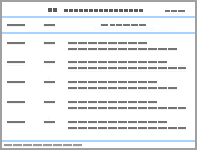
表1
患者一般资料"
| 指标 | 统计量 |
|---|---|
| 性别(男/女)/n | 25/4 |
| 年龄/岁 | 52.86±16.38 |
| 身高/cm | 169.86±6.16 |
| 体质量/kg | 72.52±13.77 |
| 病程/d | 36.62±37.54 |
| 利手(右/左)/n | 24/5 |
| FMA上肢部分 | 22.10±15.41 |
| FMA手功能 | 5.31±5.35 |
| MMSE | 28.41±1.12 |
| 上肢感觉障碍(有/无)/n | 2/27 |
| 病灶部位(皮质/皮质下/混合)/n | 2/11/16 |
| 优势半球受累(是/否)/n | 12/17 |
| 病灶侧别(左/右)/n | 15/14 |
| 失语(有/无)/n | 2/27 |
| 偏侧忽略(有/无)/n | 0/29 |
| Brunnstrom上肢分期(Ⅱ/Ⅲ/Ⅳ期及以上)/n | 9/11/9 |
| Brunnstrom手分期(Ⅰ/Ⅱ/Ⅲ/Ⅳ/Ⅴ)/n | 8/8/2/4/7 |
| 脑卒中类型(梗死/出血)/n | 23/6 |
| 高血压(是/否)/n | 18/11 |
| 糖尿病(是/否)/n | 8/21 |
| 高血脂(是/否)/n | 5/24 |
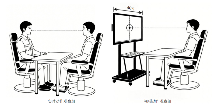
图1
场景布局"

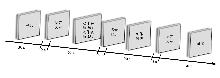
图2
任务流程"
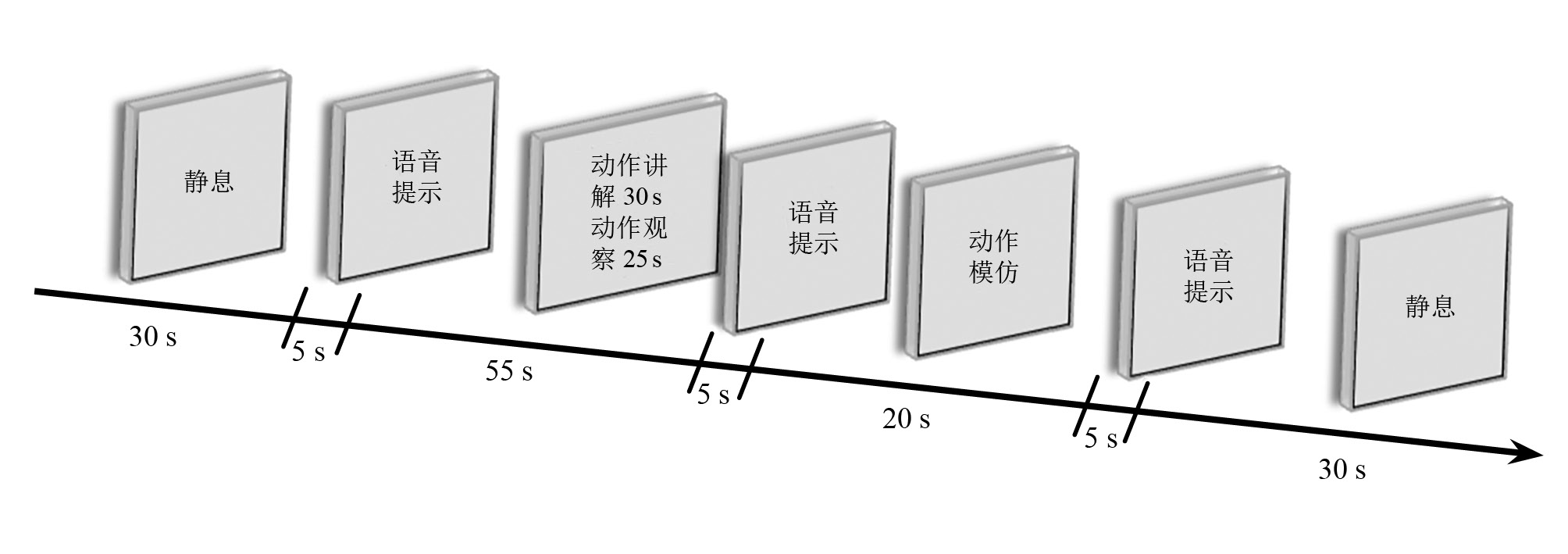
图3
光极布局示意图"
表2
观察期全脑18个脑区-侧别统计结果"
| 脑区 | V-AOT | R-AOT | 原始P值 | PFDR(k = 18) | PFDR(k = 3) | Z值 | r值 |
|---|---|---|---|---|---|---|---|
| Broca(非病灶侧脑区) | -0.002(-0.024, 0.018) | 0.006(-0.015, 0.041) | 0.126 | 0.454 | — | 1.530 | 0.284 |
| Broca(病灶侧脑区) | 0.006(-0.017, 0.033) | 0.011(-0.009, 0.033) | 0.550 | 0.901 | — | 0.597 | 0.111 |
| DLPFC(非病灶侧脑区) | 0.004(-0.009, 0.016) | 0.008(-0.007, 0.028) | 0.550 | 0.826 | — | 0.597 | 0.111 |
| DLPFC(病灶侧脑区) | 0.000(-0.006, 0.010) | 0.010(-0.005, 0.020) | 0.029 | 0.262 | 0.045 | 2.183 | 0.405 |
| FEF(非病灶侧脑区) | 0.004(-0.011, 0.018) | 0.000(-0.009, 0.018) | 0.949 | 0.949 | — | 0.064 | 0.012 |
| FEF(病灶侧脑区) | 0.012(-0.007, 0.023) | 0.002(-0.016, 0.017) | 0.247 | 0.635 | — | 1.158 | 0.215 |
| FPA(非病灶侧脑区) | -0.003(-0.013, 0.013) | 0.007(-0.002, 0.028) | 0.162 | 0.487 | — | 1.398 | 0.260 |
| FPA(病灶侧脑区) | -0.001(-0.007, 0.010) | 0.009(-0.008, 0.027) | 0.092 | 0.414 | — | 1.685 | 0.313 |
| OC(非病灶侧脑区) | 0.027(-0.031, 0.066) | 0.022(-0.067, 0.123) | 0.898 | 0.951 | — | 0.128 | 0.024 |
| OC(病灶侧脑区) | 0.046(-0.054, 0.149) | -0.027(-0.044, 0.078) | 0.020 | 0.365 | 0.060 | 2.321 | 0.431 |
| M1 (非病灶侧脑区) | 0.011(-0.017, 0.028) | 0.011(-0.002, 0.028) | 0.594 | 0.823 | — | 0.533 | 0.099 |
| M1 (病灶侧脑区) | 0.007(-0.009, 0.019) | 0.008(-0.002, 0.024) | 0.429 | 0.966 | — | 0.790 | 0.147 |
| PMC&SMC(非病灶侧脑区) | 0.010(-0.006, 0.022) | 0.012(-0.004, 0.016) | 0.701 | 0.842 | — | 0.384 | 0.071 |
| PMC&SMC(病灶侧脑区) | 0.000(-0.006, 0.015) | 0.004(-0.014, 0.014) | 0.522 | 0.940 | — | 0.640 | 0.119 |
| SSC(非病灶侧脑区) | 0.004(-0.006, 0.023) | 0.014(0.000, 0.027) | 0.670 | 0.861 | — | 0.426 | 0.079 |
| SSC(病灶侧脑区) | 0.011(-0.011, 0.029) | 0.007(-0.005, 0.026) | 0.749 | 0.843 | — | 0.320 | 0.059 |
| TC(非病灶侧脑区) | -0.008(-0.024, 0.024) | 0.013(-0.003, 0.031) | 0.080 | 0.479 | — | 1.752 | 0.325 |
| TC(病灶侧脑区) | 0.000(-0.032, 0.037) | 0.010(-0.003, 0.029) | 0.481 | 0.962 | 0.481 | 0.704 | 0.131 |
表3
模仿期全脑18个脑区-侧别统计结果"
| 脑区 | V-AOT | R-AOT | 原始P值 | PFDR (k = 18) | PFDR (k = 3) | Z值 | r值 |
|---|---|---|---|---|---|---|---|
| Broca(非病灶侧脑区) | -0.011(-0.039, 0.008) | -0.003(-0.036, 0.018) | 0.325 | 0.731 | — | 0.984 | 0.183 |
| Broca(病灶侧脑区) | 0.000(-0.024, 0.037) | 0.001(-0.044, 0.031) | 0.156 | 0.702 | — | 1.420 | 0.264 |
| DLPFC(非病灶侧脑区) | -0.004(-0.018, 0.009) | 0.008(-0.004, 0.038) | 0.053 | 0.477 | — | 1.932 | 0.359 |
| DLPFC(病灶侧脑区) | 0.003(-0.010, 0.026) | 0.014(-0.008, 0.033) | 0.247 | 0.741 | 0.375 | 1.158 | 0.215 |
| FEF(非病灶侧脑区) | 0.007(-0.002, 0.025) | 0.007(-0.004, 0.060) | 0.284 | 0.730 | — | 1.071 | 0.199 |
| FEF(病灶侧脑区) | 0.004(-0.014, 0.025) | -0.001(-0.021, 0.011) | 0.686 | 0.882 | — | 0.405 | 0.075 |
| FPA(非病灶侧脑区) | -0.010(-0.031, 0.011) | -0.001(-0.017, 0.029) | 0.053 | 0.318 | — | 1.932 | 0.359 |
| FPA(病灶侧脑区) | 0.001(-0.013, 0.018) | 0.006(-0.007, 0.025) | 0.405 | 0.729 | — | 0.833 | 0.155 |
| OC(非病灶侧脑区) | -0.018(-0.199, 0.020) | 0.002(-0.109, 0.086) | 0.405 | 0.663 | — | 0.833 | 0.155 |
| OC(病灶侧脑区) | 0.018(-0.070, 0.082) | 0.020(-0.030, 0.084) | 0.639 | 0.959 | 0.639 | 0.469 | 0.087 |
| M1 (非病灶侧脑区) | -0.001(-0.022, 0.025) | 0.008(-0.012, 0.034) | 0.654 | 0.906 | — | 0.448 | 0.083 |
| M1 (病灶侧脑区) | 0.005(-0.012, 0.016) | 0.013(-0.016, 0.040) | 0.198 | 0.713 | — | 1.288 | 0.239 |
| PMC&SMC(非病灶侧脑区) | 0.006(-0.013, 0.027) | 0.015(-0.001, 0.027) | 0.798 | 0.898 | — | 0.256 | 0.047 |
| PMC&SMC(病灶侧脑区) | -0.001(-0.016, 0.017) | 0.002(-0.010, 0.021) | 0.325 | 0.650 | — | 0.984 | 0.183 |
| SSC(非病灶侧脑区) | 0.006(-0.013, 0.028) | 0.005(-0.006, 0.020) | 0.882 | 0.882 | — | 0.149 | 0.028 |
| SSC(病灶侧脑区) | 0.005(-0.012, 0.025) | 0.002(-0.024, 0.045) | 0.733 | 0.880 | — | 0.341 | 0.063 |
| TC(非病灶侧脑区) | -0.005(-0.020, 0.028) | 0.006(-0.022, 0.042) | 0.848 | 0.897 | — | 0.192 | 0.036 |
| TC(病灶侧脑区) | -0.025(-0.040, 0.016) | 0.030(-0.012, 0.056) | 0.006 | 0.108 | 0.018 | 2.724 | 0.506 |
图4
观察期监测皮质区域血氧动力学变化表面映射图 注:脑图谱经左右翻转标准化,示意图右侧为病灶侧,左侧为非病灶侧,不代表患者的真实解剖侧别;色条为Oxy-Hb激活中位数,暖色激活升高,冷色去激活,统一色阶用于组间对比。"
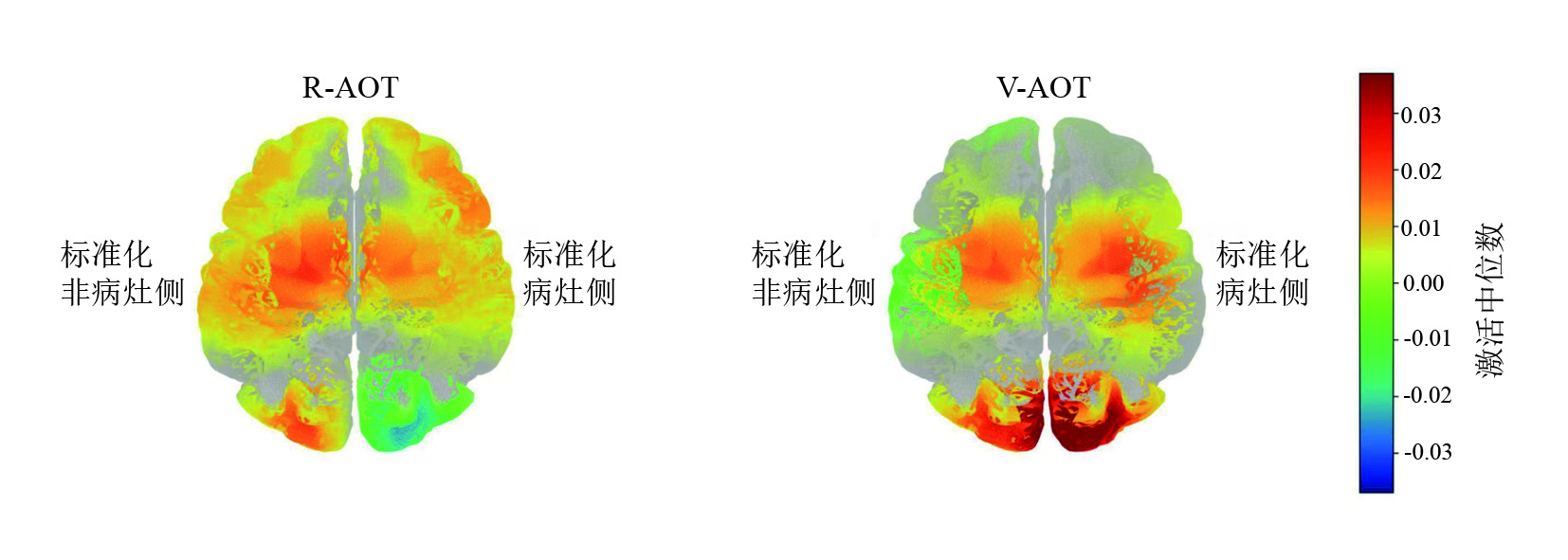
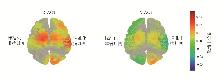
图5
模仿期监测皮质区域血氧动力学变化表面映射图 注:脑图谱经左右翻转标准化,示意图右侧为病灶侧,左侧为非病灶侧,不代表患者的真实解剖侧别;色条为Oxy-Hb激活中位数,暖色激活升高,冷色去激活,统一色阶用于组间对比。"
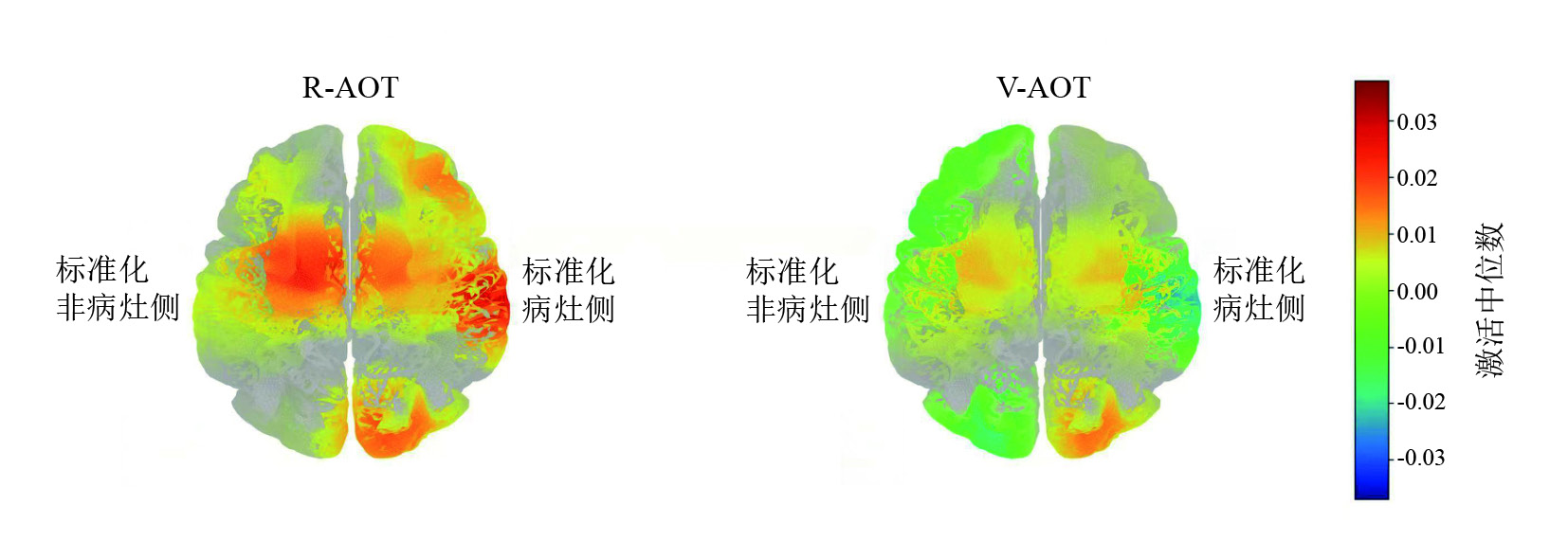
表4
观察期和模仿期病灶侧核心脑区两种条件间激活差异"
| 脑区 | 阶段 | Z值 | 原始P值 | PFDR值 | r值 | 激活特征(R-AOT vs. V-AOT) |
|---|---|---|---|---|---|---|
| DLPFC | 观察期 | 2.183 | 0.029 | 0.045 | 0.405 | 显著激活(R-AOT更高) |
| OC | 观察期 | 2.321 | 0.020 | 0.060 | 0.431 | 未达统计学显著性但呈趋势(R-AOT反向激活) |
| TC | 观察期 | 0.704 | 0.480 | 0.480 | 0.131 | 无显著性差异 |
| DLPFC | 模仿期 | 1.158 | 0.247 | 0.375 | 0.215 | 无显著性差异 |
| OC | 模仿期 | 0.469 | 0.639 | 0.640 | 0.087 | 无显著性差异 |
| TC | 模仿期 | 2.724 | 0.006 | 0.018 | 0.506 | 显著激活(R-AOT更高) |
| [1] | 中华医学会神经病学分会, 中华医学会神经病学分会脑血管病学组. 中国急性缺血性卒中诊治指南2023[J]. 中华神经科杂志, 2024, 57(6): 523-559. |
| Chinese Society of Neurology, Chinese Stroke Society. Chinese guidelines for diagnosis and treatment of acute ischemic stroke 2023[J]. Chin J Neurol, 2024, 57(6): 523-559. | |
| [2] |
Zhang C P, Li X W, Wang H B. Application of action observation therapy in stroke rehabilitation: a systematic review[J]. Brain Behav, 2023, 13(8): e3157.
doi: 10.1002/brb3.3157 pmid: 37480161 |
| [3] |
Biswas A, Rao P D, Madhavan S, et al. Video parameters for action observation training in stroke rehabilitation: a scoping review[J]. Disabil Rehabil, 2024, 46(7): 1256-1265.
doi: 10.1080/09638288.2023.2191016 |
| [4] |
Chu M, Ma Y, Tian R, et al. Advances in functional near-infrared spectroscopy: physical principles and expanding applications in neuroscience[J]. J Biophotonics, 2025, 18(11): e202500147.
doi: 10.1002/jbio.v18.11 |
| [5] |
Bǎcilǎ C I, Marcu G M, Vintilă B I, et al. Applications of functional near-infrared spectroscopy (fNIRS) in monitoring treatment response in psychiatry: a scoping review[J]. J Clin Med, 2025, 14(15): 5197.
doi: 10.3390/jcm14155197 |
| [6] |
Su W C, Dashtestani H, Miguel H O, et al. Simultaneous multimodal fNIRS-EEG recordings reveal new insights in neural activity during motor execution, observation, and imagery[J]. Sci Rep, 2023, 13(1): 5151.
doi: 10.1038/s41598-023-31609-5 |
| [7] | Ertelt D, Small S, Solodkin A, et al. Action observation has a positive impact on rehabilitation of motor deficits after stroke[J]. Neuroimage, 2007, 36: T164-T173. |
| [8] |
Zhang B, Kan L, Dong A, et al. The effects of action observation training on improving upper limb motor functions in people with stroke: a systematic review and meta-analysis[J]. PLoS One, 2019, 14(8): e0221166.
doi: 10.1371/journal.pone.0221166 |
| [9] |
Roberts M, Lietz N H, Portelli N A, et al. Implementing technology enhanced real-time action observation therapy in persons with chronic stroke: a pilot study[J]. Physiother Theory Pract, 2022, 38(13): 2665-2676.
doi: 10.1080/09593985.2021.1978120 |
| [10] |
王建平, 桂沛君, 谢瑛. 动作观察疗法对重度偏瘫患者上肢运动功能的效果[J]. 中国康复理论与实践, 2020, 26(1): 85-88.
doi: 10.3969/j.issn.1006-9771.2020.01.015 |
| Wang J P, Gui P J, Xie Y. Effect of action observation therapy on upper limb motor function for severe hemiplegics[J]. Chin J Rehabil Theory Pract, 2020, 26(1): 85-88. | |
| [11] |
Tropea P, Infarinato F, Sterpi I, et al. Action observation treatment for upper limb rehabilitation in patients with stroke: protocol for a multicenter randomized controlled trial[J]. JMIR Res Protoc, 2023, 12(4): e42094.
doi: 10.2196/42094 |
| [12] |
Xie Y J, Chen K X, Ma X D, et al. Cortical activity during balance and walking tasks in stroke patients: functional near-infrared spectroscopy neuroimaging research[J]. Brain Res, 2025, 1864: 149808.
doi: 10.1016/j.brainres.2025.149808 |
| [13] |
Klein F. Optimizing spatial specificity and signal quality in fNIRS: an overview of potential challenges and possible options for improving the reliability of real-time applications[J]. Front Neuroergon, 2024, 5: 1286586.
doi: 10.3389/fnrgo.2024.1286586 |
| [14] |
Cote M P, Lubowitz J H, Brand J C, et al. Misinterpretation of P values and statistical power creates a false sense of certainty: statistical significance, lack of significance, and the uncertainty challenge[J]. Arthroscopy, 2021, 37(4): 1057-1063.
doi: 10.1016/j.arthro.2021.02.010 pmid: 33812509 |
| [15] |
Zhao W, Liu Q, Zhang X, et al. Differential responses in the mirror neuron system during imitation of individual emotional facial expressions and association with autistic traits[J]. Neuroimage, 2023, 277: 120263.
doi: 10.1016/j.neuroimage.2023.120263 |
| [16] |
Sato W, Kochiyama T, Yoshikawa S. The widespread action observation/execution matching system for facial expression processing[J]. Hum Brain Mapp, 2023, 44(8): 3057-3071.
doi: 10.1002/hbm.26262 pmid: 36895114 |
| [17] |
Thura D, Cabana J F, Feghaly A, et al. Integrated neural dynamics of sensorimotor decisions and actions[J]. PLoS Biol, 2022, 20(12): e3001861.
doi: 10.1371/journal.pbio.3001861 |
| [18] |
Hsieh Y W, Lee M T, Chen C C, et al. Development and user experience of an innovative multi-mode stroke rehabilitation system for the arm and hand for patients with stroke[J]. Sci Rep, 2022, 12(1): 1868.
doi: 10.1038/s41598-022-05314-8 |
| [19] | Sulfikar Ali A, Bhat M, Palaniswamy H P, et al. Does action observation of the whole task influence mirror neuron system and upper limb muscle activity better than part task in people with stroke?[J]. Stroke Res Treat, 2024, 2024(1): 9967369. |
| [20] |
He X, Bai J, Jiang Y, et al. Beyond motion extrapolation: vestibular contribution to head-rotation-induced flash-lag effects[J]. Psychol Res, 2022, 86(7): 2083-2098.
doi: 10.1007/s00426-021-01638-8 |
| [21] | He X, Bao M. Neuroimaging evidence of visual-vestibular interaction accounting for perceptual mislocalization induced by head rotation[J]. Neurophotonics, 2024, 11(1): 015005. |
| [22] |
Prinsen J, Alaerts K. Eye contact enhances interpersonal motor resonance: comparing video stimuli to a live two-person action context[J]. Soc Cogn Affect Neurosci, 2019, 14(9): 967-976.
doi: 10.1093/scan/nsz064 pmid: 31506688 |
| [23] |
Prinsen J, Bernaerts S, Wang Y, et al. Direct eye contact enhances mirroring of others' movements: a transcranial magnetic stimulation study[J]. Neuropsychologia, 2017, 95: 111-118.
doi: S0028-3932(16)30449-3 pmid: 27939365 |
| [24] |
Garrison K A, Winstein C J, Aziz-Zadeh L. The mirror neuron system: a neural substrate for methods in stroke rehabilitation[J]. Neurorehabil Neural Repair, 2010, 24(5): 404-412.
doi: 10.1177/1545968309354536 pmid: 20207851 |
| [25] |
Prinsen J, Alaerts K. Enhanced mirroring upon mutual gaze: multimodal evidence from TMS-assessed corticospinal excitability and the EEG mu rhythm[J]. Sci Rep, 2020, 10(1): 20449.
doi: 10.1038/s41598-020-77508-x pmid: 33235329 |
| [26] |
Franceschini M, Ceravolo M G, Agosti M, et al. Clinical relevance of action observation in upper-limb stroke rehabilitation: a possible role in recovery of functional dexterity. A randomized clinical trial [J]. Neurorehabil Neural Repair, 2012, 26(5): 456-462.
doi: 10.1177/1545968311427406 pmid: 22235059 |
| [27] |
Pizzamiglio G, Zhang Z, Kolasinski J, et al. A role for the action observation network in apraxia after stroke[J]. Front Hum Neurosci, 2019, 13: 422.
doi: 10.3389/fnhum.2019.00422 pmid: 31920586 |
| [28] | 杨浩, 余秋蓉, 魏彧, 等. 脑卒中运动功能障碍的局部一致性fMRI研究[J]. 中国康复医学杂志, 2020, 35(1): 10-16. |
| Yang H, Yu Q R, Wei Y, et al. Brain regional homogeneity alterations at resting state in the patients with motor deficits after stroke[J]. Chin J Rehabil Med, 2020, 35(1): 10-16. | |
| [29] |
Yang Y M, Park J H. Effects of upper limb robot therapy with action observation training on subacute stroke patients: a randomised controlled trial[J]. J Mot Behav, 2025, 57(4): 358-376.
doi: 10.1080/00222895.2025.2497376 |
| [30] |
Kim J, Kim E, Lee S H, et al. Use of cortical hemodynamic responses in digital therapeutics for upper limb rehabilitation in patients with stroke[J]. J Neuroeng Rehabil, 2024, 21(1): 115.
doi: 10.1186/s12984-024-01404-y pmid: 38987817 |
| [31] |
Molenberghs P, Hayward L, Mattingley J B, et al. Activation patterns during action observation are modulated by context in mirror system areas[J]. Neuroimage, 2012, 59(1): 608-615.
doi: 10.1016/j.neuroimage.2011.07.080 pmid: 21840404 |
| [32] |
Patel M. Action observation in the modification of postural sway and gait: theory and use in rehabilitation[J]. Gait Posture, 2017, 58: 115-120.
doi: S0966-6362(17)30824-X pmid: 28772130 |
| [33] | Adhikari S P, Tretriluxana J, Chaiyawat P, et al. Enhanced upper extremity functions with a single session of action-observation-execution and accelerated skill acquisition program in subacute stroke[J]. Stroke Res Treat, 2018, 2018(1): 1490692. |
| [34] |
Emerson J R, Scott M W, Van Schaik P, et al. A neural signature for combined action observation and motor imagery? An fNIRS study into prefrontal activation, automatic imitation, and self-other perceptions[J]. Brain Behav, 2022, 12(2): e2407.
doi: 10.1002/brb3.2407 pmid: 34994997 |
| [35] |
Fuchshofer K, Merz C, Denecke K, et al. Intervention platform for action observation and motor imagery training after stroke: usability test[J]. Stud Health Technol Inform, 2022, 292: 71-74.
doi: 10.3233/SHTI220324 pmid: 35575851 |
| [1] | 苏盼盼, 何川, 琼吉, 孟殿怀. 老年脑卒中偏瘫患者不同站立姿势下静态平衡特征的比较[J]. 《中国康复理论与实践》, 2026, 32(9): 1052-1060. |
| [2] | 沈小花, 陈芳元, 荣积峰, 饶彪琴, 孔令轩, 田威, 陈志群, 李丽. 座椅前倾对脑卒中患者坐-站转移能力的影响及脑网络研究[J]. 《中国康复理论与实践》, 2026, 32(9): 1061-1067. |
| [3] | 冯晓娟, 黄富表, 李冬跃, 周明毅, 牛宇轩, 麦格皮热提·伊斯马伊力, 王曦贤, 王子乐. 一种自稳式家用手功能互动训练装置的研发及可行性研究[J]. 《中国康复理论与实践》, 2026, 32(9): 1068-1077. |
| [4] | 闫嘉铮, 罗小琴, 刘日华, 于瀛, 亓丰学. 非侵入性脑刺激技术改善脑卒中后平衡功能的网状Meta分析[J]. 《中国康复理论与实践》, 2026, 32(8): 903-915. |
| [5] | 刘姗, 许坤尧, 周芷萌, 周凌云, 曾茂, 何莎, 代洛阳, 覃婷, 胡庆林, 杨家海, 李蕊. 不同电磁刺激方案对脑卒中患者手功能及日常生活活动能力效果的网状Meta分析[J]. 《中国康复理论与实践》, 2026, 32(8): 916-926. |
| [6] | 周洁, 何志成, 张晓钰, 王雪, 刘大美, 宋宁, 吴珺. 视动整合训练对脑卒中后单侧空间忽略的效果[J]. 《中国康复理论与实践》, 2026, 32(7): 745-751. |
| [7] | 黄耀辉, 叶祥明, 刘勇, 唐沛, 卢逸舒. 重复经颅磁刺激对脑卒中后慢性意识障碍的效果[J]. 《中国康复理论与实践》, 2026, 32(7): 752-759. |
| [8] | 单桂香, 杜巨豹, 曹磊, 叶琳琳, 姜春静, 张晔, 马慧娟, 宋为群. 基于超声的脑卒中患者膈肌功能的特征分析[J]. 《中国康复理论与实践》, 2026, 32(7): 760-767. |
| [9] | 张费, 傅博勋, 沈慧, 陈进. 基于镜像神经元理论的动作观察疗法联合低频重复经颅磁刺激对脑卒中后单侧空间忽略的效果[J]. 《中国康复理论与实践》, 2026, 32(7): 768-775. |
| [10] | 樊留博, 单婷婷, 刘宝华, 罗咪咪, 张露丁, 王明慧. 超声引导联合改良导管球囊定位下不同剂量A型肉毒毒素治疗脑卒中后环咽肌功能障碍的效果[J]. 《中国康复理论与实践》, 2026, 32(7): 776-787. |
| [11] | 周广雪, 徐宁, 施滨. 虚拟现实技术联合作业治疗对脑卒中患者上肢运动功能康复效果的Meta分析[J]. 《中国康复理论与实践》, 2026, 32(7): 788-796. |
| [12] | 敦士博, 李玉周. 血流限制训练对脑卒中下肢运动功能康复效果的Meta分析[J]. 《中国康复理论与实践》, 2026, 32(7): 797-806. |
| [13] | 袁依依, 田武超, 张献斌, 钞强, 李永生, 刘桂新, 吴万庆, 王朴. 双任务训练对脑卒中患者移动和平衡功能康复疗效的Meta分析[J]. 《中国康复理论与实践》, 2026, 32(7): 807-816. |
| [14] | 李欣源, 郑洁皎, 张廷宇, 吴雪娇, 梁晓笑. 间歇性θ脉冲刺激改善脑卒中患者下肢运动和平衡功能的Meta分析[J]. 《中国康复理论与实践》, 2026, 32(6): 631-644. |
| [15] | 高惠刚, 刘远文, 秦煜玲, 胡昔权, 朱琳. 2020年至2025年足踝软体外骨骼机器人改善脑卒中患者步行功能的Scoping综述[J]. 《中国康复理论与实践》, 2026, 32(6): 645-652. |
| 阅读次数 | ||||||
|
全文 |
|
|||||
|
摘要 |
|
|||||
|
||
