



《中国康复理论与实践》 ›› 2026, Vol. 32 ›› Issue (9): 1052-1060.doi: 10.3969/j.issn.1006-9771.2026.09.007
苏盼盼1, 何川1, 琼吉2, 孟殿怀3( )
)
收稿日期:2026-04-21
修回日期:2026-06-24
接受日期:2026-07-01
出版日期:2026-09-25
发布日期:2026-09-20
通讯作者:
孟殿怀(1976-),男,汉族,博士,主任医师,研究生导师,主要研究方向:运动损伤与康复、老年康复。E-mail: dhdream@126.com作者简介:苏盼盼(1988-),女,汉族,江苏淮安市人,硕士研究生,副主任技师,主要研究方向:神经康复。
基金资助:
Su Panpan1, He Chuan1, Qiongji 2, Meng Dianhuai3()
Received:2026-04-21
Revised:2026-06-24
Accepted:2026-07-01
Published:2026-09-25
Online:2026-09-20
Contact:
Meng Dianhuai, E-mail: dhdream@126.comSupported by:摘要:
目的 比较老年脑卒中偏瘫患者在不同站立姿势下静态平衡特征的差异。
方法 选取2022年9月至2024年8月江苏盛泽医院老年脑卒中偏瘫患者38例,采用Prokin平衡测试和训练系统评估患者在7种站立姿势下的静态平衡特征,包括双足并拢站姿(BS)、患侧半串联站姿(ASTS)、健侧半串联站姿(USTS)、患侧串联站姿(ATS)、健侧串联站姿(UTS)、健侧单腿站姿(UMS)和自选站姿(SS)。每项任务中维持姿势稳定15 s。采集静态平衡的压力中心(COP)参数,包括前后方向平均运动速度(VAP)、左右方向平均运动速度(VML)、运动面积(SA)、运动长度(SL)、前后方向标准差(SDAP)和左右方向标准差(SDML)。
结果 不同站立姿势对患者的COP参数均有显著主效应(F > 39.793, χ2 = 109.632, P < 0.001)。SS在多数COP指标上表现出较小的姿势摆动(P < 0.05),UMS在VAP、VML、SA和SL方面高于其他站姿(P < 0.05),除SDML外,UTS的COP参数均高于BS、ASTS和USTS (P < 0.05),且UTS的VAP、SA、SL和SDAP高于ATS (P < 0.05)。除VML和SDML外,ATS的COP参数均高于BS、ASTS和USTS (P < 0.05)。USTS的VAP高于BS (P < 0.05)。
结论 在具有较好独立站立能力的老年脑卒中偏瘫患者中,不同站姿下COP参数存在差异。SS的姿势摆动较小,UMS和UTS姿势摆动较大;串联站姿下双足前后位置可能影响静态平衡控制。
中图分类号:
苏盼盼, 何川, 琼吉, 孟殿怀. 老年脑卒中偏瘫患者不同站立姿势下静态平衡特征的比较[J]. 《中国康复理论与实践》, 2026, 32(9): 1052-1060.
Su Panpan, He Chuan, Qiongji , Meng Dianhuai. Comparison of static balance characteristics under different standing postures in older patients with post-stroke hemiplegia[J]. Chinese Journal of Rehabilitation Theory and Practice, 2026, 32(9): 1052-1060.
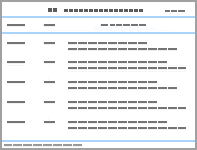
表1
患者的基线资料"
| 特征 | 数值 |
|---|---|
| 性别(男/女)/n | 32/6 |
| 年龄/岁 | 65.85±5.41 |
| 身高/m | 1.68±0.09 |
| 体质量/kg | 69.93±11.08 |
| 体质量指数/(kg·m-2) | 24.83±3.16 |
| 脑卒中类型(缺血/出血)/n | 31/7 |
| 脑卒中病程/月 | 4.96±2.32 |
| 下肢Brunnstrom分期/n | |
| III期 | 19 |
| IV期 | 11 |
| V期 | 8 |
| 计时起立-行走测试/s | 26.25±15.03 |
| 30 s坐站测试/个 | 8.71±2.46 |
| 偏瘫侧(左/右)/n | 21/17 |
| 过去12个月内有跌倒史/n | 6 |
表2
静态平衡测试中的站姿任务描述"
| 任务编号 | 任务名称 | 操作定义 |
|---|---|---|
| 任务1 | BS | 双足内侧缘并拢相触,双足跟并拢,双足呈平行位,脚尖向前 |
| 任务2 | ASTS | 患侧足在前,患足跟接触健足足弓中部 |
| 任务3 | USTS | 健侧足在前,健足跟接触患足足弓中部 |
| 任务4 | ATS | 患侧足在前,患足的足跟紧贴健足的脚尖,双足呈直线前后排列 |
| 任务5 | UTS | 健侧足在前,健足的足跟紧贴患足的脚尖,双足呈直线前后排列 |
| 任务6 | UMS | 健侧下肢单腿支撑,患侧腿抬离地面,尽量保持躯干直立,骨盆维持中立位 |
| 任务7 | SS | 患者选择自我感觉最稳定、最舒适的站立姿势 |
表3
不同站姿下VAP和VML比较"
| 站姿 | n | VAP | VML |
|---|---|---|---|
| BS | 38 | 12.46±3.93 | 10.12±3.35 |
| ASTS | 38 | 14.48±4.46 | 12.27±3.44 |
| USTS | 38 | 17.46±6.49 | 12.44±3.83 |
| ATS | 38 | 20.99±7.29 | 17.82±4.65 |
| UTS | 38 | 28.11±10.04 | 16.91±3.96 |
| UMS | 38 | 38.62±13.01 | 30.02±7.17 |
| SS | 38 | 10.35±3.33 | 6.51±2.36 |
| F值 | 80.848 | 139.772 | |
| P值 | < 0.001 | < 0.001 |
表4
不同站姿下VAP Bonferroni两两比较(均值差)"
| 任务 | ASTS | USTS | ATS | UTS | UMS | SS |
|---|---|---|---|---|---|---|
| BS | 2.026 | 5.009a | 8.535b | 15.649b | 26.167b | -2.105a |
| ASTS | 2.982 | 6.609b | 13.623b | 24.140b | -4.132a | |
| USTS | 3.526 | 10.640b | 21.158b | -7.114b | ||
| ATS | 7.114a | 17.632b | -10.640b | |||
| UTS | 10.518a | -17.754b | ||||
| UMS | -28.272b |
表5
不同站姿下VML Bonferroni两两比较(均值差)"
| 任务 | BS | ASTS | USTS | ATS | UTS | UMS |
|---|---|---|---|---|---|---|
| ASTS | 2.149 | |||||
| USTS | 2.232 | 0.175 | ||||
| ATS | 7.702a | 5.553a | 5.377a | |||
| UTS | 6.781a | 4.632a | 4.456a | -0.921 | ||
| UMS | 19.895a | 17.749a | 17.570a | 12.193a | 13.114a | |
| SS | -3.614a | -5.763a | -5.939a | -11.316a | -10.395a | -23.509a |
表6
不同站姿下SA和SL比较"
| 站姿 | n | SA/mm2 | SL/mm |
|---|---|---|---|
| BS | 38 | 471.12±219.11 | 317.11±95.83 |
| ASTS | 38 | 548.47±222.99 | 353.20±91.79 |
| USTS | 38 | 658.14±301.08 | 390.34±116.76 |
| ATS | 38 | 842.61±403.75 | 518.88±131.17 |
| UTS | 38 | 1074.15±522.28 | 631.62±207.19 |
| UMS | 38 | 2283.53±1405.85 | 914.55±253.19 |
| SS | 38 | 270.87±140.66 | 236.97±76.21 |
| F值 | 53.796 | 112.232 | |
| P值 | < 0.001 | < 0.001 |
表7
不同站姿下SA Bonferroni两两比较(均值差)"
| 站姿 | ASTS | USTS | ATS | UTS | UMS | SS |
|---|---|---|---|---|---|---|
| BS | 77.342 | 187.018 | 371.272a | 603.026a | 1812.412a | -200.254a |
| ASTS | 109.675 | 294.149a | 525.684a | 1735.070a | -277.596a | |
| USTS | 184.474b | 416.008a | 1625.395a | -387.272a | ||
| ATS | 231.535b | 1440.921a | -571.746a | |||
| UTS | 1209.386a | -803.281a | ||||
| UMS | -2012.667a |
表8
不同站姿下SL Bonferroni两两比较(均值差)"
| 站姿 | BS | ASTS | USTS | ATS | UTS | UMS |
|---|---|---|---|---|---|---|
| ASTS | 36.088 | |||||
| USTS | 73.228 | 37.140 | ||||
| ATS | 201.772a | 165.684a | 128.544a | |||
| UTS | 314.509a | 278.421a | 241.281a | 112.737a | ||
| UMS | 597.439a | 561.351a | 524.211a | 395.667a | 282.930a | |
| SS | -80.140a | -116.228a | -153.368a | -281.912a | -394.649a | -677.579a |
表9
不同站姿下SDML和SDAP比较"
| 站姿 | n | SDAP/mm | SDML/mm |
|---|---|---|---|
| BS | 38 | 5.36±1.63 | 4.67(3.67,6.00) |
| ASTS | 38 | 5.67±2.02 | 4.67(3.67,5.75) |
| USTS | 38 | 6.23±2.42 | 4.83(4.00,6.33) |
| ATS | 38 | 7.55±3.57 | 5.00(4.33,6.41) |
| UTS | 38 | 10.11±3.41 | 5.67(4.58,6.83) |
| UMS | 38 | 11.59±3.94 | 9.67(6.92,17.75) |
| SS | 38 | 4.81±1.46 | 2.83(2.00,3.67) |
| F/χ2值 | 39.793 | 109.632 | |
| P值 | < 0.001 | < 0.001 |
表10
不同站姿下SDAP Bonferroni两两比较(均值差)"
| 站姿 | ASTS | USTS | ATS | UTS | UMS | SS |
|---|---|---|---|---|---|---|
| BS | 0.316 | 0.868 | 2.193a | 4.746b | 6.237b | -0.553 |
| ASTS | 0.553 | 1.877a | 4.430b | 5.921b | -0.868 | |
| USTS | 1.325 | 3.877b | 5.368b | -1.421 | ||
| ATS | 2.553b | 4.044b | -2.746a | |||
| UTS | 1.491 | -5.298b | ||||
| UMS | -6.789b |
表11
不同站姿下SDML Bonferroni两两比较(Z值)"
| 站姿 | BS | ASTS | USTS | ATS | UTS | UMS |
|---|---|---|---|---|---|---|
| ASTS | 0.133 | |||||
| USTS | -1.142 | -1.274 | ||||
| ATS | -1.699 | -1.832 | -0.558 | |||
| UTS | -3.159a | -3.292a | -2.018 | -1.460 | ||
| UMS | -6.160b | -6.292b | -5.018b | -4.460b | -3.000 | |
| SS | 3.478a | 3.345a | 4.620b | 5.177b | 6.637b | 9.638b |
| [1] | 李亚芳, 梁珊珊, 王子怡, 等. 中国脑卒中流行病学和疾病负担的Meta分析[J]. 中国循证医学杂志, 2025, 25(6): 664-669. |
| Li Y F, Liang S S, Wang Z Y, et al. Epidemiology and disease burden of stroke in China: a meta-analysis[J]. Chin J Evid-Based Med, 2025, 25(6): 664-669. | |
| [2] |
Feigin V L, Brainin M, Norrving B, et al. World stroke organization: global stroke fact sheet 2025[J]. Int J Stroke, 2025, 20(2): 132-144.
doi: 10.1177/17474930241308142 pmid: 39635884 |
| [3] |
Ghrouz A, Guillen-Sola A, Morgado-Perez A, et al. The effect of a motor relearning on balance and postural control in patients after stroke: an open-label randomized controlled trial[J]. Eur Stroke J, 2024, 9(2): 303-311.
doi: 10.1177/23969873231220218 |
| [4] |
Kwon I H, Shin W S, Choi K S, et al. Effects of real-time feedback methods on static balance training in stroke patients: a randomized controlled trial[J]. Healthcare, 2024, 12(7): 767.
doi: 10.3390/healthcare12070767 |
| [5] |
阚超杰, 郭川, 朱仕哲, 等. 老年人在认知-平衡双任务下的皮质激活特征[J]. 中国康复理论与实践, 2023, 29(10): 1189-1194.
doi: 10.3969/j.issn.1006-9771.2023.10.010 |
| Kan C J, Guo C, Zhu S Z, et al. Characteristics of cortical activation in older adults under cognition-balance dual tasks[J]. Chin J Rehabil Theory Pract, 2023, 29(10): 1189-1194. | |
| [6] |
Wang Z, Molenaar P M C, Newell K M. The effects of foot position and orientation on inter-and intra-foot coordination in standing postures: a frequency domain PCA analysis[J]. Exp Brain Res, 2013, 230(1): 15-27.
doi: 10.1007/s00221-013-3627-9 |
| [7] |
Luo W, Huang Z, Li H, et al. Regulation of static and dynamic balance in healthy young adults: interactions between stance width and visual conditions[J]. Front Bioeng Biotechnol, 2025, 13: 1538286.
doi: 10.3389/fbioe.2025.1538286 |
| [8] |
Lo P Y, Su B L, You Y L, et al. Measuring the reliability of postural sway measurements for a static standing task: the effect of age[J]. Front Physiol, 2022, 13: 850707.
doi: 10.3389/fphys.2022.850707 |
| [9] |
Schedler S, Tenelsen F, Wich L, et al. Effects of balance training on balance performance in youth: role of training difficulty[J]. BMC Sports Sci Med Rehabil, 2020, 12(1): 71.
doi: 10.1186/s13102-020-00218-4 pmid: 33292455 |
| [10] |
Murillo D B, Solana R S, Vera-Garcia F J, et al. Effect of increasing difficulty in standing balance tasks with visual feedback on postural sway and EMG: complexity and performance[J]. Hum Mov Sci, 2012, 31(5): 1224-1237.
doi: 10.1016/j.humov.2012.01.002 |
| [11] |
Almohiza M A, Reddy R S. Relationship between postural and kinesthetic awareness, static balance, and weight-bearing asymmetry in individuals with chronic stroke: a cross-sectional study[J]. PLoS One, 2026, 21(1): e0341001.
doi: 10.1371/journal.pone.0341001 |
| [12] |
De Abreu D C C, Bandeira A C L, Magnani P E, et al. Standing balance test for fall prediction in older adults: a 6-month longitudinal study[J]. BMC Geriatr, 2024, 24(1): 947.
doi: 10.1186/s12877-024-05380-9 pmid: 39548372 |
| [13] |
张季辉, 伊龙悦, 杨远滨. 中老年人平衡功能障碍的相关因素及其与功能性下肢肌力的关联: 基于CHARLS数据库的分析[J]. 中国康复理论与实践, 2026, 32(1): 13-22.
doi: 10.3969/j.issn.1006-9771.2026.01.002 |
| Zhang J H, Yi L Y, Yang Y B. Associated factors of balance dysfunction and its correlation with functional lower limb muscle strength in middle-aged and older adults: an analysis based on CHARLS database[J]. Chin J Rehabi Theory Pract, 2026, 32(1): 13-22. | |
| [14] | 中华医学会神经病学分会, 中华医学会神经病学分会脑血管病学组. 中国各类主要脑血管病诊断要点2019[J]. 中华神经科杂志, 2019, 52(9): 710-715. |
| Chinese Society of Neurology, Chinese Stroke Society. Diagnostic criteria of cerebrovascular diseases in China (version 2019) [J]. Chin J Neurol, 2019, 52(9): 710-715. | |
| [15] |
Zheng S, Xue X, Yu L, et al. Balance Error Scoring System in the assessment of chronic ankle stability: a systematic review and meta-analysis[J]. PM R, 2025, 17(1): 76-87.
doi: 10.1002/pmrj.v17.1 |
| [16] | Osada Y, Kobayashi Y, Osuka T. Differences in pre-swing posture between successful and tripping steps in individuals with stroke[J]. Gait Posture, 2026, 110: 110173. |
| [17] |
Warmerdam E, Schumacher M, Beyer T, et al. Postural sway in Parkinson's disease and multiple sclerosis patients during tasks with different complexity[J]. Front Neurol, 2022, 13: 857406.
doi: 10.3389/fneur.2022.857406 |
| [18] |
Muehlbauer T, Roth R, Bopp M, et al. An exercise sequence for progression in balance training[J]. J Strength Cond Res, 2012, 26(2): 568-574.
doi: 10.1519/JSC.0b013e318225f3c4 pmid: 22067238 |
| [19] |
Wang T, Yang L, Li X, et al. Characteristics of static balance performance in 4-Stage Balance Test in the healthy older adults[J]. Int J Neurosci, 2025, 135(5): 563-569.
doi: 10.1080/00207454.2024.2312992 |
| [20] |
Kohli S, Fitzgibbon-Collins L K, Luan S, et al. Exploring the relationship between prefrontal cortex activation, standing balance, and fatigue in people post-stroke: a fNIRS study[J]. NeuroRehabilitation, 2025, 57(3): 352-362.
doi: 10.1177/10538135251341124 |
| [21] |
Richer N, Saunders D, Polskaia N, et al. The effects of attentional focus and cognitive tasks on postural sway may be the result of automaticity[J]. Gait Posture, 2017, 54: 45-49.
doi: S0966-6362(17)30056-5 pmid: 28259038 |
| [22] |
Goh H T, Stewart J C. Poststroke fatigue is related to motor and cognitive performance: a secondary analysis[J]. J Neurol Phys Ther, 2019, 43(4): 233-239.
doi: 10.1097/NPT.0000000000000290 |
| [23] |
Penedo T, Polastri P F, Rodrigues S T, et al. Motor strategy during postural control is not muscle fatigue joint-dependent, but muscle fatigue increases postural asymmetry[J]. PLoS One, 2021, 16(2): e0247395.
doi: 10.1371/journal.pone.0247395 |
| [24] | Joo B, Marquez J L, Osmotherly P G. Ten-second tandem stance test: a potential tool to assist walking aid prescription and falls risk in balance impaired individuals[J]. Arch Rehabil Res Clin Transl, 2022, 4(1): 100173. |
| [25] |
Sozzi S, Honeine J L, Do M C, et al. Leg muscle activity during tandem stance and the control of body balance in the frontal plane[J]. Clin Neurophysiol, 2013, 124(6): 1175-1186.
doi: 10.1016/j.clinph.2012.12.001 pmid: 23294550 |
| [26] |
Jonsson E, Seiger Å, Hirschfeld H. Postural steadiness and weight distribution during tandem stance in healthy young and elderly adults[J]. Clin Biomech, 2005, 20(2): 202-208.
pmid: 15621326 |
| [27] |
Inoue M, Amimoto K, Chiba Y, et al. Analyses of weight-bearing asymmetry pattern for standing in the early phase after stroke: a cross-sectional study[J]. Physiother Theory Pract, 2024, 40(6): 1241-1248.
doi: 10.1080/09593985.2022.2163860 |
| [28] |
Hsiao H Y, Gray V L, Borrelli J, et al. Biomechanical control of paretic lower limb during imposed weight transfer in individuals post-stroke[J]. J Neuroeng Rehabil, 2020, 17(1): 140.
doi: 10.1186/s12984-020-00768-1 |
| [29] |
苏盼盼, 叶朋, 卢倩, 等. 视觉剥夺训练联合本体感觉训练对脑卒中偏瘫患者平衡功能的效果[J]. 中国康复理论与实践, 2025, 31(3): 254-263.
doi: 10.3969/j.issn.1006-9771.2025.03.002 |
| Su P P, Ye P, Lu Q, et al. Effect of visual deprivation training combined with proprioceptive training on balance in hemiplegic patients after stroke[J]. Chin J Rehabil Theory Pract, 2025, 31(3): 254-263. | |
| [30] |
Alderink G, Mccrumb D, Zeitler D, et al. Analysis of connectivity in electromyography signals to examine neural correlations in the activation of lower leg muscles for postural stability: a pilot study[J]. Bioengineering, 2025, 12(1): 84.
doi: 10.3390/bioengineering12010084 |
| [31] | 祝珺文, 张汇, 诸斌, 等. 四肢联动训练对脑卒中偏瘫患者运动功能和下肢表面肌电的影响[J]. 中国康复医学杂志, 2025, 40(11): 1645-1649. |
| Zhu J W, Zhang H, Zhu B, et al. The effect of limb linkage training on motor function and lower limb surface electromyography in stroke patients with hemiplegia[J]. Chin J Rehabil Med, 2025, 40(11): 1645-1649. | |
| [32] | 肖仔仙, 陈谦, 孟殿怀. 脑卒中偏瘫恢复期患者双足间距离对静态站立平衡功能的影响[J]. 康复学报, 2021, 31(3): 241-245, 251. |
| Xiao Z X, Chen Q, Meng D H. Effects of the distance between two feet on static standing balance function in convalescent hemiplegia patients with stroke[J]. Rehabil Med, 2021, 31(3): 241-245, 251. | |
| [33] |
Amiridis I G, Hatzitaki V, Arabatzi F. Age-induced modifications of static postural control in humans[J]. Neurosci Lett, 2003, 350(3): 137-140.
doi: 10.1016/s0304-3940(03)00878-4 pmid: 14550913 |
| [34] |
Yu J W, Wang C, Yang F M. Observations on the kinematic characteristics of the healthy side of the knee in stroke patients: a cross-sectional study[J]. Medicine, 2022, 101(46): e31853.
doi: 10.1097/MD.0000000000031853 |
| [35] |
Hansen C, Beckbauer M, Romijnders R, et al. Reliability of IMU-derived static balance parameters in neurological diseases[J]. Int J Environ Res Public Health, 2021, 18(7): 3644.
doi: 10.3390/ijerph18073644 |
| [36] |
Hong S, Park S. Biomechanical optimization and reinforcement learning provide insight into transition from ankle to hip strategy in human postural control[J]. Sci Rep, 2025, 15(1): 13640.
doi: 10.1038/s41598-025-97637-5 |
| [37] | Frankowski G, Zyznawska J, Boczoń K. EMG and postural stability: parallel vs. semi-tandem foot position 4-Stage Balance Test[J]. Folia Med Cracov, 2025, 65(2): 142-152. |
| [1] | 孙凤仪, 殷海燕, 尹婷婷, 杨冰清, 顾剑鹏, 汪妍, 柏亚妹, 徐桂华, 宋玉磊. 中枢听觉测验联合脑电特征在阿尔茨海默病源性轻度认知障碍早期筛查中的应用[J]. 《中国康复理论与实践》, 2026, 32(9): 1016-1024. |
| [2] | 黄旭丽, 王萍芝, 罗天娥. 实时与视频动作观察疗法下脑卒中患者脑区血氧动力学反应比较:一项基于功能性近红外光谱的研究[J]. 《中国康复理论与实践》, 2026, 32(9): 1041-1051. |
| [3] | 沈小花, 陈芳元, 荣积峰, 饶彪琴, 孔令轩, 田威, 陈志群, 李丽. 座椅前倾对脑卒中患者坐-站转移能力的影响及脑网络研究[J]. 《中国康复理论与实践》, 2026, 32(9): 1061-1067. |
| [4] | 冯晓娟, 黄富表, 李冬跃, 周明毅, 牛宇轩, 麦格皮热提·伊斯马伊力, 王曦贤, 王子乐. 一种自稳式家用手功能互动训练装置的研发及可行性研究[J]. 《中国康复理论与实践》, 2026, 32(9): 1068-1077. |
| [5] | 王晓蕾, 赵晓晴, 陈澍盈, 张明皓, 周笑昱, 李海燕, 张建华, 井淇, 董志伟. 老年心脏病患者认知障碍风险列线图预测模型构建[J]. 《中国康复理论与实践》, 2026, 32(9): 993-1002. |
| [6] | 闫嘉铮, 罗小琴, 刘日华, 于瀛, 亓丰学. 非侵入性脑刺激技术改善脑卒中后平衡功能的网状Meta分析[J]. 《中国康复理论与实践》, 2026, 32(8): 903-915. |
| [7] | 刘姗, 许坤尧, 周芷萌, 周凌云, 曾茂, 何莎, 代洛阳, 覃婷, 胡庆林, 杨家海, 李蕊. 不同电磁刺激方案对脑卒中患者手功能及日常生活活动能力效果的网状Meta分析[J]. 《中国康复理论与实践》, 2026, 32(8): 916-926. |
| [8] | 梁艳华, 张通, 张琦, 周天添, 张燕庆, 岳青, 李思佳. 康复机器人训练对偏瘫儿童腹肌厚度和平衡能力的效果[J]. 《中国康复理论与实践》, 2026, 32(8): 927-937. |
| [9] | 周洁, 何志成, 张晓钰, 王雪, 刘大美, 宋宁, 吴珺. 视动整合训练对脑卒中后单侧空间忽略的效果[J]. 《中国康复理论与实践》, 2026, 32(7): 745-751. |
| [10] | 黄耀辉, 叶祥明, 刘勇, 唐沛, 卢逸舒. 重复经颅磁刺激对脑卒中后慢性意识障碍的效果[J]. 《中国康复理论与实践》, 2026, 32(7): 752-759. |
| [11] | 单桂香, 杜巨豹, 曹磊, 叶琳琳, 姜春静, 张晔, 马慧娟, 宋为群. 基于超声的脑卒中患者膈肌功能的特征分析[J]. 《中国康复理论与实践》, 2026, 32(7): 760-767. |
| [12] | 张费, 傅博勋, 沈慧, 陈进. 基于镜像神经元理论的动作观察疗法联合低频重复经颅磁刺激对脑卒中后单侧空间忽略的效果[J]. 《中国康复理论与实践》, 2026, 32(7): 768-775. |
| [13] | 樊留博, 单婷婷, 刘宝华, 罗咪咪, 张露丁, 王明慧. 超声引导联合改良导管球囊定位下不同剂量A型肉毒毒素治疗脑卒中后环咽肌功能障碍的效果[J]. 《中国康复理论与实践》, 2026, 32(7): 776-787. |
| [14] | 周广雪, 徐宁, 施滨. 虚拟现实技术联合作业治疗对脑卒中患者上肢运动功能康复效果的Meta分析[J]. 《中国康复理论与实践》, 2026, 32(7): 788-796. |
| [15] | 敦士博, 李玉周. 血流限制训练对脑卒中下肢运动功能康复效果的Meta分析[J]. 《中国康复理论与实践》, 2026, 32(7): 797-806. |
| 阅读次数 | ||||||
|
全文 |
|
|||||
|
摘要 |
|
|||||
|
||
