



《中国康复理论与实践》 ›› 2025, Vol. 31 ›› Issue (12): 1439-1449.doi: 10.3969/j.issn.1006-9771.2025.12.008
颜如秀1,2a, 宋鲁平1,3( ), 黄富表1,2a(), 梁艳华1,2b, 崔尧1,2c, 杨昊1,2a
收稿日期:2025-08-05
修回日期:2025-10-06
出版日期:2025-12-25
发布日期:2025-12-29
通讯作者:
宋鲁平,黄富表
E-mail:songluping882002@aliyun.com
作者简介:颜如秀(1987-),男,汉族,福建三明市人,主管技师,主要研究方向:神经康复作业疗法、认知康复。
基金资助:
YAN Ruxiu1,2a, SONG Luping1,3(), HUANG Fubiao1,2a(), LIANG Yanhua1,2b, CUI Yao1,2c, YANG Hao1,2a
Received:2025-08-05
Revised:2025-10-06
Published:2025-12-25
Online:2025-12-29
Contact:
SONG Luping, HUANG Fubiao
E-mail:songluping882002@aliyun.com
Supported by:摘要:
目的 观察计算机认知矫正疗法(CCRT)对卒中后认知功能障碍(PSCI)患者认知功能和日常生活活动能力(ADL)的影响。
方法 选择2021年11月至2023年5月在北京博爱医院住院的PSCI患者56例,随机分为对照组(n = 28)和试验组(n = 28)。对照组接受常规认知训练结合作业疗法认知作业活动,试验组接受常规认知训练结合CCRT,共4周。分别于训练前后,采用洛文斯顿作业疗法认知评定量表(LOTCA)和重复性成套神经心理状态测验(rBANS)评定认知功能,采用改良Barthel指数(MBI)评定ADL。
结果 对照组和试验组各脱落3例。训练后,两组LOTCA总分、rBANS总分和MBI评分均显著提高(|t| ≥ 8.944, P < 0.001)。试验组治疗前后LOTCA的视运动组织和思维操作评分差值大于对照组(|t| ≥ 2.120, P < 0.05),治疗前后rBANS的即刻记忆、言语功能、注意和延时记忆评分差值大于对照组(|t| ≥ 2.392, P < 0.05)。
结论 CCRT可以有效改善PSCI患者的总体认知功能,提高其ADL。与OT认知作业活动比较,CCRT在视运动组织、思维操作、即刻记忆、言语功能、注意以及延时记忆等方面疗效更佳。
中图分类号:
颜如秀, 宋鲁平, 黄富表, 梁艳华, 崔尧, 杨昊. 计算机认知矫正疗法对卒中后认知功能障碍的效果[J]. 《中国康复理论与实践》, 2025, 31(12): 1439-1449.
YAN Ruxiu, SONG Luping, HUANG Fubiao, LIANG Yanhua, CUI Yao, YANG Hao. Effect of computerized cognitive remediation therapy on post-stroke cognitive impairment[J]. Chinese Journal of Rehabilitation Theory and Practice, 2025, 31(12): 1439-1449.
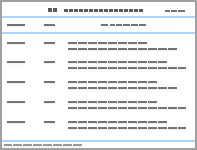
表1
两组基线资料比较"
| 项目 | 对照组(n = 25) | 试验组(n = 25) | t/χ²值 | P值 |
|---|---|---|---|---|
| 性别(男/女)/n | 16/9 | 17/8 | -0.089 | 0.765 |
| 年龄/岁 | 52.04±18.57 | 51.00±15.07 | 0.217 | 0.829 |
| 受教育程度/年 | 13.28±2.99 | 13.80±3.50 | -0.565 | 0.575 |
| 脑卒中类型(脑梗死/脑出血) /n | 12/13 | 7/18 | -2.122 | 0.145 |
| 病程/月 | 2.44±1.45 | 2.24±1.42 | 0.493 | 0.624 |
| 病灶侧(左侧/右侧)/n | 19/6 | 17/8 | -0.397 | 0.529 |
| MMSE总分 | 18.88±5.75 | 19.76±6.16 | -0.522 | 0.604 |
| 定向力 | 6.28±2.91 | 6.84±2.32 | -0.752 | 0.456 |
| 记忆力 | 2.84±0.37 | 2.64±0.70 | 1.260 | 0.216 |
| 注意力与计算力 | 2.36±1.91 | 2.64±1.96 | -0.512 | 0.611 |
| 回忆能力 | 1.44±0.92 | 1.40±0.96 | 0.151 | 0.881 |
| 语言能力 | 5.96±2.17 | 6.24±2.01 | -0.474 | 0.638 |
表2
两组训练前后LOTCA总分比较"
| 组别 | n | 测试 | t值 | P值 | |
|---|---|---|---|---|---|
| 对照组 | 25 | 前测 | 84.92±16.11 | -15.982 | < 0.001 |
| 后测 | 94.16±15.16 | ||||
| 训练前后差值 | 9.24±2.89 | ||||
| 试验组 | 25 | 前测 | 86.04±17.51 | -13.335 | < 0.001 |
| 后测 | 99.96±14.54 | ||||
| 训练前后差值 | 13.92±5.22 | ||||
| 训练前两组均值差 | -1.12±4.76 | -0.235 | 0.815 | ||
| 训练后两组均值差 | -5.80±4.20 | -1.381 | 0.174 | ||
| 两组差值均值差 | -4.68±1.19 | -3.922 | < 0.001 |
表3
两组训练前后LOTCA各项因子比较"
| 项目因子 | 组别 | n | 测试 | t值 | P值 | |
|---|---|---|---|---|---|---|
| 定向 | 对照组 | 25 | 前测 | 11.68±3.84 | -6.107 | < 0.001 |
| 后测 | 13.04±3.25 | |||||
| 训练前后差值 | 1.36±1.11 | |||||
| 试验组 | 25 | 前测 | 11.72±4.17 | -6.149 | < 0.001 | |
| 后测 | 13.68±3.39 | |||||
| 训练前后差值 | 1.96±1.59 | |||||
| 训练前两组均值差 | -0.04±1.13 | -0.035 | 0.972 | |||
| 训练后两组均值差 | -0.64±0.94 | -0.682 | 0.499 | |||
| 两组差值均值差 | -0.60±0.39 | -1.543 | 0.129 | |||
| 视知觉 | 对照组 | 25 | 前测 | 14.08±1.61 | -6.647 | < 0.001 |
| 后测 | 15.16±1.21 | |||||
| 训练前后差值 | 1.08±0.81 | |||||
| 试验组 | 25 | 前测 | 13.72±1.79 | -6.914 | < 0.001 | |
| 后测 | 15.36±1.47 | |||||
| 训练前后差值 | 1.64±1.19 | |||||
| 训练前两组均值差 | 0.36±0.48 | 0.748 | 0.458 | |||
| 训练后两组均值差 | -0.20±0.38 | -0.525 | 0.602 | |||
| 两组差值均值差 | -0.56±0.29 | -1.948 | 0.058 | |||
| 空间知觉 | 对照组 | 25 | 前测 | 10.12±2.46 | -4.575 | < 0.001 |
| 后测 | 10.88±2.09 | |||||
| 训练前后差值 | 0.76±0.83 | |||||
| 试验组 | 25 | 前测 | 10.08±2.74 | -6.914 | 0.001 | |
| 后测 | 11.00±2.10 | |||||
| 训练前后差值 | 0.92±1.08 | |||||
| 训练前两组均值差 | 0.04±0.74 | 0.054 | 0.957 | |||
| 训练后两组均值差 | -0.12±0.59 | -0.203 | 0.840 | |||
| 两组差值均值差 | -0.16±0.27 | -0.588 | 0.559 | |||
| 动作运用 | 对照组 | 25 | 前测 | 10.12±2.05 | -5.237 | < 0.001 |
| 后测 | 10.92±1.55 | |||||
| 训练前后差值 | 0.80±0.76 | |||||
| 试验组 | 25 | 前测 | 10.56±1.71 | -6.914 | < 0.001 | |
| 后测 | 11.52±1.09 | |||||
| 训练前后差值 | 0.96±1.02 | |||||
| 训练前两组均值差 | -0.44±0.53 | -0.825 | 0.414 | |||
| 训练后两组均值差 | -0.60±0.38 | -1.584 | 0.120 | |||
| 两组差值均值差 | -0.16±0.25 | -0.628 | 0.533 | |||
| 视运动组织 | 对照组 | 25 | 前测 | 20.56±4.67 | -7.135 | < 0.001 |
| 后测 | 22.88±4.37 | |||||
| 训练前后差值 | 2.32±1.63 | |||||
| 试验组 | 25 | 前测 | 21.16±5.49 | -7.906 | < 0.001 | |
| 后测 | 24.64±4.30 | |||||
| 训练前后差值 | 3.48±2.20 | |||||
| 训练前两组均值差 | -0.60±1.44 | -0.416 | 0.679 | |||
| 训练后两组均值差 | -1.76±1.23 | -1.435 | 0.158 | |||
| 两组差值均值差 | -1.16±0.55 | -2.120 | 0.039 | |||
| 思维操作 | 对照组 | 25 | 前测 | 18.36±5.76 | -11.332 | < 0.001 |
| 后测 | 21.28±5.90 | |||||
| 训练前后差值 | 2.92±1.29 | |||||
| 试验组 | 25 | 前测 | 18.80±5.96 | -14.224 | < 0.001 | |
| 后测 | 23.76±5.37 | |||||
| 训练前后差值 | 4.96±1.74 | |||||
| 训练前两组均值差 | -0.44±1.66 | -0.266 | 0.792 | |||
| 训练后两组均值差 | -2.48±1.60 | -1.554 | 0.127 | |||
| 两组差值均值差 | -2.04±0.43 | -4.705 | < 0.001 |
表4
两组训练前后rBANS总分比较"
| 组别 | n | 测试 | t值 | P值 | |
|---|---|---|---|---|---|
| 对照组 | 25 | 前测 | 61.52±19.80 | -10.633 | < 0.001 |
| 后测 | 67.76±20.88 | ||||
| 训练前后差值 | 6.24±2.63 | ||||
| 试验组 | 25 | 前测 | 59.28±15.00 | -10.523 | < 0.001 |
| 后测 | 71.92±16.76 | ||||
| 训练前后差值 | 12.64±6.01 | ||||
| 训练前两组均值差 | 2.24±4.97 | 0.451 | 0.654 | ||
| 训练后两组均值差 | -4.16±5.36 | -0.777 | 0.441 | ||
| 两组差值均值差 | -6.40±1.31 | -4.879 | < 0.001 |
表5
两组训练前后rBANS各项因子比较"
| 项目因子 | 组别 | n | 测试 | t值 | P值 | |
|---|---|---|---|---|---|---|
| 即刻记忆 | 对照组 | 25 | 前测 | 60.52±22.50 | -9.222 | < 0.001 |
| 后测 | 66.52±23.58 | |||||
| 训练前后差值 | 6.00±3.25 | |||||
| 试验组 | 25 | 前测 | 55.72±18.22 | -7.915 | < 0.001 | |
| 后测 | 66.12±19.36 | |||||
| 训练前后差值 | 10.40±6.57 | |||||
| 训练前两组均值差 | 4.80±5.79 | 0.829 | 0.411 | |||
| 训练后两组均值差 | 0.40±6.10 | 0.066 | 0.948 | |||
| 两组差值均值差 | -4.40±1.47 | -3.001 | 0.005 | |||
| 视觉广度 | 对照组 | 25 | 前测 | 77.36±21.33 | -10.792 | < 0.001 |
| 后测 | 85.08±22.53 | |||||
| 训练前后差值 | 7.72±3.58 | |||||
| 试验组 | 25 | 前测 | 80.08±22.41 | -6.589 | < 0.001 | |
| 后测 | 91.60±19.35 | |||||
| 训练前后差值 | 11.52±8.74 | |||||
| 训练前两组均值差 | -2.72±6.19 | -0.440 | 0.662 | |||
| 训练后两组均值差 | -6.52±5.94 | -1.098 | 0.278 | |||
| 两组差值均值差 | -3.80±1.89 | -2.012 | 0.053 | |||
| 言语功能 | 对照组 | 25 | 前测 | 66.20±24.00 | -7.095 | 0.001 |
| 后测 | 71.20±25.47 | |||||
| 训练前后差值 | 5.00±3.52 | |||||
| 试验组 | 25 | 前测 | 68.12±20.68 | -6.028 | < 0.001 | |
| 后测 | 77.04±21.58 | |||||
| 训练前后差值 | 8.92±7.40 | |||||
| 训练前两组均值差 | -1.92±6.34 | -0.303 | 0.763 | |||
| 训练后两组均值差 | -5.84±6.68 | -0.875 | 0.386 | |||
| 两组差值均值差 | -3.92±1.64 | -2.392 | 0.022 | |||
| 注意 | 对照组 | 25 | 前测 | 61.48±19.15 | -6.426 | 0.002 |
| 后测 | 66.04±18.53 | |||||
| 训练前后差值 | 4.56±3.55 | |||||
| 试验组 | 25 | 前测 | 61.52±17.17 | -8.865 | < 0.001 | |
| 后测 | 72.76±17.71 | |||||
| 训练前后差值 | 11.24±6.34 | |||||
| 训练前两组均值差 | -0.04±5.14 | -0.008 | 0.994 | |||
| 训练后两组均值差 | -6.72±5.13 | -1.311 | 0.196 | |||
| 两组差值均值差 | -6.68±1.45 | -4.597 | < 0.001 | |||
| 延时记忆 | 对照组 | 25 | 前测 | 62.96±24.50 | -10.092 | < 0.001 |
| 后测 | 69.08±25.03 | |||||
| 训练前后差值 | 6.12±3.03 | |||||
| 试验组 | 25 | 前测 | 61.80±19.97 | -9.396 | < 0.001 | |
| 后测 | 74.12±21.22 | |||||
| 训练前后差值 | 12.32±6.56 | |||||
| 训练前两组均值差 | 1.16±6.32 | 0.184 | 0.855 | |||
| 训练后两组均值差 | -5.04±6.56 | -0.768 | 0.446 | |||
| 两组差值均值差 | -6.20±1.44 | -4.292 | < 0.001 |
表6
两组训练前后MBI评分比较"
| 组别 | n | 测试 | t值 | P值 | |
|---|---|---|---|---|---|
| 对照组 | 25 | 前测 | 61.36±18.50 | -10.937 | < 0.001 |
| 后测 | 73.08±16.88 | ||||
| 训练前后差值 | 11.72±5.36 | ||||
| 试验组 | 25 | 前测 | 63.72±20.04 | -8.944 | < 0.001 |
| 后测 | 78.84±15.65 | ||||
| 训练前后差值 | 15.12±8.45 | ||||
| 训练前两组均值差 | -2.36±5.46 | -0.433 | 0.667 | ||
| 训练后两组均值差 | -5.76±4.60 | -1.251 | 0.217 | ||
| 两组差值均值差 | -3.40±2.00 | -1.699 | 0.096 |
| [1] |
HUANG Y Y, CHEN S D, LENG X Y, et al. Post-stroke cognitive impairment: epidemiology, risk factors, and management[J]. J Alzheimers Dis, 2022, 86(3): 983-999.
doi: 10.3233/JAD-215644 |
| [2] | 王陇德, 彭斌, 张鸿祺, 等. «中国脑卒中防治报告2020»概要[J]. 中国脑血管病杂志, 2022, 19(2): 136-144. |
| WANG L D, PENG B, ZHANG H Q, et al. Summary of "China Stroke Prevention and Treatment Report 2020"[J]. Chin J Cerebrovascular Dis, 2022, 19(2): 136-144. | |
| [3] | «中国脑卒中防治报告2021»编写组. «中国脑卒中防治报告2021»概要[J]. 中国脑血管病杂志, 2023, 20(11): 783-793. |
| Writing group of China Stroke Prevention and Treatment Report 2021. Summary of "China Stroke Prevention and Treatment Report 2021"[J]. Chin J Cerebrovascular Dis, 2023, 20(11): 783-793. | |
| [4] | 中国卒中学会血管性认知障碍分会. 卒中后认知障碍管理专家共识2021[J]. 中国卒中杂志, 2021, 16(4): 376-389. |
| [5] | 中华医学会神经病学分会神经康复学组, 中华医学会神经病学分会脑血管病学组, 卫生部脑卒中筛查与防治工程委员会办公室. 中国脑卒中康复治疗指南(2011完全版)[J]. 中国康复理论与实践, 2012, 18(4): 301-318. |
| [6] |
ROST N S, BRODTMANN A, PASE M P, et al. Post-stroke cognitive impairment and dementia[J]. Circ Res, 2022, 130(8): 1252-1271.
doi: 10.1161/CIRCRESAHA.122.319951 pmid: 35420911 |
| [7] | 赵雪姣, 李娟, 李雨洁, 等. 中国脑卒中后认知障碍患病趋势及影响因素的Meta分析[J]. [优先发表]. 中国全科医学, 2025. https://d.wanfangdata.com.cn/periodical/CiBQZXJpb2RpY2FsUHJlcHVibGlzaE5ld1MyMDI1MDgxOBIRemdxa3l4MjAyNTA3MTYwMDgaCDlxNWx0bzNt. |
| ZHAO X J, LI J, LI Y J, et al. Prevalence trends and influencing factors for post-stroke cognitive impairment in China: a meta-analysis[J]. [ahead of print]. Chin General Pract, 2025. https://d.wanfangdata.com.cn/periodical/CiBQZXJpb2RpY2FsUHJlcHVibGlzaE5ld1MyMDI1MDgxOBIRemdxa3l4MjAyNTA3MTYwMDgaCDlxNWx0bzNt. | |
| [8] | 王瑞云, 于宏丽, 赵继巍, 等. 脑卒中后认知功能障碍的研究进展[J]. 中华神经医学杂志, 2017, 16(11): 1129-1133. |
| WANG R Y, YU H L, ZHAO J W, et al. Research progress on cognitive dysfunction after stroke[J]. Chin J Neurol, 2017, 16(11): 1129-1133. | |
| [9] | 董强, 郭起浩, 罗本燕, 等. 卒中后认知障碍管理专家共识[J]. 中国卒中杂志, 2017, 12(6): 519-531. |
| DONG Q, GUO Q H, LUO B Y, et al. Expert consensus on management of cognitive impairment after stroke[J]. Chin J Stroke, 2017, 12(6): 519-531. | |
| [10] |
MIJAJLOVIĆ M D, PAVLOVIĆ A, BRAININ M, et al. Post-stroke dementia: a comprehensive review[J]. BMC Med, 2017, 15(1): 11.
doi: 10.1186/s12916-017-0779-7 |
| [11] | 中国卒中学会卒中后认知障碍研究圆桌会议专家组. 中国卒中后认知障碍防治研究专家共识[J]. 中国卒中杂志, 2020, 15(2): 158-166. |
| [12] |
CICERONE K D, GOLDIN Y, GANCI K, et al. Evidence-based cognitive rehabilitation: systematic review of the literature from 2009 through 2014[J]. Arch Phys Med Rehabil, 2019, 100(8): 1515-1533.
doi: 10.1016/j.apmr.2019.02.011 |
| [13] |
IRAZOKI E, CONTRERAS-SOMOZA L M, TORIBIO-GUZMÁN J M, et al. Technologies for cognitive training and cognitive rehabilitation for people with mild cognitive impairment and dementia. A systematic review[J]. Front Psychol, 2020, 11: 648.
doi: 10.3389/fpsyg.2020.00648 pmid: 32373018 |
| [14] | CLARE L, WOODS R T, MONIZ COOK E D, et al. Cognitive rehabilitation and cognitive training for early-stage Alzheimer's disease and vascular dementia[J]. Cochrane Database Syst Rev, 2003(4): CD003260. |
| [15] | BAHAR-FUCHS A, MARTYR A, GOH A M, et al. Cognitive training for people with mild to moderate dementia[J]. Cochrane Database Syst Rev, 2019, 3(3): CD013069. |
| [16] |
CLARE L, BAYER A, BURNS A, et al. Goal-oriented cognitive rehabilitation in early-stage dementia: study protocol for a multi-centre single-blind randomised controlled trial (GREAT)[J]. Trials, 2013, 14: 152.
doi: 10.1186/1745-6215-14-152 pmid: 23710796 |
| [17] |
ZHOU Y, FENG H, LI G, et al. Efficacy of computerized cognitive training on improving cognitive functions of stroke patients: a systematic review and meta-analysis of randomized controlled trials[J]. Int J Nurs Pract, 2022, 28(3): e12966.
doi: 10.1111/ijn.v28.3 |
| [18] |
KLOJČNIK M, BAKRACEVIC K. The effectiveness of computerized cognitive remediation therapy (CCRT) for deficits in attention and executive functions in depression: a pilot study[J]. Appl Neuropsychol Adult, 2023, 30(3): 306-314.
doi: 10.1080/23279095.2021.1941965 |
| [19] |
HU J J, SUN X R, NI S M, et al. Computerized cognitive remediation therapy on cognitive impairment and social function in patients with chronic schizophrenia[J]. World J Psychiatry, 2024, 14(6): 884-893.
doi: 10.5498/wjp.v14.i6.884 |
| [20] |
MCGUINESS A, TRAVETHAN L, IRVIN K, et al. The potential of cognitive remediation therapy for improving the communication capabilities of adults with schizophrenia and other psychotic spectrum disorders[J]. Int J Lang Commun Disord, 2025, 60(1): e13141.
doi: 10.1111/jlcd.v60.1 |
| [21] |
TSAPEKOS D, STRAWBRIDGE R, CELLA M, et al. Cognitive Remediation in Bipolar (CRiB2): study protocol for a randomised controlled trial assessing efficacy and mechanisms of cognitive remediation therapy compared to treatment as usual[J]. BMC Psychiatry, 2023, 23(1): 842.
doi: 10.1186/s12888-023-05327-1 pmid: 37968619 |
| [22] |
HARGREAVES A, DILLON R, ANDERSON-SCHMIDT H, et al. Computerised working-memory focused cognitive remediation therapy for psychosis: a preliminary study[J]. Schizophr Res, 2015, 169(1/3): 135-140.
doi: 10.1016/j.schres.2015.09.004 |
| [23] |
FAN F, ZOU Y, TAN Y, et al. Computerized cognitive remediation therapy effects on resting state brain activity and cognition in schizophrenia[J]. Sci Rep, 2017, 7(1): 4758.
doi: 10.1038/s41598-017-04829-9 pmid: 28684776 |
| [24] |
TAN S, ZHU X, FAN H, et al. Who will benefit from computerized cognitive remediation therapy? Evidence from a multisite randomized controlled study in schizophrenia[J]. Psychol Med, 2020, 50(10): 1633-1643.
doi: 10.1017/S0033291719001594 pmid: 31298171 |
| [25] | 中华医学会神经病学分会, 中华医学会神经病学分会脑血管病学组. 中国各类主要脑血管病诊断要点2019[J]. 中华神经科杂志, 2019, 52(9): 710-715. |
| Chinese Society of Neurology, Chinese Stroke Society. Diagnostic criteria of cerebrovascular diseases in China (version 2019)[J]. Chin J Neurol, 2019, 52(9): 710-715. | |
| [26] | 燕铁斌, 马超, 郭友华, 等. Loewenstein认知评定量表(简体中文版)的效度及信度研究[J]. 中华物理医学与康复杂志, 2004(2): 19-22. |
| YAN T B, MA C, GUO Y H, et al. A study on the validity and reliability of the Loewenstein Cognitive Assessment Scale (Simplified Chinese Version)[J]. Chin J Phys Med Rehabil, 2004(2): 19-22. | |
| [27] | 张保华, 谭云龙, 张五芳, 等. 重复性成套神经心理状态测验的信度、效度分析[J]. 中国心理卫生杂志, 2008, 22(12): 865-869. |
| ZHANG B H, TAN Y L, ZHANG W F, et al. Analysis of the reliability and validity of the repetable Battery for the Assessment of Neuropsychological Status[J]. Chin J Mental Health, 2008, 22(12): 865-869. | |
| [28] |
WANG Y C, CHANG P F, CHEN Y M, et al. Comparison of responsiveness of the Barthel Index and modified Barthel Index in patients with stroke[J]. Disabil Rehabil, 2023, 45(6): 1097-1102.
doi: 10.1080/09638288.2022.2055166 |
| [29] |
HAYASHI H, SONE T, IOKAWA K, et al. Effects of computerized cognitive training on biomarker responses in older adults with mild cognitive impairment: a scoping review[J]. Health Sci Rep, 2024, 7(6): e2175.
doi: 10.1002/hsr2.2175 pmid: 38895550 |
| [30] |
WU J, HE Y, LIANG S, et al. Computerized cognitive training enhances episodic memory by down-modulating posterior cingulate-precuneus connectivity in older persons with mild cognitive impairment: a randomized controlled trial[J]. Am J Geriatr Psychiatry, 2023, 31(10): 820-832.
doi: 10.1016/j.jagp.2023.04.008 pmid: 37169709 |
| [31] |
LIN F, HEFFNER K L, REN P, et al. Cognitive and neural effects of vision-based speed-of-processing training in older adults with amnestic mild cognitive impairment: a pilot study[J]. J Am Geriatr Soc, 2016, 64(6): 1293-1298.
doi: 10.1111/jgs.14132 pmid: 27321608 |
| [32] | GAO M, HUANG L, YI J, et al. The effectiveness of computerized cognitive training in patients with poststroke cognitive impairment: systematic review and meta-analysis[J]. J Med Internet Res, 2025, 27: e73140. |
| [33] |
公冶慧娟, 徐潇潇, 王皎, 等. 计算机辅助认知康复训练对脑卒中患者总体认知功能改善的Meta分析[J]. 阿尔茨海默病及相关病杂志, 2024, 7(3): 204-209.
doi: 10.3969/j.issn.2096-5516.2024.03.008 |
| GONGYE H J, XU X X, WANG J, et al. Meta-analysis of the effect of computer-assisted cognitive rehabilitation training on the overall cognitive function improvement in stroke patients[J]. J Alzheimer Dis Related Disorders, 2024, 7(3): 204-209. | |
| [34] | 韩明娥. 计算机辅助训练对卒中后认知障碍患者认知功能康复效果的Meta分析[J]. 山东第一医科大学(山东省医学科学院)学报, 2023, 44(4): 278-285. |
| HAN M E. Meta-analysis of the effect of computer-assisted training on the rehabilitation of cognitive function in patients with post-stroke cognitive impairment[J]. J Shandong First Med Univ (Shandong Acad Med Sci), 2023, 44(4): 278-285. | |
| [35] |
SONI A K, KUMAR M, KOTHARI S. Efficacy of home based computerized adaptive cognitive training in patients with post stroke cognitive impairment: a randomized controlled trial[J]. Sci Rep, 2025, 15(1): 1072.
doi: 10.1038/s41598-025-85511-3 |
| [36] |
HAN K, LIU G, LIU N, et al. Effects of mobile intelligent cognitive training for patients with post-stroke cognitive impairment: a 12-week, multicenter, randomized controlled study[J]. J Alzheimers Dis, 2024, 100(3): 999-1015.
doi: 10.3233/JAD-240356 pmid: 38968051 |
| [37] |
VEISI-PIRKOOHI S, HASSANI-ABHARIAN P, KAZEMI R, et al. Efficacy of RehaCom cognitive rehabilitation software in activities of daily living, attention and response control in chronic stroke patients[J]. J Clin Neurosci, 2020, 71: 101-107.
doi: 10.1016/j.jocn.2019.08.114 |
| [38] |
WEN X, SONG S, TIAN H, et al. Intervention of computer-assisted cognitive training combined with occupational therapy in people with mild cognitive impairment: a randomized controlled trial[J]. Front Aging Neurosci, 2024, 16: 1384318.
doi: 10.3389/fnagi.2024.1384318 |
| [39] |
FENG X, SUN X, LIU J, et al. Effectiveness of computer-assisted cognitive training on cognitive function and activities of daily living in patients with post-stroke cognitive impairment[J]. Front Aging Neurosci, 2025, 17: 1590783.
doi: 10.3389/fnagi.2025.1590783 |
| [40] |
DE MARCO M, MENEGHELLO F, PILOSIO C, et al. Up-regulation of DMN connectivity in mild cognitive impairment via network-based cognitive training[J]. Curr Alzheimer Res, 2018, 15(6): 578-589.
doi: 10.2174/1567205015666171212103323 pmid: 29231140 |
| [41] |
HOSSEINI S M, KRAMER J H, KESLER S R. Neural correlates of cognitive intervention in persons at risk of developing Alzheimer's disease[J]. Front Aging Neurosci, 2014, 6: 231.
doi: 10.3389/fnagi.2014.00231 pmid: 25206335 |
| [1] | 都丽露, 姚仁魁, 赵衍宇, 李孟轩, 邹敏, 张功法. 生命意义感和居住方式在日常生活活动能力对老年人抑郁影响中的效应[J]. 《中国康复理论与实践》, 2025, 31(8): 987-992. |
| [2] | 林利霞, 曾秋婵, 郭蕴源, 梁荣相, 吴昊, 邵玉萍. 睡眠时长模式对中老年日常生活活动能力的影响[J]. 《中国康复理论与实践》, 2025, 31(3): 331-338. |
| [3] | 魏辰, 王子贤, 李淑璠, 王芃, 贾舒祺, 田英. 镜像疗法对脑卒中患者上肢运动功能和日常生活活动能力影响的Meta分析[J]. 《中国康复理论与实践》, 2024, 30(3): 281-291. |
| [4] | 王昊懿, 史亚伟, 鲁俊, 许光旭. 主观垂直感知障碍对脑卒中患者功能影响的回顾性研究[J]. 《中国康复理论与实践》, 2024, 30(1): 68-73. |
| [5] | 林煜凡, 韦添元, 张晓颖, 李晁金子, 何静杰, 杜晓霞. 音乐治疗对脑卒中后认知障碍的效果[J]. 《中国康复理论与实践》, 2023, 29(6): 714-719. |
| [6] | 赵婧, 吴鸣, 倪朝民, 张阳, 崔俊才. 全膝关节置换术围手术期作业治疗的效果[J]. 《中国康复理论与实践》, 2023, 29(4): 491-496. |
| [7] | 魏天祺, 罗家麒, 李紫娟, 吴雪良, 许攀攀, 张艳美, 赵晓萌, 吴勤峰. 基于丰富环境的增强现实训练对脑卒中步行功能的影响[J]. 《中国康复理论与实践》, 2023, 29(12): 1439-1445. |
| [8] | 李秀丽, 李珊, 冯梦晨, 黄富表. 上肢运动游戏对轻度认知障碍脑卒中患者功能恢复的效果[J]. 《中国康复理论与实践》, 2023, 29(1): 98-103. |
| [9] | 韩凯月,刘光亮,苏文龙,唐芷晴,张皓. 智能有氧踏车训练对不同病程脑梗死患者的效果[J]. 《中国康复理论与实践》, 2022, 28(7): 822-827. |
| [10] | 黄楚红,曾庆,陈欢,李宇淇,黄国志. 复合式腕手矫形器辅助疗法对脑卒中后腕手功能障碍的效果[J]. 《中国康复理论与实践》, 2020, 26(12): 1446-1452. |
| [11] | 雷幸幸,宋鲁平. 基于PASS理论的认知训练对卒中后认知障碍的效果[J]. 《中国康复理论与实践》, 2020, 26(1): 70-76. |
| [12] | 王建平,桂沛君,谢瑛. 动作观察疗法对重度偏瘫患者上肢运动功能的效果[J]. 《中国康复理论与实践》, 2020, 26(1): 85-88. |
| [13] | 谢军, 韩造木, 尹琬凌. 音乐疗法对脑卒中患者认知和情绪的效果[J]. 《中国康复理论与实践》, 2019, 25(9): 1075-1078. |
| [14] | 樊文朝, 崔晓, 黄春水, 吴毅. 康复结对指导模式对脑卒中患者患肢功能及日常生活活动能力的疗效[J]. 《中国康复理论与实践》, 2018, 24(9): 1099-1102. |
| [15] | 阮秋香,李向哲,王彤,董耿娟. 肺康复对慢性精神分裂症并发肺部感染患者稳定期肺功能及日常生活能力的影响[J]. 《中国康复理论与实践》, 2018, 24(4): 457-461. |
| 阅读次数 | ||||||
|
全文 |
|
|||||
|
摘要 |
|
|||||
|
||
