



《中国康复理论与实践》 ›› 2020, Vol. 26 ›› Issue (10): 1167-1175.doi: 10.3969/j.issn.1006-9771.2020.10.008
黄琴1,周立志1,谭彩玲1,郑苏1,彭力2( )
收稿日期:2019-12-19
修回日期:2020-03-15
出版日期:2020-10-25
发布日期:2020-10-29
通讯作者:
彭力
E-mail:397966687@qq.com
作者简介:黄琴(1994-),女,汉族,湖北十堰市人,硕士研究生,主要研究方向:脑血管疾病康复治疗机理研究。
基金资助:
HUANG Qin1,ZHOU Li-zhi1,TAN Cai-ling1,ZHENG Su1,PENG Li2()
Received:2019-12-19
Revised:2020-03-15
Published:2020-10-25
Online:2020-10-29
Contact:
PENG Li
E-mail:397966687@qq.com
Supported by:摘要:
目的 研究穴位埋线对局灶性脑缺血再灌注大鼠运动功能的影响,并探讨其可能作用机制。
方法 取3月龄健康雄性SPF级Sprague-Dawley大鼠48只,随机分为3组,每组16只。假手术组仅离断右侧颈外动脉,模型组和穴位埋线组制作局灶性脑缺血90 min再灌注大鼠模型,穴位埋线组缺血再灌注90 min后于百会穴、右侧顶颞前斜线进行穴位埋线。再灌注1 d、3 d、7 d、14 d后,进行神经功能评分和网屏实验;再灌注14 d后,TTC染色比较各组脑梗死体积;HE染色观察神经细胞损伤;免疫组织化学、Western blotting和逆转录实时定量聚合酶链反应(RT-qPCR)检测缺血半暗带脑组织内胶质纤维酸性蛋白(GFAP)、突触素I的表达。
结果 与假手术组相比,模型组神经功能评分显著降低(t > 11.851, P < 0.001),网屏实验时间显著缩短( t > 6.190, P < 0.001),GFAP阳性表达增加( P < 0.05),突触素I阳性表达下降( P < 0.05);与模型组比较,穴位埋线组神经功能评分显著增加( t > 3.464, P < 0.001),网屏实验时间显著增加( t > 3.642, P < 0.001),脑梗死体积显著减小( F = 93.426, P < 0.001),GFAP阳性表达降低( P < 0.05),突触素I阳性表达增加( P < 0.05)。
结论 穴位埋线可促进局灶性脑缺血再灌注损伤大鼠运动功能恢复,可能与抑制星形胶质细胞反应性增生,增加缺血半暗带内轴突的再生,加强突触间连接与传导有关。
中图分类号:
黄琴,周立志,谭彩玲,郑苏,彭力. 穴位埋线对局灶性脑缺血再灌注损伤大鼠运动功能的影响[J]. 《中国康复理论与实践》, 2020, 26(10): 1167-1175.
HUANG Qin,ZHOU Li-zhi,TAN Cai-ling,ZHENG Su,PENG Li. Effects of Acupoint Catgut Embedding on Motor Function in Cerebral Ischemia-reperfusion Injury in Rats[J]. 《Chinese Journal of Rehabilitation Theory and Practice》, 2020, 26(10): 1167-1175.
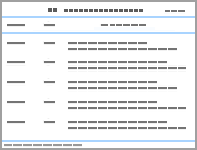
表1
三组神经功能评分比较"
| 组别 | n | 第1天 | 第3天 | 第7天 | 第14天 | F值 | P值 |
|---|---|---|---|---|---|---|---|
| 假手术组 | 8 | 18.000±0.000 | 18.000±0.000 | 18.000±0.000 | 18.000±0.000 | ||
| 模型组 | 8 | 9.714±0.680 | 10.429±0.649 | 11.143±0.404 | 12.143±0.349 | 4.849 | 0.012 |
| 穴位埋线组 | 8 | 12.000±0.436 | 13.000±0.436 | 14.429±0.481 | 15.857±0.459 | 34.972 | 0.001 |
| F值 | 84.125 | 72.633 | 89.431 | 80.688 | |||
| P值 | < 0.001 | < 0.001 | < 0.001 | < 0.001 | |||
| t值a | 12.557 | 11.851 | 13.370 | 12.554 | |||
| P值a | < 0.001 | < 0.001 | < 0.001 | < 0.001 | |||
| t值b | 3.464 | 4.025 | 6.406 | 7.961 | |||
| P值b | < 0.001 | < 0.001 | < 0.001 | < 0.001 |
表2
三组网屏实验(30°)时间比较(s)"
| 组别 | n | 第1天 | 第3天 | 第7天 | 第14天 | F值 | P值 |
|---|---|---|---|---|---|---|---|
| 假手术组 | 6 | 56.633±1.570 | 57.682±1.314 | 60.000±0.000 | 60.000±0.000 | 3.632 | 0.086 |
| 模型组 | 6 | 16.248±4.453 | 20.390±4.613 | 28.148±3.685 | 38.028±3.035 | 28.255 | 0.002 |
| 穴位埋线组 | 6 | 41.593±5.143 | 46.118±4.128 | 46.920±4.309 | 53.307±3.113 | 4.979 | 0.014 |
| F值 | 25.636 | 27.297 | 23.919 | 20.132 | |||
| P值 | < 0.001 | < 0.001 | < 0.001 | < 0.001 | |||
| t值a | 7.084 | 7.217 | 6.880 | 6.190 | |||
| P值a | < 0.001 | < 0.001 | < 0.001 | < 0.001 | |||
| t值b | 4.446 | 4.979 | 4.055 | 4.304 | |||
| P值b | < 0.001 | < 0.001 | < 0.001 | < 0.001 |
表3
三组网屏实验(60°)时间比较(s)"
| 组别 | n | 第1天 | 第3天 | 第7天 | 第14天 | F值 | P值 |
|---|---|---|---|---|---|---|---|
| 假手术组 | 6 | 57.905±1.290 | 58.090±1.744 | 59.233±0.767 | 56.518±1.846 | 0.880 | 0.474 |
| 模型组 | 6 | 5.002±0.503 | 9.040±0.744 | 12.058±0.557 | 21.612±1.599 | 131.541 | < 0.001 |
| 穴位埋线组 | 6 | 11.565±1.719 | 22.003±1.785 | 30.260±1.810 | 37.283±2.027 | 33.492 | < 0.001 |
| F值 | 511.961 | 285.814 | 406.954 | 91.017 | |||
| P值 | < 0.001 | < 0.001 | < 0.001 | < 0.001 | |||
| t值a | 29.352 | 23.070 | 28.284 | 13.469 | |||
| P值a | < 0.001 | < 0.001 | < 0.001 | < 0.001 | |||
| t值b | 3.642 | 6.097 | 10.913 | 6.047 | |||
| P值b | < 0.001 | < 0.001 | < 0.001 | < 0.001 |
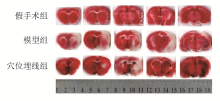
图1
各组TTC染色"
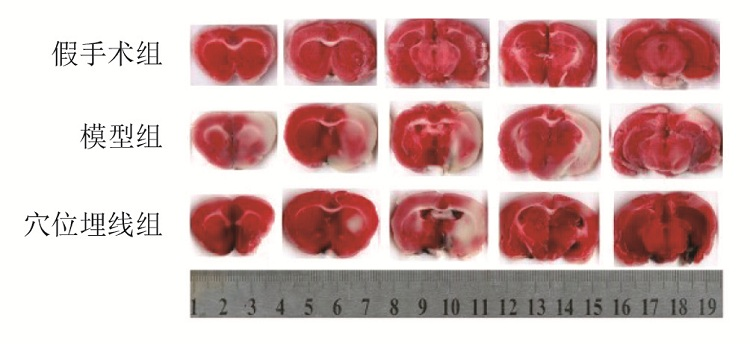
表4
三组脑梗死体积比较(%)"
| 组别 | n | 脑梗死体积 |
|---|---|---|
| 假手术组 | 4 | 0 |
| 模型组 | 4 | 22.7±1.899 |
| 穴位埋线组 | 4 | 5.64±0.9384a |
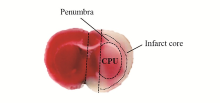
图2
梗死中心区和缺血半暗带区脑区定位 注:CPU, nucleus caudate putamen"

表5
三组GFAP与突触素I免疫组化阳性细胞比较(COD)"
| 组别 | n | GFAP | 突触素I |
|---|---|---|---|
| 假手术组 | 4 | 0.046±0.008 | 0.081±0.011 |
| 模型组 | 4 | 0.061±0.007a | 0.043±0.010a |
| 穴位埋线组 | 4 | 0.035±0.008b | 0.059±0.007b |
| F值 | 4.060 | 4.230 | |
| P值 | < 0.05 | < 0.05 |
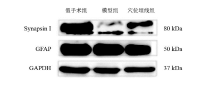
图5
三组GFAP和突触素I的Western blotting"
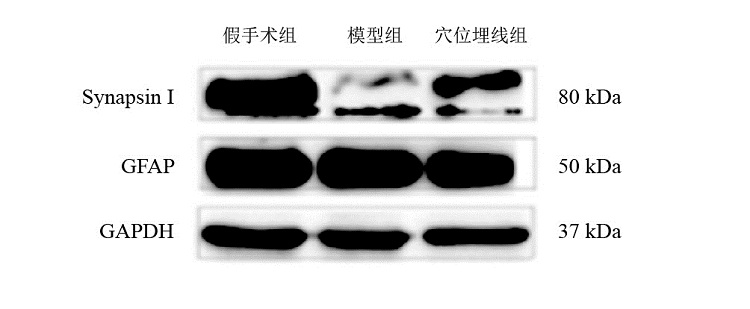
表6
三组GFAP与突触素I蛋白水平比较(/GADPH)"
| 组别 | n | GFAP蛋白 | 突触素I蛋白 |
|---|---|---|---|
| 假手术组 | 4 | 2.146±0.597 | 1.348±0.218 |
| 模型组 | 4 | 3.049±1.223a | 0.515±0.426a |
| 穴位埋线组 | 4 | 1.930±1.177b | 1.156±0.262b |
| F值 | 0.326 | 1.917 | |
| P值 | < 0.05 | < 0.05 |
表7
三组GFAP与突触素I的mRNA水平比较(/GADPH)"
| 组别 | n | GFAP mRNA | 突触素I mRNA |
|---|---|---|---|
| 假手术组 | 4 | 1.439±0.184 | 2.690±0.096 |
| 模型组 | 4 | 0.942±0.015a | 0.917±0.065a |
| 穴位埋线组 | 4 | 0.457±0.063b | 1.447±0.069b |
| F值 | 19.014 | 135.629 | |
| P值 | < 0.05 | < 0.05 |
| [1] |
GBD 2013 Mortality and Causes of Death Collaborators. Global, regional, and national age-sex specific all-cause and cause-specific mortality for 240 causes of death, 1990-2013: a systematic analysis for the Global Burden of Disease Study 2013BD 2013 Mortality and Causes of Death Collaborators. Global, regional, and national age-sex specific all-cause and cause-specific mortality for 240 causes of death, 1990-2013: a systematic analysis for the Global Burden of Disease Study 2013[J]. Lancet, 2015, 385(9963):117-171.
doi: 10.1016/S0140-6736(14)61682-2 |
| [2] |
Yeo L L, Paliwal P, Teoh H L, et al. Timing of recanalization after intravenous thrombolysis and functional outcomes after acute ischemic stroke[J]. JAMA Neurol, 2013, 70(3):353-358.
doi: 10.1001/2013.jamaneurol.547 |
| [3] |
Biondi O, Grondard C, Lecolle S, et al. Exercise-induced activation of NMDA receptor promotes motor unit development and survival in a type 2 spinal muscular atrophy model mouse[J]. J Neurosci, 2008, 28(4):953-962.
doi: 10.1523/JNEUROSCI.3237-07.2008 |
| [4] | Huo J, Zhao J, Yuan Y, et al. [Research status of the effect mechanism on catgut-point embedding therapy][J]. [in Chinese]. Zhongguo Zhen Jiu, 2017, 37(11):1251-1254. |
| [5] | Guo A S, Li A H, Chen X, et al. [Effect of acupoint catgut embedding on motor function and serum high sensitivity C-reactive protein and IL-6 levels in patients with acute cerebral infarction][J]. [in Chinese]. Zhen Ci Yan Jiu, 2013, 38(3):224-228, 258. |
| [6] |
Longa E Z, Weinstein P R, Carlson S, et al. Reversible middle cerebral artery occlusion without craniectomy in rats[J]. Stroke, 1989, 20(1):84-91.
pmid: 2643202 |
| [7] |
Garcia J H, Wagner S, Liu K F, et al. Neurological deficit and extent of neuronal necrosis attributable to middle cerebral artery occlusion in rats. Statistical validation[J]. Stroke, 1995, 26(4):627-634, 635.
pmid: 7709410 |
| [8] |
Ashwal S, Tone B, Tian H R, et al. Core and penumbral nitric oxide synthase activity during cerebral ischemia and reperfusion[J]. Stroke, 1998, 29(5):1037-1046, discussion 1047.
pmid: 9596255 |
| [9] |
Cervera M A, Soekadar S R, Ushiba J, et al. Brain-computer interfaces for post-stroke motor rehabilitation: a meta-analysis[J]. Ann Clin Transl Neurol, 2018, 5(5):651-663.
doi: 10.1002/acn3.2018.5.issue-5 |
| [10] |
Biasiucci A, Leeb R, Iturrate I, et al. Brain-actuated functional electrical stimulation elicits lasting arm motor recovery after stroke[J]. Nat Commun, 2018, 9(1):2421.
doi: 10.1038/s41467-018-04673-z pmid: 29925890 |
| [11] |
Bockbrader M A, Francisco G, Lee R, et al. Brain computer interfaces in rehabilitation medicine[J]. PM R, 2018, 10:233-243.
doi: 10.1016/S1934-1482(18)30028-5 |
| [12] | Mehrholz J, Pohl M, Platz T, et al. Electromechanical and robot-assisted arm training for improving activities of daily living, arm function, and arm muscle strength after stroke[J]. Cochrane Database Syst Rev, 2018, 9:D6876. |
| [13] | Chisari C, Bertolucci F, Monaco V, et al. Robot-assisted gait training improves motor performances and modifies Motor Unit firing in poststroke patients[J]. Eur J Phys Rehabil Med, 2015, 51(1):59-69. |
| [14] | Baker E W, Kinder H A, West F D. Neural stem cell therapy for stroke: a multimechanistic approach to restoring neurological function[J]. Brain Behav, 2019, 9(3):e1214. |
| [15] |
Huang L, Zhang L. Neural stem cell therapies and hypoxic-ischemic brain injury[J]. Prog Neurobiol, 2019, 173:1-17.
doi: S0301-0082(17)30113-2 pmid: 29758244 |
| [16] |
Webb R L, Kaiser E E, Scoville S L, et al. Human neural stem cell extracellular vesicles improve tissue and functional recovery in the murine thromboembolic stroke model[J]. Transl Stroke Res, 2018, 9(5):530-539.
doi: 10.1007/s12975-017-0599-2 |
| [17] | 许兰, 李奕琴, 徐远红. 穴位埋线对脑卒中后运动功能障碍及生活质量的影响[J]. 世界最新医学信息文摘, 2017, 17(90):93-98. |
| Xu L, Li Y Q, Xu Y H, et al. Effects of acupoint catgut embedding on motor dysfunction and quality of life after stroke[J]. World Latest Med Inform, 2017, 17(90):93-98. | |
| [18] | Sharp F R, Lu A, Tang Y, et al. Multiple molecular penumbras after focal cerebral ischemia[J]. J Cereb Blood Flow Metab, 2000, 20(7):1011-1032. |
| [19] |
Chen Z, Hu Q, Xie Q, et al. Effects of treadmill exercise on motor and cognitive function recovery of MCAO mice through the caveolin-1/VEGF signaling pathway in ischemic penumbra[J]. Neurochem Res, 2019, 44(4):930-946.
doi: 10.1007/s11064-019-02728-1 |
| [20] |
Thirugnanachandran T, Ma H, Singhal S, et al. Refining the ischemic penumbra with topography[J]. Int J Stroke, 2018, 13(3):277-284.
doi: 10.1177/1747493017743056 pmid: 29140184 |
| [21] |
Canedo A. Primary motor cortex influences on the descending and ascending systems[J]. Prog Neurobiol, 1997, 51(3):287-335.
pmid: 9089791 |
| [22] |
Rouiller E M, Olivier E. Functional recovery after lesions of the primary motor cortex[J]. Prog Brain Res, 2004, 143:467-475.
pmid: 14653189 |
| [23] |
Wang X, Chen A, Wu H, et al. Enriched environment improves post-stroke cognitive impairment in mice by potential regulation of acetylation homeostasis in cholinergic circuits[J]. Brain Res, 2016, 1650:232-242.
doi: S0006-8993(16)30646-1 pmid: 27637156 |
| [24] |
Nie J, Yang X. Modulation of synaptic plasticity by exercise training as a basis for ischemic stroke rehabilitation[J]. Cell Mol Neurobiol, 2017, 37(1):5-16.
doi: 10.1007/s10571-016-0348-1 |
| [25] |
Peters D M, Fridriksson J, Stewart J C, et al. Cortical disconnection of the ipsilesional primary motor cortex is associated with gait speed and upper extremity motor impairment in chronic left hemispheric stroke[J]. Hum Brain Mapp, 2018, 39(1):120-132.
doi: 10.1002/hbm.23829 |
| [26] |
Kang N, Weingart A, Cauraugh J H. Transcranial direct current stimulation and suppression of contralesional primary motor cortex post-stroke: a systematic review and meta-analysis[J]. Brain Inj, 2018, 32(9):1063-1070.
doi: 10.1080/02699052.2018.1481526 |
| [27] |
Thompson S N, Gibson T R, Thompson B M, et al. Relationship of calpain-mediated proteolysis to the expression of axonal and synaptic plasticity markers following traumatic brain injury in mice[J]. Exp Neurol, 2006, 201(1):253-265.
doi: 10.1016/j.expneurol.2006.04.013 |
| [28] |
Eng L F, Ghirnikar R S, Lee Y L. Glial fibrillary acidic protein: GFAP-thirty-one years (1969-2000)[J]. Neurochem Res, 2000, 25(9-10):1439-1451.
pmid: 11059815 |
| [29] |
Shen S W, Duan C L, Chen X H, et al. Neurogenic effect of VEGF is related to increase of astrocytes transdifferentiation into new mature neurons in rat brains after stroke[J]. Neuropharmacology, 2016, 108:451-461.
doi: 10.1016/j.neuropharm.2015.11.012 |
| [30] |
Yang Z, Wang K K. Glial fibrillary acidic protein: from intermediate filament assembly and gliosis to neurobiomarker[J]. Trends Neurosci, 2015, 38(6):364-374.
doi: 10.1016/j.tins.2015.04.003 |
| [31] | 宋晓磊, 冯晓东. 穴位埋线治疗脑卒中后肌张力障碍临床研究[J]. 中医学报, 2011, 26(12):1533-1534. |
| Song X L, Feng X D. Clinical research on catgut embedding therapy in treating dystonia after stroke[J]. Chin J Chin Med, 2011, 26(12):1533-1534. | |
| [32] | 全超, 徐远红. 穴位埋线对脑卒中偏瘫患者步行功能影响的三维步态研究[J]. 世界最新医学信息文摘, 2019, 19(20):158-159. |
| Quan C, Xu Y H. The clinical effect of acupoint embedding therapy on hemiplegic gait based on evaluating by gait analysis[J]. World Latest Med Inform, 2019, 19(20):158-159. | |
| [33] | 冯晓东, 李瑞青, 任彬彬, 等. 穴位埋线对脑卒中后上肢痉挛患者的疗效观察[J]. 中国康复医学杂志, 2013, 28(9):843-845. |
| Feng X D, Li R Q, Ren B B, et al. The clinical effect of acupoint embedding therapy on patients with upper limb spasm after stroke[J]. Chin J Rehabil Med, 2013, 28(9):843-845. | |
| [34] | 余智. 病灶头皮反射区埋线治疗脑卒中后感觉障碍临床研究[J]. 中国针灸, 2014, 34(7):631-635. |
| Yu Z. Clinical research of catgut implantation at scalp reflecting foci for post-stroke sensory disturbance[J]. Chin Acupunc Moxib, 2014, 34(7):631-635. | |
| [35] | 李瑞青, 徐志伟, 孙伟娟, 等. 穴位埋线对脑缺血再灌注后肢体痉挛大鼠谷氨酰胺合成酶表达的影响[J]. 中华中医药杂志, 2018, 33(10):4736-4739. |
| Li R Q, Xu Z W, Sun W J, et al. Effects of catgut implantation in acupoints on GS expressions in brain of rats with spasticity after stroke[J]. Zhong Hua Zhong Yi Yao Za Zhi, 2018, 33(10):4736-4739. | |
| [36] | Huang F, Xie Y, Zhao S, et al. The effectiveness and safety of acupoint catgut embedding for the treatment of postmenopausal osteoporosis: a systematic review and meta-analysis[J]. Evid Based Complement Alternat Med, 2019, 2019:2673763. |
| [37] |
Zhang L, Wang Y, Xu Y, et al. Metabonomic analysis reveals efficient ameliorating effects of acupoint stimulations on the menopause-caused alterations in mammalian metabolism[J]. Sci Rep, 2014, 4:3641.
doi: 10.1038/srep03641 |
| [38] |
Chen G Z, Xu Y X, Zhang J W, et al. Effect of acupoint catgut-embedding on the quality of life, reproductive endocrine and bone metabolism of postmenopausal women[J]. Chin J Integr Med, 2010, 16(6):498-503.
doi: 10.1007/s11655-010-0574-1 |
| [39] |
Du K, Wang X, Chi L, et al. Role of sigma-1 receptor/p38 MAPK inhibition in acupoint catgut embedding-mediated analgesic effects in complete freund's adjuvant-induced inflammatory pain[J]. Anesth Analg, 2017, 125(2):662-669.
doi: 10.1213/ANE.0000000000001857 |
| [40] | Cui W Q, Sun W S, Xu F, et al. Spinal serotonin 1A receptor contributes to the analgesia of acupoint catgut embedding by inhibiting phosphorylation of the N-methyl-D-aspartate receptor GluN1 subunit in complete Freund's adjuvant-induced inflammatory pain in rats[J]. J Pain, 2019, 20(1):11-16. |
| [41] | 李箭, 李义, 马福彦. 穴位埋线疗法在髋关节置换术后镇痛的疗效[J]. 长春中医药大学学报, 2017, 33(5):781-783. |
| Li J, Li Y, Ma F Y, et al. Acesodyne effect of catgut embedment in acupoint therapy after hip replacemen[J]. J Changchun Univ Chin Med, 2017, 33(5):781-783. | |
| [42] | 陈盼碧, 陈静, 崔瑾, 等. 穴位埋线法对原发性痛经大鼠神经-内分泌-免疫网络的调控与影响[J]. 针刺研究, 2018, 43(1):29-33. |
| Chen P B, Chen J, Cui J, et al. Effects of the acupoint catgut embedding on nerve-endocrine-immune network in dysmenorrhea rat[J]. Zhen Ci Yan Jiu, 2018, 43(1):29-33. |
| [1] | 吴澄, 章云枫, 王卫宁, 余克威, 张艳正, 沈嘉蓉, 吴毅. 肘腕功能支具对脑卒中偏瘫患者足底压力和平衡功能的效果[J]. 《中国康复理论与实践》, 2026, 32(1): 30-39. |
| [2] | 高云汉, 侯闪闪, 汪鑫煜, 朱崇田. 基于功能性近红外光谱探讨脑机接口对脑卒中患者上肢运动功能障碍的效果[J]. 《中国康复理论与实践》, 2025, 31(9): 1066-1073. |
| [3] | 王晓锋, 胡梦巧, 汪嫣, 魏坤, 徐文竹, 任丹, 马晔. 外骨骼机器人辅助步态训练对脑卒中和脊髓损伤下肢功能康复效果的系统综述[J]. 《中国康复理论与实践》, 2025, 31(8): 914-921. |
| [4] | 刘璇, 高玲, 褚凤明, 陈杰, 张明. 脑机接口联合上肢康复机器人对脑卒中患者上肢功能的影响[J]. 《中国康复理论与实践》, 2025, 31(6): 703-710. |
| [5] | 周天添, 张通, 张琦, 梁艳华, 张燕庆, 岳青, 李思佳. Lokomat机器人辅助步行训练对偏瘫儿童下肢运动功能的效果[J]. 《中国康复理论与实践》, 2025, 31(6): 711-720. |
| [6] | 施滨, 徐宁, 周广雪. 镜像疗法应用于脑卒中运动功能康复的文献计量分析[J]. 《中国康复理论与实践》, 2025, 31(5): 561-572. |
| [7] | 李鑫磊, 魏伟, 宋健, 赵雨晴, 孔维橙, 蔡嘉玉, 施浩然, 薛偕华. 静息态脑电图在脑卒中患者上肢运动功能评估中的应用[J]. 《中国康复理论与实践》, 2025, 31(4): 448-457. |
| [8] | 何爱群, 黎景波, 刘海鸥, 宋秋爽, 何茂莉, 林如敏. 上肢机器人启动训练后双侧上肢训练对脑卒中重度偏瘫上肢功能的效果[J]. 《中国康复理论与实践》, 2025, 31(11): 1265-1270. |
| [9] | 张浩, 许传蕾, 魏振兴, 马丽虹. 不同虚拟现实技术对帕金森病患者运动功能疗效的网状Meta分析[J]. 《中国康复理论与实践》, 2025, 31(11): 1290-1302. |
| [10] | 徐胜, 张敏, 杨青青, 王庆雷, 耿阿燕, 王彤, 郭川. 功能性电刺激手摇车对脑卒中患者脑网络功能连接的功能性近红外光谱研究[J]. 《中国康复理论与实践》, 2025, 31(10): 1181-1187. |
| [11] | 于子夫, 杨晓霞, 赵霞, 曹新燕, 陈良侠, 刘西花. 头针联合皮内针同步康复疗法对脑卒中患者上肢运动功能的效果[J]. 《中国康复理论与实践》, 2025, 31(10): 1194-1205. |
| [12] | 罗红, 徐丽. 重复经颅磁刺激联合重复外周磁刺激对脑出血患者上肢运动功能的效果:基于静息态功能磁共振成像的随机对照试验[J]. 《中国康复理论与实践》, 2024, 30(9): 1060-1068. |
| [13] | 王敏, 方篮天, 黄晨燚. 改良分级运动表象训练对脑卒中患者上肢运动功能效果的随机对照试验[J]. 《中国康复理论与实践》, 2024, 30(9): 1069-1073. |
| [14] | 段林茹, 郑洁皎, 陈茜, 李燕. 脑卒中患者跌倒风险的相关因素研究[J]. 《中国康复理论与实践》, 2024, 30(7): 811-817. |
| [15] | 罗薇, 何怡, 张庆苏. 脑卒中后构音障碍患者构音器官运动功能与言语清晰度的相关性[J]. 《中国康复理论与实践》, 2024, 30(7): 818-822. |
| 阅读次数 | ||||||
|
全文 |
|
|||||
|
摘要 |
|
|||||
|
||
