



《中国康复理论与实践》 ›› 2025, Vol. 31 ›› Issue (2): 158-164.doi: 10.3969/j.issn.1006-9771.2025.02.005
向松柏1,2, 周雯慧3, 王崇高3( )
)
收稿日期:2024-08-26
修回日期:2024-11-05
出版日期:2025-02-25
发布日期:2025-02-25
通讯作者:
王崇高(1989-),男,汉族,河南南阳市人,博士,讲师,主要研究方向:特殊儿童认知与心理发展,E-mail: wchonggao@ccnu.edu.cn。
作者简介:向松柏(1989-),男,汉族,四川巴中市人,博士,副教授,主要研究方向:孤独症儿童社会性发展。
基金资助:
XIANG Songbai1,2, ZHOU Wenhui3, WANG Chonggao3()
Received:2024-08-26
Revised:2024-11-05
Published:2025-02-25
Online:2025-02-25
Contact:
WANG Chonggao, E-mail: wchonggao@ccnu.edu.cn
Supported by:摘要:
目的 分析机器人应用于孤独症谱系障碍(ASD)儿童康复领域的研究现状、热点和演化趋势。
方法 检索2004年至2024年Web of Science核心合集数据库中机器人应用于ASD儿童康复领域相关文献,采用CiteSpace 6.3.R1进行分析。
结果 共纳入902篇文献。发文量呈波动上升态势,发文量最多的国家是美国,中心性最高的国家是英国。发文最多的作者是Ichiro Yoshikawa,发文量最多的机构是赫特福德大学。康复机器人、模仿能力、人机交互、共同注意和人形机器人是领域内的高频关键词和突现词。
结论 机器人在ASD儿童康复领域的研究呈上升趋势。机器人智能化程度不断提升,应用场景不断丰富,实施多模态数据的采集和分析,结合脑科学技术揭示ASD儿童与机器人交互过程中的神经机制,根据ASD儿童的特定需求开发个性化的康复方案,将成为未来研究的重点。
向松柏, 周雯慧, 王崇高. 2004年至2024年机器人在孤独症谱系障碍儿童康复中应用的文献计量分析[J]. 《中国康复理论与实践》, 2025, 31(2): 158-164.
XIANG Songbai, ZHOU Wenhui, WANG Chonggao. Application of robots in rehabilitation of children with autism spectrum disorder from 2004 to 2024: a bibliometrics analysis[J]. Chinese Journal of Rehabilitation Theory and Practice, 2025, 31(2): 158-164.

图1
年发文量"


图2
国家合作网络图谱"
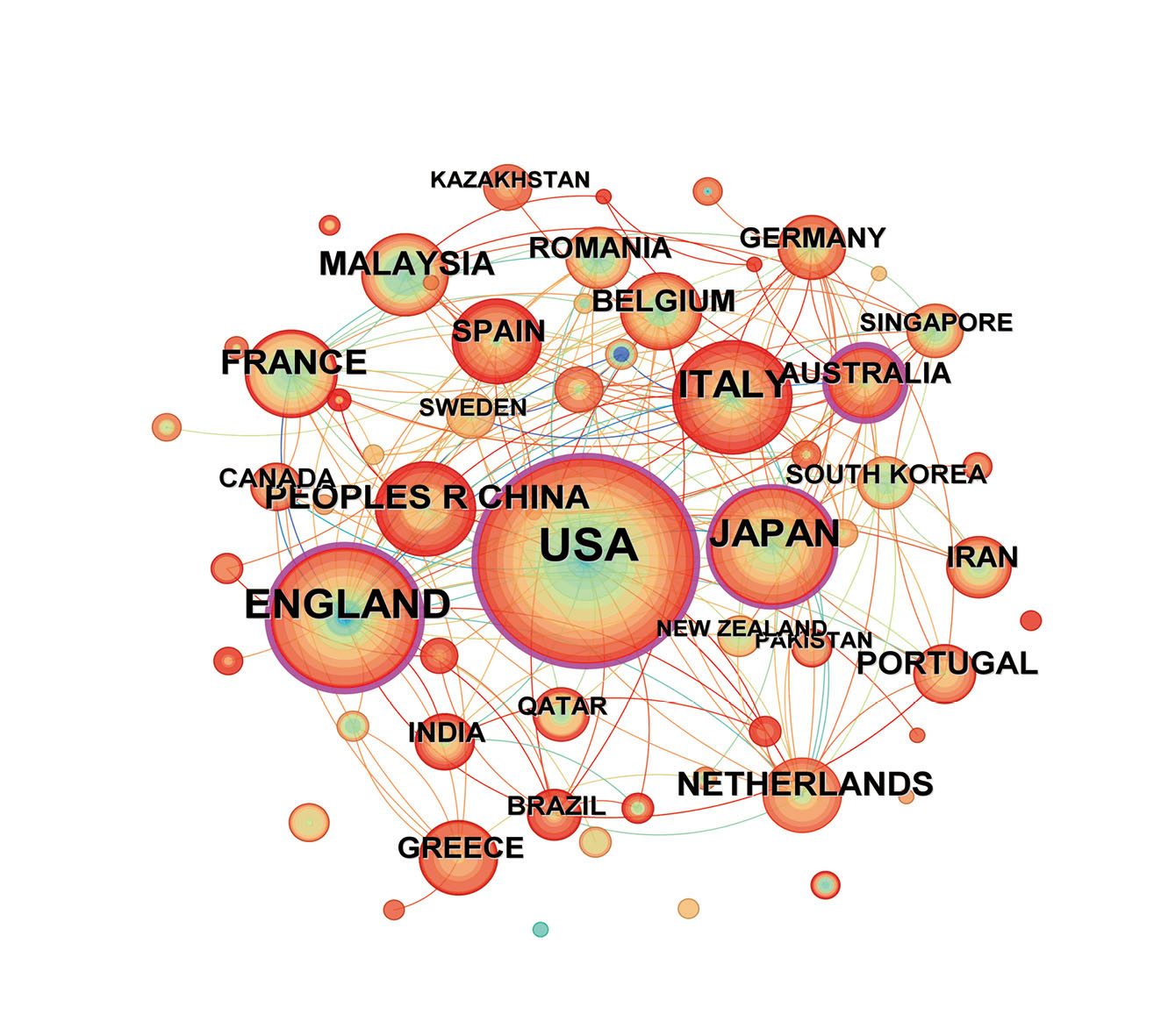

表1
发文量前10的国家"
| 国家 | 发文量/n | 中心性 |
|---|---|---|
| 美国 | 215 | 0.24 |
| 英国 | 115 | 0.43 |
| 日本 | 89 | 0.22 |
| 意大利 | 83 | 0.07 |
| 中国 | 52 | 0.07 |
| 法国 | 51 | 0.08 |
| 马来西亚 | 46 | 0.04 |
| 荷兰 | 44 | 0.05 |
| 葡萄牙 | 37 | 0.01 |
| 西班牙 | 33 | 0.13 |
表2
发文量前10的机构"
| 研究机构 | 发文量/n | 中心性 |
|---|---|---|
| 赫特福德大学 | 45 | 0.11 |
| 大阪大学 | 29 | 0.00 |
| 玛拉工艺大学 | 28 | 0.01 |
| 金泽大学 | 24 | 0.00 |
| 庆应义塾大学 | 23 | 0.00 |
| 法国国家科学研究中心 | 22 | 0.08 |
| 范德堡大学 | 21 | 0.01 |
| 日本国家科学技术研究院 | 19 | 0.00 |
| 巴比什-波雅依大学 | 18 | 0.06 |
| 索邦大学 | 17 | 0.05 |

图3
关键词共现图谱"

表3
排名前10的高频关键词"
| 高频词 | 频次 | 中心性 |
|---|---|---|
| human-robot interaction | 112 | 0.17 |
| joint attention | 90 | 0.08 |
| interventions | 65 | 0.04 |
| imitation | 61 | 0.08 |
| technology | 53 | 0.06 |
| play | 39 | 0.06 |
| communication | 34 | 0.04 |
| humanoid robot | 32 | 0.05 |
| social skill | 31 | 0.05 |
| machine learning | 28 | 0.06 |

图4
突现关键词"


图5
关键词时间线图谱"

| [1] | PANCERI J A C, FREITAS É, DE SOUZA J C, et al. A new socially assistive robot with integrated serious games for therapies with children with autism spectrum disorder and down syndrome: a pilot study[J]. Sensors, 2021, 21(24): 1-19. |
| [2] | SCASSELLATI B. How social robots will help us to diagnose, treat, and understand autism[M]. Berlin:Springer, 2007. |
| [3] | ISLAM M A, HASAN M M, DEOWAN S A. Robot-assisted training for children with autism spectrum disorder: a review[J]. J Intelligent Robot Syst, 2023, 108: 1-36. |
| [4] | SARA B S, YASAR A. Robot assisted therapy for children with autism spectrum disorder: a survey[J]. Robot Autom Eng J, 2018, 2(3): 555-589. |
| [5] | 陈东帆, 李睿强, 韩琨. 人形机器人技术在孤独症儿童干预中的应用[J]. 中国康复理论与实践, 2015, 21(11): 1325-1328. |
| CHEN D F, LI R Q, HAN K. Application of humanoid robot in intervention for autistic children[J]. Chin J Rehabil Theory Pract, 2015, 21(11): 1325-1328. | |
| [6] | KUMAZAKI H, MURAMATSU T, YOSHIKAWA Y, et al. Android robot promotes disclosure of negative narratives by individuals with autism spectrum disorders[J]. Front Psychiatry, 2022, 13: 899664. |
| [7] | TAHERI A, MEGHDARI A, ALEMI M, et al. Clinical interventions of social humanoid robots in the treatment of a set of high and low functioning autistic Iranian twins[J]. Sci Iran, 2018, 25(3): 1197-1214. |
| [8] | CHUNG E Y H. Robot-mediated social skill intervention programme for children with autism spectrum disorder: an ABA time-series study[J]. Int J Soc Robot, 2021, 13(5): 1095-1107. |
| [9] | KOUROUPA A, LAWS K R, IRVINE K, et al. The use of social robots with children and young people on the autism spectrum: a systematic review and meta analysis[J]. PLoS One, 2022, 17(6): e0269800. |
| [10] | 代美娜, 孙玉梅. 机器人应用于自闭症谱系障碍儿童干预的研究[J]. 中国特殊教育, 2019(4): 40-46. |
| DAI M N, SUN Y M. The application of robots in the interventions for children with autism spectrum disorders[J]. Chin J Spec Educ, 2019(4): 40-46. | |
| [11] |
高丽梅, 汪凯, 李丹丹. 社交机器人在孤独症谱系障碍儿童中的应用[J]. 心理科学进展, 2024, 32(5): 834-844.
doi: 10.3724/SP.J.1042.2024.00834 |
|
GAO L M, WANG K, LI D D. The application of social robots in intervention for children with autism spectrum disorders[J]. Adv Psychol Sci, 2024, 32(5): 834-844.
doi: 10.3724/SP.J.1042.2024.00834 |
|
| [12] | 何文凤, 鲜国炜, 马勇. 基于文献计量分析的我国突发公共卫生事件应急治理研究现状[J]. 中国医院, 2024, 28(2): 24-28. |
| HE W F, XIAN G W, MA Y. Current research status of emergency governance for public health emergencies in China based on bibliometric analysis[J]. Chin Hospit, 2024, 28(2): 24-28. | |
| [13] | ROBINS B, DAUTENHAHN K, DUBOWSKI J. Does appearance matter in the interaction of children with autism with a humanoid robot?[J]. Interaction Stud, 2006, 7(3): 479-512. |
| [14] | ROBINS B, DAUTENHAHN K. The role of the experimenter in HRI research: a case study evaluation of children with autism interacting with a robotic toy[C]. Roman:The 15th IEEE International Symposium on Robot and Human Interactive Communication, 2006. |
| [15] | KOZIMA H, NAKAGAWA C, YASUDA Y. Interactive robots for communication-care: a case-study in autism therapy[C]. Roman: IEEE International Workshop on Robot and Human Interactive Communication, 2005. |
| [16] | ROBINS B, DAUTENHAHN K, BOEKHORST R T, et al. Robotic assistants in therapy and education of children with autism: can a small humanoid robot help encourage social interaction skills?[J]. Univ Access Inform Soc, 2005, 4(2): 105-120. |
| [17] | RAVINDRA P, SILVA D S, TADANO K, et al. Therapeutic-assisted robot for children with autism[C]. IEEE/RSJ International Conference on Intelligent Robots and Systems, 2009. |
| [18] | ROBINS B, DICKERSON P, STRIBLING P, et al. Robot-mediated joint attention in children with autism: a case study in robot-human interaction[J]. Interact Stud, 2004, 5(2): 161-198. |
| [19] | DUQUETTE A, MICHAUD F, MERCIER H. Exploring the use of a mobile robot as an imitation agent with children with low-functioning autism[J]. Auton Robot, 2008, 24: 147-157. |
| [20] | FUJIMOTO I, MATSUMOTO T, DE SILVA P R S, et al. Study on an assistive robot for improving imitation skill of children with autism[M]. Singapore: Springer, 2010. |
| [21] | SRINIVASAN S M, EIGSTI I M, GIFFORD T, et al. The effects of embodied rhythm and robotic interventions on the spontaneous and responsive social attention patterns of children with autism spectrum disorder: a pilot randomized controlled trial[J]. Res Autism Spectr Disord, 2016, 27: 73-87. |
| [22] | PECA A, SIMUT R, PINTEA S, et al. How do typically developing children and children with autism perceive different social robots?[J]. Comput Human Behav, 2014, 41: 268-277. |
| [23] | COSTA S, LEHMANN H, DAUTENHAHN K, et al. Using a humanoid robot to elicit body awareness and appropriate physical interaction in children with autism[J]. Int J Soc Robot, 2015(7): 265-278. |
| [24] | PUYON M, GIANNOPULU I. Emergent emotional and verbal strategies in autism are based on multimodal interactions with toy robots in free spontaneous game play[C]. Roman:2013 IEEE, 2013. |
| [25] | OZCAN B, CALIGIORE D, SPERATI V, et al. Transitional wearable companions: a novel concept of soft interactive social robots to improve social skills in children with autism spectrum disorder[J]. Int J Soc Robot, 2016, 8(4): 471-481. |
| [26] | DAMM O, MALCHUS K, JAECKS P, et al. Different gaze behavior in human-robot interaction in Asperger's syndrome: an eye-tracking study[C]. IEEE International Workshop on Robot and Human Communication, 2013. |
| [27] | KIM E S, BERKOVITS L D, BERNIER E P, et al. Social robots as embedded reinforcers of social behavior in children with autism[J]. J Autism Develop Disord, 2013, 43(5): 1038-1049. |
| [28] | 韩保祯. 基于多模态信息融合的脑网络研究及其应用[D]. 成都: 电子科技大学, 2018. |
| [29] | YUN S S, CHOI J, PARK S K, et al. Social skills training for children with autism spectrum disorder using a robotic behavioral intervention system[J]. Autism Res, 2017, 10(7): 1306-1323. |
| [30] | TAKATA K, YOSHIKAWA Y, MURAMATSU T, et al. Social skills training using multiple humanoid robots for individuals with autism spectrum conditions[J]. Front Psychiatry, 2023, 14: 1168837. |
| [31] | KUMAZAKI H, MURAMATSU T, YOSHIKAWA Y, et al. Enhancing communication skills of individuals with autism spectrum disorders while maintaining social distancing using two tele-operated robots[J]. Front Psychiatry, 2021, 11: 598688. |
| [32] | SCASSELLATI B, BOCCANFUSO L, HUANG C M, et al. Improving social skills in children with ASD using a long-term, in-home social robot[J]. Sci Robot, 2018, 3(21): eaat7544. |
| [33] | MOJTABA S, ALIREZA T, MOHAMMAD M, et al. Utilizing social virtual reality robot (V2R) for music education to children with high-functioning autism[J]. Educ Inform Technol, 2022, 27: 819-843. |
| [34] |
FORBES P A G, PAN X, HAMILTON A F C. Reduced mimicry to virtual reality avatars in autism spectrum disorder[J]. J Autism Dev Disord, 2016, 46(12): 3788-3797.
pmid: 27696183 |
| [35] | TARYADI B R, KURNIAWAN I. The improvement of autism spectrum disorders on children communication ability with PECS method Multimedia Augmented Reality-Based[J]. J Phys: Conf Ser, 2017, 947: 012009. |
| [36] | MANJU T, PADMAVATHI S, TAMILSELVI D A. Rehabilitation therapy for autism spectrum disorder using virtual reality[C]. International Conference on Intelligent Information Technologies, 2017. |
| [37] | ROSENFIELD N S, LAMKIN K, RE J, et al. A virtual reality system for practicing conversation skills for children with autism[J]. Multimodal Technol Interact, 2019, 3(2): 28. |
| [38] | OSAMA H, SAMIR E S, JIHAD A, et al. Design of immersive virtual reality system to improve communication skills in individuals with autism[J]. Int J Emerg Technol Learn, 2017, 12: 50-64. |
| [39] | MOGHADAS M, MORADI H. Analyzing human-robot interaction using machine vision for autism screening[C]. RSI International Conference on Robotics and Mechatronics, 2018. |
| [40] | 何成刚, 朱岚涤, 汪晓鑫, 等. 机器人磨抛力主动柔顺控制研究进展[J]. 机器人技术与应用, 2024(3): 14-19. |
| [41] | SCHADENBERG B R, REIDSMA D, EVERS V, et al. Predictable robots for autistic children-variance in robot behaviour, idiosyncrasies in autistic children's characteristics, and child-robot engagement[J]. ACM Transact Computer-Human Interact, 2012, 28(5): 36. |
| [42] | PLIASA S, FACHANTIDIS N. Using daisy robot as a motive for children with ASD to participate in triadic activities[J]. Themes eLearning, 2019, 12(12): 35-50. |
| [43] |
SALIMI Z, JENABI E, BASHIRIAN S. Are social robots ready yet to be used in care and therapy of autism spectrum disorder: a systematic review of randomized controlled trials[J]. Neurosci Biobehav Rev, 2021, 129: 1-16.
doi: 10.1016/j.neubiorev.2021.04.009 pmid: 33862066 |
| [44] |
MATSUDA S, NUNEZ E, HIROKAWA M, et al. Facilitating social play for children with PDDs: effects of paired robotic devices[J]. Front Psychol, 2017, 8: 1029.
doi: 10.3389/fpsyg.2017.01029 pmid: 28701971 |
| [45] |
SIMUT R E, VANDERFAEILLIE J, PECA A, et al. Children with autism spectrum disorders make a fruit salad with Probo, the social robot: an interaction study[J]. J Autism Dev Disord, 2016, 46: 113-126.
doi: 10.1007/s10803-015-2556-9 pmid: 26304031 |
| [46] | SALEH M A, HANAPIAH F A, HASHIM H. Robot applications for autism: a comprehensive review[J]. Disabil Rehabil Assist Tech, 2021, 16(6): 580-602. |
| [47] | SYRIOPOULOU-DELLI C K, GKIOLNTA E. Review of assistive technology in the training of children with autism spectrum disorders[J]. Int J Develop Disabil, 2022, 68(2): 73-85. |
| [48] | FACHANTIDIS N, SYRIOPOULOU-DELLI C K, ZYGOPOULOU M. The effectiveness of socially assistive robotics in children with autism spectrum disorder[J]. Int J Develop Disabil, 2020, 66(2): 113-121. |
| [49] | POPESCU A L, POPESCU N, DOBRE C, et al. IoT and AI-based application for automatic interpretation of the affective state of children diagnosed with autism[J]. Sensors, 2022, 22(7): 25-28. |
| [1] | 钱李果, 吴同绚, 张巧云, 邢剑, 杨延砚. 康复治疗师继续教育病例库联合案例学习法的设计与运用效果[J]. 《中国康复理论与实践》, 2026, 32(3): 249-257. |
| [2] | 安乐, 覃小霞, 顾彬, 胡国兵, 田维毅. 职业本科康复治疗专业“双师型”教师胜任力模型:基于康复胜任力架构与多源标准的融合研究[J]. 《中国康复理论与实践》, 2026, 32(3): 258-269. |
| [3] | 刘华, 王丽媛, 马欣, 李静, 王丽. 基于OBE-CDIO模式运动康复训练教程课程改革的效果[J]. 《中国康复理论与实践》, 2026, 32(3): 270-275. |
| [4] | 刘霞, 张元民, 葛淑惠, 刘金美, 孙晨鸣, 王元会, 刘静, 李文福. 新医科背景下地方院校康复治疗人才培养模式的构建与实践[J]. 《中国康复理论与实践》, 2026, 32(3): 276-285. |
| [5] | 朱丽丽, 赵嘉欣, 程雪, 王会娟, 陈小霞. 康复期脑卒中患者疾病体验及需求的Meta整合[J]. 《中国康复理论与实践》, 2026, 32(3): 286-293. |
| [6] | 刘平, 周楠, 薛晓杰, 邵伟波. 脑卒中后吞咽障碍康复治疗技术应用研究的文献计量分析[J]. 《中国康复理论与实践》, 2026, 32(3): 294-303. |
| [7] | 蒲心语, 王靖萱, 王虎军, 修安达, 王颖鹏. 重复外周磁刺激在康复治疗中应用的文献计量分析[J]. 《中国康复理论与实践》, 2026, 32(3): 304-316. |
| [8] | 孙奎, 黄海伦, 刘永皑, 高恒. 脑机接口技术在脊髓损伤治疗领域的文献计量分析[J]. 《中国康复理论与实践》, 2026, 32(3): 317-328. |
| [9] | 张文静, 李浩, 袁佳佳, 胡怀宁. 远程监督指导下居家肺部音乐疗法对慢性阻塞性肺疾病的效果[J]. 《中国康复理论与实践》, 2026, 32(3): 337-344. |
| [10] | 梁冠军, 徐欢岚, 张何威, 张大力, 顾琴, 李明娣. 不同视觉输入及任务条件下痉挛型偏瘫儿童平衡与下肢生物力学变化[J]. 《中国康复理论与实践》, 2026, 32(3): 345-355. |
| [11] | 吴世彩. 康复伦理管理的理论构建与实践探索[J]. 《中国康复理论与实践》, 2026, 32(2): 125-131. |
| [12] | 何照楠, 张婷婷, 何照珂, 孟丽君. 基于BERTopic模型的我国康复伦理研究主题挖掘与内容分析[J]. 《中国康复理论与实践》, 2026, 32(2): 132-141. |
| [13] | 孟丽君. 残疾儿童康复研究伦理审查的挑战与思考[J]. 《中国康复理论与实践》, 2026, 32(2): 142-150. |
| [14] | 郭亚彬, 曾必云, 周阳. 2015年至2025年肌少症-疼痛共病研究的文献计量分析[J]. 《中国康复理论与实践》, 2026, 32(2): 151-161. |
| [15] | 李水艳, 李湘, 李彦慧, 陆翊濛, 李杜娟, 杨小良, 谢秋幼. 气道廓清技术在重症康复应用的文献计量分析[J]. 《中国康复理论与实践》, 2026, 32(2): 162-173. |
| 阅读次数 | ||||||
|
全文 |
|
|||||
|
摘要 |
|
|||||
|
||
