



《中国康复理论与实践》 ›› 2026, Vol. 32 ›› Issue (6): 631-644.doi: 10.3969/j.issn.1006-9771.2026.06.002
李欣源1,2, 郑洁皎1,2( ), 张廷宇3,4, 吴雪娇5, 梁晓笑6
收稿日期:2025-08-05
修回日期:2026-01-26
出版日期:2026-06-25
发布日期:2026-06-24
通讯作者:
郑洁皎,E-mail: zjjcss@163.com作者简介:李欣源(2000-),女,汉族,云南陆良县人,硕士研究生,主要研究方向:老年康复、跌倒预防。基金资助:
LI Xinyuan1,2, ZHENG Jiejiao1,2(), ZHANG Tingyu3,4, WU Xuejiao5, LIANG Xiaoxiao6
Received:2025-08-05
Revised:2026-01-26
Published:2026-06-25
Online:2026-06-24
Contact:
ZHENG Jiejiao, E-mail: zjjcss@163.com
Supported by:摘要:
目的 系统评价间歇性θ脉冲刺激(iTBS)对脑卒中患者下肢运动和平衡功能的效果。
方法 计算机检索Cochrane Library、Embase、PubMed、Web of Science、中国知网、中国生物医学数据库、万方数据库和维普,纳入比较iTBS与常规治疗或安慰性iTBS治疗脑卒中后下肢运动和平衡功能障碍患者的随机对照试验。检索时限为建库至2025年2月19日。采用Cochrane偏倚风险评估工具对纳入文献进行质量评价,采用RevMan 5.4和Stata 14.0进行Meta分析。
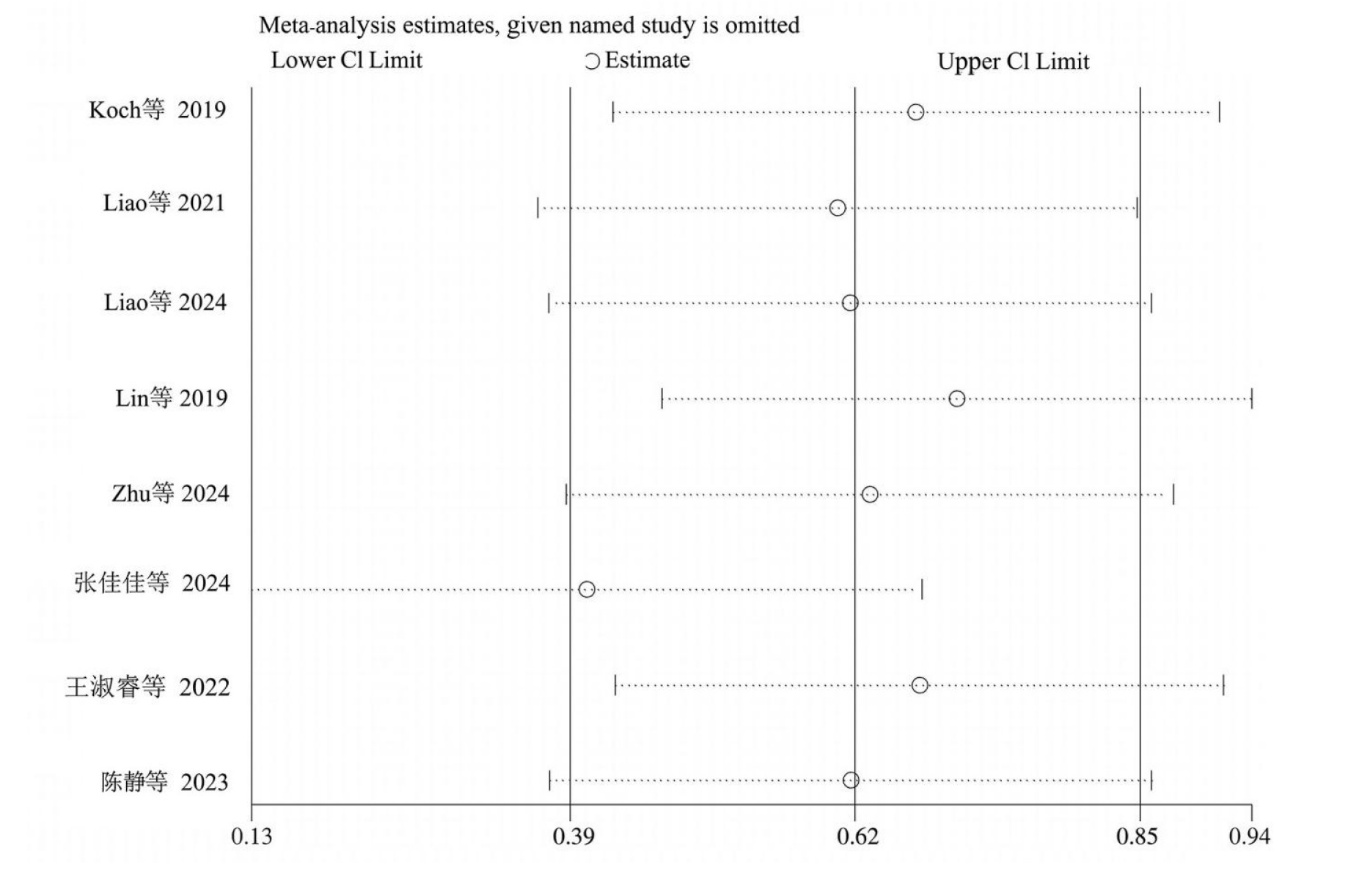
结果 共纳入16项研究,涉及647例患者。Meta分析结果显示,iTBS能够提高脑卒中患者的Fugl-Meyer评定量表下肢部分评分(MD=2.58, 95%CI 1.61~3.55, P<0.001)、Berg平衡量表评分(MD=4.11, 95%CI 2.43~5.79, P<0.001)、Barthel指数评分(MD=4.95, 95%CI 0.97~8.92, P=0.010),缩短运动诱发电位潜伏期(MD=-1.42, 95%CI -2.54~-0.30,P=0.010)。亚组分析显示,亚急性期、小脑iTBS、刺激次数>10次,单日脉冲1 200次效果可能更好。
结论 iTBS可改善脑卒中患者下肢运动功能和日常生活活动能力,并缩短MEP潜伏期,在改善平衡功能方面可能具有一定潜在获益。
中图分类号:
李欣源, 郑洁皎, 张廷宇, 吴雪娇, 梁晓笑. 间歇性θ脉冲刺激改善脑卒中患者下肢运动和平衡功能的Meta分析[J]. 《中国康复理论与实践》, 2026, 32(6): 631-644.
LI Xinyuan, ZHENG Jiejiao, ZHANG Tingyu, WU Xuejiao, LIANG Xiaoxiao. Effect of intermittent theta burst stimulation on lower extremity motor function and balance function in stroke patients: a meta-analysis[J]. Chinese Journal of Rehabilitation Theory and Practice, 2026, 32(6): 631-644.

表1
PICO架构"
| 人群(Population) | 干预(Intervention) | 比较(Comparison) | 结局(Outcome) |
|---|---|---|---|
| 脑卒中患者 经头颅CT或MRI确诊 经评估存在下肢运动或平衡功能障碍 | iTBS治疗或iTBS联合其他常规治疗(如常规药物、物理治疗、悬吊练习、感觉运动整合训练等) | 假刺激联合常规治疗或仅常规治疗 | 运动功能:FMA-LE 平衡功能:BBS 日常生活能力:BI 步行能力:TUGT、10MWT 电生理指标:MEP潜伏期 |
图1
文献筛选流程图"
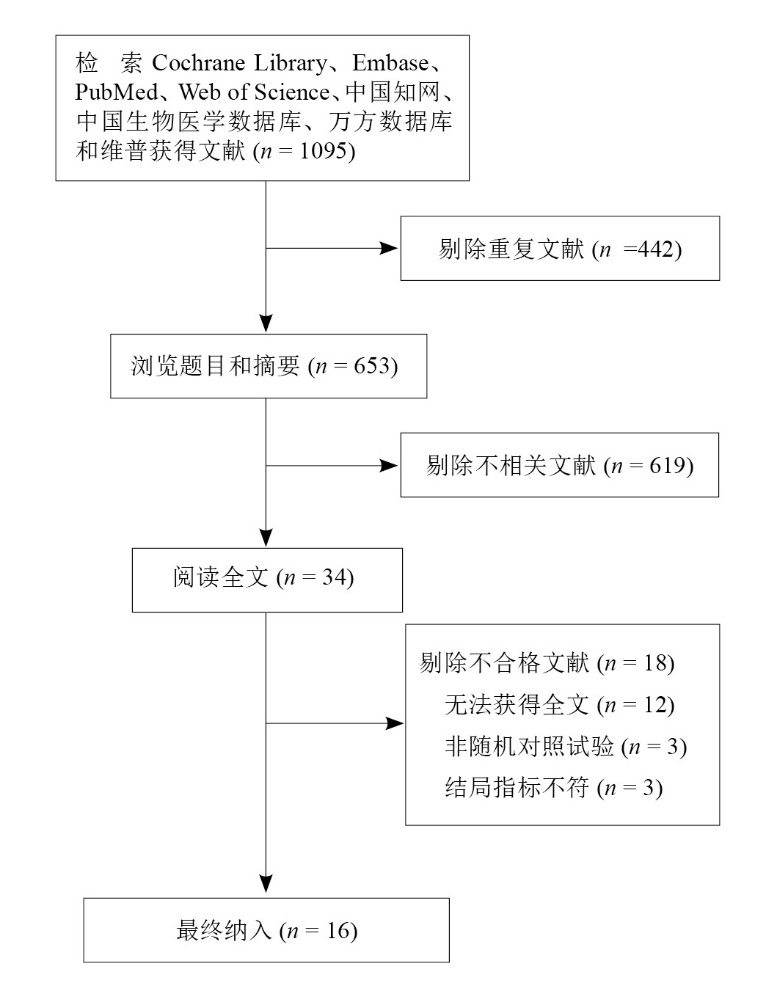
图2
偏倚风险"
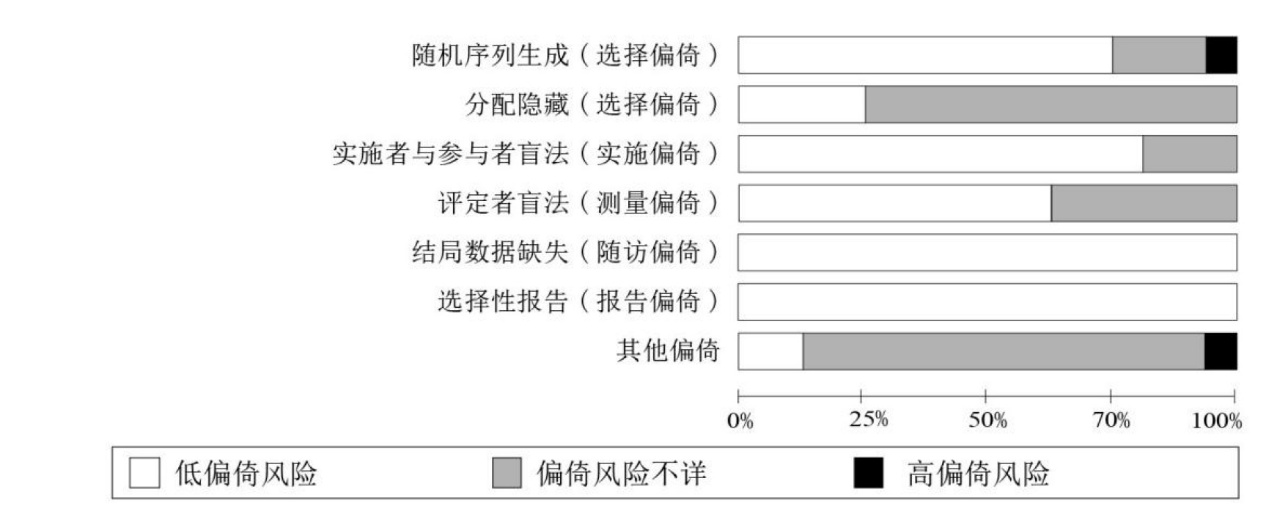
图3
纳入研究偏倚评估"
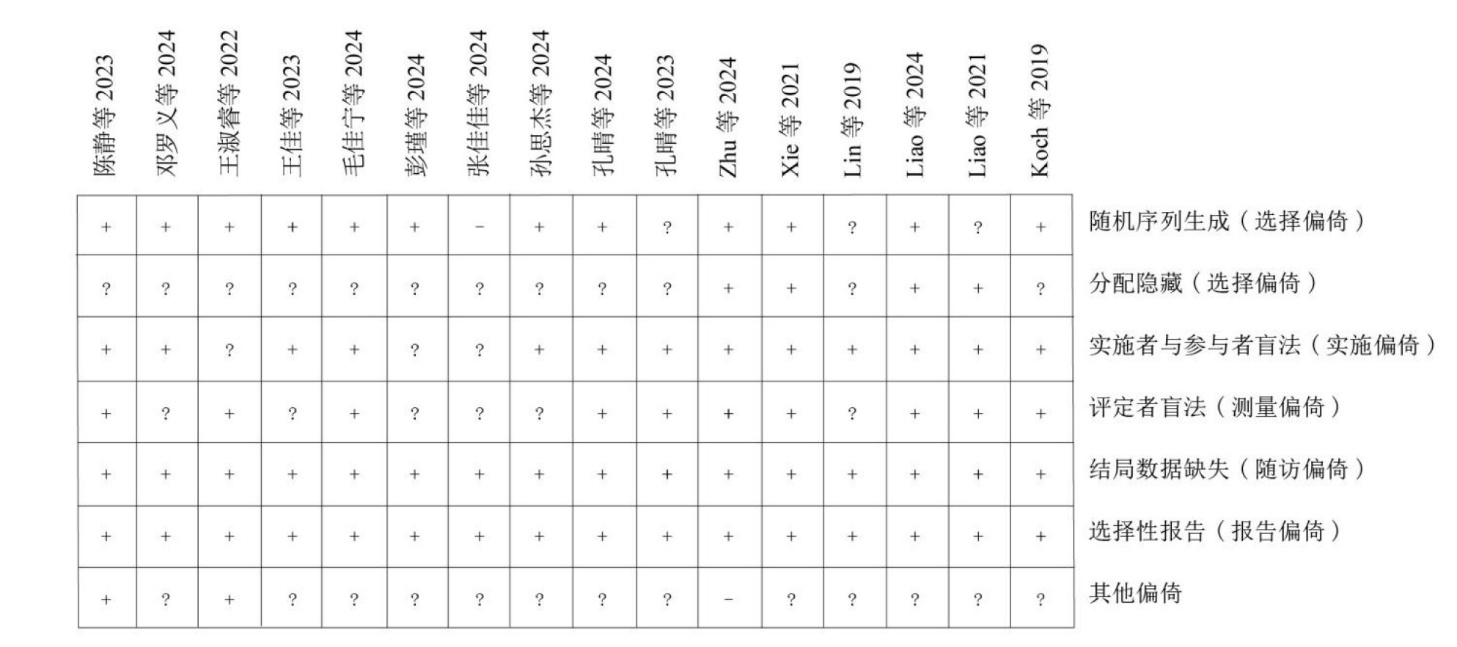
表2
纳入文献基本特征"
| 作者 | 患者资料 | 干预措施 | 治疗参数 | 治疗周期 | 结局指标 | ||||
|---|---|---|---|---|---|---|---|---|---|
| n | 年龄/岁 | 性别 (男/女)/n | 刺激 部位 | 刺激强度和 脉冲数 | 线圈 类型 | ||||
| Lin等[ | C:10 T1:10 | C:61.1±9.7 T1:60.8±8.1 | C:8/2 T1:9/1 | C:假刺激+常规治疗 T1:iTBS+常规治疗 | M1 | 100%RMT; 每天2400次脉冲 | “8”字形线圈 | 每周2次,共5周 | ①②③④⑤ |
| Koch等[ | C:17 T1:17 | C:65±12 T1:63±11 | C:10/7 T1:11/6 | C:假刺激+常规治疗 T1:iTBS+常规治疗 | 小脑 | 80%AMT; 每天1200次脉冲 | “8”字形线圈 | 每周5次,共3周,3周后随访 | ②③ |
| 孔晴等[ | C:15 T1:15 | C:62.87±8.91 T1:59.60±8.85 | C:9/6 T1:10/5 | C:假刺激+常规治疗 T1:iTBS+常规治疗 | 小脑 | 80%RMT; 每天600次脉冲 | “8”字形线圈 | 每周5次,共3周 | ①②⑥ |
| Liao等[ | C:12 T1:12 T2:12 | C:57.08±11.28 T1:57.17±11.63 T2:58.25±14.63 | C:10/2 T1:7/5 T2:9/3 | C:假刺激+常规治疗 T1:iTBS+常规治疗 T2:iTBS+常规治疗 | 小脑/M1 小脑 M1 | 80%AMT; 每天1200次脉冲 | “8”字形线圈 | 每周5次,共3周,3周后随访 | ①②③ |
| Zhu等[ | C:18 T1:18 | C:62.3±8.78 T1:58.6±7.24 | C:13/5 T1:14/4 | C:假刺激+常规治疗 T1:iTBS+常规治疗 | 小脑 | 80%AMT; 每天1200次脉冲 | “8”字形线圈 | 每周5次,共2周 | ①②③④ |
| 孔晴等[ | C:12 T1:12 | C:61.25±9.00 T1:59.83±9.66 | C:9/3 T1:7/5 | C:假刺激+常规治疗 T1:iTBS+常规治疗 | 小脑 | 80%RMT; 每天600次脉冲 | “8”字形线圈 | 每周5次,共3周 | ①② |
| 张佳佳等[ (2024) | C:47 T1:49 | C:58.51±6.27 T1:59.37±7.19 | C:26/21 T1:27/22 | C:常规治疗+感觉整合训练 T1:iTBS+常规治疗+感觉整合训练 | 小脑 | 110%RMT; 每天2400次脉冲 | “8”字形线圈 | 每周6次,共6周 | ①③⑥ |
| Liao等[ | C:15 T1:15 | C:55.4±8.1 T1:51.5±9.22 | C:9/6 T1:12/3 | C:假刺激+常规治疗 T1:iTBS+常规治疗 | 小脑 | 80%AMT; 每天600次脉冲 | “8”字形线圈 | 每周5次,共2周 | ①②③ |
| Xie等[ | C:18 T1:18 | C:54.4±7.01 T1:52.3±8.62 | C:11/7 T1:13/5 | C:假刺激+常规治疗 T1:iTBS+常规治疗 | 小脑 | 80%AMT; 每天600次脉冲 | “8”字形线圈 | 每周5次,共2周 | ①④⑤⑥ |
| 孙思杰等[ | C:21 T1:21 T2:21 | C:50.20±16.16 T1:50.81±13.77 T2:54.86±12.08 | C:19/2 T1:19/2 T2:19/2 | C:假刺激+常规治疗 T1:iTBS+常规治疗 T2:iTBS+常规治疗 | 小脑/M1 小脑+M1 小脑 | 80%AMT; 每天600次脉冲 | 锥形线圈 | 每周5次,共3周 | ①② |
| 彭瑾等[ | C:21 T1:21 | C:60.52±9.09 T1:60.33±8.40 | C:15/6 T1:14/7 | C:常规治疗 T1:iTBS+常规治疗 | 小脑 蚓部 | - 每天1200次脉冲 | “8”字形线圈 | 每周6次,共2周 | ①② |
| 王佳等[ | C:18 T1:18 | C:53.44±16.60 T1:54.83±12.57 | C:12/6 T1:13/5 | C:假刺激+常规治疗 T1:iTBS+常规治疗 | M1 | 70%RMT; 每天1200次脉冲 | 锥形线圈 | 每周6次,共3周 | ①②⑥ |
| 王淑睿等[ | C:21 T1:21 | C:54.62±7.85 T1:52.62±8.61 | C:9/12 T1:11/10 | C:常规治疗+悬吊训练 T1:iTBS+常规治疗+悬吊训练 | 小脑 | 80%AMT; 每天1200次脉冲 | “8”字形线圈 | 每周5次,共4周 | ①②③⑥ |
| 邓罗义等[ | C:25 T1:25 | C:48.28±16.77 T1:52.64±13.04 | C:20/5 T1:14/11 | C:假刺激+常规治疗 T1:iTBS+常规治疗 | 小脑 | 80%RMT; 每天600次脉冲 | “8”字形线圈 | 每周5次,共3周 | ①② |
| 陈静等[ | C:16 T1:16 | C:62.38±12.66 T1:58.88±15.79 | C:9/7 T1:11/5 | C:假刺激+常规治疗 T1:iTBS+常规治疗 | 小脑 | 80%RMT; 每天600次脉冲 | “8”字形线圈 | 每周5次,共3周,3周后随访 | ①②③⑤ |
| 毛佳宁等[ (2024) | C:20 T1:20 | C:60.75±13.84 T1:59.82±10.40 | C:12/8 T1:14/6 | C:假刺激+常规治疗 T1:iTBS+常规治疗 | 小脑 | - 每天1200次脉冲 | “8”字形线圈 | 每周5次,共2周 | ② |
表3
Meta分析结果"
| 结局 | 纳入研究数/n | 样本量/n | 异质性检验结果 | 效应模型 | Meta分析结果 | ||
|---|---|---|---|---|---|---|---|
| P值 | I2 | MD(95%CI) | P值 | ||||
| FMA-LE[ | 14 | 573 | 0.003 | 58% | 随机 | 2.58(1.61~3.55) | <0.001 |
| FMA-LE随访[ | 2 | 68 | 0.002 | 90% | 随机 | 0.04(-1.53~1.61) | 0.960 |
| BBS[ | 14 | 515 | <0.001 | 67% | 随机 | 4.11(2.43~5.79) | <0.001 |
| BBS随访[ | 3 | 102 | 0.58 | 0% | 固定 | 6.43(2.97~9.90) | <0.001 |
| BI[ | 8 | 320 | <0.001 | 75% | 随机 | 4.95(0.97~8.92) | 0.010 |
| BI随访[ | 3 | 102 | 0.730 | 0% | 固定 | 7.79(2.19~13.39) | 0.006 |
| TUGT[ | 3 | 92 | 0.580 | 0% | 固定 | -0.93(-4.56~2.70) | 0.620 |
| 10MWT[ | 3 | 88 | 0.530 | 0% | 固定 | -0.72(-3.28~1.84) | 0.580 |
| MEP潜伏期[ | 5 | 240 | 0.001 | 78% | 随机 | -1.42(-2.54~-0.30) | 0.010 |
表4
FMA-LE评分亚组分析结果"
| 亚组 | 纳入研究数/n | 异质性检验结果 | 效应模型 | 亚组分析结果 | |||
|---|---|---|---|---|---|---|---|
| P值 | I2 | MD(95%CI) | P值 | ||||
| 治疗时机 | 9 | 0.005 | 64% | 随机 | 2.29(1.51~3.07) | <0.001 | |
| 亚急性期 | 8 | 0.310 | 15% | 3.29(2.35~4.23) | <0.001 | ||
| 慢性期 | 1 | - | - | 0.10(-1.29~1.49) | 0.890 | ||
| 刺激靶点 | 16 | 0.002 | 58% | 随机 | 2.67(1.68~3.67) | <0.001 | |
| 小脑 | 10 | 0.080 | 41% | 2.51(1.43~3.59) | <0.001 | ||
| M1 | 4 | 0.006 | 76% | 2.67(-0.61~5.94) | 0.110 | ||
| 小脑+M1 | 1 | - | - | 4.81(1.74~7.88) | 0.002 | ||
| 小脑蚓 | 1 | - | - | 3.29(1.74~4.84) | <0.001 | ||
| 治疗次数 | 14 | 0.003 | 58% | 随机 | 2.58(1.61~3.55) | <0.001 | |
| ≤ 10次 | 4 | 0.460 | 0% | 0.55(-0.61~1.71) | 0.350 | ||
| >10次 | 10 | 0.050 | 46% | 3.06(2.10~4.03) | <0.001 | ||
| 单日脉冲数 | 14 | 0.003 | 58% | 随机 | 2.58(1.61~3.55) | <0.001 | |
| 600次 | 8 | 0.270 | 20% | 2.12(1.18~3.07) | <0.001 | ||
| 1 200次 | 4 | 0.220 | 32% | 4.17(2.46~5.88) | <0.001 | ||
| 2 400次 | 2 | 0.002 | 89% | 1.85(-1.68~5.38) | 0.300 | ||
表5
BBS评分亚组分析结果"
| 亚组 | 纳入研究数/n | 异质性检验结果 | 效应模型 | 亚组分析结果 | |||
|---|---|---|---|---|---|---|---|
| P值 | I2 | MD(95% CI) | P值 | ||||
| 治疗时机 | 10 | <0.001 | 77% | 随机 | 6.21(3.39~9.02) | <0.001 | |
| 亚急性 | 8 | 0.002 | 70% | 7.31(3.92~10.70) | <0.001 | ||
| 慢性 | 2 | 0.410 | 0% | 0.79(-1.45~3.02) | 0.490 | ||
| 刺激靶点 | 16 | <0.001 | 62% | 随机 | 4.13(2.49~5.76) | <0.001 | |
| 小脑 | 10 | 0.004 | 63% | 4.34(2.16~6.52) | <0.001 | ||
| M1 | 4 | 0.008 | 75% | 5.64(-0.57~11.85) | 0.080 | ||
| 小脑+M1 | 1 | - | - | 8.51(2.51~14.51) | 0.030 | ||
| 小脑蚓 | 1 | - | - | 2.24(0.63~3.85) | <0.001 | ||
| 治疗次数 | 14 | <0.001 | 67% | 随机 | 4.11(2.43~5.79) | <0.001 | |
| ≤ 10次 | 4 | <0.001 | 85% | 3.77(-0.76~8.30) | 0.100 | ||
| >10次 | 10 | 0.040 | 48% | 3.76(2.09~5.42) | <0.001 | ||
| 单日脉冲数 | 14 | <0.001 | 67% | 随机 | 4.11(2.43~5.79) | <0.001 | |
| 600次 | 7 | 0.510 | 0% | 2.35(1.27~3.43) | <0.001 | ||
| 1 200次 | 6 | <0.001 | 79% | 6.94(2.91~10.97) | <0.001 | ||
| 2 400次 | 1 | - | - | 0.60(-1.68~2.88) | 0.610 | ||
表6
BI评分亚组分析结果"
| 亚组 | 纳入研究数/n | 异质性检验结果 | 效应模型 | 亚组分析结果 | |||
|---|---|---|---|---|---|---|---|
| P值 | I2 | MD(95%CI) | P值 | ||||
| 治疗时机 | 5 | 0.050 | 57% | 随机 | 3.31(-1.66~8.28) | 0.190 | |
| 亚急性 | 3 | 0.410 | 0% | 5.48(0.92~10.04) | 0.020 | ||
| 慢性 | 2 | 0.400 | 0% | -1.38(-3.74~0.99) | 0.250 | ||
| 刺激靶点 | 9 | <0.001 | 72% | 随机 | 4.97(1.08~8.86) | 0.010 | |
| 小脑 | 7 | 0.890 | 0% | 6.24(4.39~8.09) | <0.001 | ||
| M1 | 2 | 0.160 | 49% | 2.05(-9.97~14.06) | 0.740 | ||
| 治疗次数 | 8 | <0.001 | 75% | 随机 | 4.95(0.97~8.92) | 0.010 | |
| ≤ 10次 | 3 | 0.020 | 76% | 4.16(-3.82~12.13) | 0.310 | ||
| >10次 | 5 | 0.710 | 0% | 6.10(4.18~8.02) | <0.001 | ||
| 单日脉冲数 | 8 | <0.001 | 75% | 随机 | 4.95(0.97~8.92) | 0.010 | |
| 600次 | 3 | 0.450 | 0% | 5.28(1.24~9.32) | 0.010 | ||
| 1 200次 | 3 | 0.830 | 0% | 8.79(1.60~15.98) | 0.020 | ||
| 2 400次 | 2 | <0.001 | 96% | 2.45(-5.26~10.15) | 0.530 | ||
图4
FMA-LE敏感性分析图"
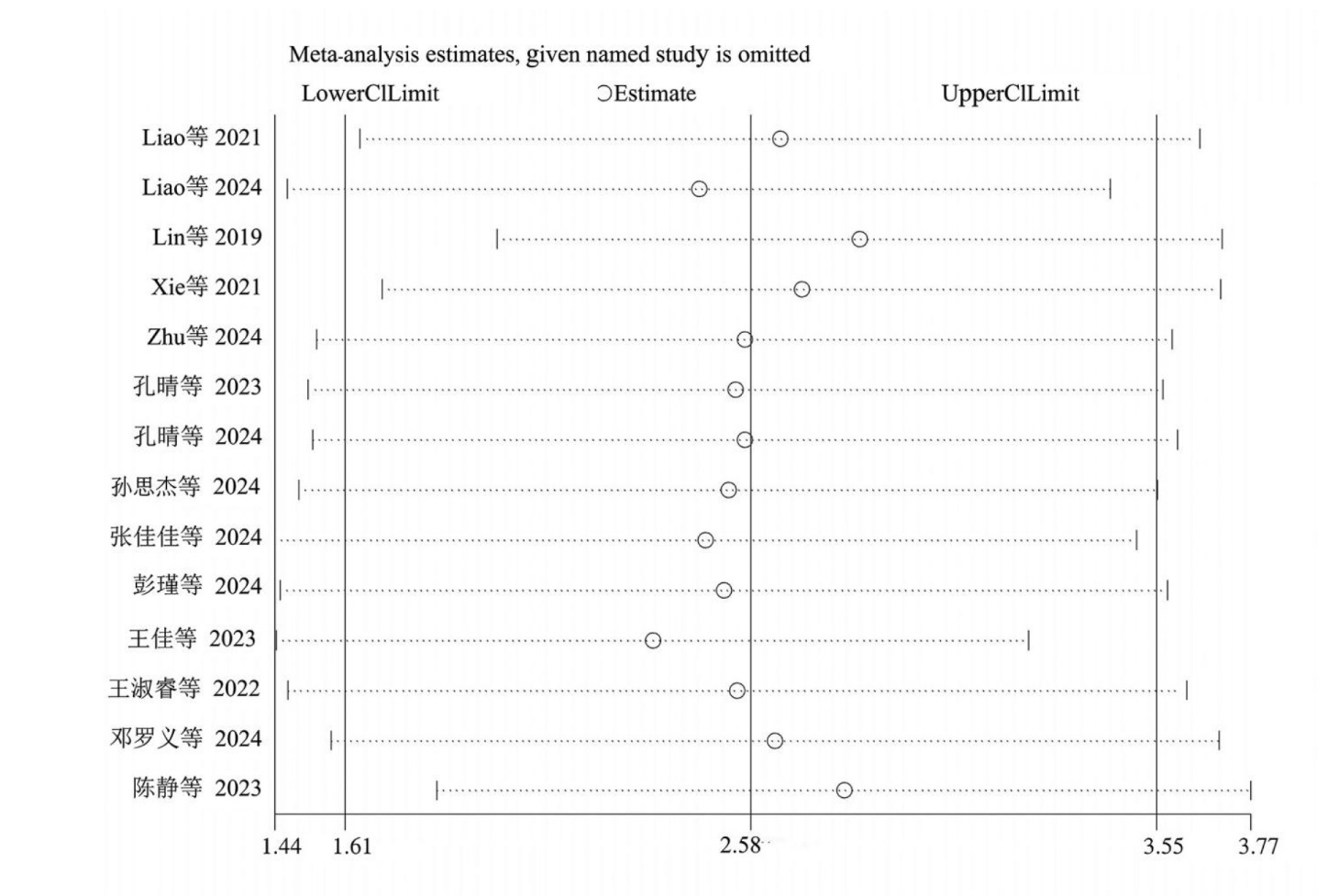
图5
BBS敏感性分析图"
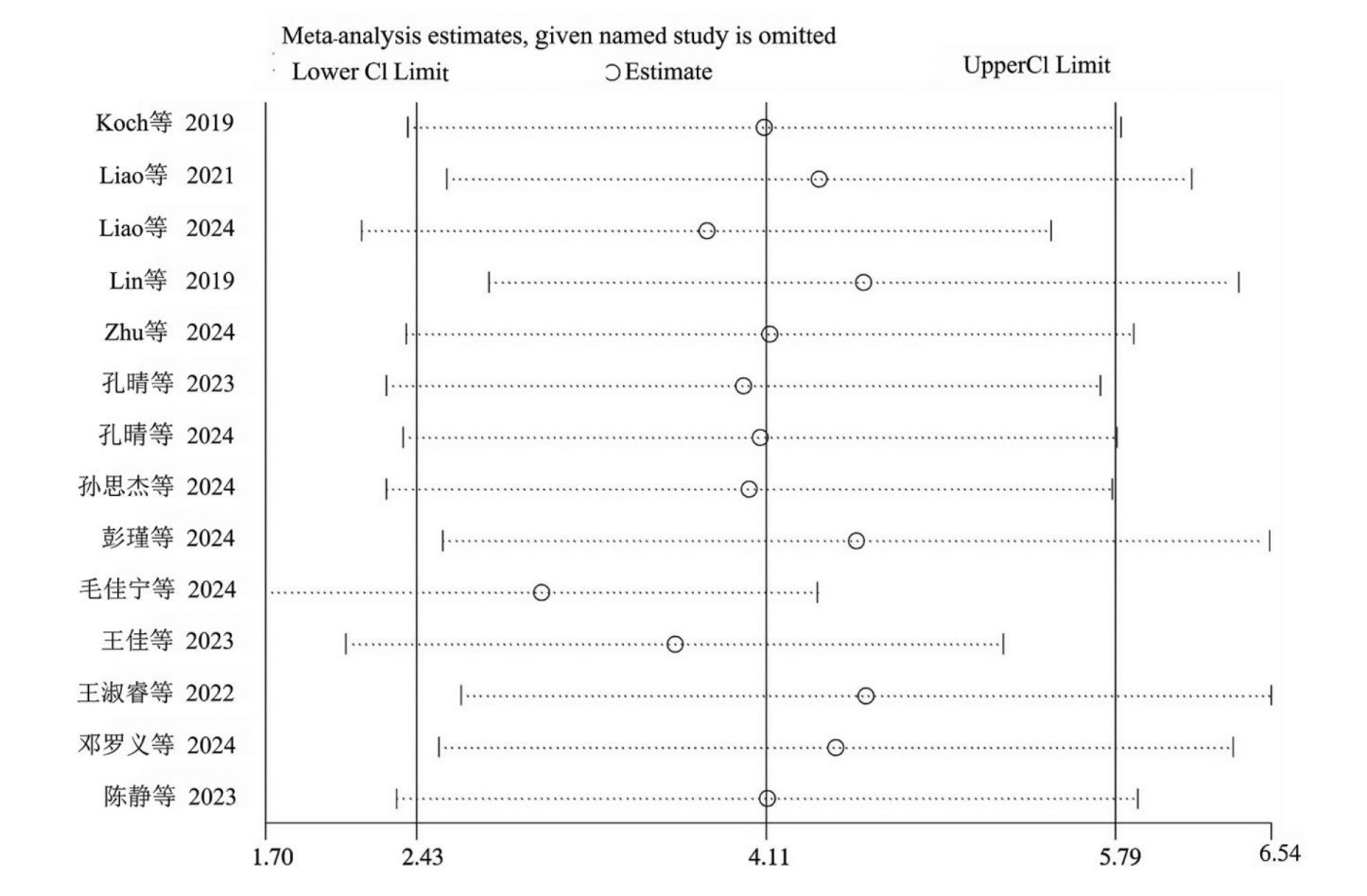
图6
BI敏感性分析图"
| [1] |
GBD 2021 Stroke Risk Factor Collaborators. Global, regional, and national burden of stroke and its risk factors, 1990-2021: a systematic analysis for the Global Burden of Disease Study 2021[J]. Lancet Neurol, 2024, 23(10): 973-1003.
doi: 10.1016/S1474-4422(24)00369-7 pmid: 39304265 |
| [2] |
SAMUELSSON C M, HANSSON P O, PERSSON C U. Early prediction of falls after stroke: a 12-month follow-up of 490 patients in the Fall Study of Gothenburg(FallsGOT)[J]. Clin Rehabil, 2019, 33(4): 773-783.
doi: 10.1177/0269215518819701 |
| [3] |
KOLLEN B, KWAKKEL G, LINDEMAN E. Longitudinal robustness of variables predicting independent gait following severe middle cerebral artery stroke: a prospective cohort study[J]. Clin Rehabil, 2006, 20(3): 262-268.
pmid: 16634346 |
| [4] |
段林茹, 郑洁皎, 陈茜, 等. 脑卒中患者跌倒风险的相关因素研究[J]. 中国康复理论与实践, 2024, 30(7): 811-817.
doi: 10.3969/j.issn.1006-9771.2024.07.009 |
| DUAN L R, ZHENG J J, CHEN X, et al. Analysis of relevant factors for fall risk in stroke patients[J]. Chin J Rehabil Theory Pract, 2024, 30(7): 811-817. | |
| [5] |
STINEAR C M, LANG C E, ZEILER S, et al. Advances and challenges in stroke rehabilitation[J]. Lancet Neurol, 2020, 19(4): 348-360.
doi: S1474-4422(19)30415-6 pmid: 32004440 |
| [6] |
JIANG T, WEI X, WANG M, et al. Theta burst stimulation: What role does it play in stroke rehabilitation? A systematic review of the existing evidence[J]. BMC Neurol, 2024, 24(1): 52.
doi: 10.1186/s12883-023-03492-0 pmid: 38297193 |
| [7] |
FU Y, WANG C S, ZHANG L L, et al. The effectiveness of theta burst stimulation for motor recovery after stroke: a systematic review[J]. Eur J Med Res, 2024, 29(1): 568.
doi: 10.1186/s40001-024-02170-2 pmid: 39609900 |
| [8] | 戴舒航, 王琳, 潘艺, 等. Theta爆发式磁刺激治疗缺血性脑卒中机制研究进展[J]. 神经损伤与功能重建, 2024, 19(10): 593-596, 614. |
| DAI S H, WANG L, PAN Y, et al. Research progress on the mechanism of theta burst stimulation in treating ischemic stroke[J]. Neural Inj Funct Reconstr, 2024, 19(10): 593-596, 614. | |
| [9] |
NETTEKOVEN C, VOLZ L J, KUTSCHA M, et al. Dose-dependent effects of theta burst rTMS on cortical excitability and resting-state connectivity of the human motor system[J]. J Neurosci, 2014, 34(20): 6849-6859.
doi: 10.1523/JNEUROSCI.4993-13.2014 pmid: 24828639 |
| [10] |
QIAO C, RAN Y, LI N, et al. Intermittent theta burst stimulation regulates microglial polarization through Cry1 to enhance neuroplasticity for stroke recovery[J]. Exp Neurol, 2025, 389: 115255.
doi: 10.1016/j.expneurol.2025.115255 |
| [11] |
CHEN S, LI X, YANG W, et al. The effectiveness of intermittent theta burst stimulation for upper limb motor recovery after stroke: an exploratory randomized controlled trial[J]. Front Neurol, 2025, 16: 1634277.
doi: 10.3389/fneur.2025.1634277 |
| [12] | LIN L F, CHANG K H, HUANG Y Z, et al. Simultaneous stimulation in bilateral leg motor areas with intermittent theta burst stimulation to improve functional performance after stroke: a feasibility pilot study[J]. Eur J Phys Rehabil Med, 2019, 55(2): 162-168. |
| [13] |
KOCH G, BONNÌ S, CASULA E P, et al. Effect of cerebellar stimulation on gait and balance recovery in patients with hemiparetic stroke: a randomized clinical trial[J]. JAMA Neurol, 2019, 76(2): 170-178.
doi: 10.1001/jamaneurol.2018.3639 pmid: 30476999 |
| [14] |
CHEN K, SUN M, ZHANG H. Effect of theta burst stimulation on lower extremity motor function improvement and balance recovery in patients with stroke: a systematic review and meta-analysis of randomized controlled trials[J]. Medicine, 2024, 103(44): e40098.
doi: 10.1097/MD.0000000000040098 |
| [15] | 孔晴, 郭壮丽, 高呈飞, 等. 小脑间歇性θ脉冲刺激对脑卒中后下肢功能障碍患者步行功能的影响[J]. 中华物理医学与康复杂志, 2024, 46(3): 226-231. |
| KONG Q, GUO Z L, GAO C F, et al. Intermittent theta burst stimulation of the cerebellum can improve the walking of stroke survivors with lower limb dysfunction[J]. Chin J Phys Med Rehabil, 2024, 46(3): 226-231. | |
| [16] |
LIAO L Y, ZHU Y, PENG Q Y, et al. Intermittent theta-burst stimulation for stroke: primary motor cortex versus cerebellar stimulation: a randomized sham-controlled trial[J]. Stroke, 2024, 55(1): 156-165.
doi: 10.1161/STROKEAHA.123.044892 |
| [17] | ZHU P A, LI Z L, LU Q Q, et al. Can cerebellar theta-burst stimulation improve balance function and gait in stroke patients? A randomized controlled trial[J]. Eur J Phys Rehabil Med, 2024, 60(3): 391-399. |
| [18] | PAGE M J, MCKENZIE J E, BOSSUYT P M, et al. The PRISMA 2020 statement: an updated guideline for reporting systematic reviews[J]. BMJ, 2021, 372: n71. |
| [19] | 孔晴, 郭壮丽, 高呈飞, 等. 小脑间歇性Theta脉冲刺激对卒中后下肢功能障碍患者步行功能的疗效[J]. 临床医学进展, 2023, 13(10): 16216-16222. |
|
KONG Q, GUO Z L, GAO C F, et al. Effects of cerebellar intermittent theta rhythm stimulation on gait in patients with post-stroke lower limb dysfunction[J]. Adv Clin Med, 2023, 13(10): 16216-16222.
doi: 10.12677/ACM.2023.13102267 |
|
| [20] |
张佳佳, 李华荣, 刘萌萌. iTBS联合感觉运动整合训练对脑卒中后运动功能障碍患者神经电生理的影响[J]. 中国疗养医学, 2024, 33(3): 73-77.
doi: 10.13517/j.cnki.ccm.2024.03.016 |
| ZHANG J J, LI H R, LIU M M. Effects of iTBS combined with sensorimotor integration training on neuroelectrophysiology in patients with motor dysfunction after stroke[J]. Chin J Convalescent Med, 2024, 33(3): 73-77. | |
| [21] |
LIAO L Y, XIE Y J, CHEN Y, et al. Cerebellar theta-burst stimulation combined with physiotherapy in subacute and chronic stroke patients: a pilot randomized controlled trial[J]. Neurorehabil Neural Repair, 2021, 35(1): 23-32.
doi: 10.1177/1545968320971735 |
| [22] |
XIE Y J, WEI Q C, CHEN Y, et al. Cerebellar theta burst stimulation on walking function in stroke patients: a randomized clinical trial[J]. Front Neurosci, 2021, 15: 688569.
doi: 10.3389/fnins.2021.688569 |
| [23] | 孙思杰, 邓罗义, 王先斌, 等. 大脑皮层下肢运动区联合小脑皮质区iTBS对脑卒中后偏瘫患者下肢运动功能的影响[J]. 贵州医科大学学报, 2024, 49(8): 1170-1175, 1197. |
| SUN S J, DENG L Y, WANG X B, et al. Effect of iTBS in the lower limb motor area of the cerebral cortex combined with the cerebellar cortical area on lower limb motor function in hemiplegia patients after stroke[J]. J Guizhou Med Univ, 2024, 49(8): 1170-1175, 1197. | |
| [24] | 彭瑾, 谢珊, 查益, 等. 间歇性θ短阵脉冲刺激小脑蚓部对脑卒中患者下肢运动功能障碍的影响[J]. 神经损伤与功能重建, 2025, 20(1): 21-25. |
| PENG J, XIE S, ZHA Y, et al. Effects of intermittent theta short burst pulse stimulation to the cerebellum vermis on lower limb motor dysfunction in stroke patients[J]. Neural Inj Funct Reconstr, 2025, 20(1): 21-25. | |
| [25] | 王佳, 王先斌, 宋宁, 等. 不同经颅磁刺激模式对脑卒中后下肢运动障碍患者肢体运动功能的影响[J]. 贵州医科大学学报, 2023, 48(6): 702-709. |
| WANG J, WANG X B, SONG N, et al. Effects of different transcranial magnetic stimulation modes on motor function of patients with lower limb dyskinesia after stroke[J]. J Guizhou Med Univ, 2023, 48(6): 702-709. | |
| [26] |
王淑睿, 李丽. 小脑间歇性θ短阵快速脉冲刺激对脑卒中患者下肢运动功能的影响[J]. 中国康复理论与实践, 2022, 28(10): 1205-1210.
doi: 10.3969/j.issn.1006-9771.2022.10.011 |
| WANG S R, LI L. Effects of cerebellar theta-burst stimulation on lower extremity motor function in stroke patients[J]. Chin J Rehabil Theory Pract, 2022, 28(10): 1205-1210. | |
| [27] | 邓罗义, 陈彦, 曾妮, 等. 健侧小脑间歇性θ短阵脉冲刺激康复治疗对脑卒中患者下肢步行功能的影响[J]. 实用医学杂志, 2024, 40(13): 1797-1802. |
| DENG L Y, CHEN Y, ZENG N, et al. Effect of contralesional cerebellar iTBS combined with routine rehabilitation on lower limb walking function in stroke patients[J]. J Pract Med, 2024, 40(13): 1797-1802. | |
| [28] | 陈静, 石明芳, 陈君, 等. 小脑间歇性θ短阵脉冲刺激联合物理治疗对脑卒中患者平衡功能和步态的影响[J]. 中华物理医学与康复杂志, 2023, 45(5): 402-407. |
| CHEN J, SHI M F, CHEN J, et al. The effects of supplementing theta burst stimulation of the cerebellum with physical therapy on balance and gait recovery after a stroke: a randomized clinical trial[J]. Chin J Phys Med Rehabil, 2023, 45(5): 402-407. | |
| [29] | 毛佳宁, 张皓, 崔利华. 小脑经颅磁刺激对脑卒中偏瘫患者平衡及运动功能的影响[J]. 神经损伤与功能重建, 2024, 19(10): 574-578, 604. |
| MAO J N, ZHANG H, CUI L H. The effect of cerebellar transcranial magnetic stimulation on balance and motor function in patients with hemiplegia following stroke[J]. Neural Inj Funct Reconstr, 2024, 19(10): 574-578, 604. | |
| [30] | HIGGINS J P T, THOMAS J, CHANDLER J, et al. Cochrane Handbook for Systematic Reviews of Interventions version 6.5(updated August 2024)[EB/OL]. [2025-07-07]. https://www.cochrane.org/handbook. |
| [31] |
ZHANG J J, DING M, LUO L, et al. Intermittent theta-burst stimulation promotes neurovascular unit remodeling after ischemic stroke in a mouse model[J]. Neural Regen Res, 2026, 21(8): 3598-3608.
doi: 10.4103/NRR.NRR-D-24-01189 |
| [32] |
ZHANG J J, LI S Y, HUANG D, et al. Effects of intermittent theta burst stimulation on the inflammatory response and cerebral blood flow in promoting neurovascular repair after ischemic stroke[J]. Mol Brain, 2025, 18(1): 48.
doi: 10.1186/s13041-025-01222-w pmid: 40490760 |
| [33] |
CANDELARIO-JALIL E, DIJKHUIZEN R M, MAGNUS T. Neuroinflammation, stroke, blood-brain barrier dysfunction, and imaging modalities[J]. Stroke, 2022, 53(5): 1473-1486.
doi: 10.1161/STROKEAHA.122.036946 |
| [34] | WARD N S, COHEN L G. Mechanisms underlying recovery of motor function after stroke[J]. Arch Neurol, 2004, 61(12): 1844-1848. |
| [35] |
BAI Z F, ZHANG J Q, FONG K N K. Effects of transcranial magnetic stimulation in modulating cortical excitability in patients with stroke: a systematic review and meta-analysis[J]. J Neuroeng Rehabil, 2022, 19(1): 24.
doi: 10.1186/s12984-022-00999-4 pmid: 35193624 |
| [36] |
DING Q, ZHANG S X, CHEN S B, et al. The effects of intermittent theta burst stimulation on functional brain network following stroke: an electroencephalography study[J]. Front Neurosci, 2021, 15: 755709.
doi: 10.3389/fnins.2021.755709 |
| [37] |
GONG C, LONG Y, PENG X M, et al. Efficacy and safety of noninvasive brain stimulation for patients with cerebellar ataxia: a systematic review and meta-analysis of randomized controlled trials[J]. J Neurol, 2023, 270(10): 4782-4799.
doi: 10.1007/s00415-023-11799-8 pmid: 37460852 |
| [38] |
STAFFORD C A, OWEN A M, FERNÁNDEZ-ESPEJOB D. The neural basis of external responsiveness in prolonged disorders of consciousness[J]. Neuroimage Clin, 2019, 22: 101791.
doi: 10.1016/j.nicl.2019.101791 |
| [39] | XU S, CHEN S F, CHEN N L, et al. Immediate neuroplastic changes in the cortex after iTBS on the cerebellum of stroke patients: a preliminary fNIRS study[J]. Neural Plast, 2025: 1362222. |
| [40] |
YE L L, ZHAO W Y, ZHANG Y C, et al. Exploring neurobiological effects of intermittent theta-burst stimulation on the left cerebellum for post-stroke unilateral neglect: a preliminary transcranial magnetic stimulation-electroencephalography investigation[J]. Cerebellum, 2025, 24(4): 103.
doi: 10.1007/s12311-025-01853-8 pmid: 40407858 |
| [41] | 李修齐, 陈颖, 吴军发, 等. 小脑间歇性θ短阵脉冲刺激对健康人双侧大脑运动皮质兴奋性的调控[J]. 中华物理医学与康复杂志, 2021, 43(3): 215-220. |
| LI X Q, CHEN Y, WU J F, et al. Modulation of bilateral motor cortex excitability using intermittent theta burst transcranial magnetic stimulation[J]. Chin J Phys Med Rehabil, 2021, 43(3): 215-220. | |
| [42] |
TERAO Y, UGAWA Y, UESAKA Y, et al. Transcranial stimulation of the leg area of the motor cortex in humans[J]. Acta Neurol Scand, 1994, 89(5): 378-383.
pmid: 8085437 |
| [43] |
曹志刚, 冯海霞, 李亚斌, 等. 基于大脑半球之间多靶区间歇性θ爆发式磁刺激对脑卒中患者上肢功能的影响[J]. 中国康复理论与实践, 2022, 28(5): 502-507.
doi: 10.3969/j.issn.1006-9771.2022.05.002 |
| CAO Z G, FENG H X, LI Y B, et al. Effects of interhemispheric multi-target intermittent theta burst stimulation on upper limb function in patients with stroke[J]. Chin J Rehabil Theory Pract, 2022, 28(5): 502-507. | |
| [44] |
WANG L, HUANG G L, ZHANG L, et al. Effects of the intermittent theta burst stimulation of the cerebellar vermis on balance recovery after stroke: a study protocol for a randomized controlled trial[J]. Front Aging Neurosci, 2022, 14: 881311.
doi: 10.3389/fnagi.2022.881311 |
| [45] |
VAN LIESHOUT E C C, VAN DER WORP H B, VISSER-MEILY J M A, et al. Timing of repetitive transcranial magnetic stimulation onset for upper limb function after stroke: a systematic review and meta-analysis[J]. Front Neurol, 2019, 10: 1269.
doi: 10.3389/fneur.2019.01269 pmid: 31849827 |
| [46] |
BIERNASKIE J, CHERNENKO G, CORBETT D. Efficacy of rehabilitative experience declines with time after focal ischemic brain injury[J]. J Neurosci, 2004, 24(5): 1245-1254.
doi: 10.1523/JNEUROSCI.3834-03.2004 pmid: 14762143 |
| [47] |
DROMERICK A W, GEED S, BARTH J, et al. Critical Period After Stroke Study(CPASS): a phase II clinical trial testing an optimal time for motor recovery after stroke in humans[J]. Proc Natl Acad Sci U S A, 2021, 118(39): e2026676118.
doi: 10.1073/pnas.2026676118 |
| [48] |
KWAKKEL G, KOLLEN B J, VAN DER GROND J, et al. Probability of regaining dexterity in the flaccid upper limb: impact of severity of paresis and time since onset in acute stroke[J]. Stroke, 2003, 34(9): 2181-2186.
doi: 10.1161/01.STR.0000087172.16305.CD pmid: 12907818 |
| [49] |
SONG J N, LIU Z W, SUI L, et al. Dynamic expression of nerve growth factor and its receptor TrkA after subarachnoid hemorrhage in rat brain[J]. Neural Regen Res, 2016, 11(8): 1278-1284.
doi: 10.4103/1673-5374.189193 |
| [50] |
KANG N, LEE R D, LEE J H, et al. Functional balance and postural control improvements in patients with stroke after noninvasive brain stimulation: a meta-analysis[J]. Arch Phys Med Rehabil, 2020, 101(1): 141-153.
doi: 10.1016/j.apmr.2019.09.003 |
| [51] |
TANG Z Q, HUANG J T, ZHOU Y, et al. Efficacy and safety of high-dose TBS on poststroke upper extremity motor impairment: a randomized controlled trial[J]. Stroke, 2024, 55(9): 2212-2220.
doi: 10.1161/STROKEAHA.124.046597 pmid: 39016009 |
| [52] |
GAMBOA O L, ANTAL A, MOLIADZE V, et al. Simply longer is not better: reversal of theta burst after-effect with prolonged stimulation[J]. Exp Brain Res, 2010, 204(2): 181-187.
doi: 10.1007/s00221-010-2293-4 pmid: 20567808 |
| [53] |
YU F Y, TANG X W, HU R P, et al. The after-effect of accelerated intermittent theta burst stimulation at different session intervals[J]. Front Neurosci, 2020, 14: 576.
doi: 10.3389/fnins.2020.00576 |
| [54] |
FREIMAN J A, CHALMERS T C, SMITH H, et al. The importance of beta, the type II error and sample size in the design and interpretation of the randomized control trial. Survey of 71 "negative" trials[J]. N Engl J Med, 1978, 299(13): 690-694.
doi: 10.1056/NEJM197809282991304 |
| [1] | 高惠刚, 刘远文, 秦煜玲, 胡昔权, 朱琳. 2020年至2025年足踝软体外骨骼机器人改善脑卒中患者步行功能的Scoping综述[J]. 《中国康复理论与实践》, 2026, 32(6): 645-652. |
| [2] | 李雯, 闫欣越, 黄秋晨, 张睿, 孙悦梅, 周越. 神经肌肉电刺激对人工全膝置换术后患者康复效果的Meta分析[J]. 《中国康复理论与实践》, 2026, 32(6): 653-664. |
| [3] | 郭子扬, 曹明. 1987年至2025年残疾人社区康复研究的文献计量分析[J]. 《中国康复理论与实践》, 2026, 32(6): 665-676. |
| [4] | 申婷婷, 刘东斐. 运动干预对唐氏综合征成人患者多维健康结局影响的Meta分析[J]. 《中国康复理论与实践》, 2026, 32(6): 677-689. |
| [5] | 陈鹏, 张思卓, 王玲, 左会武, 郑成. 前交叉韧带重建术后患者下肢肌肉的激活时序与协同特征[J]. 《中国康复理论与实践》, 2026, 32(6): 708-720. |
| [6] | 曹传宝, 马刚, 闫士芳. 渐进式平衡训练对慢性踝关节不稳患者运动皮质兴奋性、本体感觉和平衡能力的影响[J]. 《中国康复理论与实践》, 2026, 32(6): 721-730. |
| [7] | 魏永利, 丁军航, 周平, 杨小满, 王贞, 于福杰, 段芳芳, 管恩京. 基于世界卫生组织康复胜任力架构构建康复工程本科专业课程体系[J]. 《中国康复理论与实践》, 2026, 32(6): 731-738. |
| [8] | 安娜, 陈迪, 杨亚茹, 邱卓英, 王忠彦. 基于ICF的数字赋能乡村残疾人精准康复服务研究[J]. 《中国康复理论与实践》, 2026, 32(5): 604-610. |
| [9] | 姜静远, 王国祥. 世界卫生组织健康服务体系视域下残疾人康复健身体育服务理论架构与优化路径[J]. 《中国康复理论与实践》, 2026, 32(5): 497-507. |
| [10] | 程亚宁, 陈迪, 汤晨晨, 田益凡, 刘丽旭, 张赢心, 王艺铮, 黄亚玲. 基于《健康服务体系中的康复》构建体育活动融入康复服务的行动者网络体系[J]. 《中国康复理论与实践》, 2026, 32(5): 508-521. |
| [11] | 韩天星, 刘昊天, 徐子淇, 彭晓涵, 王杨, 曹丹娜. 基于静息态磁共振功能成像对阿尔茨海默病轻度认知障碍期默认网络与内侧颞叶区脑功能连接研究的Meta分析[J]. 《中国康复理论与实践》, 2026, 32(5): 522-533. |
| [12] | 刘睿, 高振梅, 周星宇, 张琦, 吴建林. 2015年至2025年数字健康技术在脑卒中上肢运动功能康复中应用的文献计量分析[J]. 《中国康复理论与实践》, 2026, 32(5): 534-549. |
| [13] | 倪天皓, 毕思雨, 戴媛, 钱红, 王勇丽, 万勤, 黄昭鸣. 汉语普通话言语失用症评估诊断工具的编制与验证[J]. 《中国康复理论与实践》, 2026, 32(5): 550-560. |
| [14] | 安咏怡, 李雪梅, 常学优, 赵雅宁, 黄海玲, 杨亚东. 不同强度血流限制训练联合低强度抗阻训练对老年脑卒中衰弱患者运动功能的影响[J]. 《中国康复理论与实践》, 2026, 32(5): 561-570. |
| [15] | 陈竹, 翟丽茹, 曹存霞, 彭晓华, 黄桃. 基于电阻抗断层成像技术评估膈神经-腹肌电刺激对脑卒中患者肺通气分布的效果[J]. 《中国康复理论与实践》, 2026, 32(5): 571-576. |
| 阅读次数 | ||||||
|
全文 |
|
|||||
|
摘要 |
|
|||||
|
||
