



《中国康复理论与实践》 ›› 2026, Vol. 32 ›› Issue (9): 1016-1024.doi: 10.3969/j.issn.1006-9771.2026.09.003
孙凤仪, 殷海燕, 尹婷婷, 杨冰清, 顾剑鹏, 汪妍, 柏亚妹, 徐桂华, 宋玉磊( )
)
收稿日期:2026-04-02
修回日期:2026-07-21
接受日期:2026-07-22
出版日期:2026-09-25
发布日期:2026-09-20
通讯作者:
宋玉磊(1986-),女,汉族,副教授,硕士研究生导师,主要研究方向:老年护理、护理管理。E-mail: songyulei@njucm.edu.cn作者简介:孙凤仪(1998-),女,汉族,江苏扬州市人,硕士研究生,主要研究方向:老年护理。
基金资助:
Sun Fengyi, Yin Haiyan, Yin Tingting, Yang Bingqing, Gu Jianpeng, Wang Yan, Bai Yamei, Xu Guihua, Song Yulei()
Received:2026-04-02
Revised:2026-07-21
Accepted:2026-07-22
Published:2026-09-25
Online:2026-09-20
Contact:
Song Yulei, E-mail: songyulei@njucm.edu.cnSupported by:摘要:
目的 探讨中枢听觉测验联合脑电特征在阿尔茨海默病源性轻度认知障碍早期筛查中的应用。
方法 采用便利抽样法,于2025年7月至9月在江苏省南京市栖霞区社区招募40例阿尔茨海默病源性轻度认知障碍老年人和23例认知正常老年人。采用听觉N-back和双耳分听经典范式进行测评,同步采集北京版蒙特利尔认知评估量表(MoCA-BJ)评分和32导联脑电数据。通过二元Logistic回归分析筛选预测指标,绘制受试者工作特征曲线并计算曲线下面积(AUC)。
结果 双耳分听总分与MoCA-BJ总分呈正相关(r = 0.475, P < 0.01),右耳优势与整体认知、视空间、抽象能力和延迟回忆呈负相关(r < -0.276, P < 0.05)。N-back各条件下任务均与整体认知功能呈正相关(r > 0.249, P < 0.05)。脑电特征方面,δ与θ波功率、功率峰值与延迟回忆呈正相关(r > 0.258, P < 0.05),(α+θ)/(α+β)及θ/(α+β)分别与命名能力和视空间执行呈正相关(r > 0.261, P < 0.05)。双耳分听总分、1-back正确率、δ波平均功率和θ/(α+β)比值是阿尔茨海默病源性轻度认知障碍的独立影响因素(P < 0.05)。听觉任务表现和脑电特征的AUC分别为0.845和0.735,两者联合后AUC提升至0.862。
结论 基于听觉任务表现和脑电特征融合的筛查模型在阿尔茨海默病源性轻度认知障碍早期识别中具有较高的分类准确性。
中图分类号:
孙凤仪, 殷海燕, 尹婷婷, 杨冰清, 顾剑鹏, 汪妍, 柏亚妹, 徐桂华, 宋玉磊. 中枢听觉测验联合脑电特征在阿尔茨海默病源性轻度认知障碍早期筛查中的应用[J]. 《中国康复理论与实践》, 2026, 32(9): 1016-1024.
Sun Fengyi, Yin Haiyan, Yin Tingting, Yang Bingqing, Gu Jianpeng, Wang Yan, Bai Yamei, Xu Guihua, Song Yulei. Application of central auditory testing combined with electroencephalogram characteristics in the early screening of mild cognitive impairment due to Alzheimer's disease[J]. Chinese Journal of Rehabilitation Theory and Practice, 2026, 32(9): 1016-1024.
表1
两组基线资料比较"
| 组别 | n | 性别(男/女)/n | 年龄/岁 | 受教育年限/年 | 婚姻状态(未婚/已婚)/n | 是否独居/n | 有无家族史/n |
|---|---|---|---|---|---|---|---|
| HC组 | 23 | 4/19 | 70(63, 73) | 11(9, 15) | 1/22 | 2/21 | 4/19 |
| AD源性MCI组 | 40 | 9/31 | 70(63, 76) | 6.5(3, 9) | 0/40 | 4/36 | 1/39 |
| Z/χ2/t值 | 0.233 | -0.279 | -3.928 | 2.926 | 7.842 | 4.290 | |
| P值 | 0.630 | 0.780 | < 0.001 | 0.492 | 0.117 | 0.059 |
表2
两组听觉任务表现比较"
| 变量 | HC组(n = 23) | AD源性MCI组(n = 40) | Z值 | P值 |
|---|---|---|---|---|
| 双耳分听任务表现 | ||||
| 左耳正确评分 | 20(19, 20) | 18.5(15, 19) | -3.950 | < 0.001 |
| 右耳正确评分 | 20(19, 20) | 19(18, 20) | -2.197 | 0.028 |
| 右耳优势 | 0(0, 0) | 1(0, 1.50) | -3.268 | 0.001 |
| 双耳分听总分 | 40(38, 40) | 38(32.5, 39) | -3.814 | < 0.001 |
| N-Back任务表现 | ||||
| 0-back正确率 | 100(100, 100) | 100(91.67, 100) | -2.497 | 0.013 |
| 1-back正确率 | 100(93.75, 100) | 93.75(50, 100) | -3.417 | < 0.001 |
| 2-back正确率 | 70(60, 80) | 50(40, 70) | -2.986 | 0.003 |
表3
两组脑电特征比较"
| 脑电特征 | HC组(n = 23) | AD源性MCI组(n = 40) | Z值 | P值 |
|---|---|---|---|---|
| δ波总功率 | 44.01(35.72, 49.07) | 35.92(31.94, 43.90) | -2.184 | 0.029 |
| δ波平均功率 | 39.24(30.95, 44.30) | 31.16(27.17, 39.13) | -2.184 | 0.029 |
| θ波总功率 | 30.95(26.05, 41.64) | 25.23(22.14, 33.02) | -1.992 | 0.046 |
| θ波平均功率 | 24.93(20.03, 35.62) | 19.20(16.12, 27.00) | -1.992 | 0.046 |
| 功率峰值 | 42.45(33.15, 46.85) | 33.77(28.45, 41.36) | -2.156 | 0.031 |
| θ/β | 9(7, 10) | 7(5, 9) | -1.994 | 0.046 |
| (α+θ)/(α+β) | 5(4, 6) | 4(3, 6) | -2.122 | 0.034 |
| θ/(α+β) | 5(3, 6) | 3(2, 5) | -2.213 | 0.027 |
表4
听觉任务表现与各认知域评分的相关性(r)"
| 项目 | 视空间与执行能力 | 命名能力 | 注意力 | 语言能力 | 抽象能力 | 延迟回忆 | 定向能力 | MoCA-BJ总分 |
|---|---|---|---|---|---|---|---|---|
| 左耳评分 | 0.409b | 0.232 | 0.369b | 0.241 | 0.322a | 0.313a | 0.178 | 0.491b |
| 右耳评分 | 0.251a | 0.230 | 0.298a | 0.257a | 0.191 | 0.071 | 0.116 | 0.276a |
| 右耳优势 | -0.408b | -0.100 | -0.219 | -0.122 | -0.276a | -0.372b | -0.243 | -0.456b |
| 双耳分听总分 | 0.379b | 0.288a | 0.365b | 0.270a | 0.308a | 0.286a | 0.155 | 0.475b |
| 0-back正确率 | 0.113 | 0.269a | -0.057 | 0.218 | 0.155 | 0.213 | -0.104 | 0.249a |
| 1-back正确率 | 0.248a | 0.293a | 0.256a | 0.308a | 0.211 | 0.275a | 0.132 | 0.384b |
| 2-back正确率 | 0.292a | 0.108 | 0.135 | 0.232 | 0.236 | 0.330b | 0.351b | 0.420b |
表5
脑电特征与各认知域评分的相关性(r)"
| 变量 | 视空间与执行能力 | 命名能力 | 注意力 | 语言能力 | 抽象能力 | 延迟回忆 | 定向能力 | MoCA-BJ总分 |
|---|---|---|---|---|---|---|---|---|
| δ波总功率 | 0.036 | 0.211 | 0.140 | -0.143 | 0.177 | 0.265a | 0.149 | 0.195 |
| δ波平均功率 | 0.036 | 0.211 | 0.140 | -0.143 | 0.177 | 0.265a | 0.149 | 0.195 |
| θ波总功率 | 0.094 | 0.155 | 0.195 | -0.116 | 0.201 | 0.282a | 0.166 | 0.228 |
| θ波平均功率 | 0.094 | 0.155 | 0.195 | -0.116 | 0.201 | 0.282a | 0.166 | 0.228 |
| 功率峰值 | 0.024 | 0.222 | 0.118 | -0.139 | 0.183 | 0.258a | 0.151 | 0.185 |
| (α+θ)/(α+β) | 0.118 | 0.261a | -0.040 | 0.099 | -0.088 | 0.020 | 0.056 | 0.113 |
| θ/(α+β) | 0.274a | 0.198 | -0.044 | 0.001 | -0.154 | 0.028 | 0.080 | 0.146 |
表6
听觉任务表现及脑电特征与AD源性MCI的多因素Logistic回归分析"
| 变量 | β | SE | Wald χ2 | P值 | OR值 | 95%CI |
|---|---|---|---|---|---|---|
| 常量 | -6.106 | 1.738 | 12.345 | < 0.001 | ||
| 听觉任务表现 | ||||||
| 双耳分听总分 | -0.250 | 0.109 | 5.268 | 0.022 | 0.778 | 0.629~0.964 |
| 1-back正确率 | -0.105 | 0.049 | 4.681 | 0.031 | 0.900 | 0.818~0.990 |
| 脑电特征 | ||||||
| δ波平均功率 | -0.067 | 0.032 | 4.307 | 0.038 | 0.935 | 0.878~0.996 |
| θ/(α+β) | -0.363 | 0.153 | 5.603 | 0.018 | 0.696 | 0.515~0.940 |
表7
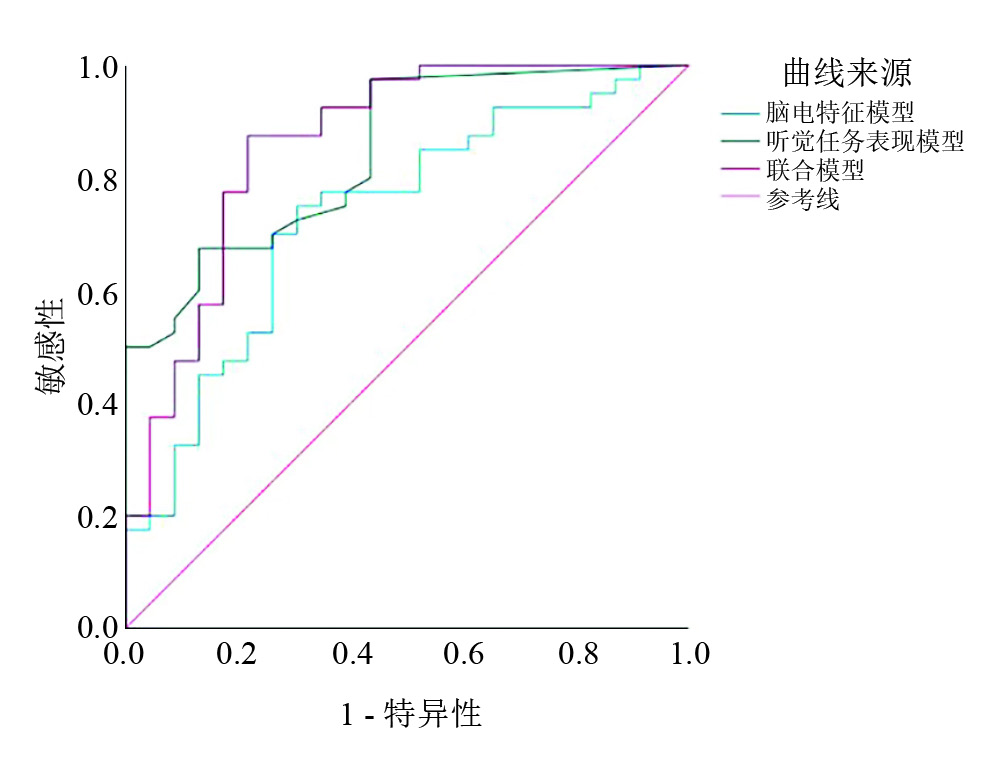
听觉任务总分、脑电特征筛查AD源性MCI的AUC和截断值"
| 指标 | AUC | 95%CI | Youden指数 | 敏感性 | 特异性 | 截断值 | P值 |
|---|---|---|---|---|---|---|---|
| 听觉任务表现模型 | 0.845 | 0.749~0.940 | 0.545 | 0.675 | 0.870 | 0.673 | < 0.001 |
| 脑电特征模型 | 0.735 | 0.606~0.863 | 0.446 | 0.750 | 0.696 | 0.640 | < 0.001 |
| 联合模型 | 0.862 | 0.761~0.963 | 0.658 | 0.875 | 0.783 | 0.589 | 0.002 |
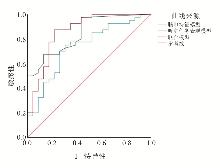
图1
听觉任务总分、脑电指标筛查AD源性MCI的ROC曲线"
| [1] |
Zhi N, Ren R, Qi J, et al. The China Alzheimer Report 2025[J]. Gen Psychiatr, 2025, 38(4): e102020.
doi: 10.1136/gpsych-2024-102020 |
| [2] | 首都医科大学宣武医院国家神经疾病医学中心, 中国疾病预防控制中心慢性非传染性疾病预防控制中心, 国家卫生健康委能力建设和继续教育中心, 等. 中国阿尔茨海默病蓝皮书(精简版)[J]. 中华医学杂志, 2024, 104(29): 2701-2727. |
| National Center for Neurological Disorders, Xuanwu Hospital, Capital Medical University, et al. National Center for Chronic and Noncommunicable Disease Control and Prevention, Chinese Center for Disease Control and Prevention, National Health Commission Capacity Building and Continuing Education Center, Blue paper on Alzheimer′s disease in China (simplified version)[J]. Nat Med J China, 2024, 104(29): 2701-2727. | |
| [3] | 中国痴呆与认知障碍诊治指南写作组, 中国医师协会神经内科医师分会认知障碍疾病专业委员会. 2018中国痴呆与认知障碍诊治指南(五):轻度认知障碍的诊断与治疗[J]. 中华医学杂志, 2018, 98(17): 1294-1301. |
| Writing Group of Chinese Guideline for the Diagnosis and Treatment of Dementia and Cognitive Impairment, WCognitive Impairment Disease Professional Committee of Chinese Medical Doctor Association. Guideline for the diagnosis and treatment of cognitive impairment in China (2018) (V): Diagnosis and treatment of mild cognitive impairment[J]. Natl Med J Chin, 2018, 98(17): 1294-1301. | |
| [4] | 中华医学会神经病学分会痴呆与认知障碍学组. 阿尔茨海默病源性轻度认知障碍诊疗中国专家共识2024[J]. 中华神经科杂志, 2024, 57(7): 715-737. |
| Chinese Society of Dementia. Cognitive Impairment. Chinese expert consensus on the diagnosis and treatment of mild cognitive impairment due to Alzheimer's disease 2024[J]. Chin J Neurol, 2024, 57(7): 715-737. | |
| [5] |
Jia L, Du Y, Chu L, et al. Prevalence, risk factors, and management of dementia and mild cognitive impairment in adults aged 60 years or older in China: a cross-sectional study[J]. Lancet Public Health, 2020, 5(12): e661-e671.
doi: 10.1016/S2468-2667(20)30185-7 pmid: 33271079 |
| [6] |
Wang Y, Li M, Haughton D, et al. Transition of mild cognitive impairment to Alzheimer's disease: medications as modifiable risk factors[J]. PLoS One, 2024, 19(8): e0306270.
doi: 10.1371/journal.pone.0306270 |
| [7] | 中国民族卫生协会卫生健康技术推广专家委员会, 中国民族卫生协会痴呆高危人群早筛系统及早期干预设备应用推广组, 江西省医学会放射学分会分子与人工智能学组, 等. 阿尔茨海默病源性认知障碍早期诊疗专家共识(2025)[J]. 中国医学影像学杂志, 2025, 33(4): 337-346. |
| Expert Committee on Health Technology Promotion, China National Ethnic Health Association, Application and Promotion Group of Early Screening Systems and Intervention Devices for Dementia High-risk Population, China National Ethnic Health Association, Molecular and Artificial Intelligence Imaging Group, Radiology Branch of Jiangxi Medical Association, et al. Expert Consensus on Early Diagnosis and Treatment of Alzheimer's Disease-Associated Cognitive Impairment (2025) [J]. Chin J Med Imag, 2025, 33(4): 337-346. | |
| [8] | Perneczky R, Quevenco F C, Hendrix J, et al. How can Alzheimer's disease blood-based biomarkers reach clinical practice?[J]. Alzheimers Dement (Amst), 2025, 17(4): e70207. |
| [9] |
韩天星, 刘昊天, 徐子淇, 等. 基于静息态磁共振功能成像对阿尔茨海默病轻度认知障碍期默认网络与内侧颞叶区脑功能连接研究的Meta分析[J]. 中国康复理论与实践, 2026, 32(5): 522-533.
doi: 10.3969/j.issn.1006-9771.2026.05.003 |
| Han T X, Liu H T, Liu Z Q, et al. Functional connectivity in default mode network and medial temporal lobe in mild cognitive impairment stage of Alzheimer's disease based on resting-state functional magnetic resonance imaging: a meta-analysis[J]. Chin J Rehabil Theory Pract, 2026, 32(5): 522-533. | |
| [10] |
Byun M S, Chang M, Yi D, et al. Association of central auditory processing dysfunction with preclinical Alzheimer's disease[J]. Otolaryngol Head Neck Surg, 2023, 169(1): 112-119.
doi: 10.1002/ohn.228 pmid: 36939433 |
| [11] | 脑认知健康管理中国专家共识制定委员会, «中华健康管理学杂志»编辑委员会. 脑认知健康管理中国专家共识(2023)[J]. 中华健康管理学杂志, 2023, 17(12): 881-892. |
| Chinese Expert Consensus Committee on Brain Cognitive Health Management, Chinese Journal of Health Management Editorial Committee. Chinese expert consensus on cognitive health management (2023)[J]. Chin J Health Manage, 2023, 17(12): 881-892. | |
| [12] |
Albert M S, Dekosky S T, Dickson D, et al. The diagnosis of mild cognitive impairment due to Alzheimer's disease: recommendations from the National Institute on Aging-Alzheimer's Association Workgroups on Diagnostic Guidelines for Alzheimer's Disease[J]. Alzheimers Dement, 2011, 7(3): 270-279.
doi: 10.1016/j.jalz.2011.03.008 pmid: 21514249 |
| [13] | 夏安琪, 李军, 岳玲, 等. 蒙特利尔认知评估量表在中国社区老人中的应用[J]. 上海交通大学学报(医学版), 2021, 41(12): 1662-1667, 1661. |
| Xia A Q, Li J, Yue L, et al. Application of Montreal Cognitive Assessment Scale to the elderly in Chinese community[J]. J Shanghai Jiao Tong University (Medical Science), 2021, 41(12): 1662-1667, 1661. | |
| [14] |
Li H, Jia J, Yang Z. Mini-Mental State Examination in elderly Chinese: a population-based normative study[J]. J Alzheimers Dis, 2016, 53(2): 487-496.
doi: 10.3233/JAD-160119 pmid: 27163822 |
| [15] | 何燕玲, 瞿光亚, 熊祥玉, 等. 老年人日常生活活动能力的评定[J]. 老年学杂志, 1990(5): 266-269. |
| He Y L, Qu G Y, Xiong X Y, et al. Assessment of daily activities of the elderly[J]. Chin J Gerontol, 1990(5): 266-269. | |
| [16] | 蒋小娟, 吴越, 刘晓伟, 等. 临床痴呆评定量表早期社区筛查阿尔茨海默病的效度[J]. 中华行为医学与脑科学杂志, 2021, 30(6): 554-559. |
| Jiang X J, Wu Y, Liu X W, et al. Validity of the Clinical Dementia Rating for early screening of Alzheimer's disease in community[J]. Chin J Behav Med Brain Sci, 2021, 30(6): 554-559. | |
| [17] |
Naito E, Morita T, Hirose S, et al. Bimanual digit training improves right-hand dexterity in older adults by reactivating declined ipsilateral motor-cortical inhibition[J]. Sci Rep, 2021, 11(1): 22696.
doi: 10.1038/s41598-021-02173-7 pmid: 34811433 |
| [18] | 马云云. 基于感官功能的轻度认知障碍患者识别与干预研究[D]. 南京: 南京中医药大学, 2023. |
| Ma Y Y. Research on early recognition and intervention of patients with mild cognitive impairment based on sensory function[D]. Nanjing: Nanjing University of Chinese Medicine, 2023. | |
| [19] |
Jablonska K, Piotrowska M, Bednarek H, et al. Maintenance vs. manipulation in auditory verbal working memory in the elderly: new insights based on temporal dynamics of information processing in the millisecond time range[J]. Front Aging Neurosci, 2020, 12: 194.
doi: 10.3389/fnagi.2020.00194 pmid: 32848698 |
| [20] | 郝腾腾, 郑欣, 王慧宇, 等. 基于多模态信息融合的心理负荷评估[J]. 中国安全生产科学技术, 2022, 18(12): 12-18. |
| Hao T T, Zheng X, Wang H Y, et al. Mental load assessment based on multi-modality information fusion[J]. J Saf Sci Technol, 2022, 18(12): 12-18. | |
| [21] | 马可, 柯余峰, 王韬, 等. 基于事件相关电位的认知负荷对任务时间效应的影响规律研究[J]. 中国生物医学工程学报, 2024, 43(2): 143-152. |
| Ma K, Ke Y F, Wang T, et al. ERP-based study on the influence of cognitive load on time-on-task effect[J]. Chin J Biomed Eng, 2024, 43(2): 143-152. | |
| [22] |
Wang P, Si Y, Cai Z, et al. The relationship between grip strength, 6 minute walking distance and working memory in older adults with mild cognitive impairment: an fNIRS study[J]. BMC Geriatr, 2025, 25(1): 437.
doi: 10.1186/s12877-025-06080-8 |
| [23] |
Lister J J, Carmenate-Nichols R, Hudak E M, et al. Auditory processing but not peripheral hearing differs between older adults with and without mild cognitive impairment[J]. Am J Audiol, 2024, 33(3): 718-727.
doi: 10.1044/2024_AJA-23-00166 |
| [24] | Jiang J, Johnson J, Levett B A, et al. Pure-tone audiometry and dichotic listening in primary progressive aphasia and Alzheimer's disease[J]. Q J Exp Psychol (Hove), 2024, 8: 17470218241287349. |
| [25] |
Mohammed A, Gibbons L E, Gates G, et al. Association of performance on dichotic auditory tests with risk for incident dementia and Alzheimer dementia[J]. JAMA Otolaryngol Head Neck Surg, 2022, 148(1): 20-27.
doi: 10.1001/jamaoto.2021.2716 |
| [26] | Ianiszewski A, Fuente A, Gagné J P. Association between the right ear advantage in dichotic listening and interaural differences in sensory processing at lower levels of the auditory system in older adults[J]. Ear Hear, 2021, 42(5): 1381-1396. |
| [27] |
Thamizhmani L, Ganapathy K, Palaniswamy H P, et al. Auditory processing and its cognitive correlates in older adults with mild cognitive impairment[J]. BMC Geriatr, 2025, 25(1): 373.
doi: 10.1186/s12877-025-05997-4 pmid: 40413385 |
| [28] |
Niu X, Wang Y, Zhang X, et al. Quantitative electroencephalography (qEEG), apolipoprotein A-I (APOA-I), and apolipoprotein epsilon 4 (APOE ɛ4) alleles for the diagnosis of mild cognitive impairment and Alzheimer's disease[J]. Neurol Sci, 2024, 45(2): 547-556.
doi: 10.1007/s10072-023-07028-9 |
| [29] |
Yener G, Hunerli-Gunduz D, Yildirim E, et al. Treatment effects on event-related EEG potentials and oscillations in Alzheimer's disease[J]. Int J Psychophysiol, 2022, 177: 179-201.
doi: 10.1016/j.ijpsycho.2022.05.008 pmid: 35588964 |
| [30] |
Ozbek Y, Yener G G. Understanding effects of late-life depressive symptoms on event-related oscillations in cognitively unimpaired seniors and individuals with mild cognitive impairment[J]. J Geriatr Psychiatry Neurol, 2026, 39(3): 288-297.
doi: 10.1177/08919887251370398 |
| [31] |
Şeker M, Ozerdem M S. Dementia rhythms: unveiling the EEG dynamics for MCI detection through spectral and synchrony neuromarkers[J]. J Neurosci Methods, 2024, 409: 110216.
doi: 10.1016/j.jneumeth.2024.110216 |
| [32] | Rossini P M, Miraglia F, Alù F, et al. Neurophysiological hallmarks of neurodegenerative cognitive decline: the study of brain connectivity as a biomarker of early dementia[J]. J Pers Med, 2020, 10(2): 34. |
| [33] |
Azami H, Zrenner C, Brooks H, et al. Beta to theta power ratio in EEG periodic components as a potential biomarker in mild cognitive impairment and Alzheimer's dementia[J]. Alzheimers Res Ther, 2023, 15(1): 133.
doi: 10.1186/s13195-023-01280-z pmid: 37550778 |
| [34] |
Baik K, Jung J H, Jeong S H, et al. Implication of EEG theta/alpha and theta/beta ratio in Alzheimer's and Lewy body disease[J]. Sci Rep, 2022, 12(1): 18706.
doi: 10.1038/s41598-022-21951-5 pmid: 36333386 |
| [35] | 国家老年疾病临床医学研究中心(华西), 老年认知障碍数字疗法联合实验室及社区轻度认知功能障碍数字化筛查中国专家共识工作组. 社区轻度认知功能障碍数字化筛查专家共识(2025版)[J]. 中华老年医学杂志, 2025, 44(3): 238-249. |
| National Clinical Medical Research Center for Geriatric Diseases (West China Hospital, Sichuan University), Joint Laboratory of Digital Therapy for Geriatric Cognitive Impairment and the Working Group of Chinese Expert Consensus on Digital Screening for Mild Cognitive Impairment in the Community. Chinese expert consensus on digital screening for mild cognitive impairment in the community (2025 edition)[J]. Chin J Geriatr, 2025, 44(3): 238-249. |
| [1] | 苏盼盼, 何川, 琼吉, 孟殿怀. 老年脑卒中偏瘫患者不同站立姿势下静态平衡特征的比较[J]. 《中国康复理论与实践》, 2026, 32(9): 1052-1060. |
| [2] | 王晓蕾, 赵晓晴, 陈澍盈, 张明皓, 周笑昱, 李海燕, 张建华, 井淇, 董志伟. 老年心脏病患者认知障碍风险列线图预测模型构建[J]. 《中国康复理论与实践》, 2026, 32(9): 993-1002. |
| [3] | 陈俊利, 张晗, 张叶凡, 张艳秋, 高润国, 高倩倩, 蔡伟芹, 李海燕, 嵇丽红, 董志伟, 井淇. 基于老年人整合照护框架构建老年人轻度认知功能障碍社区-家庭管理模式[J]. 《中国康复理论与实践》, 2026, 32(1): 90-100. |
| [4] | 李红卫, 黄彬彬, 朱传花, 李伟. 经颅直流电刺激对意识障碍患者脑功能网络方向性连接的影响[J]. 《中国康复理论与实践》, 2025, 31(9): 1050-1056. |
| [5] | 张梓寒, 管津智, 黄幸, 周莉, 张雅宣, 张蒙园, 常静玲. 卒中后失语患者汉语词图匹配任务态脑电的时域及时频特征[J]. 《中国康复理论与实践》, 2025, 31(8): 947-957. |
| [6] | 都丽露, 姚仁魁, 赵衍宇, 李孟轩, 邹敏, 张功法. 生命意义感和居住方式在日常生活活动能力对老年人抑郁影响中的效应[J]. 《中国康复理论与实践》, 2025, 31(8): 987-992. |
| [7] | 李峤桢, 冯枫, 杜霞, 邵雯, 高咪, 惠琳娜, 袁华, 孙晓龙. 脊髓损伤神经病理性疼痛的脑电信号特征[J]. 《中国康复理论与实践》, 2025, 31(7): 830-837. |
| [8] | 段林茹, 郑洁皎, 郑拥军, 丁建伟. 老年人与青年人姿势控制能力的差异[J]. 《中国康复理论与实践》, 2025, 31(7): 846-852. |
| [9] | 吴晓晖, 蒋雷, 朱静茹, 解利辉. 深度学习在老年人轻度认知障碍诊断中应用的Scoping综述[J]. 《中国康复理论与实践》, 2025, 31(6): 674-681. |
| [10] | 陈俊利, 张晗, 石志学, 刘亚, 赵盈喆, 董志伟, 嵇丽红, 李海燕, 陈芳芳, 王春平, 马安宁, 井淇. 老年人轻度认知障碍社区识别-干预工具包的研制[J]. 《中国康复理论与实践》, 2025, 31(6): 692-702. |
| [11] | 李鑫磊, 魏伟, 宋健, 赵雨晴, 孔维橙, 蔡嘉玉, 施浩然, 薛偕华. 静息态脑电图在脑卒中患者上肢运动功能评估中的应用[J]. 《中国康复理论与实践》, 2025, 31(4): 448-457. |
| [12] | 林利霞, 曾秋婵, 郭蕴源, 梁荣相, 吴昊, 邵玉萍. 睡眠时长模式对中老年日常生活活动能力的影响[J]. 《中国康复理论与实践》, 2025, 31(3): 331-338. |
| [13] | 徐晓红, 钟晓珂, 孙思怡, 张祁, 程怀春. 轻度认知障碍老年人参与艺术治疗心理健康效益的系统综述[J]. 《中国康复理论与实践》, 2025, 31(2): 165-171. |
| [14] | 顾剑鹏, 宋玉磊, 殷海燕, 尹婷婷, 孙凤仪, 杨冰清, 赵鸣晖, 徐桂华, 柏亚妹. 定量脑电图在轻度认知障碍数字化筛查中的应用[J]. 《中国康复理论与实践》, 2025, 31(11): 1314-1321. |
| [15] | 张梓寒, 张家成, 刘婧訸, 陈宇航, 吴丹, 王荟荧, 黄幸, 常静玲. 基于功能连接探索卒中后失语患者的脑电脑功能网络特征[J]. 《中国康复理论与实践》, 2025, 31(11): 1342-1353. |
| 阅读次数 | ||||||
|
全文 |
|
|||||
|
摘要 |
|
|||||
|
||
