



《中国康复理论与实践》 ›› 2026, Vol. 32 ›› Issue (9): 1025-1032.doi: 10.3969/j.issn.1006-9771.2026.09.004
魏彤彤1, 田益凡2,3, 陈婷4, 姚琦1, 胡建民4( )
)
收稿日期:2026-04-20
修回日期:2026-07-27
接受日期:2026-08-06
出版日期:2026-09-25
发布日期:2026-09-20
通讯作者:
胡建民(1972-),男,汉族,福建泉州市人,博士,主任医师、教授,主要研究方向:低视力康复、ICF、眼底病。E-mail: doctorhjm@163.com作者简介:魏彤彤(2002-),女,汉族,福建泉州市人,硕士研究生,主要研究方向:低视力康复、ICF;基金资助:
Wei Tongtong1, Tian Yifan2,3, Chen Ting4, Yao Qi1, Hu Jianmin4()
Received:2026-04-20
Revised:2026-07-27
Accepted:2026-08-06
Published:2026-09-25
Online:2026-09-20
Contact:
Hu Jianmin, E-mail: doctorhjm@163.comSupported by:摘要:
目的 总结《国际功能、残疾和健康分类》(ICF)在视力障碍康复领域的应用现状。
方法 检索PubMed、Web of Science、中国知网、万方数据库和维普数据库中建库至2026年5月的ICF与视力障碍康复相关学术文献;在国家标准化管理委员会国家标准全文公开系统、中国残疾人联合会官网、中国政府网检索2026年5月前发布的视力障碍相关标准与政策文件。遵循PRISMA-ScR,基于ICF框架,从理论、实践和政策3个维度进行分析。
结果 最终纳入17篇学术文献,涉及2 648例研究对象,以及4项国内视力障碍评估标准和1项指南。理论层面,国内视力障碍标准与ICF身体功能维度契合度最高,活动和参与维度覆盖不均,环境因素维度覆盖度最低。实践层面,ICF主要用于视力障碍评估工具开发、临床评估与干预、服务模式探索。政策层面,国内特殊教育、医保支付的整体导向契合ICF全人康复理念,但尚未形成具体实施细则。
结论 ICF框架为我国视力障碍康复体系提供了全面、系统的整合思路,在标准构建、临床实践优化和政策完善方面具备应用价值。
中图分类号:
魏彤彤, 田益凡, 陈婷, 姚琦, 胡建民. ICF在视力障碍康复中应用的Scoping综述[J]. 《中国康复理论与实践》, 2026, 32(9): 1025-1032.
Wei Tongtong, Tian Yifan, Chen Ting, Yao Qi, Hu Jianmin. Application of ICF in visual impairment rehabilitation: a scoping review[J]. Chinese Journal of Rehabilitation Theory and Practice, 2026, 32(9): 1025-1032.
图1
资料筛选流程图"
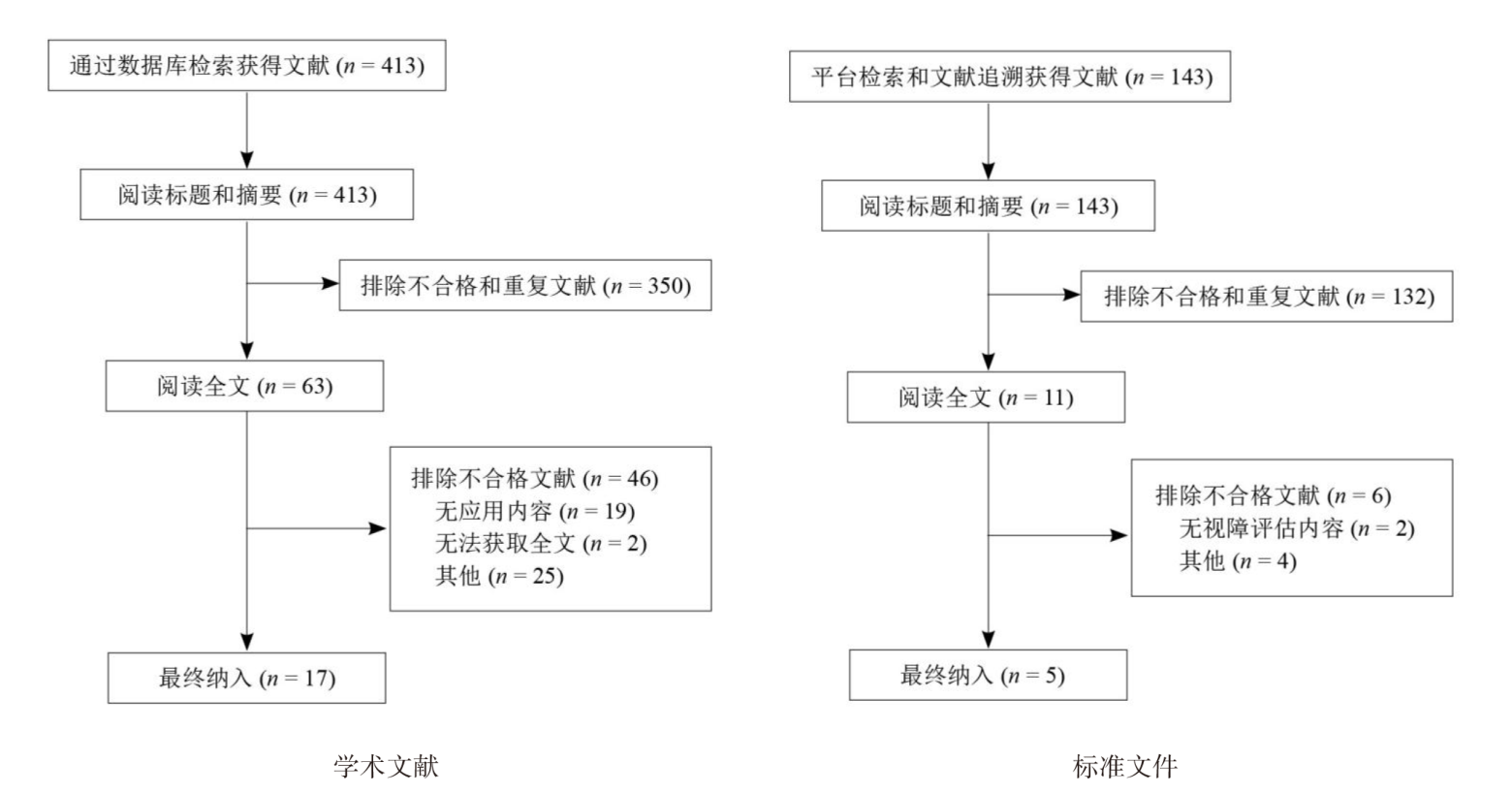
表1
纳入学术文献基本特征"
| 纳入文献 | 国家 | 研究对象 | n | 研究设计 | ICF维度 | 应用场景 | 主要结局 |
|---|---|---|---|---|---|---|---|
| Bruijning等[ | 荷兰 | 视障成人 康复专业人员 | 41 50 | 焦点小组+量表开发 | 活动和参与(扩展心理健康域) | 评估工具开发 | 构建D-AI量表 |
| Bruijning等[ | 荷兰 | 成年低视力康复者 | 241 | 量表验证 | 活动和参与 | 评估工具的精简与临床验证 | 精简后D-AI内部一致性及重测信度良好 |
| Lee等[ | 韩国 | 成年残疾人 其中视障 | 32 7 | 焦点小组+内容分析+ICF链接 | 身体功能、活动参与、环境因素 | 健康需求评估 | 环境因素是最常提及的健康需求 |
| Subhi等[ | 英国 | 成年周边视野损伤患者 | 52 | 横断面相关分析 | 活动和参与(D-AI) | 低视力功能评估 | 周边视野优于中央、下方视野优于上方视野预测移动功能 |
| Billiet等[ | 跨国 | 成年视障者(含盲及中重度低视力) | 763 | 横断面研究 | 身体功能、活动参与、环境因素 | 视障ICF核心集构建 | 视障对功能的影响远超视觉本身,覆盖情绪、出行、就业多个维度 |
| Colombo等[ | 意大利 | 视障儿童青少年 父母 专业人员 | 12 14 10 | 半结构化访谈+主题分析 | 身体功能、活动参与、环境因素 | 残疾多维评估 | 视障青少年残疾体验受个人、家庭、环境交互影响,需个性化支持方案 |
| Adhikari等[ | 尼泊尔 | 盲童 中重度视力障碍儿童 正常视力儿童 | 100 100 100 | 横断面对比研究 | 身体功能、活动和参与(PAI-CY) | 儿童视障活动和参与度测评 | 视障程度与日常活动参与限制正相关 |
| Morelli等[ | 意大利 | 视障儿童青少年 家长 康复从业者 | 18 110 4 | 工具开发与效度验证 | 身体功能与结构、活动和参与 | 评估工具研发 | 自主能力评估量表信效度达标 |
| Christy等[ | 印度 | 视障者 | 305 | 回顾性临床研究 | 未明确分域 | 远程视障康复干预 | 远程康复可覆盖偏远人群,网络、家属配合为主要实施阻碍 |
| Van Leeuwen等[ | 荷兰 | 18~25岁视障青年 | 319 | 回顾性研究+ICF链接编码 | 身体功能、活动参与、环境因素 | 康复需求评估 | 需求集中于教育、就业、出行、沟通与心理适应;成人ICF工具不适配青年群体 |
| Adhikari等[ | 尼泊尔 | 视障儿童 | 6 | 量表跨文化调适预实验 | 活动和参与(PAI-CY) | 儿童视障康复需求评估工具调适 | 调适后量表可识别当地儿童活动和参与困难 |
| Elsman等[ | 荷兰 | 0~25岁视障者 家长 低视力康复人员 | 30 24 17 | 量表可行性试点 | 活动和参与 | 分年龄段康复评估工具开发 | 条目优化后量表可用于康复入院评估 |
| Philip等[ | 印度 | 脑性视觉损伤儿童的家长 | 17 | 质性研究(虚拟焦点小组讨论) | 环境、个人因素 | 儿童远程康复服务 | 家庭支持、专业可及性、持续监测是远程康复的主要促进因素 |
| Øien[ | 丹麦 | 低视力成人 | 60 | 行动研究 | 环境因素 | 居家照明康复干预 | 照明优化可改善视障者功能表现 |
| 林良烽等[ | 中国 | 低视力儿童 | 60 | 随机对照试验 | 身体功能与结构、活动和参与 | 儿童临床康复干预 | 基于ICF理念的联合训练效果优于单一助视器训练 |
| Li等[ | 中国 | 复杂眼病低视力儿童 | 1 | 病例报告 | 身体功能、活动参与、环境因素 | 儿童视障临床康复评估与干预 | ICF-CY指导下个体化干预效果显著 |
| Illum等[ | 丹麦 | 不同类型残疾儿童的家长 其中视障 | 162 5 | 评估工具开发与验证 | 身体功能与结构、活动和参与 | 儿童残疾居家评估工具开发 | 家长应用ICF编码评估信效度良好 |
表2
基于ICF框架的视障标准文件对比分析"
| 标准/指南 | 核心维度 | ICF维度/类目 | 与ICF的差异 | 主要应用场景 |
|---|---|---|---|---|
| 残疾人残疾分类和分级[ | 最佳矫正视力、视野半径 | 视觉功能(b210) | 未纳入活动、环境维度 | 残疾认定、福利发放、全国视障人群筛查统计 |
| 老年人能力评估规范[ | 视力水平,补充感知觉与沟通维度定性描述 | 视觉功能(b210),感知觉与沟通描述涉及活动(沟通) | 无标准化活动评估指标,不涉及环境因素 | 老年人能力分级、照护资源分配 |
| 视觉功能障碍法医临床鉴定技术规范[ | 视力、视野,新增视觉电生理、色觉功能等视觉亚功能指标 | 视觉功能(b210) | 不涉及活动和环境因素 | 人身损害视损伤分级、赔偿鉴定 |
| 0岁~6岁视障儿童早期干预机构服务规范[ | 视功能水平,认知、运动、语言沟通、生活自理等儿童发展能力 | 视觉功能(b210);活动和参与(学习应用、移动、沟通、自我照料等);环境因素(机构无障碍设施、辅助器具配置、家庭指导) | 活动和参与聚焦机构可干预的日常技能;环境因素仅覆盖机构与家庭场景,未纳入社会政策、社区环境等广义维度 | 0~6岁视障儿童早期干预机构建设、个体化康复方案制定、服务质量评价 |
| 中国低视力康复临床指南(2021)[ | 远/近最佳矫正视力、视野、对比敏感度;康复潜力与日常活动能力评估 | 视觉功能(b210);活动和参与(日常视觉应用、独立行动能力);环境因素(e125) (助视器适配) | 活动和参与仅作为康复目标定性提及,无统一评分条目与操作规范;环境因素仅覆盖辅助器具 | 低视力康复临床诊疗、康复方案制定、疗效评价 |
| [1] | 踪玮, 王爱平. 视力障碍对老年人社会功能影响的研究进展[J]. 护理研究, 2021, 35(9): 1621-1625. |
| Zong W, Wang A P. Research progress on the influence of visual impairment on social function in the elderly[J]. Chin Nurs Res, 2021, 35(9): 1621-1625. | |
| [2] | World Health Organization. World report on vision[R]. Geneva: World Health Organization, 2019. |
| [3] |
Xu T, Wang B, Liu H, et al. Prevalence and causes of vision loss in China from 1990 to 2019: findings from the Global Burden of Disease Study 2019[J]. Lancet Public Health, 2020, 5(12): e682-e691.
doi: 10.1016/S2468-2667(20)30254-1 pmid: 33271081 |
| [4] |
Hald A N, Nannerup Kjærgaard F, Hald G M, et al. The role of gender in the association between sensory impairments and well-being, depression symptoms, and relationship satisfaction among older adults[J]. Aging Ment Health, 2025, 29(9): 1563-1571.
doi: 10.1080/13607863.2025.2456483 |
| [5] |
Fraser S, Beeman I, Southall K, et al. Stereotyping as a barrier to the social participation of older adults with low vision: a qualitative focus group study[J]. BMJ Open, 2019, 9(9): e029940.
doi: 10.1136/bmjopen-2019-029940 |
| [6] |
Burton M J, Ramke J, Marques A P, et al. The Lancet Global Health Commission on Global Eye Health: vision beyond 2020[J]. Lancet Glob Health, 2021, 9(4): e489-e551.
doi: 10.1016/S2214-109X(20)30488-5 pmid: 33607016 |
| [7] |
Cai C, Shuai Y, Li G. The effect of low vision rehabilitation on the quality of life and caregiver burden of low vision patients: a randomized trial[J]. BMC Ophthalmol, 2025, 25(1): 20.
doi: 10.1186/s12886-025-03864-9 |
| [8] |
Chotikavanich S, Eiamsamarng A, Layangool T, et al. Outcomes of multidisciplinary low-vision rehabilitation using two questionnaires and the International Classification of Functioning, Disability, and Health[J]. Siriraj Med J, 2024, 76(10): 661-667.
doi: 10.33192/smj.v76i10 |
| [9] | World Health Organization. International Classification of Functioning, Disability and Health[S/OL]. (2025-01-21) [2026-04-08].https://icd.who.int/browse/2025-01/icf/zh. |
| [10] |
Tricco A C, Lillie E, Zarin W, et al. PRISMA extension for scoping reviews (PRISMA-ScR): checklist and explanation[J]. Ann Intern Med, 2018, 169(7): 467-473.
doi: 10.7326/M18-0850 pmid: 30178033 |
| [11] |
Bruijning J, Van Nispen R, Verstraten P, et al. A Dutch ICF version of the Activity Inventory: results from focus groups with visually impaired persons and experts[J]. Ophthalmic Epidemiol, 2010, 17(6): 366-377.
doi: 10.3109/09286586.2010.528133 |
| [12] |
Bruijning J E, Van Rens G, Knol D, et al. Psychometric analyses to improve the Dutch ICF Activity Inventory[J]. Optom Vis Sci, 2013, 90(8): 806-819.
doi: 10.1097/OPX.0b013e318282cdce pmid: 23518676 |
| [13] |
Lee M, Heo H H. Investigating similarities and differences in health needs according to disability type using the International Classification of Functioning, Disability and Health[J]. Disabil Rehabil, 2021, 43(26): 3723-3732.
doi: 10.1080/09638288.2020.1773941 |
| [14] |
Subhi H, Latham K, Myint J, et al. Functional visual fields: relationship of visual field areas to self-reported function[J]. Ophthalmic Physiol Opt, 2017, 37(4): 399-408.
doi: 10.1111/opo.2017.37.issue-4 |
| [15] |
Billiet L, Van Der Aa H P A, Van De Velde D, et al. Development of the International Classification of Functioning, Disability and Health Core Set for Vision Loss: insights from the lived experience of people with vision loss[J]. Ophthalmic Physiol Opt, 2026, 46(2): 242-251.
doi: 10.1007/s44402-026-00031-5 |
| [16] |
Colombo A, Lanza M, Incagli F, et al. Social and subjective representations of visual impairment in Italy: a qualitative study[J]. BMJ Paediatr Open, 2026, 10(1): e004228.
doi: 10.1136/bmjpo-2025-004228 |
| [17] |
Adhikari S, Elsman E B M, Van Nispen R M A, et al. Participation and quality of life of Nepalese children with visual impairment in comparison with normally sighted peers: a cross sectional comparative study[J]. J Patient Rep Outcomes, 2025, 9(1): 64.
doi: 10.1186/s41687-025-00893-2 pmid: 40471460 |
| [18] |
Morelli F, Grumi S, Catalano G, et al. Autonomy in children and adolescents with visual impairment: validation of the Visual Impairment Developmental Autonomy scale[J]. Dev Med Child Neurol, 2025, 67(11): 1472-1481.
doi: 10.1111/dmcn.v67.11 |
| [19] |
Christy B, Mahalakshmi M, Aishwarya T V, et al. Tele-rehabilitation for persons with vision impairment during COVID-19: experiences and lessons learned[J]. Indian J Ophthalmol, 2022, 70(3): 1026-1029.
doi: 10.4103/ijo.IJO_1722_21 pmid: 35225566 |
| [20] |
Van Leeuwen L M, Rainey L, Kef S, et al. Investigating rehabilitation needs of visually impaired young adults according to the International Classification of Functioning, Disability and Health[J]. Acta Ophthalmol, 2015, 93(7): 642-650.
doi: 10.1111/aos.12782 pmid: 26109392 |
| [21] |
Adhikari S, Elsman E B M, Van Nispen R M A, et al. Translation and cross-cultural adaptation of a Nepali version of the Dutch Participation and Activity Inventory for Children and Youth (PAI-CY) with visual impairment[J]. J Patient Rep Outcomes, 2021, 5(1): 77.
doi: 10.1186/s41687-021-00342-w pmid: 34432179 |
| [22] |
Elsman E B M, Van Nispen R M A, Van Rens G. Feasibility of the Participation and Activity Inventory for Children and Youth (PAI-CY) and Young Adults (PAI-YA) with a visual impairment: a pilot study[J]. Health Qual Life Outcomes, 2017, 15(1): 98.
doi: 10.1186/s12955-017-0677-x |
| [23] |
Philip J, Hussaindeen J R, Jacob N, et al. Parental perception of facilitators and barriers to activity and participation in an integrated tele-rehabilitation model for children with cerebral visual impairment in South India: a virtual focus group discussion study[J]. Indian J Ophthalmol, 2023, 71(2): 601-607.
doi: 10.4103/ijo.IJO_1670_22 |
| [24] |
Øien T B. A study of environmental factors in low vision rehabilitation[J]. Front Rehabil Sci, 2022, 3: 829903.
doi: 10.3389/fresc.2022.829903 |
| [25] | 林良烽, 汪勇芬, 于杨, 等. 基于"国际功能、残疾和健康分类"理念的联合康复训练对低视力儿童发育行为的影响[J]. 中国当代医药, 2022, 29(11): 77-80. |
| Lin L F, Wang Y F, Yu Y, et al. Influence of combined rehabilitation training based on the concept of "International Classification of Functioning, Disability and Health" on developmental behavior of children with low vision[J]. Chin Mod Med, 2022, 29(11): 77-80. | |
| [26] |
Li B, Yu Y, Hu J. Applying the ICF-CY in visually impaired rehabilitation: a case report in China[J]. Ann Palliat Med, 2021, 10(3): 3459-3468.
doi: 10.21037/apm |
| [27] | Illum N O, Gradel K O. Parents' assessments of disability in their children using World Health Organization International Classification of Functioning, Disability and Health, Child and Youth Version joined body functions and activity codes related to everyday life[J]. Clin Med Insights Pediatr, 2017, 11: 1179556517715037. |
| [28] |
吕雪丽, 杨亚茹, 邱卓英, 等. 基于ICF和ICD-11的中国6种视力残疾相关标准比较研究[J]. 中国康复理论与实践, 2025, 31(7): 755-762.
doi: 10.3969/j.issn.1006-9771.2025.07.002 |
| Lü X L, Yang Y R, Qiu Z Y, et al. Comparative study of six visual disability-related standards in China based on ICF and ICD-11[J]. Chin J Rehabil Theory Pract, 2025, 31(7): 755-762. | |
| [29] | GB/T 26341-2010 残疾人残疾分类和分级[S]. |
| GB/T 26341-2010 Classification and grading criteria of disability[S]. | |
| [30] | GB/T 42195-2022 老年人能力评估规范[S]. |
| GB/T 42195-2022 Specification for ability assessment of older adults[S]. | |
| [31] | GB/T 43639-2024 视觉功能障碍法医临床鉴定技术规范[S]. |
| GB/T 43639-2024 Technical specification for forensic clinical identification of visual dysfunction[S]. | |
| [32] | GB/T 44668-2024 0岁-6岁视障儿童早期干预机构服务规范[S]. |
| cation of early intervention institutions for children of ages GB/T 44668-2024 0-6 with visual impairment[S]. | |
| [33] | 国家重点研发计划YFC2008200项目组, 中华医学会眼科学分会眼视光学组, 中国医师协会眼科医师分会眼视光专业委员会. 中国低视力康复临床指南(2021)[J]. 中华眼视光学与视觉科学杂志, 2021, 23(3): 161-170. |
| Research Panel of the National Key R&D Project 2020YFC2008200, Chinese Optometric Association of Chinese Ophthalmological Society, Optometry Committee of Chinese Ophthalmologists Association. Chinese Low Vision Rehabilitation Clinical Guideline (2021)[J]. Chin J Optom Ophthalmol Vis Sci, 2021, 23(3): 161-170. | |
| [34] | 教育部. 教育部印发«特殊教育办学质量评价指南»[A/OL]. (2022-11-07) [2026-04-08]. http://www.moe.gov.cn/jyb_xwfb/gzdt_gzdt/s5987/202211/t20221107_976412.html. |
| [35] | 国务院. 国务院关于印发"十四五"残疾人保障和发展规划的通知[A/OL]. (2021-07-21) [2026-04-08]. https://www.gov.cn/zhengce/content/2021-07/21/content_5626391.htm. |
| [36] | 国务院办公厅. 国务院办公厅关于转发教育部等部门"十四五"特殊教育发展提升行动计划的通知[A/OL]. (2021-12-31) [2026-04-08]. https://www.gov.cn/zhengce/content/2022-01/25/content_5670341.htm. |
| [37] | 盛政, 李月霞, 阮艺华. 建立以功能相关分类为基础的康复住院医保支付方式的探索与思考[J]. 中国医疗保险, 2018, (11): 45-48. |
| Sheng Z, Li Y X, Ruan Y H. To explore the establishment of function related groups based on the rehabilitation of hospitalization medical insurance payment[J]. Chin Health Insur, 2018, (11): 45-48. | |
| [38] | 胡琳琳, 龙飞, 李佳, 等. 康复病组按价值付费的"长沙模式"[J]. 中国医疗保险, 2022, (6): 74-79. |
| Hu L L, Long F, Li J, et al. The exploration of value-based medical insurance payment method for rehabilitation in Changsha City[J]. Chin Health Insur, 2022, (6): 74-79. | |
| [39] | 胡琳琳, 邵宁军, 支梦佳, 等. 急性后期康复护理医保支付制度改革的实践探索:以浙江省金华市为例[J]. 卫生经济研究, 2021, 38(12): 11-15, 19. |
| Hu L L, Shao N J, Zhi M J, et al. Practical exploration on the reform of medical insurance payment system for post-acute rehabilitation nursing: a case study of Jinhua City in Zhejiang Province[J]. Health Econ Res, 2021, 38(12): 11-15, 19. | |
| [40] | Ghazaryan T, Iskandaryan L, Babikian V A, et al. Experiences of occupational therapists in implementing the WHO ICF model for disability determination in Armenia[J]. Ar J Spec Educ, 2025, 9(1): 90-109. |
| [41] |
Stineman M G, Tassoni C J, Escarce J J, et al. Development of function-related groups version 2.0: a classification system for medical rehabilitation[J]. Health Serv Res, 1997, 32(4): 529-548.
pmid: 9327817 |
| [42] |
杨亚茹, 邱卓英, 陈迪, 等. 主要残疾类别的定义、分类、分级以及评估研究:基于ICF和ICD-11的方法[J]. 中国康复理论与实践, 2025, 31(4): 373-381.
doi: 10.3969/j.issn.1006-9771.2025.04.001 |
| Yang Y R, Qiu Z Y, Chen D, et al. Disability definition, classification, grading and assessment in disability eligibility: an ICF and ICD-11 framework perspective[J]. Chin J Rehabil Theory Pract, 2025, 31(4): 373-381. | |
| [43] | 张静, 邱卓英, 陈迪, 等. 基于ICF的脑卒中功能障碍的测量:理论、方法及研究进展[J]. 中国康复理论与实践, 2012, 18(5): 430-432. |
| Zhang J, Qiu Z Y, Chen D, et al. Functional measurement based on ICF for stroke: framework, approaches and progress (review)[J]. Chin J Rehabil Theory Pract, 2012, 18(5): 430-432. | |
| [44] | 刘芷忻, 王翠, 王宁华. 膝关节置换术围手术期国际功能、残疾和健康分类核心分类组合的信效度评价[J]. 中国心理卫生杂志, 2024, 38(9): 787-795. |
| Liu Z X, Wang C, Wang N H. Validity and reliability of the comprehensive International Classification of Functioning, Disability and Health Core Set for Knee Arthroplasty Perioperative Period[J]. Chin Ment Health J, 2024, 38(9): 787-795. | |
| [45] |
Billiet L, Van Nispen R M A, De Baets S, et al. The first step in developing an International Classification of Functioning, Disability and Health Core Set for Vision Loss: a systematic review[J]. Ophthalmic Physiol Opt, 2024, 44(2): 413-425.
doi: 10.1111/opo.v44.2 |
| [1] | 蒋阳, 彭皓, 尹兴晓, 李艳琪, 宋艳萍, 姚娜, 申震, 陈奇刚. 虚拟现实运动游戏对认知功能障碍人群多维结局的影响:基于ICF框架的三水平Meta分析[J]. 《中国康复理论与实践》, 2026, 32(9): 1003-1015. |
| [2] | 迟茜茜, 张小年, 朱晓敏, 孙琬玥, 张欣, 周进, 卜宏伟, 翟蕾, 张新, 凌子锐, 陈泓宇. 规范化康复单元对脑外伤的效果[J]. 《中国康复理论与实践》, 2026, 32(9): 1033-1040. |
| [3] | 冯晓娟, 黄富表, 李冬跃, 周明毅, 牛宇轩, 麦格皮热提·伊斯马伊力, 王曦贤, 王子乐. 一种自稳式家用手功能互动训练装置的研发及可行性研究[J]. 《中国康复理论与实践》, 2026, 32(9): 1068-1077. |
| [4] | 周慧玲, 曾嘉彦, 陈冰. 轻度伤残职业康复者生活质量状况及其与不同层次复工结局的关联[J]. 《中国康复理论与实践》, 2026, 32(9): 1078-1086. |
| [5] | 郭旭霞, 虞恒睿, 卢宇澄, 杨思创, 龙雨, 李佳蔚, 陈琳, 农飞玉, 龙耀斌. 基于感知-认知解耦的可解释人工智能运动康复评估系统设计与验证[J]. 《中国康复理论与实践》, 2026, 32(9): 1108-1116. |
| [6] | 中国康复医学会青年工作委员会, 中国微循环学会周围血管委员会淋巴水肿专家委员会, 中国抗癌协会肿瘤康复整合护理专业专委会, 中国康复医学会社区康复工作委员会. 乳腺癌术后腋网综合征治疗与管理规范中国专家共识(2025)[J]. 《中国康复理论与实践》, 2026, 32(8): 869-881. |
| [7] | 中国康复医学会青年工作委员会, 中国微循环学会周围血管委员会淋巴水肿专家委员会, 中国抗癌协会肿瘤康复整合护理专业委员会. 乳腺癌术后腋网综合征识别与诊断标准中国专家共识[J]. 《中国康复理论与实践》, 2026, 32(8): 882-891. |
| [8] | 王子龙, 李宏玉, 王志浩, 李洪欣, 江莹莹, 唐强. 慢性疲劳综合征肌肉病理生理的Scoping综述[J]. 《中国康复理论与实践》, 2026, 32(8): 892-902. |
| [9] | 梁艳华, 张通, 张琦, 周天添, 张燕庆, 岳青, 李思佳. 康复机器人训练对偏瘫儿童腹肌厚度和平衡能力的效果[J]. 《中国康复理论与实践》, 2026, 32(8): 927-937. |
| [10] | 田靖晓, 艾佳茗, 闵红巍, 赵克聪, 张宝翠, 姜虹, 杨威, 刘均娥. 基于每日目标管理路径的全膝关节置换术患者运动干预方案的构建及初步验证[J]. 《中国康复理论与实践》, 2026, 32(8): 959-967. |
| [11] | 刘华, 马欣, 李静, 王丽媛, 王丽. 基于康复胜任力的运动康复专业硕士研究生培养方案比较[J]. 《中国康复理论与实践》, 2026, 32(8): 984-992. |
| [12] | 李锦萌, 柳君娜, 陈强, 毕鸿雁. 2011年至2025年远程医疗、可穿戴设备和人工智能在慢性阻塞性肺疾病肺康复中应用的文献计量分析[J]. 《中国康复理论与实践》, 2026, 32(7): 829-840. |
| [13] | 张溢杉, 宋佳佳, 侯天宇, 孟丽君. 康复工程中的伦理挑战与治理前瞻[J]. 《中国康复理论与实践》, 2026, 32(7): 861-868. |
| [14] | 李欣源, 郑洁皎, 张廷宇, 吴雪娇, 梁晓笑. 间歇性θ脉冲刺激改善脑卒中患者下肢运动和平衡功能的Meta分析[J]. 《中国康复理论与实践》, 2026, 32(6): 631-644. |
| [15] | 高惠刚, 刘远文, 秦煜玲, 胡昔权, 朱琳. 2020年至2025年足踝软体外骨骼机器人改善脑卒中患者步行功能的Scoping综述[J]. 《中国康复理论与实践》, 2026, 32(6): 645-652. |
| 阅读次数 | ||||||
|
全文 |
|
|||||
|
摘要 |
|
|||||
|
||
