



《中国康复理论与实践》 ›› 2022, Vol. 28 ›› Issue (9): 1032-1038.doi: 10.3969/j.issn.1006-9771.2022.09.005
朱旭,刘静,董泽萍,仇大伟( )
收稿日期:2022-03-18
修回日期:2022-06-08
出版日期:2022-09-25
发布日期:2022-10-08
通讯作者:
仇大伟
E-mail:dwqiu@foxmail.com
作者简介:朱旭(1998-),男,汉族,河南信阳市人,硕士研究生,主要研究方向:表面肌电与手部康复。
基金资助:
ZHU Xu,LIU Jing,DONG Zeping,QIU Dawei()
Received:2022-03-18
Revised:2022-06-08
Published:2022-09-25
Online:2022-10-08
Contact:
QIU Dawei
E-mail:dwqiu@foxmail.com
Supported by:摘要:
目的 系统综述基于表面肌电图的手势动作意图识别的研究进展。
方法 通过检索中国知网、万方数据库、PubMed、Web of Science,搜集基于表面肌电图的手势动作意图识别的实验研究,检索时限为建库至2021年12月。根据实验内容和质量筛选文献,并对其分类方法和其他影响因素进行总结性分析。
结果 共返回文献735篇,最终纳入25篇,发表时间主要集中于2012年至2021年,研究对象为正常受试者或截肢者,分类模型包含传统机器学习模型和深度学习模型,其他影响因素包含采集方式、噪声干扰和滑动窗口大小。
结论 目前基于表面肌电信号的传统机器学习模型已得到成熟应用,深度学习模型的手势识别技术具有很大潜力。受试者的个体差异、手势分类的实时性需求和肌电设备的稳定性需求仍有待解决。
中图分类号:
朱旭,刘静,董泽萍,仇大伟. 基于表面肌电图手势动作意图识别的系统综述[J]. 《中国康复理论与实践》, 2022, 28(9): 1032-1038.
ZHU Xu,LIU Jing,DONG Zeping,QIU Dawei. Gesture action intent recognition based on surface electromyography: a systematic review[J]. 《Chinese Journal of Rehabilitation Theory and Practice》, 2022, 28(9): 1032-1038.

图1
文献筛选流程图"
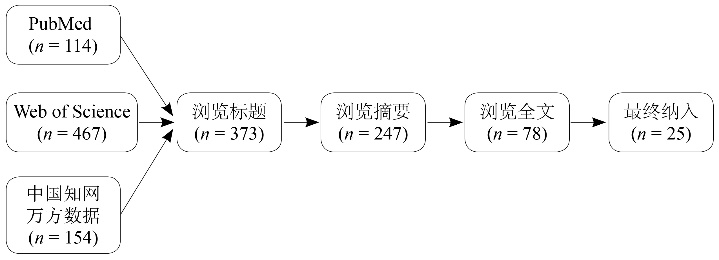
表1
纳入文献的一般情况"
| 纳入文献 | 受试者 | 手势数 | 分类模型 | 结论 |
|---|---|---|---|---|
| Wu等[ | 4例男性、2例女性 | 6 | BPNN | 与sEMG特征数量相比,测量位置数量变化对识别结果影响更大 |
| Naik等[ | 5例截肢受试者 | 12 | ICA-SSO | 减少肌电传感器的数量,提高肌电控制系统的鲁棒性 |
| Du等[ | 23例健康受试者 | 22 | DBN | 先进的分类器使用高密度sEMG数据集比稀疏多通道sEMG得到更高准确率 |
| Chen等[ | 18例健康受试者 | 8 | 3D-CNN | 3D-CNN比2D-CNN能更好识别高密度sEMG数据集,但处理时间也增加 |
| Duan等[ | 4例男性、4例女性 | 9 | LDA | 使用3个传感器识别9个手势,平均准确率91.7% |
| Zhang等[ | 8例男性、4例女性 | 5 | ANN | 手势识别率98.7% |
| Saeed等[ | 10例健康受试者、6例截肢受试者 | 11 | LDA、ANN | 与原始信号相比,特征组合作为输入能得到更高识别率 |
| Tang等[ | 6例男性 | 11 | LDA、KNN、NB | 通过定义新的特征和设计新的级联结构提高手势识别率 |
| Xue等[ | 8例男性、2例女性 | 13 | CCA-OT | 减少不同受试者肢体之间概率函数漂移的必要性 |
| Sun等[ | 8例男性、2例女性 | 52 | GFM | GFM分解特征因子对提高肌电手势分类准确率有积极作用 |
| Cao等[ | 36例健康受试者 | 4 | AMPSO-SVM | 遗传算法用于解决高维和冗余问题 |
| Junior等[ | 8例男性、5例女性 | 6 | ELM、KNN、SVM-RBF等 | 降维和特征量缩减可以有效提高手势识别率 |
| Jie等[ | 7例男性、1例女性 | 5 | PSO | 少量特征仍然可以达到高密度sEMG信号的手势识别率 |
| Sharif等[ | 6例男性、2例女性 | 16 | SVM、CNN | 动态手势的手势识别精度不如静态手势 |
| Zhai等[ | 40例健康受试者、11例截肢受试者 | 49 | CNN | 重新校准后的CNN可以补偿sEMG基准漂移 |
| Cheng等[ | 20例男性、7例女性 | 52 | CNN | sEMG多特征图像能够更好实现信息互补,提高手势分类准确率 |
| Asif等[ | 18例健康受试者 | 10 | CNN | 单个网络会明显偏好个别手势 |
| 许留凯等[ | 40例健康受试者 | 49 | CNN | CNN结合能量核相图有着较好的手势识别精度 |
| 李沿宏等[ | 20例男性、7例女性 | 52 | 多流卷积网络 | 多流卷积网络学习sEMG信号的时序信息 |
| Nasri等[ | 35例健康受试者 | 6 | GRU | GRU实时评估系统能区分大约80%训练手势 |
| Zhang等[ | 8例男性、5例女性 | 21 | GRU | 文献提出的模型有着更好的实时性能和准确性 |
| Yu等[ | 8例男性 | 150 | DBN | 特征级融合作为网络的输入有着最好的手势识别率 |
| [1] | SAMADANI A A, KULIC D. Hand gesture recognition based on surface electromyography[C]. 2014 36th Annual International Conference of the IEEE Engineering in Medicine and Biology Society, IEEE, 2014: 4196-4199. |
| [2] |
OUDAH M, AL-NAJI A, CHAHL J. Hand gesture recognition based on computer vision: a review of techniques[J]. J Imaging, 2020, 6(8): 73.
doi: 10.3390/jimaging6080073 |
| [3] |
ATZORI M, GIJSBERTS A, CASTELLINI C, et al. Electromyography data for non-invasive naturally-controlled robotic hand prostheses[J]. Sci Data, 2014, 1(1): 1-13.
doi: 10.3233/DS-170013 |
| [4] |
DISSELHORST-KLUG C, SCHMITZ-RODE T, RAU G. Surface electromyography and muscle force: limits in sEMG-force relationship and new approaches for applications[J]. Clin Biomech (Bristol, Avon), 2009, 24(3): 225-235.
doi: 10.1016/j.clinbiomech.2008.08.003 |
| [5] |
BITTIBSSI T M, GENEDY M A, MAGED S A. sEMG pattern recognition based on recurrent neural network[J]. Biomed Signal Process Control, 2021, 70: 103048.
doi: 10.1016/j.bspc.2021.103048 |
| [6] | 曹梦琳, 陈宇豪, 王珏, 等. 基于表面肌电图的人体运动意图识别研究进展[J]. 中国康复理论与实践, 2021, 27(5): 595-603. |
| CAO M L, CHEN Y H, WANG J, et al. Advance in human motion intention recognition based on surface electromyography[J]. Chin J Rehabil Theory Pract, 2021, 27(5): 595-603. | |
| [7] | 胡进, 侯增广, 陈翼雄, 等. 下肢康复机器人及其交互控制方法[J]. 自动化学报, 2014, 40(11): 2377-2390. |
| HU J, HOU Z G, CHEN Y X, et al. Lower limb rehabilitation robots and interactive control methods[J]. Acta Autom Sin, 2014, 40(11): 2377-2390. | |
| [8] | 丁其川, 熊安斌, 赵新刚, 等. 基于表面肌电的运动意图识别方法研究及应用综述[J]. 自动化学报, 2016, 42(1): 13-25. |
| DING Q C, XIONG A B, ZHAO X G, et al. A review on researches and applications of sEMG-based motion intent recognition methods[J]. Acta Autom Sin, 2016, 42(1): 13-25. | |
| [9] |
AFSHARIPOUR B, SOEDIRDJO S, MERLETTI R. Two-dimensional surface EMG: the effects of electrode size, interelectrode distance and image truncation[J]. Biomed Signal Process Control, 2019, 49: 298-307.
doi: 10.1016/j.bspc.2018.12.001 |
| [10] |
JUNIOR J J A M, FREITAS M, SIQUEIRA H, et al. Comparative analysis among feature selection of sEMG signal for hand gesture classification by armband[J]. IEEE Lat Am Trans, 2020, 18(6): 1135-1143.
doi: 10.1109/TLA.2020.9099752 |
| [11] |
LI W, SHI P, YU H. Gesture recognition using surface electromyography and deep learning for prostheses hand: state-of-the-art, challenges, and future[J]. Front Neurosci, 2021, 15: 621885.
doi: 10.3389/fnins.2021.621885 |
| [12] |
WU C, YAN Y, CAO Q, et al. sEMG measurement position and feature optimization strategy for gesture recognition based on ANOVA and neural networks[J]. IEEE Access, 2020, 8: 56290-56299.
doi: 10.1109/ACCESS.2020.2982405 |
| [13] |
NAIK G R, AL-TIMEMY A H, NGUYEN H T. Transradial amputee gesture classification using an optimal number of sEMG sensors: an approach using ICA clustering[J]. IEEE Trans Neural Syst Rehabil Eng, 2016, 24(8): 837-846.
doi: 10.1109/TNSRE.2015.2478138 |
| [14] |
DU Y, JIN W, WEI W, et al. Surface EMG-based inter-session gesture recognition enhanced by deep domain adaptation[J]. Sensors (Basel), 2017, 17(3): 458.
doi: 10.3390/s17030458 |
| [15] |
CHEN J, BI S, ZHANG G, et al. High-density surface EMG-based gesture recognition using a 3D convolutional neural network[J]. Sensors (Basel), 2020, 20(4): 1201.
doi: 10.3390/s20041201 |
| [16] |
DUAN F, REN X, YANG Y. A gesture recognition system based on time domain features and linear discriminant analysis[J]. IEEE Trans Cogn Dev Syst, 2018, 13(1): 200-208.
doi: 10.1109/TCDS.2018.2884942 |
| [17] |
ZHANG Z, YANG K, QIAN J, et al. Real-time surface EMG pattern recognition for hand gestures based on an artificial neural network[J]. Sensors (Basel), 2019, 19(14): 3170.
doi: 10.3390/s19143170 |
| [18] |
SAEED B, ZIA-UR-REHMAN M, GILANI S O, et al. Leveraging ANN and LDA classifiers for characterizing different hand movements using EMG signals[J]. Arab J Sci Eng, 2021, 46(2): 1761-1769.
doi: 10.1007/s13369-020-05044-x |
| [19] |
TANG X, LIU Y, LV C, et al. Hand motion classification using a multi-channel surface electromyography sensor[J]. Sensors (Basel), 2012, 12(2): 1130-1147.
doi: 10.3390/s120201130 |
| [20] |
XUE B, WU L, WANG K, et al. Multiuser gesture recognition using sEMG signals via canonical correlation analysis and optimal transport[J]. Comput Biol Med, 2021, 130: 104188.
doi: 10.1016/j.compbiomed.2020.104188 |
| [21] |
SUN W, LIU H, TANG R, et al. sEMG-based hand-gesture classification using a generative flow model[J]. Sensors (Basel), 2019, 19(8): 1952.
doi: 10.3390/s19081952 |
| [22] | CAO L, ZHANG W, KAN X, et al. A novel adaptive mutation PSO optimized SVM algorithm for sEMG-based gesture recognition[J]. Sci Programming, 2021, 2021: 9988823. |
| [23] |
JUNIOR J J A M, FREITAS M L B, SIQUEIRA H V, et al. Feature selection and dimensionality reduction: an extensive comparison in hand gesture classification by sEMG in eight channels armband approach[J]. Biomed Signal Process Control, 2020, 59: 101920.
doi: 10.1016/j.bspc.2020.101920 |
| [24] |
JIE J, LIU K, ZHENG H, et al. High dimensional feature data reduction of multichannel sEMG for gesture recognition based on double phases PSO[J]. Complex Intell Syst, 2021, 7(4): 1877-1893.
doi: 10.1007/s40747-020-00232-6 |
| [25] |
MENDES JUNIOR J J A, FREITAS M L B, CAMPOS D P, et al. Analysis of influence of segmentation, features, and classification in sEMG processing: a case study of recognition of brazilian sign language alphabet[J]. Sensors (Basel), 2020, 20(16): 4359.
doi: 10.3390/s20164359 |
| [26] |
TRIWIYANTO T, PAWANA I P A, PURNOMO M H. An improved performance of deep learning based on convolution neural network to classify the hand motion by evaluating hyper parameter[J]. IEEE Trans Neural Syst Rehabil Eng, 2020, 28(7): 1678-1688.
doi: 10.1109/TNSRE.2020.2999505 |
| [27] |
CHEN L, FU J, WU Y, et al. Hand gesture recognition using compact CNN via surface electromyography signals[J]. Sensors (Basel), 2020, 20(3): 672.
doi: 10.3390/s20030672 |
| [28] | SHARIF H, SEO S B, KESAVADAS T K. Hand gesture recognition using surface electromyography[C]. 2020 42nd Annual International Conference of the IEEE Engineering in Medicine and Biology Society, IEEE, 2020: 682-685. |
| [29] |
ZHAI X, JELFS B, CHAN R H M, et al. Self-recalibrating surface EMG pattern recognition for neuroprosthesis control based on convolutional neural network[J]. Front Neurosci, 2017, 11: 379.
doi: 10.3389/fnins.2017.00379 |
| [30] | CHENG Y, LI G, YU M, et al. Gesture recognition based on surface electromyography‐feature image[J]. Concurr Comp-Pract E, 2021, 33(6): e6051. |
| [31] |
ASIF A R, WARIS A, GILANI S O, et al. Performance evaluation of convolutional neural network for hand gesture recognition using EMG[J]. Sensors (Basel), 2020, 20(6): 1642.
doi: 10.3390/s20061642 |
| [32] | 许留凯, 张克勤, 徐兆红, 等. 基于表面肌电信号能量核相图的卷积神经网络人体手势识别算法[J]. 生物医学工程学杂志, 2021, 38(4): 621-629. |
| XU L K, ZHANG K Q, XU Z H, et al. Convolutional neural network human gesture recognition algorithm based on phase portrait of surface electromyography energy kernel[J]. J Biomed Eng, 2021, 38(4): 621-629. | |
| [33] | 李沿宏, 江茜, 邹可, 等. 融合注意力机制的多流卷积肌电手势识别网络[J]. 计算机应用研究, 2021, 38(11): 3258-3263. |
| LI Y H, JIANG X, ZOU K, et al. Multi-stream convolutional myoelectric gesture recognition networks fusing attentional mechanisms[J]. Appl Res Comput, 2021, 38(11): 3258-3263. | |
| [34] |
NASRI N, ORTS-ESCOLANO S, GOMEZ-DONOSO F, et al. Inferring static hand poses from a low-cost non-intrusive sEMG sensor[J]. Sensors (Basel), 2019, 19(2): 371.
doi: 10.3390/s19020371 |
| [35] |
ZHANG Z, HE C, YANG K. A novel surface electromyographic signal-based hand gesture prediction using a recurrent neural network[J]. Sensors (Basel), 2020, 20(14): 3994.
doi: 10.3390/s20143994 |
| [36] |
YU Y, CHEN X, CAO S, et al. Exploration of Chinese sign language recognition using wearable sensors based on deep belief net[J]. IEEE J Biomed Health Inform, 2019, 24(5): 1310-1320.
doi: 10.1109/JBHI.2019.2941535 |
| [37] |
WEI W, WONG Y, DU Y, et al. A multi-stream convolutional neural network for sEMG-based gesture recognition in muscle-computer interface[J]. Pattern Recogn Lett, 2019, 119: 131-138.
doi: 10.1016/j.patrec.2017.12.005 |
| [38] | AMMA C, KRINGS T, BÖER J, et al. Advancing muscle-computer interfaces with high-density electromyography[C]. Proceedings of the 33rd Annual ACM Conference on Human Factors in Computing Systems (CHI), 2015: 929-938. |
| [39] |
MATRAN-FERNANDEZ A, RODRÍGUEZ MARTÍNEZ I J, POLI R, et al. SEEDS, simultaneous recordings of high-density EMG and finger joint angles during multiple hand movements[J]. Sci Data, 2019, 6(1): 186.
doi: 10.1038/s41597-019-0200-9 |
| [40] |
ENGLEHART K, HUDGINS B. A robust, real-time control scheme for multifunction myoelectric control[J]. IEEE Trans Biomed Eng, 2003, 50(7): 848-854.
doi: 10.1109/TBME.2003.813539 |
| [41] |
HUDGINS B, PARKER P, SCOTT RN. A new strategy for multifunction myoelectric control[J]. IEEE Trans Biomed Eng, 1993, 40(1): 82-94.
doi: 10.1109/10.204774 |
| [1] | 杨同念, 任杰, 肖辉. 儿童青少年身体活动对焦虑的效果:系统综述的系统综述[J]. 《中国康复理论与实践》, 2025, 31(8): 883-888. |
| [2] | 王晓锋, 胡梦巧, 汪嫣, 魏坤, 徐文竹, 任丹, 马晔. 外骨骼机器人辅助步态训练对脑卒中和脊髓损伤下肢功能康复效果的系统综述[J]. 《中国康复理论与实践》, 2025, 31(8): 914-921. |
| [3] | 顾逸青, 程舒芃, 李勇强, 毛二莉, 励建安. 成年气管切开患者拔管的直接策略与堵管策略对比的系统综述[J]. 《中国康复理论与实践》, 2025, 31(6): 666-673. |
| [4] | 王梅, 朱文平. 身体活动干预2型糖尿病患者的健康效益:系统综述的系统综述[J]. 《中国康复理论与实践》, 2025, 31(5): 553-560. |
| [5] | 叶绿, 常晶, 凌海润. 网络行为成瘾的运动干预效果:系统综述的系统综述[J]. 《中国康复理论与实践》, 2025, 31(4): 431-440. |
| [6] | 朱志强, 徐巧玲, 邵雪云. 肥胖和超重儿童参与身体活动的健康效益:系统综述的系统综述[J]. 《中国康复理论与实践》, 2025, 31(3): 296-305. |
| [7] | 蔡倩, 张溪, 苏海荣, 刘娜, 黄颖, 李际强, 夏金根, 郑德采. 吸气肌训练对脱机失败者脱机疗效的系统综述[J]. 《中国康复理论与实践》, 2025, 31(3): 306-313. |
| [8] | 徐晓红, 钟晓珂, 孙思怡, 张祁, 程怀春. 轻度认知障碍老年人参与艺术治疗心理健康效益的系统综述[J]. 《中国康复理论与实践》, 2025, 31(2): 165-171. |
| [9] | 段富文, 张倍齐, 李丽. 运动干预对运动相关性脑震荡预防作用的系统综述[J]. 《中国康复理论与实践》, 2025, 31(12): 1385-1397. |
| [10] | 马凌燕, 曹杰, 陈仲略, 任康, 冯涛. 基于语音特征的帕金森病与多系统萎缩帕金森型的早期鉴别诊断[J]. 《中国康复理论与实践》, 2025, 31(10): 1227-1233. |
| [11] | 杨文睿, 崔思栋, 曾莉. 虚拟与增强现实对孤独症谱系障碍儿童青少年认知、情绪和适应性行为干预效果的系统综述[J]. 《中国康复理论与实践》, 2024, 30(9): 1026-1033. |
| [12] | 朱博文, 赵素红, 李苗秀, 张帅攀, 姚重界, 朱清广, 房敏. 基于表面肌电图的手法治疗对老年人膝骨关节炎效果的随机对照试验[J]. 《中国康复理论与实践》, 2024, 30(9): 1099-1106. |
| [13] | 周静, 张晓晓, 丁忠冰, 陈建超, 魏星星, 林姝琦. 智力与发展性残疾儿童言语与语言障碍康复的系统综述[J]. 《中国康复理论与实践》, 2024, 30(8): 894-902. |
| [14] | 杨家坤, 张晓侠. 适应性体育活动对智力与发展性残疾儿童功能、活动和参与效益的系统综述[J]. 《中国康复理论与实践》, 2024, 30(7): 768-777. |
| [15] | 唐乐天, 黄兆欣, 刘超, 肖晓飞. 前交叉韧带重建术后患者高血流限制训练康复效果的系统综述[J]. 《中国康复理论与实践》, 2024, 30(7): 789-796. |
| 阅读次数 | ||||||
|
全文 |
|
|||||
|
摘要 |
|
|||||
|
||
