



《中国康复理论与实践》 ›› 2026, Vol. 32 ›› Issue (7): 807-816.doi: 10.3969/j.issn.1006-9771.2026.07.008
袁依依1,2, 田武超3, 张献斌1, 钞强3, 李永生3, 刘桂新3, 吴万庆1, 王朴2( )
收稿日期:2025-08-12
修回日期:2025-10-11
接受日期:2026-04-16
出版日期:2026-07-25
发布日期:2026-07-30
通讯作者:
王朴,E-mail: wangpu@sysush.com作者简介:袁依依(2004-),女,汉族,湖南长沙市人,本科生。基金资助:
Yuan Yiyi1,2, Tian Wuchao3, Zhang Xianbin1, Chao Qiang3, Li Yongsheng3, Liu Guixin3, Wu Wanqing1, Wang Pu2()
Received:2025-08-12
Revised:2025-10-11
Accepted:2026-04-16
Published:2026-07-25
Online:2026-07-30
Supported by:摘要:
目的 系统评价双任务训练(DTT)对脑卒中患者行动能力和平衡功能的康复疗效。
方法 系统检索中国知网、万方、维普、PubMed、Web of Science、Embase和Cochrane Library数据库,纳入建库至2025年6月发表的关于DTT对比单任务训练对脑卒中患者进行干预的随机对照试验(RCT)。采用Cochrane偏倚风险评估工具、PEDro量表对纳入研究的质量进行评价,采用RevMan 5.4进行Meta分析。
结果 共纳入11项RCT,涉及517例患者。PEDro量表评分4~8分。DTT能改善患者Fugl-Meyer评定量表下肢部分评分(MD = 3.70, 95%CI 1.88~5.53, P < 0.001)、Berg平衡量表(BBS)评分(MD = 3.04, 95%CI 1.58~4.49, P < 0.001)、跌倒发生率(OR = 0.32, 95%CI 0.11~0.87, P = 0.025)、单任务步速(MD = 0.08, 95%CI 0.03~0.12, P = 0.002)、双任务步速(MD = 0.13, 95%CI 0.10~0.16, P < 0.001)、计时起立行走测试时间(MD = -2.78, 95%CI -3.85~-1.72, P < 0.001)和改良Barthel指数评分(MD = 4.77, 95%CI 1.88~7.66, P = 0.001)。亚组分析显示,运动-运动DTT在提高BBS评分和单任务步速方面优于认知-运动DTT。
结论 双任务训练能够有效提升脑卒中患者的移动能力和平衡功能,且运动任务较认知任务效果更显著。
中图分类号:
袁依依, 田武超, 张献斌, 钞强, 李永生, 刘桂新, 吴万庆, 王朴. 双任务训练对脑卒中患者移动和平衡功能康复疗效的Meta分析[J]. 《中国康复理论与实践》, 2026, 32(7): 807-816.
Yuan Yiyi, Tian Wuchao, Zhang Xianbin, Chao Qiang, Li Yongsheng, Liu Guixin, Wu Wanqing, Wang Pu. Effect of dual task training on mobility and balance in stroke patients: a meta-analysis[J]. Chinese Journal of Rehabilitation Theory and Practice, 2026, 32(7): 807-816.

表1
PICO架构"
| 人群(Population) | 干预(Intervention) | 比较(Comparison) | 结局(Outcome) |
|---|---|---|---|
| 疾病状况 脑卒中患者,涵盖急性期、亚急性期和慢性期全病程 功能状态 认知功能尚可并伴有行动功能障碍,保留一定平衡能力,具备进行针对性康复训练的生理基础 年龄 ≥ 18岁 | 干预场所 医院或康复中心 干预人员 康复治疗师 干预方式 DTT 干预参数 干预类型 干预频率 单次干预时长 | 与对照组比较 不同干预类型比较 | 平衡能力 下肢功能(FMA-LE) 平衡功能(BBS、跌倒发生率) 移动能力 步态(单任务步速、双任务步速、TUGT) 功能独立性 日常生活活动能力(MBI) |
图1
文献筛选流程图"
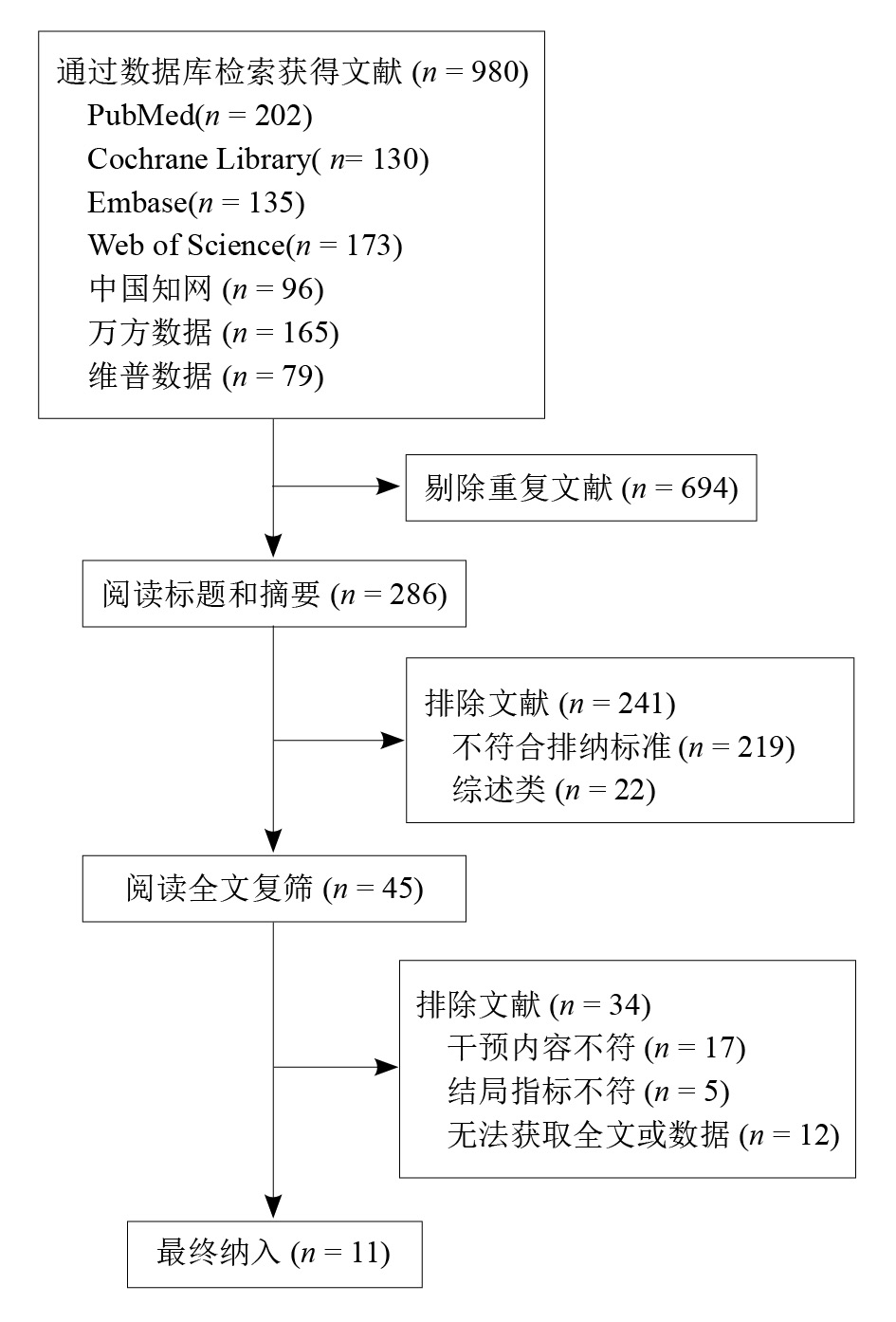
图2
偏倚风险比例"
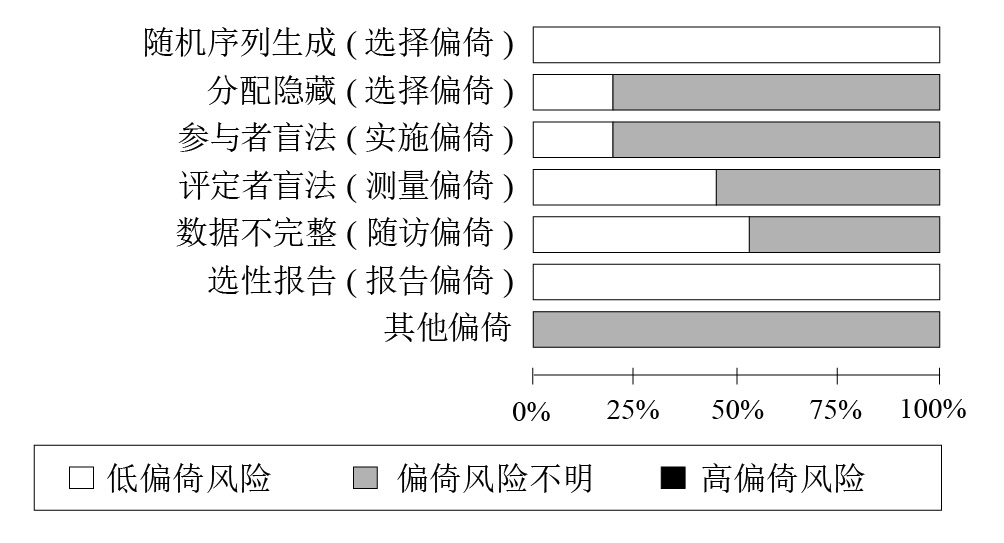
图3
纳入文献偏倚评估"
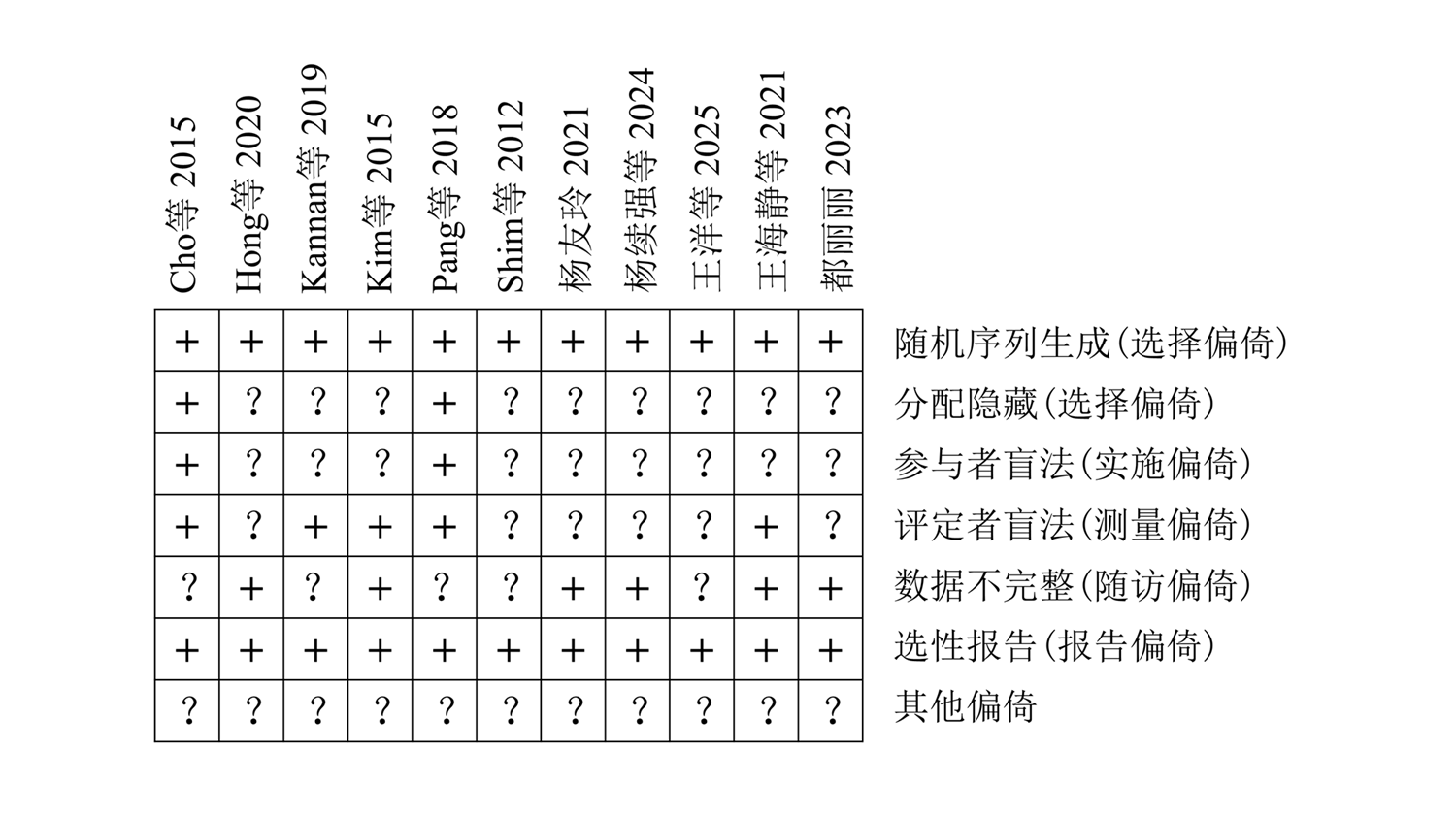
表2
纳入文献PEDro量表评分"
| 纳入文献 | 资格标准 | 随机分配 | 分配隐藏 | 基线相似 | 受试施盲 | 治疗师施盲 | 评估者施盲 | 被试流失率≤15% | 意向性分析 | 组间统计比较 | 变异性测量 | 总分 |
|---|---|---|---|---|---|---|---|---|---|---|---|---|
| Shim等[ | √ | √ | √ | √ | √ | √ | 5 | |||||
| Cho等[ | √ | √ | √ | √ | √ | √ | √ | √ | √ | 8 | ||
| Kim等[ | √ | √ | √ | √ | √ | √ | √ | √ | 7 | |||
| Pang等[ | √ | √ | √ | √ | √ | √ | √ | √ | √ | 8 | ||
| Kannan等[ | √ | √ | √ | √ | √ | √ | 5 | |||||
| Hong等[ | √ | √ | √ | √ | √ | 4 | ||||||
| 杨友玲[ | √ | √ | √ | √ | √ | √ | √ | 6 | ||||
| 王海静等[ | √ | √ | √ | √ | √ | √ | √ | √ | 7 | |||
| 都丽丽等[ | √ | √ | √ | √ | √ | √ | √ | 6 | ||||
| 杨绪强等[ | √ | √ | √ | √ | √ | √ | √ | 6 | ||||
| 王洋等[ | √ | √ | √ | √ | √ | √ | 5 |
表3
纳入文献基本特征"
| 纳入文献 | n(C/T) | 性别 (男/女)/n | 年龄/岁 (C/T) | 平均病程/月 (C/T) | 干预频率 | 干预措施 | 随访措施 | 结局指标 |
|---|---|---|---|---|---|---|---|---|
| Shim等[ | 16/17 | 20/13 | (61.56±6.17)/(65.59±5.81) | (17.44±3.67)/(16.29±2.62) | 每次30 min,每周3次,共6周 | C:基础步态训练 T:基础治疗+行走时交替用非瘫痪侧膝/瘫痪侧脚踢球20 m往返,治疗师手持带绳泡沫球控制移动速度 | 无长期随访 | ① |
| Cho等[ | 11/11 | 7/15 | (58.6±11.86)/(60.0±9.38) | (8.8±4.8)/ (9.1±6.4) | 每次30 min,每周5次,共4周 | C:虚拟环境行走 T:跑步机行走+虚拟社区环境认知任务,每周切换认知任务(记忆/算术/言语/对话)模拟真实社区的多任务需求 | 无长期随访 | ① |
| Kim等[ | 20/20 | 26/14 | (48.1±7.5)/(51.0±13.5) | ≥ 6/≥ 6 | 每次30 min,每周3次,共4周 | C:跑步机行走+超市实景视频 T:跑步机行走+超市实景视频(100 cm/s),附加认知任务(记忆5种商品并按键识别) | 无长期随访 | ① |
| Pang等[ | 28/28 | 42/14 | (61.2±6.2)/(59.9±6.8) | (66.6±41.6)/ (71.9±63.6) | 每次60 min,每周3次,共8周 | C:运动任务 T:运动任务(前向行走、TUGT、障碍跨越)+认知任务(命名特定类别词汇、连续减法、记忆并复述物品序列) | 干预后8周评估+6个月跌倒监测 | ②③⑦ |
| Kannan等[ | 12/12 | 13/11 | (61±4.6)/(57.5±8.04) | (9.09±6.36)/ (8.9±5.39) | 每次90 min,共6周 | C:定制化平衡训练 T:Wii Fit游戏(泡泡平衡/桌面倾斜/走钢丝/头球)+认知任务(字母数字序列/心算/类比) | 无长期随访 | ①③④⑦ |
| Hong等[ | 9/8 | 10/7 | (66.22±11.55)/(56.63±8.78) | (15.33±7.47)/ (19±8.38) | 每次30 min,每周3次,共4周 | C:相同下肢运动任务,无信号灯提示 T:站立位下根据交通信号灯指示移动健侧下肢;随机灯光提示进行三方向髋关节屈曲运动 | 无长期随访 | ①③④⑦ |
| 杨友玲[ | 33/34 | 38/29 | (59.15±6.82)/(61.18±7.21) | (9.67±1.95)/(10.00±2.10) | 每次60 min,每周5次,共6周 | C:常规康复训练60 min T:常规康复训练40 min+认知运动双任务步行训练20 min,双任务为步行同时执行认知任务如倒背月份 | 无长期随访 | ①④⑤⑥ |
| 王海静等[ | 14/17 | 23/8 | (62.4±9.5)/(59.4±12.9) | ≥ 6/≥ 6 | 每次45 min,每周5次,共6周 | C:常规康复训练60 min T:常规康复训练30 min+双运动任务步行训练15 min,双任务为步行同时执行运动任务(投掷物品、转移物品、手持水杯行走等) | 无长期随访 | ①③④⑥⑦ |
| 都丽丽等[ | 35/35 | 38/32 | (63.74±4.92)/(63.74±4.73) | (2.91±1.36)/ (2.73±1.25) | 每次30 min,每天2次,共4周 | C:步行训练 T:上午、下午分别进行步行+认知、步行+运动DTT | 干预后1年跌倒监测 | ①②⑦ |
| 杨绪强等[ | 42/42 | 40/44 | (52.31±7.81)/(49.98±6.59) | (1.66±0.46)/ (1.76±0.52) | 每次70 min,每周5次,共4周 | C:常规康复 T:常规康复+多平面躯干训练(坐位骨盆控制、站位拾物、对角线步行)和DTT(步行中持水杯防洒、连续减法计算) | 干预后3个月、6个月评估 | ①③④ ⑤⑥⑦ |
| 王洋等[ | 37/36 | 56/17 | (59.43±9.58)/(62.78±6.62) | 2周~6个月(恢复期) | 每次30 min,每周5次,共4周 | C:常规康复 T:常规康复+运动-运动DTT,主要任务为奥塔戈运动,次要任务为上肢运动(拿放物品、转移物品、手持水杯) | 无长期随访 | ④⑥⑦ |
表4
Meta分析结果"
| 结局指标 | 纳入研究数/n | 异质性 | 效应模型 | Meta分析结果 | ||
|---|---|---|---|---|---|---|
| I2 | P值 | MD/OR (95%CI) | P值 | |||
| FMA-LE | 2[ | 68% | 0.079 | 随机 | 3.70(1.88~5.53) | < 0.001 |
| BBS | 6[ | 60% | 0.022 | 随机 | 3.04(1.58~4.49) | < 0.001 |
| 跌倒发生率a | 2[ | 0% | 0.331 | 固定 | 0.32(0.11~0.87) | 0.025 |
| 单任务步速 | 7[ | 67% | 0.006 | 随机 | 0.08(0.03~0.12) | 0.002 |
| 双任务步速 | 4[ | 14% | 0.322 | 固定 | 0.13(0.10~0.16) | < 0.001 |
| TUGT | 4[ | 0% | 0.466 | 固定 | -2.78(-3.85~-1.72) | < 0.001 |
| MBI | 4[ | 83% | < 0.001 | 随机 | 4.77(1.88~7.66) | 0.001 |
表5
DTT对BBS评分的亚组分析"
| 干预类型 | 纳入研究数/n | 异质性 | 效应模型 | Meta分析结果 | ||
|---|---|---|---|---|---|---|
| I2 | P值 | MD(95%CI) | P值 | |||
| 运动-认知 | 3[ | 0% | 0.312 | 随机 | 1.58(-0.20, 3.35) | 0.081 |
| 运动-运动 | 3[ | 66% | 0.055 | 随机 | 3.98(2.19~5.77) | < 0.001 |
表6
DTT对单任务步速的亚组分析"
| 干预类型 | 纳入研究数/n | 异质性 | 效应模型 | Meta分析结果 | ||
|---|---|---|---|---|---|---|
| I2 | P值 | MD(95%CI) | P值 | |||
| 运动-认知 | 4[ | 0% | 0.864 | 随机 | 0.05(0.02~0.09) | 0.002 |
| 运动-运动 | 3[ | 60% | 0.082 | 随机 | 0.11(0.03~0.18) | 0.004 |
| [1] | 王陇德, 彭斌, 张鸿祺, 等. «中国脑卒中防治报告2020»概要[J]. 中国脑血管病杂志, 2022, 19(2): 136-144. |
| Wang L D, Peng B, Zhang H Q, et al. Brief report on stroke prevention and treatment in China, 2020[J]. Chin J Cerebrovasc Dis, 2022, 19(2): 136-144. | |
| [2] | 宇传华, 罗丽莎, 李梅, 等. 从全球视角看中国脑卒中疾病负担的严峻性[J]. 公共卫生与预防医学, 2016, 27(1): 1-5. |
| Yu C H, Luo L S, Li M, et al. From the global views to understand the seriousness of the burden of stroke in China[J]. J Public Health Prev Med, 2016, 27(1): 1-5. | |
| [3] | Faheem S, Briana M, Rahman A Z, et al. Stroke: molecular mechanisms and therapies: update on recent developments[J]. Neurochem Int, 2023, 162: 105458. |
| [4] | 邵伟波, 孙美红. 脑卒中后感觉障碍的康复训练作用探讨[J]. 中国康复理论与实践, 2004, 14(12): 747-748. |
| Shao W B, Sun M H. Effect of rehabilitation training on sensory dysfunction after stroke[J]. Chin J Rehabil Theory Pract, 2004, 14(12): 747-748. | |
| [5] | 于增志. 脑卒中后语言障碍[J]. 中国临床康复, 2003, 7(5): 715-717. |
| Yu Z Z. Language disorder after stroke[J]. Chin J Clin Rehabil, 2003, 7(5): 715-717. | |
| [6] | 汪凯, 董强, 郁金泰, 等. 卒中后认知障碍管理专家共识2021[J]. 中国卒中杂志, 2021, 16(4): 376-389. |
| Wang K, Dong Q, Yu J T, et al. Experts consensus on post-stroke cognitive impairment management 2021[J]. Chin J Stroke, 2021, 16(4): 376-389. | |
| [7] | Stockbridge M D, Bunker L D, Hillis A E. Reversing the ruin: Rehabilitation, recovery, and restoration after stroke[J]. Curr Neurol Neurosci Rep, 2022, 22(11): 745-755. |
| [8] | Bronnum-Hansen H, Davidsen M, Horvaldsén P. Long-term survival and causes of death after stroke[J]. Stroke, 2001, 32(9): 2131-2136. |
| [9] | Wu S, Wu B, Liu M, et al. Stroke in China: advances and challenges in epidemiology, prevention, and management[J]. Lancet Neurol, 2019, 18(4): 394-405. |
| [10] | 沈滢, 殷稚飞, 孟殿怀, 等. 康复临床实践指南·脑卒中患者立位平衡障碍[J]. 康复学报, 2024, 34(3): 195-210. |
| Shen Y, Yin Z F, Meng D H, et al. Clinical rehabilitation practice guidelines on standing balance disorder in patients with stroke[J]. Rehabil Med, 2024, 34 (3): 195-210. | |
| [11] | Markle-Reid M, Orridge C, Weir R, et al. Interprofessional stroke rehabilitation for stroke survivors using home care[J]. Can J Neurol Sci, 2011, 38(2): 317-334. |
| [12] | Moore S A, Boyne P, Fulk G, et al. Walk the talk: current evidence for walking recovery after stroke, future pathways and a mission for research and clinical practice[J]. Stroke, 2022, 53(11): 3494-3505. |
| [13] | Beatrix A, Asa L, Stibrant K S. Functioning of stroke survivors: a validation of the ICF core set for stroke in Sweden[J]. Disabil Rehabil, 2010, 32(7): 551-559. |
| [14] | Weerdestey V, De Niet M, Van Duijnhoven H J R, et al. Falls in individuals with stroke[J]. J Rehabil Res Dev, 2008, 45(8): 1195-1213. |
| [15] | Lord S E, McPherson K, McNaughton H K, et al. Community ambulation after stroke: how important and obtainable is it and what measures appear predictive?[J]. Arch Phys Med Rehabil, 2004, 85(2): 234-239. |
| [16] | 刘庭, 刁子晏, 皮红英. 运动训练预防脑卒中患者跌倒的研究进展[J]. 解放军医学院学报, 2022, 43(7): 813-817. |
| Liu T, Diao Z Y, Pi H Y. Research progress of exercise training in preventing falls in stroke patients[J]. J Acad Chin PLA Med Sch, 2022, 43(7): 813-817. | |
| [17] | Yogev G, Hausdorff J M, Giladi N. The role of executive function and attention in gait[J]. Mov Disord, 2008, 23(3): 329-342. |
| [18] | 王佳, 张清芳, 洪雅晴, 等. 认知-运动双任务训练对脑卒中患者步行稳定性影响的Meta分析[J]. 中国康复, 2025, 40(6): 362-372. |
| Wang J, Zhang Q F, Hong Y Q, et al. Effect of cognitive-motor dual task training on walking stability in stroke patients: a meta-analysis[J]. Chin J Rehabil, 2025, 40(6): 362-372. | |
| [19] | Yang Y R, Wang R Y, Chen Y C, et al. Dual-task exercise improves walking ability in chronic stroke: a randomized controlled trial[J]. Arch Phys Med Rehabil, 2007, 88(10): 1236-1240. |
| [20] | 梁雷超, 吕娇娇, 黄灵燕, 等. 认知-姿势控制双任务在老年人跌倒研究中的应用进展[J]. 中国康复理论与实践, 2016, 22(11): 1289-1293. |
| Liang L C, Lü J J, Huang L Y, et al. Advance in cognitive and postural control dual-task in falls of older people (review)[J]. Chin J Rehabil Theory Pract, 2016, 22(11): 1289-1293. | |
| [21] | Page M J, Moher D, Bossuyt P M, et al. PRISMA 2020 explanation and elaboration: updated guidance and exemplars for reporting systematic reviews[J]. BMJ, 2021, 372: n160. |
| [22] | Cashin A G, Mcauley J H. Clinimetrics: Physiotherapy Evidence Database (PEDro) scale[J]. J Physiother, 2020, 66 (1): 59. |
| [23] | Shim S, Yu J, Jung J, et al. Effects of motor dual task training on spatio-temporal gait parameters of post-stroke patients[J]. Phys Ther Sci, 2012, 24(9): 845-848. |
| [24] | Cho H K, Kim K M, Lee H, et al. Virtual reality training with cognitive load improves walking function in chronic stroke patients[J]. Tohoku J Exp Med, 2015, 236(4): 273-280. |
| [25] | Kim H, Choi W, Lee K, et al. Virtual dual-task treadmill training using video recording for gait of chronic stroke survivors: a randomized controlled trial[J]. Phys Ther Sci, 2015, 27(12): 3693-3697. |
| [26] | Pang M Y C, Yang L, Ouyang H, et al. Dual-task exercise reduces cognitive-motor interference in walking and falls after stroke[J]. Stroke, 2018, 49(12): 2990-2998. |
| [27] | Kannan L, Vora J, Bhatt T, et al. Cognitive-motor exergaming for reducing fall risk in people with chronic stroke: a randomized controlled trial[J]. NeuroRehabilitation, 2019, 44(4): 493-510. |
| [28] | Hong S, Moon Y, Choi J. Effects of cognitive task training on dynamic balance and gait of patients with stroke: a preliminary randomized controlled study[J]. Med Sci Monit Basic Res, 2020, 1026: e925264. |
| [29] | 杨友玲. 认知运动双任务训练对脑卒中偏瘫患者下肢运动功能的影响[D]. 郑州: 郑州大学, 2021. |
| Yang Y L. Effect of cognitive-motor dual task training on lower limb motor function in stroke patients with hemiplegia[D]. Zhengzhou: Zhengzhou University, 2021. | |
| [30] | 王海静, 高崇, 李庆雯. 运动双任务训练对慢性脑卒中患者平衡功能的影响[J]. 中国康复医学杂志, 2021, 36(9): 1111-1117. |
| Wang H J, Gao C, Li Q W. Effects of motor dual task training on balance function in patients with chronic stroke[J]. Chin J Rehabil Med, 2021, 36(9): 1111-1117. | |
| [31] | 都丽丽, 李明贞, 李佳昊, 等. 双重任务训练预防脑卒中患者跌倒的效果研究[J]. 系统医学, 2023, 8(9): 64-68. |
| Du L L, Li M Z, Li J H, et al. Study on the effect of dual-task training in preventing falls in stroke patients[J]. Syst Med, 2023, 8(9): 64-68. | |
| [32] | 杨绪强, 熊荣飞, 王寿强, 等. 强化多平面躯干联合双重任务训练对脑卒中患者运动功能的影响[J]. 中国康复, 2024, 39(12): 724-728. |
| Yang X Q, Xiong R F, Wang S Q, et al. Effects of intensive multiplanar trunk training combined with dual-task training on motor ability in stroke patients[J]. Chin J Rehabil, 2024, 39(12): 724-728. | |
| [33] | 王洋, 邢慧敏, 谭寅虎, 等. 运动-运动双任务训练在缺血性脑卒中患者跌倒效能中的应用效果[J]. 慢性病学杂志, 2025, 26(2): 213-216. |
| [34] | 丁可欣, 宋飞云, 孙明运, 等. 双任务训练对老年中枢神经系统疾病患者运动和认知功能的影响[J]. 山东第一医科大学(山东省医学科学院)学报, 2024, 45(8): 507-512. |
| Ding K X, Song F Y, Sun M Y, et al. Effects of dual-task training on motor and cognitive function in elderly patients with central nervous system disorders[J]. J Shandong First Med Univ Shandong Acad Med Sci, 2024, 45(8): 507-512. | |
| [35] | De Freitas T B, Leite P H W, Doná F, et al. The effects of dual task gait and balance training in Parkinson's disease: a systematic review[J]. Physiother Theory Pract, 2020, 36(10): 1088-1096. |
| [36] | Chiaramonte R, Cioni M. Critical spatiotemporal gait parameters for individuals with dementia: a systematic review and meta-analysis[J]. Hong Kong Physiother J, 2021, 41(1): 1-14. |
| [37] | Martino C A, Bisirri A, Leone E, et al. Effect of dual-task training on balance in patients with multiple sclerosis: a systematic review and meta-analysis[J]. Clin Rehabil, 2021, 35(10): 1399-1412. |
| [38] | Yang L, Lam F M, Huang M, et al. Dual-task mobility among individuals with chronic stroke: changes in cognitive-motor interference patterns and relationship to difficulty level of mobility and cognitive tasks[J]. Eur J Phys Rehabil Med, 2017, 54(4): 526-535. |
| [39] | Kelly C, Meyer J, Hanks V, et al. Neurorehabilitation for an individual with bilateral thalamic stroke and preexisting visual impairment presenting with impaired use of sensory cues: a case report[J]. Physiother Theory Pract, 2019, 37(10): 1-7. |
| [40] | Hyndman D, Ashburn A. "Stops walking when talking" as a predictor of falls in people with stroke living in the community[J]. J Neurol Neurosurg Psychiatry, 2004, 75(7): 994-997. |
| [41] | Ruthruff E, Pashler H E, Klaassen A. Processing bottlenecks in dual-task performance: structural limitation or strategic postponement?[J]. Psychon Bull Rev, 2001, 8(1): 73-80. |
| [42] | 叶泽童. 干扰任务难度和双任务指导语对内隐记忆提取干扰效应的影响[D]. 福州: 福建师范大学, 2023. |
| Ye Z T. The influence of interference task difficulty and dual-task instruction on interference effect of implicit memory retrieval[D]. Fuzhou: Fujian Normal University, 2023. | |
| [43] | 潘界诺. 不同类型双任务平衡训练对脑卒中患者平衡功能的疗效探究[D]. 济南: 山东中医药大学, 2024. |
| Pan J N. Exploring the efficacy of different types of dual-task balance training on balance function in stroke patients[D]. Ji'nan: Shandong University of Traditional Chinese Medicine, 2024. | |
| [44] | Chiaramonte R, Bonfiglio M, Leonforte P, et al. Proprioceptive and dual-task training: the key of stroke rehabilitation, a systematic review[J]. J Funct Morphol Kinesiol, 2022, 7(3): 53-54. |
| [45] | 龚迪. 不同形式核心稳定训练对核心肌肉激活程度的影响[D]. 上海: 上海体育学院, 2019. |
| Gong D. Effects of core stability training on core muscle activation under different types[D]. Shanghai: Shanghai University of Sport, 2019. | |
| [46] | Plummer P, Eskes G, Wallace S, et al. Cognitive-motor interference during functional mobility after stroke: state of the science and implications for future research[J]. Arch Phys Med Rehabil, 2013, 94(12): 2565-2574. |
| [47] | Kelly V E, Eusterbrock A J, Shumway-Cook A. A review of dual-task walking deficits in people with Parkinson's disease: motor and cognitive contributions, mechanisms and clinical implications[J]. Parkinsons Dis, 2012: 918719. |
| [48] | Collett J, Fleming M K, Meester D, et al. Dual-task walking and automaticity after stroke: insights from a secondary analysis and imaging sub-study of a randomised controlled trial[J]. Clin Rehabil, 2021, 35(11): 1599-1610. |
| [49] | Schmid A, Duncan P W, Studenski S, et al. Improvements in speed-based gait classifications are meaningful[J]. Stroke, 2007, 38(7): 2096-2100. |
| [50] | Jeong S H, Kim J S. Impaired calcium metabolism in benign paroxysmal positional vertigo: a topical review[J]. J Neurol Phys Ther, 2019, 43(2): S37-S41. |
| [51] | Klick S M, Magnuson J R, Penko L, et al. Females versus males exhibit greater brain activation in sensorimotor regions during motor imagery after stroke[J]. Neuroscience, 2025, 582: 104-113. |
| [52] | 王海静, 李庆雯. 双任务训练治疗脑卒中患者平衡障碍的研究进展[J]. 中国康复理论与实践, 2019, 25(9): 1026-1031. |
| Wang H J, Li Q W. Advances in dual-task training for balance dysfunction after stroke (review)[J]. Chin J Rehabil Theory Pract, 2019, 25(9): 1026-1031. | |
| [53] | 肖春梅. 单项任务与双重任务条件下平衡训练提高老年人平衡能力比较研究[J]. 中国体育科技, 2012, 48(3): 100-103, 128. |
| Xiao C M. Comparative study on balance training in improving balance function of elderly people under single task and dual task conditions[J]. China Sport Sci Technol, 2012, 48(3): 100-103, 128. | |
| [54] | Liu Y C, Yang Y R, Tsai Y A, et al. Brain activation and gait alteration during cognitive and motor dual task walking in stroke: a functional near-infrared spectroscopy study[J]. IEEE Trans Neural Syst Rehabil Eng, 2018, 26(12): 2416-2423. |
| [1] | 周洁, 何志成, 张晓钰, 王雪, 刘大美, 宋宁, 吴珺. 视动整合训练对脑卒中后单侧空间忽略的效果[J]. 《中国康复理论与实践》, 2026, 32(7): 745-751. |
| [2] | 黄耀辉, 叶祥明, 刘勇, 唐沛, 卢逸舒. 重复经颅磁刺激对脑卒中后慢性意识障碍的效果[J]. 《中国康复理论与实践》, 2026, 32(7): 752-759. |
| [3] | 单桂香, 杜巨豹, 曹磊, 叶琳琳, 姜春静, 张晔, 马慧娟, 宋为群. 基于超声的脑卒中患者膈肌功能的特征分析[J]. 《中国康复理论与实践》, 2026, 32(7): 760-767. |
| [4] | 张费, 傅博勋, 沈慧, 陈进. 基于镜像神经元理论的动作观察疗法联合低频重复经颅磁刺激对脑卒中后单侧空间忽略的效果[J]. 《中国康复理论与实践》, 2026, 32(7): 768-775. |
| [5] | 樊留博, 单婷婷, 刘宝华, 罗咪咪, 张露丁, 王明慧. 超声引导联合改良导管球囊定位下不同剂量A型肉毒毒素治疗脑卒中后环咽肌功能障碍的效果[J]. 《中国康复理论与实践》, 2026, 32(7): 776-787. |
| [6] | 周广雪, 徐宁, 施滨. 虚拟现实技术联合作业治疗对脑卒中患者上肢运动功能康复效果的Meta分析[J]. 《中国康复理论与实践》, 2026, 32(7): 788-796. |
| [7] | 敦士博, 李玉周. 血流限制训练对脑卒中下肢运动功能康复效果的Meta分析[J]. 《中国康复理论与实践》, 2026, 32(7): 797-806. |
| [8] | 李欣源, 郑洁皎, 张廷宇, 吴雪娇, 梁晓笑. 间歇性θ脉冲刺激改善脑卒中患者下肢运动和平衡功能的Meta分析[J]. 《中国康复理论与实践》, 2026, 32(6): 631-644. |
| [9] | 高惠刚, 刘远文, 秦煜玲, 胡昔权, 朱琳. 2020年至2025年足踝软体外骨骼机器人改善脑卒中患者步行功能的Scoping综述[J]. 《中国康复理论与实践》, 2026, 32(6): 645-652. |
| [10] | 李雯, 闫欣越, 黄秋晨, 张睿, 孙悦梅, 周越. 神经肌肉电刺激对人工全膝置换术后患者康复效果的Meta分析[J]. 《中国康复理论与实践》, 2026, 32(6): 653-664. |
| [11] | 申婷婷, 刘东斐. 运动干预对唐氏综合征成人患者多维健康结局影响的Meta分析[J]. 《中国康复理论与实践》, 2026, 32(6): 677-689. |
| [12] | 曹传宝, 马刚, 闫士芳. 渐进式平衡训练对慢性踝关节不稳患者运动皮质兴奋性、本体感觉和平衡能力的影响[J]. 《中国康复理论与实践》, 2026, 32(6): 721-730. |
| [13] | 韩天星, 刘昊天, 徐子淇, 彭晓涵, 王杨, 曹丹娜. 基于静息态磁共振功能成像对阿尔茨海默病轻度认知障碍期默认网络与内侧颞叶区脑功能连接研究的Meta分析[J]. 《中国康复理论与实践》, 2026, 32(5): 522-533. |
| [14] | 刘睿, 高振梅, 周星宇, 张琦, 吴建林. 2015年至2025年数字健康技术在脑卒中上肢运动功能康复中应用的文献计量分析[J]. 《中国康复理论与实践》, 2026, 32(5): 534-549. |
| [15] | 倪天皓, 毕思雨, 戴媛, 钱红, 王勇丽, 万勤, 黄昭鸣. 汉语普通话言语失用症评估诊断工具的编制与验证[J]. 《中国康复理论与实践》, 2026, 32(5): 550-560. |
| 阅读次数 | ||||||
|
全文 |
|
|||||
|
摘要 |
|
|||||
|
||
