



《中国康复理论与实践》 ›› 2026, Vol. 32 ›› Issue (9): 1033-1040.doi: 10.3969/j.issn.1006-9771.2026.09.005
迟茜茜1,2, 张小年1,2( ), 朱晓敏1,2, 孙琬玥1,2, 张欣1,2, 周进1,2, 卜宏伟1,2, 翟蕾1,2, 张新1,2, 凌子锐2, 陈泓宇2
收稿日期:2026-02-09
修回日期:2026-05-31
接受日期:2026-06-09
出版日期:2026-09-25
发布日期:2026-09-20
通讯作者:
张小年,男,博士,主任医师,副教授,硕士研究生导师。E-mail: youthzxn@163.com作者简介:迟茜茜(1984-),女,汉族,北京市人,硕士,副主任医师,主要研究方向:神经康复。
基金资助:
Chi Qianqian1,2, Zhang Xiaonian1,2(), Zhu Xiaomin1,2, Sun Wanyue1,2, Zhang Xin1,2, Zhou Jin1,2, Bu Hongwei1,2, Zhai Lei1,2, Zhang Xin1,2, Ling Zirui2, Chen Hongyu2
Received:2026-02-09
Revised:2026-05-31
Accepted:2026-06-09
Published:2026-09-25
Online:2026-09-20
Contact:
Zhang Xiaonian, E-mail: youthzxn@163.comSupported by:摘要:
目的 构建适配脑外伤全病程特点的急性期、重症期和综合恢复期三模式规范化康复单元,明确其多学科协作架构、标准化流程和信息化管理体系,并对比传统管理模式,验证该分型康复单元在改善脑外伤患者长期功能预后、降低住院并发症方面的临床有效性。
方法 分模式构建和疗效验证两阶段实施。第一阶段在神经外科、重症医学科、康复科分别建立急性期、重症期和恢复期脑外伤康复单元,统一多学科团队配置、评定与治疗方案、协同工作流程,并配套开发专用信息管理系统。第二阶段选取2023年7月至2025年7月入住新建康复单元的324例脑外伤患者为观察组,回顾性选取2018年1月至2022年12月接受传统管理模式的167例脑外伤患者为对照组。主要观察指标为伤后1年格拉斯哥预后量表、残疾等级量表评分;次要观察指标包括住院期间并发症发生率,气管插管、胃管、尿管平均保留时间。
结果 观察组伤后1年格拉斯哥预后量表评分显著高于对照组(t = -7.836, P < 0.001),残疾等级量表评分显著低于对照组(t = -6.742, P < 0.001)。观察组总体并发症发生率显著低于对照组(χ2 = 18.762, P < 0.001);肺部感染、尿路感染、下肢静脉血栓、压疮和关节挛缩畸形发生率均低于对照组(χ2 > 4.328, P < 0.05)。观察组气管插管、胃管和尿管保留时间均显著短于对照组(t > 10.276, P < 0.001)。
结论 急性-重症-综合三阶段分型脑外伤康复单元通过多学科协同、全程标准化管理和信息化质控,可显著改善脑外伤患者长期功能预后,降低并发症发生率,缩短有创管路留置时间。本模式贴合脑外伤疾病规律,可实现从急性期救治到恢复期康复的全程无缝衔接,具备良好临床可行性和推广价值,可为我国脑外伤康复的同质化、规范化建设提供循证依据和实践参考。
中图分类号:
迟茜茜, 张小年, 朱晓敏, 孙琬玥, 张欣, 周进, 卜宏伟, 翟蕾, 张新, 凌子锐, 陈泓宇. 规范化康复单元对脑外伤的效果[J]. 《中国康复理论与实践》, 2026, 32(9): 1033-1040.
Chi Qianqian, Zhang Xiaonian, Zhu Xiaomin, Sun Wanyue, Zhang Xin, Zhou Jin, Bu Hongwei, Zhai Lei, Zhang Xin, Ling Zirui, Chen Hongyu. Effect of standardized rehabilitation unit on traumatic brain injury[J]. Chinese Journal of Rehabilitation Theory and Practice, 2026, 32(9): 1033-1040.
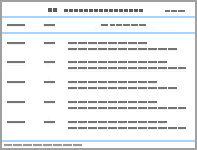
表1
两组基线资料比较"
| 基线指标 | 对照组(n = 167) | 观察组(n = 324) | t/χ2值 | P值 |
|---|---|---|---|---|
| 年龄/岁 | 40.8±18.7 | 44.2±18.5 | -1.992 | 0.052 |
| 性别(男/女)/n | 102/65 | 198/126 | 0.001 | 0.975 |
| 入院GCS评分 | 10.5(8.0, 13.0) | 10.0(7.5, 12.5) | -0.864 | 0.388 |
| 基础疾病(有)/n | 53 | 101 | 0.015 | 0.903 |
| 高血压/n | 32 | 60 | 0.032 | 0.858 |
| 糖尿病/n | 15 | 29 | 0.001 | 0.975 |
| 冠心病/n | 8 | 16 | 0.002 | 0.964 |
| 损伤类型(脑挫裂伤)/n | 98 | 190 | 0.001 | 0.975 |
| 受伤原因(交通事故)/n | 105 | 202 | 0.028 | 0.867 |
| 伤后昏迷(有)/n | 123 | 237 | 0.035 | 0.852 |
表2
两组GOS评分比较"
| GOS | 对照组(n = 167) | 观察组(n = 324) | t/χ2值 | P值 |
|---|---|---|---|---|
| GOS评分 | 3.58±0.80 | 4.12±0.76 | -7.836 | < 0.001 |
| 恢复良好(Ⅴ级)/n | 26 | 86 | 8.924 | 0.003 |
| 中度残疾(Ⅳ级)/n | 52 | 118 | 1.628 | 0.202 |
| 重度残疾(Ⅲ级)/n | 82 | 105 | 14.536 | < 0.001 |
| 植物生存(Ⅱ级)/n | 7 | 15 | 0.068 | 0.794 |
表3
两组DRS评分比较"
| DRS | 对照组(n = 167) | 观察组(n = 324) | t/χ2值 | P值 |
|---|---|---|---|---|
| DRS评分 | 11.56±6.81 | 8.23±5.94 | -6.742 | < 0.001 |
| 无残疾(0~4 分)/n | 31 | 95 | 9.247 | 0.002 |
| 轻度残疾(5~10分)/n | 48 | 127 | 8.351 | 0.004 |
| 中度残疾(11~20分)/n | 65 | 88 | 9.563 | 0.002 |
| 重度残疾(21~30分)/n | 23 | 14 | 17.285 | < 0.001 |
表4
两组并发症发生率比较"
| 并发症 | 对照组(n = 167) | 观察组(n = 324) | χ2值 | P值 |
|---|---|---|---|---|
| 并发症 | 78 | 95 | 18.762 | < 0.001 |
| 肺部感染 | 35 | 42 | 6.583 | 0.010 |
| 尿路感染 | 28 | 31 | 7.245 | 0.007 |
| 下肢静脉血栓 | 16 | 18 | 4.328 | 0.038 |
| 压疮 | 12 | 10 | 6.015 | 0.014 |
| 关节挛缩畸形 | 9 | 6 | 5.871 | 0.015 |
表5
两组保留管路时间比较"
| 保留管路时间 | 对照组(n = 167) | 观察组(n = 324) | t值 | P值 |
|---|---|---|---|---|
| 气管插管保留时间 | 7.8±3.2 | 4.5±2.1 | 11.643 | < 0.001 |
| 胃管保留时间 | 12.5±4.6 | 8.3±3.5 | 10.276 | < 0.001 |
| 尿管保留时间 | 9.6±3.8 | 5.7±2.6 | 11.038 | < 0.001 |
| [1] | 张小年, 张皓, 朱镛连. 创伤性颅脑损伤的流行病学概况[J]. 中国康复理论与实践, 2005, 11(12): 987-988. |
| Zhang X N, Zhang H, Zhu Y L. Epidemiological survey of traumatic brain injury[J]. Chin J Rehabil Theory Pract, 2005, 11(12): 987-988. | |
| [2] | 刘佰运, 张玉琪, 张文. 急性颅脑损伤治疗结果分析[J]. 中国急救医学, 2004, 24(6): 391-393. |
| Liu B Y, Zhang Y Q, Zhang W. Therapeutic effect analysis of acute traumatic brain injury[J]. Chin J Crit Care Med, 2004, 24(6): 391-393. | |
| [3] | 宋振全. 美国急性期和亚急性期脑外伤的康复治疗[J]. 中国临床康复, 2001, 5: 22-23. |
| Song Z Q. Rehabilitation treatment of traumatic brain injury in acute and subacute stage in USA[J]. Chin J Clin Rehabil, 2001, 5: 22-23. | |
| [4] | 王拥军. 建立卒中单元,完成卒中医疗模式的转变[J]. 中国康复医学杂志, 2005, 20: 243. |
| [5] | 张皓, 张小年, 芦海涛. 创伤性颅脑损伤康复治疗患者相关因素的回顾性分析[J]. 中国康复理论与实践, 2005, 11(9): 730-732. |
| Zhang H, Zhang X N, Lu H T. Characters of traumatic brain injury in patients accepted rehabilitation[J]. Chin J Rehabil Theory Pract, 2005, 11(9): 730-732. | |
| [6] | 张皓, 张小年, 张通. 创伤性颅脑损伤患者的长期预后研究[J]. 中华创伤杂志, 2007, 23(4): 244-246. |
| Zhang H, Zhang X N, Zhang T. Study of long-term outcome after traumatic brain injury[J]. Chin J Trauma, 2007, 23(4): 244-246. | |
| [7] | 张皓. 颅脑创伤单元:值得积极倡导的颅脑创伤管理模式[J]. 中华物理医学与康复杂志, 2012, 34(8): 621-623. |
| [8] | 张皓. 中国脑外伤康复专家共识[M]// 中华医学会物理医学与康复学分会. 物理医学与康复学指南与共识. 北京: 人民卫生出版社, 2019. |
| [9] |
Dahdah M N, Barisa M T, Schmidt K, et al. Comparative effectiveness of traumatic brain injury rehabilitation: differential outcomes across TBI model systems centers[J]. J Head Trauma Rehabil, 2014, 29(5): 451-459.
doi: 10.1097/HTR.0b013e3182a61983 pmid: 24052093 |
| [10] |
Alvsåker K, Hanoa R, Gran J M, et al. Impact of rehabilitation in the neurointensive care unit on long-term survival in patients with traumatic brain injury[J]. Acta Anaesthesiol Scand, 2025, 69(4): e70026.
doi: 10.1111/aas.v69.4 |
| [11] |
Fakhry S M, Trask A L, Waller M A, et al. Management of brain-injured patients by an evidence-based medicine protocol improves outcomes and decreases hospital charges[J]. J Trauma, 2004, 56(3): 492-500.
doi: 10.1097/01.TA.0000115650.07193.66 |
| [12] | 江基尧, 朱诚, 罗其中. 颅脑创伤临床救治指南[M]. 5版. 上海: 上海第二军医大学出版社, 2020. |
| [13] | Gil-Jardiné C, Payen J F, Bernard R, et al. Management of patients suffering from mild traumatic brain injury 2023[J]. Anaesth Crit Care Pain Med, 2023, 42(4): 101260. |
| [14] |
Kumar M A, Romero F G, Dharaneeswaran K. Early mobilization in neurocritical care patients[J]. Curr Opin Crit Care, 2020, 26(2): 147-154.
doi: 10.1097/MCC.0000000000000709 pmid: 32068582 |
| [15] |
Alvsåker K, Hanoa R, Olasveengen T M. Selecting patients for early interdisciplinary rehabilitation during neurointensive care after moderate to severe traumatic brain injury[J]. Acta Anaesthesiol Scand, 2023, 67(8): 1069-1078.
doi: 10.1111/aas.14285 pmid: 37259274 |
| [16] |
Maas A I R, Menon D K, Manley G T, et al. Traumatic brain injury: progress and challenges in prevention, clinical care, and research[J]. Lancet Neurol, 2022, 21(11): 1004-1060.
doi: 10.1016/S1474-4422(22)00309-X pmid: 36183712 |
| [17] |
Cuevas-Østrem M, Thorsen K, Wisborg T, et al. Care pathways and factors associated with interhospital transfer to neurotrauma centers for patients with isolated moderate-to-severe traumatic brain injury: a population-based study from the Norwegian trauma registry[J]. Scand J Trauma Resusc Emerg Med, 2023, 31(1): 34.
doi: 10.1186/s13049-023-01097-7 |
| [18] |
Tverdal C, Andelic N, Helseth E, et al. In the aftermath of acute hospitalization for traumatic brain injury: factors associated with the direct pathway into specialized rehabilitation[J]. J Clin Med, 2021, 10(16): 3577.
doi: 10.3390/jcm10163577 |
| [19] |
Rakhit S, Nordness M F, Lombardo S R, et al. Management and challenges of severe traumatic brain injury[J]. Semin Respir Crit Care Med, 2021, 42(1): 127-144.
doi: 10.1055/s-0040-1716493 |
| [20] |
Eapen B C, Bowles A O, Sall J, et al. The management and rehabilitation of post-acute mild traumatic brain injury[J]. Brain Inj, 2022, 36(5): 693-702.
doi: 10.1080/02699052.2022.2033848 |
| [21] |
Mao X, Zhou Y, Chen Q, et al. Clinical management and nursing care for patients with tracheostomy following traumatic brain injury[J]. Front Neurol, 2024, 15: 1455926.
doi: 10.3389/fneur.2024.1455926 |
| [22] | Evans V. Caring for traumatic brain injury patients: australian nursing perspectives[J]. Crit Care Nurs Clin North Am, 2021, 33(1): 21-36. |
| [23] |
Clark D, Joannides A, Adeleye A O, et al.; Global Neurotrauma Outcomes Study Collaborative. Casemix, management, and mortality of patients receiving emergency neurosurgery for traumatic brain injury in the Global Neurotrauma Outcomes Study: a prospective observational cohort study[J]. Lancet Neurol, 2022, 21(5): 438-449.
doi: 10.1016/S1474-4422(22)00037-0 pmid: 35305318 |
| [24] | Kreitzer N, Rath K, Kurowski B G, et al. Rehabilitation practices in patients with moderate and severe traumatic brain injury[J]. J Head Trauma Rehabil, 2019, 34(5): e66-e72. |
| [25] | Dénes Z, Masát O. [Rehabilitation results after severe traumatic brain injury][J]. [in Hungarian] Ideggyogy Sz, 2022, 75(1/2): 31-37. |
| [26] |
Elser H, Gottesman R F, Walter A E, et al. Head injury and long-term mortality risk in community-dwelling adults[J]. JAMA Neurol, 2023, 80(3): 260-269.
doi: 10.1001/jamaneurol.2022.5024 pmid: 36689218 |
| [27] |
Greenwald B D, Harris K A, Ayyala H, et al. Community reintegration after traumatic brain injury[J]. Phys Med Rehabil Clin N Am, 2024, 35(3): 637-650.
doi: 10.1016/j.pmr.2024.02.012 pmid: 38945656 |
| [28] |
Nguyen M V, Hackman D E, Truitt A R. Vocational outcomes of service members and veterans after traumatic brain injury: a scoping review[J]. J Head Trauma Rehabil, 2022, 37(6): e467-e487.
doi: 10.1097/HTR.0000000000000747 |
| [29] |
Waltzman D, Haarbauer-Krupa J, Womack L S. Traumatic brain injury in older adults: a public health perspective[J]. JAMA Neurol, 2022, 79(5): 437-438.
doi: 10.1001/jamaneurol.2022.0114 pmid: 35285868 |
| [30] |
Cnossen M, Lingsma H, Tenovuo O, et al. Rehabilitation after traumatic brain injury: a survey in 70 European neurotrauma centres participating in the CENTER-TBI study[J]. J Rehabil Med, 2017, 49(5): 395-401.
doi: 10.2340/16501977-2216 pmid: 28440841 |
| [31] | 吕春玲. 颅脑创伤单元模式下分期康复护理指导对偏瘫患者的康复疗效[J]. 国际医药卫生导报, 2017, 23(24): 3946-3949. |
| Lü C L. The effect of staged rehabilitation nursing instruction on patients with hemiplegia under craniocerebral trauma unit model[J]. Int J Med Health Guid, 2017, 23(24): 3946-3949. | |
| [32] |
Yang C, Ma Y, Xie L, et al. Intracranial pressure monitoring in the intensive care unit for patients with severe traumatic brain injury: analysis of the CENTER-TBI China Registry[J]. Neurocrit Care, 2022, 37(1): 160-171.
doi: 10.1007/s12028-022-01463-w pmid: 35246788 |
| [33] |
Buh F C, Hutchinson P J A, Anwar F. Early neuro-rehabilitation in traumatic brain injury: the need for an African perspective[J]. BMC Med, 2023, 21(1): 290.
doi: 10.1186/s12916-023-03009-z pmid: 37542228 |
| [34] |
Baxter P. Acute and chronic management of traumatic brain injury[J]. Dev Med Child Neurol, 2013, 55(8): 680.
doi: 10.1111/dmcn.12196 pmid: 23834202 |
| [35] |
Hassett L. Physiotherapy management of moderate-to-severe traumatic brain injury[J]. J Physiother, 2023, 69(3): 141-147.
doi: 10.1016/j.jphys.2023.05.015 pmid: 37286387 |
| [36] | Poblete R A, Yaceczko S, Aliakbar R, et al. Optimization of nutrition after brain injury: mechanistic and therapeutic considerations[J]. Biomedicine, 2023, 11(9): 2551. |
| [37] |
Li Y, Liu C, Xiao W, et al. Incidence, risk factors, and outcomes of ventilator-associated pneumonia in traumatic brain injury: a meta-analysis[J]. Neurocrit Care, 2020, 32(1): 272-285.
doi: 10.1007/s12028-019-00773-w pmid: 31300956 |
| [38] |
Jafari A A, Shah M, Mirmoeeni S, et al. Paroxysmal sympathetic hyperactivity during traumatic brain injury[J]. Clin Neurol Neurosurg, 2022, 212: 107081.
doi: 10.1016/j.clineuro.2021.107081 |
| [39] |
Estraneo A, Briand M M, Noé E. Medical comorbidities in patients with prolonged disorder of consciousness: a narrative review[J]. NeuroRehabilitation, 2024, 54(1): 61-73.
doi: 10.3233/NRE-230130 pmid: 38217620 |
| [40] |
Kowalski R G, Hammond F M, Weintraub A H, et al. Recovery of consciousness and functional outcome in moderate and severe traumatic brain injury[J]. JAMA Neurol, 2021, 78(5): 548-557.
doi: 10.1001/jamaneurol.2021.0084 pmid: 33646273 |
| [41] |
Xie E, Pellegrini M, Chen Z, et al. The influence of substance use on traumatic brain injury recovery and rehabilitation outcomes: the outcome-ABI study[J]. Arch Phys Med Rehabil, 2023, 104(7): 1115-1123.
doi: 10.1016/j.apmr.2023.03.015 |
| [42] |
Andelic N, Bautz-Holter E, Ronning P, et al. Does an early onset and continuous chain of rehabilitation improve the long-term functional outcome of patients with severe traumatic brain injury?[J]. J Neurotrauma, 2012, 29(1): 66-74.
doi: 10.1089/neu.2011.1811 |
| [43] |
Riberholt C G, Olsen M H, Søndergaard C B, et al. Early orthostatic exercise by head-up tilt with stepping vs. standard care after severe traumatic brain injury is feasible[J]. Front Neurol, 2021, 12: 626014.
doi: 10.3389/fneur.2021.626014 |
| [44] |
Borgen I M H, Røe C, Brunborg C, et al. CENTER-TBI participants investigators. Care transitions in the first 6 months following traumatic brain injury: lessons from the CENTER-TBI study[J]. Ann Phys Rehabil Med, 2021, 64(6): 101458.
doi: 10.1016/j.rehab.2020.10.009 |
| [1] | 魏彤彤, 田益凡, 陈婷, 姚琦, 胡建民. ICF在视力障碍康复中应用的Scoping综述[J]. 《中国康复理论与实践》, 2026, 32(9): 1025-1032. |
| [2] | 冯晓娟, 黄富表, 李冬跃, 周明毅, 牛宇轩, 麦格皮热提·伊斯马伊力, 王曦贤, 王子乐. 一种自稳式家用手功能互动训练装置的研发及可行性研究[J]. 《中国康复理论与实践》, 2026, 32(9): 1068-1077. |
| [3] | 周慧玲, 曾嘉彦, 陈冰. 轻度伤残职业康复者生活质量状况及其与不同层次复工结局的关联[J]. 《中国康复理论与实践》, 2026, 32(9): 1078-1086. |
| [4] | 郭旭霞, 虞恒睿, 卢宇澄, 杨思创, 龙雨, 李佳蔚, 陈琳, 农飞玉, 龙耀斌. 基于感知-认知解耦的可解释人工智能运动康复评估系统设计与验证[J]. 《中国康复理论与实践》, 2026, 32(9): 1108-1116. |
| [5] | 中国康复医学会青年工作委员会, 中国微循环学会周围血管委员会淋巴水肿专家委员会, 中国抗癌协会肿瘤康复整合护理专业专委会, 中国康复医学会社区康复工作委员会. 乳腺癌术后腋网综合征治疗与管理规范中国专家共识(2025)[J]. 《中国康复理论与实践》, 2026, 32(8): 869-881. |
| [6] | 中国康复医学会青年工作委员会, 中国微循环学会周围血管委员会淋巴水肿专家委员会, 中国抗癌协会肿瘤康复整合护理专业委员会. 乳腺癌术后腋网综合征识别与诊断标准中国专家共识[J]. 《中国康复理论与实践》, 2026, 32(8): 882-891. |
| [7] | 梁艳华, 张通, 张琦, 周天添, 张燕庆, 岳青, 李思佳. 康复机器人训练对偏瘫儿童腹肌厚度和平衡能力的效果[J]. 《中国康复理论与实践》, 2026, 32(8): 927-937. |
| [8] | 田靖晓, 艾佳茗, 闵红巍, 赵克聪, 张宝翠, 姜虹, 杨威, 刘均娥. 基于每日目标管理路径的全膝关节置换术患者运动干预方案的构建及初步验证[J]. 《中国康复理论与实践》, 2026, 32(8): 959-967. |
| [9] | 刘华, 马欣, 李静, 王丽媛, 王丽. 基于康复胜任力的运动康复专业硕士研究生培养方案比较[J]. 《中国康复理论与实践》, 2026, 32(8): 984-992. |
| [10] | 李锦萌, 柳君娜, 陈强, 毕鸿雁. 2011年至2025年远程医疗、可穿戴设备和人工智能在慢性阻塞性肺疾病肺康复中应用的文献计量分析[J]. 《中国康复理论与实践》, 2026, 32(7): 829-840. |
| [11] | 张溢杉, 宋佳佳, 侯天宇, 孟丽君. 康复工程中的伦理挑战与治理前瞻[J]. 《中国康复理论与实践》, 2026, 32(7): 861-868. |
| [12] | 李欣源, 郑洁皎, 张廷宇, 吴雪娇, 梁晓笑. 间歇性θ脉冲刺激改善脑卒中患者下肢运动和平衡功能的Meta分析[J]. 《中国康复理论与实践》, 2026, 32(6): 631-644. |
| [13] | 郭子扬, 曹明. 1987年至2025年残疾人社区康复研究的文献计量分析[J]. 《中国康复理论与实践》, 2026, 32(6): 665-676. |
| [14] | 魏永利, 丁军航, 周平, 杨小满, 王贞, 于福杰, 段芳芳, 管恩京. 基于世界卫生组织康复胜任力架构构建康复工程本科专业课程体系[J]. 《中国康复理论与实践》, 2026, 32(6): 731-738. |
| [15] | 安娜, 陈迪, 杨亚茹, 邱卓英, 王忠彦. 基于ICF的数字赋能乡村残疾人精准康复服务研究[J]. 《中国康复理论与实践》, 2026, 32(5): 604-610. |
| 阅读次数 | ||||||
|
全文 |
|
|||||
|
摘要 |
|
|||||
|
||
