



《中国康复理论与实践》 ›› 2026, Vol. 32 ›› Issue (8): 916-926.doi: 10.3969/j.issn.1006-9771.2026.08.005
刘姗1, 许坤尧1, 周芷萌1, 周凌云2, 曾茂3, 何莎4, 代洛阳4, 覃婷4, 胡庆林4, 杨家海1, 李蕊4( )
收稿日期:2026-05-19
修回日期:2026-07-21
接受日期:2026-07-30
出版日期:2026-08-25
发布日期:2026-08-25
通讯作者:
李蕊,E-mail: 463036433@qq.com作者简介:刘姗(1999-),女,汉族,贵州毕节市人,硕士研究生,主要研究方向:中西医结合神经康复、脑卒中后功能障碍康复、老年病学研究。基金资助:
Liu Shan1, Xu Kunyao1, Zhou Zhimeng1, Zhou Lingyun2, Zeng Mao3, He Sha4, Dai Luoyang4, Qin Ting4, Hu Qinglin4, Yang Jiahai1, Li Rui4()
Received:2026-05-19
Revised:2026-07-21
Accepted:2026-07-30
Published:2026-08-25
Online:2026-08-25
Contact:
Li Rui,E-mail: 463036433@qq.comSupported by:摘要:
目的 采用网状Meta分析(NMA)系统对比各类电磁刺激方案对脑卒中患者手功能和日常生活活动能力的疗效,筛选最优康复刺激方案。
方法 严格遵循PRISMA-NMA规范,系统检索中国知网、万方、维普、中国生物医学文献数据库、PubMed、Web of Science和Embase数据库,检索时限为各数据库建库至2026年4月,纳入对比不同电磁刺激方案改善脑卒中后手功能和日常生活活动能力的随机对照试验(RCT)。采用Cochrane偏倚风险工具和PEDro量表进行文献质量评价,采用GRADE系统对Fugl-Meyer评定量表上肢部分(FMA-UE)和改良Barthel指数(MBI)进行证据分级;进行文献筛选、数据提取和偏倚风险评价;采用RevMan 5.4和Stata 17.0进行Meta分析和NMA。
结果 最终纳入22项RCT,涵盖17种单一/联合电磁刺激方案。纳入研究PEDro评分6~10分。改善FMA-UE评分最好的前5位方案为重复外周磁刺激(rPMS)+重复经颅磁刺激(rTMS)、间歇性θ爆发刺激(iTBS)+rPMS、iTBS+经颅直流电刺激(tDCS)、经皮穴位电刺激(TEAS)、对侧控制功能性电刺激(CCFES);改善MBI评分的方案最好的是tDCS,以下依次为TEAS、iTBS+rPMS。FMA-UE、MBI结局指标证据等级均为中等,漏斗图提示发表偏倚风险较低,网状模型一致性检验结果良好。
结论 电磁刺激可有效促进脑卒中后偏瘫患者上肢运动功能重建、提升日常生活活动能力;中枢-外周联合磁刺激方案对改善上肢运动功能效果最优,tDCS对提升患者日常生活活动能力更具优势。
中图分类号:
刘姗, 许坤尧, 周芷萌, 周凌云, 曾茂, 何莎, 代洛阳, 覃婷, 胡庆林, 杨家海, 李蕊. 不同电磁刺激方案对脑卒中患者手功能及日常生活活动能力效果的网状Meta分析[J]. 《中国康复理论与实践》, 2026, 32(8): 916-926.
Liu Shan, Xu Kunyao, Zhou Zhimeng, Zhou Lingyun, Zeng Mao, He Sha, Dai Luoyang, Qin Ting, Hu Qinglin, Yang Jiahai, Li Rui. Effects of different electromagnetic stimulation protocols on hand function and activities of daily living for stroke patients: a network meta-analysis[J]. Chinese Journal of Rehabilitation Theory and Practice, 2026, 32(8): 916-926.

表1
PICO架构"
| 人群(Population) | 干预(Intervention) | 比较(Comparison) | 结局(Outcome) |
|---|---|---|---|
| 脑卒中(8B20)患者 | 干预措施 | 不同干预方式比较 | FMA-UE |
| 首次发病 | 常规康复 | 干预组与对照组比较 | b7神经肌肉骨骼和运动相关功能 |
| 单侧上肢运动功能障碍 | 各类电磁刺激 | MBI | |
| d4行动能力 | |||
| d440精细手的使用 | |||
| d445手和手臂的使用 | |||
| d5自我照顾 | |||
| d6家庭生活 | |||
| b760随意运动控制功能 |
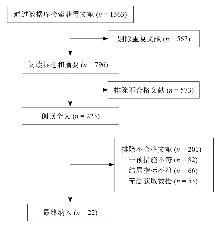
图1
文献筛选流程图"

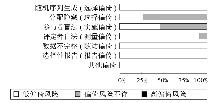
图2
偏倚风险比例"
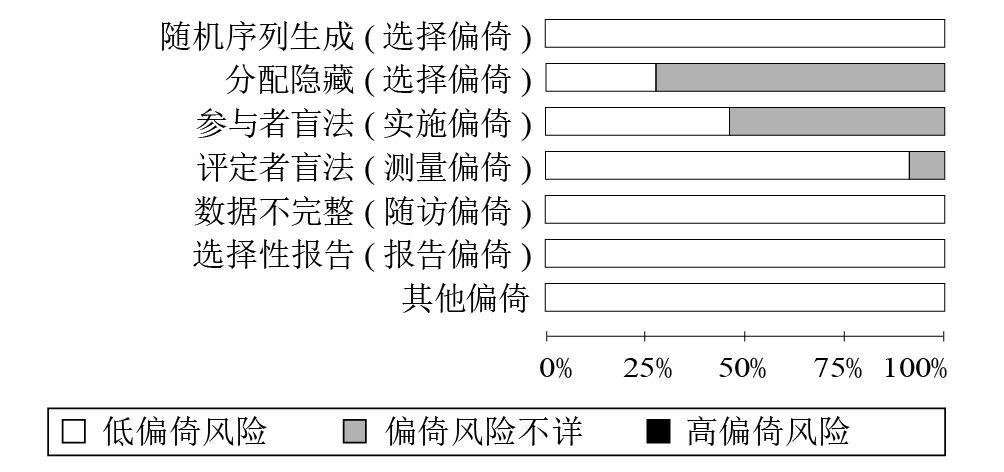
表2
纳入文献的PEDro量表评分"
| 纳入文献 | 资格标准 | 随机分配 | 分配隐藏 | 基线均衡 | 被试施盲盲 | 治疗师施盲 | 评估者施盲 | 被试流失率≤15% | 意向性分析 | 组间统计比较 | 点估计与变异性测量 | 总分 |
|---|---|---|---|---|---|---|---|---|---|---|---|---|
| Tosun等[ | √ | √ | √ | √ | √ | √ | √ | √ | 7 | |||
| Chen等[ | √ | √ | √ | √ | √ | √ | √ | √ | 7 | |||
| Allman等[ | √ | √ | √ | √ | √ | √ | √ | √ | √ | √ | 9 | |
| Wu等[ | √ | √ | √ | √ | √ | √ | √ | √ | √ | √ | 9 | |
| Shim等[ | √ | √ | √ | √ | √ | √ | √ | 6 | ||||
| Luk等[ | √ | √ | √ | √ | √ | √ | √ | √ | √ | √ | 9 | |
| Alwhaibi等[ | √ | √ | √ | √ | √ | √ | √ | 6 | ||||
| Jiang等[ | √ | √ | √ | √ | √ | √ | √ | √ | 7 | |||
| Huang等[ | √ | √ | √ | √ | √ | √ | √ | √ | √ | √ | 9 | |
| Wang等[ | √ | √ | √ | √ | √ | √ | √ | √ | 7 | |||
| Shen等[ | √ | √ | √ | √ | √ | √ | √ | √ | 7 | |||
| Chen等[ | √ | √ | √ | √ | √ | √ | √ | √ | 7 | |||
| Yang等[ | √ | √ | √ | √ | √ | √ | √ | √ | 7 | |||
| Tang等[ | √ | √ | √ | √ | √ | √ | √ | √ | √ | √ | √ | 10 |
| 陈瑶等[ | √ | √ | √ | √ | √ | √ | √ | √ | 7 | |||
| 马明等[ | √ | √ | √ | √ | √ | √ | √ | √ | √ | 8 | ||
| 吴朝阳等[ | √ | √ | √ | √ | √ | √ | √ | √ | 7 | |||
| 肖长林等[ | √ | √ | √ | √ | √ | √ | √ | √ | 7 | |||
| 谢晶军等[ | √ | √ | √ | √ | √ | √ | √ | √ | 7 | |||
| 俞风云等[ | √ | √ | √ | √ | √ | √ | √ | √ | 7 | |||
| 张永卿[ | √ | √ | √ | √ | √ | √ | √ | √ | 7 | |||
| 赵利娜等[ | √ | √ | √ | √ | √ | √ | √ | √ | √ | 8 |
表3
纳入文献基本特征"
| 纳入文献 | 样本量(男/女)/n | 年龄/岁 | 病程/d | 干预措施 | 干预时间/周 | 随访时间/周 | 不良 反应 | 结局指标 | |||||
|---|---|---|---|---|---|---|---|---|---|---|---|---|---|
| T | C | T | C | T | C | T | C | ||||||
| Tosun等[ | T1 | 6/3 | 5/4 | 57.6±12.6 | 61.3±10.1 | 49.3±43.6 | 47.2±41.1 | rTMS | 常规康复 | 4 | 0 | 无 | ① |
| T2 | 3/4 | 56.0±10.1 | 59.6±58.3 | rTMS+NMES | |||||||||
| Chen等[ | 9/3 | 7/5 | 62.1±15.6 | 65.9±14.0 | 607.5±442.2 | 540.0±522.6 | tDCS+iTBS | 常规康复 | 6 | 0 | 两组各1例恶心 | ① | |
| Allman等[ | 8/3 | 9/4 | 59.5±12.1 | 66.8±10.4 | 1536±1002 | 1698±1194 | tDCS | 常规康复 | 10 d | 12 | 无 | ① | |
| Wu等[ | 34/11 | 35/10 | 45.9±11.2 | 49.3±12.6 | 147±90 | 147±87 | tDCS | 常规康复 | 4 | 4 | 无 | ①② | |
| Shim等[ | 7/7 | 11/5 | 67.3±10.8 | 63.6±16.1 | 107.1±41.7 | 91.8±46.8 | rTMS | 常规康复 | 4 | 0 | 无 | ①② | |
| Luk等[ | 7/5 | 7/5 | 67.3±5.8 | 65.1±3.1 | 95.2±42.7 | 105.7±49.0 | rTMS | 常规康复 | 2 | 10 | 无 | ① | |
| Alwhaibi等[ | 8/12 | 11/9 | 52.5±4.9 | 51.8±5.7 | 666.3±92.1 | 636.6±62.7 | TENS | 常规康复 | 6 | 0 | 无 | ① | |
| Jiang等[ | T1 | 11/7 | 59.8±5.3 | 10.5±1.7 | iTBS | 4 | 0 | 无 | ①② | ||||
| T2 | 12/7 | 59.4±4.6 | 11.4±1.4 | rPMS | |||||||||
| T3 | 11/8 | 60.4±4.6 | 10.7±1.5 | iTBS+rPMS | |||||||||
| Huang等[ | T1 | 18/7 | 56.2±12.2 | 43.9±33.4 | CCFES | 3 | 0 | 无 | ① | ||||
| T2 | 16/9 | 60.4±11.3 | 46.3±33.1 | NMES | |||||||||
| Wang等[ | 18/2 | 15/5 | 55.0±11.0 | 57.0±11.0 | 96.0±61.2 | 124.5±48.0 | taVNS | 常规康复 | 4 | 0 | 无 | ①② | |
| Shen等[ | T1 | 24/6 | 59.7±15.2 | 49.7±30.4 | CCFES | 3 | 0 | 无 | ① | ||||
| T2 | 20/10 | 60.9±13.5 | 45.3±35.6 | NMES | |||||||||
| Chen等[ | 7/4 | 7/4 | 52.9±11.1 | 52.6±8.3 | ≥ 180 | iTBS | 常规康复 | 2 | 0 | 无 | ① | ||
| Yang等[ | T1 | 16/4 | 52.5±8.0 | 113.3±23.5 | rTMS+FES | 2 | 0 | 无 | ① | ||||
| T2 | 12/8 | 54.9±11.6 | 109.7±13.4 | rTMS | |||||||||
| T3 | 13/7 | 57.9±10.5 | 109.9±12.8 | FES | |||||||||
| Tang等[ | T1 | 12/3 | 12/2 | 50.6±13.4 | 53.57±9.77 | 108.6±119.4 | 83.7±49.5 | iTBS | 常规康复 | 3 | 0 | 无 | ①② |
| T2 | 11/3 | 48.4±12.6 | 134.7±154.2 | cTBS | |||||||||
| 陈瑶等[ | 19/7 | 20/7 | 60.8±16.6 | 60.45±11.25 | 275.95±59.11 | 271.43±74.01 | TEAS | 常规康复 | 6 | 6 | 无 | ①② | |
| 马明等[ | 22/8 | 21/9 | 55.9±8.8 | 57.0±9.7 | 168.0±51.0 | 174.0±57.0 | rPMS | 常规康复 | 4 | 0 | 无 | ①② | |
| 吴朝阳等[ | 12/8 | 13/7 | 64.9±12.1 | 64.1±11.9 | 41.3±22.9 | 44.3±20.2 | NMES | 常规康复 | 4 | 0 | 无 | ①② | |
| 肖长林等[ | 8/5 | 8/6 | 59.1±9.3 | 60.9±10.2 | 71.8±28.0 | 74.7±40.3 | rTMS | 常规康复 | 2 | 0 | rTMS组3例刺激部位疼痛 | ①② | |
| 谢晶军等[ | 23/19 | 24/16 | 50.4±10.8 | 49.68±10.52 | 40.28±9.28 | 41.95±10.88 | TEAS | 常规康复 | 4 | 0 | 无 | ①② | |
| 俞风云等[ | T1 | 11/2 | 12/2 | 55.9±6.7 | 55.57±9.43 | 85.08±50.41 | 81.86±47.99 | rPMS | 常规康复 | 2 | 0 | 无 | ①② |
| T2 | 12/3 | 51.6±12.8 | 74.27±42.50 | iTBS | |||||||||
| 张永卿[ | T1 | 16/4 | 16/4 | 57.9±9.3 | 55.6±12.4 | 55.5±42.6 | 52.9±35.3 | rTMS | 常规康复 | 2 | 0 | rTMS组1例头痛 | ①② |
| T2 | 17/3 | 55.5±10.7 | 55.2±46.9 | rTMS+rPMS | |||||||||
| 赵利娜等[ | 15/5 | 14/6 | 57.7±9.5 | 55.5±13.2 | 54.1±14.3 | 52.1±13.8 | rTMS | 常规康复 | 10 d | 4 | rTMS组1例轻微头晕及呕吐 | ① | |
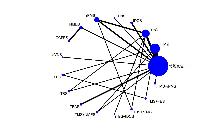
图3
FMA-UE的网络证据图"
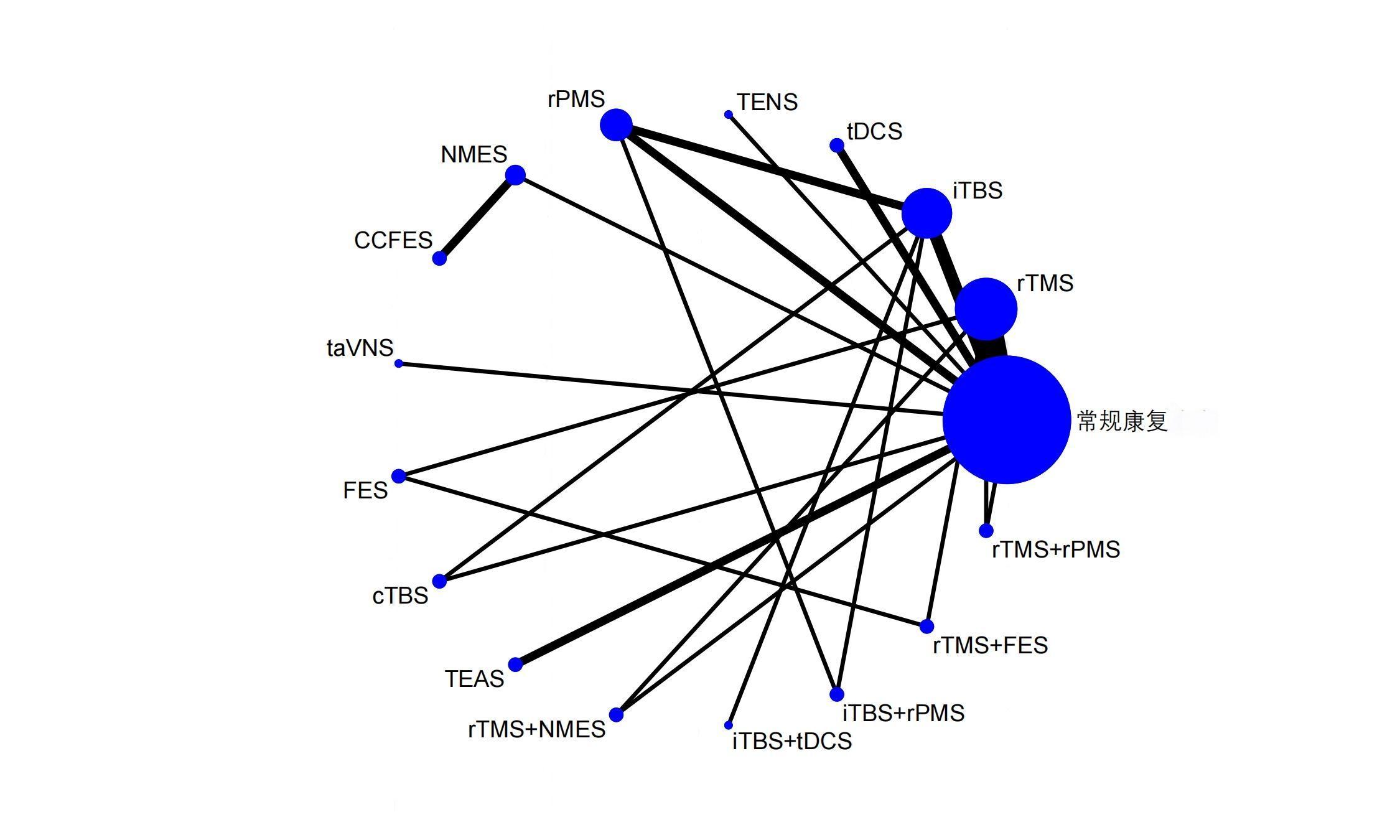
表4
FMA-UE的一致性检验结果"
| 干预方法 | IF | P | 95%CI | I² |
|---|---|---|---|---|
| 常规康复-rTMS-TEAS | 14.037 | 0.135 | 0.00~32.42 | 8.471 |
| 常规康复-iTBS-FES | 5.492 | 0.131 | 0.00~12.62 | 0.000 |
| 常规康复-iTBS-TENS | 2.754 | 0.374 | 0.00~8.82 | 2.472 |
| iTBS-TENS-rTMS+rPMS | 1.900 | 0.564 | 0.00~8.35 | 0.000 |
| 常规康复-rTMS-iTBS+rPMS | 1.363 | 0.865 | 0.00~17.13 | 12.024 |
表5
FMA-UE的累积概率"
| 干预方法 | SUCRA | PrBest | 干预方法 | SUCRA | PrBest | 干预方法 | SUCRA | PrBest |
|---|---|---|---|---|---|---|---|---|
| rTMS+rPMS | 84.2 | 31.2 | rTMS+FES | 57.9 | 1.9 | rPMS | 35.6 | 0.0 |
| iTBS+rPMS | 82.7 | 19.8 | taVNS | 56.8 | 4.5 | rTMS | 30.7 | 0.0 |
| iTBS+tDCS | 75.1 | 23.9 | tDCS | 52.6 | 0.9 | FES | 27.6 | 0.0 |
| TEAS | 73.2 | 3.3 | iTBS | 47.3 | 0.0 | TENS | 11.3 | 0.0 |
| CCFES | 66.4 | 9.2 | NMES | 46.4 | 0.2 | 常规康复 | 5.2 | 0.0 |
| cTBS | 59.2 | 1.2 | rTMS+NMES | 37.4 | 3.9 |
图4
MBI的网络证据图"
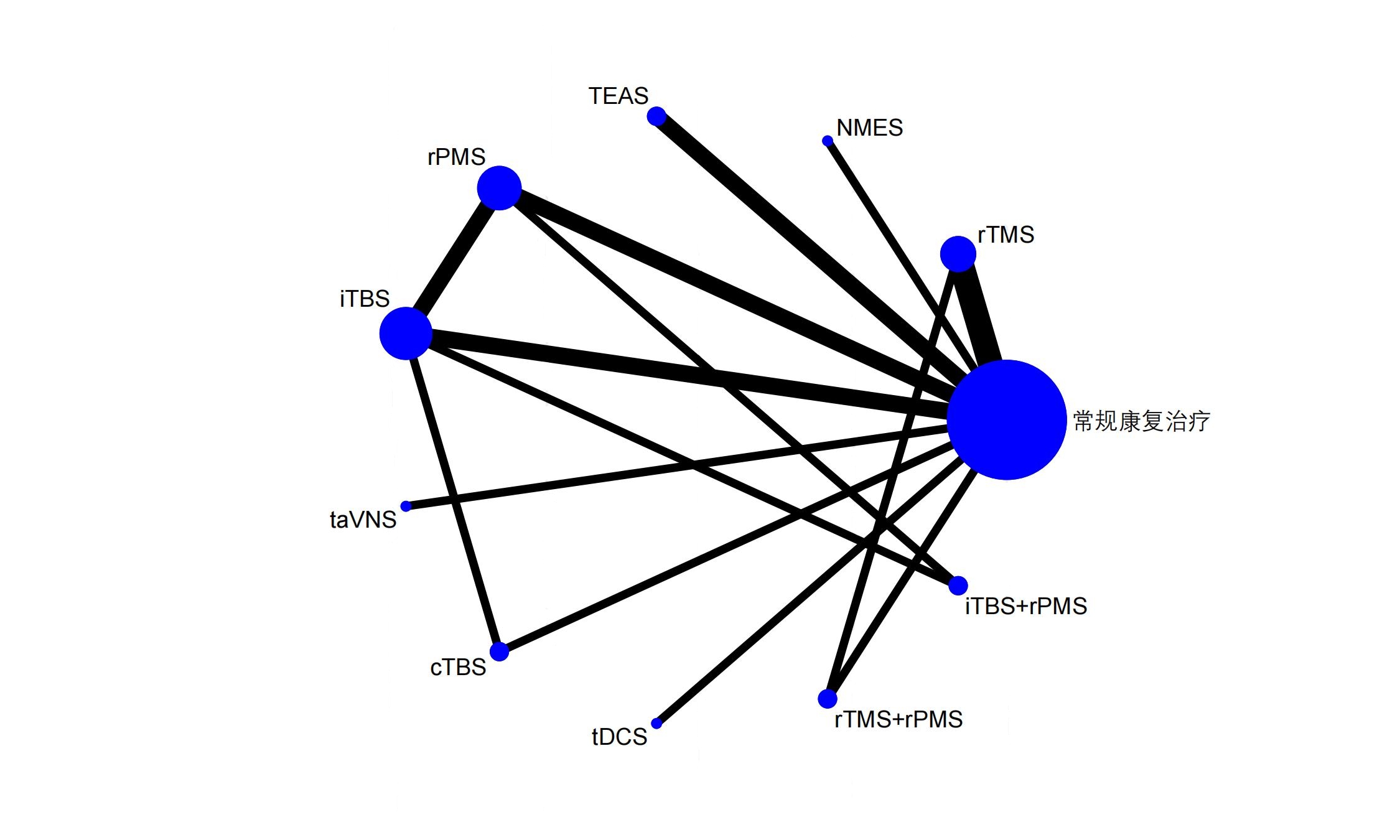
表6
MBI的一致性检验结果"
| 干预方法 | IF | P | 95%CI | I² |
|---|---|---|---|---|
| 常规康复-iTBS-iTBS+rPMS | 1.650 | 0.804 | 0.00~14.71 | 0.000 |
| 常规康复-rTMS-tDCS | 1.016 | 0.909 | 0.00~18.43 | 0.000 |
| rPMS-iTBS-rTMS+rPMS | 0.840 | 0.712 | 0.00~5.30 | 0.000 |
| 常规康复-rPMS-iTBS | 0.271 | 0.907 | 0.00~4.84 | 0.000 |
表7
MBI的累积概率"
| 干预方法 | SUCRA | PrBest | 干预方法 | SUCRA | PrBest |
|---|---|---|---|---|---|
| tDCS | 98.0 | 87.6 | iTBS | 41.0 | 0.0 |
| TEAS | 81.1 | 5.2 | rPMS | 37.2 | 0.0 |
| iTBS+rPMS | 73.2 | 2.1 | cTBS | 36.1 | 0.3 |
| NMES | 60.3 | 2.0 | rTMS | 12.0 | 0.0 |
| taVNS | 52.9 | 0.3 | 常规康复 | 10.3 | 0.0 |
| rTMS+rPMS | 47.8 | 2.5 |
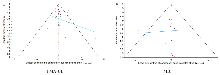
图5
发表偏倚漏斗图"
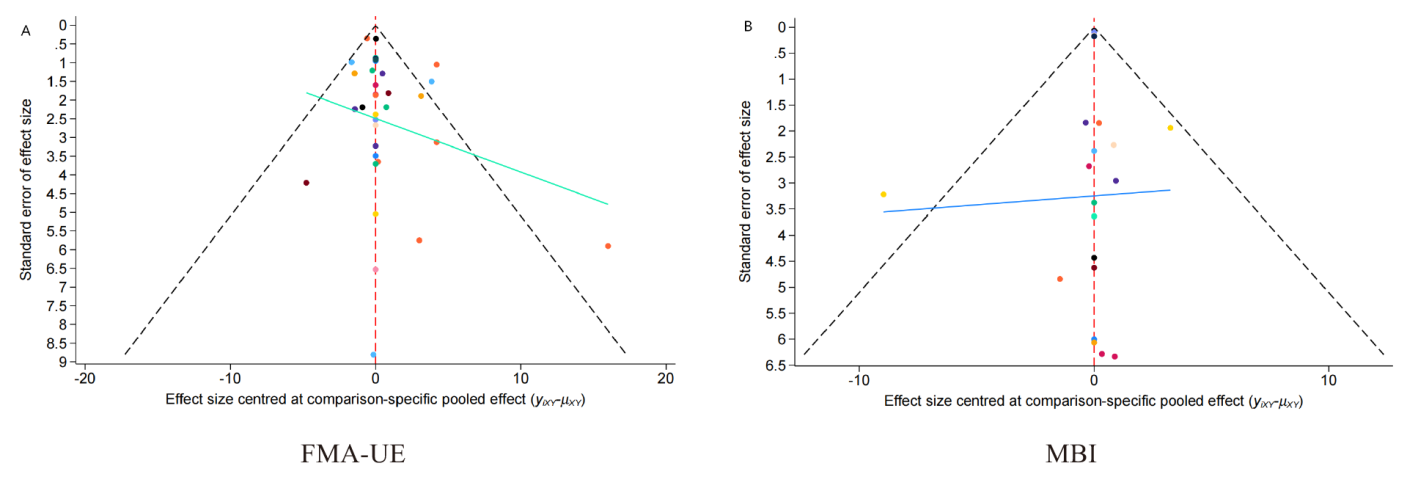
表8
GRADE证据等级"
| 结局指标 | 偏倚风险 | 不一致性 | 间接性 | 不精确性 | 发表偏倚 | 证据质量 |
|---|---|---|---|---|---|---|
| FMA-UE | -1 | 0 | 0 | 0 | 0 | 中 |
| MBI | -1 | 0 | 0 | 0 | 0 | 中 |
| [1] | 《中国脑卒中防治报告2021》编写组. 《中国脑卒中防治报告2021》概要[J]. 中国脑血管病杂志, 2023, 20(11): 783-792. |
| Special Writing Group of China Stroke Surveillance Report. Brief report on stroke prevention and treatment in China, 2021[J]. Chin J Cerebrovasc Dis, 2023, 20(11): 783-792. | |
| [2] |
Li Y, Lian Y, Chen X, et al. Effect of task-oriented training assisted by force feedback hand rehabilitation robot on finger grasping function in stroke patients with hemiplegia: a randomised controlled trial[J]. J Neuroeng Rehabil, 2024, 21(1): 77.
doi: 10.1186/s12984-024-01372-3 pmid: 38745227 |
| [3] | 凌骏麒, 蒋留军, 白玉龙. 腕-手矫形器在脑卒中患者手功能障碍康复治疗中的应用研究进展[J]. 上海医药, 2023, 44(13): 48-51, 109. |
| Ling J Q, Jiang L J, Bai Y L, et al. Research progress in the application of wrist-hand orthosis in the rehabilitation of stroke patients with hand dysfunction[J]. Shanghai Med Pharm J, 2023, 44(13): 48-51, 109. | |
| [4] |
李京斌, 崔向红, 佟明杰, 等. 脑卒中后手功能障碍康复治疗的进展[J]. 中国疗养医学, 2024, 33(2): 54-58.
doi: 10.13517/j.cnki.ccm.2024.02.011 |
| Li J B, Cui X H, Tong M J, et al. Progress in rehabilitation treatment of hand dysfunction after stroke[J]. Chin J Convalescent Med, 2024, 33(2): 54-58. | |
| [5] | 刘永香, 严璐, 张沙沙, 等. 脑卒中后偏瘫侧手功能康复的研究进展[J]. 医学研究与教育, 2025, 42(3): 16-21. |
| Liu Y X, Yan L, Zhang S S, et al. Advances on rehabilitation of hemiplegic side hand function after stroke[J]. Med Res Educ, 2025, 42(3): 16-21. | |
| [6] | 降锦洲, 余方向, 刘喆宇, 等. 脑卒中后手痉挛康复治疗的研究进展[J]. 中国老年学杂志, 2025, 45(7): 1750-1754. |
| [7] | 王智达, 马金娜. 针刺及电刺激治疗中风后功能障碍的研究进展[J]. 中国现代医学杂志, 2026, 36(1): 56-63. |
| Wang Z D, Ma J N. Research progress on acupuncture and electrical stimulation in the treatment of post-stroke functional impairments[J]. Chin J Mod Med, 2026, 36(1): 56-63. | |
| [8] | 吴毅. 重复经颅磁刺激在脑卒中康复中的临床应用与作用机制的研究进展[J]. 中国康复医学杂志, 2023, 38(2): 147-150. |
| [9] | 胡双风, 陈颖, 马强, 等. 水疗联合经颅直流电刺激对脑卒中恢复期手功能障碍的疗效观察[J]. 中南医学科学杂志, 2026, 54(1): 154-156, 166. |
| Hu S F, Chen Y, Ma Q, et al. Efficacy of hydrotherapy combined with transcranial direct current stimulation on hand dysfunction in stroke patients during recovery phase[J]. Med Sci J Cent South China, 2026, 54(1): 154-156, 166. | |
| [10] | 丁玲, 姚倩, 孙洪琼, 等. 经皮穴位电刺激对脑卒中患者手功能康复疗效的Meta分析[J]. 中国民族民间医药, 2025, 34(14): 108-114, 118. |
| Ding L, Yao Q, Sun H Q, et al. Therapeutic effect of transcutaneous electrical acupoint stimulation on hand dysfunction after stroke: a meta-analysis[J]. Chin J Ethnomed Ethnopharm, 2025, 34(14): 108-114, 118. | |
| [11] | 李若薇, 夏渊, 李永杰, 等. 不同刺激方式的经颅直流电刺激对脑卒中患者上肢运动功能和日常生活活动能力的影响:网状Meta分析[J]. 中国康复医学杂志, 2023, 38(3): 394-402. |
| [12] |
Lin X, Li H, Chen N, et al. Network meta-analysis of 4 rehabilitation methods with rTMS on upper limb function and daily activities in patients with stroke[J]. Stroke, 2025, 56(9): 2644-2657.
doi: 10.1161/STROKEAHA.124.049546 |
| [13] | World Health Organization. International Classification of Diseases 11th revision[EB/OL]. (2019-10-17) [2025-06-16]. https://icd.who.int/browse11/l-m/en. |
| [14] | 世界卫生组织. 国际功能、残疾和健康分类(国际中文增补版)[M]. 邱卓英,译. 日内瓦: 世界卫生组织, 2015. |
| World Health Organization. International Classification of Functioning, Disability and Health (Chinese supplementary version)[M]. Qiu Z Y, trans. Geneva: World Health Organization, 2015. | |
| [15] |
Jackson D, Turner R. Power analysis for random-effects meta-analysis[J]. Res Synth Methods, 2017, 8(3): 290-302.
doi: 10.1002/jrsm.1240 pmid: 28378395 |
| [16] |
Hutton B, Salanti G, Caldwell D M, et al. The PRISMA extension statement for reporting of systematic reviews incorporating network meta-analyses of health care interventions: checklist and explanations[J]. Ann Intern Med, 2015, 162(11): 777-784.
doi: 10.7326/M14-2385 pmid: 26030634 |
| [17] | 中华医学会神经病学分会, 中华医学会神经病学分会脑血管病学组. 中国急性缺血性卒中诊治指南2023[J]. 中华神经科杂志, 2024, 57(6): 523-559. |
| Chinese Society of Neurology, Chinese Stroke Society. Chinese guidelines for diagnosis and treatment of acute ischemic stroke 2023[J]. Chin J Neurol, 2024, 57(6): 523-559. | |
| [18] |
Maher C G, Sherrington C, Herbert R D, et al. Reliability of the PEDro scale for rating quality of randomized controlled trials[J]. Phys Ther, 2003, 83(8): 713-721.
pmid: 12882612 |
| [19] |
Guyatt G H, Oxman A D, Schünemann H J, et al. GRADE guidelines: a new series of articles in the journal of clinical epidemiology[J]. J Clin Epidemiol, 2011, 64(4): 380-382.
doi: 10.1016/j.jclinepi.2010.09.011 pmid: 21185693 |
| [20] |
Tosun A, Türe S, Askin A, et al. Effects of low-frequency repetitive transcranial magnetic stimulation and neuromuscular electrical stimulation on upper extremity motor recovery in the early period after stroke: a preliminary study[J]. Top Stroke Rehabil, 2017, 24(5): 361-367.
doi: 10.1080/10749357.2017.1305644 pmid: 28327054 |
| [21] |
Chen S C, Yang L Y, Adeel M, et al. Transcranial electrostimulation with special waveforms enhances upper-limb motor function in patients with chronic stroke: a pilot randomized controlled trial[J]. J Neuroeng Rehabil, 2021, 18(1): 106.
doi: 10.1186/s12984-021-00901-8 |
| [22] | Allman C, Amadi U, Winkler A M, et al. Ipsilesional anodal tDCS enhances the functional benefits of rehabilitation in patients after stroke[J]. Sci Transl Med, 2016, 8(330): 330re1. |
| [23] |
Wu D, Qian L, Zorowitz R D, et al. Effects on decreasing upper-limb poststroke muscle tone using transcranial direct current stimulation: a randomized sham-controlled study[J]. Arch Phys Med Rehabil, 2013, 94(1): 1-8.
doi: 10.1016/j.apmr.2012.07.022 |
| [24] |
Shim J, Lee S. Effects of high-frequency repetitive transcranial magnetic stimulation combined with motor learning on motor function and grip force of the upper limbs and activities of daily living in patients with a subacute stroke[J]. Int J Environ Res Public Health, 2023, 20(12): 6093.
doi: 10.3390/ijerph20126093 |
| [25] | Luk K Y, Ouyang H X, Pang M Y C. Low-frequency rTMS over contralesional M1 increases ipsilesional cortical excitability and motor function with decreased interhemispheric asymmetry in subacute stroke: a randomized controlled study[J]. Neural Plast, 2022, 2022: 3815357. |
| [26] | Alwhaibi R, Mahmoud N F, Zakaria H, et al. Therapeutic efficacy of transcutaneous electrical nerve stimulation acupoints on motor and neural recovery of the affected upper extremity in chronic stroke: a sham-controlled randomized clinical trial[J]. Healthcare (Basel), 2021, 9(5): 614. |
| [27] | Jiang S, Han T, Zhang Z, et al. Effects of central intermittent theta-burst stimulation combined with repetitive peripheral magnetic stimulation on upper limb function in stroke patients[J]. Colomb Med (Cali), 2023, 54(4): e2005766. |
| [28] | Huang S, Liu P, Chen Y, et al. Effectiveness of contralaterally controlled functional electrical stimulation versus neuromuscular electrical stimulation on upper limb motor functional recovery in subacute stroke patients: a randomized controlled trial[J]. Neural Plast, 2021, 2021: 1987662. |
| [29] |
Wang M H, Wang Y X, Xie M, et al. Transcutaneous auricular vagus nerve stimulation with task-oriented training improves upper extremity function in patients with subacute stroke: a randomized clinical trial[J]. Front Neurosci, 2024, 18: 1346634.
doi: 10.3389/fnins.2024.1346634 |
| [30] |
Shen Y, Yin Z, Fan Y, et al. Comparison of the effects of contralaterally controlled functional electrical stimulation and neuromuscular electrical stimulation on upper extremity functions in patients with stroke[J]. CNS Neurol Disord Drug Targets, 2015, 14(10): 1260-1266.
pmid: 26556084 |
| [31] |
Chen Y J, Huang Y Z, Chen C Y, et al. Intermittent theta burst stimulation enhances upper limb motor function in patients with chronic stroke: a pilot randomized controlled trial[J]. BMC Neurol, 2019, 19(1): 69.
doi: 10.1186/s12883-019-1302-x |
| [32] |
Yang Z, Qiao L, He J, et al. Effects of repetitive transcranial magnetic stimulation combined with functional electrical stimulation on hand function of stroke: a randomized controlled trial[J]. Neurorehabilitation, 2022, 51(2): 283-289.
doi: 10.3233/NRE-220074 |
| [33] |
Tang Z, Huang J, Zhou Y, et al. Efficacy and safety of high-dose TBS on poststroke upper extremity motor impairment: a randomized controlled trial[J]. Stroke, 2024, 55(9): 2212-2220.
doi: 10.1161/STROKEAHA.124.046597 pmid: 39016009 |
| [34] |
陈瑶, 王鹤玮, 项育枝, 等. 低频经皮穴位电刺激对脑卒中后遗症期手和上肢功能障碍的疗效[J]. 中国康复理论与实践, 2018, 24(12): 1371-1375.
doi: 10.3969/j.issn.1006-9771.2018.12.002 |
| Chen Y, Wang H W, Xiang Y Z, et al. Effects of low frequency transcutaneous electric acupoint stimulation on upper limbs and hands function for chronic stroke patients[J]. Chin J Rehabil Theory Pract, 2018, 24(12): 1371-1375. | |
| [35] | 马明, 蔡倩, 徐亮, 等. 重复性外周神经磁刺激对脑卒中患者上肢屈肘肌痉挛的影响[J]. 中华物理医学与康复杂志, 2017, 39(2): 127-130. |
| Ma M, Cai Q, Xu L, et al. Repetitive magnetic stimulation can reduce elbow flexor spasticity after stroke[J]. Chin J Phys Med Rehabil, 2017, 39(2): 127-130. | |
| [36] | 吴朝阳, 王凯, 胡永善, 等. 低频电刺激辅助治疗脑卒中患者上肢功能障碍的随机对照研究[J]. 中华物理医学与康复杂志, 2010, 32(9): 696-697. |
| [37] |
肖长林, 潘翠环, 陈艳, 等. 高频重复经颅磁刺激对脑卒中患者手功能康复的疗效[J]. 中国康复理论与实践, 2018, 24(2): 179-183.
doi: 10.3969/j.issn.1006-9771.2018.02.012 |
| Xiao C L, Pan C H, Chen Y, et al. Effect of high-frequency repetitive transcranial magnetic stimulation on hand function in patients after stroke[J]. Chin J Rehabil Theory Pract, 2018, 24(2): 179-183. | |
| [38] | 谢晶军, 李金霞, 孙琦. 经皮穴位电刺激治疗脑卒中后上肢功能障碍的随机对照研究[J]. 中国中医基础医学杂志, 2019, 25(7): 969-971. |
| Xie J J, Li J X, Sun Q. A randomized controlled trial of transcutaneous electrical acupoint stimulation for upper extremity dysfunction after stroke[J]. Chin J Basic Med Tradit Chin Med, 2019, 25(7): 969-971. | |
| [39] | 俞风云, 朱玉连, 梁思捷, 等. 经颅和外周磁刺激治疗脑卒中后上肢运动功能障碍的随机对照研究[J]. 中国康复医学杂志, 2021, 36(5): 538-545. |
| Yu F Y, Zhu Y L, Liang S J, et al. A randomized controlled study of transcranial and peripheral magnetic stimulation for upper limb motor dysfunction after stroke[J]. Chin J Rehabil Med, 2021, 36(5): 538-545. | |
| [40] | 张永卿. 经颅联合外周磁刺激对脑卒中患者上肢运动功能及日常生活活动能力的影响[D]. 蚌埠: 蚌埠医学院, 2023. |
| Zhang Y Q. Effects of transcranial combined peripheral magnetic stimulation on upper limb motor function and activities of daily living in stroke patients[D]. Bengbu: Bengbu Medical College, 2023. | |
| [41] | 赵利娜, 张志强, 张立新, 等. 1Hz重复经颅磁刺激对缺血性脑卒中后上肢运动功能的疗效[J]. 中国康复理论与实践, 2015, 21(2): 216-219. |
| Zhao L N, Zhang Z Q, Zhang L X, et al. Effect of 1 Hz repetitive transcranial magnetic stimulation on upper limb motor function after ischemic stroke[J]. Chin J Rehabil Theory Pract, 2015, 21(2): 216-219. | |
| [42] |
Carmona C, Sullivan J E, Arceo R, et al. Development and preliminary validity study of a modified version of the upper extremity Fugl-Meyer Assessment for use in telerehabilitation[J]. J Neurol Phys Ther, 2023, 47(4): 208-216.
doi: 10.1097/NPT.0000000000000447 pmid: 37314323 |
| [43] | 孙悦, 孙莹, 施加加. 改良版扩展Barthel指数量表的编制及在评定脑卒中患者时的信效度分析[J]. 中华物理医学与康复杂志, 2024, 46(9): 769-775. |
| Sun Y, Sun Y, Shi J J. The reliability and validity of the modified extended Barthel index scale[J]. Chin J Phys Med Rehabil, 2024, 46(9): 769-775. | |
| [44] | Amano S, Umeji A, Uchita K, et al. Psychometric properties of the action research arm test using decision rules for skipping items in hemiparetic patients after stroke: a retrospective study[J]. Disabil Rehabil, 2023, 45(25): 4312-4318. |
| [45] | Bikmal S, Liu F, Moon C H, et al. Microstructure of the residual corticofugal projection from primary motor cortex in chronic stroke[J]. Brain Commun, 2025, 7(1): fcaf016. |
| [46] |
Beltrá P, Viudes-Sarrión N, Giner M J, et al. Electrical nerve stimulation induces synaptic plasticity in the brain and the spinal cord: a systematic review[J]. Neuromodulation, 2025, 28(8): 1187-1212.
doi: 10.1016/j.neurom.2025.02.008 |
| [47] |
Safdar A, Smith M C, Byblow W D, et al. Applications of repetitive transcranial magnetic stimulation to improve upper limb motor performance after stroke: a systematic review[J]. Neurorehabil Neural Repair, 2023, 37(11-12): 837-849.
doi: 10.1177/15459683231209722 |
| [48] | 樊东, 许文强, 余秋华, 等. 基于"中枢-外周-中枢"闭环干预系统在脑卒中后手功能康复的研究进展[J]. 中国医学创新, 2022, 19(15): 160-165. |
| Fan D, Xu W Q, Yu Q H, et al. Research progress of hand function rehabilitation based on "central-peripheral-central" closed-loop intervention system after stroke[J]. Chin Med Innov, 2022, 19(15): 160-165. | |
| [49] |
Elsner B, Kwakkel G, Kugler J, et al. Transcranial direct current stimulation (tDCS) for improving capacity in activities and arm function after stroke: a network meta-analysis of randomised controlled trials[J]. J Neuroeng Rehabil, 2017, 14(1): 95.
doi: 10.1186/s12984-017-0301-7 pmid: 28903772 |
| [50] | 刘家庆, 向云, 李浩, 等. 经颅直流电刺激对脑卒中上肢运动功能的网络Meta分析[J]. 中国康复医学杂志, 2022, 37(8): 1102-1106. |
| [51] |
Barbati S A, Cocco S, Longo V, et al. Enhancing plasticity mechanisms in the mouse motor cortex by anodal transcranial direct-current stimulation: the contribution of nitric oxide signaling[J]. Cereb Cortex, 2020, 30(5): 2972-2985.
doi: 10.1093/cercor/bhz288 pmid: 31821409 |
| [1] | 闫嘉铮, 罗小琴, 刘日华, 于瀛, 亓丰学. 非侵入性脑刺激技术改善脑卒中后平衡功能的网状Meta分析[J]. 《中国康复理论与实践》, 2026, 32(8): 903-915. |
| [2] | 周洁, 何志成, 张晓钰, 王雪, 刘大美, 宋宁, 吴珺. 视动整合训练对脑卒中后单侧空间忽略的效果[J]. 《中国康复理论与实践》, 2026, 32(7): 745-751. |
| [3] | 黄耀辉, 叶祥明, 刘勇, 唐沛, 卢逸舒. 重复经颅磁刺激对脑卒中后慢性意识障碍的效果[J]. 《中国康复理论与实践》, 2026, 32(7): 752-759. |
| [4] | 单桂香, 杜巨豹, 曹磊, 叶琳琳, 姜春静, 张晔, 马慧娟, 宋为群. 基于超声的脑卒中患者膈肌功能的特征分析[J]. 《中国康复理论与实践》, 2026, 32(7): 760-767. |
| [5] | 张费, 傅博勋, 沈慧, 陈进. 基于镜像神经元理论的动作观察疗法联合低频重复经颅磁刺激对脑卒中后单侧空间忽略的效果[J]. 《中国康复理论与实践》, 2026, 32(7): 768-775. |
| [6] | 樊留博, 单婷婷, 刘宝华, 罗咪咪, 张露丁, 王明慧. 超声引导联合改良导管球囊定位下不同剂量A型肉毒毒素治疗脑卒中后环咽肌功能障碍的效果[J]. 《中国康复理论与实践》, 2026, 32(7): 776-787. |
| [7] | 周广雪, 徐宁, 施滨. 虚拟现实技术联合作业治疗对脑卒中患者上肢运动功能康复效果的Meta分析[J]. 《中国康复理论与实践》, 2026, 32(7): 788-796. |
| [8] | 敦士博, 李玉周. 血流限制训练对脑卒中下肢运动功能康复效果的Meta分析[J]. 《中国康复理论与实践》, 2026, 32(7): 797-806. |
| [9] | 袁依依, 田武超, 张献斌, 钞强, 李永生, 刘桂新, 吴万庆, 王朴. 双任务训练对脑卒中患者移动和平衡功能康复疗效的Meta分析[J]. 《中国康复理论与实践》, 2026, 32(7): 807-816. |
| [10] | 李欣源, 郑洁皎, 张廷宇, 吴雪娇, 梁晓笑. 间歇性θ脉冲刺激改善脑卒中患者下肢运动和平衡功能的Meta分析[J]. 《中国康复理论与实践》, 2026, 32(6): 631-644. |
| [11] | 高惠刚, 刘远文, 秦煜玲, 胡昔权, 朱琳. 2020年至2025年足踝软体外骨骼机器人改善脑卒中患者步行功能的Scoping综述[J]. 《中国康复理论与实践》, 2026, 32(6): 645-652. |
| [12] | 刘睿, 高振梅, 周星宇, 张琦, 吴建林. 2015年至2025年数字健康技术在脑卒中上肢运动功能康复中应用的文献计量分析[J]. 《中国康复理论与实践》, 2026, 32(5): 534-549. |
| [13] | 倪天皓, 毕思雨, 戴媛, 钱红, 王勇丽, 万勤, 黄昭鸣. 汉语普通话言语失用症评估诊断工具的编制与验证[J]. 《中国康复理论与实践》, 2026, 32(5): 550-560. |
| [14] | 安咏怡, 李雪梅, 常学优, 赵雅宁, 黄海玲, 杨亚东. 不同强度血流限制训练联合低强度抗阻训练对老年脑卒中衰弱患者运动功能的影响[J]. 《中国康复理论与实践》, 2026, 32(5): 561-570. |
| [15] | 陈竹, 翟丽茹, 曹存霞, 彭晓华, 黄桃. 基于电阻抗断层成像技术评估膈神经-腹肌电刺激对脑卒中患者肺通气分布的效果[J]. 《中国康复理论与实践》, 2026, 32(5): 571-576. |
| 阅读次数 | ||||||
|
全文 |
|
|||||
|
摘要 |
|
|||||
|
||
