



Chinese Journal of Rehabilitation Theory and Practice ›› 2025, Vol. 31 ›› Issue (11): 1279-1289.doi: 10.3969/j.issn.1006-9771.2025.11.005
Previous Articles Next Articles
JIANG Yi1, LIANG Kang1, CHU Jiahao2, YANG Dan3, GAO Fei4, LI Hanzhi4, DU Xiaoxia4( )
)
Received:2025-09-12
Revised:2025-10-10
Published:2025-11-25
Online:2025-11-26
Contact:
DU Xiaoxia
E-mail:duxiaoxia2005@gmail.com
Supported by:CLC Number:
JIANG Yi, LIANG Kang, CHU Jiahao, YANG Dan, GAO Fei, LI Hanzhi, DU Xiaoxia. Application of brain-computer interface technology in stroke rehabilitation from 2021 to 2025: a bibliometric analysis[J]. Chinese Journal of Rehabilitation Theory and Practice, 2025, 31(11): 1279-1289.
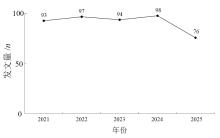
Figure 1
Annual volume of literatures"

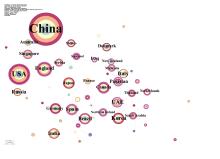
Figure 2
Co-occurrence map of countries"

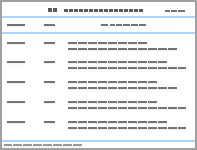
Table 1
Top ten countries of publication volume"
| 国家 | 发文量/n | 中心性 |
|---|---|---|
| China | 197 | 0.00 |
| USA | 71 | 0.12 |
| England | 31 | 0.35 |
| Japan | 28 | 0.06 |
| Germany | 27 | 0.06 |
| South Korea | 23 | 0.00 |
| India | 21 | 0.00 |
| Canada | 20 | 0.31 |
| Spain | 17 | 0.57 |
| Brazil | 17 | 0.31 |
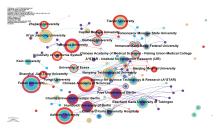
Figure 3
Co-occurrence map of institutions"

Table 2
Top ten institutions of publication volume"
| 机构 | 发文量/n | 中心性 |
|---|---|---|
| 复旦大学 | 14 | 0.18 |
| Aalborg University | 14 | 0.05 |
| 天津大学 | 12 | 0.00 |
| 中国科学院 | 12 | 0.28 |
| 西安交通大学 | 11 | 0.05 |
| 清华大学 | 11 | 0.25 |
| 南洋理工大学 | 10 | 0.01 |
| Charite Universitatsmedizin Berlin | 9 | 0.05 |
| Free University of Berlin | 9 | 0.05 |
| Humboldt University of Berlin | 9 | 0.05 |
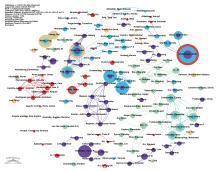
Figure 4
Cooperation map of authors"

Table 3
Top ten authors by publication volume"
| 作者 | 发文量/n | 中心性 |
|---|---|---|
| Mads R Jochumsen | 10 | 0.00 |
| 关存太 | 7 | 0.01 |
| Surjo R Soekadar | 6 | 0.00 |
| 贾杰 | 6 | 0.00 |
| 王晶 | 6 | 0.00 |
| 陈树耿 | 6 | 0.00 |
| Kai Keng Ang | 6 | 0.01 |
| Imran Khan Niazi | 4 | 0.00 |
| 张瑞 | 4 | 0.00 |
| Floriana Pichiorri | 4 | 0.00 |
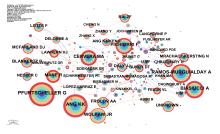
Figure 5
Co-occurrence map of co-citation authors"

Table 4
Top ten authors with the most citation frequency"
| 作者 | 频次/n | 中心性 |
|---|---|---|
| Pfurtscheller G | 167 | 0.31 |
| Kai Keng Ang | 158 | 0.63 |
| Ander Ramos-Murguialday | 129 | 0.37 |
| Biasiucci A | 118 | 0.47 |
| Floriana Pichiorri | 108 | 0.65 |
| Jonathan R Wolpaw | 106 | 0.09 |
| María A Cervera | 104 | 0.50 |
| Ravikiran Mane | 92 | 0.10 |
| Alexander A Frolov | 77 | 0.09 |
| Benjamin Blankertz | 71 | 0.04 |
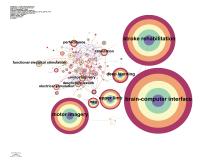
Figure 6
Co-occurrence map of keywords"

Table 5
Top ten high-frequency keywords"
| 关键词 | 频次/n | 中心性 |
|---|---|---|
| brain-computer interface | 337 | 0.03 |
| stroke rehabilitation | 260 | 0.02 |
| motor imagery | 187 | 0.00 |
| upper limb | 104 | 0.06 |
| deep learning | 79 | 0.04 |
| EEG | 54 | 0.00 |
| stimulation | 36 | 0.04 |
| performance | 36 | 0.01 |
| motor recovery | 32 | 0.09 |
| functional electrical stimulation | 31 | 0.04 |

Figure 7
Clustering map of keywords"

Table 6
Keyword clustering table"
| 聚类号 | 节点数/n | 轮廓值 | 主要关键词 |
|---|---|---|---|
| #0 | 21 | 0.911 | machine learning; brain asymmetry; action observation; artificial intelligence |
| #1 | 19 | 0.923 | amyotrophic lateral sclerosis; heart rate variability; human; sensorimotor rhythms |
| #2 | 17 | 0.916 | feature extraction; stroke (medical condition); motors; convolutional neural networks |
| #3 | 16 | 0.823 | motor imagery; brain-computer interface; stroke rehabilitation; electroencephalography (EEG) |
| #4 | 16 | 0.950 | functional near-infrared spectroscopy; effective connectivity; clinical translation |
| #5 | 15 | 0.913 | motor imagery; brain-computer interface (BCI) ; brain-computer interface; stroke |
| #6 | 15 | 0.950 | EEG; hemiparesis; systematic review; decoding; brain-computer interfaces |
| #7 | 15 | 0.899 | neurofeedback, motor restoration, bimanual BCI-FES, delta alpha ratio |
| #8 | 13 | 0.871 | electroencephalography (EEG), upper limb, brain-computer interface |
| #9 | 12 | 0.922 | motor rehabilitation, functional electrical stimulation, continuous trajectory reconstruction |
| #10 | 12 | 0.831 | neurological diseases, virtual reality, neuroscience, volitional control |
| #11 | 11 | 0.968 | motor function, upper extremity, stroke, network calibration, robotic arm |
| #12 | 9 | 0.989 | movement-related cortical potential, kinesthetic motor imagery, event-related desynchronization |
| #13 | 8 | 0.805 | neuroprosthetic, gps tracking, community participation, intracortical brain-computer interfaces |
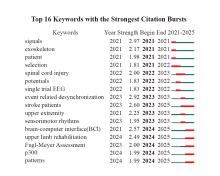
Figure 8
Bursting keywords"

| [1] |
KAWALA-STERNIUK A, BROWARSKA N, AL-BAKRI A, et al. Summary of over fifty years with brain-computer interfaces: a review[J]. Brain sciences, 2021, 11(1): 43.
doi: 10.3390/brainsci11010043 |
| [2] | KÜBLER A. The history of BCI: from a vision for the future to real support for personhood in people with locked-in syndrome[J]. Neuroethics, 2019, 13, 163-180. |
| [3] |
CANTILLO-NEGRETE J, CARINO-ESCOBAR R I, ORTEGA-ROBLES E, et al. A comprehensive guide to BCI-based stroke neurorehabilitation interventions[J]. MethodsX, 2023, 11: 102452.
doi: 10.1016/j.mex.2023.102452 |
| [4] |
VARSEHI H, FIROOZABADI S M P. An EEG channel selection method for motor imagery based brain-computer interface and neurofeedback using Granger causality[J]. Neural Netw, 2021: 133: 193-206.
doi: 10.1016/j.neunet.2020.11.002 |
| [5] |
POO M M, DU J L, IP N Y, et al. China brain project: basic neuroscience, brain diseases, and brain-inspired computing[J]. Neuron, 2016, 92(3): 591-596.
doi: 10.1016/j.neuron.2016.10.050 |
| [6] |
BATISTIĆ L, SUŠANJ D, PINČIĆ D, et al. Motor imagery classification based on EEG sensing with visual and vibrotactile guidance[J]. Sensors, 2023, 23(11): 5064.
doi: 10.3390/s23115064 |
| [7] |
YOU Y, LU C, WANG W, et al. Relative CNN-RNN: learning relative atmospheric visibility from images[J]. IEEE Transact Image Process, 2018, 28(1): 45-55.
doi: 10.1109/TIP.2018.2857219 |
| [8] |
SINHA P, SAHU D, PRAKASH S, et al. A high performance hybrid LSTM CNN secure architecture for IoT environments using deep learning[J]. Scientific Reports, 2025, 15(1): 9684.
doi: 10.1038/s41598-025-94500-5 |
| [9] |
TANG Y, HUANG W, CHEN C, et al. CT-DCENet: deep EEG denoising via CNN-transformer-based dual-stage collaborative ensemble learning[J]. IEEE J Biomed Health Inform, 2025, 29(6): 4095-4108.
doi: 10.1109/JBHI.2025.3535592 |
| [10] |
ELASHMAWI W H, AYMAN A, ANTOUN M, et al. A comprehensive review on brain-computer interface (BCI)-based machine and deep learning algorithms for stroke rehabilitation[J]. Appl Sci, 2024, 14(14): 6347.
doi: 10.3390/app14146347 |
| [11] |
TONIN A, SEMPRINI M, KIPER P, et al. Brain-computer interfaces for stroke motor rehabilitation[J]. Bioengineering, 2025, 12(8): 820.
doi: 10.3390/bioengineering12080820 |
| [12] |
AL-QAYSI Z T, AHMED M A, HAMMASH N M, et al. Systematic review of training environments with motor imagery brain-computer interface: coherent taxonomy, open issues and recommendation pathway solution[J]. Health Technol, 2021, 11(4): 783-801.
doi: 10.1007/s12553-021-00560-8 |
| [13] |
MA Z Z, WU J J, CAO Z, et al. Motor imagery-based brain-computer interface rehabilitation programs enhance upper extremity performance and cortical activation in stroke patients[J]. J Neuroengin Rehabil, 2024, 21(1): 91.
doi: 10.1186/s12984-024-01387-w |
| [14] |
ZHANG M, ZHU F, JIA F, et al. Efficacy of brain-computer interfaces on upper extremity motor function rehabilitation after stroke: a systematic review and meta-analysis[J]. NeuroRehabilitation, 2024, 54(2): 199-212.
doi: 10.3233/NRE-230215 |
| [15] |
LENNON O, TONELLATO M, DEL FELICE A, et al. A systematic review establishing the current state-of-the-art, the limitations, and the DESIRED checklist in studies of direct neural interfacing with robotic gait devices in stroke rehabilitation[J]. Front Neurosci, 2020, 14: 578.
doi: 10.3389/fnins.2020.00578 |
| [16] |
YEN H C, CHEN W S, JENG J S, et al. Standard early rehabilitation and lower limb transcutaneous nerve or neuromuscular electrical stimulation in acute stroke patients: a randomized controlled pilot study[J]. Clinical Rehabilitation, 2019, 33(8): 1344-1354.
doi: 10.1177/0269215519841420 |
| [17] |
SEMPRINI M, LENCIONI T, HINTERLANG W, et al. User-centered design and development of TWIN-Acta: a novel control suite of the TWIN lower limb exoskeleton for the rehabilitation of persons post-stroke[J]. Front Neurosci, 2022, 16: 915707.
doi: 10.3389/fnins.2022.915707 |
| [18] | REN S, WANG W, HOU Z G, et al. Enhanced motor imagery based brain-computer interface via FES and VR for lower limbs[J]. IEEE Trans Neur Sys Rehabil Engin, 2020, 28(8): 1846-1855. |
| [19] |
BIASIUCCI A, LEEB R, ITURRATE I, et al. Brain-actuated functional electrical stimulation elicits lasting arm motor recovery after stroke[J]. Nat Commun, 2018, 9(1): 2421.
doi: 10.1038/s41467-018-04673-z pmid: 29925890 |
| [20] |
SAID R R, HEYAT M B B, SONG K, et al. A systematic review of virtual reality and robot therapy as recent rehabilitation technologies using EEG-brain-computer interface based on movement-related cortical potentials[J]. Biosensors, 2022, 12(12): 1134.
doi: 10.3390/bios12121134 |
| [21] |
COLUCCI A, VERMEHREN M, CAVALLO A, et al. Brain-computer interface-controlled exoskeletons in clinical neurorehabilitation: ready or not?[J]. Neurorehabil Neural Repair, 2022, 36(12): 747-756.
doi: 10.1177/15459683221138751 |
| [22] |
WEN D, FAN Y, HSU S H, et al. Combining brain-computer interface and virtual reality for rehabilitation in neurological diseases: a narrative review[J]. Ann Phys Rehabil Med, 2021, 64(1): 101404.
doi: 10.1016/j.rehab.2020.03.015 |
| [23] |
DALY J J, WOLPAW J R. Brain-computer interfaces in neurological rehabilitation[J]. Lancet Neurol, 2008, 7(11): 1032-1043.
doi: 10.1016/S1474-4422(08)70223-0 pmid: 18835541 |
| [24] |
ZIADEH H, GULYAS D, NIELSEN L D, et al. "Mine works better": examining the influence of embodiment in virtual reality on the sense of agency during a binary motor imagery task with a brain-computer interface[J]. Front Psychol, 2021, 12: 806424.
doi: 10.3389/fpsyg.2021.806424 |
| [25] |
AFONSO M, SÁNCHEZ-CUESTA F, GONZÁLEZ-ZAMORANO Y, et al. Investigating the synergistic neuromodulation effect of bilateral rTMS and VR brain-computer interfaces training in chronic stroke patients[J]. J Neural Eng, 2024, 21(5): 056037.
doi: 10.1088/1741-2552/ad8836 |
| [26] |
NUNES J D, VOURVOPOULOS A, BLANCO-MORA D A, et al. Brain activation by a VR-based motor imagery and observation task: an fMRI study[J]. PLoS One, 2023, 18(9): e0291528.
doi: 10.1371/journal.pone.0291528 |
| [27] |
KAWANO T, HATTORI N, UNO Y, et al. Large-scale phase synchrony reflects clinical status after stroke: an EEG study[J]. Neurorehabil Neural Repair, 2017, 31(6): 561-570.
doi: 10.1177/1545968317697031 pmid: 28506148 |
| [28] |
YANG X, SHI X, XUE X, et al. Efficacy of robot-assisted training on rehabilitation of upper limb function in patients with stroke: a systematic review and meta-analysis[J]. Arch Phys Med Rehabil, 2023, 104(9): 1498-1513.
doi: 10.1016/j.apmr.2023.02.004 |
| [29] |
WHEATON L A, SHIBASAKI H, HALLETT M. Temporal activation pattern of parietal and premotor areas related to praxis movements[J]. Clin Neurophysiol, 2005, 116(5): 1201-1212.
pmid: 15826863 |
| [30] |
DE SETA V, COLAMARINO E, PICHIORRI F, et al. Brain and muscle derived features to discriminate simple hand motor tasks for a rehabilitative BCI: comparative study on healthy and post-stroke individuals[J]. J Neural Eng, 2024, 21(6): 066015.
doi: 10.1088/1741-2552/ad8838 |
| [31] |
BRAMBILLA C, PIROVANO I, MIRA R M, et al. Combined use of EMG and EEG techniques for neuromotor assessment in rehabilitative applications: a systematic review[J]. Sensors, 2021, 21(21): 7014.
doi: 10.3390/s21217014 |
| [32] |
QU G, ZHOU Z, CALHOUN V D, et al. Integrated brain connectivity analysis with fMRI, DTI, and sMRI powered by interpretable graph neural networks[J]. Med Image Anal, 2025, 103: 103570.
doi: 10.1016/j.media.2025.103570 |
| [33] |
STÄMPFLI P, REISCHAUER C, JÄRMANN T, et al. Combining fMRI and DTI: a framework for exploring the limits of fMRI-guided DTI fiber tracking and for verifying DTI-based fiber tractography results[J]. Neuroimage, 2008, 39(1): 119-126.
pmid: 17931889 |
| [34] |
HE B, LIU Z. Multimodal functional neuroimaging: integrating functional MRI and EEG/MEG[J]. IEEE Rev Biomed Eng, 2008, 1: 23-40.
doi: 10.1109/RBME.2008.2008233 pmid: 20634915 |
| [35] |
BUTET S, FLEURY M, DUCHÉ Q, et al. EEG-fMRI neurofeedback versus motor imagery after stroke, a randomized controlled trial[J]. J Neuroeng Rehabil, 2025, 22(1): 67.
doi: 10.1186/s12984-025-01598-9 |
| [1] | WEI Jingyi, WANG Xiaojing, WANG Ran, WEI Chen, MA Sai, LIU Xihua. Effect of acupuncture synchronized speech training on post-stroke motor aphasia [J]. Chinese Journal of Rehabilitation Theory and Practice, 2025, 31(9): 1000-1008. |
| [2] | WANG Xiaojing, WEI Jingyi, WEI Chen, WANG Ran, MA Sai, LIU Xihua. Effect of synchronous acupuncture and articulation training on spastic dysarthria after stroke [J]. Chinese Journal of Rehabilitation Theory and Practice, 2025, 31(9): 1009-1016. |
| [3] | ZHOU Xinyue, YE Ruixue, MA Yaqi, XU Ying, CAO Longyao, WANG Yulong. Researches on central post-stroke pain: a bibliometric analysis [J]. Chinese Journal of Rehabilitation Theory and Practice, 2025, 31(9): 1038-1049. |
| [4] | GAO Yunhan, HOU Shanshan, WANG Xinyu, ZHU Chongtian. Effect of brain-computer interface on upper limb motor dysfunction in stroke patients based on functional near-infrared spectroscopy [J]. Chinese Journal of Rehabilitation Theory and Practice, 2025, 31(9): 1066-1073. |
| [5] | GAO Fei, LIU Lixu, HU Xueyan, WU Xiaoli, YANG Lingyu, YANG Yuqi, YE Changqing, DU Xiaoxia. Effect of unilateral or bilateral transcranial direct current stimulation on post-stroke dysphagia [J]. Chinese Journal of Rehabilitation Theory and Practice, 2025, 31(9): 993-999. |
| [6] | ZHANG Ziang, CHEN Jing, SHEN Mengru, GENG Zongxiao, HAN Xue, ZHAO Xu, XU Lei. Comparison of effect of different types of exercise on gait and balance for stroke patients [J]. Chinese Journal of Rehabilitation Theory and Practice, 2025, 31(8): 896-905. |
| [7] | LU Dandan, YAO Jingzhi, LI Zi, WANG Kewen, SUN Xinliao, CHEN Jianmin, XU Jianwen. Physical therapy for Parkinson's disease from 2014 to 2023: a bibliometric analysis [J]. Chinese Journal of Rehabilitation Theory and Practice, 2025, 31(8): 906-913. |
| [8] | WANG Xiaofeng, HU Mengqiao, WANG Yan, WEI Kun, XU Wenzhu, REN Dan, MA Ye. Effect of exoskeleton robot-assisted gait training on lower limb function after stroke and spinal cord injury: a systematic review [J]. Chinese Journal of Rehabilitation Theory and Practice, 2025, 31(8): 914-921. |
| [9] | LIANG Fei, CHEN Ximei, QI Jing, WANG Shurong, LIANG Yongsheng. Functioning, vocational competency and career development of college students with disabilities based on ICF and RCF [J]. Chinese Journal of Rehabilitation Theory and Practice, 2025, 31(8): 922-929. |
| [10] | DONG Yuanjun, LOU Xin, SUN Rui, WANG Wenshuai, LIU Xiaoqin, XIA Xue, YANG Yaru, WANG Zhongyan, QIU Zhuoying. Cultivating key competencies of teamwork and interprofessional practice for rehabilitation psychology professionals based on RCF [J]. Chinese Journal of Rehabilitation Theory and Practice, 2025, 31(8): 939-946. |
| [11] | ZHANG Zihan, GUAN Jinzhi, HUANG Xing, ZHOU Li, ZHANG Yaxuan, ZHANG Mengyuan, CHANG Jingling. Characteristics of time-domain and time-frequency of Chinese word-picture matching task-related electroencephalogram in patients with post-stroke aphasia [J]. Chinese Journal of Rehabilitation Theory and Practice, 2025, 31(8): 947-957. |
| [12] | LÜ Xueqin, ZHANG Tong, LIU Huilin, LIU Jianhua, LI Da, WANG Huawei. Effect of preoperative exercise on patients undergoing ventriculoperitoneal shunt [J]. Chinese Journal of Rehabilitation Theory and Practice, 2025, 31(8): 958-964. |
| [13] | SONG Zhuman, LIU Na, LIU Yang, DING Xuemei, ZHANG Xiaoli. Mental health in parents of children with autism spectrum disorder: a bibliometric analysis from 2016 to 2025 [J]. Chinese Journal of Rehabilitation Theory and Practice, 2025, 31(7): 790-801. |
| [14] | SUN Wanting, YASEN Ailipinai, GONG Xiang, XIAO Yue, GAN Zhaodan, LIU Mingjie, ZENG Lanting, MA Shuyue, LU Jun, XU Guangxu. Effect of high-frequency repetitive transcranial magnetic stimulation on upper limb function of stroke patients based on motor sequence learning [J]. Chinese Journal of Rehabilitation Theory and Practice, 2025, 31(7): 812-821. |
| [15] | SHAN Lei, LIU Ying, ZHANG Xin, CHI Qianqian, ZHU Xiaomin. Effect of accelerated intermittent theta burst stimulation on post-stroke depression [J]. Chinese Journal of Rehabilitation Theory and Practice, 2025, 31(7): 822-829. |
| Viewed | ||||||
|
Full text |
|
|||||
|
Abstract |
|
|||||
|
||
