



Chinese Journal of Rehabilitation Theory and Practice ›› 2024, Vol. 30 ›› Issue (4): 373-380.doi: 10.3969/j.issn.1006-9771.2024.04.001
Previous Articles Next Articles
ZHANG Qing1,2, LI Yanqun1,2, JIA Wenrong1,2, LIU Qiaoyun3, JIANG Ruilin1,2( )
)
Received:2024-03-21
Published:2024-04-25
Online:2024-05-08
Contact:
JIANG Ruilin, E-mail: Supported by:CLC Number:
ZHANG Qing, LI Yanqun, JIA Wenrong, LIU Qiaoyun, JIANG Ruilin. Research on framework, core content and priority areas of international policy of healthcare, rehabilitation and education services for children with hearing and speech impairments[J]. Chinese Journal of Rehabilitation Theory and Practice, 2024, 30(4): 373-380.
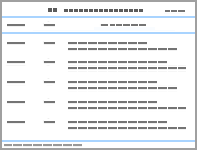
Table 1
International policy framework and core content of services related to hearing and speech impairments based on WHO six building blocks of health service system"
| 6大要素 | 政策架构 | 核心内容 | 主要行动 |
|---|---|---|---|
| 领导力与治理 | 发展强有力的领导和治理结构,协调听力障碍和言语障碍儿童服务的各方面 | 1.强调强有力的政策和立法支持,以确保听力障碍和言语障碍儿童的教育权利得到保障,包括制定和实施有关特殊教育和包容性教育的法律和政策 2.促进残疾人士的权利和福祉,包括教育、就业、健康和社会服务等领域的平等机会 | 制定全国范围内的儿童听力保健和康复策略 监管和标准制定,确保服务质量 促进政策、研究和实践之间的协调 |
| 筹资 | 建立可持续的融资机制,支持听力障碍和言语障碍儿童的服务 | 1.制定残疾人康复服务筹资战略计划 2.优化经费分配制度 3.扩大经费福利覆盖面,增加经费来源 | 为低收入家庭提供助听器和康复服务的资金支持 政策支持,包括保险覆盖听力保健服务 |
| 人力资源 | 发展专业化的健康人力资源政策,包括培训听力专家、言语治疗师和特殊教育教师 | 教师培训和专业发展 加强听力保健专业人员的培训和教育,鼓励提供关于听力障碍和言语障碍、特殊教育需求和包容性教育的培训 | 言语治疗师和特殊教育老师 多学科团队合作,包括医生、护士和社会工作者 |
| 服务提供 | 确立全面和综合的服务提供政策,涵盖从早期诊断到终身管理的连续性服务 | 1.早期识别和干预 强调对新生儿和儿童进行早期听力筛查的重要性,以便及早识别听力损失并实施及时干预; 推广使用听力筛查技术和程序,特别是在高风险群体中 2.个别化教育计划 为听力障碍和言语障碍儿童制定个性化的教育计划,以满足他们特定的学习需求; 涉及特殊教学方法、辅助技术的使用以及对教师的特殊培训 3.提供综合性听力保健服务 倡导建立和加强综合性听力保健服务,包括预防、诊断、治疗和康复; 推动跨学科合作,包括听力学家、言语治疗师、教育工作者和社会工作者等 4.提高听力保健服务的可及性和质量 提升听力保健服务的覆盖面,确保所有人群,尤其是低收入和边远地区的人群,能够获得高质量的听力保健服务; 支持提供可负担和可持续的听力保健服务 | 早期筛查和干预 定期听力评估 听力康复服务,包括助听器和语言治疗 儿童及家庭的心理社会支持 |
| 医疗技术与设备设施 | 确保高质量和可获得的医疗产品和技术,包括助听设备和教育资源 | 促进听力辅助技术的使用 推广现代听力辅助技术,如助听器、人工耳蜗和其他通讯辅助设备; 支持技术创新和提高辅助设备的可获得性 | 确保助听器和其他听力辅助设备的可获得性和负担能力 使用新技术和应用程序来增强听力康复和教育 |
| 信息系统与监测 | 建立综合性健康信息系统,收集和分析关于听力障碍和言语障碍儿童的数据 | 1.建立听力障碍和言语障碍服务信息统计制度 推进人口健康信息统计 2.统筹听力障碍和言语障碍服务及相关研究的健康数据并分析 支持听力保健研究和数据收集,以改善政策制定和服务提供 3.推进信息化听力障碍和言语障碍服务网络系统建立 推广包容性政策和实践,确保包括听力障碍和言语障碍儿童在内的残疾人全面参与和平等 | 建立和维护儿童听力健康数据库 跟踪和评估干预效果 提供给家长和教育工作者的资源和培训材料 |
Table 2
Priority areas in healthcare, rehabilitation and education for children with hearing and speech impairments"
| 优先发展领域 | 主要内容 | 主要行动 | 服务方法 | 评价指标 |
|---|---|---|---|---|
| 早期干预和教育 | 早期识别听力损失,提供及时干预和教育服务 | 早期筛查和诊断 组建多学科团队 促进家庭参与 | 制定个性化康复计划 提供助听器和听觉设备 提供专业的语言治疗 | 听力水平 语言发展 社交互动 家庭参与 |
| 听力和言语治疗 | 定期听力评估,开展听力和语言治疗 | 听力评估 助听器配备和调试 植入式听觉设备手术及调试 | 制定个性化治疗计划 实施多模式治疗 | 听力功能改善 语言发展 沟通能力 |
| 心理社会支持 | 提供心理咨询和治疗、社会支持、家庭支持 | 心理咨询和治疗 社会支持计划 教育和培训 | 提供个性化服务 支持多元化服务 | 心理健康状况 社会参与度 生活质量 |
| 社交技能和社区参与 | 培养社交技能,促进社区参与 | 社交技能训练 社区活动组织 社会技能辅导 | 小组培训 个性化辅导 社区参与项目 | 社交技能水平 社区参与程度 自我认知和自信心 |
| 职业教育和生活技能培训 | 提供与他们兴趣和能力相匹配的职业教育以及生活技能培训 | 职业导向辅导 实践机会提供 生活技能课程 | 个性化培训计划 职业技师支持 技术辅助工具 | 职业技能水平 就业情况 生活自主能力 |
| [1] | World Health Organization. Deafness and hearing loss[EB/OL]. (2024-02-02)[2024-02-28]. https://www.who.int/news-room/fact-sheets/detail/deafness-and-hearing-loss. |
| [2] | American Speech-Language-Hearing Association. Hearing loss[EB/OL]. (2023-03-17)[2024-02-06]. https://www.asha.org/public/hearing/types-of-hearing-loss/. |
| [3] | 世界卫生组织. 国际功能、残疾和健康分类(国际中文增补版)[M]. 邱卓英,译. 日内瓦: 世界卫生组织, 2015. |
| World Health Organization. International Classification of Functioning, Disability and Health-International Chinese Supplement[M]. QIU Z Y, trans trans. Geneva: World Health Organization, 2015. | |
| [4] |
邱卓英, 李伦, 陈迪, 等. 基于世界卫生组织国际健康分类家族康复指南研究:理论架构和方法体系[J]. 中国康复理论与实践, 2020, 26(2): 125-135.
doi: 10.3969/j.issn.1006-9771.2020.02.001 |
| QIU Z Y, LI L, CHEN D, et al. Research on rehabilitation guidelines using World Health Organization Family International Classifications: framework and approaches[J]. Chin J Rehabil Theory Pract, 2020, 26(2): 125-135. | |
| [5] |
张玉红, 王春晖, 努尔署瓦克•托列别克, 等. 听觉障碍中学生就业期望特征调查[J]. 中国康复理论与实践, 2022, 28(9): 1104-1109.
doi: 10.3969/j.issn.1006-9771.2022.09.015 |
| ZHANG Y H, WANG C H, TUOLIEBIEKE N, et al. Characteristics of employment expectation for middle school students with hearing impairment[J]. Chin J Rehabil Theory Pract, 2022, 28(9): 1104-1109. | |
| [6] |
CHADHA S, KAMENOV K, CIEZA A. The world report on hearing, 2021[J]. Bull World Health Organ, 2021, 99(4): 242-242 A.
doi: 10.2471/BLT.21.285643 |
| [7] | World Health Organization. WHO promotes access to ear and hearing care in communities[EB/OL]. (2023-03-03). [2024-02-25]. https://www.who.int/news/item/03-03-2023-who-promotes-access-to-ear-and-hearing-care-in-communities. |
| [8] |
邱卓英, 郭键勋, 李伦, 等. 世界卫生组织康复指南«健康服务体系中的康复»:背景、理论架构与方法、主要内容和实施[J]. 中国康复理论与实践, 2020, 26(1): 16-21.
doi: 10.3969/j.issn.1006-9771.2020.01.003 |
| QIU Z Y, KWOK J K F, LI L, et al. WHO Rehabilitation in Health System: background, framework and approach, contents and implementation[J]. Chin J Rehabil Theory Pract, 2020, 26(1): 16-21. | |
| [9] | World Health Organization. World Report on Disability 2011[EB/OL]. (2011-05-18)[2024-02-25]. https://www.who.int/teams/noncommunicable-diseases/sensory-functions-disability-and-rehabilitation/world-report-on-disability. |
| [10] | World Health Organization. World report on hearing[M]. Geneva: World Health Organization, 2021. |
| [11] | World Health Organization, Regional Office For Europe. Physical activity strategy for the WHO European Region 2016-2025[M]. Copenhagen: World Health Organization, Regional Office for Europe, 2016. |
| [12] |
叶绿, 王斌. 健康服务视域下健康促进学校及身体活动监测与评估研究[J]. 中国康复理论与实践, 2022, 28(12): 1400-1407.
doi: 10.3969/j.issn.1006-9771.2022.12.004 |
| YE L, WANG B. Monitoring and evaluation of health-promoting schools and physical activity from the perspective of health services[J]. Chin J Rehabil Theory Pract, 2022, 28(12): 1400-1407. | |
| [13] | 中华人民共和国中央人民政府. 中华人民共和国残疾人保障法[EB/OL]. (2005-05-25)[2024-01-27]. https://www.gov.cn/ztzl/gacjr/content_459363.htm. |
| [14] |
TORDRUP D, SMITH R, KAMENOV K, et al. Global return on investment and cost-effectiveness of WHO's HEAR interventions for hearing loss: a modelling study[J]. Lancet Glob Health, 2022, 10(1): e52-e62.
doi: 10.1016/S2214-109X(21)00447-2 pmid: 34919856 |
| [15] |
WILSON B S, TUCCI D L, MERSON M H, et al. Global hearing health care: new findings and perspectives[J]. Lancet, 2017, 390(10111): 2503-2515.
doi: S0140-6736(17)31073-5 pmid: 28705460 |
| [16] | 国务院办公厅. 国务院办公厅关于转发教育部等部门"十四五"特殊教育发展提升行动计划的通知[EB/OL]. (2022-01-25)[2024-01-29]. https://www.gov.cn/zhengce/content/2022-01/25/content_5670341.htm. |
| [17] |
MURRAY J J, HALL W C, SNODDON K. Education and health of children with hearing loss: the necessity of signed languages[J]. Bull World Health Organ, 2019, 97(10): 711-716.
doi: 10.2471/BLT.19.229427 |
| [18] | 国务院. "十四五"残疾人保障和发展规划[EB/OL]. (2021-07-21)[2024-02-01]. https://www.gov.cn/zhengce/content/2021-07/21/content_5626391.htm. |
| [19] | 中国残联. "十四五"残疾人康复服务实施方案[EB/OL]. (2021-08-16)[2024-01-26]. https://www.gov.cn/zhuanti/2021-08/20/content_5650192.htm. |
| [20] | World Health Organization. Integrated people-centred ear and hearing care: policy brief[M]. Geneva: World Health Organization, 2021. |
| [21] |
LILLO-MARTIN D C, GALE E, PICHLER D C. Family ASL: an early start to equitable education for deaf children[J]. Topics Early Child Spec Educ, 2023, 43(2): 156-166.
doi: 10.1177/02711214211031307 |
| [22] |
CHADHA S, KAMENOV K, CIEZA A. Health system requirements for hearing care services[J]. Bull World Health Organ, 2019, 97(10): 647-647A.
doi: 10.2471/BLT.19.243683 |
| [1] | QIAN Liguo, WU Tongxuan, ZHANG Qiaoyun, XING Jian, YANG Yanyan. Design and application effect of continuing education case library combined with case-based learning for rehabilitation therapists [J]. Chinese Journal of Rehabilitation Theory and Practice, 2026, 32(3): 249-257. |
| [2] | AN Le, QIN Xiaoxia, GU Bin, HU Guobing, TIAN Weiyi. A competency model for "dual-qualified" teachers in vocational undergraduate rehabilitation therapy programs based on the integration of rehabilitation competency framework and multi-source standards [J]. Chinese Journal of Rehabilitation Theory and Practice, 2026, 32(3): 258-269. |
| [3] | LIU Hua, WANG Liyuan, MA Xin, LI Jing, WANG Li. OBE-CDIO model of teaching for curriculum of exercise rehabilitation training [J]. Chinese Journal of Rehabilitation Theory and Practice, 2026, 32(3): 270-275. |
| [4] | LIU Xia, ZHANG Yuanmin, GE Shuhui, LIU Jinmei, SUN Chenming, WANG Yuanhui, LIU Jing, LI Wenfu. Cultivation mode of rehabilitation therapy talents in local colleges and universities under the background of New Medicine [J]. Chinese Journal of Rehabilitation Theory and Practice, 2026, 32(3): 276-285. |
| [5] | ZHU Lili, ZHAO Jiaxin, CHENG Xue, WANG Huijuan, CHEN Xiaoxia. Experiences and needs of stroke patients during rehabilitation: a qualitative meta-synthesis [J]. Chinese Journal of Rehabilitation Theory and Practice, 2026, 32(3): 286-293. |
| [6] | LIU Ping, ZHOU Nan, XUE Xiaojie, SHAO Weibo. Application of rehabilitation therapy techniques for post-stroke dysphagia: a bibliometric analysis [J]. Chinese Journal of Rehabilitation Theory and Practice, 2026, 32(3): 294-303. |
| [7] | PU Xinyu, WANG Jingxuan, WANG Hujun, XIU Anda, WANG Yingpeng. Application of repetitive peripheral magnetic stimulation in rehabilitation therapy: a bibliometric analysis [J]. Chinese Journal of Rehabilitation Theory and Practice, 2026, 32(3): 304-316. |
| [8] | ZHANG Wenjing, LI Hao, YUAN Jiajia, HU Huaining. Effect of tele-supervised home-based pulmonary music therapy on chronic obstructive pulmonary disease [J]. Chinese Journal of Rehabilitation Theory and Practice, 2026, 32(3): 337-344. |
| [9] | WU Shicai. Theoretical construction and practical exploration of rehabilitation ethics management [J]. Chinese Journal of Rehabilitation Theory and Practice, 2026, 32(2): 125-131. |
| [10] | HE Zhaonan, ZHANG Tingting, HE Zhaoke, MENG Lijun. Topic mining and content analysis of rehabilitation ethics research in China based on BERTopic model [J]. Chinese Journal of Rehabilitation Theory and Practice, 2026, 32(2): 132-141. |
| [11] | MENG Lijun. Challenges and reflections on ethical review of rehabilitation research for children with disabilities [J]. Chinese Journal of Rehabilitation Theory and Practice, 2026, 32(2): 142-150. |
| [12] | LI Shuiyan, LI Xiang, LI Yanhui, LU Yimeng, LI Dujuan, YANG Xiaoliang, XIE Qiuyou. Application of airway clearance techniques in critical care rehabilitation: a bibliometric analysis [J]. Chinese Journal of Rehabilitation Theory and Practice, 2026, 32(2): 162-173. |
| [13] | XIA Yan, XU Siwei, ZHU Yanyan, WANG Fengli, LIANG Sijie, LI Jingye, MEI Guangyan, XIANG Jie. Effect of personalized home-based rehabilitation under digital health model on Parkinson's disease [J]. Chinese Journal of Rehabilitation Theory and Practice, 2026, 32(2): 181-190. |
| [14] | QI Li, ZHANG Lei, QI Yi, FENG Lijun, LIU Dongmei, MA Huina. Effect of cardiopulmonary rehabilitation exercise on old patients with chronic obstructive pulmonary disease and chronic heart failure [J]. Chinese Journal of Rehabilitation Theory and Practice, 2026, 32(2): 191-197. |
| [15] | HUANG Ru, QIU Ziyu, CAI Dongxing, LU Xunwen, GAO Chaoquan. Effect of intelligent work simulation training combined with activity pacing on brain injury patients with headache [J]. Chinese Journal of Rehabilitation Theory and Practice, 2026, 32(2): 215-221. |
| Viewed | ||||||
|
Full text |
|
|||||
|
Abstract |
|
|||||
|
||
