



《Chinese Journal of Rehabilitation Theory and Practice》 ›› 2021, Vol. 27 ›› Issue (9): 1093-1097.doi: 10.3969/j.issn.1006-9771.2021.09.015
Previous Articles Next Articles
LI Liang1,2,LIAO Li-min1,2( ),WU Juan1,2,JING Hua-fang1,2,GAO Yi1,2,WANG Yue1,2
Received:2021-08-18
Revised:2021-09-01
Published:2021-09-25
Online:2021-10-09
Contact:
LIAO Li-min
E-mail:lmliao@263.net
Supported by:LI Liang,LIAO Li-min,WU Juan,JING Hua-fang,GAO Yi,WANG Yue. Effect of Pelvic Floor Muscle Training on Neurogenic Detrusor Overactivity[J]. 《Chinese Journal of Rehabilitation Theory and Practice》, 2021, 27(9): 1093-1097.
"
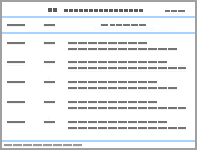
| 项目 | 对照组 (n = 8) | 试验组 (n = 9) | χ²/F值 | P值 |
|---|---|---|---|---|
| 性别(男/女, n) | 6/2 | 6/3 | 0.142 | 0.707 |
| 年龄(岁) | 44.25±12.40 | 42.22±13.74 | 0.035 | 0.754 |
| 病程(月) | 13.75±6.43 | 13.66±4.63 | 0.673 | 0.976 |
| 损伤分级(C/D, n) | 7/1 | 6/3 | 1.022 | 0.312 |
| 肌力分级(3/4, n) | 7/1 | 7/2 | 0.275 | 0.599 |
"
| 组别 | n | 治疗前 | 治疗后 | t值 | P值 |
|---|---|---|---|---|---|
| 对照组 | 8 | 120.87±47.40 | 163.87±46.73 | -7.243 | < 0.001 |
| 试验组 | 9 | 121.77±42.42 | 205.00±29.63 | -11.566 | < 0.001 |
| t值 | 0.041 | 2.194 | |||
| P值 | 0.968 | 0.044 |
"
| 组别 | n | 治疗前 | 治疗后 | t值 | P值 |
|---|---|---|---|---|---|
| 对照组 | 8 | 104.12±45.62 | 130.62±38.77 | -5.539 | < 0.001 |
| 试验组 | 9 | 96.44±41.84 | 176.00±30.40 | -8.021 | < 0.001 |
| t值 | -0.360 | 2.702 | |||
| P值 | 0.724 | 0.016 |
"
| 组别 | n | 治疗前 | 治疗后 | t值 | P值 |
|---|---|---|---|---|---|
| 对照组 | 8 | 61.87±12.04 | 50.50±9.97 | 10.651 | < 0.001 |
| 试验组 | 9 | 61.22±26.12 | 38.33±12.25 | 4.443 | 0.002 |
| t值 | -0.065 | -2.226 | |||
| P值 | 0.949 | 0.042 |
"
| 组别 | n | 治疗前 | 治疗后 | t'值 | P值 |
|---|---|---|---|---|---|
| 对照组 | 8 | 65.37±10.28 | 54.37±10.13 | 12.702 | < 0.001 |
| 试验组 | 9 | 68.33±27.20 | 41.22±7.04 | 3.674 | 0.006 |
| t'值 | 0.303 | -3.139 | |||
| P值 | 0.768 | 0.007 |
"
| 组别 | n | 治疗前 | 治疗后 | t值 | P值 |
|---|---|---|---|---|---|
| 对照组 | 8 | 79.37±32.01 | 63.75±27.22 | 6.063 | 0.001 |
| 试验组 | 9 | 94.22±55.26 | 51.66±26.92 | 4.206 | 0.003 |
| t值 | 0.666 | -0.919 | |||
| P值 | 0.516 | 0.373 |
"
| 组别 | n | 治疗前 | 治疗后 | t'值 | P值 |
|---|---|---|---|---|---|
| 对照组 | 8 | 56.50±3.70 | 45.37±7.53 | 6.406 | < 0.001 |
| 试验组 | 9 | 50.89±8.26 | 38.55±5.05 | 7.327 | < 0.001 |
| t'值 | -1.839 | -2.215 | |||
| P值 | 0.092 | 0.043 |
"
| 组别 | n | 治疗前 | 治疗后 | Z值 | P值 |
|---|---|---|---|---|---|
| 对照组 | 8 | 5.00(4.00,5.75) | 4.00(3.25,4.75) | -2.646 | 0.016 |
| 试验组 | 9 | 5.00(4.00,5.50) | 4.00(3.00,4.50) | -2.714 | 0.008 |
| Z值 | -0.051 | -0.311 | |||
| P值 | 1 | 0.952 |
| [1] | 中国残疾人康复协会脊髓损伤康复专业委员会, 国际脊髓学会中国脊髓损伤学会, 中华医学会泌尿外科学分会尿控学组. 脊髓损伤患者泌尿系管理与临床康复指南[J]. 中国康复理论与实践, 2013, 19(4):301-317. |
| Society of Spinal Cord Injury of China Association of Rehabilitation of Disabled Persons, Chinese Society of Spinal Cord Injury of International Society of Spinal Cord, Chinese Continence Society of Chinese Medical Association. Guideline of Clinical Rehabilitation and Urologic Management for Patients with Spinal Cord Injury[J]. Chin J Rehabil Theory Pract, 2013, 19(4):301-317. | |
| [2] | MOUSSA M, PAPATSORIS A, CHAKRA M A, et al. Lower urinary tract dysfunction in common neurological diseases[J]. Turk J Urol, 2020, 46(1):70-78. |
| [3] | 索吕, 王红星. 中枢神经损伤后膀胱逼尿肌过度活动的治疗进展[J]. 中国康复医学杂志, 2020, 35(8):1004-1008. |
| SUO L, WANG H X. Chin J Rehabil Med, 2020, 35(8):1004-1008. | |
| [4] | 廖利民. 神经源性膀胱的治疗现状和进展[J]. 中国康复医学杂志, 2011, 26(3):201-205. |
| LIAO L M. Chin J Rehabil Med, 2011, 26(3):201-205. | |
| [5] |
GAO Y, LIAO L. Regional activity and functional connectivity in brain networks associated with urinary bladder filling in patients with tethered cord syndrome[J]. Int Urol Nephrol, 2021, 53(9):1805-1812.
doi: 10.1007/s11255-021-02880-0 |
| [6] |
SEKIDO N, IGAWA Y, KAKIZAKI H, et al. Clinical Guidelines for the Diagnosis and Treatment of Lower Urinary Tract Dysfunction in Patients with Spinal Cord Injury[J]. Int J Urol, 2020, 27(4):276-288.
doi: 10.1111/iju.v27.4 |
| [7] | 丛惠伶, 廖利民. 加倍剂量酒石酸托特罗定治疗脊髓损伤致逼尿肌过度活动的效果观察[J]. 中国康复理论与实践, 2010, 16(12):1108-1110. |
| CONG H L, LIAO L M. Effect of double dosage tolterodine on detrusor overactivity after spinal cord injury[J]. Chin J Rehabil Theory Pract, 2010, 16(12):1108-1110. | |
| [8] |
FITZ F, SARTORI M, GIRÃO M J, et al. Pelvic floor muscle training for overactive bladder symptoms: a prospective study[J]. Rev Assoc Med Bras, 2017, 63(12):1032-1038.
doi: 10.1590/1806-9282.63.12.1032 |
| [9] | BYKOVIENE L, KUBILIUS R, ANIULIENE R, et al. Pelvic floor muscle training with or without tibial nerve stimulation and lifestyle changes have comparable effects on the overactive bladder. A randomized clinical trial[J]. Urol J, 2018, 15(4):186-192. |
| [10] | 康海琼, 周红俊, 刘根林, 等. 脊髓损伤神经学分类国际标准检查表2019版最新修订及解读[J]. 中国康复理论与实践, 2019, 25(8):983-985. |
| KANG H Q, ZHOU H J, LIU G L, et al. Modification and interpretation of the 2019 International Standards for Neurological Classification of Spinal Cord Injury Worksheet[J]. Chin J Rehabil Theory Pract, 2019, 25(8):983-985. | |
| [11] |
KIRSHBLUM S, SNIDER B, RUPP R, et al. Updates of the International Standards for Neurologic Classification of Spinal Cord Injury: 2015 and 2019[J]. Phys Med Rehabil Clin N Am, 2020, 31(3):319-330.
doi: 10.1016/j.pmr.2020.03.005 |
| [12] |
SCHACHAR J S, DEVAKUMAR H, MARTIN L, et al. Pelvic floor muscle weakness: a risk factor for anterior vaginal wall prolapse recurrence[J]. Int Urogynecol J, 2018, 29(11):1661-1667.
doi: 10.1007/s00192-018-3626-2 |
| [13] | 陈娟, 任远, 朱兰. 改良牛津肌力分级和盆底表面肌电评估女性压力性尿失禁患者盆底肌功能的相关性[J]. 中华医学杂志, 2020, 100(37):2908-2912. |
| CHEN J, REN Y, ZHU L. Correlation between modified Oxford Grading Scale and pelvic floor surface electromyography in assessment of pelvic floor muscle function in female patients with stress urinary incontinence[J]. Natl Med J Chin, 2020, 100(37):2908-2912. | |
| [14] |
NILSEN I, REBOLLEDO G, ACHARYA G, et al. Mechanical oscillations superimposed on the pelvic floor muscles during Kegel exercises reduce urine leakage in women suffering from stress urinary incontinence: a prospective cohort study with a 2-year follow up[J]. Acta Obstet Gynecol Scand, 2018, 97(10):1185-1191.
doi: 10.1111/aogs.2018.97.issue-10 |
| [15] | WELK B, MORROW S A, MADARASZ W, et al. The conceptualization and development of a patient-reported neurogenic bladder symptom score[J]. Res Rep Urol, 2013, 5:129-137. |
| [16] |
WELK B, LENHERR S, ELLIOTT S, et al. The Neurogenic Bladder Symptom Score (NBSS): a secondary assessment of its validity, reliability among people with a spinal cord injury[J]. Spinal Cord, 2018, 56(3):259-264.
doi: 10.1038/s41393-017-0028-0 |
| [17] | WELK B, MCKIBBON M. A randomized, controlled trial of transcutaneous tibial nerve stimulation to treat overactive bladder and neurogenic bladder patients[J]. Can Urol Assoc J, 2020, 14(7):297-303. |
| [18] | GRIFFITHS D. Neural control of micturition in humans: a working model[J]. Nat Rev Urol, 2015, 12(12):695-705. |
| [19] | FOWLER C J, GRIFFITHS D, DE GROAT W C. The neural control of micturition[J]. Nat Rev Neurosci, 2008, 9(6):453-466. |
| [20] | SAKAKIBARA R, KISHI M, TSUYUSAKI Y, et al. Neurology and the bladder: how to assess and manage neurogenic bladder dysfunction, with particular references to the neural control of micturition[J]. Brain Nerve, 2014, 53(3):527-537. |
| [21] | AMARENCO G, SHEIKH ISMAËL S, CHESNEL C, et al. Diagnosis and clinical evaluation of neurogenic bladder[J]. Eur J Phys Rehabil Med, 2017, 53(6):975-980. |
| [22] |
AZURI J, KAFRI R, ZIV-BARAN T, et al. Outcomes of different protocols of pelvic floor physical therapy and anti-cholinergics in women with wet over-active bladder: a 4-year follow-up[J]. Neurourol Urodyn, 2017, 36(3):755-758.
doi: 10.1002/nau.23016 |
| [23] |
BURGIO K L. Update on behavioral and physical therapies for incontinence and overactive bladder: the role of pelvic floor muscle training[J]. Curr Urol Rep, 2013, 14(5):457-464.
doi: 10.1007/s11934-013-0358-1 |
| [24] |
BURGIO K L, KRAUS S R, JOHNSON T M, et al. Effectiveness of combined behavioral and drug therapy for overactive bladder symptoms in men: a randomized clinical trial[J]. JAMA Intern Med, 2020, 180(3):411-419.
doi: 10.1001/jamainternmed.2019.6398 |
| [25] |
JHANG J F, KUO H C. Botulinum Toxin A and lower urinary tract dysfunction: pathophysiology and mechanisms of action[J]. Toxins (Basel), 2016, 8(4):120.
doi: 10.3390/toxins8040120 |
| [26] |
KATO T, MIZUNO K, NISHIO H, et al. Urodynamic effectiveness of a beta-3 adrenoreceptor agonist (vibegron) for a pediatric patient with anticholinergic-resistant neurogenic detrusor overactivity: a case report[J]. J Med Case Rep, 2021, 15(1):86.
doi: 10.1186/s13256-020-02564-w |
| [27] |
KAGA K, YAMANISHI T, KAGA M, et al. Urodynamic efficacy of fesoterodine for the treatment of neurogenic detrusor overactivity and/or low compliance bladder[J]. Int J Urol, 2020, 27(10):899-904.
doi: 10.1111/iju.v27.10 |
| [28] | ORGEN S, DELIKTAS H, SAHIN H, et al. Histopathologic and urodynamic effects of the anticholinergic drugs oxybutynin, tolterodine, and trospium on the bladder[J]. Low Urin Tract Symptoms, 2017, 9(1):52-56. |
| [29] |
VAN OPHOVEN A, ENGELBERG S, LILLEY H, et al. Systematic literature review and meta-analysis of sacral neuromodulation (SNM) in patients with neurogenic lower urinary tract dysfunction (nLUTD): over 20 years' experience and future directions[J]. Adv Ther, 2021, 38(4):1987-2006.
doi: 10.1007/s12325-021-01650-9 |
| [30] |
STAMPAS A, KHAVARI R, FRONTERA J E, et al. Feasibility of self-administered neuromodulation for neurogenic bladder in spinal cord injury[J]. Int Neurourol J, 2019, 23(3):249-256.
doi: 10.5213/inj.1938120.060 |
| [31] |
KNIGHT S L, EDIRISINGHE N, LEAKER B, et al. Conditional neuromodulation of neurogenic detrusor overactivity using transrectal stimulation in patients with spinal cord injury: a proof of principle study[J]. Neurourol Urodyn, 2018, 37(1):385-393.
doi: 10.1002/nau.v37.1 |
| [32] |
BOURBEAU D J, GUSTAFSON K J, BROSE S W. At-home genital nerve stimulation for individuals with SCI and neurogenic detrusor overactivity: a pilot feasibility study[J]. J Spinal Cord Med, 2019, 42(3):360-370.
doi: 10.1080/10790268.2017.1422881 |
| [33] |
ÇETINEL B, KOCJANCIC E, DEMIRDAĞ Ç. Augmentation cystoplasty in neurogenic bladder[J]. Investig Clin Urol, 2016, 57(5):316-323.
doi: 10.4111/icu.2016.57.5.316 |
| [34] |
HOEN L', ECCLESTONE H, BLOK B F M, et al. Long-term effectiveness and complication rates of bladder augmentation in patients with neurogenic bladder dysfunction: a systematic review[J]. Neurourol Urodyn, 2017, 36(7):1685-1702.
doi: 10.1002/nau.23205 |
| [35] |
LÚCIO A, LOURENÇO C B, DAMASCENO B P, et al. The effect of pelvic floor muscle contraction on detrusor overactivity pressure in neurogenic and nonneurogenic women during urodynamic study: a cross-sectional study[J]. Am J Phys Med Rehabil, 2019, 98(4):275-279.
doi: 10.1097/PHM.0000000000001065 |
| [36] |
ANGELINI K. Pelvic floor muscle training to manage overactive bladder and urinary incontinence[J]. Nurs Womens Health, 2017, 21(1):51-57.
doi: 10.1016/j.nwh.2016.12.004 |
| [37] |
VÁSQUEZ N, KNIGHT S L, SUSSER J, et al. Pelvic floor muscle training in spinal cord injury and its impact on neurogenic detrusor over-activity and incontinence[J]. Spinal Cord, 2015, 53(12):887-889.
doi: 10.1038/sc.2015.121 |
| [1] | QIAN Liguo, WU Tongxuan, ZHANG Qiaoyun, XING Jian, YANG Yanyan. Design and application effect of continuing education case library combined with case-based learning for rehabilitation therapists [J]. Chinese Journal of Rehabilitation Theory and Practice, 2026, 32(3): 249-257. |
| [2] | AN Le, QIN Xiaoxia, GU Bin, HU Guobing, TIAN Weiyi. A competency model for "dual-qualified" teachers in vocational undergraduate rehabilitation therapy programs based on the integration of rehabilitation competency framework and multi-source standards [J]. Chinese Journal of Rehabilitation Theory and Practice, 2026, 32(3): 258-269. |
| [3] | LIU Hua, WANG Liyuan, MA Xin, LI Jing, WANG Li. OBE-CDIO model of teaching for curriculum of exercise rehabilitation training [J]. Chinese Journal of Rehabilitation Theory and Practice, 2026, 32(3): 270-275. |
| [4] | LIU Xia, ZHANG Yuanmin, GE Shuhui, LIU Jinmei, SUN Chenming, WANG Yuanhui, LIU Jing, LI Wenfu. Cultivation mode of rehabilitation therapy talents in local colleges and universities under the background of New Medicine [J]. Chinese Journal of Rehabilitation Theory and Practice, 2026, 32(3): 276-285. |
| [5] | ZHU Lili, ZHAO Jiaxin, CHENG Xue, WANG Huijuan, CHEN Xiaoxia. Experiences and needs of stroke patients during rehabilitation: a qualitative meta-synthesis [J]. Chinese Journal of Rehabilitation Theory and Practice, 2026, 32(3): 286-293. |
| [6] | LIU Ping, ZHOU Nan, XUE Xiaojie, SHAO Weibo. Application of rehabilitation therapy techniques for post-stroke dysphagia: a bibliometric analysis [J]. Chinese Journal of Rehabilitation Theory and Practice, 2026, 32(3): 294-303. |
| [7] | PU Xinyu, WANG Jingxuan, WANG Hujun, XIU Anda, WANG Yingpeng. Application of repetitive peripheral magnetic stimulation in rehabilitation therapy: a bibliometric analysis [J]. Chinese Journal of Rehabilitation Theory and Practice, 2026, 32(3): 304-316. |
| [8] | SUN Kui, HUANG Hailun, LIU Yongai, GAO Heng. Brain-computer interface technology in treatment for spinal cord injury: a bibliometric analysis [J]. Chinese Journal of Rehabilitation Theory and Practice, 2026, 32(3): 317-328. |
| [9] | ZHANG Wenjing, LI Hao, YUAN Jiajia, HU Huaining. Effect of tele-supervised home-based pulmonary music therapy on chronic obstructive pulmonary disease [J]. Chinese Journal of Rehabilitation Theory and Practice, 2026, 32(3): 337-344. |
| [10] | WU Shicai. Theoretical construction and practical exploration of rehabilitation ethics management [J]. Chinese Journal of Rehabilitation Theory and Practice, 2026, 32(2): 125-131. |
| [11] | HE Zhaonan, ZHANG Tingting, HE Zhaoke, MENG Lijun. Topic mining and content analysis of rehabilitation ethics research in China based on BERTopic model [J]. Chinese Journal of Rehabilitation Theory and Practice, 2026, 32(2): 132-141. |
| [12] | MENG Lijun. Challenges and reflections on ethical review of rehabilitation research for children with disabilities [J]. Chinese Journal of Rehabilitation Theory and Practice, 2026, 32(2): 142-150. |
| [13] | LI Shuiyan, LI Xiang, LI Yanhui, LU Yimeng, LI Dujuan, YANG Xiaoliang, XIE Qiuyou. Application of airway clearance techniques in critical care rehabilitation: a bibliometric analysis [J]. Chinese Journal of Rehabilitation Theory and Practice, 2026, 32(2): 162-173. |
| [14] | XIA Yan, XU Siwei, ZHU Yanyan, WANG Fengli, LIANG Sijie, LI Jingye, MEI Guangyan, XIANG Jie. Effect of personalized home-based rehabilitation under digital health model on Parkinson's disease [J]. Chinese Journal of Rehabilitation Theory and Practice, 2026, 32(2): 181-190. |
| [15] | QI Li, ZHANG Lei, QI Yi, FENG Lijun, LIU Dongmei, MA Huina. Effect of cardiopulmonary rehabilitation exercise on old patients with chronic obstructive pulmonary disease and chronic heart failure [J]. Chinese Journal of Rehabilitation Theory and Practice, 2026, 32(2): 191-197. |
| Viewed | ||||||
|
Full text |
|
|||||
|
Abstract |
|
|||||
|
||
