



《Chinese Journal of Rehabilitation Theory and Practice》 ›› 2021, Vol. 27 ›› Issue (12): 1384-1392.doi: 10.3969/j.issn.1006-9771.2021.12.003
Previous Articles Next Articles
YANG Bao-yi1,2,3,JIANG Jing-yuan1,2,3,DAI Qi1,WANG Guo-xiang1,2,3( ),QIU Zhuo-ying2,3,4,5(),CAI Geng1,2,3,SUN Hui-zhen6,YANG Jian2,3,7,WANG Shao-pu2,8,ZHU Ting3,9,LI An-qiao2,3,HAO Chuan-ping2,3,10,ZHANG Meng1,2,3,ZHOU Sheng1,2,3,TANG Xiu-qi2,3,11,LIU Jing2,3,11
Received:2021-11-05
Revised:2021-11-23
Published:2021-12-25
Online:2021-12-29
Contact:
WANG Guo-xiang,QIU Zhuo-ying
E-mail:kwang63@163.com;qiutiger@hotmail.com
Supported by:CLC Number:
YANG Bao-yi,JIANG Jing-yuan,DAI Qi,WANG Guo-xiang,QIU Zhuo-ying,CAI Geng,SUN Hui-zhen,YANG Jian,WANG Shao-pu,ZHU Ting,LI An-qiao,HAO Chuan-ping,ZHANG Meng,ZHOU Sheng,TANG Xiu-qi,LIU Jing. Analysis of Functioning and Design of Individualized Rehabilitation Protocol for Children with Learning Disability Using ICF[J]. 《Chinese Journal of Rehabilitation Theory and Practice》, 2021, 27(12): 1384-1392.
"
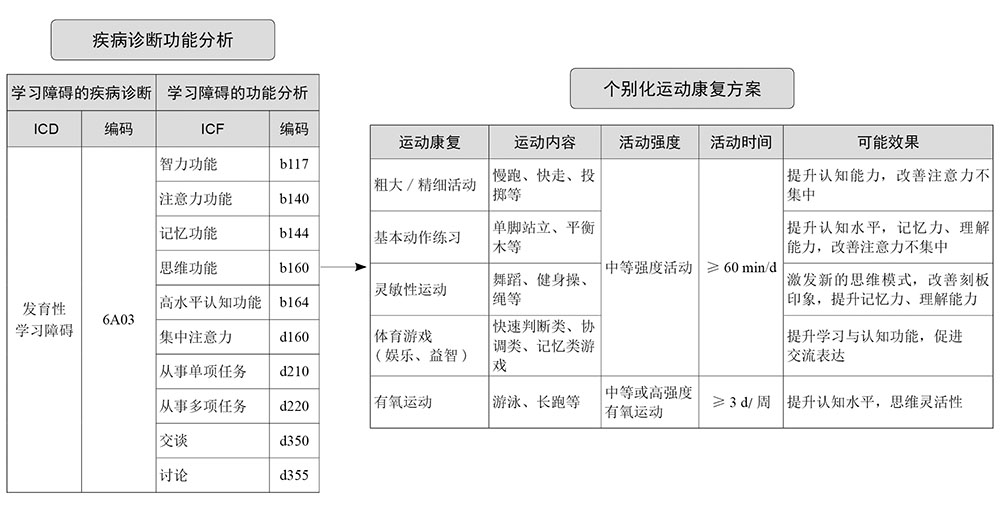
| 疾病诊断 | 编码 |
|---|---|
| 发育性学习障碍 | 6A03 |
| 发育性学习障碍伴阅读受损 | 6A03.0 |
| 发育性学习障碍伴书面表达受损 | 6A03.1 |
| 发育性学习障碍伴数学受损 | 6A03.2 |
| 发育性学习障碍伴其他特指的学习受损 | 6A03.3 |
| 未特指的发育性学习障碍 | 6A03.Z |
"
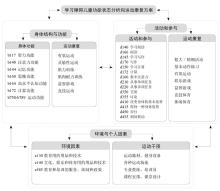
| 成份 | 类目及编码 | 功能类目及编码 | 内容 |
|---|---|---|---|
| 身体结构(s)和身体功能(b) | 精神功能(b1) | 智力功能(b117) | 智力水平通常正常,部分儿童低于正常水平 |
| 注意力功能(b140) | 学习时注意力难以集中,容易走神 | ||
| 记忆功能(b144) | 短时、长时记忆力较差 | ||
| 思维功能(b160) | 缺乏连贯和符合逻辑的思维 | ||
| 高水平认知功能(b164) | 理解知识能力、洞察力和判断力较低 | ||
| 计算功能(b172) | 难以完成简单、复杂的数学运算 | ||
| 运动功能(b750-b789) | 活动量低,整体运动水平较低 | ||
| 活动和参与(d) | 学习和应用知识(d1) | 学习阅读(d140)、阅读(d166) | 难以流利、准确地阅读书面材料,对文字的理解和解释存在偏差和困难 |
| 学习写作(d145)、写作(d170) | 通过文字或符号等,在表达意思、传达信息、展示观点方面有困难 | ||
| 学习计算(d150)、计算(d172) | 不擅长利用数学原理来运算或解决问题 | ||
| 集中注意力(d160) | 学习时容易被身边的事物干扰,难以有目的地集中注意于某件事 | ||
| 一般任务和要求(d2) | 从事单项任务(d210) | 在安排、处理或协调与学习相关的任务时有困难,且步骤和顺序不清晰 | |
| 从事多项任务(d220) | |||
| 交流(d3) | 交谈(d350) | 不擅长通过会话、文字和符号等形式与他人交流学习相关内容,不愿意与他人沟通交流 | |
| 讨论(d355) | |||
| 活动(d4) | 改变身体的基本姿势(d410) | 喜欢久坐或躺的姿势,不积极参与各种身体活动或运动项目 | |
| 保持一种身体姿势(d415) | |||
| 步行(d450) | 喜欢独处,对于跑步、散步等活动积极性不高,且运动水平较普通儿童较低 | ||
| 到处移动(d455) | |||
| 环境因素(e) | 用品和技术(e1) | 教育用的用品和技术(e130) | 缺乏适宜教学设备、书籍、教具、计算机等 |
| 文化、娱乐和体育用的用品和技术(e140) | 缺乏适用的体育活动器材、设备、场地等,如玩具、球类、乐器、特殊设计用品等 | ||
| 服务、体制和政策(e5) | 教育和培训的服务、体制和政策(e585) | 缺乏针对性的培训机构和专业教师,没有权威的教育培训行政管理监督机制和政策 |
"

"
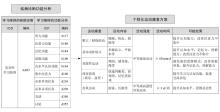
| 活动方式 | 活动量 | 涉及功能 | 运动间接效果 | 来源 | ||
|---|---|---|---|---|---|---|
| 活动强度 | 活动时间 | 身体功能 | 活动和参与 | |||
| 粗大/精细活动 | 中等强度活动 | ≥ 60 min/d | 智力功能(b117)、注意力功能(b140) | 改变身体的基本姿势(d410)、保持一种身体姿势(d415)、步行(d450) | 提升智力水平,提升认知能力,改善注意力不集中,控制注意力 | 《WHO关于身体活动和久坐行为的指南》(2020) 《美国人身体活动指南(第二版)》(2018) 《澳大利亚身体活动与久坐行为指南(青少年版)》(2017) 《加拿大身体活动和久坐行为指南》(2011) 《关于健康运动的全球指南》(2010) |
| 基本动作练习 | 中等强度活动 | ≥ 60 min/d | 智力功能(b117)、记忆功能(b144) | 集中注意力(d160)、改变身体的基本姿势(d410)、保持一种身体姿势(d415) | 提升认知水平,记忆力、理解能力,改善注意力不集中,提高身体平衡能力、稳定性、协调性 | |
| 灵敏性运动 | 中等强度活动 | ≥ 60 min/d | 记忆功能(b144)、思维功能(b160) | 集中注意力(d160) | 激发新的思维模式,改善刻板印象,提升记忆力、理解能力 | |
| 肌力/肌耐力训练 | 中等强度活动 | ≥ 60 min/d | 高水平认知功能(b164) | 改变身体的基本姿势(d410)、保持一种身体姿势(d415) | 增加身体姿势控制力,提升肌力和肌耐力,改善关节活动 | |
| 高强度活动 | ≥ 3 d/周 | |||||
| 有氧运动 | 中等或高强度有氧运动 | ≥ 3 d/周 | 智力功能(b117)、注意力功能(b140)、高水平认知功能(b164) | 改变身体的基本姿势(d410)、保持一种身体姿势(d415)、步行(d450)、到处移动(d455) | 提升认知水平,思维灵活性等 | |
| 竞技体育 | 中等到高强度活动 | ≥ 60 min/d | 智力功能(b117)、注意力功能(b140)、记忆功能(b144)、思维功能(b160) | 改变身体的基本姿势(d410)、交谈(d350)、讨论(d355)、到处移动(d455) | 团队活动中增加与人沟通和交流的机会 | |
| 休闲体育 | 低等到中等强度活动 | ≥ 60 min/d | 智力功能(b117)、注意力功能(b140)、记忆功能(b144)、思维功能(b160) | 改变身体的基本姿势(d410)、交谈(d350)、讨论(d355)、步行(d450)、到处移动(d455) | ||
| 体育竞赛 | 中等到高强度活动 | ≥ 60 min/d | 思维功能(b160)、高水平认知功能(b164) | 从事单项任务(d210)、从事多项任务(d220)、交谈(d350)、讨论(d355)、到处移动(d455) | 在多人合作或单人模式的体育运动中提升处理任务的逻辑性、规划性,改善注意力 | |
| 体育游戏(娱乐、益智) | 中等强度活动 | ≥ 60 min/d | 智力功能(b117)、注意力功能(b140)、记忆功能(b144)、思维功能(b160) | 阅读(d166)、写作(d170)、计算(d172)、交谈(d350)、讨论(d355) | 运动干预提升学习与认知功能,从而改善阅读、理解、写作、计算、表达等方面的不足 | |
"
| [1] | BISHOP T W. Mental disorders and learning disabilities in children and adolescents: learning disabilities[J]. FP Essent, 2018, 475:18-22. |
| [2] |
PEIJNENBORGH J C, HURKS P M, ALDENKAMP A P, et al. Efficacy of working memory training in children and adolescents with learning disabilities: a review study and meta-analysis[J]. Neuropsychol Rehabil, 2016, 26(5-6):645-672.
doi: 10.1080/09602011.2015.1026356 |
| [3] | 邱卓英, 李伦, 陈迪, 等. 基于世界卫生组织国际健康分类家族康复指南研究:理论架构和方法体系[J]. 中国康复理论与实践, 2020, 26(2):125-135. |
| QIU Z Y, LI L, CHEN D, et al. Research on Rehabilitation Guidelines Using World Health Organization Family International Classifications: framework and approaches[J]. Chin J Rehabil Theory Pract, 2020, 26(2):125-135. | |
| [4] |
KARANDE S, DESHMUKH N, RANGARAJAN V, et al. Brain SPECT scans in students with specific learning disability: preliminary results[J]. J Postgrad Med, 2019, 65(1):33-37.
doi: 10.4103/jpgm.JPGM_61_18 |
| [5] | 姜静远, 李安巧, 邱服冰, 等. 基于ICF-CY儿童青少年身体活动指南的内容分析与比较[J]. 中国康复理论与实践, 2020, 26(9):993-1004. |
| JIANG J Y, LI A Q, QIU F B, et al. Content analysis and comparison of physical activity guidelines for children based on ICF-CY[J]. Chin J Rehabil Theory Pract, 2020, 26(9):993-1004. | |
| [6] | 邱卓英, 李欣, 刘冯铂, 等. 基于ICF的智力残疾模式、测量方法及社会支持系统研究[J]. 中国康复理论与实践, 2016, 22(4):373-377. |
| QIU Z Y, LI X, LIU F B, et al. Framework, measurement, and social support of intellectual disability based on ICF[J]. Chin J Rehabil Theory Pract, 2016, 22(4):373-377. | |
| [7] | 孙宏伟, 邹敏, 邱卓英, 等. 基于ICF的智力残疾个别化服务与支持方案设计研究[J]. 中国康复理论与实践, 2019, 25(1):10-14. |
| SUN H W, ZOU M, QIU Z Y, et al. Individualized services and support plan for people with intellectual disability based on ICF[J]. Chin J Rehabil Theory Pract, 2019, 25(1):10-14. | |
| [8] | WILLCUTT E G, MCGRATH L M, PENNINGTON B F, et al. Understanding comorbidity between specific learning disabilities[J]. New Dir Child Adolesc Dev, 2019, 2019(165):91-109. |
| [9] | NICOLIELO-CARRILHO A P, HAGE S R V. Metacognitive reading strategies of children with learning disabilities[J]. Codas, 2017, 29(3):e20160091. |
| [10] |
MORSANYI K, DEVINE A, NOBES A, et al. The link between logic, mathematics and imagination: evidence from children with developmental dyscalculia and mathematically gifted children[J]. Dev Sci, 2013, 16(4):542-553.
doi: 10.1111/desc.12048 |
| [11] |
FAEDDA N, ROMANI M, ROSSETTI S, et al. Intellectual functioning and executive functions in children and adolescents with attention deficit hyperactivity disorder (ADHD) and specific learning disorder (SLD)[J]. Scand J Psychol, 2019, 60(5):440-446.
doi: 10.1111/sjop.v60.5 |
| [12] |
IUCULANO T, ROSENBERG L M, RICHARDSON J, et al. Cognitive tutoring induces widespread neuroplasticity and remediates brain function in children with mathematical learning disabilities[J]. Nat Commun, 2015, 6:8453.
doi: 10.1038/ncomms9453 |
| [13] | WERTH R. What causes dyslexia? Identifying the causes and effective compensatory therapy[J]. Restor Neurol Neurosci, 2019, 37(6):591-608. |
| [14] | HABERSTROH S SCHULTE-KÖRNE G. The diagnosis and treatment of dyscalculia[J]. Dtsch Arztebl Int, 2019, 116(7):107-114. |
| [15] |
WILKEY E D, POLLACK C, PRICE G R. Dyscalculia and typical math achievement are associated with individual differences in number-specific executive function[J]. Child Dev, 2020, 91(2):596-619.
doi: 10.1111/cdev.v91.2 |
| [16] |
KERNS K A, MCINERNEY R J, WILDE N J. Time reproduction, working memory, and behavioral inhibition in children with ADHD[J]. Child Neuropsychol, 2001, 7(1):21-31.
doi: 10.1076/chin.7.1.21.3149 |
| [17] | ABDOOLA F, FLACK P S, KARRIM S B. Facilitating pragmatic skills through role-play in learners with language learning disability[J]. S Afr J Commun Disord, 2017, 64(1):e1-e12. |
| [18] | SUHAILI I, HARUN D, KADAR M, et al. Motor performance and functional mobility in children with specific learning disabilities[J]. Med J Malaysia, 2019, 74(1):34-39. |
| [19] |
HALLAWELL B, STEPHENS J, CHARNOCK D. Physical activity and learning disability[J]. Br J Nurs, 2012, 21(10):609-612.
doi: 10.12968/bjon.2012.21.10.609 |
| [20] |
PONTIFEX M B, FINE J G, DA CRUZ K, et al. The role of physical activity in reducing barriers to learning in children with developmental disorders[J]. Monogr Soc Res Child Dev, 2014, 79(4):93-118.
doi: 10.1111/mono.v79.4 |
| [21] |
LUBANS D, RICHARDS J, HILLMAN C, et al. Activity for cognitive and mental health in youth: a systematic review of mechanisms[J]. Pediatrics, 2016, 138(3):e20161642.
doi: 10.1542/peds.2016-1642 |
| [22] |
JIROUT J, LOCASALE-CROUCH J, TURNBULL K, et al. How lifestyle factors affect cognitive and executive function and the ability to learn in children[J]. Nutrients, 2019, 11(8):1953.
doi: 10.3390/nu11081953 |
| [23] |
BIDDLE S J, ASARE M. Physical activity and mental health in children and adolescents: a review of reviews[J]. Br J Sports Med, 2011, 45(11):886-895.
doi: 10.1136/bjsports-2011-090185 |
| [24] |
DONNELLY J E, HILLMAN C H, CASTELLI D, et al. Physical activity, fitness, cognitive function, and academic achievement in children: a systematic review[J]. Med Sci Sports Exerc, 2016, 48(6):1197-1222.
doi: 10.1249/MSS.0000000000000901 |
| [25] | U.S. Department of Health and Human Services. Physical Activity Guidelines for Americans. 2nd ed [EB/OL]. (2018-11-26). https://health.gov/our-work/physical-activity/current-guidelines . |
| [26] | Australian Government Department of Health. Australia's Physical Activity and Sedentary Behaviour Guidelines [R]. Woden Town: Australian Government Department of Health, 2014. |
| [27] | The Canadian Society for Exercise Physiology. Canadian Physical Activity Guidelines & Canadian Sedentary Behaviour Guidelines [EB/OL]. [2021-10-10]. http://csepguidelines.ca . |
| [28] | World Health Organization. WHO Guidelines on Physical Activity and Sedentary Behaviour [R]. Geneva: World Health Organization, 2020. |
| [29] | 世界卫生组织. 关于身体活动有益健康的全球建议[R]. 日内瓦:世界卫生组织, 2010. |
| World Health Organization. Global Recommendations on Physical Activity for Health [R]. Geneva: World Health Organization, 2010. | |
| [30] | HUANG C J, TU H Y, HSUEH M C, et al. Effects of acute aerobic exercise on executive function in children with and without learning disability: a randomized controlled trial[J]. Adapt Phys Activ Q, 2020, 37(4):404-422. |
| [31] |
GARCÍA-REDONDO P, GARCÍA T, ARECES D, et al. Serious games and their effect improving attention in students with learning disabilities[J]. Int J Environ Res Public Health, 2019, 16(14):2480.
doi: 10.3390/ijerph16142480 |
| [32] |
RAPIN I. Dyscalculia and the calculating brain[J]. Pediatr Neurol, 2016, 61:11-20.
doi: 10.1016/j.pediatrneurol.2016.02.007 |
| [33] |
KOEGEL L K, GLUGATCH L B, KOEGEL R L, et al. Targeting IEP social goals for children with autism in an inclusive summer camp[J]. J Autism Dev Disord, 2019, 49(6):2426-2436.
doi: 10.1007/s10803-019-03992-4 |
| [34] |
ŞAHIN S, KAYA KARA Ö, KÖSE B, et al. Investigation on participation, supports and barriers of children with specific learning disabilities[J]. Res Dev Disabil, 2020, 101:103639.
doi: 10.1016/j.ridd.2020.103639 |
| [35] | 杨桃, 王国祥, 邱卓英, 等. 脑性瘫痪儿童功能特点分析与个别化康复策略设计——基于ICF-CY理论与方法[J]. 中国康复理论与实践, 2017, 23(10):1117-1122. |
| YANG T, WANG G X, QIU Z Y, et al. Analysis of functioning and disability, and design of individualized rehabilitation strategies for children with cerebral palsy using ICF-CY[J]. Chin J Rehabil Theory Pract, 2017, 23(10):1117-1122. | |
| [36] | 孙慧珍, 王国祥, 邱卓英, 等. 应用ICF-CY研究孤独症儿童的功能状态与体育活动和运动康复[J]. 中国康复理论与实践, 2017, 23(10):1123-1129. |
| SUN H Z, WANG G X, QIU Z Y, et al. Application of ICF-CY in analysis of functioning and disability, and physical activity and sport rehabilitation for children with autism spectrum disorder[J]. Chin J Rehabil Theory Pract, 2017, 23(10):1123-1129. | |
| [37] | HATTABI S, BOUALLEGUE M, BEN Y H, et al. Rehabilitation of ADHD children by sport intervention: a Tunisian experience[J]. Tunis Med, 2019, 97(7):874-881. |
| [1] | LIU Hua, WANG Liyuan, MA Xin, LI Jing, WANG Li. OBE-CDIO model of teaching for curriculum of exercise rehabilitation training [J]. Chinese Journal of Rehabilitation Theory and Practice, 2026, 32(3): 270-275. |
| [2] | LIANG Fei, CHEN Ximei, QI Jing, WANG Shurong, LIANG Yongsheng. Functioning, vocational competency and career development of college students with disabilities based on ICF and RCF [J]. Chinese Journal of Rehabilitation Theory and Practice, 2025, 31(8): 922-929. |
| [3] | LI Sha, QIU Zhuoying. Characteristics of speech and language functioning in children with intellectual and developmental disabilities and their educational curricula and rehabilitation interventions: an ICF-based study [J]. Chinese Journal of Rehabilitation Theory and Practice, 2025, 31(8): 930-938. |
| [4] | YANG Yaru, QIU Zhuoying, CHEN Di, WANG Zhongyan, ZHANG Meng, SONG Guiyun. Constructing disability eligibility standards using ICF: conceptual framework, approaches and methodological systems [J]. Chinese Journal of Rehabilitation Theory and Practice, 2025, 31(7): 745-754. |
| [5] | LÜ Xueli, YANG Yaru, QIU Zhuoying, WANG Zhongyan, TIAN Yifan, LIU Ye, LI Chen, CHEN Di. Comparative study of six visual disability-related standards in China based on ICF and ICD-11 [J]. Chinese Journal of Rehabilitation Theory and Practice, 2025, 31(7): 755-762. |
| [6] | QIN Qing, YANG Yaru, QIU Zhuoying, CHEN Di, LIU Ye, TIAN Yifan, WANG Zhongyan. Comparative study of six hearing disability-related standards in China based on ICF and ICD-11 [J]. Chinese Journal of Rehabilitation Theory and Practice, 2025, 31(7): 763-771. |
| [7] | YE Haiyan, YANG Yaru, QIU Zhuoying, WANG Zhongyan, CHEN Di, SONG Guiyun, WANG Fangyong, TIAN Yifan, LIU Ye. Comparative study of five physical disability-related standards in China based on ICF and ICD-11 [J]. Chinese Journal of Rehabilitation Theory and Practice, 2025, 31(7): 772-780. |
| [8] | LI Sha. Adaptive development evaluation indicator system for students with special needs based on ICF [J]. Chinese Journal of Rehabilitation Theory and Practice, 2025, 31(6): 628-634. |
| [9] | ZHU Chenchen, LIAO Sisi, PAN Jianming, XIA Bihua, HONG Ningjie. Early home-based education and rehabilitation for infants and toddlers with developmental disabilities: construction of goal and service system using ICF [J]. Chinese Journal of Rehabilitation Theory and Practice, 2025, 31(6): 635-641. |
| [10] | SHAO Xueyun. Physical activity, functioning and psycho-behavioral health in obese children: policy framework and health behavior intervention model [J]. Chinese Journal of Rehabilitation Theory and Practice, 2025, 31(6): 642-649. |
| [11] | WU Dang, ZHANG Qing, WU Jiaming, JIA Wenrong, WU Aihong, WU Jian. Support system for children with special needs participating in physical activity in an inclusive education context [J]. Chinese Journal of Rehabilitation Theory and Practice, 2025, 31(6): 650-657. |
| [12] | WU Aihong, ZHANG Qing, WU Jiaming, XIE Junxia, WU Dang. Construction of a competency-based and functioning-oriented training curriculum system for inclusive education teachers in primary and secondary schools [J]. Chinese Journal of Rehabilitation Theory and Practice, 2025, 31(5): 539-547. |
| [13] | ZHANG Xiaoyan, CAO Jing, QIU Zhuoying, YAN Zixue, CHEN Yanke. Characteristics of adaptive behavior in children with intellectual and developmental disabilities [J]. Chinese Journal of Rehabilitation Theory and Practice, 2025, 31(5): 592-600. |
| [14] | YANG Yaru, QIU Zhuoying, CHEN Di, LÜ Jun, TIAN Yifan, ZHANG Aimin. Disability definition, classification, grading and assessment in disability eligibility: an ICF and ICD -11 framework perspective [J]. Chinese Journal of Rehabilitation Theory and Practice, 2025, 31(4): 373-381. |
| [15] | TIAN Yifan, CHEN Di, QIU Zhuoying, YANG Yaru, LÜ Jun, DONG Xiangbing. Comparison of classification and grading approach in four selected disability standards using ICF framework [J]. Chinese Journal of Rehabilitation Theory and Practice, 2025, 31(4): 382-390. |
| Viewed | ||||||
|
Full text |
|
|||||
|
Abstract |
|
|||||
|
||
