



《Chinese Journal of Rehabilitation Theory and Practice》 ›› 2022, Vol. 28 ›› Issue (2): 220-226.doi: 10.3969/j.issn.1006-9771.2022.02.013
Previous Articles Next Articles
XI Xiaoming1,BI Hongyan2( )
)
Received:2021-10-21
Revised:2022-01-18
Published:2022-02-25
Online:2022-03-09
Contact:
BI Hongyan
E-mail:hongyan_bi@163.com
Supported by:CLC Number:
XI Xiaoming,BI Hongyan. Effect of abdominal torsion movement on depression, constipation, motor symptoms and quality of life in patients with Parkinson's disease[J]. 《Chinese Journal of Rehabilitation Theory and Practice》, 2022, 28(2): 220-226.
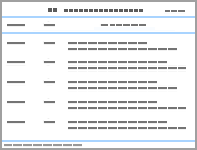
"
| 组别 | n | 性别/n | 年龄/岁 | 病程/年 | Hoehn-Year分期 | |
|---|---|---|---|---|---|---|
| 男 | 女 | |||||
| 对照组 | 33 | 15 | 18 | 67.02±4.52 | 3.36±1.52 | 3.67±0.48 |
| 试验组 | 33 | 17 | 16 | 67.41±4.42 | 4.00±2.06 | 3.70±0.47 |
| t/χ²值 | 0.243 | 2.878 | 1.428 | 0.260 | ||
| P值 | 0.622 | 0.970 | 0.158 | 0.795 | ||
"
| 组别 | n | 治疗前 | 治疗后 | t值 | P值 |
|---|---|---|---|---|---|
| 对照组 | 33 | 16.52±3.89 | 11.33±2.48 | 11.540 | < 0.001 |
| 试验组 | 33 | 16.06±3.76 | 7.76±2.73 | 17.310 | < 0.001 |
| t值 | 0.483 | 5.569 | |||
| P值 | 0.631 | < 0.001 |
"
| 组别 | n | 治疗前 | 治疗后 | t值 | P值 |
|---|---|---|---|---|---|
| 对照组 | 33 | 12.00±2.51 | 9.12±2.75 | 9.674 | < 0.001 |
| 试验组 | 33 | 12.82±2.35 | 7.33±1.81 | 14.169 | < 0.001 |
| t值 | 1.366 | 3.120 | |||
| P值 | 0.177 | 0.003 |
"
| 组别 | n | 治疗前 | 治疗后 | t值 | P值 |
|---|---|---|---|---|---|
| 对照组 | 33 | 24.06±2.42 | 19.67±2.25 | 10.000 | < 0.001 |
| 试验组 | 33 | 23.06±2.45 | 15.97±2.28 | 14.914 | < 0.001 |
| t值 | 1.668 | 6.630 | |||
| P值 | 0.100 | < 0.001 |
"
| 组别 | n | 治疗前 | 治疗后 | t值 | P值 |
|---|---|---|---|---|---|
| 对照组 | 33 | 30.42±4.20 | 36.39±3.90 | 10.795 | < 0.001 |
| 试验组 | 33 | 30.64±3.68 | 39.39±3.13 | 13.660 | < 0.001 |
| t值 | 0.218 | 3.447 | |||
| P值 | 0.828 | 0.001 |
"
| 组别 | n | 治疗前 | 治疗后 | t值 | P值 |
|---|---|---|---|---|---|
| 对照组 | 33 | 654.42±45.37 | 460.48±40.28 | 18.266 | < 0.001 |
| 试验组 | 33 | 653.36±40.23 | 350.58±28.10 | 39.161 | < 0.001 |
| t值 | 0.100 | 12.856 | |||
| P值 | 0.920 | < 0.001 |
"
| 组别 | n | 治疗前 | 治疗后 | t值 | P值 |
|---|---|---|---|---|---|
| 对照组 | 33 | 1298.79±120.22 | 733.79±81.60 | 23.639 | < 0.001 |
| 试验组 | 33 | 1273.06±119.26 | 507.55±115.53 | 24.477 | < 0.001 |
| t值 | 0.873 | 9.188 | |||
| P值 | 0.386 | < 0.001 |
"
| 组别 | n | 治疗前 | 治疗后 | t值 | P值 |
|---|---|---|---|---|---|
| 对照组 | 33 | 85.36±4.37 | 73.67±3.89 | 16.750 | < 0.001 |
| 试验组 | 33 | 84.42±4.11 | 67.45±4.55 | 17.808 | < 0.001 |
| t值 | 0.900 | 5.959 | |||
| P值 | 0.372 | < 0.001 |
| [1] | DORSEY E R, SHERER T, OKUN M S, et al. The emerging evidence of the Parkinson pandemic[J]. J Parkinsons Dis, 2018, 8(S1): S3-S8. |
| [2] |
COELHO M, MARTI M J, TOLOSA E, et al. Late-stage Parkinson's disease: the Barcelona and Lisbon cohort[J]. J Neurol, 2010, 257(9): 1524-1532.
doi: 10.1007/s00415-010-5566-8 |
| [3] | SCHRAG A, TADDEI R N. Depression and anxiety in Parkinson's disease[J]. Int Rev Neurobiol, 2017, 133(1): 623-655. |
| [4] |
CRYAN J F, O'RIORDAN K J, COWAN C S M, et al. The microbiota-gut-brain axis[J]. Physiol Rev, 2019, 99(4): 1877-2013.
doi: 10.1152/physrev.00018.2018 |
| [5] | MARTIN C R, MAYER E A. Gut-brain axis and behavior[J]. Nestle Nutr Inst Workshop Ser, 2017, 88(1): 45-53. |
| [6] |
KELLY J R, BORRE Y, O'BRIEN C, et al. Transferring the blues: depression-associated gut microbiota induces neurobehavioural changes in the rat[J]. J Psychiatr Res, 2016, 82(1): 109-118.
doi: 10.1016/j.jpsychires.2016.07.019 |
| [7] |
ZHENG P, ZENG B, ZHOU C, et al. Gut microbiome remodeling induces depressive-like behaviors through a pathway mediated by the host's metabolism[J]. Mol Psychiatry, 2016, 21(6): 786-796.
doi: 10.1038/mp.2016.44 |
| [8] |
BRAVO J A, FORSYTHE P, CHEW M V, et al. Ingestion of Lactobacillus strain regulates emotional behavior and central GABA receptor expression in a mouse via the vagus nerve[J]. Proc Natl Acad Sci U S A, 2011, 108(38): 16050-16055.
doi: 10.1073/pnas.1102999108 |
| [9] |
ARSENEAULT-BREARD J, RONDEAU I, GILBERT K, et al. Combination of lactobacillus helveticus R0052 and bifidobacterium longum R0175 reduces post-myocardial infarction depression symptoms and restores intestinal permeability in a rat model[J]. Br J Nutr, 2012, 107(12): 1793-1799.
doi: 10.1017/S0007114511005137 |
| [10] |
REICH S G, SAVITT J M. Parkinson's disease[J]. Med Clin North Am, 2019, 103(2): 337-350.
doi: 10.1016/j.mcna.2018.10.014 |
| [11] |
CAPUTI V, GIRON M C. Microbiome-gut-brain axis and toll-like receptors in Parkinson's disease[J]. Int J Mol Sci, 2018, 19(6): 1689.
doi: 10.3390/ijms19061689 |
| [12] | 中华医学会神经病学分会帕金森病及运动障碍学组, 中国医师协会神经内科医师分会帕金森病及运动障碍专业组. 中国帕金森病的诊断标准2016版[J]. 中华神经科杂志, 2016, 49(4): 268-271. |
| Parkinson's Disease and Dyskinesia Group, Neurologist Branch of Chinese Medical Association, Parkinson's Disease and Dyskinesia Group. Diagnostic criteria for Parkinson's disease in China (2016 Edition)[J]. Chin J Neurol, 2016, 49(4): 268-271. | |
| [13] | DOMINGOS J, KEUS S H J, DEAN J, et al. The European Physiotherapy Guideline for Parkinson's Disease: implications for neurologists[J]. J Parkinsons Dis, 2018, 8(4): 499-502. |
| [14] | 丁光迪. 诸病源候论养生方导引法研究[M]. 北京: 人民卫生出版社, 2010: 245-248. |
| DING G D. Research on the Method of Keeping in Good Health and Daoyin in Zhu Bing Yuan Hou Lun [M]. Beijing: People's Medical Publishing House, 2010: 245-248. | |
| [15] |
REIJNDERS J S, EHRT U, WEBER W E, et al. A systematic review of prevalence studies of depression in Parkinson's disease[J]. Mov Disord, 2008, 23(2): 183-189.
doi: 10.1002/mds.21803 |
| [16] |
VAN DER HOEK T C, BUS B A, MATUI P, et al. Prevalence of depression in Parkinson's disease: effects of disease stage, motor subtype and gender[J]. J Neurol Sci, 2011, 310(1-2): 220-224.
doi: 10.1016/j.jns.2011.07.007 |
| [17] |
ROJO A, AGUILAR M, GAROLERA M T, et al. Depression in Parkinson's disease: clinical correlates and outcome[J]. Parkinsonism Relat Disord, 2003, 10(1): 23-28.
doi: 10.1016/S1353-8020(03)00067-1 |
| [18] |
MARSH L. Depression and Parkinson's disease: current knowledge[J]. Curr Neurol Neurosci Rep, 2013, 13(12): 409.
doi: 10.1007/s11910-013-0409-5 |
| [19] |
FOSTER J A, MCVEY NEUFELD K A. Gut-brain axis: how the microbiome influences anxiety and depression[J]. Trends Neurosci, 2013, 36(5): 305-312.
doi: 10.1016/j.tins.2013.01.005 |
| [20] |
DU Y, GAO X R, PENG L, et al. Crosstalk between the microbiota-gut-brain axis and depression[J]. Heliyon, 2020, 6(6): e04097.
doi: 10.1016/j.heliyon.2020.e04097 |
| [21] | NANTHAKUMARAN S, SRIDHARAN S, SOMAGUTTA M R, et al. The gut-brain axis and its role in depression[J]. Cureus, 2020, 12(9): e10280. |
| [22] |
LIANG S, WU X, HU X, et al. Recognizing depression from the microbiota-gut-brain axis[J]. Int J Mol Sci, 2018, 19(6): 1592.
doi: 10.3390/ijms19061592 |
| [23] |
DINAN T G, CRYAN J F. The microbiome-gut-brain axis in health and disease[J]. Gastroenterol Clin North Am, 2017, 46(1): 77-89.
doi: 10.1016/j.gtc.2016.09.007 |
| [24] | 张玮, 李华南, 海兴华, 等. 腹部推拿对便秘型肠易激综合征血浆脑肠肽含量干预作用的临床研究[J]. 四川中医, 2015, 33(11): 164-166. |
| ZAHNG W, LI H N, HAI X H, et al. Clinical study on the intervention effect of abdominal massage on the plasma brain-gut peptide content in constipation-type irritable bowel syndrome[J]. Sichuan Tradit Chin Med, 2015, 33(11): 164-166. | |
| [25] | 王金贵, 王艳国, 孙庆, 等. 摩腹法对肠易激综合征模型结肠组织脑肠肽表达的影响[J]. 天津中医药大学学报, 2007(1): 19-21. |
| WANG J G, WANG Y G, SUN Q, et al. Influence of Rubbing abdomen on express of braingut petide in colon tissue in irritable bowel Syndrome model[J]. J Tianjin Univ Tradit Chin Med, 2007(1): 19-21. | |
| [26] | 程艳彬, 房敏, 朱清广, 等. 推拿相关感受器转导与传入机制初探[J]. 中华中医药杂志, 2014, 29(7): 2133-2136. |
| CHENG Y B, FANG M, ZHU Q G, et al. Discussion on the transduction and afferent mechanisms of the receptor associated with Manipulation[J]. Chin J Tradit Chin Med, 2014, 29(7): 2133-2136. | |
| [27] | 张粲, 王健, 邰先桃. 基于肠道菌群-肠-脑相通理论探讨小儿推拿与脑性瘫痪的关系[J]. 中医药临床杂志, 2021, 33(9): 1658-1662. |
| ZHANG C, WANG J, TAI X T, et al. Discussion on the relationship between massage and cerebral palsy in children based on the theory of intestinal flora-intestine-brain communication[J]. Clin J Tradit Chin Med, 2021, 33(9): 1658-1662. | |
| [28] |
RASMUSSEN P, BRASSARD P, ADSER H, et al. Evidence for a release of brain-derived neurotrophic factor from the brain during exercise[J]. Exp Physiol, 2009, 94(10): 1062-1069.
doi: 10.1113/expphysiol.2009.048512 |
| [29] |
KAWASHIMA S, UEKI Y, KATO T, et al. Changes in striatal dopamine release associated with human motor-skill acquisition[J]. PLoS One, 2012, 7(2): e31728.
doi: 10.1371/journal.pone.0031728 |
| [30] |
SVEINBJORNSDOTTIR S. The clinical symptoms of Parkinson's disease[J]. J Neurochem, 2016, 139(1): 318-324.
doi: 10.1111/jnc.13691 |
| [31] |
JANKOVIC J, TAN E K. Parkinson's disease: etiopathogenesis and treatment[J]. J Neurol Neurosurg Psychiatry, 2020, 91(8): 795-808.
doi: 10.1136/jnnp-2019-322338 |
| [32] |
BREEN D P, HALLIDAY G M, LANG A E. Gut-brain axis and the spread of α-synuclein pathology: vagal highway or dead end?[J]. Mov Disord, 2019, 34(3): 307-316.
doi: 10.1002/mds.v34.3 |
| [33] |
CAO H, LIU X, AN Y, et al. Dysbiosis contributes to chronic constipation development via regulation of serotonin transporter in the intestine[J]. Sci Rep, 2017, 7(1): 10322.
doi: 10.1038/s41598-017-10835-8 |
| [34] | WANG H X, WANG Y P. Gut microbiota-brain axis[J]. Chin Med J (Engl), 2016, 129(19): 2373-2380. |
| [35] |
DIMIDI E, CHRISTODOULIDES S, SCOTT S M, et al. Mechanisms of action of probiotics and the gastrointestinal microbiota on gut motility and constipation[J]. Adv Nutr, 2017, 8(3): 484-494.
doi: 10.3945/an.116.014407 |
| [36] |
GOMES D O V S, MORAIS M B. Gut microbiota and the use of probiotics in constipation in children and adolescents: systematic review[J]. Rev Paul Pediatr, 2019, 38: e2018123.
doi: 10.1590/1984-0462/2020/38/2018123 |
| [37] |
JANKOVIC J. Parkinson's disease: clinical features and diagnosis[J]. J Neurol Neurosurg Psychiatry, 2008, 79(4): 368-376.
doi: 10.1136/jnnp.2007.131045 |
| [38] |
BERARDELLI A, ROTHWELL J C, THOMPSON P D, et al. Pathophysiology of bradykinesia in Parkinson's disease[J]. Brain, 2001, 124(11): 2131-2146.
doi: 10.1093/brain/124.11.2131 |
| [39] |
COOPER J A, SAGAR H J, TIDSWELL P, et al. Slowed central processing in simple and go/no-go reaction time tasks in Parkinson's disease[J]. Brain, 1994, 117(3): 517-529.
doi: 10.1093/brain/117.3.517 |
| [40] |
GIOVANNONI G, VAN SCHALKWYK J, FRITZ V U, et al. Bradykinesia akinesia incoordination test (BRAIN TEST):an objective computerised assessment of upper limb motor function[J]. J Neurol Neurosurg Psychiatry, 1999, 67(5): 624-629.
doi: 10.1136/jnnp.67.5.624 |
| [41] |
CURTZE C, NUTT J G, CARLSON-KUHTA P, et al. Levodopa is a double-edged sword for balance and gait in people with Parkinson's disease[J]. Movement Disorders, 2015, 30(10): 1361-1370.
doi: 10.1002/mds.26269 |
| [42] |
CAVAGNA G A, KANEKO M. Mechanical work and efficiency in level walking and running[J]. J Physiol, 1977, 268(2): 467-481.
doi: 10.1113/jphysiol.1977.sp011866 |
| [43] | GIARDINI M, NARDONE A, GODI M, et al. Instrumental or physical-exercise rehabilitation of balance improves both balance and gait in Parkinson's disease[J]. Neural Plast, 2018, 2018: 5614242. |
| [44] |
CHASTAN N, WESTBY G W, YELNIK J, et al. Effects of nigral stimulation on locomotion and postural stability in patients with Parkinson's disease[J]. Brain, 2009, 132(1): 172-184.
doi: 10.1093/brain/awn294 |
| [45] |
MORTON S M, BASTIAN A J. Relative contributions of balance and voluntary leg-coordination deficits to cerebellar gait ataxia[J]. J Neurophysiol, 2003, 89(4): 1844-1856.
doi: 10.1152/jn.00787.2002 |
| [46] |
DEBÛ B, DE OLIVEIRA GODEIRO C, LINO J C, et al. Managing gait, balance, and posture in Parkinson's disease[J]. Curr Neurol Neurosci Rep, 2018, 18(5): 23.
doi: 10.1007/s11910-018-0828-4 |
| [47] |
MCNEELY M E, EARHART G M. Medication and subthalamic nucleus deep brain stimulation similarly improve balance and complex gait in Parkinson disease[J]. Parkinsonism Relat Disord, 2013, 19(1): 86-91.
doi: 10.1016/j.parkreldis.2012.07.013 |
| [48] | PÉLISSIER J, PÉRENNOU D. [Exercices program and rehabilitation of motor disorders in Parkinson's disease][J]. [in French]. Revue Neurologique, 2000, 156(2): 190-200. |
| [49] |
SCHLENSTEDT C, MUTHURAMAN M, WITT K, et al. Postural control and freezing of gait in Parkinson's disease[J]. Parkinsonism Relat Disord, 2016, 24(1): 107-112.
doi: 10.1016/j.parkreldis.2015.12.011 |
| [50] |
FENG Y S, YANG S D, TAN Z X, et al. The benefits and mechanisms of exercise training for Parkinson's disease[J]. Life Sci, 2020, 245(1): 117345.
doi: 10.1016/j.lfs.2020.117345 |
| [51] | GRACIES J M. [Neurorehabilitation in Parkinsonian syndromes][J]. [in French]. Rev Neurol, 2010, 166(2): 196-212. |
| [52] |
BALESTRINO R, MARTINEZ-MARTIN P. Neuropsychiatric symptoms, behavioural disorders, and quality of life in Parkinson's disease[J]. J Neurol Sci, 2017, 373(1): 173-178.
doi: 10.1016/j.jns.2016.12.060 |
| [53] | ELLIS T, ROCHESTER L. Mobilizing Parkinson's disease: the future of exercise[J]. J Parkinsons Dis, 2018, 8(S1): S95-S100. |
| [54] |
HIRSCH M A, IYER S S, SANJAK M. Exercise-induced neuroplasticity in human Parkinson's disease: what is the evidence telling us?[J]. Parkinsonism Relat Disord, 2016, 22(S1): S78-S81.
doi: 10.1016/j.parkreldis.2015.09.030 |
| [1] | ZHANG Liyin. Depression in Parkinson's disease and its association with cognition, balance and quality of life [J]. Chinese Journal of Rehabilitation Theory and Practice, 2026, 32(2): 174-180. |
| [2] | TAN Mingdan, FENG Dingyao, LI Yongxue. Third-party disability in caregivers of head and neck cancer patients with dysphagia [J]. Chinese Journal of Rehabilitation Theory and Practice, 2025, 31(9): 1032-1037. |
| [3] | XUE Xing, ZHAO Haiyan, YUE Shuling, CHENG Jie, TANG Qiqun, CHENG Xiaohua, GUO Zonghai, LIU Pingping. Effect of remote ischemic conditioning combined with binaural beat music training in patients with cognitive dysfunction after cerebral infarction [J]. Chinese Journal of Rehabilitation Theory and Practice, 2025, 31(9): 1057-1065. |
| [4] | DU Lilu, YAO Renkui, ZHAO Yanyu, LI Mengxuan, ZOU Min, ZHANG Gongfa. Impact of meaning in life and living arrangements on association between activities of daily living and depression in older adults [J]. Chinese Journal of Rehabilitation Theory and Practice, 2025, 31(8): 987-992. |
| [5] | SHAN Lei, LIU Ying, ZHANG Xin, CHI Qianqian, ZHU Xiaomin. Effect of accelerated intermittent theta burst stimulation on post-stroke depression [J]. Chinese Journal of Rehabilitation Theory and Practice, 2025, 31(7): 822-829. |
| [6] | YANG Yicheng, WANG Dandan, SHEN Qunce, ZHANG Lei, WU Xueping. Effect of exercise on cancer patients with anxiety and depression during chemotherapy: a meta-analysis [J]. Chinese Journal of Rehabilitation Theory and Practice, 2025, 31(2): 184-193. |
| [7] | XIE Haixia, HU Xinxing, ZHAI Hua, LIN Peipei, HE Jianhui, ZHANG Jia, DONG Xiaowan, CHANG Fengshui. Effect of life reconstruction training on anxiety and depression among individuals with chronic spinal cord injury and their caregivers [J]. Chinese Journal of Rehabilitation Theory and Practice, 2025, 31(11): 1333-1341. |
| [8] | CHEN Yuhang, YANG Yu'ai, LU Xuanyu, WANG Yuhang, ZHANG Mengyuan, ZHANG Zihan, WANG Huiying, CHANG Jingling. Spontaneous brain activity changes in post-stroke aphasia and post-stroke depression: a meta-analysis of resting state functional magnetic resonance imaging [J]. Chinese Journal of Rehabilitation Theory and Practice, 2025, 31(10): 1143-1155. |
| [9] | LÜ Meiling, WANG Jie, ZENG Weisi, WEN Xiaoting, CHU Xin. Effect of virtual reality on cognitive function and quality of life in patients with Parkinson's disease: a meta-analysis [J]. Chinese Journal of Rehabilitation Theory and Practice, 2024, 30(6): 648-656. |
| [10] | SU Rufeng, ZHONG Xiaoke, GAO Xiaoyan, JIANG Changhao. Application of artificial intelligence in anxiety and depression among children and adolescents: a scoping review [J]. Chinese Journal of Rehabilitation Theory and Practice, 2024, 30(5): 513-519. |
| [11] | GE Ying, ZHAO Wowa, ZHANG Lu, SHU Xuan, LI Jiawei, LIU Ying. Motor function and quality of life in Parkinson's disease patients with freezing of gait [J]. Chinese Journal of Rehabilitation Theory and Practice, 2024, 30(3): 339-344. |
| [12] | LI Fang, LIU Huizhen, MEI Liping, ZHANG Tong, ZHANG Haojie, LI Bingjie, ZHAO Jun. Related factors of post-stroke depression in patients with cerebral infarction during hospitalization in rehabilitation department [J]. Chinese Journal of Rehabilitation Theory and Practice, 2024, 30(2): 217-222. |
| [13] | ZHANG Minglan, ZHANG Lingling, WANG Lisha, LIU Li, GAO Run, RAO Jiang, LIU Wan, XIA Zi'an, ZHANG Chuanwen, CHENG Xinxin. Impact of autonomic nerve function on motor function in patients with post-stroke depression [J]. Chinese Journal of Rehabilitation Theory and Practice, 2024, 30(2): 223-231. |
| [14] | YANG Ting, ZHOU Jingjie, WANG Tao, ZHU Weiwei, CHU Fengming, CHEN Wei. Effect of home exercise on pain, function and quality of life after operation for rotator cuff injury [J]. Chinese Journal of Rehabilitation Theory and Practice, 2024, 30(12): 1461-1472. |
| [15] | ZHANG Haoyuan, TIAN Gang, LI Xuefeng, LI Hongjiang, MIN Hongwei, TANG Peng, ZHANG Rui, GU Rui, LIU Kemin. Influence of clinical and rehabilitation characteristics on prognosis of diabetic foot amputees: a systematic review [J]. Chinese Journal of Rehabilitation Theory and Practice, 2024, 30(11): 1281-1290. |
| Viewed | ||||||
|
Full text |
|
|||||
|
Abstract |
|
|||||
|
||
