



《Chinese Journal of Rehabilitation Theory and Practice》 ›› 2023, Vol. 29 ›› Issue (12): 1454-1464.doi: 10.3969/j.issn.1006-9771.2023.12.010
Previous Articles Next Articles
YANG Yaru1,2,3, YANG Jian1,2,3( )
)
Received:2023-03-10
Revised:2023-10-23
Published:2023-12-25
Online:2023-12-28
Contact:
YANG Jian, E-mail: Supported by:CLC Number:
YANG Yaru, YANG Jian. Content comparison of assessment tools of activity and participation, and quality of life: based on ICD-11 and ICF[J]. 《Chinese Journal of Rehabilitation Theory and Practice》, 2023, 29(12): 1454-1464.
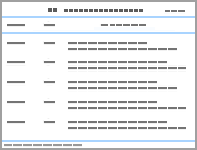
"
| 测量工具 | 维度和测量项目 | 测量内容 | 测量方式 | 常模/标准参照 | 适用人群 | 适用情境 | 完成时长 |
|---|---|---|---|---|---|---|---|
| BI[ | 10个测量项目 | 1.进食 2.修饰 3.洗澡 4.穿衣 5.控制大便 6.控制小便 7.如厕 8.床椅转移 9.行走 10.爬楼梯 | 1.观察测量 2.自我报告 | 标准参照 | 脑卒中; 其他神经肌肉骨骼疾病; 肿瘤患者 | 医疗; 康复; 社区; 社会服务机构 | 1.自我报告(2~5 min); 2.直接观察(20 min,也根据患者的能力和耐受性) |
| IADL[ | 8个测量项目 | 1.上街购物 2.外出活动 3.食物烹调 4.家务维持 5.洗衣服 6.使用电话的能力 7.服用药物 8.处理财务的能力 | 1.观察测量 2.自我报告 3.代理人(照护者)的半结构化访谈 | 标准参照 | 成年群体(适用于不同疾病与功能状态的患者,如脑外伤、脊髓损伤等) | 医疗; 康复; 社区; 社会服务机构 | 30~60 min |
| SF-36[ | 8个维度 36个测量项目 | 1.生理功能 2.生理职能 3.身体疼痛 4.一般健康状况 5.精力/活力 6.社会功能 7.情感角色功能 8.心理健康 | 1.自我报告 2.访谈 | 常模参照 | 所有疾病和功能障碍的患者; 一般人群 | 医疗; 康复; 社区; 社会服务机构; 教育机构 | 10~30 min |
| WHOQOL-BREF[ | 4个维度 26个测量项目 | 1.身体健康 2.心理 3.社会关系 4.环境 | 1.访谈 2.问卷调查 | 常模参照 | 患有特定疾病的特定人群; 一般人群 | 医疗; 康复; 社区; 社会服务机构; 教育机构 | 10~30 min |
| WHOQOL-DIS[ | 5个维度 39个测量项目(含总分项) | 1.身体健康 2.心理 3.社会关系 4.环境 5.残疾(包括歧视、自主性、社交和社会活动) | 1.访谈 2.问卷调查 | 常模参照 | 患有特定疾病的特定人群 | 医疗; 康复; 社区; 社会服务机构; 教育机构 | 10~30 min |
| WHODAS 2.0[ | 6个维度 36个测量项目 | 1.理解与交流 2.四处走动 3.自我照顾 4.与他人相处 5.生活活动 6.社会参与 | 1.观察测量 2.自我报告 3.代理人报告 | 常模参照 | 患有疾病的人群; 一般人群 | 医疗; 康复; 社区; 社会服务机构; 教育机构 | 10~30 min |
"
| 测量工具 | 测量项目 | 测量概念与内容(活动和参与内容) | ICF编码 |
|---|---|---|---|
| BI | 1.进食 | 进食和喝饮料 | d550 吃 d560 喝 |
| 2.洗澡 | 盥洗与护理 | d510 盥洗自身 | |
| 3.修饰 | 洗脸、刷牙 | d520 护理身体各部 | |
| 4.穿衣 | 穿衣 | d540 穿着 | |
| 5.控制大便 | 控制大便 | d5301 控制大便 | |
| 6.控制小便 | 控制小便 | d5300 控制小便 | |
| 7.如厕 | 如厕 | d530 如厕 | |
| 8.床椅转移 | 坐姿转换 | d4200 坐姿移动自身 | |
| 9.平地行走 | 步行 | d450 步行 | |
| 10.上下楼梯 | 爬楼梯 | d451 上下楼梯 | |
| IADL | 1.上街购物 | 购物 | d6200 购物 |
| 2.外出活动 | 日常活动 | d499 未特指的活动 | |
| 3.食物烹调 | 做饭 | d630 准备膳食 | |
| 4.家务维持 | 做家务 | d640 做家务 | |
| 5.洗衣服 | 洗衣 | d6400 清洗和晾干衣服及外衣 | |
| 6.使用电话的能力 | 使用电话 | d3600 使用通讯设备 | |
| 7.服用药物 | 服用药物 | d570 照顾个人的健康 | |
| 8.处理财务的能力 | 处理财务 | d230 进行日常事务 | |
| SF-36 | 1.日常活动(4a~d,5a~c),7项 | 日常活动 | d2303 控制自身活动水平 |
| 交流 | d350 交谈 | ||
| 使用电话 | d360 使用交流设备与技术 | ||
| 2.弯腰、跪下、弯腰(3f)1项 | 改变姿势 | d410 改变身体的基本姿势 | |
| 3.提升,搬运(3a~c)3项 | 转换 | d4200 坐姿移动自身 | |
| 提或搬运东西 | d430 举起和搬运物体 | ||
| 精细手的使用 | d440 精巧手的使用 | ||
| 4.步行(3g~i)3项 | 步行 | d450 步行 | |
| 5.爬(3d,3e)2项 | 爬 | d4551 攀登 | |
| 6.跑(3a)1项 | 跑步 | d4552 奔跑 | |
| 7.装扮(3j)1项 | 洗漱 | d510 盥洗自身 | |
| 夹子、剃须、梳子、洗发水、化妆品 | d520 护理身体各部 | ||
| 如厕 | d530 如厕 | ||
| 穿衣 | d540 穿着 | ||
| 8.家务劳动(3b,8)2项 | 做家务 | d640 做家务 | |
| 9.与其他人的社交活动(6,10)2项 | 与他人交往 | d750 非正式社会关系 d760 家庭人际关系 | |
| 10.工作 (4a~d,5a~c)7项 | 工作 | d850 有报酬的就业 d855 无报酬的就业 | |
| 休闲 | d920 娱乐和休闲 d930 宗教和精神性活动 | ||
| WHOQOL-BREF | 1.应付日常生活 | 日常活动 | d2303 控制自身活动水平 |
| 交流 | d350 交谈 | ||
| 使用电话 | d360 使用交流设备与技术 | ||
| 2.获得所需要的信息 | 获取信息 | d138获取信息 | |
| 3.休闲活动 | 休闲娱乐 | d920 娱乐和休闲 | |
| 4.与人社交1 | 人际关系 | d750 非正式社会关系 d760 家庭人际关系 | |
| 5.与人社交2 | |||
| 6.交通 | 交通活动 | d470 利用交通工具 | |
| WHOQOL-DIS | 1.应付日常生活 | 日常活动 | d2303 控制自身活动水平 |
| 交流 | d350 交谈 d310 交流-接收-口头讯息 | ||
| 使用电话 | d360 使用交流设备与技术 | ||
| 2.获得所需要的信息 | 获取信息 | d138获取信息 | |
| 3.休闲活动 | 休闲娱乐 | d920 娱乐和休闲 | |
| 4.与人社交1 | 人际关系 | d750 非正式社会关系 d760 家庭人际关系 | |
| 5.与人社交2 | |||
| 6.交通 | 交通活动 | d470 利用交通工具 | |
| 7.社会活动 | 社区、社会和公民生活 | d999 未特指的社区、社会和公民生活 | |
| 8.社区活动 | 社区、社会和公民生活 | d999 未特指的社区、社会和公民生活 | |
| WHODAS 2.0 | 1.认知 | 集中注意力 | b140吸引注意力 d161吸引注意力(VA00注意功能[WHODAS]) |
| 记得做重要的事 | b144记忆功能(VA01记忆功能[WHODAS]) | ||
| 分析并解决日常生活问题 | d175 解决问题(VA02解决问题[WHODAS]) | ||
| 学习一项新任务 | d155掌握技能(VA03基本学习[WHODAS]) | ||
| 理解别人的言语 | d310 交流—接收—口头讯息(VD04 交流-接收-口头讯息沟[WHODAS]) | ||
| 发起并维持谈话 | d350交谈(VA05对话) | ||
| 2.活动 | 长时间站立 | d415保持一种身体姿势(VD10 保持站姿) | |
| 坐下后站立 | d410改变身体的基本姿势(VD11 改变身体的基本姿式-站立[WHODAS]) | ||
| 家中来回走动 | d460在不同地点到处移动(VD12 在家中移动[WHODAS]) | ||
| 从家中外出 | d460在不同地点到处移动(VD13 在住所和其他建筑物外到处移动[WHODAS]) | ||
| 长距离行走 | d450步行(VD14 步行[WHODAS]) | ||
| 3.自我照料 | 洗澡 | d510 盥洗自身(VD20 盥洗自身[WHODAS]) | |
| 穿衣服 | d540 穿着(VD21 穿着[WHODAS]) | ||
| 进食 | d550 吃(VD22 吃[WHODAS]) | ||
| 独立生活数日 | d230 进行日常事务(VD23 进行日常事[WHODAS]) | ||
| 4.与他人相处 | 与陌生人相处 | d730 与陌生人的联系(VD30与陌生人交往[WHODAS]) | |
| 维持一段友情 | d750 非正式社会关系(VD31与朋友的非正式关系——维持[WHODAS]) | ||
| 同他人密切相处 | d760 家庭人际关系(VD32家庭关系 [WHODAS]) | ||
| 结交新朋友 | d750 非正式社会关系(VD33与朋友的非正式关系——结交新朋友 [WHODAS]) | ||
| 性活动 | d770 亲密关系(VD34亲密关系 [WHODAS]) | ||
| 5.生活活动 | 承担家务劳动责任 | d650 照管居家物品(VD40 担负起家务的责任[WHODAS]) | |
| 完成家务劳动 | d640 做家务 (VD41 完成大多数重要的家务任务[WHODAS] VD42 做家务[WHODAS]) | ||
| 干完所有家务劳动 | |||
| 尽快完成家务劳动 | |||
| 日常工作或学习 | d815 学龄前教育 d820 学校教育 d825 职业训练 d830 高等教育 d850 有报酬的就业 (VD43.0 日常工作或学习中面临的困难[WHODAS] VD43.1 完成大多数工作或学习中的任务[WHODAS] VD43.2 完成所需要的全部工作或学习中的任务[WHODAS] VD43.3 迅速完成有报酬的工作或学习任务[WHODAS]) | ||
| 很好地完成大多数重要工作或学习 | |||
| 完成份内所有工作 | |||
| 尽可能完成工作 | |||
| 6.参与和健康问题的影响 | 像他人一样参与社区活动 | d910 社区生活(VD50娱乐和休闲[WHODAS]) | |
| “有尊严的活着”的困难 | d940 人权(VD52 人权) | ||
| 健康问题及影响上花费时间 | d570 照顾个人的健康(VD53 花费在健康状况上的时间[WHODAS]) | ||
| 健康问题对家庭带来的经济损失 | d870 经济自给(VD55 在健康方面损失资金[WHODAS]) | ||
| 自我放松或娱乐方面的困难 | d920 娱乐和休闲(VD57 在放松或娱乐方面面临的问题[WHODAS]) |
| [1] | United Nations. Convention on the Rights of Persons with Disabilities[EB/OL]. (2006-12-13)[2022-12-09]. https://www.ohchr.org/en/instruments-mechanisms/instruments/convention-rights-persons-disabilities. |
| [2] |
BENKA J, NAGYOVA I, ROSENBERGER J, et al. Social participation in early and established rheumatoid arthritis patients[J]. Disabil Rehabil, 2016, 38(12): 1172-1179.
doi: 10.3109/09638288.2015.1076071 pmid: 26287286 |
| [3] |
YI T I, HAN J S, LEE K E, et al. Participation in leisure activity and exercise of chronic stroke survivors using community-based rehabilitation services in seongnam city[J]. Ann Rehabil Med, 2015, 39(2): 234-242.
doi: 10.5535/arm.2015.39.2.234 pmid: 25932420 |
| [4] |
BERGES I M, SEALE G S, OSTIR G V. The role of positive affect on social participation following stroke[J]. Disabil Rehabil, 2012, 34(25): 2119-2123.
doi: 10.3109/09638288.2012.673684 |
| [5] |
CHOI Y I, PARK J H, JUNG M Y, et al. Psychosocial predictors of participation restriction poststroke in Korea: a path analysis[J]. Rehabil Psychol, 2015, 60(3): 286-294.
doi: 10.1037/rep0000051 pmid: 26192049 |
| [6] |
CHEN L, ZHANG Z. Community participation and subjective well-being of older adults: the roles of sense of community and neuroticism[J]. Int J Environ Res Public Health, 2022, 19(6) :3261.
doi: 10.3390/ijerph19063261 |
| [7] |
CRAIG A, NICHOLSON PERRY K, GUEST R, et al. Adjustment following chronic spinal cord injury: determining factors that contribute to social participation[J]. Br J Health Psychol, 2015, 20(4): 807-823.
doi: 10.1111/bjhp.12143 pmid: 26037456 |
| [8] |
PETER C, MÜLLER R, POST M W, et al. Psychological resources, appraisals, and coping and their relationship to participation in spinal cord injury: a path analysis[J]. Arch Phys Med Rehabil, 2014, 95(9): 1662-1671.
doi: 10.1016/j.apmr.2014.04.012 |
| [9] |
SWEET S N, NOREAU L, LEBLOND J, et al. Peer support need fulfillment among adults with spinal cord injury: relationships with participation, life satisfaction and individual characteristics[J]. Disabil Rehabil, 2016, 38(6): 558-565.
doi: 10.3109/09638288.2015.1049376 pmid: 26017541 |
| [10] |
FALLAHPOUR M, KOTTORP A, NYGARD L, et al. Participation after acquired brain injury: associations with everyday technology and activities in daily life[J]. Scand J Occup Ther, 2015, 22(5): 366-376.
doi: 10.3109/11038128.2015.1011229 pmid: 25732326 |
| [11] |
ZHANG L F, YAN T B, YOU L M, et al. Barriers to activity and participation for stroke survivors in rural China[J]. Arch Phys Med Rehabil, 2015, 96(7): 1222-1228.
doi: 10.1016/j.apmr.2015.01.024 |
| [12] |
杨亚茹, 郝传萍. 基于ICF构建智力残疾儿童适应性体育课程体系[J]. 中国康复理论与实践, 2022, 28(6): 659-669.
doi: 10.3969/j.issn.1006-9771.2022.06.006 |
| YANG Y Y, HAO C P. Construction of adapted physical education curriculum for children with intellectual disabilities using ICF[J]. Chin J Rehabil Theory Pract, 2022, 28(6): 659-669. | |
| [13] |
RICE I M, WONG A W, SALENTINE B A, et al. Differences in participation based on self-esteem in power and manual wheelchair users on a university campus: a pilot study[J]. Disabil Rehabil Assist Technol, 2015, 10(2): 102-107.
doi: 10.3109/17483107.2013.840864 pmid: 24088039 |
| [14] | EGAN M, KUBINA L A, DUBOULOZ C J, et al. Very low neighbourhood income limits participation post stroke: preliminary evidence from a cohort study[J]. BMC Public Health, 2015, 4(15): 528. |
| [15] |
YEUNG P, TOWERS A. An exploratory study examining the relationships between the personal, environmental and activity participation variables and quality of life among young adults with disabilities[J]. Disabil Rehabil, 2014, 36(1): 63-73.
doi: 10.3109/09638288.2013.777808 pmid: 23527568 |
| [16] |
BOURASSA K J, MEMEL M, WOOLVERTON C, et al. Social participation predicts cognitive functioning in aging adults over time: comparisons with physical health, depression, and physical activity[J]. Aging Ment Health, 2017, 21(2): 133-146.
doi: 10.1080/13607863.2015.1081152 pmid: 26327492 |
| [17] |
MINAGAWA Y, SAITO Y. Active social participation and mortality risk among older people in Japan: results from a nationally representative sample[J]. Res Aging, 2015, 37(5): 481-499.
doi: 10.1177/0164027514545238 pmid: 25651580 |
| [18] | 世界卫生组织. 国际功能、残疾和健康分类(国际中文增补版)[M]. 邱卓英,译. 日内瓦: 世界卫生组织, 2015. |
| World Health Organization. International Classification of Functioning, Disability and Health-International (Chinese Supplement)[M]. QIU Z Y, trans trans. Geneva: World Health Organization, 2015. | |
| [19] |
邱卓英, 李伦, 陈迪, 等. 基于世界卫生组织国际健康分类家族康复指南研究:理论架构和方法体系[J]. 中国康复理论与实践, 2020, 26(2): 125-135.
doi: 10.3969/j.issn.1006-9771.2020.02.001 |
| QIU Z Y, LI L, CHEN D, et al. Research on rehabilitation guidelines using World Health Organization Family International Classifications: framework and approaches[J]. Chin J Rehabil Theory Pract, 2020, 26(2): 125-135. | |
| [20] |
KARIMI M, BRAZIER J. Health, health-related quality of life, and quality of life: what is the difference?[J]. Pharmacoeconomics, 2016, 34(7): 645-649.
doi: 10.1007/s40273-016-0389-9 pmid: 26892973 |
| [21] |
CIEZA A, BROCKOW T, EWERT T, et al. Linking health-status measurements to the International Classification of Functioning, Disability and Health[J]. J Rehabil Med, 2002, 34(3): 205-210.
doi: 10.1080/165019702760279189 |
| [22] |
PATRICK D L, DEYO R A. Generic and disease-specific measures in assessing health status and quality of life[J]. Med Care, 1989, 27(3 Suppl): S217-S232.
doi: 10.1097/00005650-198903001-00018 pmid: 2646490 |
| [23] |
FAYED N, CIEZA A, BICKENBACH J E. Linking health and health-related information to the ICF: a systematic review of the literature from 2001 to 2008[J]. Disabil Rehabil, 2011, 33(21-22): 1941-1951.
doi: 10.3109/09638288.2011.553704 pmid: 21303198 |
| [24] |
CIEZA A, STUCKI G. Content comparison of Health-related Quality of Life (HRQOL) instruments based on the International Classification of Functioning, Disability and Health (ICF)[J]. Qual Life Res, 2005, 14(5): 1225-1237.
doi: 10.1007/s11136-004-4773-0 pmid: 16047499 |
| [25] |
HUANG Y, WANG Y, YANG J, et al. Application of the International Classification of Functioning, Disability and Health (ICF) in dementia research and practice: a scoping review[J]. Aging Ment Health, 2022, 19(3): 1-15.
doi: 10.1080/13607863.2014.979012 |
| [26] |
BALLERT C S, HOPFE M, KUS S, et al. Using the refined ICF linking rules to compare the content of existing instruments and assessments: a systematic review and exemplary analysis of instruments measuring participation[J]. Disabil Rehabil, 2019, 41(5): 584-600.
doi: 10.1080/09638288.2016.1198433 pmid: 27414962 |
| [27] |
COHEN J. A coefficient of agreement for nominal scales[J]. Educ Psychol Meas, 1960, 20(2): 37-46.
doi: 10.1177/001316446002000104 |
| [28] | MAHONEY F I, BARTHEL D W. Functional evaluation: the Barthel Index[J]. Maryland State Med J, 2018, 14(6): 61-65. |
| [29] |
LIANG Y, WELMER A K, MÖLLER J, et al. Trends in disability of instrumental activities of daily living among older Chinese adults, 1997-2006: population based study[J]. BMJ Open, 2017, 7(8): e016996.
doi: 10.1136/bmjopen-2017-016996 |
| [30] |
LI L, WANG H M, SHEN Y. Chinese SF-36 Health Survey: translation, cultural adaptation, validation, and normalisation[J]. J Epidemiol Community Health, 2003, 57(4): 259-263.
doi: 10.1136/jech.57.4.259 |
| [31] |
The World Health Organization Quality of Life Assessment (WHOQOL): development and general psychometric properties[J]. Soc Sci Med, 1998, 46(12): 1569-1585.
doi: 10.1016/s0277-9536(98)00009-4 pmid: 9672396 |
| [32] |
TOWNSEND-WHITE C, PHAM A N, VASSOS M V. Review: a systematic review of quality of life measures for people with intellectual disabilities and challenging behaviours[J]. J Intellect Disabil Res, 2012, 56(3): 270-284.
doi: 10.1111/jir.2012.56.issue-3 |
| [33] | World Health Organization. WHO Disability Assessment Schedule 2.0 (WHODAS 2.0)[EB/OL]. [2022-12-10]. https://www.who.int/standards/classifications/international-classification-of-functioning-disability-and-health/who-disability-assessment-schedule. |
| [34] |
DUTIL E, FORGET A, VANIER M, et al. Development of the ADL profile[J]. Occup Ther Health Care, 1990, 7(1): 7-22.
doi: 10.1080/J003v07n01_03 pmid: 23952486 |
| [35] |
SONG J M, LEE H. Mapping items of functioning questionnaires into the International Classification of Functioning, Disability and Health: stroke[J]. J Korean Phys Ther, 2016, 28(6): 341-347.
doi: 10.18857/jkpt.2016.28.5.341 |
| [36] |
WADE D T, COLLIN C. The Barthel ADL Index: a standard measure of physical disability?[J]. Int Disabil Stud, 1988, 10(2): 64-67.
doi: 10.3109/09638288809164105 pmid: 3042746 |
| [37] |
LIU W, UNICK J, GALIK E, et al. Barthel Index of activities of daily living: item response theory analysis of ratings for long-term care residents[J]. Nurs Res, 2015, 64(2): 88-99.
doi: 10.1097/NNR.0000000000000072 pmid: 25738620 |
| [1] | MENG Lijun. Challenges and reflections on ethical review of rehabilitation research for children with disabilities [J]. Chinese Journal of Rehabilitation Theory and Practice, 2026, 32(2): 142-150. |
| [2] | WEI Chenjing, DUAN Jinjuan, CONG Yan, SUN Fengjiao, CAI Hongbo. Development of an assessment-adaptation-evaluation framework for wheelchair cushions [J]. Chinese Journal of Rehabilitation Theory and Practice, 2025, 31(9): 1092-1100. |
| [3] | DU Lilu, YAO Renkui, ZHAO Yanyu, LI Mengxuan, ZOU Min, ZHANG Gongfa. Impact of meaning in life and living arrangements on association between activities of daily living and depression in older adults [J]. Chinese Journal of Rehabilitation Theory and Practice, 2025, 31(8): 987-992. |
| [4] | YANG Yaru, QIU Zhuoying, CHEN Di, WANG Zhongyan, ZHANG Meng, SONG Guiyun. Constructing disability eligibility standards using ICF: conceptual framework, approaches and methodological systems [J]. Chinese Journal of Rehabilitation Theory and Practice, 2025, 31(7): 745-754. |
| [5] | YE Haiyan, YANG Yaru, QIU Zhuoying, WANG Zhongyan, CHEN Di, SONG Guiyun, WANG Fangyong, TIAN Yifan, LIU Ye. Comparative study of five physical disability-related standards in China based on ICF and ICD-11 [J]. Chinese Journal of Rehabilitation Theory and Practice, 2025, 31(7): 772-780. |
| [6] | SUN Jiayao, MA Chunhua, LÜ Jun, TANG Qi, SHAO Zhimin, HU Kangning, HUANG Haoying, HUANG Aihua. Development of a needs assessment tool for grading care services for adults with disabilities in welfare institutions [J]. Chinese Journal of Rehabilitation Theory and Practice, 2025, 31(7): 802-811. |
| [7] | ZHANG Xiaoyan, CAO Jing, QIU Zhuoying, YAN Zixue, CHEN Yanke. Characteristics of adaptive behavior in children with intellectual and developmental disabilities [J]. Chinese Journal of Rehabilitation Theory and Practice, 2025, 31(5): 592-600. |
| [8] | YANG Yaru, QIU Zhuoying, CHEN Di, LÜ Jun, TIAN Yifan, ZHANG Aimin. Disability definition, classification, grading and assessment in disability eligibility: an ICF and ICD -11 framework perspective [J]. Chinese Journal of Rehabilitation Theory and Practice, 2025, 31(4): 373-381. |
| [9] | TIAN Yifan, CHEN Di, QIU Zhuoying, YANG Yaru, LÜ Jun, DONG Xiangbing. Comparison of classification and grading approach in four selected disability standards using ICF framework [J]. Chinese Journal of Rehabilitation Theory and Practice, 2025, 31(4): 382-390. |
| [10] | LIN Lixia, ZENG Qiuchan, GUO Yunyuan, LIANG Rongxiang, WU Hao, SHAO Yuping. Relationship between patterns of sleep duration and activities of daily living among middle-aged and older adults [J]. Chinese Journal of Rehabilitation Theory and Practice, 2025, 31(3): 331-338. |
| [11] | WANG Xiaoxiao, QU Lu, WANG Jiaxin, ZHAO Meiping, LI Muzi, LIU Qiaoyun. Structure, content and psychometric properties of assessment tools for interoceptive function: a scoping review based on COSMIN and ICF [J]. Chinese Journal of Rehabilitation Theory and Practice, 2025, 31(2): 172-183. |
| [12] | YAN Ruxiu, SONG Luping, HUANG Fubiao, LIANG Yanhua, CUI Yao, YANG Hao. Effect of computerized cognitive remediation therapy on post-stroke cognitive impairment [J]. Chinese Journal of Rehabilitation Theory and Practice, 2025, 31(12): 1439-1449. |
| [13] | ZHANG Haoqi, LIU Hua, SUN Pu, WEN Yanfei, ZHANG Jiyue, YANG Lu. Structural content and psychometric properties of fundamental movement skills assessment scales for school-age children based on ICF-CY: a systematic review [J]. Chinese Journal of Rehabilitation Theory and Practice, 2025, 31(10): 1172-1180. |
| [14] | YU Boyang, YANG Yanyan, MA Ao, LI Tao, LIU Xiaoxie, LI Zhengyang, DUAN Yajing, LIU Jiaqi, XIE Yuxiao, WANG Cui, HUANG Zhen, ZHANG Lining, LIU Xinyi, JIA Zishan, ZHOU Mouwang. Reliability and validity of assessment tools of Brief ICF Core Sets for Arthroplasty of Knee Osteoarthritis in Perioperative Period [J]. Chinese Journal of Rehabilitation Theory and Practice, 2024, 30(9): 1053-1059. |
| [15] | ZHOU Yiwen, ZHONG Yaping, WEI Mengli, WANG Haifeng, YU Shaohua, GUI Huixian. Risk assessment of return to sport based on gait data of athletes after anterior cruciate ligament reconstruction [J]. Chinese Journal of Rehabilitation Theory and Practice, 2024, 30(8): 948-956. |
| Viewed | ||||||
|
Full text |
|
|||||
|
Abstract |
|
|||||
|
||
