



Chinese Journal of Rehabilitation Theory and Practice ›› 2026, Vol. 32 ›› Issue (4): 399-410.doi: 10.3969/j.issn.1006-9771.2026.04.004
Previous Articles Next Articles
HUANG Cheng1, SHEN Yangyi1, LU Biying2, LIU Tong1,3( ), LIU Yue1,3()
Received:2026-01-30
Published:2026-04-25
Online:2026-05-06
Contact:
LIU Tong, LIU Yue
E-mail:liutongmama@163.com;liuyue2288@163.com
Supported by:CLC Number:
HUANG Cheng, SHEN Yangyi, LU Biying, LIU Tong, LIU Yue. Application of action observation therapy in stroke rehabilitation from 2016 to 2025: a bibliometric analysis[J]. Chinese Journal of Rehabilitation Theory and Practice, 2026, 32(4): 399-410.
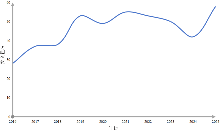
Figure 1
Annual publication of literatures"
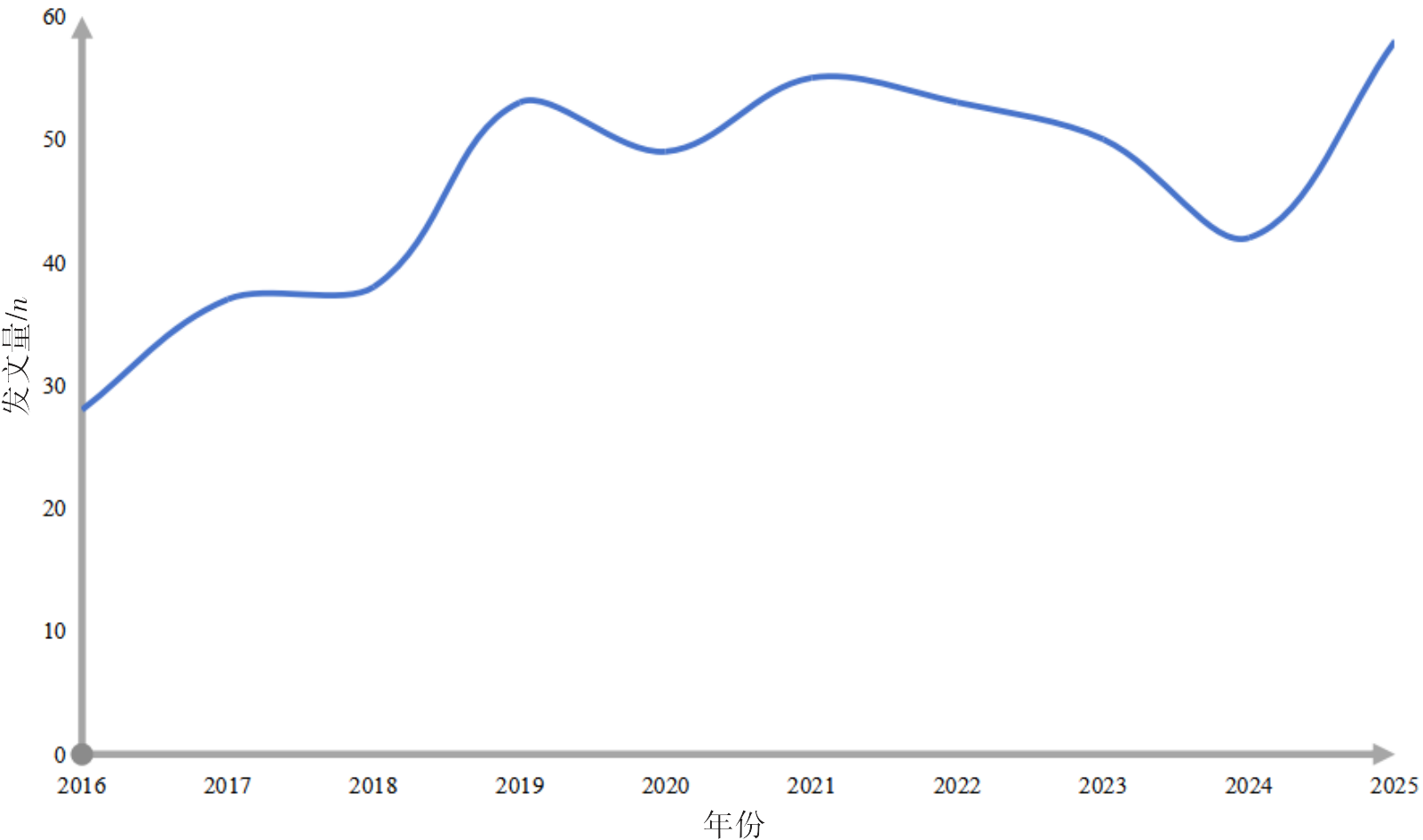
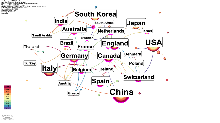
Figure 2
Co-occurrence map of countries"
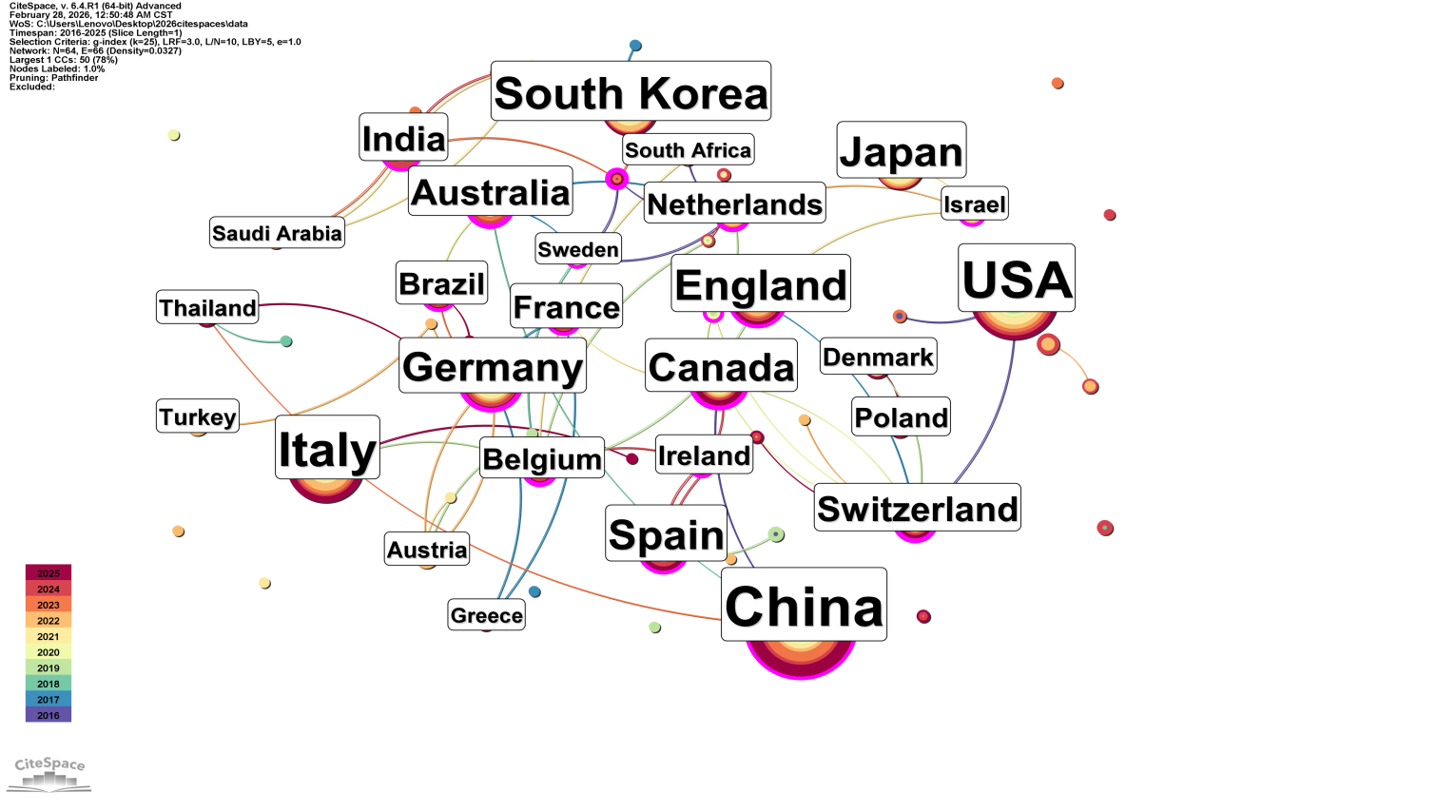

Table 1
Top ten countries by number of publications"
| 排名 | 国家 | 发文量/n | 中心性 |
|---|---|---|---|
| 1 | 中国 | 108 | 0.16 |
| 2 | 美国 | 73 | 0.05 |
| 3 | 意大利 | 54 | 0.05 |
| 4 | 韩国 | 37 | 0.05 |
| 5 | 英国 | 33 | 0.09 |
| 6 | 西班牙 | 29 | 0.15 |
| 7 | 日本 | 29 | 0.05 |
| 8 | 德国 | 25 | 0.25 |
| 9 | 加拿大 | 23 | 0.37 |
| 10 | 澳大利亚 | 18 | 0.22 |
Figure 3
Co-occurrence map of authors"
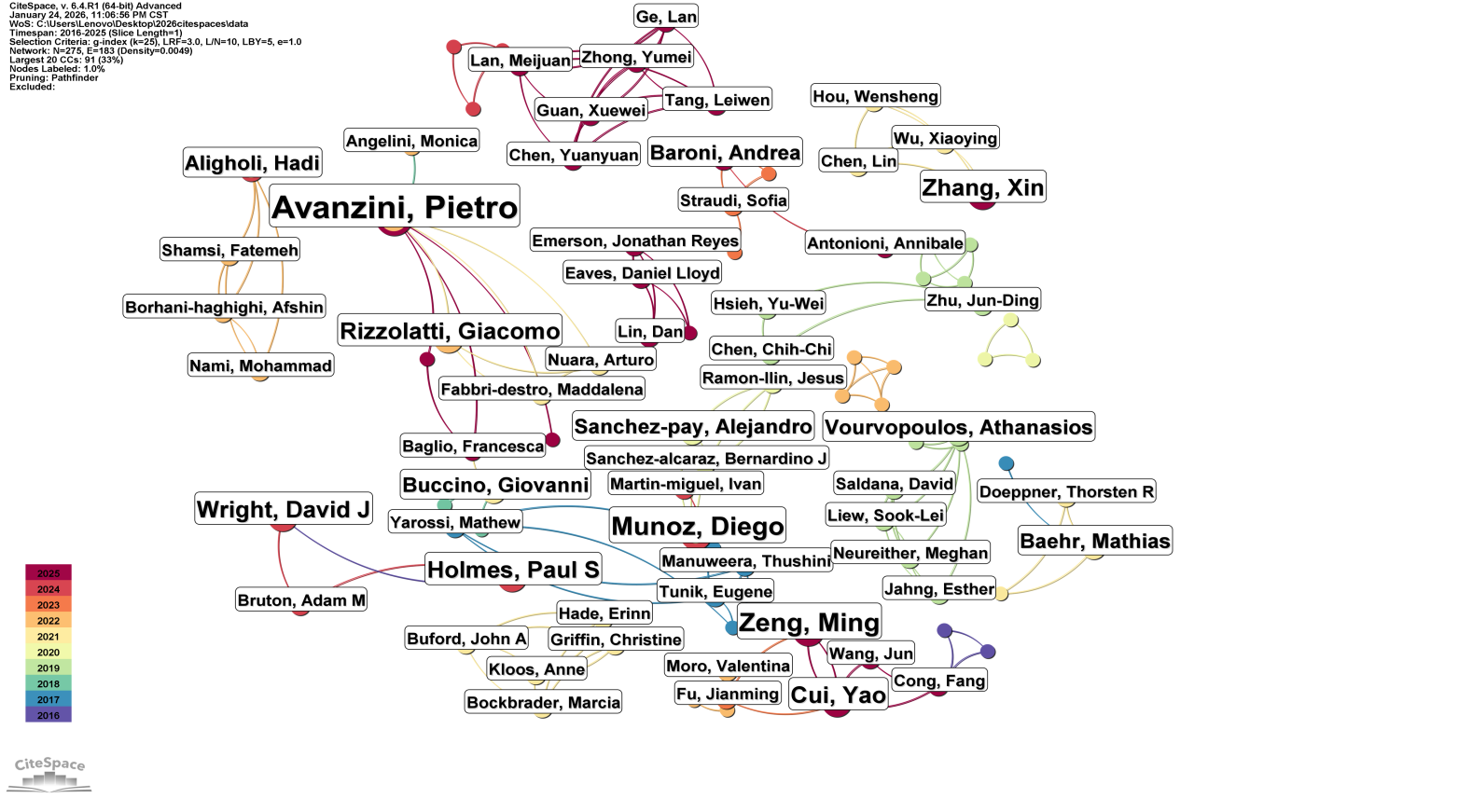
Table 2
Top ten authors by number of publications"
| 排名 | 作者 | 发文量/n | 中心性 |
|---|---|---|---|
| 1 | Pietro Avanzini | 8 | 0 |
| 2 | Zeng Ming | 5 | 0 |
| 3 | Diego Munoz | 5 | 0 |
| 4 | Paul S Holmes | 4 | 0 |
| 5 | David J Wright | 4 | 0 |
| 6 | Giacomo Rizzolatti | 4 | 0 |
| 7 | Zhang Xin | 4 | 0 |
| 8 | Cui Yao | 4 | 0 |
| 9 | Alejandro Sanchez-pay | 3 | 0 |
| 10 | Ziemowit Bankosz | 3 | 0 |
Figure 4
Co-occurrence map of institutions"
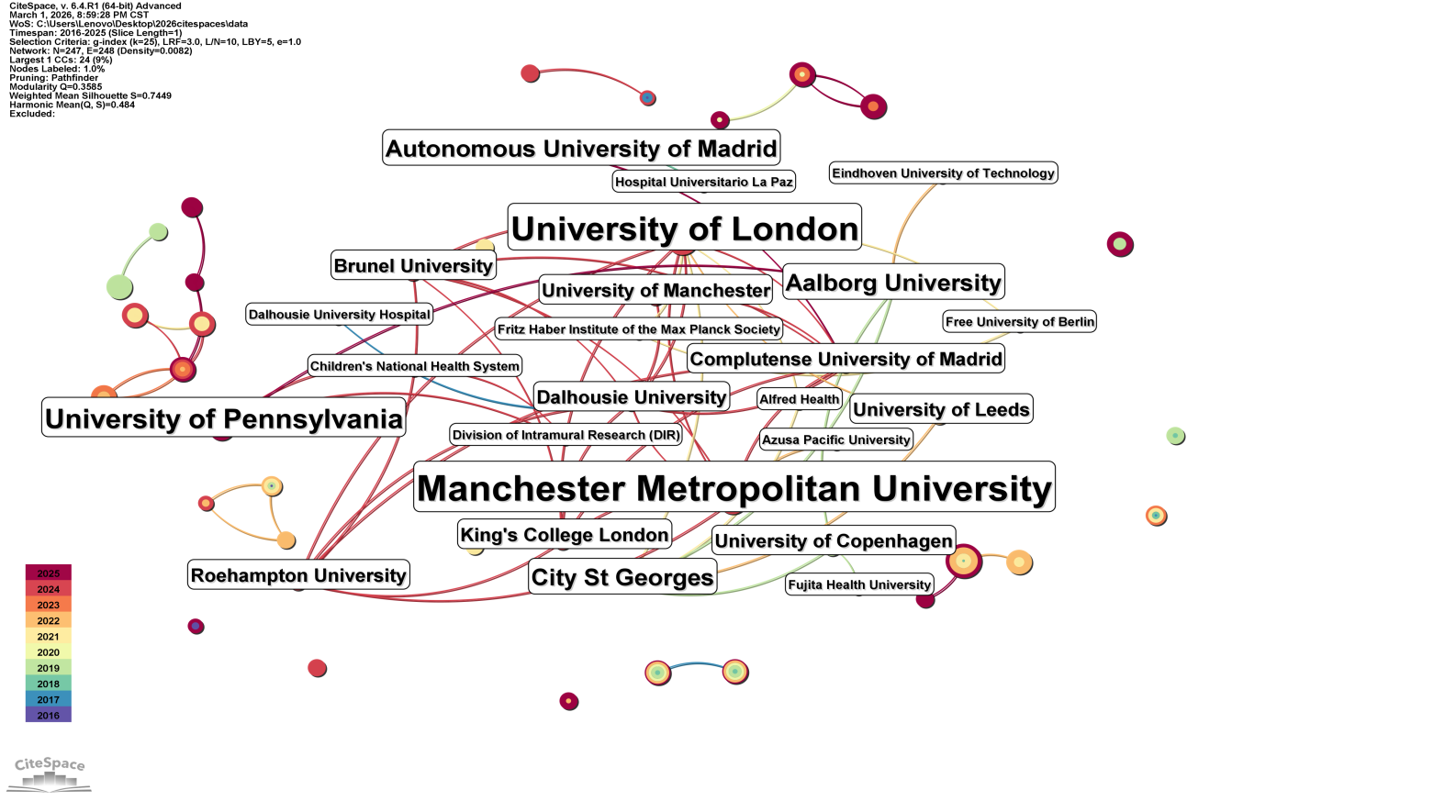
Table 3
Top ten institutions by number of publications"
| 排名 | 机构 | 发文量/n | 中心性 |
|---|---|---|---|
| 1 | Chang Gung University | 8 | 0 |
| 2 | Consiglio Nazionale delle Ricerche | 8 | 0 |
| 3 | Cheongju University | 7 | 0 |
| 4 | University of Murcia | 7 | 0 |
| 5 | Manchester Metropolitan University | 7 | 0 |
| 6 | Eulji University | 6 | 0 |
| 7 | University of London | 6 | 0 |
| 8 | Chongqing University | 5 | 0 |
| 9 | University of Parma | 5 | 0 |
| 10 | The Ohio State University | 5 | 0 |
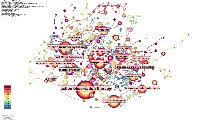
Figure 5
Co-occurrence map of keywords"

Table 4
Top ten keywords with highest frequency"
| 排名 | 关键词 | 频次/n | 中心性 |
|---|---|---|---|
| 1 | mirror neuron system | 82 | 0.03 |
| 2 | motor imagery | 63 | 0.03 |
| 3 | upper limb | 46 | 0.01 |
| 4 | brain-computer interfaces | 30 | 0.05 |
| 5 | stroke rehabilitation | 28 | 0.04 |
| 6 | imitation | 28 | 0.23 |
| 7 | mental practice | 28 | 0.06 |
| 8 | virtual reality | 25 | 0.02 |
| 9 | motor recovery | 23 | 0.14 |
| 10 | mirror therapy | 21 | 0.06 |
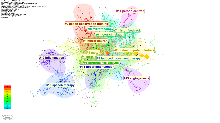
Figure 6
Clustering map of keywords"

Table 5
Keywords cluster labels and main keywords"
| 编号 | 大小 | 轮廓值 | 标签 | 关键词 |
|---|---|---|---|---|
| #0 | 30 | 0.880 | action observation training | action observation training; focal vibration; manual dexterity; virtual reality; hand dexterity |
| #1 | 29 | 0.837 | mirror neuron | action observation; chronic stroke; brain-computer interface; motor rehabilitation; upper extremity function |
| #2 | 25 | 0.795 | brain-computer interface | action observation; brain-computer interface; motor rehabilitation; chronic stroke; motor intervention |
| #3 | 25 | 0.924 | motor | mirror neuron system; action observation; action verbs; dimensionality reduction; Riemannian geometry |
| #4 | 23 | 0.811 | apraxia | action observation; motor imagery; action execution; brain activity; multi-frequency magnetoencephalography |
| #5 | 22 | 0.926 | performance analysis | action observation; mental practice; stroke rehabilitation; occupational therapy; motor observation |
| #6 | 22 | 0.897 | motor simulation | motor imagery; action observation; motor simulation; action observation system; movement control |
| #7 | 22 | 0.895 | mirror feedback | virtual reality; motor learning; prosthetic control; motor imagery; strength |
| #8 | 21 | 0.858 | mirror therapy | action observation; beta rebound; mirror neurons; upper limb rehabilitation; primary motor |
| #9 | 19 | 0.862 | induced movement therapy | action observation; brain lesions; error monitoring; action monitoring; brain computer interfaces |
| #10 | 19 | 0.884 | speech therapy | cerebrovascular disease; Asian American; war refugees; racial disparity; immigrant health |
| #11 | 19 | 0.842 | upper limb function | action observation; video parameters; control videos; corticospinal excitability; electrical stimulation |
| #12 | 18 | 0.992 | inflammation | ischemic stroke; dipeptidyl peptidase; neutrophil rolling; multiple sclerosis; Alzheimers disease |
| #13 | 10 | 1.000 | angiogenesis | simulation; myocardial infarction; dysfunction; transmural heterogeneity; strain |
| #14 | 5 | 1.000 | person-centred | action observation; virtual reality; brain-computer interfaces; appreciative inquiry; brain-computer interface |
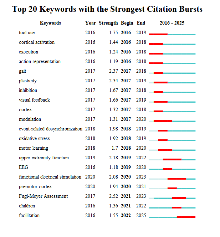
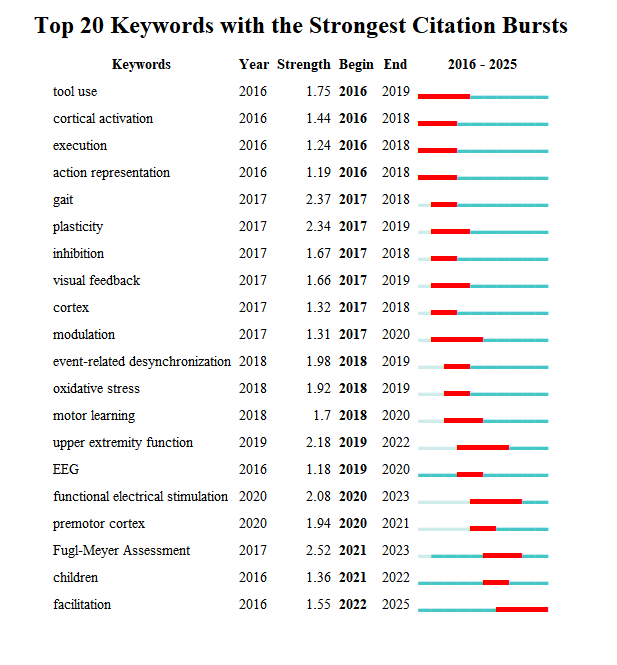
Figure 7
Bursting keywords"
| [1] |
RIZZOLATTI G, CRAIGHERO L. The mirror-neuron system[J]. Annu Rev Neurosci, 2004, 27: 169-192.
pmid: 15217330 |
| [2] |
BUCCINO G. Action observation treatment: a novel tool in neurorehabilitation[J]. Philos Trans R Soc Lond B Biol Sci, 2014, 369(1644): 20130185.
doi: 10.1098/rstb.2013.0185 |
| [3] |
CIULLO G, BOZZETTI F, ZICCARELLI S, et al. Neurophysiological mechanisms underlying action observation treatment for upper limb stroke rehabilitation: a mini-review[J]. Neurosci Biobehav Rev, 2026, 180: 106484.
doi: 10.1016/j.neubiorev.2025.106484 |
| [4] | ZHANG J J Q, FONG K N K, WELAGE N, et al. The activation of the mirror neuron system during action observation and action execution with mirror visual feedback in stroke: a systematic review[J]. Neural Plast, 2018, 2018: 2321045. |
| [5] | ERTELT D, SMALL S, SOLODKIN A, et al. Action observation has a positive impact on rehabilitation of motor deficits after stroke[J]. Neuroimage, 2007, 36(Suppl 2): T164-T173. |
| [6] |
KEYSERS C, GAZZOLA V. Hebbian learning and predictive mirror neurons for actions, sensations and emotions[J]. Philos Trans R Soc Lond B Biol Sci, 2014, 369(1644): 20130175.
doi: 10.1098/rstb.2013.0175 |
| [7] |
BRUNNER I C, SKOUEN J S, ERSLANG L, et al. Plasticity and response to action observation: a longitudinal fMRI study of potential mirror neurons in patients with subacute stroke[J]. Neurorehabil Neural Repair, 2014, 28(9): 874-884.
doi: 10.1177/1545968314527350 pmid: 24642381 |
| [8] |
BIASIUCCI A, LEEB R, ITURRATE I, et al. Brain-actuated functional electrical stimulation elicits lasting arm motor recovery after stroke[J]. Nat Commun, 2018, 9(1): 2421.
doi: 10.1038/s41467-018-04673-z pmid: 29925890 |
| [9] |
MANSOUR S, ANG K K, NAIR K P S, et al. Efficacy of brain-computer interface and the impact of its design characteristics on poststroke upper-limb rehabilitation: a systematic review and meta-analysis of randomized controlled trials[J]. Clin EEG Neurosci, 2022, 53(1): 79-90.
doi: 10.1177/15500594211009065 |
| [10] |
VOURVOPOULOS A, PARDO O M, LEFEBVRE S, et al. Effects of a brain-computer interface with virtual reality (VR) neurofeedback: a pilot study in chronic stroke patients[J]. Front Hum Neurosci, 2019, 13: 210.
doi: 10.3389/fnhum.2019.00210 pmid: 31275126 |
| [11] |
ROSSI F, SAVI F, PRESTIA A, et al. Combining action observation treatment with a brain-computer interface system: perspectives on neurorehabilitation[J]. Sensors (Basel), 2021, 21(24): 8504.
doi: 10.3390/s21248504 |
| [12] |
RIZZOLATTI G, FABBRI-DESTRO M, NUARA A, et al. The role of mirror mechanism in the recovery, maintenance, and acquisition of motor abilities[J]. Neurosci Biobehav Rev, 2021, 127: 404-423.
doi: 10.1016/j.neubiorev.2021.04.024 pmid: 33910057 |
| [13] |
FU J, ZENG M, SHEN F, et al. Effects of action observation therapy on upper extremity function, daily activities and motion evoked potential in cerebral infarction patients[J]. Medicine (Baltimore), 2017, 96(42): e8080.
doi: 10.1097/MD.0000000000008080 |
| [14] | EAVES D L, RIACH M, HOLMES P S, et al. Motor imagery during action observation: a brief review of evidence, theory and future research opportunities[J]. Front Neurosci, 2016, 10: 514. |
| [15] |
WILSON P H, ADAMS I L, CAEYENBERGHS K, et al. Motor imagery training enhances motor skill in children with DCD: a replication study[J]. Res Dev Disabil, 2016, 57: 54-62.
doi: 10.1016/j.ridd.2016.06.014 pmid: 27388492 |
| [16] | BEK J, HOLMES P S, CRAIG C E, et al. Action imagery and observation in neurorehabilitation for Parkinson's disease (ACTION-PD): development of a user-informed home training intervention to improve functional hand movements[J]. Parkinsons Dis, 2021, 2021: 4559519. |
| [17] |
EMERSON J R, BINKS J A, SCOTT M W, et al. Combined action observation and motor imagery therapy: a novel method for post-stroke motor rehabilitation[J]. AIMS Neurosci, 2018, 5(4): 236-252.
doi: 10.3934/Neuroscience.2018.4.236 pmid: 32341964 |
| [18] |
VOURVOPOULOS A, JORGE C, ABREU R, et al. Efficacy and brain imaging correlates of an immersive motor imagery BCI-driven VR system for upper limb motor rehabilitation: a clinical case report[J]. Front Hum Neurosci, 2019, 13: 244.
doi: 10.3389/fnhum.2019.00244 pmid: 31354460 |
| [19] |
TANI M, OMO Y, MATSUBARA M, et al. Action observation facilitates motor cortical activity in patients with stroke and hemiplegia[J]. Neurosci Res, 2018, 133: 7-14.
doi: S0168-0102(17)30277-8 pmid: 29031830 |
| [20] |
SUN Y, WEI W, LUO Z, et al. Improving motor imagery practice with synchronous action observation in stroke patients[J]. Top Stroke Rehabil, 2016, 23(4): 245-253.
doi: 10.1080/10749357.2016.1141472 pmid: 27077982 |
| [21] |
MAIER M, BALLESTER B R, VERSCHURE P F M J. Principles of neurorehabilitation after stroke based on motor learning and brain plasticity mechanisms[J]. Front Syst Neurosci, 2019, 13: 74.
doi: 10.3389/fnsys.2019.00074 pmid: 31920570 |
| [22] |
SALEH S, YAROSSI M, MANUWEERA T, et al. Network interactions underlying mirror feedback in stroke: a dynamic causal modeling study[J]. Neuroimage Clin, 2016, 13: 46-54.
doi: 10.1016/j.nicl.2016.11.012 |
| [23] | BORGES L R, FERNANDES A B, MELO L P, et al. Action observation for upper limb rehabilitation after stroke[J]. Cochrane Database Syst Rev, 2018, 10(10): CD011887. |
| [24] |
MAO H, LI Y, TANG L, et al. Effects of mirror neuron system-based training on rehabilitation of stroke patients[J]. Brain Behav, 2020, 10(8): e01729.
doi: 10.1002/brb3.v10.8 |
| [25] |
PENG T H, ZHU J D, CHEN C C, et al. Action observation therapy for improving arm function, walking ability, and daily activity performance after stroke: a systematic review and meta-analysis[J]. Clin Rehabil, 2019, 33(8): 1277-1285.
doi: 10.1177/0269215519839108 |
| [26] |
MARTIN M, NITSCHKE K, BEUME L, et al. Brain activity underlying tool-related and imitative skills after major left hemisphere stroke[J]. Brain, 2016, 139(Pt 5): 1497-1516.
doi: 10.1093/brain/aww035 pmid: 26956421 |
| [27] |
PAZZAGLIA M, GALLI G. Action observation for neurorehabilitation in apraxia[J]. Front Neurol, 2019, 10: 309.
doi: 10.3389/fneur.2019.00309 pmid: 31001194 |
| [28] |
CHOI J W, KIM B H, HUH S, et al. Observing actions through immersive virtual reality enhances motor imagery training[J]. IEEE Trans Neural Syst Rehabil Eng, 2020, 28(7): 1614-1622.
doi: 10.1109/TNSRE.7333 |
| [29] | RYAN D, FULLEN B, RIO E, et al. Effect of action observation therapy in the rehabilitation of neurologic and musculoskeletal conditions: a systematic review[J]. Arch Rehabil Res Clin Transl, 2021, 3(1): 100106. |
| [30] |
LLORENS R, FUENTES M A, BORREGO A, et al. Effectiveness of a combined transcranial direct current stimulation and virtual reality-based intervention on upper limb function in chronic individuals post-stroke with persistent severe hemiparesis: a randomized controlled trial[J]. J Neuroeng Rehabil, 2021, 18(1): 108.
doi: 10.1186/s12984-021-00896-2 pmid: 34210347 |
| [31] |
LIM H, KU J. A brain-computer interface-based action observation game that enhances mu suppression[J]. IEEE Trans Neural Syst Rehabil Eng, 2018, 26(12): 2290-2296.
doi: 10.1109/TNSRE.7333 |
| [32] |
WRIGHT D J, MCCORMICK S A, WILLIAMS J, et al. Viewing instructions accompanying action observation modulate corticospinal excitability[J]. Front Hum Neurosci, 2016, 10: 17.
doi: 10.3389/fnhum.2016.00017 pmid: 26869901 |
| [33] |
MORENO-VERDU M, HAMOLINE G, VAN CAENEGEM E E, et al. Guidelines for reporting action simulation studies (GRASS): proposals to improve reporting of research in motor imagery and action observation[J]. Neuropsychologia, 2024, 192: 108733.
doi: 10.1016/j.neuropsychologia.2023.108733 |
| [34] | KIM M G, LIM H, LEE H S, et al. Brain-computer interface-based action observation combined with peripheral electrical stimulation enhances corticospinal excitability in healthy subjects and stroke patients[J]. J Neural Eng, 2022, 19(3). doi: 10.1088/1741-2552/ac76e0. |
| [35] |
CHA T H, HWANG H S. Rehabilitation interventions combined with noninvasive brain stimulation on upper limb motor function in stroke patients[J]. Brain Sci, 2022, 12(8): 994.
doi: 10.3390/brainsci12080994 |
| [36] | BURZI V, TEALDI G, BOYD R N, et al. Action observation in infancy: implications for neuro-rehabilitation[J]. Dev Med Child Neurol, 2016, 58(Suppl 4): 74-77. |
| [37] |
KIRKPATRICK E, PEARSE J, JAMES P, et al. Effect of parent-delivered action observation therapy on upper limb function in unilateral cerebral palsy: a randomized controlled trial[J]. Dev Med Child Neurol, 2016, 58(10): 1049-1056.
doi: 10.1111/dmcn.13109 pmid: 27038153 |
| [38] |
ERRANTE A, SAVIOLA D, CANTONI M, et al. Effectiveness of action observation therapy based on virtual reality technology in the motor rehabilitation of paretic stroke patients: a randomized clinical trial[J]. BMC Neurol, 2022, 22(1): 109.
doi: 10.1186/s12883-022-02640-2 pmid: 35317736 |
| [1] | QI Yuanyuan, GAO Haifeng, LIU Lina, XIE Yujie, XU Jing, GAO Feng, CHEN Liang, YANG Degang, LI Jun. Spinal cord stimulation for spinal cord injury from 1999 to 2025: a bibliometric analysis [J]. Chinese Journal of Rehabilitation Theory and Practice, 2026, 32(4): 373-386. |
| [2] | GUI Shun, ZHANG Jianfei, HUANG Huizhi. Prediction of neurological function rehabilitation outcome for stroke patients using interpretable machine learning models [J]. Chinese Journal of Rehabilitation Theory and Practice, 2026, 32(4): 463-472. |
| [3] | ZHU Lili, ZHAO Jiaxin, CHENG Xue, WANG Huijuan, CHEN Xiaoxia. Experiences and needs of stroke patients during rehabilitation: a qualitative meta-synthesis [J]. Chinese Journal of Rehabilitation Theory and Practice, 2026, 32(3): 286-293. |
| [4] | LIU Ping, ZHOU Nan, XUE Xiaojie, SHAO Weibo. Application of rehabilitation therapy techniques for post-stroke dysphagia: a bibliometric analysis [J]. Chinese Journal of Rehabilitation Theory and Practice, 2026, 32(3): 294-303. |
| [5] | PU Xinyu, WANG Jingxuan, WANG Hujun, XIU Anda, WANG Yingpeng. Application of repetitive peripheral magnetic stimulation in rehabilitation therapy: a bibliometric analysis [J]. Chinese Journal of Rehabilitation Theory and Practice, 2026, 32(3): 304-316. |
| [6] | SUN Kui, HUANG Hailun, LIU Yongai, GAO Heng. Brain-computer interface technology in treatment for spinal cord injury: a bibliometric analysis [J]. Chinese Journal of Rehabilitation Theory and Practice, 2026, 32(3): 317-328. |
| [7] | YANG Ling, WANG Qinglei, WANG Jie, XU Wenjie, WANG Tong, GUO Chuan, QIAN Xue. Activation patterns and mechanism in the prefrontal cortex of post-stroke anxiety patients: a study using functional near-infrared spectroscopy [J]. Chinese Journal of Rehabilitation Theory and Practice, 2026, 32(3): 329-336. |
| [8] | HE Zhaonan, ZHANG Tingting, HE Zhaoke, MENG Lijun. Topic mining and content analysis of rehabilitation ethics research in China based on BERTopic model [J]. Chinese Journal of Rehabilitation Theory and Practice, 2026, 32(2): 132-141. |
| [9] | GUO Yabin, ZENG Biyun, ZHOU Yang. Researches in sarcopenia-pain comorbidity from 2015 to 2025: a bibliometric analysis [J]. Chinese Journal of Rehabilitation Theory and Practice, 2026, 32(2): 151-161. |
| [10] | YUE Yuan, ZHANG Tong, LIU Yuanmin, WANG Ya'nan. Effect of lower extremity exoskeleton robots on balance and walking function of patients with post-stroke cerebellar ataxia [J]. Chinese Journal of Rehabilitation Theory and Practice, 2026, 32(1): 23-29. |
| [11] | WU Cheng, ZHANG Yunfeng, WANG Weining, YU Kewei, ZHANG Yanzheng, SHEN Jiarong, WU Yi. Effect of elbow-wrist functional orthosis on plantar pressure and balance function in stroke patients with hemiplegia [J]. Chinese Journal of Rehabilitation Theory and Practice, 2026, 32(1): 30-39. |
| [12] | ZHANG Junfeng, CHEN Hao, DU Yuzheng, LI Chen, YU Tao, YANG Yuanqing. Non-pharmacological management for post-stroke spasticity from 2004 to 2024: a bibliometric analysis [J]. Chinese Journal of Rehabilitation Theory and Practice, 2026, 32(1): 45-58. |
| [13] | GAO Kaixiang, LU Haitao. Research in neurorehabilitation from 2015 to 2024: a bibliometric analysis [J]. Chinese Journal of Rehabilitation Theory and Practice, 2026, 32(1): 59-68. |
| [14] | DONG Lijun, XU Shihao, CHEN Qiuhua, ZHANG Lu, YIN Xiaobing. Application of virtual reality technology in managing negative emotions and postoperative rehabilitation in perioperative patients from 2015 to 2025: a bibliometric analysis [J]. Chinese Journal of Rehabilitation Theory and Practice, 2026, 32(1): 69-82. |
| [15] | WEI Jingyi, WANG Xiaojing, WANG Ran, WEI Chen, MA Sai, LIU Xihua. Effect of acupuncture synchronized speech training on post-stroke motor aphasia [J]. Chinese Journal of Rehabilitation Theory and Practice, 2025, 31(9): 1000-1008. |
| Viewed | ||||||
|
Full text |
|
|||||
|
Abstract |
|
|||||
|
||
