



Chinese Journal of Rehabilitation Theory and Practice ›› 2026, Vol. 32 ›› Issue (6): 621-630.doi: 10.3969/j.issn.1006-9771.2026.06.001
Previous Articles Next Articles
GUAN Yujie1, LIU Keyan1, YANG Keqin2, LIANG Yulin2, ZHANG Jinpeng2, ZHAO Bin2( )
Received:2026-03-16
Revised:2026-05-15
Published:2026-06-25
Online:2026-06-24
Supported by:CLC Number:
GUAN Yujie, LIU Keyan, YANG Keqin, LIANG Yulin, ZHANG Jinpeng, ZHAO Bin. Effect of cluster scalp acupuncture combined with Taijiquan on brain functional connectivity and network topology for patients with post-stroke depression[J]. Chinese Journal of Rehabilitation Theory and Practice, 2026, 32(6): 621-630.

Table 1
Comparison of baseline data between two groups"
| 组别 | n | 性别 (男/女)/n | 年龄/岁 | 病程/d | 疾病性质 (出血/梗死)/n | 受教育 年限/年 | 高血压/n | 糖尿病/n | MMSE |
|---|---|---|---|---|---|---|---|---|---|
| 对照组 | 20 | 7/13 | 66.51±8.50 | 35.50±11.50 | 4/16 | 9.50±2.65 | 19 | 18 | 28.20±1.01 |
| 试验组 | 20 | 9/11 | 64.50±8.50 | 38.50±13.90 | 5/15 | 8.50±3.59 | 17 | 16 | 28.75±0.85 |
| χ²/t值 | 0.417 | 0.747 | 0.744 | 0.156 | 1.002 | 0.417 | 0.784 | 1.868 | |
| P值 | 0.519 | 0.460 | 0.462 | 0.693 | 0.323 | 0.292 | 0.376 | 0.070 |
Table 2
Comparison of score of HAMD-17 between two groups pre- and post-treatment"
| 组别 | n | 测试 | t值 | P值 | |
|---|---|---|---|---|---|
| 对照组 | 20 | 前测 | 20.15±6.50 | 2.922 | 0.009 |
| 后测 | 15.50±5.50 | ||||
| 试验组 | 20 | 前测 | 20.90±6.73 | 5.047 | <0.001 |
| 后测 | 11.50±4.50 | ||||
| 治疗前两组均值差 | -0.75±2.10 | 0.357 | 0.723 | ||
| 治疗后两组均值差 | 4.00±1.59 | 2.517 | 0.016 |
Table 3
Comparison of score of FMA between two groups pre- and post-treatment"
| 组别 | n | 测试 | t值 | P值 | |
|---|---|---|---|---|---|
| 对照组 | 20 | 前测 | 35.50±5.24 | 8.366 | <0.001 |
| 后测 | 46.27±6.50 | ||||
| 试验组 | 20 | 前测 | 35.68±5.83 | 9.332 | <0.001 |
| 后测 | 52.50±8.50 | ||||
| 治疗前两组均值差 | -0.18±1.75 | 0.103 | 0.919 | ||
| 治疗后两组均值差 | -6.23±2.39 | 2.604 | 0.013 |
Table 4
Comparison of score of BI between two groups pre- and post-treatment"
| 组别 | n | 测试 | t值 | P值 | |
|---|---|---|---|---|---|
| 对照组 | 20 | 前测 | 36.51±7.42 | 3.339 | 0.003 |
| 后测 | 43.51±6.49 | ||||
| 试验组 | 20 | 前测 | 38.51±6.50 | 4.741 | <0.001 |
| 后测 | 49.50±7.49 | ||||
| 治疗前两组均值差 | -2.00±2.20 | 0.907 | 0.370 | ||
| 治疗后两组均值差 | -5.99±2.22 | 2.703 | 0.010 |
Table 5
Comparison of serum biomarker levels between two groups pre- and post-treatment"
| 变量 | 组别 | n | 测试 | t值 | P值 | |
|---|---|---|---|---|---|---|
| DA/(ng·mL-1) | 对照组 | 20 | 前测 | 115.50±14.50 | 2.890 | 0.009 |
| 后测 | 129.51±14.50 | |||||
| 试验组 | 20 | 前测 | 112.50±13.50 | 7.060 | <0.001 | |
| 后测 | 142.50±15.50 | |||||
| 治疗前两组均值差 | 3.00±4.43 | 0.676 | 0.503 | |||
| 治疗后两组均值差 | -12.99±4.75 | 2.738 | 0.009 | |||
| 5-HT/(ng·mL-1) | 对照组 | 20 | 前测 | 58.51±6.51 | 2.637 | 0.016 |
| 后测 | 64.95±7.48 | |||||
| 试验组 | 20 | 前测 | 59.50±6.49 | 5.146 | <0.001 | |
| 后测 | 70.50±8.49 | |||||
| 治疗前两组均值差 | -1.00±2.06 | 0.486 | 0.629 | |||
| 治疗后两组均值差 | -5.55±2.53 | 2.192 | 0.035 | |||
| IL-6/(pg·mL-1) | 对照组 | 20 | 前测 | 19.50±5.50 | 1.843 | 0.081 |
| 后测 | 15.92±5.50 | |||||
| 试验组 | 20 | 前测 | 20.50±6.50 | 4.245 | <0.001 | |
| 后测 | 12.50±4.50 | |||||
| 治疗前两组均值差 | -1.00±1.90 | 0.526 | 0.602 | |||
| 治疗后两组均值差 | 3.42±1.59 | 2.154 | 0.038 | |||
| TNF-α/(pg·mL-1) | 对照组 | 20 | 前测 | 25.50±6.09 | 1.914 | 0.071 |
| 后测 | 21.50±5.50 | |||||
| 试验组 | 20 | 前测 | 25.50±6.50 | 4.059 | <0.001 | |
| 后测 | 17.73±4.77 | |||||
| 治疗前两组均值差 | 0.00±1.99 | 0.001 | 1.000 | |||
| 治疗后两组均值差 | 3.76±1.63 | 2.313 | 0.026 |
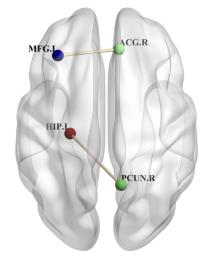
Figure 1
Brain regions showing FC differences between two groups after treatment"
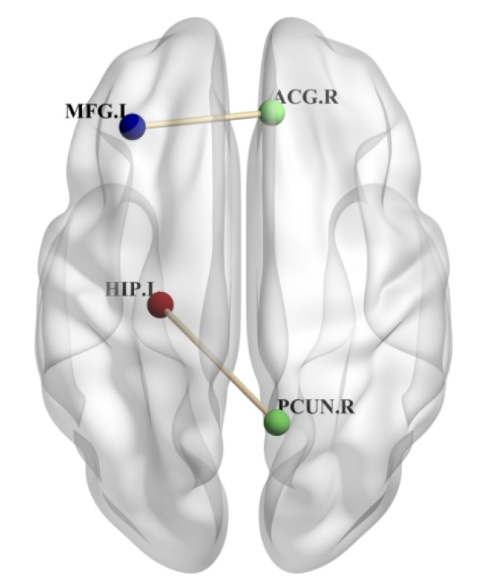
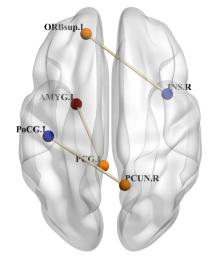
Figure 2
Brain regions showing differences in FC pre- and post-treatment in the control group"
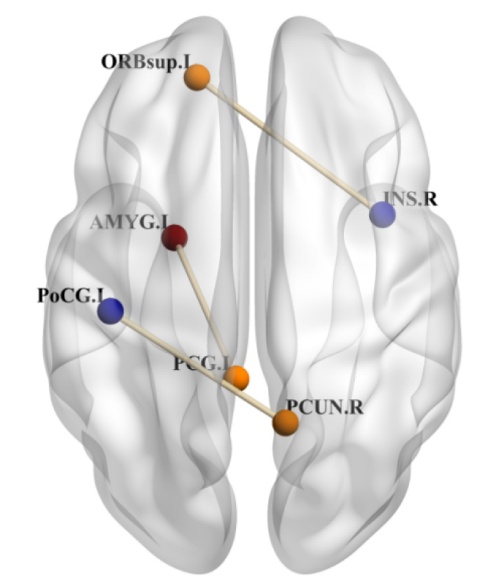
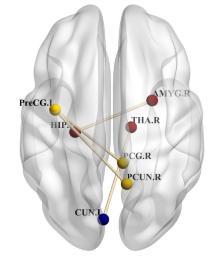
Figure 3
Brain regions showing differences in FC pre- and post-treatment in the experimental group"
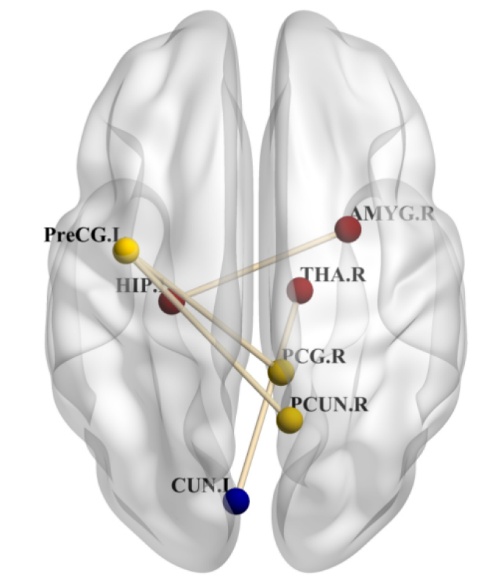
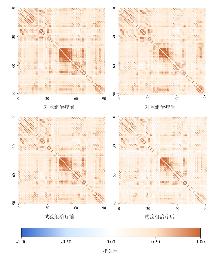
Figure 4
FC matrices pre- and post-treatment for two groups"
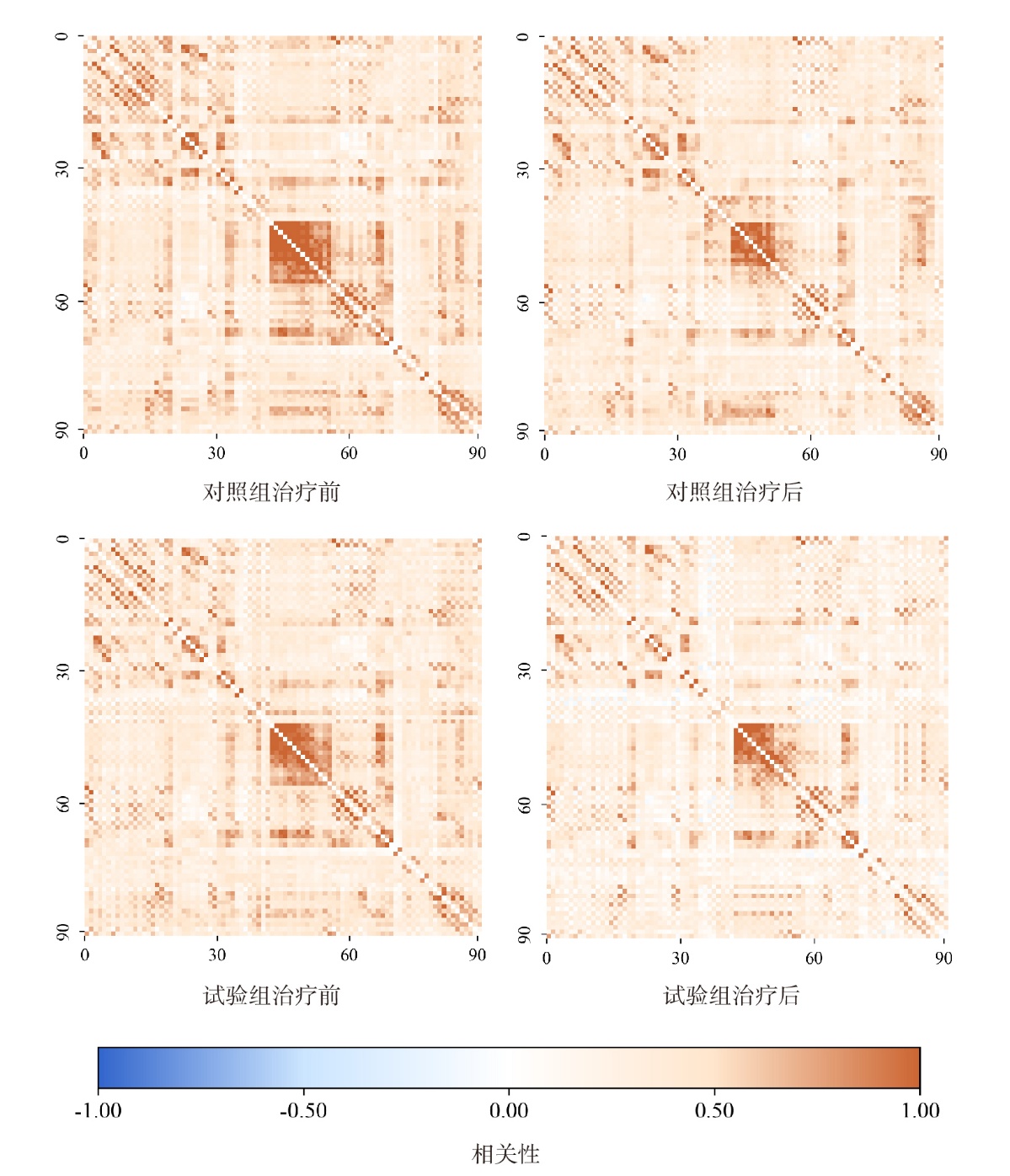
Table 6
Comparison of graph-theoretical indices between two groups pre- and post-treatment"
| 变量 | 组别 | n | 测试 | t值 | P值 | |
|---|---|---|---|---|---|---|
| Eg | 对照组 | 20 | 前测 | 0.173±0.008 | 4.778 | 0.002 |
| 后测 | 0.185±0.006 | |||||
| 试验组 | 20 | 前测 | 0.177±0.006 | 6.511 | <0.001 | |
| 后测 | 0.192±0.003 | |||||
| 治疗前两组均值差 | -0.004±0.004 | 1.152 | 0.269 | |||
| 治疗后两组均值差 | -0.007±0.002 | 2.944 | 0.011 | |||
| σ | 对照组 | 20 | 前测 | 0.520±0.079 | 2.828 | 0.025 |
| 后测 | 0.631±0.062 | |||||
| 试验组 | 20 | 前测 | 0.582±0.045 | 6.804 | <0.001 | |
| 后测 | 0.723±0.074 | |||||
| 治疗前两组均值差 | -0.062±0.032 | 1.948 | 0.072 | |||
| 治疗后两组均值差 | -0.092±0.034 | 2.675 | 0.018 |
| [1] |
ROBINSON R G, JORGE R E. Post-stroke depression: a review[J]. Am J Psychiatry, 2016, 173(3): 221-231.
doi: 10.1176/appi.ajp.2015.15030363 |
| [2] |
ROBINSON R G, JORGE R E, STARKSTEIN S E. Poststroke depression: an update[J]. J Neuropsychiatry Clin Neurosci, 2024, 36(1): 22-35.
doi: 10.1176/appi.neuropsych.21090231 |
| [3] |
LIU L, XU M, MARSHALL I J, et al. Prevalence and natural history of depression after stroke: a systematic review and meta-analysis of observational studies[J]. PLoS Med, 2023, 20(3): e1004200.
doi: 10.1371/journal.pmed.1004200 |
| [4] |
MEDEIROS G C, ROY D, KONTOS N, et al. Post-stroke depression: a 2020 updated review[J]. Gen Hosp Psychiatry, 2020, 66: 70-80.
doi: 10.1016/j.genhosppsych.2020.06.011 |
| [5] | 倪小佳, 林浩, 罗旭飞, 等. 脑卒中中西医结合防治指南(2023版)[J]. 中国全科医学, 2025, 28(5): 521-533. |
| NI X J, LIN H, LUO X F, et al. Clinical practice guideline for the prevention and treatment of stroke with integrated traditional Chinese and western medicine (2023 edition)[J]. Chin Gen Pract, 2025, 28(5): 521-533. | |
| [6] | LEGG L A, RUDBERG A S, HUA X, et al. Selective serotonin reuptake inhibitors (SSRIs) for stroke recovery[J]. Cochrane Database Syst Rev, 2021, 11(11): CD009286. |
| [7] |
KALBOUNEH H M, TOUBASI A A, ALBUSTANJI F H, et al. Safety and efficacy of SSRIs in improving poststroke recovery: a systematic review and meta-analysis[J]. J Am Heart Assoc, 2022, 11(13): e025868.
doi: 10.1161/JAHA.122.025868 |
| [8] |
XIAO K, LI X, HU W, et al. Acupuncture combined with repetitive transcranial magnetic stimulation for the treatment of post-stroke depression: a systematic evaluation and meta-analysis based on randomised controlled trial[J]. Front Neurol, 2024, 15: 1360437.
doi: 10.3389/fneur.2024.1360437 |
| [9] |
WANG H, LI Y. A pilot controlled trial of a combination of electroacupuncture and psychological intervention for post-stroke depression[J]. Complement Ther Med, 2022, 71: 102899.
doi: 10.1016/j.ctim.2022.102899 |
| [10] | 徐花, 郏文亭, 朱承媛, 等. 有氧训练对脑卒中后抑郁患者的效果[J]. 国际精神病学杂志, 2023, 50(5): 1072-1074. |
| XU H, JIA W T, ZHU C Y, et al. The effect of aerobic training on depression patients after stroke[J]. Int J Psychiatry, 2023, 50(5): 1072-1074. | |
| [11] |
ZHANG S H, WANG Y L, ZHANG C X, et al. Effect of interactive dynamic scalp acupuncture on post-stroke cognitive function, depression, and anxiety: a multicenter, randomized, controlled trial[J]. Chin J Integr Med, 2022, 28(2): 106-115.
doi: 10.1007/s11655-021-3338-1 |
| [12] | 陈静, 曾超, 李辉, 等. 针康法对卒中后抑郁患者认知及神经功能恢复的影响[J]. 中医药学报, 2021, 49(6): 72-75. |
| CHEN J, ZENG C, LI H, et al. Effects of acupuncture-rehabilitation therapy on cognitive and neurological recovery in patients with post-stroke depression[J]. Acta Chin Med Pharmacol, 2021, 49(6): 72-75. | |
| [13] |
赵彬, 唐强, 王艳, 等. 太极拳对卒中后抑郁患者运动功能及抑郁状态的影响[J]. 中国康复理论与实践, 2017, 23(3): 334-337.
doi: 10.3969/j.issn.1006-9771.2017.03.019 |
| ZHAO B, TANG Q, WANG Y, et al. Effects of Taijiquan on motor function and depression in patients with post-stroke depression[J]. Chin J Rehabil Theory Pract, 2017, 23(3): 334-337. | |
| [14] |
GUAN X, LAN M, GE L, et al. Effect of Tai Chi combined with visual-action-sensory rehabilitation therapies on cognitive function in acute ischemic stroke: a study protocol for a randomized controlled trial[J]. Ann Med, 2025, 57(1): 2566877.
doi: 10.1080/07853890.2025.2566877 |
| [15] |
ZHAO J, CHAU J P C, CHAN A W K, et al. Tailored sitting Tai Chi program for subacute stroke survivors: a randomized controlled trial[J]. Stroke, 2022, 53(7): 2192-2203.
doi: 10.1161/STROKEAHA.121.036578 |
| [16] | 中华医学会神经病学分会, 中华医学会神经病学分会脑血管病学组. 中国各类主要脑血管病诊断要点2019[J]. 中华神经科杂志, 2019, 52(9): 710-715. |
| Chinese Society of Neurology, Chinese Stroke Society. Diagnostic criteria of cerebrovascular diseases in China (version 2019)[J]. Chin J Neurol, 2019, 52(9): 710-715. | |
| [17] | 周强, 李明, 董全伟, 等. «国际疾病分类第十一次修订本(ICD-11)»传统医学章节与新版中医国家标准的比较研究[J]. 上海中医药杂志, 2021, 55(5): 1-6, 23. |
| ZHOU Q, LI M, DONG Q W, et al. A comparative study on international classification of traditional medicine included in ICD-11 and new editions of TCM national standards[J]. Shanghai J Tradit Chin Med, 2021, 55(5): 1-6, 23. | |
| [18] | 赵彬. 针康法对脑卒中后抑郁患者静息态功能核磁及血清标志物的影响[D]. 哈尔滨: 黑龙江中医药大学, 2022. |
| ZHAO B. Effects of acupuncture and health therapy on resting-state functional MRI and serum markers in patients with post-stroke depression[D]. Harbin: Heilongjiang University of Chinese Medicine, 2022. | |
| [19] | 于致顺. 头穴基础与临床[M]. 北京: 中国医药科技出版社, 1992. |
| YU Z S. Head point: foundation and clinic[M]. Beijing: China Medical Science and Technology Press, 1992. | |
| [20] |
LIU F, GONG L, ZHAO H, et al. Validity of evaluation scales for post-stroke depression: a systematic review and meta-analysis[J]. BMC Neurol, 2024, 24(1): 286.
doi: 10.1186/s12883-024-03744-7 pmid: 39148052 |
| [21] |
WIESNER K, SCHWARZ A, MEYA L, et al. Interrater reliability of the Fugl-Meyer motor assessment in stroke patients: a quality management project within the ESTREL study[J]. Front Neurol, 2024, 15: 1335375.
doi: 10.3389/fneur.2024.1335375 |
| [22] |
WANG Y C, CHANG P F, CHEN Y M, et al. Comparison of responsiveness of the Barthel Index and modified Barthel Index in patients with stroke[J]. Disabil Rehabil, 2023, 45(6): 1097-1102.
doi: 10.1080/09638288.2022.2055166 |
| [23] |
RUBINOV M, SPORNS O. Complex network measures of brain connectivity: uses and interpretations[J]. Neuroimage, 2010, 52(3): 1059-1069.
doi: 10.1016/j.neuroimage.2009.10.003 pmid: 19819337 |
| [24] |
BULLMORE E, SPORNS O. Complex brain networks: graph theoretical analysis of structural and functional systems[J]. Nat Rev Neurosci, 2009, 10(3): 186-198.
doi: 10.1038/nrn2575 pmid: 19190637 |
| [25] | 周婷, 白昕予, 孙甜, 等. 滋水涵木针法联合头穴透刺治疗卒中后上肢运动功能障碍临床研究[J]. 辽宁中医杂志, 2024, 51(6): 167-170. |
| ZHOU T, BAI X Y, SUN T, et al. Clinical study on treatment of upper limb motor dysfunction after stroke by nourishing water to moisten wood acupuncture combined with head point penetrating acupuncture[J]. Liaoning J Tradit Chin Med, 2024, 51(6): 167-170. | |
| [26] | 唐强. 头穴丛刺与康复治疗的有机结合[J]. 中国康复理论与实践, 2011, 17(4): 301-303. |
| TANG Q. A combined approach of cluster needling of scalp acupuncture and rehabilitation for functional recovery of stroke[J]. Chin J Rehabil Theory Pract, 2011, 17(4): 301-303. | |
| [27] | 姜林鸿, 齐瑞, 赵莉娟, 等. 太极拳运动对卒中后运动功能障碍影响及其机制的研究进展[J]. 中国康复医学杂志, 2022, 37(8): 1116-1120. |
| [28] |
MONCRIEFF J, COOPER R E, STOCKMANN T, et al. The serotonin theory of depression: a systematic umbrella review of the evidence[J]. Mol Psychiatry, 2023, 28(8): 3243-3256.
doi: 10.1038/s41380-022-01661-0 |
| [29] |
NESTLER E J, CARLEZON W A. The mesolimbic dopamine reward circuit in depression[J]. Biol Psychiatry, 2006, 59(12): 1151-1159.
doi: 10.1016/j.biopsych.2005.09.018 |
| [30] |
MAC GIOLLABHUI N, NG T H, ELLMAN L M, et al. The longitudinal associations of inflammatory biomarkers and depression revisited: systematic review, meta-analysis, and meta-regression[J]. Mol Psychiatry, 2021, 26(7): 3302-3314.
doi: 10.1038/s41380-020-00867-4 |
| [31] | 付琳, 李冀, 董婉茹, 等. 基于"神经-内分泌-免疫"调节机制探讨针刺治疗抑郁症的研究概况[J]. 针灸临床杂志, 2021, 37(4): 93-97. |
| FU L, LI J, DONG W R, et al. Research overview of acupuncture in treating depression based on 'neuro-endocrine-immune' regulation mechanism[J]. J Clin Acupunct Moxibustion, 2021, 37(4): 93-97. | |
| [32] | 韩名媛, 高睿泽, 杨成妍, 等. 针刺治疗卒中后抑郁的神经-内分泌-免疫网络机制[J]. 中国针灸, 2024, 44(9): 1100-1106. |
| HAN M Y, GAO R Z, YANG C Y, et al. Neuro-endocrine-immune network mechanism of acupuncture for post-stroke depression[J]. Chin Acupunct Moxibustion, 2024, 44(9): 1100-1106. | |
| [33] |
OH J E, KIM S N. Anti-inflammatory effects of acupuncture at ST36 point: a literature review in animal studies[J]. Front Immunol, 2021, 12: 813748.
doi: 10.3389/fimmu.2021.813748 |
| [34] |
ZHAO R. Exercise mimetics: a novel strategy to combat neuroinflammation and Alzheimer's disease[J]. J Neuroinflammation, 2024, 21(1): 40.
doi: 10.1186/s12974-024-03031-9 |
| [35] |
ZHANG B, QI S, LIU S, et al. Altered spontaneous neural activity in the precuneus, middle and superior frontal gyri, and hippocampus in college students with subclinical depression[J]. BMC Psychiatry, 2021, 21(1): 280.
doi: 10.1186/s12888-021-03292-1 pmid: 34074266 |
| [36] |
ROLLS E T, CHENG W, GONG W, et al. Functional connectivity of the anterior cingulate cortex in depression and in health[J]. Cereb Cortex, 2019, 29(8): 3617-3630.
doi: 10.1093/cercor/bhy236 pmid: 30418547 |
| [37] |
ZHANG Y, SHAO J, WANG X, et al. Functional impairment-based segmentation of anterior cingulate cortex in depression and its relationship with treatment effects[J]. Hum Brain Mapp, 2021, 42(12): 4035-4047.
doi: 10.1002/hbm.25537 pmid: 34008911 |
| [38] |
KAISER R H, ANDREWS-HANNA J R, WAGER T D, et al. Large-scale network dysfunction in major depressive disorder: a meta-analysis of resting-state functional connectivity[J]. JAMA Psychiatry, 2015, 72(6): 603-611.
doi: 10.1001/jamapsychiatry.2015.0071 pmid: 25785575 |
| [39] |
YAN C G, CHEN X, LI L, et al. Reduced default mode network functional connectivity in patients with recurrent major depressive disorder[J]. Proc Natl Acad Sci U S A, 2019, 116(18): 9078-9083.
doi: 10.1073/pnas.1900390116 |
| [40] |
ZENG L, WANG C, SUN K, et al. Upregulation of a small-world brain network improves inhibitory control: an fNIRS neurofeedback training study[J]. Brain Sci, 2023, 13(11): 1568.
doi: 10.3390/brainsci13111568 |
| [41] |
ZHOU Y, LONG Y. Sex differences in human brain networks in normal and psychiatric populations from the perspective of small-world properties[J]. Front Psychiatry, 2024, 15: 1456714.
doi: 10.3389/fpsyt.2024.1456714 |
| [42] |
SIEGEL J S, SEITZMAN B A, RAMSEY L E, et al. Re-emergence of modular brain networks in stroke recovery[J]. Cortex, 2018, 101: 44-59.
doi: S0010-9452(17)30427-6 pmid: 29414460 |
| [43] | NEMATI P R, BACKHAUS W, FELDHEIM J, et al. Brain network topology early after stroke relates to recovery[J]. Brain Commun, 2022, 4(2): fcac049. |
| [1] | YANG Ling, WANG Qinglei, WANG Jie, XU Wenjie, WANG Tong, GUO Chuan, QIAN Xue. Activation patterns and mechanism in the prefrontal cortex of post-stroke anxiety patients: a study using functional near-infrared spectroscopy [J]. Chinese Journal of Rehabilitation Theory and Practice, 2026, 32(3): 329-336. |
| [2] | LUO Dandan, SHEN Min, WANG Sujuan, QIU Wengxin, ZHANG Yuxuan, WU Yun, WANG Shengxiao. Characterisation of whole-brain resting-state functional connectivity in children with Chinese developmental dyslexia [J]. Chinese Journal of Rehabilitation Theory and Practice, 2025, 31(9): 1023-1031. |
| [3] | SHAN Lei, LIU Ying, ZHANG Xin, CHI Qianqian, ZHU Xiaomin. Effect of accelerated intermittent theta burst stimulation on post-stroke depression [J]. Chinese Journal of Rehabilitation Theory and Practice, 2025, 31(7): 822-829. |
| [4] | ZHANG Zihan, ZHANG Jiacheng, LIU Jinghe, CHEN Yuhang, WU Dan, WANG Huiying, HUANG Xing, CHANG Jingling. Characteristics of brain functional network based on electroencephalogram in post-stroke aphasia patients based on functional connectivity [J]. Chinese Journal of Rehabilitation Theory and Practice, 2025, 31(11): 1342-1353. |
| [5] | XU Qi, ZHENG Dingzhao, NIU Zhenyuan, YANG Yaling, WEN Weiyou, XU Jingsheng, WU Longqiang, WU Fan, YAN Tiebin. Effect of transcranial direct current stimulation combined with seated Taijiquan Yunshou in different sequences on cerebral cortical activation in stroke patients with hemiplegia: a functional near-infrared spectroscopy study [J]. Chinese Journal of Rehabilitation Theory and Practice, 2025, 31(10): 1121-1127. |
| [6] | WANG Junwei, XU Qi, WANG Xinxin, HE Yiqi, WU Xinhong, ZHANG Yun. Effect of transcranial direct current stimulation combined with seated Taijiquan Yunshou in different sequences on cerebral cortical activation for healthy youths: a functional near-infrared spectroscopy study [J]. Chinese Journal of Rehabilitation Theory and Practice, 2025, 31(10): 1128-1133. |
| [7] | CHEN Yuhang, YANG Yu'ai, LU Xuanyu, WANG Yuhang, ZHANG Mengyuan, ZHANG Zihan, WANG Huiying, CHANG Jingling. Spontaneous brain activity changes in post-stroke aphasia and post-stroke depression: a meta-analysis of resting state functional magnetic resonance imaging [J]. Chinese Journal of Rehabilitation Theory and Practice, 2025, 31(10): 1143-1155. |
| [8] | LI Fang, LIU Huizhen, MEI Liping, ZHANG Tong, ZHANG Haojie, LI Bingjie, ZHAO Jun. Related factors of post-stroke depression in patients with cerebral infarction during hospitalization in rehabilitation department [J]. Chinese Journal of Rehabilitation Theory and Practice, 2024, 30(2): 217-222. |
| [9] | ZHANG Minglan, ZHANG Lingling, WANG Lisha, LIU Li, GAO Run, RAO Jiang, LIU Wan, XIA Zi'an, ZHANG Chuanwen, CHENG Xinxin. Impact of autonomic nerve function on motor function in patients with post-stroke depression [J]. Chinese Journal of Rehabilitation Theory and Practice, 2024, 30(2): 223-231. |
| [10] | LUO Qihang, WU Yuxi, ZHANG Jiaxuan, LI Wanying, OU Haining, LIN Qiang, LIANG Junjie. Brain network during balance in older adults: a functional near-infrared spectroscopy study [J]. 《Chinese Journal of Rehabilitation Theory and Practice》, 2023, 29(2): 238-242. |
| [11] | QIN Yanqiang, DONG Hao, SUN Yingchun, CHENG Xiankuan, YAO Haijiang. Effects of different acupuncture schemes on neurotransmitters and related inflammatory factors in rats with post-stroke depression [J]. 《Chinese Journal of Rehabilitation Theory and Practice》, 2023, 29(1): 30-37. |
| [12] | TIAN Jing,LIU Jue,HE Zhijie,FAN Chenyu,LI Haozheng,YANG Qing,WU Yi,YU Kewei. Brain network functional connectivity as unilateral or bilateral upper limb training for patients with upper limb motor dysfunction after stroke: study with functional near-infrared spectroscopy [J]. 《Chinese Journal of Rehabilitation Theory and Practice》, 2022, 28(5): 497-501. |
| [13] | LIU Shaowen,WEI Conghui,SHAN Xinying,ZHANG Yan. Brain functional connectivity in lower limb amputees [J]. 《Chinese Journal of Rehabilitation Theory and Practice》, 2022, 28(1): 90-94. |
| [14] | Zhi-cheng LIN,Yong-mei YOU,Jun WANG,Wei WEI,Min XIA,Xie-hua XUE. Functional Connectivity from Hypothalamus and Whole Brain Anisotropy in Patients with Dysphagia after Stroke: A Study with Magnetic Resonance Imaging [J]. 《Chinese Journal of Rehabilitation Theory and Practice》, 2021, 27(5): 504-509. |
| [15] | Xiao-qian YING,Li-min LIAO. Changes of Brain Functional Connections in Patients with Overactive Bladder [J]. 《Chinese Journal of Rehabilitation Theory and Practice》, 2021, 27(4): 466-471. |
| Viewed | ||||||
|
Full text |
|
|||||
|
Abstract |
|
|||||
|
||
