



Chinese Journal of Rehabilitation Theory and Practice ›› 2025, Vol. 31 ›› Issue (11): 1290-1302.doi: 10.3969/j.issn.1006-9771.2025.11.006
Previous Articles Next Articles
ZHANG Hao1, XU Chuanlei2, WEI Zhenxing3, MA Lihong1( )
)
Received:2025-08-14
Revised:2025-09-12
Published:2025-11-25
Online:2025-11-26
Contact:
MA Lihong
E-mail:Lhma2002@163.com
Supported by:CLC Number:
ZHANG Hao, XU Chuanlei, WEI Zhenxing, MA Lihong. Comparison of different virtual reality technologies on motor function in Parkinson's disease: a network meta-analysis[J]. Chinese Journal of Rehabilitation Theory and Practice, 2025, 31(11): 1290-1302.
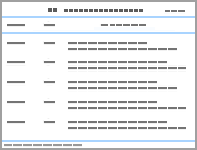
Table 1
PICO framework for the efficacy of VR on motor function in Parkinson's disease"
| 人群(Population) | 干预(Intervention) | 比较(Comparison) | 结局(Outcome) | |
|---|---|---|---|---|
| 帕金森病患者 不限年龄、性别、病程 | 8A00.0帕金森病 | 干预措施 | 干预前后比较 | 整体运动功能(UPDRS-III) |
| IVR | 干预方式比较 | b760 随意运动控制功能 | ||
| VRT | 干预组与对照组比较 | 平衡功能(BBS) | ||
| AR | d415维持身体姿势功能 | |||
| 干预时间 | 综合移动能力(TUGT) | |||
| d450 行走功能 | ||||
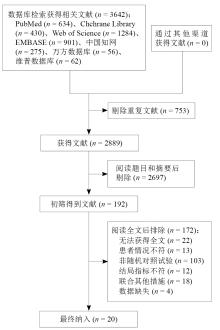
Figure 1
Flowchart of literature screening"
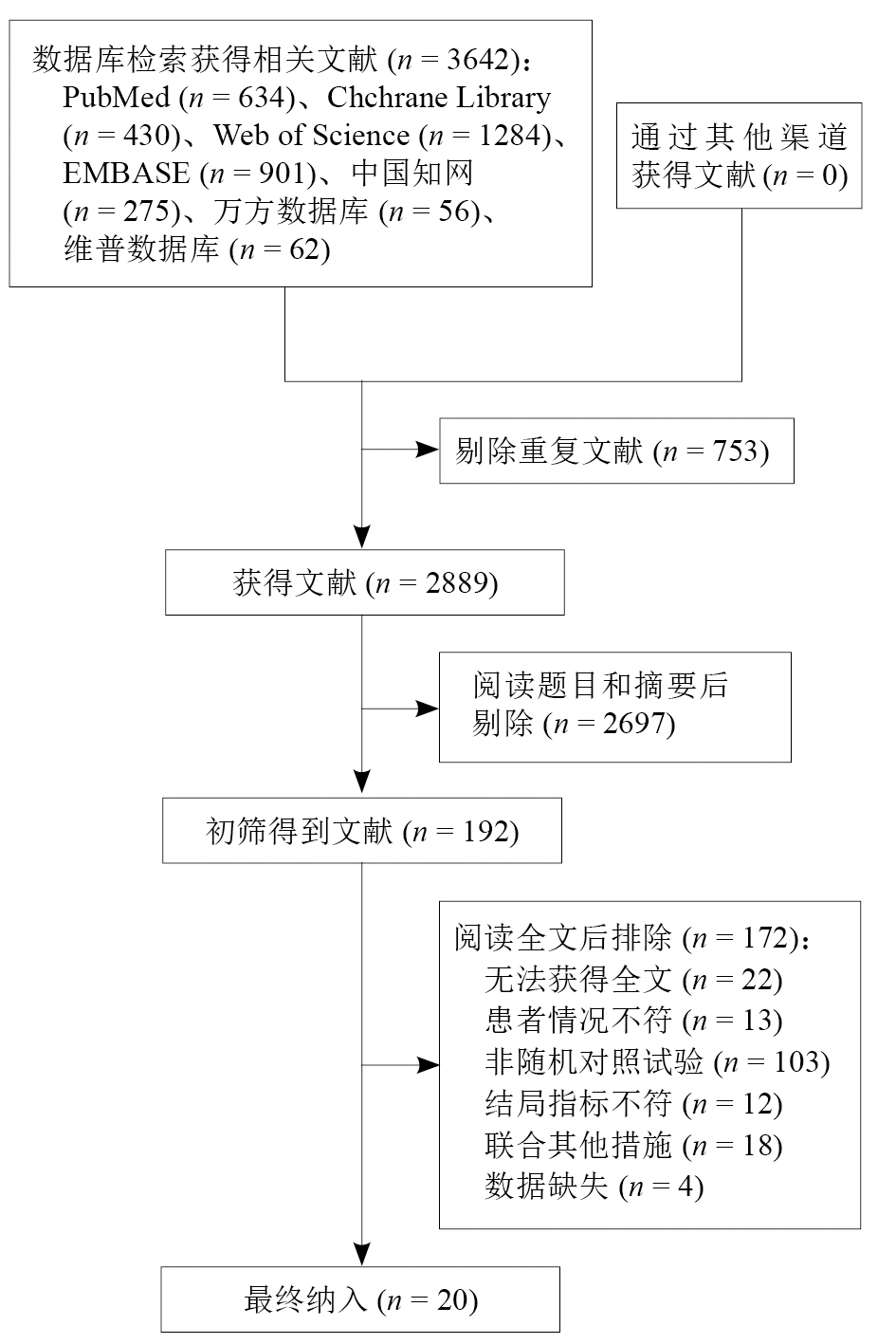
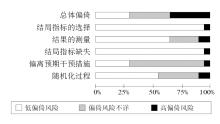
Figure 2
Risk of bias"
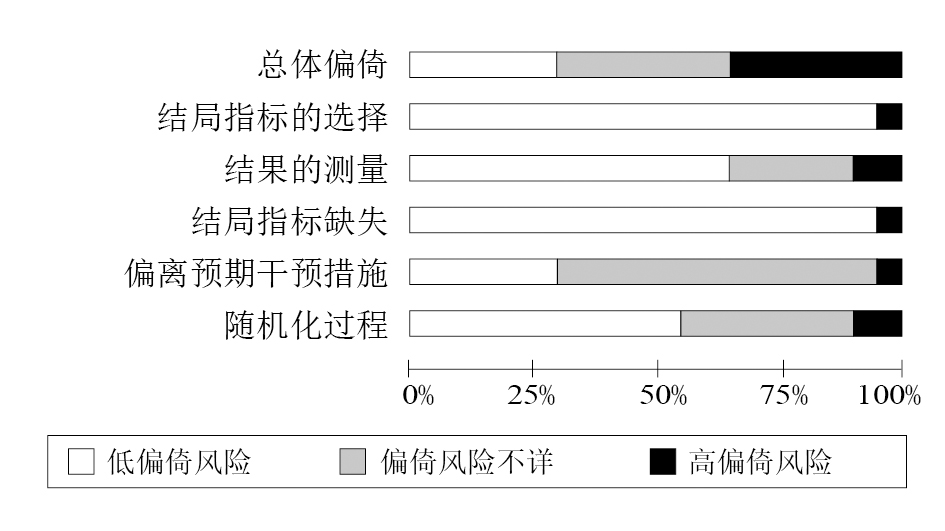
Table 2
Basical characteristics of included studies"
| 纳入文献 | 国家 | n(T/C) | 年龄(T/C)/岁 | 干预措施 | 对照 | 干预时间 | 结局指标 |
|---|---|---|---|---|---|---|---|
| 娄峰旗等[ | 中国 | 30/30 | (66.57±5.21)/(67.12±4.92) | IVR | TAU | 4周 | UPDRS-III、TUGT、BBS |
| 刘静等[ | 中国 | 21/21 | (62.14±7.21)/(61.86±7.53) | IVR | TAU | 4周 | UPDRS-III、TUGT、BBS |
| 陈思等[ | 中国 | 20/20 | (66.45±5.60)/(66.50±5.58) | IVR | TAU | 4周 | TUGT、BBS |
| 林志诚等[ | 中国 | 30/30 | (67.5±8.1)/(68.2±7.9) | VRT | TAU | 6周 | TUGT、BBS |
| 冯浩等[ | 中国 | 32/32 | (62.3±7.2)/(61.8±7.5) | VRT | TAU | 4周 | TUGT、BBS |
| Rosenfeldt等[ | 美国 | 25/22 | (70.0±6.44)/(68.1±5.94) | AR | TAU | 8周 | TUGT |
| Pazzaglia等[ | 意大利 | 25/26 | (72.0±7.0)/(70.0±10.0) | VRT | TAU | 6周 | BBS、DGI |
| Pompeu等[ | 巴西 | 16/16 | — | VRT | TAU | 7周 | BBS |
| Lee等[ | 韩国 | 10/10 | (68.4±2.9)/(70.1±3.3) | VRT | TAU | 6周 | BBS |
| Yuan等[ | 中国 | 12/12 | (67.8±5.5)/(66.5±8.8) | IVR | TAU | 6周 | BBS |
| Kashif等[ | 巴基斯坦 | 20/20 | (63.20±4.85)/(61.95±4.62) | VRT | TAU | 12周 | UPDRS-III、BBS |
| Goffredo等[ | 意大利 | 49/48 | (67.8±6.6)/(68.2±5.8) | VRT | TAU | 6周 | UPDRS-III |
| Santos等[ | 巴西 | 13/14 | (61.7±7.3)/(64.5±9.8) | VRT | TAU | 8周 | BBS;DGI、TUGT |
| Song等[ | 澳大利亚 | 28/25 | (68±7)/(65±7) | VRT | TAU | 12周 | TUGT |
| Yang等[ | 中国 | 11/12 | (72.5±8.4)/(75.4±6.3) | VRT | TAU | 6周 | UPDRS-III、BBS、TUGT |
| Gulcan等 [ | 土耳其 | 15/15 | — | AR | TAU | 6周 | UPDRS-III、BBS、TUGT |
| Mirelman等[ | 美国 | 20/20 | (64.9±8.4)/(68.2±6.9) | VRT | AC | 6周 | UPDRS-III、TUGT |
| Feng等[ | 中国 | 14/14 | (67.47±4.79)/(66.93±4.64) | VRT | TAU | 12周 | UPDRS-III、TUGT、BBS |
| Gandolfi等[ | 意大利 | 36/36 | (69.3±8.1)/(68.8±7.8) | VRT | TAU | 8周 | UPDRS-III、TUGT、BBS |
| Liao等[ | 中国 | 20/20 | (65.6±8.4)/(68.3±7.1) | VRT | TAU | 6周 | UPDRS-III、TUGT、BBS |
Table 3
Specific contents of the conventional therapies of the included studies"
| 研究 | 对照组类型 | 干预内容 | 频率与时长 |
|---|---|---|---|
| 娄峰旗等[ | TAU | 常规康复训练 | — |
| 刘静等[ | TAU | 常规平衡训练 | — |
| 陈思等[ | TAU | 常规平衡训练 | — |
| 林志诚等[ | TAU | 常规平衡训练 | — |
| 冯浩等[ | TAU | 常规康复训练 | — |
| Rosenfeldt等[ | TAU | 标准物理治疗,包括平衡、步态和功能性任务训练 | — |
| Pazzaglia等[ | TAU | 传统康复计划,包括平衡练习、步态训练和上肢功能活动 | 每次40 min,每周3次,共6周 |
| Pompeu等[ | TAU | 平衡锻炼疗法,不使用外部提示或认知刺激 | 每次30 min,每周2次,共7周 |
| Lee等[ | TAU | 常规物理治疗,包括关节活动度、伸展、平衡和步态训练 | — |
| Yuan等[ | TAU | 常规平衡训练 | — |
| Kashif等[ | TAU | 常规物理治疗 | — |
| Goffredo等[ | TAU | 在家自行进行的结构化常规运动活动,包括平衡和下肢运动 | 每周3~5次,共6~10周,共30次 |
| Santos等[ | TAU | 常规锻炼 | — |
| Song等[ | TAU | 常规护理 | — |
| Yang等[ | TAU | 常规平衡训练 | — |
| Gulcan等[ | TAU | 常规物理治疗,包括平衡和步态训练 | — |
| Mirelman等[ | AC | 在跑步机上行走,无VR内容 | 每次 45 min,每周3次,共6周 |
| Feng等[ | TAU | 常规物理治疗,包括重心转移训练、平衡训练、步态训练等 | 每次45 min,每周5次,共12周 |
| Gandolfi等[ | TAU | 在诊所进行的“感觉整合平衡训练” | 每次50 min,每周3次,共7周 |
| Liao等[ | TAU | 常规物理治疗 | — |
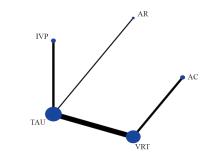
Figure 3
Evidence relationship diagram of UPDRS-Ⅲ score"
Table 4
League table of UPDRS-III outcome scores (SMD, 95%CI)"
| 项目 | VRT | IVR | TAU |
|---|---|---|---|
| IVR | 0.61 (0.09~1.13)a | ||
| TAU | -0.21 (-0.46~0.04) | -0.82 (-1.28~-0.37)a | |
| AR | -0.12 (-0.93~0.69) | -0.73 (-1.63~0.16) | 0.09 (-0.68~0.86) |
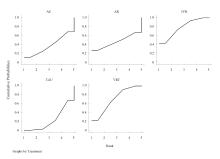
Figure 4
Cumulative probability plot of UPDRS-Ⅲ score"

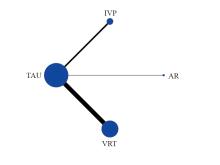
Figure 5
BBS rating evidence relationship diagram"
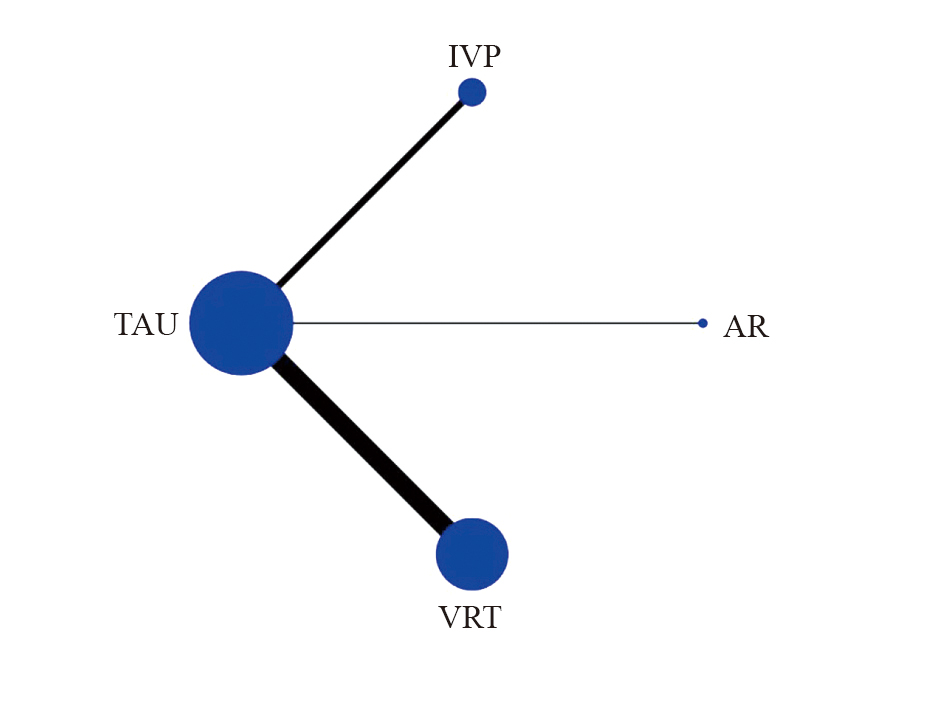
Table 5
League table of BBS ending ratings (SMD, 95%CI)"
| 项目 | VRT | IVR | TAU |
|---|---|---|---|
| IVR | -2.56 (-5.90~0.77) | ||
| TAU | 1.38 (-0.37~3.13) | 3.94 (1.08~6.80)a | |
| AR | 2.35 (-5.12~9.83) | 4.92 (-2.89~12.73) | 0.97 (-6.29~8.24) |
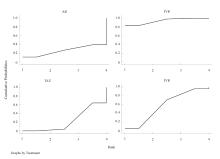
Figure 6
Cumulative probability plot of BBS ratings"
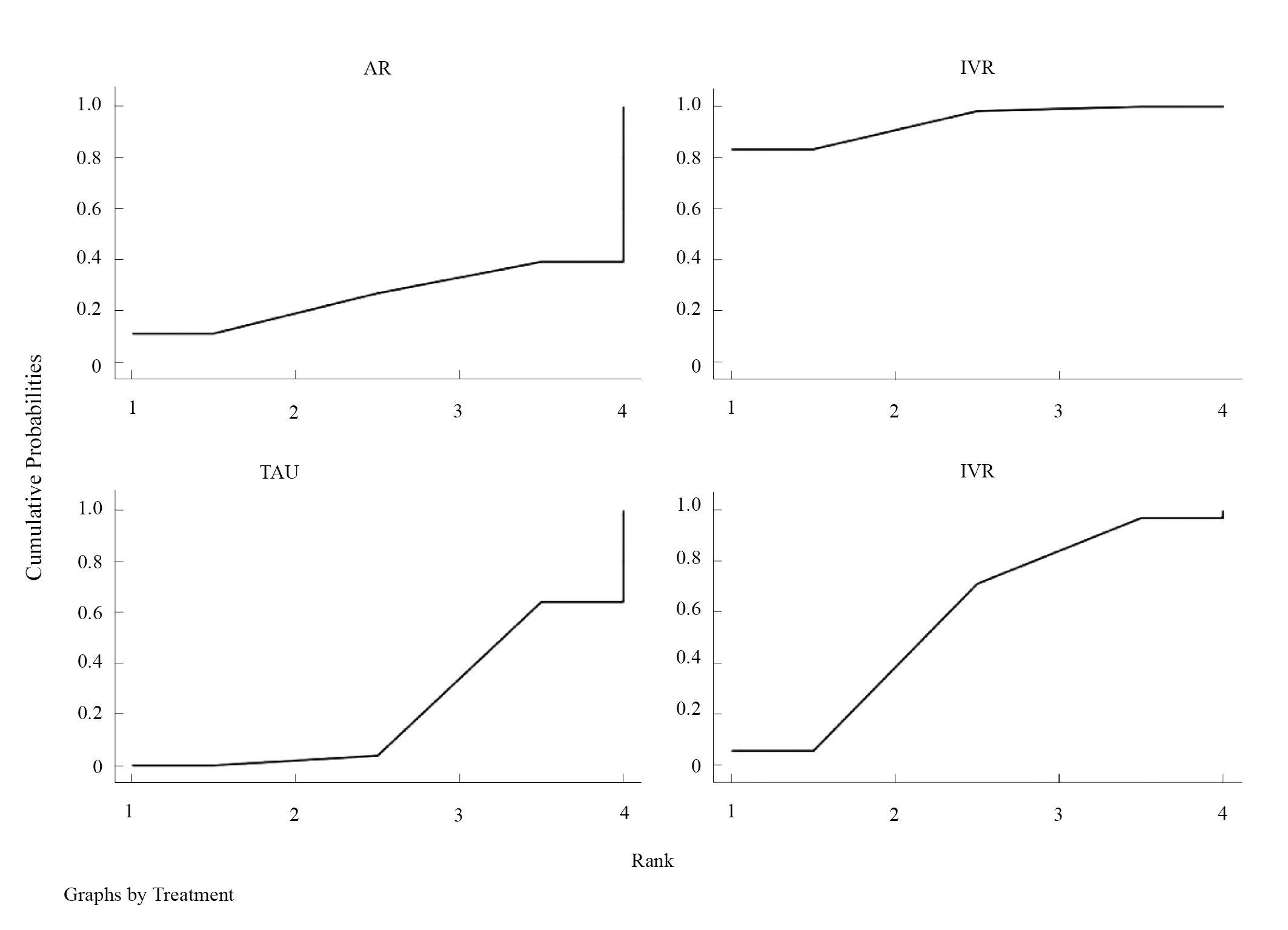
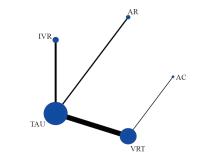
Figure 7
TUGT rating evidence relationship diagram"
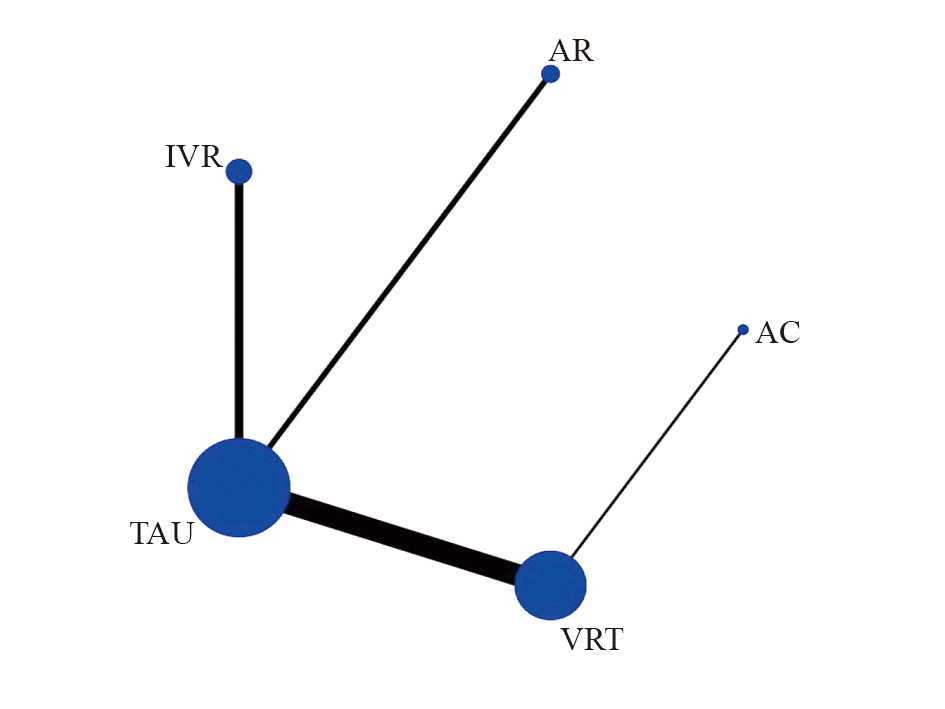
Table 6
TUGT outcome scoring league table (SMD, 95%CI)"
| 项目 | VRT | IVR | TAU | AR |
|---|---|---|---|---|
| IVR | 1.06 (0.40~1.72)a | |||
| TAU | -0.33 (-0.67~0.01) | -1.38 (-1.95~-0.82)a | ||
| AR | -0.03 (-0.80~0.74) | -1.09 (-1.98~-0.19)a | 0.30 (-0.40~0.99) | |
| AC | -0.39 (-1.35~0.58) | -1.45 (-2.62~-0.28)a | -0.06 (-1.09~0.96) | -0.36 (-1.59~0.88) |
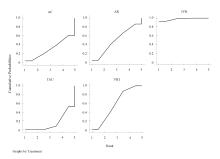
Figure 8
Cumulative probability plot of TUGT ratings"
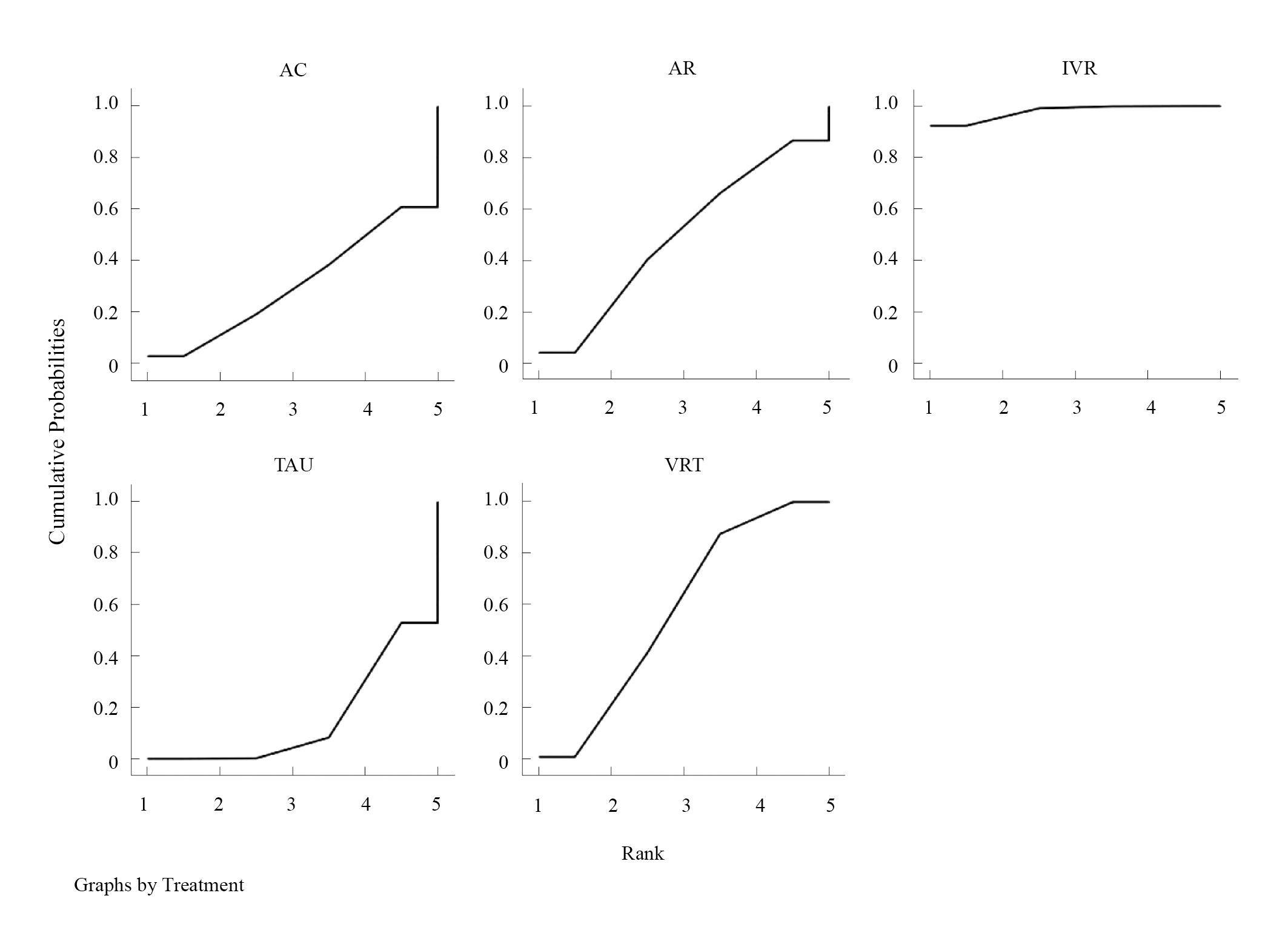
Table 7
Summary of SUCRA outcomes"
| 干预措施 | UPDRS-III | BBS | TUGT | |||
|---|---|---|---|---|---|---|
| SUCRA值 | 排名 | SUCRA值 | 排名 | SUCRA值 | 排名 | |
| IVR | 97.7% | 1 | 85.2% | 1 | 95.1% | 1 |
| VRT | 52.3% | 2 | 63.5% | 2 | 61.3% | 2 |
| AR | 34.7% | 3 | 24.2% | 3 | 40.5% | 3 |
| TAU | 15.2% | 4 | 27.1% | 4 | 28.2% | 4 |
| AC | — | — | 24.8% | 5 | ||
| [1] |
PARK J H, KIM D H, KWON D Y, et al. Trends in the incidence and prevalence of Parkinson's disease in Korea: a nationwide, population-based study[J]. BMC Geriatr, 2019, 19(1): 320.
doi: 10.1186/s12877-019-1332-7 |
| [2] |
BASSO V, DÖBRÖSSY M D, THOMPSON L H, et al. State of the art in sub-phenotyping midbrain dopamine neurons[J]. Biology, 2024, 13(9): 690.
doi: 10.3390/biology13090690 |
| [3] | 王子瑜, 王晓慧, 等. 帕金森病动物模型研究进展[J]. 中国神经精神疾病杂志, 2025, 51(3): 186-192. |
| WANG Z Y, WANG X H. Research progress on animal models of Parkinson's disease[J]. Chin J Nerv Ment Dis, 2025, 51(3): 186-192. | |
| [4] |
PEI H, WU Z, MA L, et al. Deep brain stimulation mechanisms in Parkinson's disease: immediate and long-term effects[J]. J Integr Neurosci, 2024, 23(6): 114.
doi: 10.31083/j.jin2306114 pmid: 38940083 |
| [5] |
GE Y, ZHAO W, ZHANG L, et al. Correlation between motor function and health-related quality of life in early to mid-stage patients with Parkinson disease: a cross-sectional observational study[J]. Front Aging Neurosci, 2024, 16: 1399285.
doi: 10.3389/fnagi.2024.1399285 |
| [6] |
LI X, DONG Z Y, DONG M, et al. Early dopaminergic replacement treatment initiation benefits motor symptoms in patients with Parkinson's disease[J]. Front Hum Neurosci, 2024, 18: 1325324.
doi: 10.3389/fnhum.2024.1325324 |
| [7] |
MONTANARI M, MERCURI N B, MARTELLA G. Exceeding the limits with nutraceuticals: looking towards Parkinson's disease and frailty[J]. Int J Mol Sci, 2024, 26(1): 122.
doi: 10.3390/ijms26010122 |
| [8] |
ZHANG Y, LIU S, XU K, et al. Non-pharmacological therapies for treating non-motor symptoms in patients with Parkinson's disease: a systematic review and meta-analysis[J]. Front Aging Neurosci, 2024, 16: 1363115.
doi: 10.3389/fnagi.2024.1363115 |
| [9] | 张树山, 朱陶, 李程旭, 等. 帕金森病非运动症状临床特点研究[J]. 川北医学院学报, 2016, 31(4): 520-524. |
| ZHANG S S, ZHU T, LI C X, et al. Clinical characteristics of non-motor symptoms in Parkinson's disease[J]. J North Sichuan Med Coll, 2016, 31(4): 520-524. | |
| [10] | V H, PK M P K, MG R. Extended reality in revolutionizing neurological disease: a new era for chronic condition treatment[J]. Cureus, 2024, 16(8): e67633. |
| [11] | 邢苑薇, 伊鸣. 基于认知脑科学原理的脑机接口应用转化方案[J]. 微纳电子与智能制造, 2022, 4(3): 83-87. |
| XING Y W, YI M. Application and transformation scheme of brain-computer interface based on cognitive brain science principles[J]. Micro/nano Electron Intell Manuf, 2022, 4(3): 83-87. | |
| [12] |
MAKRANSKY G, PETERSEN G B. The cognitive affective model of immersive learning (CAMIL): a theoretical research-based model of learning in immersive virtual reality[J]. Educ Psychol Rev, 2021, 33(3): 937-958.
doi: 10.1007/s10648-020-09586-2 |
| [13] |
FUSCO A, TIERI G. Challenges and perspectives for clinical applications of immersive and non-immersive virtual reality[J]. J Clin Med, 2022, 11(15): 4540.
doi: 10.3390/jcm11154540 |
| [14] |
COMPARCINI D, SIMONETTI V, GALLI F, et al. Immersive and non-immersive virtual reality for pain and anxiety management in pediatric patients with hematological or solid cancer: a systematic review[J]. Cancers (Basel), 2023, 15(3): 985.
doi: 10.3390/cancers15030985 |
| [15] |
GUO Q, ZHANG L, HAN L L, et al. Effects of virtual reality therapy combined with conventional rehabilitation on pain, kinematic function, and disability in patients with chronic neck pain: randomized controlled trial[J]. JMIR Serious Games, 2024, 12: e42829.
doi: 10.2196/42829 |
| [16] | 娄峰旗, 梅雪, 李娴, 等. 基于虚拟现实技术的卡伦平衡训练对帕金森病患者平衡功能以及上下肢运动能力的影响[J]. 山西医药杂志, 2021, 50(20): 2915-2918. |
| LOU F Q, MEI X, LI X. Effect of Karen balance training based on virtual reality technology on balance function and motor ability of upper and lower limbs in patients with Parkinson's disease[J]. Shanxi Med J, 2021, 50(20): 2915-2918. | |
| [17] | 刘静, 颜智, 廖瑞松, 等. 虚拟现实技术对帕金森病患者平衡功能的康复效果[J]. 中国康复医学杂志, 2020, 35(6): 682-687. |
| LIU J, YAN Z, LIAO R S, et al. Rehabilitation effect of virtual reality technology on balance function in patients with Parkinson's disease[J]. Chin J Rehabil Med, 2020, 35(6): 682-687. | |
| [18] |
陈思, 刘杰, 李顺, 等. 虚拟现实技术对帕金森病患者平衡功能的影响[J]. 中国康复理论与实践, 2017, 23(9): 1091-1095.
doi: 10.3969/j.issn.1006-9771.2017.09.021 |
| CHEN S, LIU J, LI S, et al. Effect of virtual reality technology on balance function in patients with Parkinson's disease[J]. Chin J Rehabil Theory Pract, 2017, 23(9): 1091-1095. | |
| [19] |
林志诚, 陈阿贞, 江一静, 等. 虚拟现实平衡游戏训练对帕金森病患者平衡功能的效果[J]. 中国康复理论与实践, 2016, 22(9): 1059-1063.
doi: 10.3969/j.issn.1006-9771.2016.09.017 |
| LIN Z C, CHEN A Z, JIANG Y J, et al. Effect of virtual reality balance game training on balance function in patients with Parkinson's disease[J]. Chin J Rehabil Theory Pract, 2016, 22(9): 1059-1063. | |
| [20] | 冯浩, 李翠云, 刘镓雨, 等. 虚拟现实训练对帕金森病患者步行能力的影响[J]. 中国卫生标准管理, 2019, 10(12): 32-34. |
| FENG H, LI C Y, LIU J Y, et al. Effect of virtual reality training on walking ability of patients with Parkinson's disease[J]. Chin Health Stand Manag, 2019, 10(12): 32-34. | |
| [21] |
ROSENFELDT A B, STREICHER M C, KAYA R D, et al. An augmented reality dual-task intervention improves postural stability in individuals with Parkinson's disease[J]. Gait Posture, 2025, 115: 102-108.
doi: 10.1016/j.gaitpost.2024.11.007 pmid: 39571253 |
| [22] |
PAZZAGLIA C, IMBIMBO I, TRANCHITA E, et al. Comparison of virtual reality rehabilitation and conventional rehabilitation in Parkinson's disease: a randomised controlled trial[J]. Physiotherapy, 2020, 106: 36-42.
doi: S0031-9406(18)30128-7 pmid: 32026844 |
| [23] |
POMPEU J E, MENDES F A D S, SILVA K G D, et al. Effect of Nintendo WiiTM-based motor and cognitive training on activities of daily living in patients with Parkinson's disease: a randomised clinical trial[J]. Physiotherapy, 2012, 98(3): 196-204.
doi: 10.1016/j.physio.2012.06.004 |
| [24] |
LEE N Y, LEE D K, SONG H S. Effect of virtual reality dance exercise on the balance, activities of daily living, and depressive disorder status of Parkinson's disease patients[J]. J Phys Ther Sci, 2015, 27(1): 145-147.
doi: 10.1589/jpts.27.145 |
| [25] |
YUAN R Y, CHEN S C, PENG C W, et al. Effects of interactive video-game-based exercise on balance in older adults with mild-to-moderate Parkinson's disease[J]. J Neuroeng Rehabil, 2020, 17(1): 91.
doi: 10.1186/s12984-020-00725-y |
| [26] |
KASHIF M, ALBALWI A A, ZULFIQAR A, et al. Effects of virtual reality versus motor imagery versus routine physical therapy in patients with Parkinson's disease: a randomized controlled trial[J]. BMC Geriatr, 2024, 24(1): 229.
doi: 10.1186/s12877-024-04845-1 pmid: 38443801 |
| [27] | GOFFREDO M, BAGLIO F, DE ICCO R, et al. Efficacy of non-immersive virtual reality-based telerehabilitation on postural stability in Parkinson's disease: a multicenter randomized controlled trial[J]. Eur J Phys Rehabil Med, 2023, 59(6): 689-697. |
| [28] |
SANTOS P, MACHADO T, SANTOS L, et al. Efficacy of the Nintendo Wii combination with conventional exercises in the rehabilitation of individuals with Parkinson's disease: a randomized clinical trial[J]. NeuroRehabilitation, 2019, 45(2): 255-263.
doi: 10.3233/NRE-192771 pmid: 31498138 |
| [29] |
SONG J, PAUL S S, CAETANO M J D, et al. Home-based step training using videogame technology in people with Parkinson's disease: a single-blinded randomised controlled trial[J]. Clin Rehabil, 2018, 32(3): 299-311.
doi: 10.1177/0269215517721593 pmid: 28745063 |
| [30] |
YANG W C, WANG H K, WU R M, et al. Home-based virtual reality balance training and conventional balance training in Parkinson's disease: a randomized controlled trial[J]. J Formos Med Assoc, 2016, 115(9): 734-743.
doi: 10.1016/j.jfma.2015.07.012 |
| [31] |
GULCAN K, GUCLU-GUNDUZ A, YASAR E, et al. The effects of augmented and virtual reality gait training on balance and gait in patients with Parkinson's disease[J]. Acta Neurol Belg, 2023, 123(5): 1917-1925.
doi: 10.1007/s13760-022-02147-0 |
| [32] | MIRELMAN A, MAIDAN I, HERMAN T, et al. Virtual reality for gait training: Can it induce motor learning to enhance complex walking and reduce fall risk in patients with Parkinson's disease?[J]. J Gerontol A Biol Sci Med Sci, 2011, 66(2): 234-240. |
| [33] |
FENG H, LI C, LIU J, et al. Virtual reality rehabilitation versus conventional physical therapy for improving balance and gait in Parkinson's disease patients: a randomized controlled trial[J]. Med Sci Monit, 2019, 25: 4186-4192.
doi: 10.12659/MSM.916455 |
| [34] | GANDOLFI M, GEROIN C, DIMITROVA E, et al. Virtual reality telerehabilitation for postural instability in Parkinson's disease: a multicenter, single-blind, randomized, controlled trial[J]. Biomed Res Int, 2017, 2017: 7962826. |
| [35] |
LIAO Y Y, YANG Y R, CHENG S J, et al. Virtual reality-based training to improve obstacle-crossing performance and dynamic balance in patients with Parkinson's disease[J]. Neurorehabil Neural Repair, 2015, 29(7): 658-667.
doi: 10.1177/1545968314562111 |
| [36] |
GARAY-SÁNCHEZ A, SUAREZ-SERRANO C, FERRANDO-MARGELÍ M, et al. Effects of immersive and non-immersive virtual reality on the static and dynamic balance of stroke patients: a systematic review and meta-analysis[J]. J Clin Med, 2021, 10(19): 4473.
doi: 10.3390/jcm10194473 |
| [37] |
SOKOLOWSKA B. Being in virtual reality and its influence on brain health: an overview of benefits, limitations and prospects[J]. Brain Sci, 2024, 14(1): 72.
doi: 10.3390/brainsci14010072 |
| [38] |
DRIGAS A, SIDERAKI A. Brain neuroplasticity leveraging virtual reality and brain-computer interface technologies[J]. Sensors (Basel), 2024, 24(17): 5725.
doi: 10.3390/s24175725 |
| [39] | HONZÍKOVÁ L, DĄBROWSKÁ M, SKŘINAŘOVÁ I, et al. Immersive virtual reality as computer-assisted cognitive-motor dual-task training in patients with Parkinson's disease[J]. Medicina (Kaunas), 2025, 61(2): 248. |
| [40] |
AGOSTINI F, CONTI M, MORONE G, et al. The role of virtual reality in postural rehabilitation for patients with Parkinson's disease: a scoping review[J]. Brain Sci, 2024, 15(1): 23.
doi: 10.3390/brainsci15010023 |
| [41] |
HOOGENDOORN E M, GEERSE D J, HELSLOOT J, et al. A larger augmented-reality field of view improves interaction with nearby holographic objects[J]. PLoS One, 2024, 19(10): e0311804.
doi: 10.1371/journal.pone.0311804 |
| [42] | CHANG H, SONG Y, CEN X. Effectiveness of augmented reality for lower limb rehabilitation: a systematic review[J]. Appl Bionics Biomech, 2022, 2022: 4047845. |
| [1] | YANG Wenrui, CUI Sidong, ZENG Li. Effect of virtual and augmented reality on cognition, emotion and adaptive behavior in children and adolescents with autism spectrum disorder: a systematic review [J]. Chinese Journal of Rehabilitation Theory and Practice, 2024, 30(9): 1026-1033. |
| [2] | LÜ Meiling, WANG Jie, ZENG Weisi, WEN Xiaoting, CHU Xin. Effect of virtual reality on cognitive function and quality of life in patients with Parkinson's disease: a meta-analysis [J]. Chinese Journal of Rehabilitation Theory and Practice, 2024, 30(6): 648-656. |
| [3] | WANG Hongzhi, YANG Jian. Application of virtual reality technology in physical activity and health of children and adolescents with cerebral palsy: a systematic review of systematic reviews [J]. Chinese Journal of Rehabilitation Theory and Practice, 2024, 30(5): 505-512. |
| [4] | LIANG Xiaoxiao, ZHENG Jiejiao, WU Xuejiao, CHEN Xi, ZHANG Tingyu, GU Qiuyi. Effect of virtual reality training on balance and walking in old patients with idiopathic normal pressure hydrocephalus [J]. Chinese Journal of Rehabilitation Theory and Practice, 2024, 30(4): 424-430. |
| [5] | CUI Tiantian, YANG Yulin, CUI Tengteng, MA Lihong. Effect of different intensive training on upper limb motor function in children with cerebral palsy: a network meta-analysis [J]. Chinese Journal of Rehabilitation Theory and Practice, 2024, 30(4): 437-448. |
| [6] | YU Chunyang, LIU Ran, ZHAO Yishuang, GUO Shuai, ZHOU Ya'nan, LI Li, ZHANG Hao. Effect of virtual reality treadmill training on balance and gait in stroke patients [J]. Chinese Journal of Rehabilitation Theory and Practice, 2024, 30(3): 310-315. |
| [7] | LIU Ye, CHEN Di, QIN Qing, JI Xiang, TIAN Yifan, YE Haiyan. Application of virtual reality technology in rehabilitation of stroke: a bibliometric analysis [J]. Chinese Journal of Rehabilitation Theory and Practice, 2024, 30(12): 1407-1419. |
| [8] | LIN Na, GAO Hanlu, LU Huiping, CHEN Yanqing, ZHENG Junfan, CHEN Shurong. Effect of virtual reality on upper limb function after stroke: a study of diffusion tensor imaging [J]. 《Chinese Journal of Rehabilitation Theory and Practice》, 2024, 30(1): 61-67. |
| [9] | WANG He, HAN Liang, KAN Mengfan, YU Shaohong. Efficacy of electrical stimulation on shoulder-hand syndrome after stroke: a systematic review and meta-analysis [J]. 《Chinese Journal of Rehabilitation Theory and Practice》, 2023, 29(9): 1048-1056. |
| [10] | ZHANG Hengrui, MENG Zhaoli, CUI Pei, WANG Ruiyi. Impact of different kinds of helmet-mounted display on human balance and posture control [J]. 《Chinese Journal of Rehabilitation Theory and Practice》, 2023, 29(11): 1359-1364. |
| [11] | LIU Yang,ZHANG Xiao-quan,WANG Heng,QI Li-ping. Effects of Virtual Reality on Balance for Patients with Parkinson's Disease: A Meta-analysis [J]. 《Chinese Journal of Rehabilitation Theory and Practice》, 2021, 27(9): 1048-1058. |
| [12] | Jing-xia GUO,Liang CHEN,Qi-chao YU,Yu WU. Efficacy of Exercise on Fall in Old Adults: A Network Meta-analysis [J]. 《Chinese Journal of Rehabilitation Theory and Practice》, 2021, 27(5): 563-573. |
| [13] | Yu WANG,Xiang-dong WU,Chang-cheng SHI,Jia-ji ZHANG,Na LI,Ye-hao MA,Liang TAO,Min TANG,Guo-kun ZUO. Visual and Haptic Feedback Fusion Based on Force Tracking in Upper-limb Rehabilitation Robot System [J]. 《Chinese Journal of Rehabilitation Theory and Practice》, 2021, 27(4): 478-486. |
| [14] | LIANG Ming,WEI Zhen,XIE Rong,XU Yi-peng,HOU Tian,TAO Jing,WANG Bao-xia,FANG Rui. Virtual Reality Training for Balance Function for Old Adults: A Meta-analysis [J]. 《Chinese Journal of Rehabilitation Theory and Practice》, 2020, 26(3): 278-284. |
| [15] | SHI Ming,PAN Wen-ping,ZENG Ming,LIN Si-jie,LI Yan,WU Hua,WANG Wei-guo. Effects of Virtual Reality Balance Training on Proprioception of Knee after Anterior Cruciate Ligament Reconstruction [J]. 《Chinese Journal of Rehabilitation Theory and Practice》, 2020, 26(12): 1458-1463. |
| Viewed | ||||||
|
Full text |
|
|||||
|
Abstract |
|
|||||
|
||
