



Chinese Journal of Rehabilitation Theory and Practice ›› 2025, Vol. 31 ›› Issue (11): 1279-1289.doi: 10.3969/j.issn.1006-9771.2025.11.005
Previous Articles Next Articles
JIANG Yi1, LIANG Kang1, CHU Jiahao2, YANG Dan3, GAO Fei4, LI Hanzhi4, DU Xiaoxia4( )
Received:2025-09-12
Revised:2025-10-10
Published:2025-11-25
Online:2025-11-26
Contact:
DU Xiaoxia
E-mail:duxiaoxia2005@gmail.com
Supported by:CLC Number:
JIANG Yi, LIANG Kang, CHU Jiahao, YANG Dan, GAO Fei, LI Hanzhi, DU Xiaoxia. Application of brain-computer interface technology in stroke rehabilitation from 2021 to 2025: a bibliometric analysis[J]. Chinese Journal of Rehabilitation Theory and Practice, 2025, 31(11): 1279-1289.
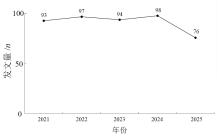
Figure 1
Annual volume of literatures"

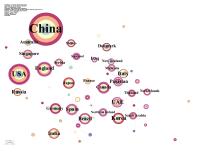
Figure 2
Co-occurrence map of countries"

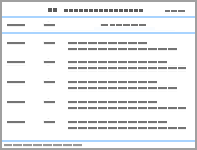
Table 1
Top ten countries of publication volume"
| 国家 | 发文量/n | 中心性 |
|---|---|---|
| China | 197 | 0.00 |
| USA | 71 | 0.12 |
| England | 31 | 0.35 |
| Japan | 28 | 0.06 |
| Germany | 27 | 0.06 |
| South Korea | 23 | 0.00 |
| India | 21 | 0.00 |
| Canada | 20 | 0.31 |
| Spain | 17 | 0.57 |
| Brazil | 17 | 0.31 |
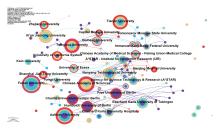
Figure 3
Co-occurrence map of institutions"

Table 2
Top ten institutions of publication volume"
| 机构 | 发文量/n | 中心性 |
|---|---|---|
| 复旦大学 | 14 | 0.18 |
| Aalborg University | 14 | 0.05 |
| 天津大学 | 12 | 0.00 |
| 中国科学院 | 12 | 0.28 |
| 西安交通大学 | 11 | 0.05 |
| 清华大学 | 11 | 0.25 |
| 南洋理工大学 | 10 | 0.01 |
| Charite Universitatsmedizin Berlin | 9 | 0.05 |
| Free University of Berlin | 9 | 0.05 |
| Humboldt University of Berlin | 9 | 0.05 |
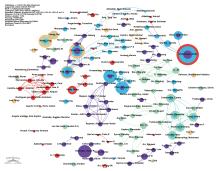
Figure 4
Cooperation map of authors"

Table 3
Top ten authors by publication volume"
| 作者 | 发文量/n | 中心性 |
|---|---|---|
| Mads R Jochumsen | 10 | 0.00 |
| 关存太 | 7 | 0.01 |
| Surjo R Soekadar | 6 | 0.00 |
| 贾杰 | 6 | 0.00 |
| 王晶 | 6 | 0.00 |
| 陈树耿 | 6 | 0.00 |
| Kai Keng Ang | 6 | 0.01 |
| Imran Khan Niazi | 4 | 0.00 |
| 张瑞 | 4 | 0.00 |
| Floriana Pichiorri | 4 | 0.00 |
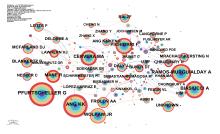
Figure 5
Co-occurrence map of co-citation authors"

Table 4
Top ten authors with the most citation frequency"
| 作者 | 频次/n | 中心性 |
|---|---|---|
| Pfurtscheller G | 167 | 0.31 |
| Kai Keng Ang | 158 | 0.63 |
| Ander Ramos-Murguialday | 129 | 0.37 |
| Biasiucci A | 118 | 0.47 |
| Floriana Pichiorri | 108 | 0.65 |
| Jonathan R Wolpaw | 106 | 0.09 |
| María A Cervera | 104 | 0.50 |
| Ravikiran Mane | 92 | 0.10 |
| Alexander A Frolov | 77 | 0.09 |
| Benjamin Blankertz | 71 | 0.04 |
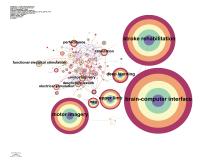
Figure 6
Co-occurrence map of keywords"

Table 5
Top ten high-frequency keywords"
| 关键词 | 频次/n | 中心性 |
|---|---|---|
| brain-computer interface | 337 | 0.03 |
| stroke rehabilitation | 260 | 0.02 |
| motor imagery | 187 | 0.00 |
| upper limb | 104 | 0.06 |
| deep learning | 79 | 0.04 |
| EEG | 54 | 0.00 |
| stimulation | 36 | 0.04 |
| performance | 36 | 0.01 |
| motor recovery | 32 | 0.09 |
| functional electrical stimulation | 31 | 0.04 |

Figure 7
Clustering map of keywords"

Table 6
Keyword clustering table"
| 聚类号 | 节点数/n | 轮廓值 | 主要关键词 |
|---|---|---|---|
| #0 | 21 | 0.911 | machine learning; brain asymmetry; action observation; artificial intelligence |
| #1 | 19 | 0.923 | amyotrophic lateral sclerosis; heart rate variability; human; sensorimotor rhythms |
| #2 | 17 | 0.916 | feature extraction; stroke (medical condition); motors; convolutional neural networks |
| #3 | 16 | 0.823 | motor imagery; brain-computer interface; stroke rehabilitation; electroencephalography (EEG) |
| #4 | 16 | 0.950 | functional near-infrared spectroscopy; effective connectivity; clinical translation |
| #5 | 15 | 0.913 | motor imagery; brain-computer interface (BCI) ; brain-computer interface; stroke |
| #6 | 15 | 0.950 | EEG; hemiparesis; systematic review; decoding; brain-computer interfaces |
| #7 | 15 | 0.899 | neurofeedback, motor restoration, bimanual BCI-FES, delta alpha ratio |
| #8 | 13 | 0.871 | electroencephalography (EEG), upper limb, brain-computer interface |
| #9 | 12 | 0.922 | motor rehabilitation, functional electrical stimulation, continuous trajectory reconstruction |
| #10 | 12 | 0.831 | neurological diseases, virtual reality, neuroscience, volitional control |
| #11 | 11 | 0.968 | motor function, upper extremity, stroke, network calibration, robotic arm |
| #12 | 9 | 0.989 | movement-related cortical potential, kinesthetic motor imagery, event-related desynchronization |
| #13 | 8 | 0.805 | neuroprosthetic, gps tracking, community participation, intracortical brain-computer interfaces |
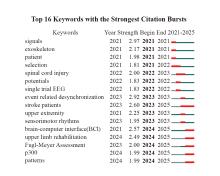
Figure 8
Bursting keywords"

| [1] |
KAWALA-STERNIUK A, BROWARSKA N, AL-BAKRI A, et al. Summary of over fifty years with brain-computer interfaces: a review[J]. Brain sciences, 2021, 11(1): 43.
doi: 10.3390/brainsci11010043 |
| [2] | KÜBLER A. The history of BCI: from a vision for the future to real support for personhood in people with locked-in syndrome[J]. Neuroethics, 2019, 13, 163-180. |
| [3] |
CANTILLO-NEGRETE J, CARINO-ESCOBAR R I, ORTEGA-ROBLES E, et al. A comprehensive guide to BCI-based stroke neurorehabilitation interventions[J]. MethodsX, 2023, 11: 102452.
doi: 10.1016/j.mex.2023.102452 |
| [4] |
VARSEHI H, FIROOZABADI S M P. An EEG channel selection method for motor imagery based brain-computer interface and neurofeedback using Granger causality[J]. Neural Netw, 2021: 133: 193-206.
doi: 10.1016/j.neunet.2020.11.002 |
| [5] |
POO M M, DU J L, IP N Y, et al. China brain project: basic neuroscience, brain diseases, and brain-inspired computing[J]. Neuron, 2016, 92(3): 591-596.
doi: 10.1016/j.neuron.2016.10.050 |
| [6] |
BATISTIĆ L, SUŠANJ D, PINČIĆ D, et al. Motor imagery classification based on EEG sensing with visual and vibrotactile guidance[J]. Sensors, 2023, 23(11): 5064.
doi: 10.3390/s23115064 |
| [7] |
YOU Y, LU C, WANG W, et al. Relative CNN-RNN: learning relative atmospheric visibility from images[J]. IEEE Transact Image Process, 2018, 28(1): 45-55.
doi: 10.1109/TIP.2018.2857219 |
| [8] |
SINHA P, SAHU D, PRAKASH S, et al. A high performance hybrid LSTM CNN secure architecture for IoT environments using deep learning[J]. Scientific Reports, 2025, 15(1): 9684.
doi: 10.1038/s41598-025-94500-5 |
| [9] |
TANG Y, HUANG W, CHEN C, et al. CT-DCENet: deep EEG denoising via CNN-transformer-based dual-stage collaborative ensemble learning[J]. IEEE J Biomed Health Inform, 2025, 29(6): 4095-4108.
doi: 10.1109/JBHI.2025.3535592 |
| [10] |
ELASHMAWI W H, AYMAN A, ANTOUN M, et al. A comprehensive review on brain-computer interface (BCI)-based machine and deep learning algorithms for stroke rehabilitation[J]. Appl Sci, 2024, 14(14): 6347.
doi: 10.3390/app14146347 |
| [11] |
TONIN A, SEMPRINI M, KIPER P, et al. Brain-computer interfaces for stroke motor rehabilitation[J]. Bioengineering, 2025, 12(8): 820.
doi: 10.3390/bioengineering12080820 |
| [12] |
AL-QAYSI Z T, AHMED M A, HAMMASH N M, et al. Systematic review of training environments with motor imagery brain-computer interface: coherent taxonomy, open issues and recommendation pathway solution[J]. Health Technol, 2021, 11(4): 783-801.
doi: 10.1007/s12553-021-00560-8 |
| [13] |
MA Z Z, WU J J, CAO Z, et al. Motor imagery-based brain-computer interface rehabilitation programs enhance upper extremity performance and cortical activation in stroke patients[J]. J Neuroengin Rehabil, 2024, 21(1): 91.
doi: 10.1186/s12984-024-01387-w |
| [14] |
ZHANG M, ZHU F, JIA F, et al. Efficacy of brain-computer interfaces on upper extremity motor function rehabilitation after stroke: a systematic review and meta-analysis[J]. NeuroRehabilitation, 2024, 54(2): 199-212.
doi: 10.3233/NRE-230215 |
| [15] |
LENNON O, TONELLATO M, DEL FELICE A, et al. A systematic review establishing the current state-of-the-art, the limitations, and the DESIRED checklist in studies of direct neural interfacing with robotic gait devices in stroke rehabilitation[J]. Front Neurosci, 2020, 14: 578.
doi: 10.3389/fnins.2020.00578 |
| [16] |
YEN H C, CHEN W S, JENG J S, et al. Standard early rehabilitation and lower limb transcutaneous nerve or neuromuscular electrical stimulation in acute stroke patients: a randomized controlled pilot study[J]. Clinical Rehabilitation, 2019, 33(8): 1344-1354.
doi: 10.1177/0269215519841420 |
| [17] |
SEMPRINI M, LENCIONI T, HINTERLANG W, et al. User-centered design and development of TWIN-Acta: a novel control suite of the TWIN lower limb exoskeleton for the rehabilitation of persons post-stroke[J]. Front Neurosci, 2022, 16: 915707.
doi: 10.3389/fnins.2022.915707 |
| [18] | REN S, WANG W, HOU Z G, et al. Enhanced motor imagery based brain-computer interface via FES and VR for lower limbs[J]. IEEE Trans Neur Sys Rehabil Engin, 2020, 28(8): 1846-1855. |
| [19] |
BIASIUCCI A, LEEB R, ITURRATE I, et al. Brain-actuated functional electrical stimulation elicits lasting arm motor recovery after stroke[J]. Nat Commun, 2018, 9(1): 2421.
doi: 10.1038/s41467-018-04673-z pmid: 29925890 |
| [20] |
SAID R R, HEYAT M B B, SONG K, et al. A systematic review of virtual reality and robot therapy as recent rehabilitation technologies using EEG-brain-computer interface based on movement-related cortical potentials[J]. Biosensors, 2022, 12(12): 1134.
doi: 10.3390/bios12121134 |
| [21] |
COLUCCI A, VERMEHREN M, CAVALLO A, et al. Brain-computer interface-controlled exoskeletons in clinical neurorehabilitation: ready or not?[J]. Neurorehabil Neural Repair, 2022, 36(12): 747-756.
doi: 10.1177/15459683221138751 |
| [22] |
WEN D, FAN Y, HSU S H, et al. Combining brain-computer interface and virtual reality for rehabilitation in neurological diseases: a narrative review[J]. Ann Phys Rehabil Med, 2021, 64(1): 101404.
doi: 10.1016/j.rehab.2020.03.015 |
| [23] |
DALY J J, WOLPAW J R. Brain-computer interfaces in neurological rehabilitation[J]. Lancet Neurol, 2008, 7(11): 1032-1043.
doi: 10.1016/S1474-4422(08)70223-0 pmid: 18835541 |
| [24] |
ZIADEH H, GULYAS D, NIELSEN L D, et al. "Mine works better": examining the influence of embodiment in virtual reality on the sense of agency during a binary motor imagery task with a brain-computer interface[J]. Front Psychol, 2021, 12: 806424.
doi: 10.3389/fpsyg.2021.806424 |
| [25] |
AFONSO M, SÁNCHEZ-CUESTA F, GONZÁLEZ-ZAMORANO Y, et al. Investigating the synergistic neuromodulation effect of bilateral rTMS and VR brain-computer interfaces training in chronic stroke patients[J]. J Neural Eng, 2024, 21(5): 056037.
doi: 10.1088/1741-2552/ad8836 |
| [26] |
NUNES J D, VOURVOPOULOS A, BLANCO-MORA D A, et al. Brain activation by a VR-based motor imagery and observation task: an fMRI study[J]. PLoS One, 2023, 18(9): e0291528.
doi: 10.1371/journal.pone.0291528 |
| [27] |
KAWANO T, HATTORI N, UNO Y, et al. Large-scale phase synchrony reflects clinical status after stroke: an EEG study[J]. Neurorehabil Neural Repair, 2017, 31(6): 561-570.
doi: 10.1177/1545968317697031 pmid: 28506148 |
| [28] |
YANG X, SHI X, XUE X, et al. Efficacy of robot-assisted training on rehabilitation of upper limb function in patients with stroke: a systematic review and meta-analysis[J]. Arch Phys Med Rehabil, 2023, 104(9): 1498-1513.
doi: 10.1016/j.apmr.2023.02.004 |
| [29] |
WHEATON L A, SHIBASAKI H, HALLETT M. Temporal activation pattern of parietal and premotor areas related to praxis movements[J]. Clin Neurophysiol, 2005, 116(5): 1201-1212.
pmid: 15826863 |
| [30] |
DE SETA V, COLAMARINO E, PICHIORRI F, et al. Brain and muscle derived features to discriminate simple hand motor tasks for a rehabilitative BCI: comparative study on healthy and post-stroke individuals[J]. J Neural Eng, 2024, 21(6): 066015.
doi: 10.1088/1741-2552/ad8838 |
| [31] |
BRAMBILLA C, PIROVANO I, MIRA R M, et al. Combined use of EMG and EEG techniques for neuromotor assessment in rehabilitative applications: a systematic review[J]. Sensors, 2021, 21(21): 7014.
doi: 10.3390/s21217014 |
| [32] |
QU G, ZHOU Z, CALHOUN V D, et al. Integrated brain connectivity analysis with fMRI, DTI, and sMRI powered by interpretable graph neural networks[J]. Med Image Anal, 2025, 103: 103570.
doi: 10.1016/j.media.2025.103570 |
| [33] |
STÄMPFLI P, REISCHAUER C, JÄRMANN T, et al. Combining fMRI and DTI: a framework for exploring the limits of fMRI-guided DTI fiber tracking and for verifying DTI-based fiber tractography results[J]. Neuroimage, 2008, 39(1): 119-126.
pmid: 17931889 |
| [34] |
HE B, LIU Z. Multimodal functional neuroimaging: integrating functional MRI and EEG/MEG[J]. IEEE Rev Biomed Eng, 2008, 1: 23-40.
doi: 10.1109/RBME.2008.2008233 pmid: 20634915 |
| [35] |
BUTET S, FLEURY M, DUCHÉ Q, et al. EEG-fMRI neurofeedback versus motor imagery after stroke, a randomized controlled trial[J]. J Neuroeng Rehabil, 2025, 22(1): 67.
doi: 10.1186/s12984-025-01598-9 |
| [1] | QIAN Liguo, WU Tongxuan, ZHANG Qiaoyun, XING Jian, YANG Yanyan. Design and application effect of continuing education case library combined with case-based learning for rehabilitation therapists [J]. Chinese Journal of Rehabilitation Theory and Practice, 2026, 32(3): 249-257. |
| [2] | AN Le, QIN Xiaoxia, GU Bin, HU Guobing, TIAN Weiyi. A competency model for "dual-qualified" teachers in vocational undergraduate rehabilitation therapy programs based on the integration of rehabilitation competency framework and multi-source standards [J]. Chinese Journal of Rehabilitation Theory and Practice, 2026, 32(3): 258-269. |
| [3] | LIU Hua, WANG Liyuan, MA Xin, LI Jing, WANG Li. OBE-CDIO model of teaching for curriculum of exercise rehabilitation training [J]. Chinese Journal of Rehabilitation Theory and Practice, 2026, 32(3): 270-275. |
| [4] | LIU Xia, ZHANG Yuanmin, GE Shuhui, LIU Jinmei, SUN Chenming, WANG Yuanhui, LIU Jing, LI Wenfu. Cultivation mode of rehabilitation therapy talents in local colleges and universities under the background of New Medicine [J]. Chinese Journal of Rehabilitation Theory and Practice, 2026, 32(3): 276-285. |
| [5] | ZHU Lili, ZHAO Jiaxin, CHENG Xue, WANG Huijuan, CHEN Xiaoxia. Experiences and needs of stroke patients during rehabilitation: a qualitative meta-synthesis [J]. Chinese Journal of Rehabilitation Theory and Practice, 2026, 32(3): 286-293. |
| [6] | LIU Ping, ZHOU Nan, XUE Xiaojie, SHAO Weibo. Application of rehabilitation therapy techniques for post-stroke dysphagia: a bibliometric analysis [J]. Chinese Journal of Rehabilitation Theory and Practice, 2026, 32(3): 294-303. |
| [7] | PU Xinyu, WANG Jingxuan, WANG Hujun, XIU Anda, WANG Yingpeng. Application of repetitive peripheral magnetic stimulation in rehabilitation therapy: a bibliometric analysis [J]. Chinese Journal of Rehabilitation Theory and Practice, 2026, 32(3): 304-316. |
| [8] | SUN Kui, HUANG Hailun, LIU Yongai, GAO Heng. Brain-computer interface technology in treatment for spinal cord injury: a bibliometric analysis [J]. Chinese Journal of Rehabilitation Theory and Practice, 2026, 32(3): 317-328. |
| [9] | YANG Ling, WANG Qinglei, WANG Jie, XU Wenjie, WANG Tong, GUO Chuan, QIAN Xue. Activation patterns and mechanism in the prefrontal cortex of post-stroke anxiety patients: a study using functional near-infrared spectroscopy [J]. Chinese Journal of Rehabilitation Theory and Practice, 2026, 32(3): 329-336. |
| [10] | ZHANG Wenjing, LI Hao, YUAN Jiajia, HU Huaining. Effect of tele-supervised home-based pulmonary music therapy on chronic obstructive pulmonary disease [J]. Chinese Journal of Rehabilitation Theory and Practice, 2026, 32(3): 337-344. |
| [11] | WU Shicai. Theoretical construction and practical exploration of rehabilitation ethics management [J]. Chinese Journal of Rehabilitation Theory and Practice, 2026, 32(2): 125-131. |
| [12] | HE Zhaonan, ZHANG Tingting, HE Zhaoke, MENG Lijun. Topic mining and content analysis of rehabilitation ethics research in China based on BERTopic model [J]. Chinese Journal of Rehabilitation Theory and Practice, 2026, 32(2): 132-141. |
| [13] | MENG Lijun. Challenges and reflections on ethical review of rehabilitation research for children with disabilities [J]. Chinese Journal of Rehabilitation Theory and Practice, 2026, 32(2): 142-150. |
| [14] | GUO Yabin, ZENG Biyun, ZHOU Yang. Researches in sarcopenia-pain comorbidity from 2015 to 2025: a bibliometric analysis [J]. Chinese Journal of Rehabilitation Theory and Practice, 2026, 32(2): 151-161. |
| [15] | LI Shuiyan, LI Xiang, LI Yanhui, LU Yimeng, LI Dujuan, YANG Xiaoliang, XIE Qiuyou. Application of airway clearance techniques in critical care rehabilitation: a bibliometric analysis [J]. Chinese Journal of Rehabilitation Theory and Practice, 2026, 32(2): 162-173. |
| Viewed | ||||||
|
Full text |
|
|||||
|
Abstract |
|
|||||
|
||
