



Chinese Journal of Rehabilitation Theory and Practice ›› 2026, Vol. 32 ›› Issue (9): 1025-1032.doi: 10.3969/j.issn.1006-9771.2026.09.004
Previous Articles Next Articles
Wei Tongtong1, Tian Yifan2,3, Chen Ting4, Yao Qi1, Hu Jianmin4( )
)
Received:2026-04-20
Revised:2026-07-27
Accepted:2026-08-06
Published:2026-09-25
Online:2026-09-20
Contact:
Hu Jianmin
E-mail:doctorhjm@163.com
Supported by:CLC Number:
Wei Tongtong, Tian Yifan, Chen Ting, Yao Qi, Hu Jianmin. Application of ICF in visual impairment rehabilitation: a scoping review[J]. Chinese Journal of Rehabilitation Theory and Practice, 2026, 32(9): 1025-1032.
Figure 1
Flowchart of literature screening"
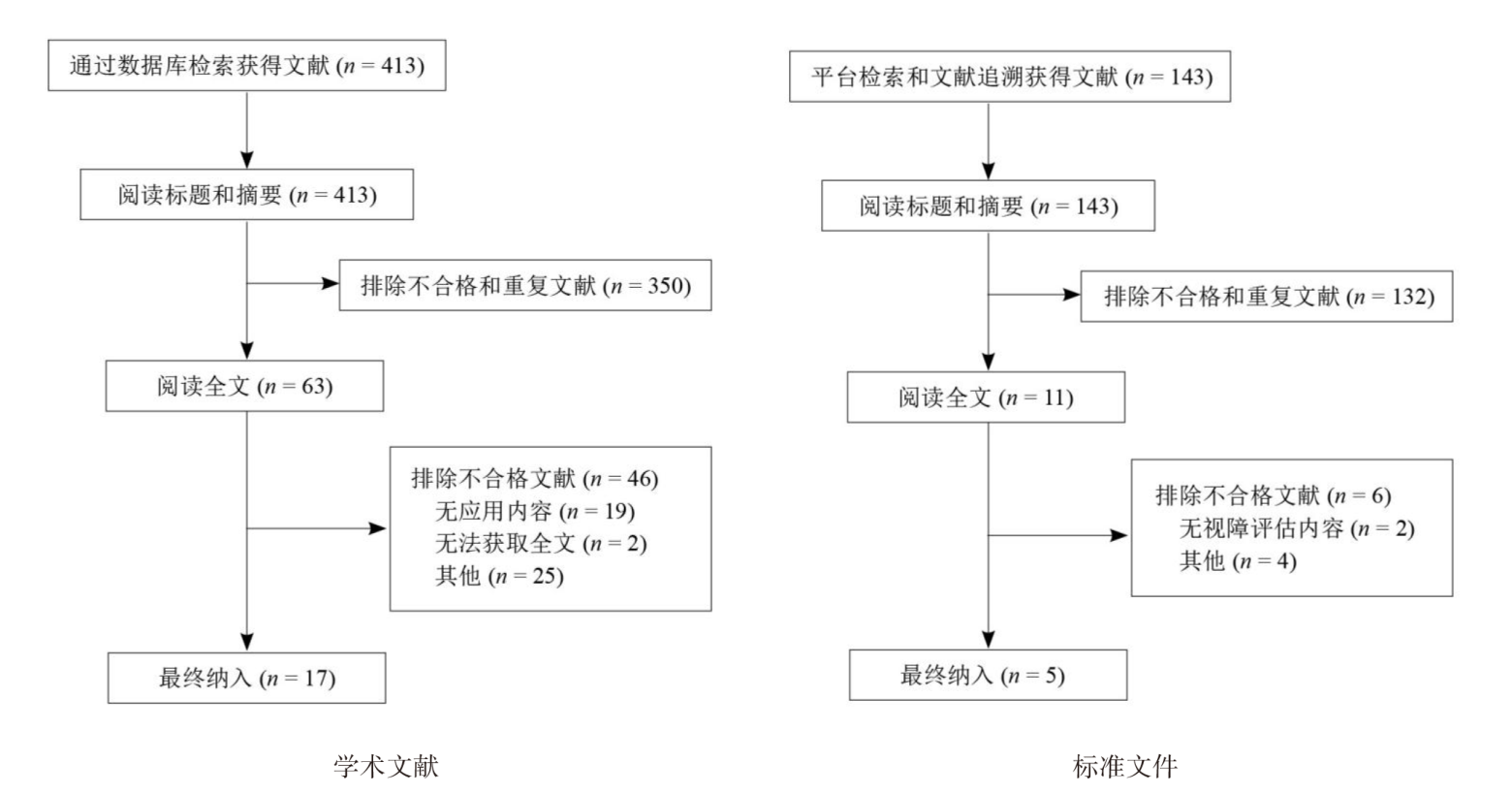
Table 1
Basic characteristics of included articles"
| 纳入文献 | 国家 | 研究对象 | n | 研究设计 | ICF维度 | 应用场景 | 主要结局 |
|---|---|---|---|---|---|---|---|
| Bruijning等[ | 荷兰 | 视障成人 康复专业人员 | 41 50 | 焦点小组+量表开发 | 活动和参与(扩展心理健康域) | 评估工具开发 | 构建D-AI量表 |
| Bruijning等[ | 荷兰 | 成年低视力康复者 | 241 | 量表验证 | 活动和参与 | 评估工具的精简与临床验证 | 精简后D-AI内部一致性及重测信度良好 |
| Lee等[ | 韩国 | 成年残疾人 其中视障 | 32 7 | 焦点小组+内容分析+ICF链接 | 身体功能、活动参与、环境因素 | 健康需求评估 | 环境因素是最常提及的健康需求 |
| Subhi等[ | 英国 | 成年周边视野损伤患者 | 52 | 横断面相关分析 | 活动和参与(D-AI) | 低视力功能评估 | 周边视野优于中央、下方视野优于上方视野预测移动功能 |
| Billiet等[ | 跨国 | 成年视障者(含盲及中重度低视力) | 763 | 横断面研究 | 身体功能、活动参与、环境因素 | 视障ICF核心集构建 | 视障对功能的影响远超视觉本身,覆盖情绪、出行、就业多个维度 |
| Colombo等[ | 意大利 | 视障儿童青少年 父母 专业人员 | 12 14 10 | 半结构化访谈+主题分析 | 身体功能、活动参与、环境因素 | 残疾多维评估 | 视障青少年残疾体验受个人、家庭、环境交互影响,需个性化支持方案 |
| Adhikari等[ | 尼泊尔 | 盲童 中重度视力障碍儿童 正常视力儿童 | 100 100 100 | 横断面对比研究 | 身体功能、活动和参与(PAI-CY) | 儿童视障活动和参与度测评 | 视障程度与日常活动参与限制正相关 |
| Morelli等[ | 意大利 | 视障儿童青少年 家长 康复从业者 | 18 110 4 | 工具开发与效度验证 | 身体功能与结构、活动和参与 | 评估工具研发 | 自主能力评估量表信效度达标 |
| Christy等[ | 印度 | 视障者 | 305 | 回顾性临床研究 | 未明确分域 | 远程视障康复干预 | 远程康复可覆盖偏远人群,网络、家属配合为主要实施阻碍 |
| Van Leeuwen等[ | 荷兰 | 18~25岁视障青年 | 319 | 回顾性研究+ICF链接编码 | 身体功能、活动参与、环境因素 | 康复需求评估 | 需求集中于教育、就业、出行、沟通与心理适应;成人ICF工具不适配青年群体 |
| Adhikari等[ | 尼泊尔 | 视障儿童 | 6 | 量表跨文化调适预实验 | 活动和参与(PAI-CY) | 儿童视障康复需求评估工具调适 | 调适后量表可识别当地儿童活动和参与困难 |
| Elsman等[ | 荷兰 | 0~25岁视障者 家长 低视力康复人员 | 30 24 17 | 量表可行性试点 | 活动和参与 | 分年龄段康复评估工具开发 | 条目优化后量表可用于康复入院评估 |
| Philip等[ | 印度 | 脑性视觉损伤儿童的家长 | 17 | 质性研究(虚拟焦点小组讨论) | 环境、个人因素 | 儿童远程康复服务 | 家庭支持、专业可及性、持续监测是远程康复的主要促进因素 |
| Øien[ | 丹麦 | 低视力成人 | 60 | 行动研究 | 环境因素 | 居家照明康复干预 | 照明优化可改善视障者功能表现 |
| 林良烽等[ | 中国 | 低视力儿童 | 60 | 随机对照试验 | 身体功能与结构、活动和参与 | 儿童临床康复干预 | 基于ICF理念的联合训练效果优于单一助视器训练 |
| Li等[ | 中国 | 复杂眼病低视力儿童 | 1 | 病例报告 | 身体功能、活动参与、环境因素 | 儿童视障临床康复评估与干预 | ICF-CY指导下个体化干预效果显著 |
| Illum等[ | 丹麦 | 不同类型残疾儿童的家长 其中视障 | 162 5 | 评估工具开发与验证 | 身体功能与结构、活动和参与 | 儿童残疾居家评估工具开发 | 家长应用ICF编码评估信效度良好 |
Table 2
Comparative analysis of standard documents for visual impairment based on the ICF framework"
| 标准/指南 | 核心维度 | ICF维度/类目 | 与ICF的差异 | 主要应用场景 |
|---|---|---|---|---|
| 残疾人残疾分类和分级[ | 最佳矫正视力、视野半径 | 视觉功能(b210) | 未纳入活动、环境维度 | 残疾认定、福利发放、全国视障人群筛查统计 |
| 老年人能力评估规范[ | 视力水平,补充感知觉与沟通维度定性描述 | 视觉功能(b210),感知觉与沟通描述涉及活动(沟通) | 无标准化活动评估指标,不涉及环境因素 | 老年人能力分级、照护资源分配 |
| 视觉功能障碍法医临床鉴定技术规范[ | 视力、视野,新增视觉电生理、色觉功能等视觉亚功能指标 | 视觉功能(b210) | 不涉及活动和环境因素 | 人身损害视损伤分级、赔偿鉴定 |
| 0岁~6岁视障儿童早期干预机构服务规范[ | 视功能水平,认知、运动、语言沟通、生活自理等儿童发展能力 | 视觉功能(b210);活动和参与(学习应用、移动、沟通、自我照料等);环境因素(机构无障碍设施、辅助器具配置、家庭指导) | 活动和参与聚焦机构可干预的日常技能;环境因素仅覆盖机构与家庭场景,未纳入社会政策、社区环境等广义维度 | 0~6岁视障儿童早期干预机构建设、个体化康复方案制定、服务质量评价 |
| 中国低视力康复临床指南(2021)[ | 远/近最佳矫正视力、视野、对比敏感度;康复潜力与日常活动能力评估 | 视觉功能(b210);活动和参与(日常视觉应用、独立行动能力);环境因素(e125) (助视器适配) | 活动和参与仅作为康复目标定性提及,无统一评分条目与操作规范;环境因素仅覆盖辅助器具 | 低视力康复临床诊疗、康复方案制定、疗效评价 |
| [1] | 踪玮, 王爱平. 视力障碍对老年人社会功能影响的研究进展[J]. 护理研究, 2021, 35(9): 1621-1625. |
| Zong W, Wang A P. Research progress on the influence of visual impairment on social function in the elderly[J]. Chin Nurs Res, 2021, 35(9): 1621-1625. | |
| [2] | World Health Organization. World report on vision[R]. Geneva: World Health Organization, 2019. |
| [3] |
Xu T, Wang B, Liu H, et al. Prevalence and causes of vision loss in China from 1990 to 2019: findings from the Global Burden of Disease Study 2019[J]. Lancet Public Health, 2020, 5(12): e682-e691.
doi: 10.1016/S2468-2667(20)30254-1 pmid: 33271081 |
| [4] |
Hald A N, Nannerup Kjærgaard F, Hald G M, et al. The role of gender in the association between sensory impairments and well-being, depression symptoms, and relationship satisfaction among older adults[J]. Aging Ment Health, 2025, 29(9): 1563-1571.
doi: 10.1080/13607863.2025.2456483 |
| [5] |
Fraser S, Beeman I, Southall K, et al. Stereotyping as a barrier to the social participation of older adults with low vision: a qualitative focus group study[J]. BMJ Open, 2019, 9(9): e029940.
doi: 10.1136/bmjopen-2019-029940 |
| [6] |
Burton M J, Ramke J, Marques A P, et al. The Lancet Global Health Commission on Global Eye Health: vision beyond 2020[J]. Lancet Glob Health, 2021, 9(4): e489-e551.
doi: 10.1016/S2214-109X(20)30488-5 pmid: 33607016 |
| [7] |
Cai C, Shuai Y, Li G. The effect of low vision rehabilitation on the quality of life and caregiver burden of low vision patients: a randomized trial[J]. BMC Ophthalmol, 2025, 25(1): 20.
doi: 10.1186/s12886-025-03864-9 |
| [8] |
Chotikavanich S, Eiamsamarng A, Layangool T, et al. Outcomes of multidisciplinary low-vision rehabilitation using two questionnaires and the International Classification of Functioning, Disability, and Health[J]. Siriraj Med J, 2024, 76(10): 661-667.
doi: 10.33192/smj.v76i10 |
| [9] | World Health Organization. International Classification of Functioning, Disability and Health[S/OL]. (2025-01-21) [2026-04-08].https://icd.who.int/browse/2025-01/icf/zh. |
| [10] |
Tricco A C, Lillie E, Zarin W, et al. PRISMA extension for scoping reviews (PRISMA-ScR): checklist and explanation[J]. Ann Intern Med, 2018, 169(7): 467-473.
doi: 10.7326/M18-0850 pmid: 30178033 |
| [11] |
Bruijning J, Van Nispen R, Verstraten P, et al. A Dutch ICF version of the Activity Inventory: results from focus groups with visually impaired persons and experts[J]. Ophthalmic Epidemiol, 2010, 17(6): 366-377.
doi: 10.3109/09286586.2010.528133 |
| [12] |
Bruijning J E, Van Rens G, Knol D, et al. Psychometric analyses to improve the Dutch ICF Activity Inventory[J]. Optom Vis Sci, 2013, 90(8): 806-819.
doi: 10.1097/OPX.0b013e318282cdce pmid: 23518676 |
| [13] |
Lee M, Heo H H. Investigating similarities and differences in health needs according to disability type using the International Classification of Functioning, Disability and Health[J]. Disabil Rehabil, 2021, 43(26): 3723-3732.
doi: 10.1080/09638288.2020.1773941 |
| [14] |
Subhi H, Latham K, Myint J, et al. Functional visual fields: relationship of visual field areas to self-reported function[J]. Ophthalmic Physiol Opt, 2017, 37(4): 399-408.
doi: 10.1111/opo.2017.37.issue-4 |
| [15] |
Billiet L, Van Der Aa H P A, Van De Velde D, et al. Development of the International Classification of Functioning, Disability and Health Core Set for Vision Loss: insights from the lived experience of people with vision loss[J]. Ophthalmic Physiol Opt, 2026, 46(2): 242-251.
doi: 10.1007/s44402-026-00031-5 |
| [16] |
Colombo A, Lanza M, Incagli F, et al. Social and subjective representations of visual impairment in Italy: a qualitative study[J]. BMJ Paediatr Open, 2026, 10(1): e004228.
doi: 10.1136/bmjpo-2025-004228 |
| [17] |
Adhikari S, Elsman E B M, Van Nispen R M A, et al. Participation and quality of life of Nepalese children with visual impairment in comparison with normally sighted peers: a cross sectional comparative study[J]. J Patient Rep Outcomes, 2025, 9(1): 64.
doi: 10.1186/s41687-025-00893-2 pmid: 40471460 |
| [18] |
Morelli F, Grumi S, Catalano G, et al. Autonomy in children and adolescents with visual impairment: validation of the Visual Impairment Developmental Autonomy scale[J]. Dev Med Child Neurol, 2025, 67(11): 1472-1481.
doi: 10.1111/dmcn.v67.11 |
| [19] |
Christy B, Mahalakshmi M, Aishwarya T V, et al. Tele-rehabilitation for persons with vision impairment during COVID-19: experiences and lessons learned[J]. Indian J Ophthalmol, 2022, 70(3): 1026-1029.
doi: 10.4103/ijo.IJO_1722_21 pmid: 35225566 |
| [20] |
Van Leeuwen L M, Rainey L, Kef S, et al. Investigating rehabilitation needs of visually impaired young adults according to the International Classification of Functioning, Disability and Health[J]. Acta Ophthalmol, 2015, 93(7): 642-650.
doi: 10.1111/aos.12782 pmid: 26109392 |
| [21] |
Adhikari S, Elsman E B M, Van Nispen R M A, et al. Translation and cross-cultural adaptation of a Nepali version of the Dutch Participation and Activity Inventory for Children and Youth (PAI-CY) with visual impairment[J]. J Patient Rep Outcomes, 2021, 5(1): 77.
doi: 10.1186/s41687-021-00342-w pmid: 34432179 |
| [22] |
Elsman E B M, Van Nispen R M A, Van Rens G. Feasibility of the Participation and Activity Inventory for Children and Youth (PAI-CY) and Young Adults (PAI-YA) with a visual impairment: a pilot study[J]. Health Qual Life Outcomes, 2017, 15(1): 98.
doi: 10.1186/s12955-017-0677-x |
| [23] |
Philip J, Hussaindeen J R, Jacob N, et al. Parental perception of facilitators and barriers to activity and participation in an integrated tele-rehabilitation model for children with cerebral visual impairment in South India: a virtual focus group discussion study[J]. Indian J Ophthalmol, 2023, 71(2): 601-607.
doi: 10.4103/ijo.IJO_1670_22 |
| [24] |
Øien T B. A study of environmental factors in low vision rehabilitation[J]. Front Rehabil Sci, 2022, 3: 829903.
doi: 10.3389/fresc.2022.829903 |
| [25] | 林良烽, 汪勇芬, 于杨, 等. 基于"国际功能、残疾和健康分类"理念的联合康复训练对低视力儿童发育行为的影响[J]. 中国当代医药, 2022, 29(11): 77-80. |
| Lin L F, Wang Y F, Yu Y, et al. Influence of combined rehabilitation training based on the concept of "International Classification of Functioning, Disability and Health" on developmental behavior of children with low vision[J]. Chin Mod Med, 2022, 29(11): 77-80. | |
| [26] |
Li B, Yu Y, Hu J. Applying the ICF-CY in visually impaired rehabilitation: a case report in China[J]. Ann Palliat Med, 2021, 10(3): 3459-3468.
doi: 10.21037/apm |
| [27] | Illum N O, Gradel K O. Parents' assessments of disability in their children using World Health Organization International Classification of Functioning, Disability and Health, Child and Youth Version joined body functions and activity codes related to everyday life[J]. Clin Med Insights Pediatr, 2017, 11: 1179556517715037. |
| [28] |
吕雪丽, 杨亚茹, 邱卓英, 等. 基于ICF和ICD-11的中国6种视力残疾相关标准比较研究[J]. 中国康复理论与实践, 2025, 31(7): 755-762.
doi: 10.3969/j.issn.1006-9771.2025.07.002 |
| Lü X L, Yang Y R, Qiu Z Y, et al. Comparative study of six visual disability-related standards in China based on ICF and ICD-11[J]. Chin J Rehabil Theory Pract, 2025, 31(7): 755-762. | |
| [29] | GB/T 26341-2010 残疾人残疾分类和分级[S]. |
| GB/T 26341-2010 Classification and grading criteria of disability[S]. | |
| [30] | GB/T 42195-2022 老年人能力评估规范[S]. |
| GB/T 42195-2022 Specification for ability assessment of older adults[S]. | |
| [31] | GB/T 43639-2024 视觉功能障碍法医临床鉴定技术规范[S]. |
| GB/T 43639-2024 Technical specification for forensic clinical identification of visual dysfunction[S]. | |
| [32] | GB/T 44668-2024 0岁-6岁视障儿童早期干预机构服务规范[S]. |
| cation of early intervention institutions for children of ages GB/T 44668-2024 0-6 with visual impairment[S]. | |
| [33] | 国家重点研发计划YFC2008200项目组, 中华医学会眼科学分会眼视光学组, 中国医师协会眼科医师分会眼视光专业委员会. 中国低视力康复临床指南(2021)[J]. 中华眼视光学与视觉科学杂志, 2021, 23(3): 161-170. |
| Research Panel of the National Key R&D Project 2020YFC2008200, Chinese Optometric Association of Chinese Ophthalmological Society, Optometry Committee of Chinese Ophthalmologists Association. Chinese Low Vision Rehabilitation Clinical Guideline (2021)[J]. Chin J Optom Ophthalmol Vis Sci, 2021, 23(3): 161-170. | |
| [34] | 教育部. 教育部印发«特殊教育办学质量评价指南»[A/OL]. (2022-11-07) [2026-04-08]. http://www.moe.gov.cn/jyb_xwfb/gzdt_gzdt/s5987/202211/t20221107_976412.html. |
| [35] | 国务院. 国务院关于印发"十四五"残疾人保障和发展规划的通知[A/OL]. (2021-07-21) [2026-04-08]. https://www.gov.cn/zhengce/content/2021-07/21/content_5626391.htm. |
| [36] | 国务院办公厅. 国务院办公厅关于转发教育部等部门"十四五"特殊教育发展提升行动计划的通知[A/OL]. (2021-12-31) [2026-04-08]. https://www.gov.cn/zhengce/content/2022-01/25/content_5670341.htm. |
| [37] | 盛政, 李月霞, 阮艺华. 建立以功能相关分类为基础的康复住院医保支付方式的探索与思考[J]. 中国医疗保险, 2018, (11): 45-48. |
| Sheng Z, Li Y X, Ruan Y H. To explore the establishment of function related groups based on the rehabilitation of hospitalization medical insurance payment[J]. Chin Health Insur, 2018, (11): 45-48. | |
| [38] | 胡琳琳, 龙飞, 李佳, 等. 康复病组按价值付费的"长沙模式"[J]. 中国医疗保险, 2022, (6): 74-79. |
| Hu L L, Long F, Li J, et al. The exploration of value-based medical insurance payment method for rehabilitation in Changsha City[J]. Chin Health Insur, 2022, (6): 74-79. | |
| [39] | 胡琳琳, 邵宁军, 支梦佳, 等. 急性后期康复护理医保支付制度改革的实践探索:以浙江省金华市为例[J]. 卫生经济研究, 2021, 38(12): 11-15, 19. |
| Hu L L, Shao N J, Zhi M J, et al. Practical exploration on the reform of medical insurance payment system for post-acute rehabilitation nursing: a case study of Jinhua City in Zhejiang Province[J]. Health Econ Res, 2021, 38(12): 11-15, 19. | |
| [40] | Ghazaryan T, Iskandaryan L, Babikian V A, et al. Experiences of occupational therapists in implementing the WHO ICF model for disability determination in Armenia[J]. Ar J Spec Educ, 2025, 9(1): 90-109. |
| [41] |
Stineman M G, Tassoni C J, Escarce J J, et al. Development of function-related groups version 2.0: a classification system for medical rehabilitation[J]. Health Serv Res, 1997, 32(4): 529-548.
pmid: 9327817 |
| [42] |
杨亚茹, 邱卓英, 陈迪, 等. 主要残疾类别的定义、分类、分级以及评估研究:基于ICF和ICD-11的方法[J]. 中国康复理论与实践, 2025, 31(4): 373-381.
doi: 10.3969/j.issn.1006-9771.2025.04.001 |
| Yang Y R, Qiu Z Y, Chen D, et al. Disability definition, classification, grading and assessment in disability eligibility: an ICF and ICD-11 framework perspective[J]. Chin J Rehabil Theory Pract, 2025, 31(4): 373-381. | |
| [43] | 张静, 邱卓英, 陈迪, 等. 基于ICF的脑卒中功能障碍的测量:理论、方法及研究进展[J]. 中国康复理论与实践, 2012, 18(5): 430-432. |
| Zhang J, Qiu Z Y, Chen D, et al. Functional measurement based on ICF for stroke: framework, approaches and progress (review)[J]. Chin J Rehabil Theory Pract, 2012, 18(5): 430-432. | |
| [44] | 刘芷忻, 王翠, 王宁华. 膝关节置换术围手术期国际功能、残疾和健康分类核心分类组合的信效度评价[J]. 中国心理卫生杂志, 2024, 38(9): 787-795. |
| Liu Z X, Wang C, Wang N H. Validity and reliability of the comprehensive International Classification of Functioning, Disability and Health Core Set for Knee Arthroplasty Perioperative Period[J]. Chin Ment Health J, 2024, 38(9): 787-795. | |
| [45] |
Billiet L, Van Nispen R M A, De Baets S, et al. The first step in developing an International Classification of Functioning, Disability and Health Core Set for Vision Loss: a systematic review[J]. Ophthalmic Physiol Opt, 2024, 44(2): 413-425.
doi: 10.1111/opo.v44.2 |
| [1] | Chi Qianqian, Zhang Xiaonian, Zhu Xiaomin, Sun Wanyue, Zhang Xin, Zhou Jin, Bu Hongwei, Zhai Lei, Zhang Xin, Ling Zirui, Chen Hongyu. Effect of standardized rehabilitation unit on traumatic brain injury [J]. Chinese Journal of Rehabilitation Theory and Practice, 2026, 32(9): 1033-1040. |
| [2] | Feng Xiaojuan, Huang Fubiao, Li Dongyue, Zhou Mingyi, Niu Yuxuan, Ismaili McGee Pireti, Wang Xixian, Wang Zile. Development and feasibility study of a self-stabilizing home-based functional interactive training device [J]. Chinese Journal of Rehabilitation Theory and Practice, 2026, 32(9): 1068-1077. |
| [3] | Zhou Huiling, Zeng Jiayan, Chen Bing. Quality of life among vocational rehabilitation patients with mild work-related disability and its association with return-to-work outcomes [J]. Chinese Journal of Rehabilitation Theory and Practice, 2026, 32(9): 1078-1086. |
| [4] | Guo Xuxia, Yu Hengrui, Lu Yucheng, Yang Sichuang, Long Yu, Li Jiawei, Chen Lin, Nong Feiyu, Long Yaobin. An explainable artificial intelligence-driven motor rehabilitation assessment system based on perception-cognition decoupling: design and validation [J]. Chinese Journal of Rehabilitation Theory and Practice, 2026, 32(9): 1108-1116. |
| [5] | Youth Working Committee of Chinese Association of Rehabilitation Medicine, Lymphedema Expert Committee of Peripheral Vascular Committee of Chinese Society of Microcirculation, Integrated Nursing Professional Committee for Tumor Rehabilitation of Chinese Anti-Cancer Association, Community Rehabilitation Working Committee of Chinese Association of Rehabilitation Medicine. Chinese expert consensus on rehabilitation and management of axillary web syndrome following breast cancer surgery (2025) [J]. Chinese Journal of Rehabilitation Theory and Practice, 2026, 32(8): 869-881. |
| [6] | Youth Working Committee of Chinese Association of Rehabilitation Medicine, Lymphedema Expert Committee of Peripheral Vascular Committee of Chinese Society of Microcirculation, Integrated Nursing Professional Committee for Tumor Rehabilitation of Chinese Anti-Cancer Association. Chinese expert consensus on identification and diagnostic criteria for axillary web syndrome after breast cancer surgery [J]. Chinese Journal of Rehabilitation Theory and Practice, 2026, 32(8): 882-891. |
| [7] | Wang Zilong, Li Hongyu, Wang Zhihao, Li Hongxin, Jiang Yinying, Tang Qiang. Pathophysiology in muscle fatigue in myalgic encephalomyelitis/chronic fatigue syndrome: a scoping review [J]. Chinese Journal of Rehabilitation Theory and Practice, 2026, 32(8): 892-902. |
| [8] | Liang Yanhua, Zhang Tong, Zhang Qi, Zhou Tiantian, Zhang Yanqing, Yue Qing, Li Sijia. Effect of rehabilitation robot training on abdominal muscle thickness and balance ability in children with hemiplegia [J]. Chinese Journal of Rehabilitation Theory and Practice, 2026, 32(8): 927-937. |
| [9] | Tian Jingxiao, Ai Jiaming, Min Hongwei, Zhao Kecong, Zhang Baocui, Jiang Hong, Yang Wei, Liu Jun'e. Formulation and initial validation of a daily goal-management-based exercise intervention for total knee arthroplasty patients [J]. Chinese Journal of Rehabilitation Theory and Practice, 2026, 32(8): 959-967. |
| [10] | Liu Hua, Ma Xin, Li Jing, Wang Liyuan, Wang Li. Comparison master's training programs in sports rehabilitation based on rehabilitation competency framework [J]. Chinese Journal of Rehabilitation Theory and Practice, 2026, 32(8): 984-992. |
| [11] | Li Jinmeng, Liu Junna, Chen Qiang, Bi Hongyan. Application of telemedicine, wearables and artificial intelligence in pulmonary rehabilitation for chronic obstructive pulmonary disease from 2011 to 2025: a bibliometric analysis [J]. Chinese Journal of Rehabilitation Theory and Practice, 2026, 32(7): 829-840. |
| [12] | Zhang Yishan, Song Jiajia, Hou Tianyu, Meng Lijun. Ethical challenges and governance prospects in rehabilitation engineering [J]. Chinese Journal of Rehabilitation Theory and Practice, 2026, 32(7): 861-868. |
| [13] | LI Xinyuan, ZHENG Jiejiao, ZHANG Tingyu, WU Xuejiao, LIANG Xiaoxiao. Effect of intermittent theta burst stimulation on lower extremity motor function and balance function in stroke patients: a meta-analysis [J]. Chinese Journal of Rehabilitation Theory and Practice, 2026, 32(6): 631-644. |
| [14] | GAO Huigang, LIU Yuanwen, QIN Yuling, HU Xiquan, ZHU Lin. Effect of ankle soft robotic exosuit on gait function for stroke patients: a scoping review from 2020 to 2025 [J]. Chinese Journal of Rehabilitation Theory and Practice, 2026, 32(6): 645-652. |
| [15] | GUO Ziyang, CAO Ming. Researches on community-based rehabilitation for people with disabilities: a bibliometric analysis from 1987 to 2025 [J]. Chinese Journal of Rehabilitation Theory and Practice, 2026, 32(6): 665-676. |
| Viewed | ||||||
|
Full text |
|
|||||
|
Abstract |
|
|||||
|
||
